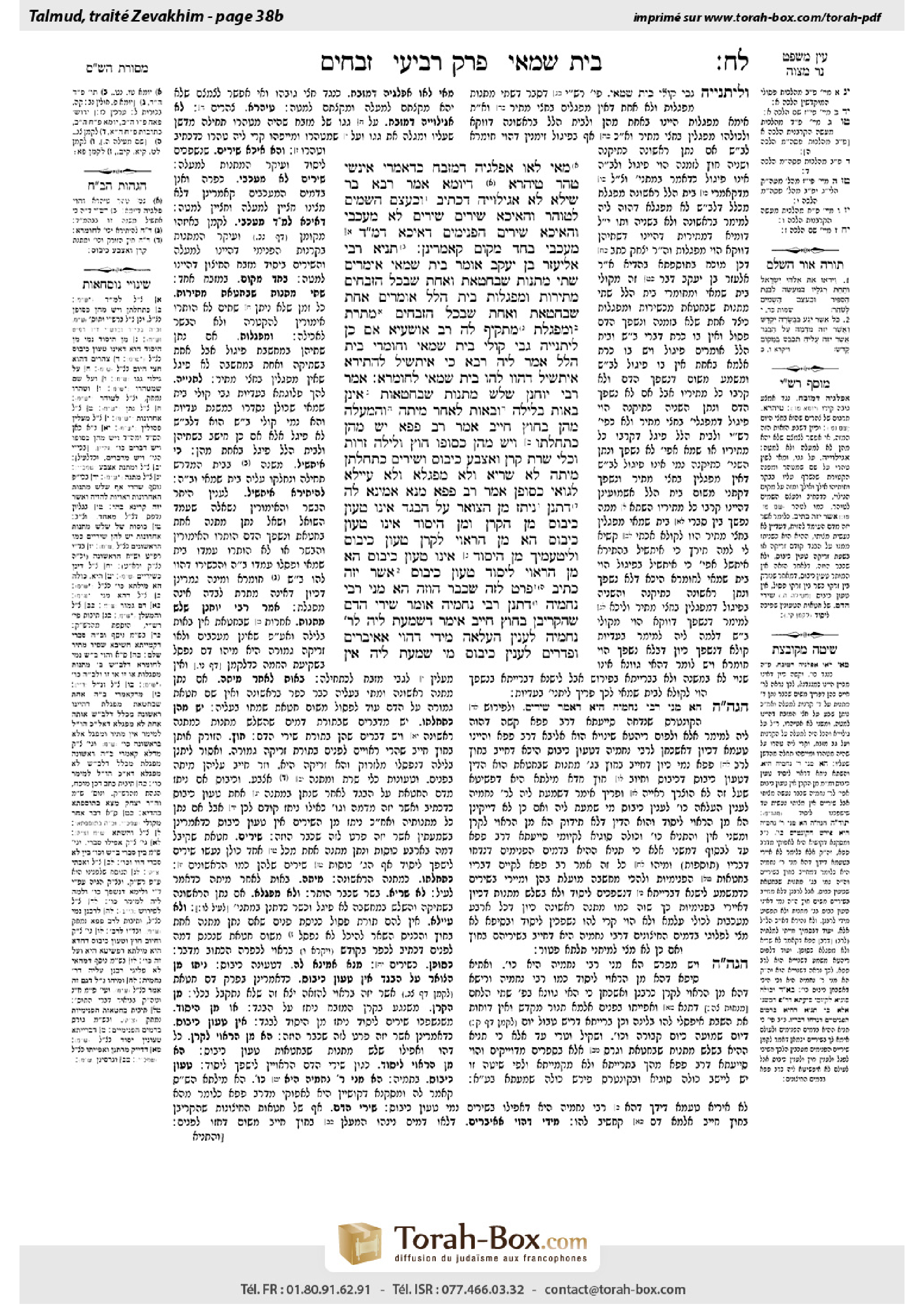
Zevachim 38b: Talmud study for Daf Yomi
Daf Yomi is the daily study of one Talmud folio. Explore 37 tractates with scans, Hebrew text, Sefaria English and AI-generated French translations where annotated.
Passage selection and English or AI-generated French translation are available where the scan has annotations. Daf Study is independent of Torah-Box and Sefaria.
Browse Zevachim · זבחים · All tractatesZevachim 38b text and translations
This page of Zevachim includes the Aramaic text, an English translation and an AI-generated French translation, alongside the scan above.
זבחים ל״ח ב · Aramaic and Hebrew text
מַאי, לָאו אַפַּלְגֵיהּ דְּמִזְבֵּחַ – כִּדְאָמְרִי אִינָשֵׁי: ״טְהַר טִיהֲרָא דְּיוֹמָא״? אָמַר רָבָא בַּר שֵׁילָא: לָא, אַגִּילּוּיֵיהּ; דִּכְתִיב: ״וּכְעֶצֶם הַשָּׁמַיִם לָטֹהַר״.
וְהָאִיכָּא שִׁירַיִם! שִׁירַיִם לָא מְעַכְּבִי.
וְהָאִיכָּא שִׁירַיִם הַפְּנִימִים, דְּאִיכָּא דְּמַאן דְּאָמַר מְעַכְּבִי! בְּחַד מָקוֹם קָאָמְרִינַן.
תַּנְיָא: רַבִּי אֱלִיעֶזֶר בֶּן יַעֲקֹב אוֹמֵר, בֵּית שַׁמַּאי אוֹמְרִים: שְׁתֵּי מַתָּנוֹת שֶׁבַּחַטָּאת, וְאַחַת שֶׁבְּכׇל הַזְּבָחִים – מַתִּירוֹת וּמְפַגְּלוֹת.
בֵּית הִלֵּל אוֹמְרִים: אַחַת שֶׁבַּחַטָּאת וְאַחַת שֶׁבְּכׇל הַזְּבָחִים – מַתֶּרֶת וּמְפַגֶּלֶת.
מַתְקֵיף לַהּ רַב אוֹשַׁעְיָא: אִם כֵּן, לִיתְנְיַיהּ גַּבֵּי קוּלֵּי בֵּית שַׁמַּאי וְחוּמְרֵי בֵּית הִלֵּל!
אֲמַר לֵיהּ רָבָא: כִּי אִיתְּשִׁיל – לְהֶתֵּירָא אִיתְּשִׁיל; דְּהָווּ לְהוּ בֵּית שַׁמַּאי לְחוּמְרָא.
אָמַר רַבִּי יוֹחָנָן: שָׁלֹשׁ מַתָּנוֹת שֶׁבַּחַטָּאוֹת – אֵינָן בָּאוֹת בַּלַּיְלָה, וּבָאוֹת לְאַחַר מִיתָה, וְהַמַּעֲלֶה מֵהֶן בַּחוּץ חַיָּיב.
אָמַר רַב פָּפָּא: יֵשׁ מֵהֶן כִּתְחִלָּתוֹ וְיֵשׁ מֵהֶן כְּסוֹפוֹ;
חוּץ, וְלַיְלָה, זָרוּת, וּכְלֵי שָׁרֵת, קֶרֶן, וְאֶצְבַּע, כִּיבּוּס, וְשִׁירַיִם – כִּתְחִלָּתָן;
וּבָאוֹת לְאַחַר מִיתָה, לָא שָׁרְיָא, וְלָא מְפַגְּלָא, וְלָא עָיְילָא לְגַוַּאי – כְּסוֹפָן.
אָמַר רַב פָּפָּא: מְנָא אָמֵינָא לַהּ? דִּתְנַן: נִיתַּז מִן הַצַּוָּאר עַל הַבֶּגֶד – אֵינוֹ טָעוּן כִּיבּוּס. מִן הַקֶּרֶן וּמִן הַיְסוֹד – אֵינוֹ טָעוּן כִּיבּוּס. הָא מִן הָרָאוּי לְקֶרֶן – טָעוּן כִּיבּוּס.
וְלִיטַעְמָיךְ, מִן הַיְסוֹד אֵינוֹ טָעוּן כִּיבּוּס – הָא מִן הָרָאוּי לַיְסוֹד טָעוּן כִּיבּוּס?! ״אֲשֶׁר יִזֶּה״ כְּתִיב – פְּרָט לָזֶה שֶׁכְּבָר הוּזָּה!
הָא מַנִּי – רַבִּי נְחֶמְיָה; דִּתְנַן, רַבִּי נְחֶמְיָה אוֹמֵר: שְׁיָרֵי הַדָּם שֶׁהִקְרִיבָן בַּחוּץ – חַיָּיב.
אֵימַר דְּשָׁמְעַתְּ לֵיהּ לְרַבִּי נְחֶמְיָה – לְעִנְיַן הַעֲלָאָה, מִידֵּי דְּהָוֵי אַאֵיבָרִים וּפְדָרִים; לְעִנְיַן כִּיבּוּס – מִי שָׁמְעַתְּ לֵיהּ?! אִין;
Zevachim 38b · English translation
What, is it not referring to the middle of the side of the altar, as people say: Clear noon [tihara], that is the middle of the day? Accordingly, the root tet, heh, reish denotes the middle; in the one case, the middle of the day, and in the other case, halfway up the altar. Now, since the blood was sprinkled on the altar seven times, inevitably some of the blood landed above the midpoint and some of it landed below the midpoint. Rava bar Sheila said: No, that is not the meaning of tohoro. Rather, tohoro means on the revealed part, i.e., the top, of the altar, as it is written: “Like the very clear [latohar] sky” (Exodus 24:10). Tohoro is referring to the top of the altar when it has been revealed, after the ashes of the incense are cleared and the pure gold is visible.
The Gemara asks again: Is there not a case where some of the blood is presented above the red line and some of it is presented below? But there is the remainder of the blood, which is poured on the base of the altar even in the case of a sin offering, the main blood of which is placed on the upper portion of the altar. The Gemara answers: The pouring of the remainder of the blood on the base of the altar is not indispensable for atonement. Blood that is indispensable for atonement is in no instance presented half above the red line and half below it.
The Gemara continues this line of questioning: But there is the remainder of the blood of the inner sin offerings, the main blood of which is sprinkled on the inner altar. The remainder of the blood of these offerings is poured on the base of the external altar, and there is one who says that this pouring of the blood is indispensable for atonement. The Gemara explains: When we said that there is no blood, half of which is presented above and half below, we said this with regard to one place, i.e., the same altar. The blood of inner sin offerings is sprinkled on the inner altar, while the remainder of that blood is poured on the base of the external altar. There is no case of blood, half of which is presented above and half of which is presented below on the same altar.
§ The mishna teaches that according to the opinion of Beit Shammai, in the case of a sin offering two placements facilitate atonement, while with regard to other offerings a single placement is sufficient. Beit Hillel disagree and say that even in the case of a sin offering one placement suffices after the fact. With regard to this issue, it is taught in a baraita that Rabbi Eliezer ben Ya’akov says: Beit Shammai say that two placements in the case of a sin offering, and one placement in the case of other offerings, they render the offering permitted for eating since these actions facilitate atonement after the fact, despite the fact that blood was not placed on all four corners of the altar. And similarly they render the offering piggul. That is to say, if the priest placed two placements of the blood of a sin offering or one placement of the blood of any another offering, intending to eat or burn the offering beyond its designated time, the offering is piggul.
Beit Hillel say: One placement in the case of a sin offering, and likewise one placement in the case of all the other offerings, if done with proper intent, renders the offering permitted for eating and, if done with improper intent, renders the offering piggul.
Rav Oshaya objects to this: If so, let this halakha be taught in the fourth chapter of tractate Eduyyot alongside the other rare cases of Beit Shammai’s leniencies and Beit Hillel’s stringencies. According to Beit Hillel, a sin offering is piggul even if the priest intended to partake of it beyond its designated time even while performing a single placement, whereas Beit Shammai maintain that the offering is piggul only if he had this improper intent during two placements.
Rava said to Rav Oshaya: When this question was initially asked, and the Sages stated their opinions concerning the matter, it was asked with regard to the permission to partake of the sin offering. In other words, the dispute arose as a result of an inquiry into the other relevant halakha, i.e., whether the priests may partake of a sin offering, the blood of which was placed only one time. In this case it is Beit Shammai who are more stringent, as they permit the meat of a sin offering only after two placements have been placed. For this reason, this case was not listed among the other leniencies of Beit Shammai and stringencies of Beit Hillel.
§ Rabbi Yoḥanan says: Despite the fact that, according to the opinion of Beit Hillel, the last three placements in the case of a sin offering are not indispensable to the atonement, they may not be performed at night, because the blood is invalidated at sunset. And these three placements may be performed after the death of the owner. If the owner of the offering died before any of the blood was placed on the altar, the blood may not be placed, and the offering is burned as a disqualified offering. But if he died after one placement, the priest may perform the other three placements, as he has already facilitated atonement by means of the first placement. And as it is a mitzva to perform these three placements on the altar, one who offers this blood up on an altar outside the Temple is liable to receive karet, the punishment received by one who offers a sacrifice outside the Temple.
Rav Pappa says: There are some respects in which the blood of the last three placements of a sin offering is treated like the blood presented at the outset, i.e., like the blood of the first placement, and there are some respects in which the blood of the last three placements is treated like the blood presented at the end, i.e., like the remainder of the blood of a sin offering.
Rav Pappa elaborates: With regard to liability for presenting blood outside the Temple, and concerning the prohibition against presenting blood at night, and with regard to the disqualification of a non-priest from presenting blood and his liability for death at the hand of Heaven if he presents blood in the Temple, and with regard to the requirement that the blood that is to be presented must first be placed in a service vessel, and that the blood must be placed on the corner of the altar, and that the placement must be performed with the priest’s finger, and concerning the obligation to launder a garment onto which the blood of a sin offering sprayed, and finally with regard to the requirement of pouring the remainder of the blood on the base of the altar, the last three placements are treated like blood presented at the outset, i.e., like the first placement.
But these last three placements may be performed after the death of the owner; and they do not render the offering permitted for eating, as that was already achieved by means of the first placement; nor do they render the offering piggul if during these placements the priest intended to eat or burn the offering beyond its designated time; and similarly, they are not governed by the halakha that if the blood enters inside the Sanctuary the sin offering is disqualified. With regard to all these matters the blood of the last three placements is treated like the blood presented at the end, i.e., like the remainder of the blood of a sin offering.
With regard to the obligation to launder a garment onto which the blood of a sin offering sprayed, Rav Pappa said: From where do I say that this halakha applies even to the blood of the last three placements? It is as we learned in a mishna (93a): If the blood of a sin offering sprayed directly from the neck of the animal onto a garment, that garment does not require laundering, as the blood had never been received in a vessel. Likewise, if the blood sprayed onto the garment from the corner of the altar after having been placed there, or from the base of the altar after the remainder was poured there, the garment does not require laundering. It may be inferred from here that blood that sprayed from the corner of the altar does not require laundering. But blood that is fit to be placed on the corner, as it has not yet been placed, requires laundering, and the blood of the last three placements is indeed fit to be placed on the corner of the altar.
The Gemara rejects this proof: But according to your reasoning, one can claim in the same manner that it is only blood that sprayed from the base of the altar that does not require laundering; but blood that is fit for the base of the altar, i.e., what remains of the blood after it has been placed on the corners, requires laundering. This is difficult, as it is written: “And when there will be sprinkled [yizze] of its blood upon any garment” (Leviticus 6:20). The future form of the word yizze serves to exclude this blood sprayed onto the garment from the corner of the altar, as it has already been sprinkled.
The Gemara explains: In accordance with whose opinion is this ruling? It is in accordance with the opinion of Rabbi Neḥemya, as we learned in a mishna (110b) that Rabbi Neḥemya says: With regard to the remainder of the blood of an offering, which was to be poured at the base of the altar, if one presented it outside the Temple, he is liable. Since Rabbi Neḥemya treats the remainder of the blood as blood with regard to liability for a service performed outside the Temple, he also treats the remainder of the blood of a sin offering as blood with regard to laundering. Accordingly, Rav Pappa’s inference from the previously cited mishna is valid only according to Rabbi Neḥemya, but not according to the majority opinion of the Rabbis, who disagree with him.
The Gemara challenges the proof even according to the opinion of Rabbi Neḥemya: Say that you heard that Rabbi Neḥemya ruled in this manner with regard to the offering up of the remainder of the blood outside the Temple, just as is the case with regard to limbs and fats. Even though the offering of the limbs and fats is not indispensable for atonement, one who offers them outside the Temple is liable. But did you also hear him say this with regard to laundering, that one must launder a garment sprayed with the remainder of the blood of a sin offering? The Gemara answers: Yes, we also heard Rabbi Neḥemya rule in this manner with regard to laundering.
Zevachim 38b · Traduction française (IA)
N’est-ce pas que cela désigne le milieu du flanc de l’autel, comme on dit : « Le plein midi [tihara] », c’est-à-dire le milieu de la journée ? Ainsi, la racine tet, he, reish désigne le milieu : dans un cas, le milieu de la journée et, dans l’autre, le milieu de la hauteur de l’autel. Or, puisque le sang a été aspergé sept fois sur l’autel, une partie du sang est nécessairement tombée au-dessus du milieu et une autre au-dessous. Rava bar Sheila dit : Non, ce n’est pas là le sens de tohoro. Tohoro signifie plutôt la partie dévoilée, c’est-à-dire le sommet de l’autel, comme il est écrit : « Comme le ciel même, dans sa pureté [latohar] » (Exode 24:10). Tohoro désigne le sommet de l’autel lorsqu’il est dévoilé, après que les cendres de l’encens ont été enlevées et que l’or pur est visible.
La Guemara demande de nouveau : N’y a-t-il pas un cas où une partie du sang est appliquée au-dessus de la ligne rouge et une autre au-dessous ? Mais il y a le reste du sang, qui est versé sur la base de l’autel même dans le cas d’un sacrifice expiatoire, dont le sang principal est appliqué sur la partie supérieure de l’autel. La Guemara répond : Le versement du reste du sang sur la base de l’autel n’est pas indispensable à l’expiation. Dans aucun cas le sang indispensable à l’expiation n’est appliqué pour moitié au-dessus de la ligne rouge et pour moitié au-dessous.
La Guemara poursuit cette série de questions : Mais il y a le reste du sang des sacrifices expiatoires intérieurs, dont le sang principal est aspergé sur l’autel intérieur. Le reste du sang de ces sacrifices est versé sur la base de l’autel extérieur, et certains disent que ce versement du sang est indispensable à l’expiation. La Guemara explique : Lorsque nous avons dit qu’il n’existe pas de sang dont une moitié est appliquée au-dessus et l’autre au-dessous, nous parlions d’un seul endroit, c’est-à-dire du même autel. Le sang des sacrifices expiatoires intérieurs est aspergé sur l’autel intérieur, tandis que le reste de ce sang est versé sur la base de l’autel extérieur. Il n’existe aucun cas où le sang est appliqué pour moitié au-dessus et pour moitié au-dessous sur le même autel.
§ La Michna enseigne que, selon l’opinion de Beit Shammaï, dans le cas d’un sacrifice expiatoire, deux applications facilitent l’expiation, tandis que, pour les autres sacrifices, une seule application suffit. Beit Hillel ne sont pas d’accord et disent que, même dans le cas d’un sacrifice expiatoire, une seule application suffit a posteriori. À ce sujet, une baraïta enseigne que Rabbi Eliezer ben Ya’akov dit : Beit Shammaï disent que deux applications dans le cas d’un sacrifice expiatoire, et une application dans le cas des autres sacrifices, rendent le sacrifice permis à la consommation, puisque ces actes facilitent l’expiation a posteriori, bien que le sang n’ait pas été appliqué sur les quatre angles de l’autel. De même, elles rendent le sacrifice piggul. Autrement dit, si le prêtre a fait deux applications du sang d’un sacrifice expiatoire ou une application du sang de tout autre sacrifice, avec l’intention de consommer ou de brûler le sacrifice au-delà du délai qui lui est fixé, le sacrifice est piggul.
Beit Hillel disent : Une application dans le cas d’un sacrifice expiatoire, et de même une application dans le cas de tous les autres sacrifices, rend le sacrifice permis à la consommation si elle est faite avec l’intention requise et le rend piggul si elle est faite avec une intention inadéquate.
Rav Oshaya objecte : Dans ce cas, que cette halakha soit enseignée dans le quatrième chapitre du traité Eduyyot, avec les autres cas peu fréquents de concessions de Beit Shammaï et de rigueurs de Beit Hillel. Selon Beit Hillel, un sacrifice expiatoire est piggul même si le prêtre a eu l’intention de le consommer au-delà du délai qui lui est fixé alors qu’il n’effectuait qu’une seule application, tandis que Beit Shammaï soutiennent que le sacrifice est piggul seulement si le prêtre a eu cette intention inadéquate pendant deux applications.
Rava dit à Rav Oshaya : Lorsque cette question a été posée initialement et que les Sages ont exprimé leurs opinions à ce sujet, elle portait sur la permission de consommer le sacrifice expiatoire. En d’autres termes, la controverse est née d’une question portant sur l’autre halakha pertinente, à savoir si les prêtres peuvent consommer un sacrifice expiatoire dont le sang n’a été appliqué qu’une seule fois. Dans ce cas, ce sont Beit Shammaï qui sont plus stricts, puisqu’ils ne permettent la consommation de la viande d’un sacrifice expiatoire qu’après deux applications. C’est pourquoi ce cas n’a pas été répertorié parmi les autres concessions de Beit Shammaï et les rigueurs de Beit Hillel.
§ Rabbi Yoḥanan dit : Bien que, selon l’opinion de Beit Hillel, les trois dernières applications dans le cas d’un sacrifice expiatoire ne soient pas indispensables à l’expiation, elles ne peuvent pas être faites la nuit, car le sang devient invalide au coucher du soleil. Ces trois applications peuvent être faites après la mort du propriétaire. Si le propriétaire du sacrifice est mort avant que le sang ait été appliqué sur l’autel, le sang ne peut pas être appliqué et le sacrifice est brûlé comme un sacrifice disqualifié. Mais s’il est mort après une application, le prêtre peut faire les trois autres, puisqu’il a déjà facilité l’expiation au moyen de la première application. Et puisqu’il est une mitsva de faire ces trois applications sur l’autel, celui qui offre ce sang sur un autel situé hors du Temple est passible de karet, la peine encourue par celui qui offre un sacrifice hors du Temple.
Rav Pappa dit : À certains égards, le sang des trois dernières applications d’un sacrifice expiatoire est considéré comme le sang appliqué au début, c’est-à-dire comme le sang de la première application ; à d’autres égards, le sang des trois dernières applications est considéré comme le sang appliqué à la fin, c’est-à-dire comme le reste du sang d’un sacrifice expiatoire.
Rav Pappa précise : En ce qui concerne la responsabilité encourue pour avoir appliqué du sang hors du Temple, l’interdiction d’appliquer du sang la nuit, la disqualification d’un non-prêtre qui applique le sang et sa responsabilité d’encourir la mort par la main du Ciel s’il applique le sang dans le Temple, ainsi que l’obligation de placer d’abord le sang destiné à être appliqué dans un récipient de service, de l’appliquer sur l’angle de l’autel et de faire l’application avec le doigt du prêtre ; en ce qui concerne aussi l’obligation de laver un vêtement sur lequel le sang d’un sacrifice expiatoire a giclé ; et enfin, en ce qui concerne l’obligation de verser le reste du sang sur la base de l’autel, les trois dernières applications sont considérées comme le sang appliqué au début, c’est-à-dire comme celui de la première application.
Mais ces trois dernières applications peuvent être faites après la mort du propriétaire ; elles ne rendent pas le sacrifice permis à la consommation, puisque cela a déjà été obtenu au moyen de la première application ; elles ne rendent pas non plus le sacrifice piggul si, pendant ces applications, le prêtre a eu l’intention de consommer ou de brûler le sacrifice au-delà du délai qui lui est fixé ; et la halakha selon laquelle le sacrifice expiatoire est disqualifié si le sang pénètre dans le Sanctuaire ne s’applique pas non plus à elles. Dans tous ces cas, le sang des trois dernières applications est considéré comme le sang appliqué à la fin, c’est-à-dire comme le reste du sang d’un sacrifice expiatoire.
Au sujet de l’obligation de laver un vêtement sur lequel le sang d’un sacrifice expiatoire a giclé, Rav Pappa dit : D’où est-ce que je déduis que cette halakha s’applique également au sang des trois dernières applications ? De ce que nous avons appris dans une Michna (93a) : Si le sang d’un sacrifice expiatoire a giclé directement du cou de l’animal sur un vêtement, ce vêtement n’a pas besoin d’être lavé, car le sang n’avait jamais été recueilli dans un récipient. De même, si le sang a giclé sur le vêtement depuis l’angle de l’autel après y avoir été appliqué, ou depuis la base de l’autel après que le reste y a été versé, le vêtement n’a pas besoin d’être lavé. On peut en déduire que le sang qui a giclé depuis l’angle de l’autel n’exige pas le lavage du vêtement. Mais le sang qui peut être appliqué sur l’angle, puisqu’il n’y a pas encore été appliqué, exige le lavage du vêtement ; or le sang des trois dernières applications peut effectivement être appliqué sur l’angle de l’autel.
La Guemara rejette cette preuve : Mais, selon votre raisonnement, on pourrait affirmer de la même manière que seul le sang qui a giclé depuis la base de l’autel n’exige pas le lavage du vêtement ; en revanche, le sang destiné à la base de l’autel, c’est-à-dire ce qui reste du sang après son application sur les angles, exige le lavage du vêtement. Cela pose une difficulté, car il est écrit : « Et si son sang est projeté [yizze] sur un vêtement quelconque » (Lévitique 6:20). La forme au futur du mot yizze sert à exclure le sang qui a giclé sur le vêtement depuis l’angle de l’autel, puisqu’il a déjà été aspergé.
La Guemara explique : De quelle opinion cette décision relève-t-elle ? De celle de Rabbi Neḥemya, car nous avons appris dans une Michna (110b) que Rabbi Neḥemya dit : Concernant le reste du sang d’un sacrifice, qui devait être versé à la base de l’autel, si quelqu’un l’applique hors du Temple, il est passible. Puisque Rabbi Neḥemya considère le reste du sang comme du sang pour ce qui est de la responsabilité encourue pour un service accompli hors du Temple, il considère également le reste du sang d’un sacrifice expiatoire comme du sang pour ce qui est du lavage du vêtement. Par conséquent, la déduction de Rav Pappa à partir de la Michna citée précédemment n’est valable que selon Rabbi Neḥemya, mais non selon l’opinion majoritaire des Rabbins, qui ne sont pas d’accord avec lui.
La Guemara conteste la preuve, même selon l’opinion de Rabbi Neḥemya : Admettons que tu aies entendu Rabbi Neḥemya statuer ainsi au sujet de l’offrande du reste du sang hors du Temple, comme dans le cas des membres et des graisses. Bien que l’offrande des membres et des graisses ne soit pas indispensable à l’expiation, celui qui les offre hors du Temple est passible. Mais l’as-tu aussi entendu dire cela au sujet du lavage, c’est-à-dire qu’il faut laver un vêtement sur lequel a giclé le reste du sang d’un sacrifice expiatoire ? La Guemara répond : Oui, nous avons également entendu Rabbi Neḥemya statuer ainsi au sujet du lavage.
Traduction française générée par IA à partir de l’édition anglaise de Sefaria. Vérifie toujours un passage avec le texte source.
Text from Sefaria: William Davidson Edition - Vocalized Aramaic (CC BY NC); William Davidson Edition - English (CC BY NC).