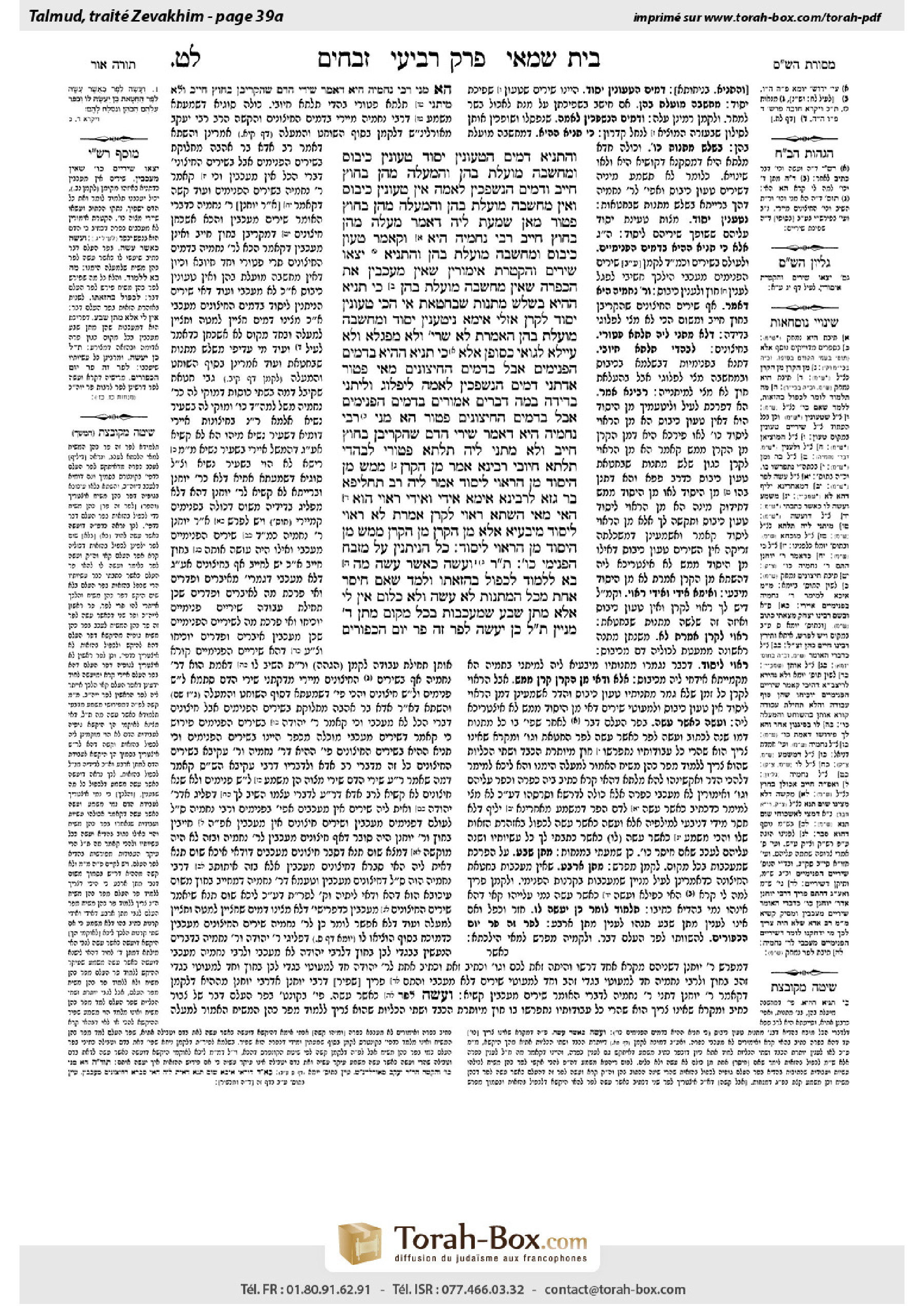
Zevachim 39a: Talmud study for Daf Yomi
Daf Yomi is the daily study of one Talmud folio. Explore 37 tractates with scans, Hebrew text, Sefaria English and AI-generated French translations where annotated.
Passage selection and English or AI-generated French translation are available where the scan has annotations. Daf Study is independent of Torah-Box and Sefaria.
Browse Zevachim · זבחים · All tractatesZevachim 39a text and translations
This page of Zevachim includes the Aramaic text, an English translation and an AI-generated French translation, alongside the scan above.
זבחים ל״ט א · Aramaic and Hebrew text
וְהָתַנְיָא: דָּמִים הַטְּעוּנִין יְסוֹד – טְעוּנִין כִּיבּוּס, וּמַחְשָׁבָה מוֹעֶלֶת בָּהֶן, וְהַמַּעֲלֶה מֵהֶן בַּחוּץ חַיָּיב;
וְדָמִים הַנִּשְׁפָּכִין לָאַמָּה – אֵין טְעוּנִין כִּיבּוּס, וְאֵין מַחְשָׁבָה מוֹעֶלֶת בָּהֶן, וְהַמַּעֲלֶה מֵהֶן בַּחוּץ פָּטוּר.
מַאן שָׁמְעַתְּ לֵיהּ דְּאָמַר מַעֲלֶה מֵהֶן בַּחוּץ חַיָּיב – רַבִּי נְחֶמְיָה הִיא; וְקָאָמַר: טָעוּן כִּיבּוּס.
וּמַחְשָׁבָה מוֹעֶלֶת בָּהֶן?! וְהָתַנְיָא: יָצְאוּ שִׁירַיִם וְהַקְטָרַת אֵימוּרִין, שֶׁאֵין מְעַכְּבִין אֶת הַכַּפָּרָה – שֶׁאֵין מַחְשָׁבָה מוֹעֶלֶת בָּהֶן!
כִּי תַּנְיָא הָהִיא – בְּשָׁלֹשׁ מַתָּנוֹת שֶׁבַּחַטָּאת.
אִי הָכִי, טְעוּנִין יְסוֹד?! לְקֶרֶן אָזְלִי! אֵימָא: נִיטְעָנִין יְסוֹד. וּמַחְשָׁבָה מוֹעֶלֶת בָּהֶן?! הָאָמְרַתְּ: לָא שַׁרְיָא וְלָא מְפַגְּלָא וְלָא עָיְילָא לְגַוַּאי – כְּסוֹפָן!
אֶלָּא כִּי תַּנְיָא הָהִיא – בְּדָמִים הַפְּנִימִיִּם.
אֲבָל בְּדָמִים הַחִיצוֹנִים מַאי, פָּטוּר?! אַדְּתָנֵי דָּמִים הַנִּשְׁפָּכִין לָאַמָּה; לִיפְלוֹג וְלִיתְנֵי בְּדִידַהּ: בַּמֶּה דְּבָרִים אֲמוּרִים – בְּדָמִים הַפְּנִימִיִּם, אֲבָל בְּדָמִים הַחִיצוֹנִים – פָּטוּר!
הָא מַנִּי – רַבִּי נְחֶמְיָה הִיא, דְּאָמַר: שְׁיָרֵי הַדָּם שֶׁהִקְרִיבָן בַּחוּץ – חַיָּיב; וְלָא מַתְנֵי לֵיהּ תְּלָתָא פְּטוּרֵי לְבַהֲדֵי תְּלָתָא חִיּוּבֵי.
רָבִינָא אָמַר: מִן הַקֶּרֶן – מַמָּשׁ, מִן הַיְסוֹד – מִן הָרָאוּי לַיְסוֹד.
אֲמַר לֵיהּ רַב תַּחְלִיפָא בַּר גַּזָּא לְרָבִינָא: אֵימָא אִידֵּי וְאִידֵּי רָאוּי הוּא! הַאי מַאי? הַשְׁתָּא רָאוּי לַקֶּרֶן – אָמְרַתְּ לָא; רָאוּי לַיְסוֹד מִיבַּעְיָא?! אֶלָּא מִן הַקֶּרֶן – מִן הַקֶּרֶן מַמָּשׁ, מִן הַיְסוֹד – מִן הָרָאוּי לַיְסוֹד.
כׇּל הַנִּיתָּנִין עַל מִזְבֵּחַ הַפְּנִימִי כּוּ׳. תָּנוּ רַבָּנַן: ״וְעָשָׂה כַּאֲשֶׁר עָשָׂה״ – מָה בָּא לִלְמוֹד?
לִכְפּוֹל בְּהַזָּאָתוֹ; וְלָמַד שֶׁאִם חִיסַּר אַחַת מִכׇּל הַמַּתָּנוֹת – לֹא עָשָׂה וְלֹא כְּלוּם. אֵין לִי אֶלָּא מַתַּן שֶׁבַע, שֶׁמְּעַכְּבוֹת בְּכׇל מָקוֹם; מַתַּן אַרְבַּע מִנַּיִין? תַּלְמוּד לוֹמַר: ״כֵּן יַעֲשֶׂה״.
״לַפָּר״ – זֶה פַּר יוֹם הַכִּפּוּרִים,
Zevachim 39a · English translation
And this is as it is taught in a baraita: With regard to blood that requires the base of the altar, presumably a reference to the remainder of the blood of a sin offering, which must be poured on the base of the altar, it requires laundering; and improper intent is effective with regard to it, i.e., if the priest poured such blood with the intent to partake of the sacrificial meat beyond its designated time, the offering is piggul; and one who offers it up outside the Temple is liable.
And conversely, with regard to blood that is poured into the Temple courtyard drain that passed through the Temple and emptied into the Kidron River, which is blood that has become disqualified, it does not require laundering, and improper intent is not effective with regard to it, and one who offers it up outside the Temple is exempt.
The Gemara inquires: About whom did you learn that he said that one who offers up the remainder of the blood outside the Temple is liable? It is Rabbi Neḥemya who says this, and he states in this baraita that a garment that was sprayed with such blood requires laundering.
The Gemara asks: And is improper intent effective with regard to blood that must be poured on the base of the altar? But isn’t it taught in a baraita discussing the intent that renders an offering piggul: The possibility of piggul applies only with regard to a service that is indispensable for atonement. This serves to exclude pouring the remainder of the blood on the altar and burning the sacrificial portions on the altar, actions that are not indispensable for atonement, concerning which the halakha is that improper intent is not effective with regard to them.
Rather, when that baraita is taught, stating that blood that requires the base requires laundering, it is not referring to the remainder of the blood after the placements have been completed. Instead, it is referring to the blood that is to be used for the last three placements of the blood of a sin offering.
The Gemara asks: If so, is it correct to describe this blood as requiring the base of the altar? After all, this blood goes to the corner of the altar, not the base. The Gemara answers: Say that this means: Blood that becomes required for the base, i.e., blood that in the end, after the placements are completed, will be poured on the base of the altar. The Gemara further asks: But is improper intent effective with regard to the blood of the last three placements of the blood of a sin offering? Didn’t you say that this blood does not render the offering permitted for eating, nor does it render the offering piggul, and it is not governed by the halakha that if the blood enters inside the Sanctuary the sin offering is disqualified? With regard to all these matters the blood of the last three placements is treated like the blood presented at the end, i.e., like the remainder of the blood of a sin offering.
The Gemara explains: Rather, when that baraita is taught, stating that blood requiring the base requires laundering, and improper intent is effective with regard to it, and one who presents of it outside the Temple is liable, it is indeed referring to the remainder of the blood after the placements have been completed. It is stated not with regard to the remainder of the blood of a standard sin offering, but with regard to the remainder of the blood of inner sin offerings, which are brought on the inner altar located inside the Sanctuary.
The Gemara asks: But if that is the case, with regard to the remainder of the blood of external sin offerings that are brought on the external altar, what is the halakha? Is one who presents them outside the Temple exempt? If so, rather than teaching the halakha of disqualified blood that is poured into the Temple courtyard drain, let the baraita distinguish and teach the halakha within the case of the remainder of the blood itself, in the following manner: In what case is this statement said? In a case of the blood of sin offerings brought on the inner altar. But in the case of the blood of sin offerings brought on the external altar, one who offers up such an offering outside the Temple is exempt.
The Gemara answers: The baraita could not have made such a distinction, for in accordance with whose opinion is this ruling? It is in accordance with the opinion of Rabbi Neḥemya, who says: With regard to the remainder of the blood of a sin offering brought on the external altar, in a case where one presented it outside the Temple, he is liable. And therefore, were the tanna to contrast the halakha of the blood of sin offerings brought on the external altar with that of the blood of sin offerings brought on the inner altar, he would not have been able to teach three rulings of exemptions corresponding to three rulings of liabilities, as Rabbi Neḥemya maintains that even with regard to the remainder of the blood of a sin offering brought on the external altar, if one presents it outside the Temple he is liable. Therefore, the tanna preferred to compare the halakhot of the remainder of the blood of inner sin offerings to the disqualified blood that is poured into the Temple courtyard drain, so that he could list three lenient rulings alongside three stringent ones.
§ The Gemara returns to discuss the statement of Rav Pappa, that a garment sprayed by blood from the last three placements of the blood of a sin offering requires laundering, and to his proof from the mishna that states that if the blood of a sin offering sprayed onto a garment from the corner of the altar or from the base of the altar, the garment does not require laundering. Ravina says, in answer to the objection raised against Rav Pappa above, that according to Rav Pappa the mishna (93a) should be understood as follows: The term: From the corner, means from the corner, literally, after the blood was placed there, and therefore Rav Pappa could infer from this that blood that is fit to be placed on the corner, including the blood to be used for the last three sprinklings, requires laundering. But the term: From the base of the altar, does not mean from the base, literally. Rather, it means: From blood that is fit for the base of the altar, i.e., from the remainder of the blood, which is to be poured on the base.
Rav Taḥlifa bar Gazza said to Ravina: One can say a different explanation, that both this and that, i.e., the term: From the corner, and the term: From the base, are referring to blood that is fit for the corner or the base, in which case the mishna teaches that a garment sprayed by the blood that was to be used for the last three placements of a sin offering does not require laundering, contrary to the opinion of Rav Pappa. Ravina replied: What is this claim? Now that you say that blood which is fit for the corner does not require laundering, is it necessary to state that the same applies to blood that is merely fit for the base of the altar? That ruling would be unnecessary. Rather, it must be that the term: From the corner, means from the corner, literally, i.e., that the blood has already been placed there, whereas the term: From the base, means from blood that is fit for the base, i.e., from the remainder of the blood, which is to be poured on the base.
§ The mishna teaches: With regard to all the offerings whose blood is to be placed on the inner altar, which are the bull and goat of Yom Kippur, the bull for an unwitting sin of the anointed priest, the bull for an unwitting communal sin, and the goat for an unwitting communal sin of idol worship, if the priest omitted even one of the placements, it is as though he did not facilitate atonement. The Sages taught in a baraita: The Torah first discusses the bull for an unwitting sin of the anointed priest and afterward the bull for an unwitting communal sin, concerning which it states: “And he shall do with the bull, as he did with the bull for a sin offering” (Leviticus 4:20). It may be asked: This phrase: “And he shall do…as he did,” what does this come to teach? All the details stated with regard to the first bull, i.e., that of the anointed priest, seem to be stated explicitly with regard to the second bull as well.
Rather, the verse comes to repeat the halakha of the sprinkling of the blood, as though it were written twice with regard to the same bull. This repetition of the halakha indicates that the sprinkling is indispensable, thereby teaching that if the priest omitted one of the placements he has done nothing. I have a derivation only with regard to the seven placements on the Curtain separating between the Sanctuary and Holy of Holies, that they are indispensable, as these seven are indispensable in all cases, as the Gemara will explain (40a). From where is it derived that the same applies to the four placements on the inner altar? The verse states: “So shall he do” (Leviticus 4:20).
The baraita continues: The verse states: “And he shall do with the bull” (Leviticus 4:20); this alludes to a different bull whose service is similar, namely the bull of Yom Kippur.
Zevachim 39a · Traduction française (IA)
Et voici ce qui est enseigné dans une baraïta : le sang qui doit être versé sur la base de l’autel — vraisemblablement le reste du sang d’un sacrifice expiatoire, qui doit être versé sur la base de l’autel — doit être lavé du vêtement ; l’intention impropre a un effet à son égard, c’est-à-dire que si le prêtre a versé ce sang avec l’intention de consommer la viande sacrificielle après le délai fixé, l’offrande devient piggoul ; et celui qui le présente à l’extérieur du Temple est passible.
À l’inverse, le sang versé dans l’égout de la cour du Temple, qui traversait le Temple et se déversait dans le torrent du Cédron — du sang devenu impropre — ne doit pas être lavé du vêtement, l’intention impropre n’a pas d’effet à son égard et celui qui le présente à l’extérieur du Temple est exempt.
La Guemara demande : De qui as-tu appris qu’il a dit que celui qui présente à l’extérieur du Temple le reste du sang est passible ? C’est Rabbi Neḥemya qui l’affirme ; dans cette baraïta, il enseigne qu’un vêtement aspergé de ce sang doit être lavé.
La Guemara demande : L’intention impropre a-t-elle un effet à l’égard du sang qui doit être versé sur la base de l’autel ? N’est-il pas enseigné dans une baraïta, à propos de l’intention qui rend une offrande piggoul, que le statut de piggoul ne s’applique qu’à un service indispensable à l’expiation ? Cela exclut le versement du reste du sang sur l’autel et la combustion des parties sacrificielles sur l’autel : ces actes ne sont pas indispensables à l’expiation, et la halakha veut que l’intention impropre n’ait pas d’effet à leur égard.
En réalité, lorsque cette baraïta enseigne que le sang qui doit être versé sur la base de l’autel doit être lavé du vêtement, elle ne parle pas du reste du sang après l’achèvement des aspersions. Elle parle plutôt du sang destiné aux trois dernières aspersions du sang d’un sacrifice expiatoire.
La Guemara demande : Dans ce cas, est-il exact de décrire ce sang comme devant être versé sur la base de l’autel ? Après tout, ce sang est appliqué à l’angle de l’autel, et non à sa base. La Guemara répond : Il faut comprendre qu’il s’agit du sang qui sera destiné à la base, c’est-à-dire du sang qui, une fois les aspersions achevées, sera versé sur la base de l’autel. La Guemara demande encore : Mais l’intention impropre a-t-elle un effet à l’égard du sang des trois dernières aspersions du sang d’un sacrifice expiatoire ? N’as-tu pas dit que ce sang ne rend pas l’offrande permise à la consommation, ne rend pas non plus l’offrande piggoul et n’est pas soumis à la halakha selon laquelle le sacrifice expiatoire est invalidé si le sang pénètre dans le Sanctuaire ? Sur tous ces points, le sang des trois dernières aspersions est traité comme le sang présenté à la fin, c’est-à-dire comme le reste du sang d’un sacrifice expiatoire.
La Guemara explique : En réalité, lorsque cette baraïta enseigne que le sang qui doit être versé sur la base de l’autel doit être lavé du vêtement, que l’intention impropre a un effet à son égard et que celui qui en présente à l’extérieur du Temple est passible, elle parle bien du reste du sang après l’achèvement des aspersions. Il ne s’agit pas du reste du sang d’un sacrifice expiatoire ordinaire, mais du reste du sang des sacrifices expiatoires intérieurs, dont le sang est apporté sur l’autel intérieur situé dans le Sanctuaire.
La Guemara demande : Mais dans ce cas, quelle est la halakha concernant le reste du sang des sacrifices expiatoires extérieurs, dont le sang est apporté sur l’autel extérieur ? Celui qui le présente à l’extérieur du Temple est-il exempt ? Si tel est le cas, au lieu d’enseigner la halakha concernant le sang devenu impropre, versé dans l’égout de la cour du Temple, la baraïta aurait dû établir une distinction au sujet du reste du sang lui-même et enseigner ce qui suit : Dans quel cas cette déclaration est-elle formulée ? Dans le cas du sang des sacrifices expiatoires apporté sur l’autel intérieur. Mais dans le cas du sang des sacrifices expiatoires apporté sur l’autel extérieur, celui qui présente une telle offrande à l’extérieur du Temple est exempt.
La Guemara répond : La baraïta ne pouvait pas établir une telle distinction, car de qui cette décision suit-elle l’avis ? De Rabbi Neḥemya, qui dit que, concernant le reste du sang d’un sacrifice expiatoire apporté sur l’autel extérieur, celui qui le présente à l’extérieur du Temple est passible. Par conséquent, si le tanna avait opposé la halakha relative au sang des sacrifices expiatoires apporté sur l’autel extérieur à celle relative au sang des sacrifices expiatoires apporté sur l’autel intérieur, il n’aurait pas pu enseigner trois cas d’exemption correspondant à trois cas de responsabilité, puisque Rabbi Neḥemya soutient que même pour le reste du sang d’un sacrifice expiatoire apporté sur l’autel extérieur, celui qui le présente à l’extérieur du Temple est passible. Le tanna a donc préféré comparer les halakhot relatives au reste du sang des sacrifices expiatoires intérieurs à celles du sang devenu impropre, versé dans l’égout de la cour du Temple, afin de pouvoir énumérer trois cas indulgents à côté de trois cas rigoureux.
§ La Guemara revient sur l’affirmation de Rav Pappa selon laquelle un vêtement aspergé par le sang des trois dernières aspersions du sang d’un sacrifice expiatoire doit être lavé, ainsi que sur sa preuve tirée de la Michna, qui enseigne que si le sang d’un sacrifice expiatoire asperge un vêtement depuis l’angle ou la base de l’autel, le vêtement ne doit pas être lavé. Ravina répond à l’objection soulevée plus haut contre Rav Pappa en disant que, selon celui-ci, la Michna (93a) doit être comprise ainsi : l’expression « depuis l’angle » désigne l’angle au sens propre, après que le sang y a été appliqué ; Rav Pappa pouvait donc en déduire que le sang destiné à être appliqué à l’angle, y compris celui qui sert aux trois dernières aspersions, doit être lavé du vêtement. Mais l’expression « depuis la base de l’autel » ne désigne pas la base au sens propre. Elle signifie plutôt : à partir du sang destiné à la base de l’autel, c’est-à-dire le reste du sang, qui doit être versé sur la base.
Rav Taḥlifa bar Gazza dit à Ravina : On peut proposer une autre explication : les deux expressions, « depuis l’angle » et « depuis la base », désignent du sang destiné à l’angle ou à la base. Dans ce cas, la Michna enseigne qu’un vêtement aspergé par le sang destiné aux trois dernières aspersions d’un sacrifice expiatoire ne doit pas être lavé, contrairement à l’avis de Rav Pappa. Ravina répondit : Que vaut cette objection ? Dès lors que tu affirmes que le sang destiné à l’angle ne doit pas être lavé du vêtement, faut-il préciser que la même règle s’applique au sang simplement destiné à la base de l’autel ? Cette précision serait inutile. Il faut donc comprendre que l’expression « depuis l’angle » désigne l’angle au sens propre, c’est-à-dire que le sang y a déjà été appliqué, tandis que l’expression « depuis la base » désigne du sang destiné à la base, c’est-à-dire le reste du sang, qui doit y être versé.
§ La Michna enseigne : pour toutes les offrandes dont le sang doit être appliqué sur l’autel intérieur — le taureau et le bouc de Yom Kippour, le taureau pour la faute involontaire du prêtre oint, le taureau pour la faute involontaire de la communauté et le bouc pour la faute involontaire de la communauté liée au culte idolâtre —, si le prêtre a omis ne serait-ce qu’une des applications, c’est comme s’il n’avait pas obtenu l’expiation. Les Sages enseignent dans une baraïta : la Torah parle d’abord du taureau pour la faute involontaire du prêtre oint, puis du taureau pour la faute involontaire de la communauté, au sujet duquel il est dit : « Il fera avec le taureau comme il a fait avec le taureau expiatoire » (Lévitique 4, 20). On peut demander : que vient enseigner cette formule « Il fera… comme il a fait » ? Tous les détails énoncés au sujet du premier taureau, celui du prêtre oint, semblent également être explicitement énoncés au sujet du second taureau.
En réalité, le verset vient répéter la halakha de l’aspersion du sang, comme si elle avait été écrite deux fois au sujet du même taureau. Cette répétition indique que l’aspersion est indispensable et enseigne donc que si le prêtre en a omis une, il n’a rien fait. Je ne dispose d’une déduction qu’au sujet des sept aspersions sur le rideau séparant le Sanctuaire du Saint des Saints, dont le caractère indispensable s’applique dans tous les cas, comme la Guemara l’expliquera (40a). D’où déduit-on qu’il en va de même pour les quatre applications sur l’autel intérieur ? Le verset dit : « Il fera ainsi » (Lévitique 4, 20).
La baraïta poursuit : le verset dit : « Il fera avec le taureau » (Lévitique 4, 20) ; cela fait allusion à un autre taureau dont le service est similaire, à savoir le taureau de Yom Kippour.
Traduction française générée par IA à partir de l’édition anglaise de Sefaria. Vérifie toujours un passage avec le texte source.
Text from Sefaria: William Davidson Edition - Vocalized Aramaic (CC BY NC); William Davidson Edition - English (CC BY NC).