Zevachim 39b: Talmud study for Daf Yomi
Daf Yomi is the daily study of one Talmud folio. Explore 37 tractates with scans, Hebrew text, Sefaria English and AI-generated French translations where annotated.
Passage selection and English or AI-generated French translation are available where the scan has annotations. Daf Study is independent of Torah-Box and Sefaria.
Browse Zevachim · זבחים · All tractatesZevachim 39b text and translations
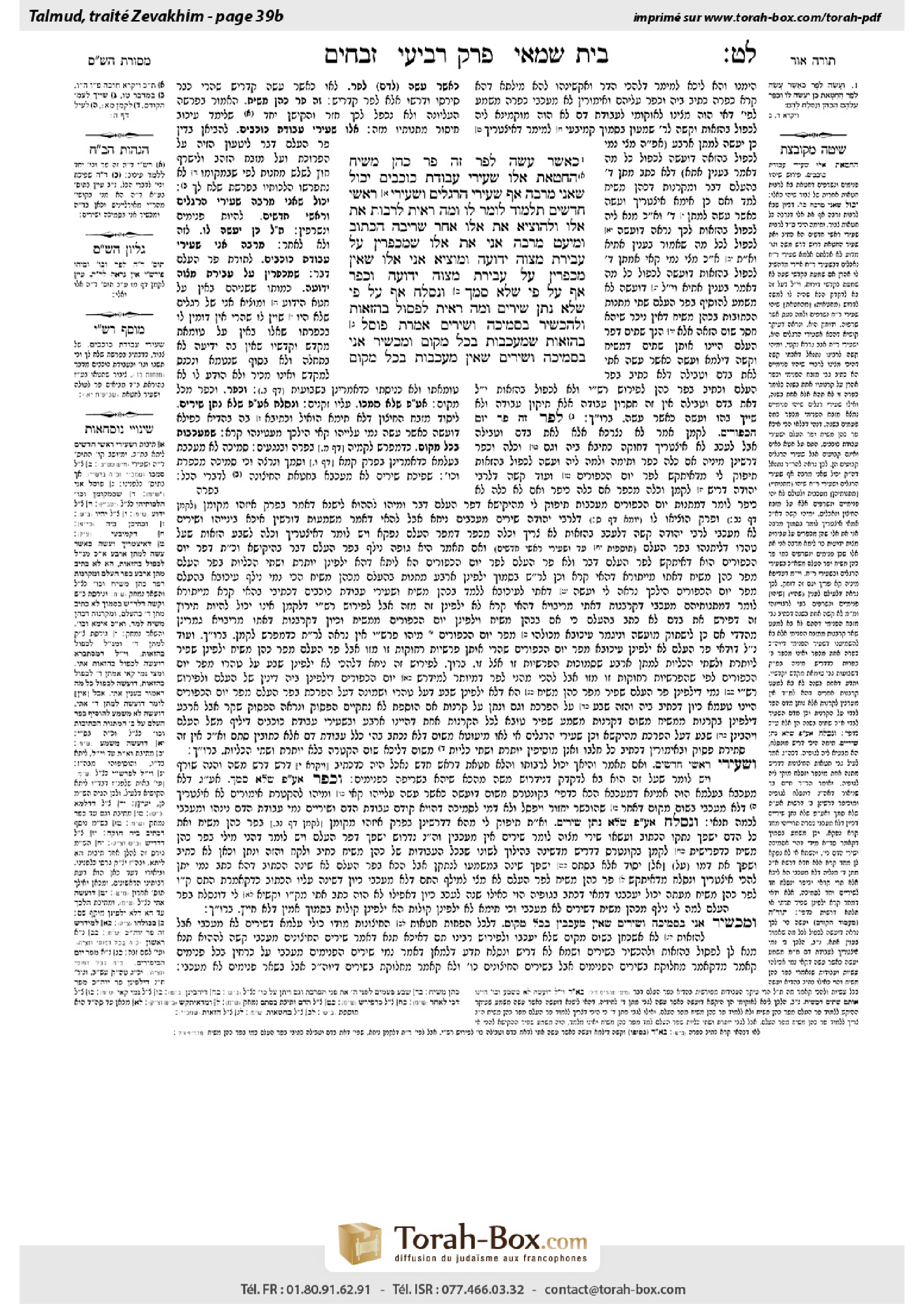
This page of Zevachim includes the Aramaic text, an English translation and an AI-generated French translation, alongside the scan above.
זבחים ל״ט ב · Aramaic and Hebrew text
״כַּאֲשֶׁר עָשָׂה לְפַר״ – זֶה פַּר כֹּהֵן מָשִׁיחַ. ״הַחַטָּאת״ – אֵלּוּ שְׂעִירֵי עֲבוֹדָה זָרָה. יָכוֹל שֶׁאֲנִי מְרַבֶּה אַף שְׂעִירֵי הָרְגָלִים וּשְׂעִירֵי רָאשֵׁי חֳדָשִׁים? תַּלְמוּד לוֹמַר: ״לוֹ״.
וּמָה רָאִיתָ לְרַבּוֹת אֶת אֵלּוּ וּלְהוֹצִיא אֶת אֵלּוּ? אַחַר שֶׁרִיבָּה הַכָּתוּב וּמִיעֵט, מְרַבֶּה אֲנִי אֶת אֵלּוּ שֶׁמְּכַפְּרִין עַל עֲבֵירַת מִצְוָה יְדוּעָה, וּמוֹצִיא אֲנִי אֵלּוּ שֶׁאֵין מְכַפְּרִין עַל עֲבֵירַת מִצְוָה יְדוּעָה.
״וְכִפֶּר״ – אַף עַל פִּי שֶׁלֹּא סָמַךְ. ״וְנִסְלַח״ – אַף עַל פִּי שֶׁלֹּא נָתַן שִׁירַיִם.
וּמָה רָאִיתָ לִפְסוֹל בְּהַזָּאוֹת, וּלְהַכְשִׁיר בִּסְמִיכָה וְשִׁירַיִם?
אָמַרְתָּ: פּוֹסֵל [אֲנִי] בְּהַזָּאוֹת – שֶׁמְּעַכְּבוֹת בְּכׇל מָקוֹם, וּמַכְשִׁיר אֲנִי בִּסְמִיכָה וְשִׁירַיִם – שֶׁאֵין מְעַכְּבוֹת בְּכׇל מָקוֹם.
Zevachim 39b · English translation
“As he did with the bull” (Leviticus 4:20); this is a reference to the bull for an unwitting sin of the anointed priest, teaching that all of the sprinklings of the blood of this bull are also indispensable. “A sin offering”; these are the goats for an unwitting communal sin of idol worship, teaching that they are offered in the same manner as the bull for an unwitting communal sin, their blood being sprinkled in the Sanctuary and their flesh burned. One might have thought that I should include also the goats of the Festivals and the goats sacrificed on the New Moons, which are communal offerings as well, i.e., that their service should be performed inside the Sanctuary like that of the bull for an unwitting communal sin. Therefore, the verse states: “So shall he do with this” (Leviticus 4:20), which indicates that this service is performed only with this animal and not with the goats of the Festivals or the goats of the New Moons.
The Gemara asks: And what did you see to include these goats for an unwitting communal sin of idol worship and to exclude those goats sacrificed on the Festivals and the New Moons? The Gemara answers: After noting that the verse included some offerings and excluded others, one can say: I include these goats for an unwitting communal sin of idol worship, as they atone for the known transgression of a mitzva, i.e., idol worship, and therefore they are similar to the bull for an unwitting communal sin, which is brought for an erroneous ruling of the Sanhedrin with regard to a specific mitzva. And I exclude those goats sacrificed on the Festivals and the New Moons, as they do not atone for the known transgression of a mitzva, but rather they atone for the unwitting defilement of the Temple or its sacrificial foods.
The baraita resumes its interpretation of the verse. “And the priest shall make atonement”; this teaches that atonement is achieved even if the Elders did not place their hands on the head of the bull as they are commanded to do (see Leviticus 4:15). “And they shall be forgiven”; this teaches that atonement is achieved even if the priest did not place the remainder of the blood on the base of the altar, as is required (see Leviticus 4:7).
The Gemara again asks: And as the verse does not specify which aspects of the service are included and which are excluded, what did you see to disqualify the offering in the case of the seven sprinklings; how did you derive that the phrase “And he shall do…as he did” teaches that the seven sprinklings are indispensable? And what did you see to render the offering fit in the absence of placing hands on the head of the offering and pouring out the remainder of the blood on the base of the altar, based on the words “And the priest shall make atonement…and they shall be forgiven”?
The Gemara answers: You should say the following logical argument: I disqualify the offering in the absence of the seven sprinklings, as these seven sprinklings are indispensable in all cases, as will be explained (40a), and I render the offering fit in the absence of placing hands on the head of the offering and in the absence of the pouring of the remainder of the blood onto the base of the altar, as these are not indispensable in all cases, and therefore it is reasonable to conclude that they are not indispensable here either.
Zevachim 39b · Traduction française (IA)
« Comme il l’a fait pour le taureau » (Lévitique 4,20) : cela renvoie au taureau offert pour la faute involontaire du prêtre oint et enseigne que toutes les aspersions du sang de ce taureau sont, elles aussi, indispensables. « Un sacrifice expiatoire » : il s’agit des boucs offerts pour la faute involontaire de la communauté liée à l’idolâtrie. Cela enseigne qu’ils sont offerts de la même manière que le taureau offert pour la faute involontaire de la communauté : leur sang est aspergé dans le Sanctuaire et leur chair est brûlée. On aurait pu penser qu’il fallait inclure également les boucs des fêtes et ceux sacrifiés aux nouvelles lunes, qui sont eux aussi des offrandes communautaires, c’est-à-dire que leur service devait être accompli à l’intérieur du Sanctuaire, comme celui du taureau offert pour la faute involontaire de la communauté. Le verset dit donc : « Il agira ainsi avec celui-ci » (Lévitique 4,20), ce qui indique que ce service ne s’accomplit qu’avec cet animal, et non avec les boucs des fêtes ou ceux des nouvelles lunes.
La Guemara demande : Qu’est-ce qui t’a conduit à inclure ces boucs offerts pour la faute involontaire de la communauté liée à l’idolâtrie et à exclure les boucs sacrifiés aux fêtes et aux nouvelles lunes ? La Guemara répond : Puisque le verset a inclus certaines offrandes et en a exclu d’autres, on peut dire : j’inclus ces boucs offerts pour la faute involontaire de la communauté liée à l’idolâtrie, car ils expient la transgression connue d’une mitsva, à savoir l’idolâtrie, et sont donc semblables au taureau offert pour la faute involontaire de la communauté, qui est apporté à la suite d’une décision erronée du Sanhédrin concernant une mitsva particulière. J’exclus les boucs sacrifiés aux fêtes et aux nouvelles lunes, car ils n’expient pas la transgression connue d’une mitsva ; ils expient plutôt la souillure involontaire du Temple ou de ses aliments sacrificiels.
La baraïta reprend son interprétation du verset. « Et le prêtre fera expiation » : cela enseigne que l’expiation est obtenue même si les Anciens n’ont pas posé leurs mains sur la tête du taureau, comme ils doivent le faire (voir Lévitique 4,15). « Et il leur sera pardonné » : cela enseigne que l’expiation est obtenue même si le prêtre n’a pas versé le reste du sang sur le socle de l’autel, comme cela est requis (voir Lévitique 4,7).
La Guemara demande à nouveau : Puisque le verset ne précise pas quels aspects du service sont inclus et lesquels sont exclus, qu’est-ce qui t’a conduit à invalider l’offrande en l’absence des sept aspersions ? Comment as-tu déduit que l’expression « Et il fera… comme il l’a fait » enseigne que les sept aspersions sont indispensables ? Et qu’est-ce qui t’a conduit à considérer l’offrande comme valide en l’absence de l’imposition des mains sur sa tête et du versement du reste du sang sur le socle de l’autel, en te fondant sur les mots « Et le prêtre fera expiation… et il leur sera pardonné » ?
La Guemara répond : Il faut tenir le raisonnement suivant : j’invalide l’offrande en l’absence des sept aspersions, car celles-ci sont indispensables dans tous les cas, comme cela sera expliqué (40a). Je considère l’offrande comme valide en l’absence de l’imposition des mains sur sa tête et du versement du reste du sang sur le socle de l’autel, car ces gestes ne sont pas indispensables dans tous les cas ; il est donc raisonnable de conclure qu’ils ne sont pas indispensables ici non plus.
Traduction française générée par IA à partir de l’édition anglaise de Sefaria. Vérifie toujours un passage avec le texte source.
Text from Sefaria: William Davidson Edition - Vocalized Aramaic (CC BY NC); William Davidson Edition - English (CC BY NC).