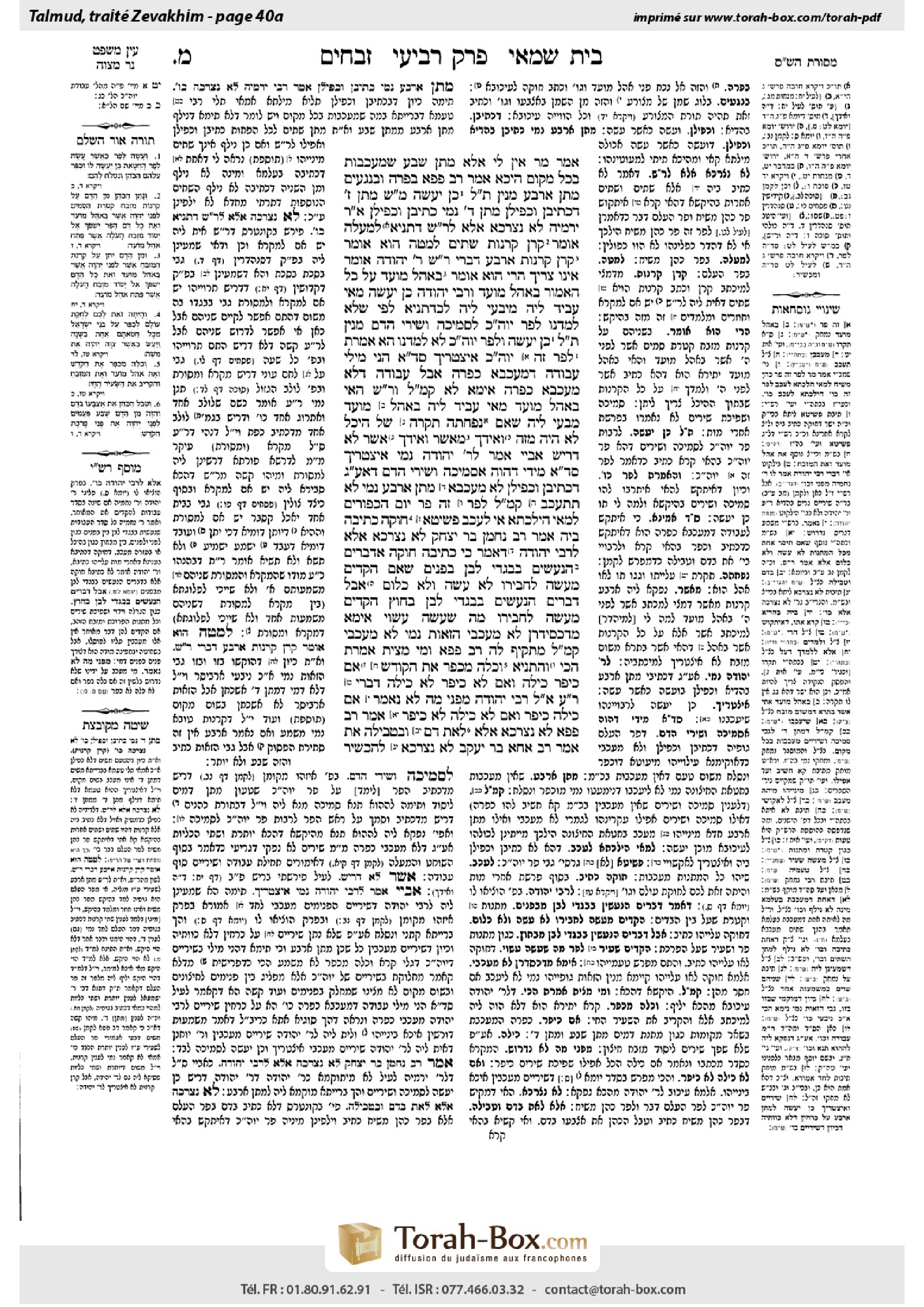
Zevachim 40a: Talmud study for Daf Yomi
Daf Yomi is the daily study of one Talmud folio. Explore 37 tractates with scans, Hebrew text, Sefaria English and AI-generated French translations where annotated.
Passage selection and English or AI-generated French translation are available where the scan has annotations. Daf Study is independent of Torah-Box and Sefaria.
Browse Zevachim · זבחים · All tractatesZevachim 40a text and translations
This page of Zevachim includes the Aramaic text, an English translation and an AI-generated French translation, alongside the scan above.
זבחים מ׳ א · Aramaic and Hebrew text
אָמַר מָר: אֵין לִי אֶלָּא מַתַּן שֶׁבַע שֶׁמְּעַכְּבוֹת בְּכׇל מָקוֹם. הֵיכָא? אָמַר רַב פָּפָּא: בְּפָרָה וּבִנְגָעִים.
מַתַּן אַרְבַּע מִנַּיִן? תַּלְמוּד לוֹמַר: ״כֵּן יַעֲשֶׂה״. מַאי שְׁנָא מַתַּן שֶׁבַע – דִּכְתִיבָן וּכְפִילָן, מַתַּן אַרְבַּע נָמֵי – כְּתִיבָן וּכְפִילָן!
אָמַר רַבִּי יִרְמְיָה: לֹא נִצְרְכָא אֶלָּא לְרַבִּי שִׁמְעוֹן. דְּתַנְיָא, לְמַעְלָה אוֹמֵר: ״קֶרֶן״–״קַרְנוֹת״ – שְׁתַּיִם; לְמַטָּה הוּא אוֹמֵר: ״קֶרֶן״–״קַרְנוֹת״ – אַרְבַּע. דִּבְרֵי רַבִּי שִׁמְעוֹן.
רַבִּי יְהוּדָה אוֹמֵר: אֵינוֹ צָרִיךְ; הֲרֵי הוּא אוֹמֵר: ״בְּאֹהֶל מוֹעֵד״ – עַל כׇּל הָאָמוּר בְּאֹהֶל מוֹעֵד. וְרַבִּי יְהוּדָה, ״כֵּן יֵעָשֶׂה״ מַאי עָבֵיד לֵיהּ?
מִיבְּעֵי לֵיהּ לְכִדְתַנְיָא: לְפִי שֶׁלֹּא לָמַדְנוּ לְפַר יוֹם הַכִּפּוּרִים לִסְמִיכָה. וּשְׁיָרֵי הַדָּם מִנַּיִן? תַּלְמוּד לוֹמַר: ״כֵּן יַעֲשֶׂה״.
וּלְפַר יוֹם הַכִּפּוּרִים לֹא לָמַדְנוּ? הָא אָמַרְתָּ: ״לַפָּר״ – זֶה יוֹם הַכִּפּוּרִים!
אִיצְטְרִיךְ; סָלְקָא דַּעְתָּךְ אָמֵינָא: הָנֵי מִילֵּי – עֲבוֹדָה דִּמְעַכְּבָא כַּפָּרָה, אֲבָל עֲבוֹדָה דְּלָא מְעַכְּבָא כַּפָּרָה – אֵימָא לָא; קָמַשְׁמַע לַן.
וְרַבִּי שִׁמְעוֹן, הַאי ״בְּאֹהֶל מוֹעֵד״ מַאי עָבֵיד לֵיהּ? ״בְּאֹהֶל מוֹעֵד״ מִבְּעֵי לֵיהּ שֶׁאִם נִפְחֲתָה תִּקְרָה שֶׁל הֵיכָל, לֹא הָיָה מַזֶּה. וְאִידַּךְ – מֵ״אֲשֶׁר״. וְאִידַּךְ – ״אֲשֶׁר״ לָא דָּרֵישׁ.
אַבָּיֵי אָמַר: לְרַבִּי יְהוּדָה נָמֵי אִיצְטְרִיךְ; סָלְקָא דַּעְתָּךְ אָמֵינָא: מִידֵּי דְּהָוֵה אַסְּמִיכָה וּשְׁיָרֵי הַדָּם – דְּאַף עַל גַּב דִּכְתִיבָן וּכְפִילָן לָא מְעַכְּבָא, מַתַּן אַרְבַּע נָמֵי לָא תִּתְעַכַּב; קָא מַשְׁמַע לַן.
״לַפָּר״ – זֶה פַּר יוֹם הַכִּפּוּרִים. לְמַאי הִילְכְתָא? אִי לְעַכֵּב – פְּשִׁיטָא, ״חֻקָּה״ כְּתִיבָה בֵּיהּ!
אָמַר רַב נַחְמָן בַּר יִצְחָק: לֹא נִצְרְכָא אֶלָּא לְרַבִּי יְהוּדָה, דְּאָמַר: כִּי כְּתִיבָה ״חֻקָּה״ – אַדְּבָרִים הַנַּעֲשִׂים בְּבִגְדֵי לָבָן בִּפְנִים, שֶׁאִם הִקְדִּים מַעֲשֶׂה לַחֲבֵירוֹ – לֹא עָשָׂה וְלֹא כְלוּם;
אֲבָל דְּבָרִים הַנַּעֲשִׂים בְּבִגְדֵי לָבָן בַּחוּץ, הִקְדִּים מַעֲשֶׂה לַחֲבֵירוֹ – מַה שֶּׁעָשָׂה עָשׂוּי; אֵימָא מִדִּכְסִידְרָן לָא מְעַכְּבִי, הַזָּאוֹת נָמֵי לָא מְעַכְּבִי; קָא מַשְׁמַע לַן.
מַתְקֵיף לַהּ רַב פָּפָּא: וּמִי מָצֵית אָמְרַתְּ הָכִי?! וְהָתַנְיָא: ״וְכִלָּה מִכַּפֵּר אֶת הַקֹּדֶשׁ״ – אִם כִּיפֵּר כִּילָּה, וְאִם לֹא כִּיפֵּר לֹא כִּילָּה. דִּבְרֵי רַבִּי עֲקִיבָא.
אָמַר לוֹ רַבִּי יְהוּדָה, מִפְּנֵי מָה לֹא נֹאמַר: אִם כִּילָּה כִּיפֵּר, וְאִם לֹא כִּילָּה לֹא כִּיפֵּר?
אָמַר רַב פָּפָּא: לֹא נִצְרְכָא אֶלָּא לְאֶת (דם) [בְּדָם] וּבִטְבִילָה. ״אֶת״ – אָמַר רַב אַחָא בַּר יַעֲקֹב: לֹא נִצְרְכָא לְהַכְשִׁיר
Zevachim 40a · English translation
The Gemara analyzes the baraita in detail. The Master said in the baraita: I have a derivation only with regard to the seven placements on the Curtain separating between the Sanctuary and Holy of Holies, that they are indispensable, as these seven are indispensable in all cases. The Gemara asks: Where are the seven indispensable? Rav Pappa says: In the case of the red heifer (see Numbers 19:2–4), and in the purification process of one afflicted with leprous marks (see Leviticus 14:16).
The baraita continues: From where is it derived that the same applies to the four placements on the inner altar? The verse states: “So shall he do” (Leviticus 4:20). The Gemara asks: What is different about seven placements, that they should be indispensable? If you say that the reason is that the seven placements are written and repeated, by means of the terms “And he shall do…as he did,” which teaches that they are indispensable, I can say that the four placements as well are written and repeated. Why then should their halakha be any different?
Rabbi Yirmeya says: This is necessary only according to the opinion of Rabbi Shimon, who maintains that only two placements are written in this chapter, while the other two are derived through a juxtaposition. Consequently, a specific derivation is required for these. As it is taught in a baraita with regard to the placements on the inner altar: Above, in the case of the bull for an unwitting sin of the anointed priest, the verse states corner in the plural form of corners (see Leviticus 4:7), i.e., it says “corners [karnot],” in the plural, where it could have written corner, in the singular. These are two corners. And below, with regard to the bull for an unwitting communal sin, it again states corner in the plural form of corners (see Leviticus 4:18). Together these amount to four corners. This is the statement of Rabbi Shimon.
Rabbi Yehuda says: This derivation is not necessary, as it states in these same verses: “And he shall put of the blood upon the corners of the altar which is before the Lord, which is in the Tent of Meeting” (Leviticus 4:18). The superfluous expression “in the Tent of Meeting” teaches that the blood must be placed on all the corners of the altar that are stated with regard to the Tent of Meeting, i.e., on all four corners. The Gemara asks: And Rabbi Yehuda, what does he do with the phrase “so shall he do,” which Rabbi Shimon interprets as referring to the four placements?
The Gemara answers that Rabbi Yehuda requires this verse for that which is taught in a baraita: As we did not learn with regard to the bull of Yom Kippur that placing hands is required, i.e., that the High Priest must place his hands on this animal before it is slaughtered, and likewise it is not stated that the remainder of its blood must be poured on the base of the altar. From where is it derived that these actions must be performed? The verse states: “So shall he do.”
The Gemara asks: And did we not learn with regard to the bull of Yom Kippur that these requirements apply? But you said earlier in the baraita: “With the bull” (Leviticus 4:20); this alludes to the bull of Yom Kippur, which indicates that all the rites performed in connection with the bull for an unwitting communal sin apply also to the bull of Yom Kippur.
The Gemara answers: The derivation from the phrase “so shall he do” was necessary, as it could enter your mind to say that this matter, the comparison between the bull for an unwitting communal sin and the bull of Yom Kippur, applies only to a service that is indispensable for atonement, e.g., the sprinkling of the blood. But with regard to a service that is not indispensable for atonement, such as placing hands on the head of the animal or pouring out the remainder of the blood, one might say that these actions need not be performed. Therefore, the verse teaches us: “So shall he do,” i.e., these services, too, must be performed with the bull of Yom Kippur.
The Gemara asks: And Rabbi Shimon, what does he do with this phrase: “In the Tent of Meeting,” from which Rabbi Yehuda derives that the blood must be placed on all four corners of the altar? The Gemara answers: Rabbi Shimon requires the phrase “in the Tent of Meeting” to teach that if the roof of the Sanctuary was breached by a hole, the priest would not sprinkle the blood, as it would no longer be called the Tent of Meeting. The Gemara asks: And the other tanna, Rabbi Yehuda, from where does he derive this halakha? The Gemara explains that Rabbi Yehuda derives it from the superfluous term “which is in the Tent of Meeting” (Leviticus 4:7, 18). The Gemara asks: And the other tanna, Rabbi Shimon? He does not interpret the term “which is” as he maintains that this expression is not significant enough to serve as the source of a halakha.
Abaye said: According to the opinion of Rabbi Yehuda as well, it was necessary to learn from the phrase “so shall he do” that the four placements are indispensable. As it might enter your mind to say that just as it is with regard to placing hands and the remainder of the blood, that even though they are written and repeated they are not indispensable, so too, the four placements of blood should not be indispensable. Therefore, the phrase “so shall he do” teaches us that this is not the case, and the four sprinklings are indeed indispensable.
§ The baraita teaches: “With the bull” (Leviticus 4:20), this alludes to the bull of Yom Kippur. To what halakha does this statement relate? If it serves to teach that all matters stated with regard to the bull of Yom Kippur are indispensable, this is obvious, since the word “statute” is written concerning it: “And this shall be an everlasting statute to you” (Leviticus 16:29), and there is a principle that halakhot described as statutes are indispensable.
Rav Naḥman bar Yitzḥak said: This statement is necessary only according to the opinion of Rabbi Yehuda, who says: When the term “statute” is written concerning the Yom Kippur service, indicating that no details may be altered, it is written only with regard to actions performed in white garments inside the Holy of Holies, e.g., burning the incense and sprinkling the blood, which are the essential services of the day, and it teaches that if the High Priest performed one of the actions before another, i.e., not in the proper order, he has done nothing.
But with regard to those actions performed in white garments outside, in the Sanctuary, if he performed one action before another, what he did is done and he is not required to repeat the rite. Consequently, one might say that from the fact that their order is not indispensable, it may be derived that the sprinklings, i.e., placements, themselves are also not indispensable. Therefore, the term “with the bull” teaches us that the placements are indeed indispensable.
Rav Pappa objects to this: And how can you say this, that Rabbi Yehuda derives from here that the placements are indispensable? But isn’t it taught in a baraita: The verse discussing the Yom Kippur service states: “And when he has finished atoning for the Sanctuary” (Leviticus 16:20). This indicates that if he performed the atonement, i.e., the sprinklings, inside the Sanctuary, he has finished the order of the service, even though he has not poured the remainder of the blood on the base of the altar; and if he did not perform the atonement, he has not finished; this is the statement of Rabbi Akiva.
Rabbi Yehuda said to him: For what reason do we not say: If he finished the entire service, which includes sprinkling the blood in the Sanctuary and pouring the remainder of the blood onto the base of the altar, he has facilitated atonement; and if he did not finish, he has not facilitated atonement? This indicates that Rabbi Yehuda derives from this verse the halakha that the sprinklings in the Sanctuary are indispensable.
Rav Pappa says: This reference to the bull of Yom Kippur in the term “with the bull,” is necessary only to apply to the bull of Yom Kippur three halakhot that are derived from that which is stated with regard to the bull for an unwitting sin of the anointed priest: “And the priest shall immerse his finger [et etzba’o] in the blood” (Leviticus 4:6). These halakhot can be summarized in the shortened form: Et, blood, and with immersion. The Gemara elaborates: With regard to the word et, Rav Aḥa bar Ya’akov says: This word is necessary only to render fit
Zevachim 40a · Traduction française (IA)
La Guemara analyse la baraïta en détail. Le Maître a dit dans la baraïta : Je ne dispose d’une déduction que pour établir que les sept aspersions sur le rideau qui sépare le Sanctuaire du Saint des Saints sont indispensables, car ces sept aspersions le sont dans tous les cas. La Guemara demande : Dans quels cas les sept aspersions sont-elles indispensables ? Rav Pappa répond : Dans le cas de la vache rousse (voir Nombres 19, 2-4) et dans le processus de purification d’une personne atteinte d’affections lépreuses (voir Lévitique 14, 16).
La baraïta poursuit : D’où déduit-on qu’il en va de même pour les quatre aspersions sur l’autel intérieur ? Le verset dit : « Il fera ainsi » (Lévitique 4, 20). La Guemara demande : En quoi les sept aspersions diffèrent-elles pour être indispensables ? Si tu dis que c’est parce que les sept aspersions sont mentionnées et répétées au moyen des expressions « Il fera… comme il a fait », ce qui enseigne qu’elles sont indispensables, je peux dire que les quatre aspersions sont elles aussi mentionnées et répétées. Pourquoi leur halakha serait-elle donc différente ?
Rabbi Yirmeya dit : Cela n’est nécessaire que selon l’opinion de Rabbi Shimon, qui considère que seuls deux placements sont mentionnés dans ce chapitre, tandis que les deux autres sont déduits par juxtaposition. Une déduction particulière est donc nécessaire à leur sujet. En effet, il est enseigné dans une baraïta au sujet des placements sur l’autel intérieur : plus haut, dans le cas du taureau offert pour la faute involontaire du prêtre oint, le verset emploie le pluriel pour le mot « angle » (voir Lévitique 4, 7), c’est-à-dire qu’il dit « angles [karnot] », au pluriel, alors qu’il aurait pu employer le singulier. Cela désigne deux angles. Plus bas, à propos du taureau offert pour la faute involontaire de la communauté, le verset emploie de nouveau le pluriel pour le mot « angle » (voir Lévitique 4, 18). Ensemble, cela fait quatre angles. Telle est la déclaration de Rabbi Shimon.
Rabbi Yehuda dit : Cette déduction n’est pas nécessaire, car ces mêmes versets disent : « Il mettra du sang sur les angles de l’autel qui est devant l’Éternel, lequel se trouve dans la Tente d’assignation » (Lévitique 4, 18). L’expression superflue « dans la Tente d’assignation » enseigne que le sang doit être placé sur tous les angles de l’autel mentionnés à propos de la Tente d’assignation, c’est-à-dire sur les quatre angles. La Guemara demande : Et que fait Rabbi Yehuda de l’expression « il fera ainsi », que Rabbi Shimon interprète comme se rapportant aux quatre placements ?
La Guemara répond que Rabbi Yehuda a besoin de ce verset pour ce qui est enseigné dans une baraïta : En effet, nous n’avons pas appris, à propos du taureau de Yom Kippour, qu’il faut poser les mains, c’est-à-dire que le grand prêtre doit poser les mains sur cet animal avant qu’il soit égorgé ; de même, il n’est pas dit que le reste de son sang doit être versé à la base de l’autel. D’où déduit-on que ces actes doivent être accomplis ? Le verset dit : « Il fera ainsi. »
La Guemara demande : N’avons-nous donc pas appris que ces exigences s’appliquent au taureau de Yom Kippour ? Pourtant, tu as dit plus haut dans la baraïta : « Avec le taureau » (Lévitique 4, 20) fait allusion au taureau de Yom Kippour, ce qui indique que tous les rites accomplis avec le taureau offert pour la faute involontaire de la communauté s’appliquent également au taureau de Yom Kippour.
La Guemara répond : La déduction de l’expression « il fera ainsi » était nécessaire, car on aurait pu penser que cette règle, la comparaison entre le taureau offert pour la faute involontaire de la communauté et le taureau de Yom Kippour, ne concerne que les actes indispensables à l’expiation, par exemple l’aspersion du sang. Mais pour un acte qui n’est pas indispensable à l’expiation, comme poser les mains sur la tête de l’animal ou verser le reste du sang, on aurait pu dire qu’il n’était pas nécessaire de l’accomplir. Le verset nous enseigne donc : « Il fera ainsi », c’est-à-dire que ces rites aussi doivent être accomplis avec le taureau de Yom Kippour.
La Guemara demande : Et que fait Rabbi Shimon de l’expression « dans la Tente d’assignation », dont Rabbi Yehuda déduit que le sang doit être placé sur les quatre angles de l’autel ? La Guemara répond : Rabbi Shimon a besoin de l’expression « dans la Tente d’assignation » pour enseigner que, si le toit du Sanctuaire était percé d’un trou, le prêtre ne ferait pas l’aspersion du sang, car le lieu ne serait alors plus appelé la Tente d’assignation. La Guemara demande : Et l’autre tanna, Rabbi Yehuda, d’où déduit-il cette halakha ? La Guemara explique que Rabbi Yehuda la déduit de l’expression superflue « qui est dans la Tente d’assignation » (Lévitique 4, 7 et 18). La Guemara demande : Et l’autre tanna, Rabbi Shimon ? Il n’interprète pas l’expression « qui est », car il considère qu’elle n’est pas suffisamment significative pour servir de source à une halakha.
Abaye dit : Même selon l’opinion de Rabbi Yehuda, il était nécessaire de déduire de l’expression « il fera ainsi » que les quatre placements sont indispensables. On aurait pu penser que, tout comme la pose des mains et le versement du reste du sang, bien que mentionnés et répétés, ne sont pas indispensables, les quatre placements de sang ne le sont pas non plus. L’expression « il fera ainsi » nous enseigne donc qu’il n’en est pas ainsi : les quatre aspersions sont effectivement indispensables.
§ La baraïta enseigne : « Avec le taureau » (Lévitique 4, 20) fait allusion au taureau de Yom Kippour. À quelle halakha cette déclaration se rapporte-t-elle ? Si elle vise à enseigner que tous les éléments mentionnés à propos du taureau de Yom Kippour sont indispensables, c’est évident, puisque le mot « statut » est écrit à son sujet : « Ce sera pour vous un statut perpétuel » (Lévitique 16, 29), et qu’un principe veut que les halakhot qualifiées de statuts soient indispensables.
Rav Naḥman bar Yitzḥak dit : Cette déclaration n’est nécessaire que selon l’opinion de Rabbi Yehuda, qui dit : Lorsque le terme « statut » est écrit à propos du service de Yom Kippour, indiquant qu’aucun détail ne peut être modifié, il ne s’applique qu’aux actes accomplis en vêtements blancs à l’intérieur du Saint des Saints, par exemple la combustion de l’encens et l’aspersion du sang, qui sont les rites essentiels du jour ; il enseigne que si le grand prêtre a accompli un acte avant un autre, c’est-à-dire dans un ordre incorrect, il n’a rien fait.
Mais pour les actes accomplis en vêtements blancs à l’extérieur, dans le Sanctuaire, s’il a accompli un acte avant un autre, ce qu’il a fait reste valide et il n’a pas à refaire le rite. On pourrait donc déduire du fait que leur ordre n’est pas indispensable que les aspersions elles-mêmes, c’est-à-dire les placements, ne sont pas non plus indispensables. Le terme « avec le taureau » nous enseigne donc que les placements sont effectivement indispensables.
Rav Pappa objecte : Comment peux-tu dire cela, à savoir que Rabbi Yehuda déduit d’ici que les placements sont indispensables ? N’est-il pas enseigné dans une baraïta : Le verset qui traite du service de Yom Kippour dit : « Lorsqu’il aura achevé l’expiation du Sanctuaire » (Lévitique 16, 20). Cela indique que s’il a accompli l’expiation, c’est-à-dire les aspersions, à l’intérieur du Sanctuaire, il a achevé l’ordre du service, même s’il n’a pas versé le reste du sang à la base de l’autel ; et s’il n’a pas accompli l’expiation, il n’a pas achevé l’ordre du service. Telle est la déclaration de Rabbi Akiva.
Rabbi Yehuda lui dit : Pourquoi ne disons-nous pas que, s’il a achevé tout le service, qui comprend l’aspersion du sang dans le Sanctuaire et le versement du reste du sang à la base de l’autel, il a rendu l’expiation possible ; et que, s’il ne l’a pas achevé, il n’a pas rendu l’expiation possible ? Cela indique que Rabbi Yehuda déduit de ce verset la halakha selon laquelle les aspersions dans le Sanctuaire sont indispensables.
Rav Pappa dit : La mention du taureau de Yom Kippour dans l’expression « avec le taureau » n’est nécessaire que pour appliquer à ce taureau trois halakhot déduites de ce qui est dit à propos du taureau offert pour la faute involontaire du prêtre oint : « Le prêtre trempera son doigt [et etzba’o] dans le sang » (Lévitique 4, 6). Ces halakhot peuvent être résumées par la formule abrégée : Et, sang et immersion. La Guemara développe : Au sujet du mot et, Rav Aḥa bar Ya’akov dit : Ce mot n’est nécessaire que pour rendre apte
Traduction française générée par IA à partir de l’édition anglaise de Sefaria. Vérifie toujours un passage avec le texte source.
Text from Sefaria: William Davidson Edition - Vocalized Aramaic (CC BY NC); William Davidson Edition - English (CC BY NC).