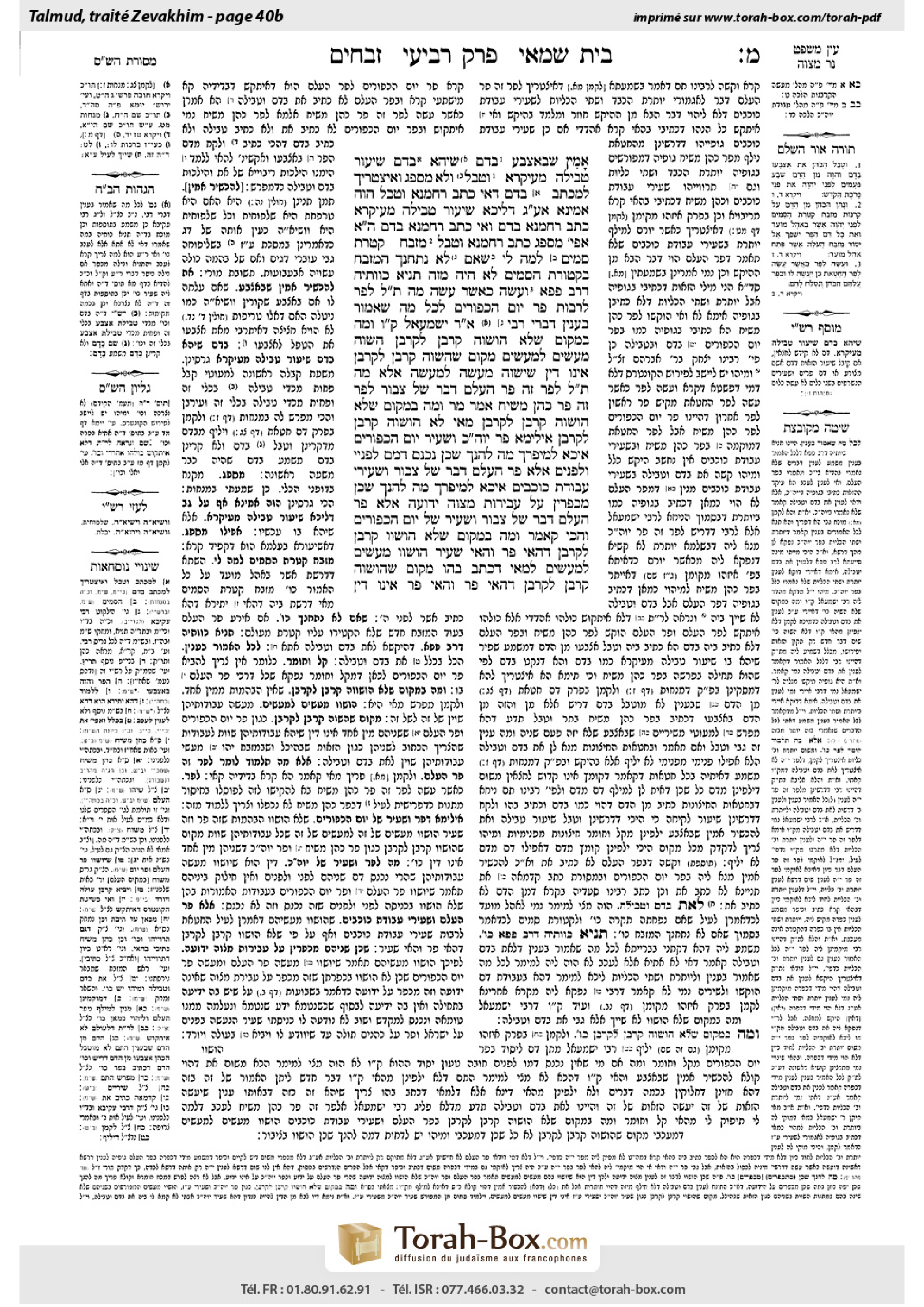
Zevachim 40b: Talmud study for Daf Yomi
Daf Yomi is the daily study of one Talmud folio. Explore 37 tractates with scans, Hebrew text, Sefaria English and AI-generated French translations where annotated.
Passage selection and English or AI-generated French translation are available where the scan has annotations. Daf Study is independent of Torah-Box and Sefaria.
Browse Zevachim · זבחים · All tractatesZevachim 40b text and translations
This page of Zevachim includes the Aramaic text, an English translation and an AI-generated French translation, alongside the scan above.
זבחים מ׳ ב · Aramaic and Hebrew text
אַמִּין שֶׁבָּאֶצְבַּע. ״בַּדָּם״ – שֶׁיְּהֵא בַּדָּם שִׁיעוּר טְבִילָה מֵעִיקָּרָא. ״וְטָבַל״ – וְלֹא מְסַפֵּג.
וְאִיצְטְרִיךְ לְמִכְתַּב ״בַּדָּם״, דְּאִי כְּתַב רַחֲמָנָא ״וְטָבַל״ – הֲוָה אָמֵינָא: אַף עַל גַּב דְּלֵיכָּא שִׁיעוּר טְבִילָה מֵעִיקָּרָא; כְּתַב רַחֲמָנָא ״בַּדָּם״.
וְאִי כְּתַב רַחֲמָנָא ״בַּדָּם״ – הֲוָה אָמֵינָא: אֲפִילּוּ מְסַפֵּג; כְּתַב רַחֲמָנָא: ״וְטָבַל״.
״מִזְבַּח קְטֹרֶת סַמִּים״ לְמָה לִי? שֶׁאִם לֹא נִתְחַנֵּךְ הַמִּזְבֵּחַ בִּקְטוֹרֶת הַסַּמִּים – לֹא הָיָה מַזֶּה.
תַּנְיָא כְּוָותֵיהּ דְּרַב פָּפָּא: ״וְעָשָׂה... כַּאֲשֶׁר עָשָׂה״ – מָה תַּלְמוּד לוֹמַר ״לַפָּר״? לְרַבּוֹת פַּר יוֹם הַכִּפּוּרִים לְכׇל מַה שֶּׁאָמוּר בָּעִנְיָן. דִּבְרֵי רַבִּי.
אָמַר רַבִּי יִשְׁמָעֵאל: קַל וָחוֹמֶר! וּמָה בְּמָקוֹם שֶׁלֹּא הוּשְׁוָה קׇרְבָּן לְקׇרְבָּן – הִשְׁוָה מַעֲשִׂים לְמַעֲשִׂים; מָקוֹם שֶׁהִשְׁוָה קׇרְבָּן לְקׇרְבָּן – אֵינוֹ דִּין שֶׁיַּשְׁוֶה מַעֲשֶׂה לְמַעֲשֶׂה?!
אֶלָּא מָה תַּלְמוּד לוֹמַר ״לַפָּר״ – זֶה פַּר הֶעְלֵם דָּבָר שֶׁל צִבּוּר. ״לְפַר״ – זֶה פַּר כֹּהֵן מָשִׁיחַ.
אָמַר מָר: וּמָה בִּמְקוֹם שֶׁלֹּא הוּשְׁוָה קׇרְבָּן לְקׇרְבָּן. מַאי לֹא הוּשְׁוָה קׇרְבָּן לְקׇרְבָּן?
אִילֵּימָא פַּר יוֹם הַכִּפּוּרִים וּשְׂעִיר יוֹם הַכִּפּוּרִים – אִיכָּא לְמִיפְרַךְ: מָה לְהָנָךְ, שֶׁכֵּן נִכְנָס דָּמָם לִפְנַיי וְלִפְנִים!
אֶלָּא פַּר הֶעְלֵם דָּבָר שֶׁל צִבּוּר וּשְׂעִירֵי עֲבוֹדָה זָרָה – אִיכָּא לְמִיפְרַךְ: מָה לְהָנָךְ, שֶׁכֵּן מְכַפְּרִין עַל עֲבֵירוֹת מִצְוָה יְדוּעָה!
אֶלָּא פַּר הֶעְלֵם דָּבָר שֶׁל צִבּוּר וְשָׂעִיר שֶׁל יוֹם הַכִּפּוּרִים. וְהָכִי קָאָמַר: וּמָה בִּמְקוֹם שֶׁלֹּא הוּשְׁווּ קׇרְבָּן לְקׇרְבָּן – דְּהַאי פַּר וְהַאי שָׂעִיר, הוּשְׁווּ מַעֲשִׂים לְמַעֲשִׂים – לְמַאי דִּכְתַב בְּהוּ; מָקוֹם שֶׁהוּשְׁוָה קׇרְבָּן לְקׇרְבָּן – דְּהַאי פַּר וְהַאי פַּר, אֵינוֹ דִּין
Zevachim 40b · English translation
service performed by a priest who has a wart or blister on his finger. These are not considered an interposition between his finger and the blood. With regard to the term “in the blood” (Leviticus 4:6), this teaches that the blood in the service vessel must be of a sufficient measure for immersion from the outset. The priest must initially collect in the vessel enough blood for all the sprinklings, rather than adding blood to the vessel for each sprinkling. Finally, the term “and the priest shall immerse his finger in the blood” indicates that there must be enough blood in the vessel such that the priest can immerse his finger in it and not have to wipe the sides of the utensil to collect blood for sprinkling.
The Gemara explains: And it was necessary for the verse to state both these last two terms. It had to write “in the blood,” as had the Merciful One written only “and the priest shall immerse,” I would say that the sprinklings are valid even if there was not a sufficient measure of blood for immersion from the outset, but only enough for a single sprinkling, provided that the priest then added more blood to the vessel for each sprinkling. Therefore, the Merciful One writes “in the blood” to teach that from the outset there must be enough blood in the vessel for all the sprinklings.
And conversely, had the Merciful One written only “in the blood,” I would say that even if there was enough blood in the vessel at the outset it is not necessary that there be enough blood for immersion for the last sprinklings, as the priest can wipe the sides of the utensil to collect blood for sprinkling. Therefore, the Merciful One writes “and the priest shall immerse.”
The Gemara addresses another apparently superfluous phrase in the same chapter: “And the priest shall put some of the blood upon the corners of the altar of sweet incense before the Lord” (Leviticus 4:7). Why do I need the verse to mention the sweet incense? It would have been enough to identify the altar as being “before the Lord” and one would have understood that the reference is to the inner altar. Rather, this serves to teach that if the altar had not been inaugurated with sweet incense, the priest would not sprinkle blood on it.
The Gemara comments: It is taught in a baraita in accordance with the opinion of Rav Pappa that the superfluous phrase in the passage discussing the bull for an unwitting communal sin alludes to the bull of Yom Kippur in order to teach the three halakhot of et, in the blood, and immersion, from the case of the bull for an unwitting sin of the anointed priest, which is also alluded to in that verse. The baraita states: “And he shall do with the bull, as he did with the bull for a sin offering” (Leviticus 4:20). What is the meaning when the verse states “with the bull”? This serves to include the bull of Yom Kippur for all that is stated in this matter, i.e., in the passage concerning the bull for an unwitting sin of the anointed priest, specifically the halakhot of et, in the blood, and immersion. This is the statement of Rabbi Yehuda HaNasi.
Rabbi Yishmael said: This inclusion is unnecessary, as these halakhot can be derived via an a fortiori inference: Just as in a case in which one offering is not equated with another offering of a different type of animal, the Torah equated the actions of sprinkling the blood in one offering with the actions of the blood in the other offering, as will be explained, in a case in which the Torah equated one offering with another offering, i.e., the bull for an unwitting sin of the anointed priest and the bull of Yom Kippur, isn’t it logical that the Torah should equate the actions of sprinkling the blood in the one offering with the actions of the blood in the other offering? Therefore, the derivation by way of a special inclusion is not necessary.
Rather, what is the meaning when the verse states: “And he shall do with the bull, as he did with the bull for a sin offering”? With regard to the first instance of “with the bull,” this is the bull for an unwitting communal sin. And with regard to the second instance of “with the bull,” this is the bull for an unwitting sin of the anointed priest. And the verse serves to teach that just as in the first case, if the priest omitted one of the sprinklings, he has done nothing, the same is true in the second case.
The Gemara clarifies the baraita. The Master said above: Just as in a case in which one offering is not equated with another offering. What is the meaning of the expression: One offering is not equated with another offering? Which offerings are not brought from the same type of animal, but nevertheless the halakhot governing the sprinkling of their blood are the same?
If we say that Rabbi Yishmael is referring to the bull of Yom Kippur and the goat of Yom Kippur, and from them he derives by way of an a fortiori inference that the actions concerning the bull of Yom Kippur are the same as those concerning the bull for an unwitting sin of the anointed priest, which are the same animal, this can be refuted as follows: What is notable about these offerings, the bull and the goat of Yom Kippur? They are notable in that their blood enters the innermost sanctum, the Holy of Holies. This is not so of the bull for an unwitting sin of the anointed priest, the blood of which is sprinkled only in the outer area of the Sanctuary.
Rather, say that the reference here is to the bull for an unwitting communal sin and the goats for an unwitting communal sin of idol worship. But once again this claim can be refuted: What is notable about these offerings? They are notable in that they both atone for the known transgressions of a mitzva, whereas the bull of Yom Kippur atones for unknown transgressions (see Shevuot 2a).
Rather, the reference here is to the bull for an unwitting communal sin and the goat of Yom Kippur, and this is what Rabbi Yishmael is saying: Just as in a case in which one offering is not equated with another offering, as this is a bull and that is a goat, nevertheless the actions of sprinkling the blood in one offering are equated with the actions of the blood in the other offering with regard to that which is written concerning it, in a case in which one offering is equated with another offering, i.e., the bull for an unwitting sin of the anointed priest and the bull of Yom Kippur, as this is a bull and that is a bull, isn’t it logical
Zevachim 40b · Traduction française (IA)
le service accompli par un prêtre qui a une verrue ou une ampoule au doigt. Celles-ci ne sont pas considérées comme une interposition entre son doigt et le sang. Quant à l’expression « dans le sang » (Lévitique 4:6), elle enseigne que le sang contenu dans le récipient de service doit être en quantité suffisante pour permettre l’immersion dès le départ. Le prêtre doit recueillir d’emblée dans le récipient assez de sang pour toutes les aspersions, plutôt que d’en ajouter pour chacune d’elles. Enfin, les mots « et le prêtre trempera son doigt dans le sang » indiquent qu’il doit y avoir dans le récipient assez de sang pour que le prêtre puisse y tremper son doigt, sans avoir à racler les parois de l’ustensile pour recueillir du sang en vue de l’aspersion.
La Guemara explique : Il était nécessaire que le verset énonce ces deux dernières expressions. Il fallait écrire « dans le sang », car si le Miséricordieux avait écrit seulement « et le prêtre trempera », j’aurais dit que les aspersions sont valides même s’il n’y avait pas, dès le départ, une quantité de sang suffisante pour l’immersion, mais seulement assez de sang pour une seule aspersion, à condition que le prêtre ajoute ensuite du sang dans le récipient pour chaque aspersion. Le Miséricordieux écrit donc « dans le sang » pour enseigner qu’il doit y avoir d’emblée dans le récipient assez de sang pour toutes les aspersions.
Inversement, si le Miséricordieux avait écrit seulement « dans le sang », j’aurais dit que, même s’il y avait assez de sang dans le récipient dès le départ, il n’était pas nécessaire qu’il y en ait assez pour pouvoir y tremper le doigt lors des dernières aspersions, puisque le prêtre pouvait racler les parois de l’ustensile pour recueillir du sang en vue de l’aspersion. Le Miséricordieux écrit donc « et le prêtre trempera ».
La Guemara examine une autre expression apparemment superflue dans le même chapitre : « Le prêtre mettra un peu du sang sur les cornes de l’autel des parfums, devant l’Éternel » (Lévitique 4:7). Pourquoi le verset doit-il mentionner l’autel des parfums ? Il aurait suffi d’identifier l’autel comme étant « devant l’Éternel », ce qui aurait permis de comprendre qu’il s’agit de l’autel intérieur. Cette mention vient plutôt enseigner que, si l’autel n’avait pas été inauguré avec de l’encens, le prêtre n’y aspergerait pas le sang.
La Guemara fait remarquer : Une baraïta enseigne conformément à l’opinion de Rav Pappa que l’expression superflue dans le passage traitant du taureau offert pour le péché involontaire de la communauté fait allusion au taureau de Yom Kippour, afin d’enseigner, à partir du cas du taureau offert pour le péché involontaire du prêtre oint, auquel ce verset fait également allusion, les trois halakhot concernant et, « dans le sang » et l’immersion. La baraïta enseigne : « Il fera du taureau comme il a fait du taureau du sacrifice expiatoire » (Lévitique 4:20). Que signifie l’expression « du taureau » dans le verset ? Elle sert à inclure le taureau de Yom Kippour pour tout ce qui est énoncé dans ce passage, c’est-à-dire dans le passage relatif au taureau offert pour le péché involontaire du prêtre oint, en particulier les halakhot concernant et, « dans le sang » et l’immersion. Telle est la déclaration de Rabbi Yehouda HaNassi.
Rabbi Yishmael dit : Cette inclusion n’est pas nécessaire, car on peut déduire ces halakhot par un raisonnement a fortiori : si, dans un cas où une offrande n’est pas assimilée à une autre offrande d’une espèce animale différente, la Torah a assimilé les modalités de l’aspersion du sang dans une offrande à celles du sang dans l’autre offrande, comme cela sera expliqué, alors, dans un cas où la Torah a assimilé une offrande à une autre, à savoir le taureau offert pour le péché involontaire du prêtre oint et le taureau de Yom Kippour, n’est-il pas logique que la Torah assimile les modalités de l’aspersion du sang dans l’une à celles du sang dans l’autre ? La déduction au moyen d’une inclusion particulière n’est donc pas nécessaire.
Que signifie donc l’expression du verset : « Il fera du taureau comme il a fait du taureau du sacrifice expiatoire » ? La première occurrence de « du taureau » désigne le taureau offert pour le péché involontaire de la communauté. La seconde occurrence de « du taureau » désigne le taureau offert pour le péché involontaire du prêtre oint. Le verset enseigne que, de même que dans le premier cas, si le prêtre a omis l’une des aspersions, il n’a rien fait, il en va de même dans le second cas.
La Guemara précise le contenu de la baraïta. Le Maître a dit plus haut : « Dans un cas où une offrande n’est pas assimilée à une autre offrande. » Que signifie l’expression « une offrande n’est pas assimilée à une autre offrande » ? De quelles offrandes s’agit-il, qui ne sont pas apportées à partir de la même espèce animale, mais dont les halakhot régissant l’aspersion du sang sont néanmoins identiques ?
Si l’on dit que Rabbi Yishmael se réfère au taureau de Yom Kippour et au bouc de Yom Kippour, et qu’il en déduit par un raisonnement a fortiori que les modalités relatives au taureau de Yom Kippour sont identiques à celles concernant le taureau offert pour le péché involontaire du prêtre oint, qui est de la même espèce animale, on peut réfuter cet argument ainsi : Qu’ont de particulier ces offrandes, le taureau et le bouc de Yom Kippour ? Elles se distinguent par le fait que leur sang pénètre dans le sanctuaire le plus intérieur, le Saint des Saints. Il n’en va pas ainsi du taureau offert pour le péché involontaire du prêtre oint, dont le sang est aspergé uniquement dans la partie extérieure du Sanctuaire.
Dis plutôt qu’il s’agit du taureau offert pour le péché involontaire de la communauté et des boucs offerts pour le péché involontaire de la communauté en matière d’idolâtrie. Mais on peut de nouveau réfuter cet argument : Qu’ont de particulier ces offrandes ? Elles se distinguent par le fait qu’elles expient toutes deux des transgressions connues d’une mitsva, tandis que le taureau de Yom Kippour expie des transgressions inconnues (voir Chevouot 2a).
Dis plutôt qu’il s’agit du taureau offert pour le péché involontaire de la communauté et du bouc de Yom Kippour. Voici ce que dit Rabbi Yishmael : de même que, dans un cas où une offrande n’est pas assimilée à une autre offrande — car l’une est un taureau et l’autre un bouc —, les modalités de l’aspersion du sang dans une offrande sont néanmoins assimilées à celles du sang dans l’autre offrande, en ce qui concerne ce qui est écrit à son sujet, dans un cas où une offrande est assimilée à une autre, à savoir le taureau offert pour le péché involontaire du prêtre oint et le taureau de Yom Kippour — car l’un est un taureau et l’autre un taureau —, n’est-il pas logique
Traduction française générée par IA à partir de l’édition anglaise de Sefaria. Vérifie toujours un passage avec le texte source.
Text from Sefaria: William Davidson Edition - Vocalized Aramaic (CC BY NC); William Davidson Edition - English (CC BY NC).