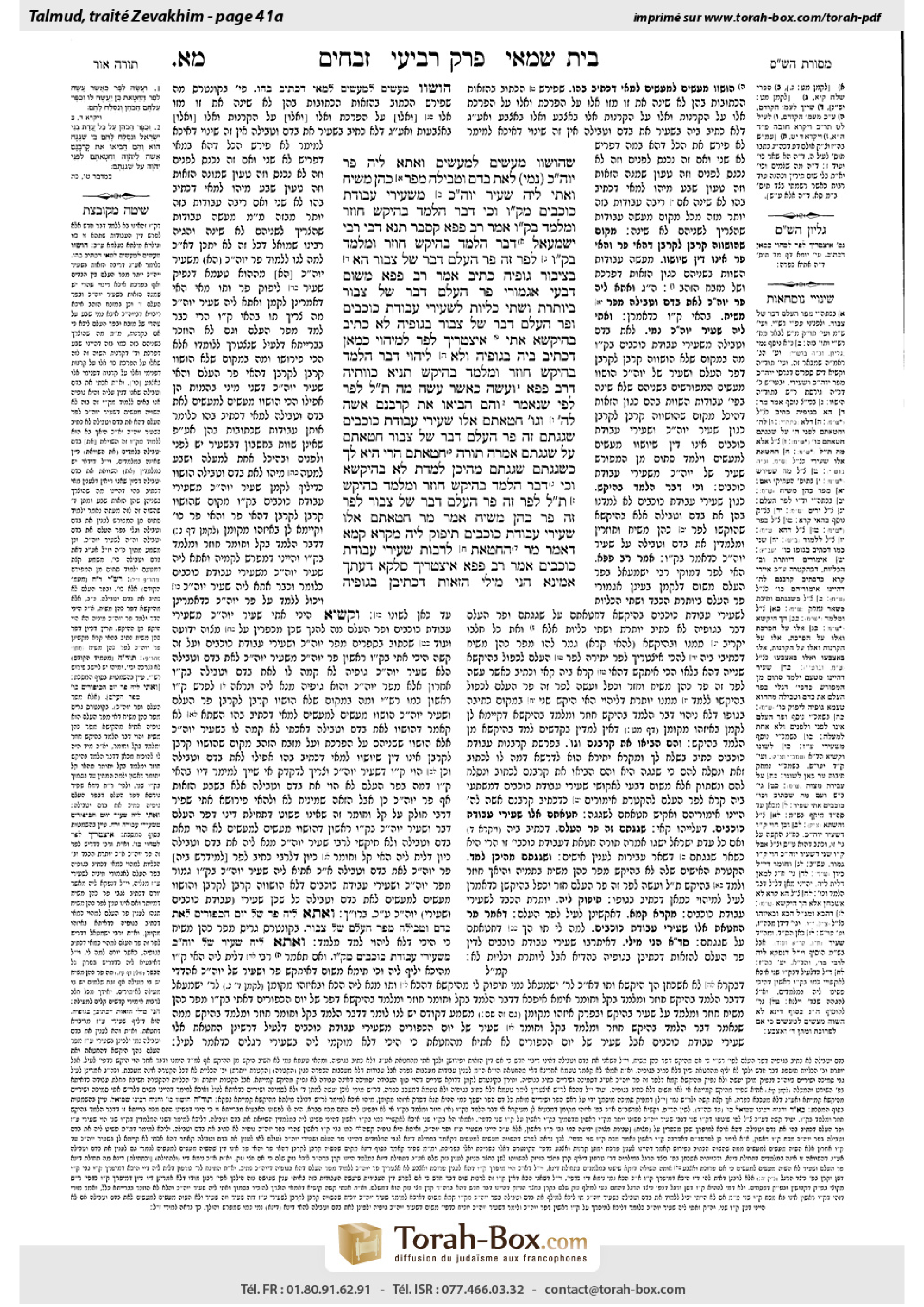
Zevachim 41a: Talmud study for Daf Yomi
Daf Yomi is the daily study of one Talmud folio. Explore 37 tractates with scans, Hebrew text, Sefaria English and AI-generated French translations where annotated.
Passage selection and English or AI-generated French translation are available where the scan has annotations. Daf Study is independent of Torah-Box and Sefaria.
Browse Zevachim · זבחים · All tractatesZevachim 41a text and translations
This page of Zevachim includes the Aramaic text, an English translation and an AI-generated French translation, alongside the scan above.
זבחים מ״א א · Aramaic and Hebrew text
שֶׁהוּשְׁווּ מַעֲשִׂים לְמַעֲשִׂים?!
וַאֲתָא לֵיהּ פַּר יוֹם הַכִּפּוּרִים (נָמֵי) לְאֶת בְּדָם וּטְבִילָה מִפַּר כֹּהֵן מָשִׁיחַ; וְאָתֵי לֵיהּ שְׂעִיר יוֹם הַכִּפּוּרִים מִשְּׂעִירֵי עֲבוֹדָה זָרָה – מִקַּל וָחוֹמֶר.
וְכִי דָּבָר הַלָּמֵד בְּהֶיקֵּשׁ, חוֹזֵר וּמְלַמֵּד בְּקַל וָחוֹמֶר?! אָמַר רַב פָּפָּא: קָסָבַר תָּנָא דְּבֵי רַבִּי יִשְׁמָעֵאל: דָּבָר הַלָּמֵד בְּהֶיקֵּשׁ, חוֹזֵר וּמְלַמֵּד בְּקַל וָחוֹמֶר.
״לַפָּר״ – זֶה פַּר הֶעְלֵם דָּבָר שֶׁל צִבּוּר. הָא בְּצִיבּוּר גּוּפֵיהּ כְּתִיב! אָמַר רַב פָּפָּא: מִשּׁוּם דְּבָעֵי אַגְמוֹרֵי פַּר הֶעְלֵם דָּבָר שֶׁל צִבּוּר בְּיוֹתֶרֶת וּשְׁתֵּי כְּלָיוֹת, לִשְׂעִירֵי עֲבוֹדָה זָרָה.
וּפַר הֶעְלֵם דָּבָר שֶׁל צִבּוּר – בְּגוּפֵיהּ לָא כְּתִיב, בְּהֶיקֵּשָׁא אָתֵי; אִיצְטְרִיךְ ״לַפָּר״ –
לְמִיהְוֵי כְּמַאן דִּכְתִיב בֵּיהּ בְּגוּפֵיהּ, וְלָא לֶיהֱוֵי דָּבָר הַלָּמֵד בְּהֶיקֵּשׁ חוֹזֵר וּמְלַמֵּד בְּהֶיקֵּשׁ.
תַּנְיָא כְּוָותֵיהּ דְּרַב פָּפָּא: ״וְעָשָׂה כַּאֲשֶׁר עָשָׂה״ – מָה תַּלְמוּד לוֹמַר ״לַפָּר״?
לְפִי שֶׁנֶּאֱמַר: ״וְהֵם הֵבִיאוּ אֶת קׇרְבָּנָם אִשֶּׁה לַה׳ וְגוֹ׳״; ״חַטָּאתָם״ – אֵלּוּ שְׂעִירֵי עֲבוֹדָה זָרָה, ״שִׁגְגָתָם״ – זֶה פַּר הֶעְלֵם דָּבָר שֶׁל צִבּוּר, ״חַטָּאתָם עַל שִׁגְגָתָם״ – אָמְרָה תּוֹרָה: חַטָּאתָם הֲרֵי הִיא לָךְ כְּשִׁגְגָתָם;
שִׁגְגָתָם מֵהֵיכָן לָמַדְתָּ – לֹא בְּהֶיקֵּשׁ? וְכִי דָּבָר הַלָּמֵד בְּהֶיקֵּשׁ חוֹזֵר וּמְלַמֵּד בְּהֶיקֵּשׁ?!
תַּלְמוּד לוֹמַר: ״לַפָּר״ – זֶה פַּר הֶעְלֵם דָּבָר שֶׁל צִבּוּר, ״לְפַר״ – זֶה פַּר כֹּהֵן מָשִׁיחַ.
אָמַר מָר: ״חַטָּאתָם״ – אֵלּוּ שְׂעִירֵי עֲבוֹדָה זָרָה. תִּיפּוֹק לֵיהּ מִקְּרָא קַמָּא, דְּאָמַר מָר: ״הַחַטָּאת״ – לְרַבּוֹת שְׂעִירֵי עֲבוֹדָה זָרָה! אָמַר רַב פָּפָּא: אִיצְטְרִיךְ; סָלְקָא דַּעְתָּךְ אָמֵינָא: הָנֵי מִילֵּי הַזָּאוֹת – דִּכְתִיבָן בְּגוּפֵיהּ,
Zevachim 41a · English translation
that the actions of sprinkling the blood in one offering are equated with the actions of the blood in the other offering? The blood of the goat of Yom Kippur is sprinkled even inside the Holy of Holies, which is not so concerning the blood of the bull. Nevertheless, with regard to the sprinkling in the Sanctuary, which is common to both, their actions are performed in the same manner, with the blood being sprinkled with a finger on the Curtain and on the corners of the altar.
And by means of this a fortiori inference the case of the bull of Yom Kippur is derived from the case of the bull of an unwitting sin of the anointed priest, with regard to the halakhot summarized by the words et, in the blood, and immersion, as they are both bulls. And likewise, the case of the goat of Yom Kippur is derived from the case of the goats for an unwitting communal sin of idol worship, with regard to the halakhot of et, in the blood, and immersion, via this a fortiori inference, as they are both goats.
The Gemara asks: How can the halakhot of the goat of Yom Kippur be derived from the goats for an unwitting communal sin of idol worship? But does a matter derived by juxtaposition, i.e., a halakha that is not written explicitly in the Torah but that is learned by means of a comparison, again teach by a fortiori inference? There is a principle that a halakha derived by juxtaposition with regard to consecrated matters cannot subsequently teach another halakha via an a fortiori inference. The halakhot alluded to by the words et, in the blood, and immersion, are not explicitly stated with regard to the goats of an unwitting communal sin of idol worship. Rather, they are derived from the comparison found in the verse: “And he shall do…as he did” (Leviticus 4:20), which alludes to the goats for an unwitting communal sin of idol worship and the bull for an unwitting sin of the anointed priest. Rav Pappa said: The school of Rabbi Yishmael maintains that a matter derived by juxtaposition does again teach by a fortiori inference, even with regard to consecrated matters.
The Gemara continues to analyze the statement of Rabbi Yishmael in the baraita: “With the bull”; this is the bull for an unwitting communal sin. The Gemara asks: Why is it necessary to derive this case by way of an exposition? This verse itself is written in reference to the bull for an unwitting communal sin. Rav Pappa said: The derivation is necessary because Rabbi Yishmael wants the case of the bull for an unwitting communal sin to teach with regard to the burning on the altar of the sacrificial portions, including the diaphragm and the two kidneys, that this obligation applies also to the goats for an unwitting communal sin of idol worship, despite the fact that this requirement is not stated with regard to them.
Rav Pappa continues: And as the obligation to burn the diaphragm and the two kidneys on the altar is not written with regard to the bull for an unwitting communal sin itself, but rather it is derived by juxtaposition from the bull for an unwitting sin of the anointed priest, in which this requirement is explictly stated (see Leviticus 4:8–9), it was necessary to include the bull for an unwitting communal sin once again with the term “with the bull.”
The Gemara elaborates: This derivation is required in order that it should be as though this halakha of burning the diaphragm and the two kidneys was written with regard to the bull for an unwitting communal sin itself. And in this manner the derivation from this case, teaching the halakha in the case of the goats for an unwitting communal sin of idol worship, should not be a matter derived by juxtaposition that again teaches by juxtaposition, as such a derivation is not done with regard to consecrated matters.
§ The Gemara comments: It is taught in a baraita in accordance with the opinion of Rav Pappa: “And he shall do with the bull, as he did” (Leviticus 4:20); what is the meaning when the verse states: “With the bull”? It is clear that this verse is referring to the bull.
The baraita answers: Because it is stated with regard to the goats for an unwitting communal sin of idol worship: “And they have brought their offering, an offering made by fire to the Lord, and their sin offering before the Lord for their error” (Numbers 15:25), and this verse is interpreted as follows: “Their sin offering”; these are the goats for an unwitting communal sin of idol worship, alluded to in that passage. “Their error”; this is the bull for an unwitting communal sin, which is brought for an inadvertent transgression of the community. The juxtaposition of these offerings in the verse: “Their sin offering…for their error,” indicates that the Torah means to say: Their sin offering is for you like their error, i.e., all the portions consumed on the altar in the case of the bull for an unwitting communal sin are also burned on the altar in the case of the goats for an unwitting sin of idol worship.
The Gemara asks: With regard to the offering brought for their error, i.e., the bull for an unwitting communal sin, from where did you learn this halakha? Was it not via juxtaposition from the bull for an unwitting sin of the anointed priest, as the diaphragm and the two kidneys are not explicitly mentioned with regard to the bull for an unwitting communal sin? But this is difficult, as does a matter derived via juxtaposition again teach via juxtaposition?
Therefore, the verse states: “And he shall do with the bull, as he did with the bull for a sin offering” (Leviticus 4:20). With regard to the first instance of “with the bull,” this is the bull for an unwitting communal sin. And with regard to the second instance of “with the bull,” this is the bull for an unwitting sin of the anointed priest. Due to this juxtaposition, it is as though the burning of the diaphragm and the two kidneys was explicitly written with regard to the bull for an unwitting communal sin, and therefore the halakha can be taught by juxtaposition with regard to the goats for an unwitting sin of idol worship, as stated by Rav Pappa.
The Gemara analyzes the previous baraita. The Master said above: “Their sin offering,” these are the goats for an unwitting communal sin of idol worship, which are juxtaposed in this verse to the bull for an unwitting communal sin. The Gemara asks: But let the tanna derive this from the earlier verse stated with regard to the bull for an unwitting communal sin, as the Master said in the baraita cited earlier (39b): “A sin offering” (Leviticus 4:20), this serves to include the goats for an unwitting communal sin of idol worship. Rav Pappa said: This derivation was necessary, as if there were only the juxtaposition from Leviticus 4:20, it would enter your mind to say: This matter applies only to the acts of sprinkling, which are written with regard to the bull for an unwitting communal sin itself.
Zevachim 41a · Traduction française (IA)
que les actes d’aspersion du sang dans une offrande sont assimilés aux actes d’aspersion du sang dans l’autre offrande ? Le sang du bouc de Yom Kippour est aspergé même à l’intérieur du Saint des Saints, contrairement au sang du taureau. Néanmoins, pour les aspersions dans le Sanctuaire, qui sont communes aux deux offrandes, elles sont accomplies de la même manière : le sang est aspergé avec un doigt sur le rideau et sur les angles de l’autel.
Et c’est au moyen de ce raisonnement a fortiori que le cas du taureau de Yom Kippour est déduit de celui du taureau offert pour le péché involontaire du prêtre oint, concernant les halakhot résumées par les termes « et », « dans le sang » et « immersion », puisqu’il s’agit dans les deux cas de taureaux. De même, le cas du bouc de Yom Kippour est déduit de celui des boucs offerts pour le péché involontaire de la communauté lié à l’idolâtrie, concernant les halakhot de « et », « dans le sang » et « immersion », au moyen de ce raisonnement a fortiori, puisqu’il s’agit dans les deux cas de boucs.
La Guemara demande : Comment les halakhot du bouc de Yom Kippour peuvent-elles être déduites de celles des boucs offerts pour le péché involontaire de la communauté lié à l’idolâtrie ? Mais une règle déduite par juxtaposition, c’est-à-dire une halakha qui n’est pas explicitement écrite dans la Torah, mais qui est apprise par comparaison, peut-elle à son tour enseigner par raisonnement a fortiori ? Un principe veut qu’une halakha déduite par juxtaposition concernant les choses consacrées ne puisse ensuite enseigner une autre halakha au moyen d’un raisonnement a fortiori. Les halakhot suggérées par les termes « et », « dans le sang » et « immersion » ne sont pas explicitement énoncées à propos des boucs offerts pour le péché involontaire de la communauté lié à l’idolâtrie. Elles sont plutôt déduites de la comparaison exprimée dans le verset : « Et il fera… comme il a fait » (Lévitique 4, 20), qui évoque les boucs offerts pour le péché involontaire de la communauté lié à l’idolâtrie et le taureau offert pour le péché involontaire du prêtre oint. Rav Pappa dit : L’école de Rabbi Yishmael estime qu’une règle déduite par juxtaposition peut à son tour enseigner par raisonnement a fortiori, même concernant les choses consacrées.
La Guemara poursuit l’analyse de la déclaration de Rabbi Yishmael dans la baraïta : « Avec le taureau » ; il s’agit du taureau offert pour le péché involontaire de la communauté. La Guemara demande : Pourquoi faut-il déduire ce cas par une interprétation ? Le verset lui-même concerne le taureau offert pour le péché involontaire de la communauté. Rav Pappa dit : Cette déduction est nécessaire, car Rabbi Yishmael veut que le cas du taureau offert pour le péché involontaire de la communauté enseigne que l’obligation de brûler sur l’autel les parties sacrificielles, notamment le diaphragme et les deux reins, s’applique aussi aux boucs offerts pour le péché involontaire de la communauté lié à l’idolâtrie, bien que cette exigence ne soit pas énoncée à leur sujet.
Rav Pappa poursuit : Et puisque l’obligation de brûler le diaphragme et les deux reins sur l’autel n’est pas écrite à propos du taureau offert pour le péché involontaire de la communauté lui-même, mais est déduite par juxtaposition du taureau offert pour le péché involontaire du prêtre oint, pour lequel cette exigence est explicitement énoncée (voir Lévitique 4, 8-9), il était nécessaire d’inclure de nouveau le taureau offert pour le péché involontaire de la communauté au moyen de l’expression « avec le taureau ».
La Guemara explique : Cette déduction est nécessaire afin que cette halakha concernant la combustion du diaphragme et des deux reins soit considérée comme si elle avait été écrite à propos du taureau offert pour le péché involontaire de la communauté lui-même. Ainsi, la déduction tirée de ce cas pour enseigner la halakha concernant les boucs offerts pour le péché involontaire de la communauté lié à l’idolâtrie ne sera pas une règle déduite par juxtaposition qui enseigne à son tour par juxtaposition, car une telle déduction ne se fait pas concernant les choses consacrées.
§ La Guemara fait remarquer : Une baraïta enseigne conformément à l’opinion de Rav Pappa : « Et il fera avec le taureau comme il a fait » (Lévitique 4, 20). Que signifie l’expression « avec le taureau » dans ce verset ? Il est clair que le verset fait référence au taureau.
La baraïta répond : Car il est dit à propos des boucs offerts pour le péché involontaire de la communauté lié à l’idolâtrie : « Ils apporteront leur offrande, un holocauste pour l’Éternel, et leur sacrifice expiatoire devant l’Éternel pour leur erreur » (Nombres 15, 25). Ce verset est interprété ainsi : « Leur sacrifice expiatoire » : il s’agit des boucs offerts pour le péché involontaire de la communauté lié à l’idolâtrie, évoqués dans ce passage. « Leur erreur » : il s’agit du taureau offert pour le péché involontaire de la communauté, apporté à la suite d’une transgression involontaire de la communauté. La juxtaposition de ces offrandes dans le verset — « leur sacrifice expiatoire… pour leur erreur » — indique que la Torah veut dire : leur sacrifice expiatoire est pour vous comme leur erreur, c’est-à-dire que toutes les parties consommées sur l’autel dans le cas du taureau offert pour le péché involontaire de la communauté sont également brûlées sur l’autel dans le cas des boucs offerts pour le péché involontaire de la communauté lié à l’idolâtrie.
La Guemara demande : Concernant l’offrande apportée pour leur erreur, c’est-à-dire le taureau offert pour le péché involontaire de la communauté, d’où as-tu appris cette halakha ? Ne l’as-tu pas apprise par juxtaposition avec le taureau offert pour le péché involontaire du prêtre oint, puisque le diaphragme et les deux reins ne sont pas explicitement mentionnés à propos du taureau offert pour le péché involontaire de la communauté ? Mais cela pose problème : une règle déduite par juxtaposition peut-elle à son tour enseigner par juxtaposition ?
C’est pourquoi le verset dit : « Et il fera avec le taureau comme il a fait avec le taureau du sacrifice expiatoire » (Lévitique 4, 20). La première occurrence de « avec le taureau » désigne le taureau offert pour le péché involontaire de la communauté. La seconde occurrence de « avec le taureau » désigne le taureau offert pour le péché involontaire du prêtre oint. Grâce à cette juxtaposition, c’est comme si l’obligation de brûler le diaphragme et les deux reins avait été explicitement écrite à propos du taureau offert pour le péché involontaire de la communauté ; la halakha peut donc être enseignée par juxtaposition concernant les boucs offerts pour le péché involontaire de la communauté lié à l’idolâtrie, comme l’a dit Rav Pappa.
La Guemara analyse la baraïta précédente. Le Maître a dit plus haut : « Leur sacrifice expiatoire » désigne les boucs offerts pour le péché involontaire de la communauté lié à l’idolâtrie, qui sont juxtaposés dans ce verset au taureau offert pour le péché involontaire de la communauté. La Guemara demande : Mais que le tanna déduise cela du verset précédent, énoncé à propos du taureau offert pour le péché involontaire de la communauté, puisque le Maître a dit dans la baraïta citée plus tôt (39b) : « Un sacrifice expiatoire » (Lévitique 4, 20) sert à inclure les boucs offerts pour le péché involontaire de la communauté lié à l’idolâtrie. Rav Pappa dit : Cette déduction était nécessaire, car si l’on ne disposait que de la juxtaposition de Lévitique 4, 20, on pourrait penser que cette règle ne s’applique qu’aux actes d’aspersion, qui sont mentionnés à propos du taureau offert pour le péché involontaire de la communauté lui-même.
Traduction française générée par IA à partir de l’édition anglaise de Sefaria. Vérifie toujours un passage avec le texte source.
Text from Sefaria: William Davidson Edition - Vocalized Aramaic (CC BY NC); William Davidson Edition - English (CC BY NC).