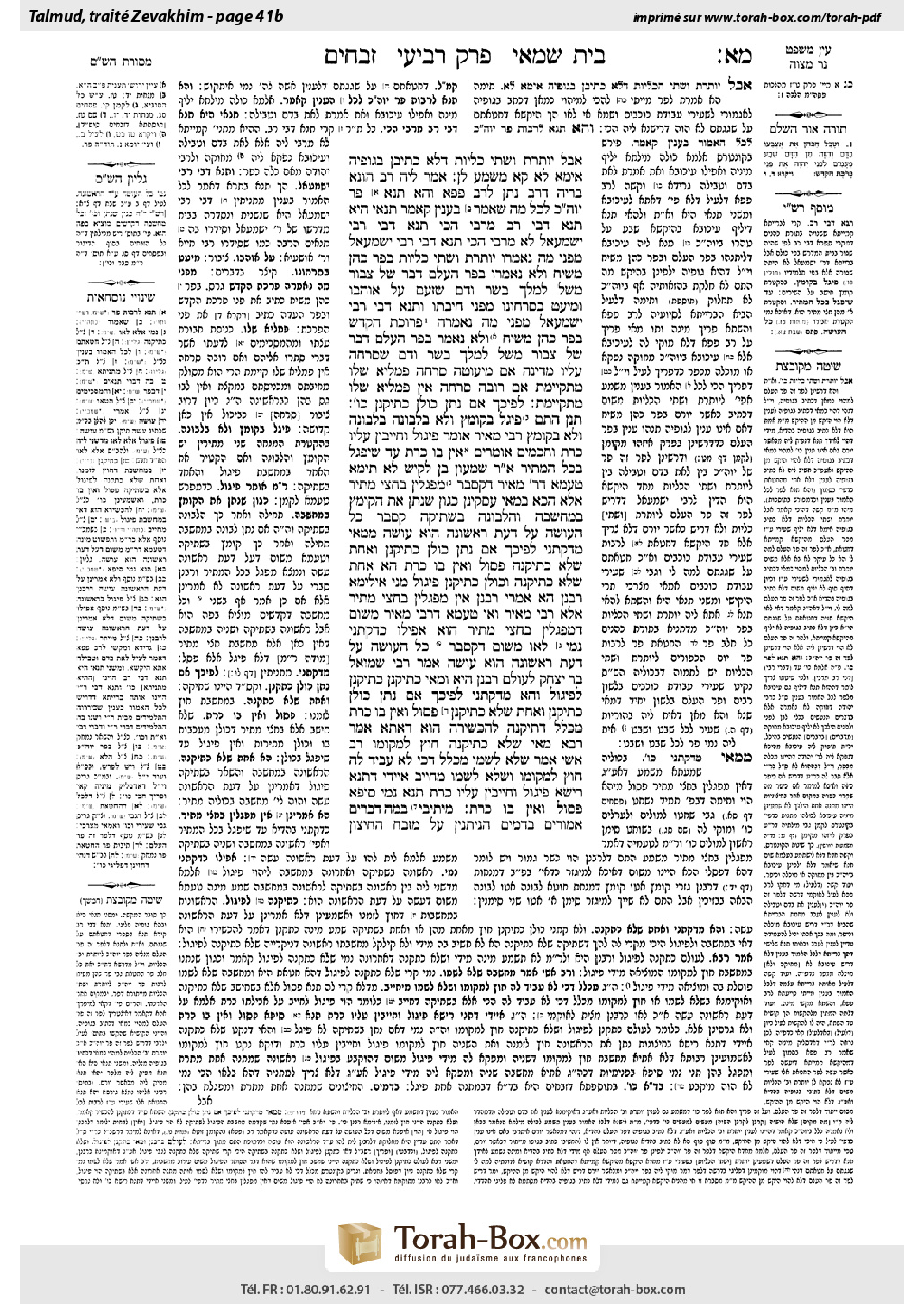
Zevachim 41b: Talmud study for Daf Yomi
Daf Yomi is the daily study of one Talmud folio. Explore 37 tractates with scans, Hebrew text, Sefaria English and AI-generated French translations where annotated.
Passage selection and English or AI-generated French translation are available where the scan has annotations. Daf Study is independent of Torah-Box and Sefaria.
Browse Zevachim · זבחים · All tractatesZevachim 41b text and translations
This page of Zevachim includes the Aramaic text, an English translation and an AI-generated French translation, alongside the scan above.
זבחים מ״א ב · Aramaic and Hebrew text
אֲבָל יוֹתֶרֶת וּשְׁתֵּי כְלָיוֹת – דְּלָא כְּתִיבָן בְּגוּפֵיהּ, אֵימָא לָא; קָא מַשְׁמַע לַן.
אֲמַר לֵיהּ רַב הוּנָא בְּרֵיהּ דְּרַב נָתָן לְרַב פָּפָּא: וְהָא תַּנָּא – פַּר יוֹם הַכִּפּוּרִים לְכׇל מַה שֶּׁאָמַר בְּעִנְיָן קָאָמַר! תַּנָּאֵי הִיא; תַּנָּא דְּבֵי רַב מְרַבֵּי הָכִי, תַּנָּא דְּבֵי רַבִּי יִשְׁמָעֵאל לָא מְרַבֵּי הָכִי.
תָּנָא דְּבֵי רַבִּי יִשְׁמָעֵאל: מִפְּנֵי מָה נֶאֶמְרוּ יוֹתֶרֶת וּשְׁתֵּי כְלָיוֹת בְּפַר כֹּהֵן מָשִׁיחַ, וְלֹא נֶאֶמְרוּ בְּפַר הֶעְלֵם דָּבָר שֶׁל צִבּוּר? מָשָׁל לְמֶלֶךְ בָּשָׂר וָדָם שֶׁזָּעַם עַל אוֹהֲבוֹ, וּמִיעֵט בְּסִרְחוֹנוֹ מִפְּנֵי חִיבָּתוֹ.
וְתָנָא דְּבֵי רַבִּי יִשְׁמָעֵאל: מִפְּנֵי מָה נֶאֶמְרָה ״פָּרֹכֶת הַקֹּדֶשׁ״ בְּפַר כֹּהֵן מָשִׁיחַ, וְלֹא נֶאֱמַר בְּפַר הֶעְלֵם דָּבָר שֶׁל צִבּוּר? מָשָׁל לְמֶלֶךְ בָּשָׂר וָדָם שֶׁסָּרְחָה עָלָיו מְדִינָה; אִם מִיעוּטָהּ סָרְחָה – פָּמַלְיָא שֶׁלּוֹ מִתְקַיֶּימֶת, אִם רוּבָּהּ סָרְחָה – אֵין פָּמַלְיָא שֶׁלּוֹ מִתְקַיֶּימֶת.
לְפִיכָךְ אִם נָתַן כּוּלָּן כְּתִיקְנָן כּוּ׳. תְּנַן הָתָם: פִּיגֵּל בַּקּוֹמֶץ וְלֹא בַּלְּבוֹנָה; בַּלְּבוֹנָה וְלֹא בַּקּוֹמֶץ – רַבִּי מֵאִיר אוֹמֵר: פִּיגּוּל, וְחַיָּיבִין עָלָיו כָּרֵת.
וַחֲכָמִים אוֹמְרִים: אֵין בּוֹ כָּרֵת עַד שֶׁיְּפַגֵּל בְּכׇל הַמַּתִּיר.
אָמַר רַבִּי שִׁמְעוֹן בֶּן לָקִישׁ: לָא תֵּימָא טַעְמָא דְּרַבִּי מֵאִיר, דְּקָסָבַר מְפַגְּלִין בַּחֲצִי מַתִּיר; אֶלָּא הָכָא בְּמַאי עָסְקִינַן – כְּגוֹן שֶׁנָּתַן אֶת הַקּוֹמֶץ בְּמַחְשָׁבָה, וְהַלְּבוֹנָה בִּשְׁתִיקָה; קָסָבַר: כׇּל הָעוֹשֶׂה – עַל דַּעַת רִאשׁוֹנָה הוּא עוֹשֶׂה.
מִמַּאי? מִדְּקָתָנֵי: לְפִיכָךְ אִם נָתַן כּוּלָּן כְּתִיקְנָן וְאַחַת שֶׁלֹּא כְּתִיקְנָהּ – פָּסוּל וְאֵין בּוֹ כָּרֵת. הָא אַחַת שֶׁלֹּא כְּתִיקְנָהּ וְכוּלָּן כְּתִיקְנָן – פִּיגּוּל;
מַנִּי? אִילֵּימָא רַבָּנַן – הָא אָמְרִי רַבָּנַן: אֵין מְפַגְּלִין בַּחֲצִי מַתִּיר! אֶלָּא רַבִּי מֵאִיר.
וְאִי טַעְמָא דְּרַבִּי מֵאִיר מִשּׁוּם דִּמְפַגְּלִין בַּחֲצִי מַתִּיר הוּא – אֲפִילּוּ כִּדְקָתָנֵי נָמֵי! לָאו מִשּׁוּם דְּקָסָבַר: כׇּל הָעוֹשֶׂה – עַל דַּעַת רִאשׁוֹנָה הוּא עוֹשֶׂה?
אָמַר רַבִּי שְׁמוּאֵל בַּר יִצְחָק: לְעוֹלָם רַבָּנַן הִיא; וּמַאי כְּתִיקְנָן – כְּתִיקְנָן לְפִיגּוּל.
וְהָא מִדְּקָתָנֵי: לְפִיכָךְ אִם נָתַן כּוּלָּן כְּתִיקְנָן וְאַחַת שֶׁלֹּא כְּתִיקְנָן – פָּסוּל וְאֵין בּוֹ כָּרֵת; מִכְּלָל דְּתִיקְנָהּ – לְהֶכְשֵׁירָה הוּא דַּאֲתָא!
אָמַר רָבָא: מַאי שֶׁלֹּא כְּתִיקְנָהּ – חוּץ לִמְקוֹמוֹ. רַב אָשֵׁי אָמַר: שֶׁלֹּא לִשְׁמוֹ.
מִכְּלָל דְּכִי לָא עָבֵיד לַהּ חוּץ לִמְקוֹמוֹ וְשֶׁלֹּא לִשְׁמוֹ – מִחַיַּיב!
אַיְּידֵי דִּתְנָא רֵישָׁא פִּיגּוּל וְחַיָּיבִין עָלָיו כָּרֵת, תְּנָא נָמֵי סֵיפָא פָּסוּל וְאֵין בּוֹ כָּרֵת.
מֵיתִיבִי: בַּמֶּה דְּבָרִים אֲמוּרִים – בְּדָמִים הַנִּיתָּנִין עַל מִזְבֵּחַ הַחִיצוֹן;
Zevachim 41b · English translation
But with regard to the burning of the diaphragm and the two kidneys, which are not written with regard to the bull for an unwitting communal sin itself, you might say that this halakha should not be derived from it. Therefore, this additional derivation of “their sin offering” teaches us that the two offerings are similar with regard to this detail as well.
Rav Huna, son of Rav Natan, said to Rav Pappa: But the tanna said: “With the bull”; this serves to include the bull of Yom Kippur for all that is stated in this matter. This statement indicates that all the details applying to the bull for an unwitting communal sin are extended to the bull of Yom Kippur by means of a single derivation. Rav Pappa responded: This issue is a dispute between tanna’im, as the tanna of the school of Rav amplifies the halakha through this juxtaposition, whereas the tanna of the school of Rabbi Yishmael does not amplify the halakha through this juxtaposition, but maintains that an additional derivation is necessary with regard to the diaphragm and the two kidneys.
§ The Gemara cites a statement that is related to the above halakhot. The school of Rabbi Yishmael taught: For what reason are the diaphragm and the two kidneys stated with regard to the bull for an unwitting sin of the anointed priest, and they are not explicitly stated with regard to the bull for an unwitting communal sin? This can be explained by a parable: It can be compared to a flesh-and-blood king who grew angry with his beloved servant for his misdeeds, but spoke little of the servant’s offense due to his great affection for him. Likewise, as the Jewish people are beloved by God, the Torah does not describe their sin offering in detail.
And the school of Rabbi Yishmael further taught: For what reason is it stated: “Before the Curtain of the Sanctuary” (Leviticus 4:6), with regard to the bull for an unwitting sin of the anointed priest, and this is not stated with regard to the bull for an unwitting communal sin, where it merely states: “Before the Curtain” (Leviticus 4:17)? This can be explained by a parable: It can be compared to a flesh-and-blood king against whom a province sinned. If a minority of that province sinned, his relationship with his entourage [pamalya] remains, i.e., the king continues to treat his loyal followers in the usual manner. But if the majority of the province sinned, his relationship with his entourage does not remain, and he no longer meets even those who remained devoted to him. Similarly, when the entire people sins, God no longer has the same relationship with them, and it is as though the place where the priest sprinkles the blood is no longer sacred.
§ The mishna teaches that all the placements upon the inner altar are indispensable, and therefore if the High Priest placed all the placements in their proper manner, and one in an improper manner, i.e., with the intent to eat or burn the offering beyond its designated time, the offering is disqualified, but there is no liability for karet for one who partakes of the offering. The Gemara states that we learned in a mishna there (Menaḥot 16a), with regard to the burning of the handful of a meal offering and the frankincense, both of which render the meal offering permitted for eating: If the priest had an intention that can render the offering piggul, and this occurred during the burning of the handful but not during the burning of the frankincense, or during the burning of the frankincense but not during the burning of the handful, i.e., he burned one of them with the intention of eating the remainder of the offering beyond its designated time, Rabbi Meir says: The offering is piggul and one who eats it is liable to receive karet.
And the Rabbis say: There is no liability for karet in this case unless he renders the offering piggul during the performance of the entire permitting factor, i.e., the burning of both the handful and the frankincense.
Rabbi Shimon ben Lakish said: Do not say that the reason of Rabbi Meir, who holds that the offering is piggul, is that he holds in general that one renders an offering piggul even if he intended to eat or burn the offering beyond its designated time during the performance of only half a permitting factor. Rather, what are we dealing with here? We are dealing with a case where he initially placed the handful of the meal offering on the altar, to burn it, with the improper intention to eat the remainder beyond its designated time, and afterward he placed the frankincense on the altar silently, i.e., without any particular intent. Rabbi Meir holds: Anyone who performs an action performs it with his initial intent. Therefore, his action with the frankincense is considered to have been performed with the same improper intention as his action with the handful.
The Gemara asks: From where does Rabbi Shimon ben Lakish learn that this is the case? He learns it from the fact that the mishna teaches: Therefore, if he placed all the placements in their proper manner and one in an improper manner, the offering is disqualified, but there is no liability for karet. Consequently it follows that if he initially placed one placement in an improper manner, with the intent to eat or burn the offering beyond its designated time, and all the other placements in the proper manner, the offering is piggul.
The Gemara explains: Whose opinion is this? If we say it is the opinion of the Rabbis, don’t the Rabbis explicitly say that one cannot render an offering piggul with an improper intention in the performance of only half a permitting factor? Here, the priest placed one placement in the proper manner. Rather, it must represent the opinion of Rabbi Meir, who says that if he had an improper intention with regard to the handful and not the frankincense the offering is piggul.
And if Rabbi Meir’s reason is that he holds in general that one renders an offering piggul even during the performance of only half a permitting factor, even if the priest acted as it taught in the mishna, the offering should also be piggul, as he had an improper intention during half the permitting factor. Rather, is Rabbi Meir’s reason not because he holds that anyone who performs an action performs it with his initial intent? Consequently, if he placed the first placement with an improper intention, the offering is piggul, and if his intention during the first placement was proper, the offering is not piggul.
Rabbi Shmuel bar Yitzḥak says: Actually, it is possible that the mishna is in accordance with the opinion of the Rabbis, who maintain that one cannot render an offering piggul with an improper intention during half a permitting factor. And what is the meaning of the term: In their proper manner, in the context of the mishna? It means in their proper manner with regard to piggul, i.e., he placed the blood with an intention that renders the offering piggul. The mishna is teaching that although he placed the first placements with an improper intention, one does not say that the last placement, which was placed without any specific intention, was performed with his initial intent.
The Gemara raises a difficulty: But from the fact that it teaches: Therefore, if he placed all the placements in their proper manner and one in an improper manner, the offering is disqualified but there is no liability for karet, which indicates that the offering is disqualified due to the one placement performed improperly, one can learn by inference that the term: In their proper manner, comes to indicate an intention that renders the offering fit, and not an intention that renders it piggul.
Rava says: It can still be explained that the term: In their proper manner, is referring to an intention that renders the offering piggul; and what is the meaning of: In an improper manner? This is referring to the intent to eat the offering outside its designated area. This intention serves to disqualify the offering, which means that it is not piggul, as not all its rites have been performed in the proper manner. Rav Ashi says: The term: In an improper manner, in the mishna, means that he placed one placement not for the sake of the offering being sacrificed, and in the case of a sin offering an intention of this kind disqualifies the offering; therefore, it is not piggul.
The Gemara raises a difficulty: If so, one can learn by inference that when the priest does not perform the last placement with the intent to eat the offering outside its designated area or not for the sake of the offering, but silently, he becomes liable, as the offering is piggul. This is certainly not in accordance with the opinion of the Rabbis, as they maintain that one cannot render an offering piggul with an improper intention during half a permitting factor.
The Gemara answers: The wording of the mishna is imprecise, as in fact, even if he placed the last placement silently the offering is not piggul. But since the tanna of the mishna taught in the first clause, with regard to an offering whose blood is placed on the external altar: If he placed the first placement with the intent to eat the offering beyond its designated time and the second placement with the intent to eat it outside its designated area, the offering is piggul and one is liable to receive karet for its consumption, he likewise taught the latter clause, with regard to a sin offering whose blood is placed on the inner altar, in a similar manner, that if he placed the last placement with the intent to eat it outside its designated area or not for the sake of the offering, the offering is disqualified, but there is no liability for karet for its consumption. One cannot infer from here that if he placed the last placement without intent the offering is piggul.
The Gemara raises an objection to the opinion of Rabbi Shimon ben Lakish from a baraita: In what case is this statement, that the offering is rendered piggul even when he intends to eat it beyond its designated time only in the first placement, said? In the case of blood that is placed on the external altar, where one placement renders the offering permitted.
Zevachim 41b · Traduction française (IA)
Mais, concernant la combustion du diaphragme et des deux reins, qui ne sont pas mentionnés à propos du taureau offert pour une faute involontaire de la communauté elle-même, on aurait pu dire qu’il ne fallait pas déduire cette halakha de ce cas. C’est pourquoi cette déduction supplémentaire, « leur sacrifice expiatoire », nous enseigne que les deux offrandes sont également semblables sur ce point.
Rav Houna, fils de Rav Natan, dit à Rav Pappa : « Mais le tanna a dit : “Avec le taureau” ; cela vient inclure le taureau de Yom Kippour pour tout ce qui est énoncé dans ce passage. » Cette déclaration indique que toutes les règles applicables au taureau offert pour une faute involontaire de la communauté s’appliquent aussi au taureau de Yom Kippour grâce à une seule déduction. Rav Pappa répondit : « C’est un désaccord entre les tannaïm : le tanna de l’école de Rav étend la halakha par ce rapprochement, tandis que le tanna de l’école de Rabbi Yishmaël ne l’étend pas ainsi et estime qu’une déduction supplémentaire est nécessaire concernant le diaphragme et les deux reins. »
§ La Guemara cite un enseignement lié aux halakhot précédentes. L’école de Rabbi Yishmaël enseignait : Pourquoi le diaphragme et les deux reins sont-ils mentionnés à propos du taureau offert pour la faute involontaire du prêtre oint, alors qu’ils ne sont pas explicitement mentionnés à propos du taureau offert pour une faute involontaire de la communauté ? On peut l’expliquer par une parabole : cela ressemble à un roi de chair et de sang qui s’irrite contre son serviteur bien-aimé à cause de ses méfaits, mais parle peu de la faute de son serviteur en raison de sa grande affection pour lui. De même, puisque le peuple juif est aimé de Dieu, la Torah ne décrit pas en détail son sacrifice expiatoire.
L’école de Rabbi Yishmaël enseignait également : Pourquoi est-il écrit, à propos du taureau offert pour la faute involontaire du prêtre oint, « devant le rideau du Sanctuaire » (Lévitique 4,6), alors qu’il n’est pas écrit ainsi à propos du taureau offert pour une faute involontaire de la communauté, où il est seulement dit : « devant le rideau » (Lévitique 4,17) ? On peut l’expliquer par une parabole : cela ressemble à un roi de chair et de sang contre lequel une province a péché. Si une minorité de cette province a péché, ses relations avec son entourage [pamalya] demeurent, c’est-à-dire que le roi continue de traiter ses fidèles comme à l’accoutumée. Mais si la majorité de la province a péché, ses relations avec son entourage ne demeurent pas, et il ne rencontre même plus ceux qui lui sont restés fidèles. De même, lorsque tout le peuple commet une faute, Dieu n’a plus avec lui la même relation, et c’est comme si le lieu où le prêtre asperge le sang n’était plus sacré.
§ La Michna enseigne que toutes les aspersions sur l’autel intérieur sont indispensables. Par conséquent, si le grand prêtre a effectué toutes les aspersions correctement, sauf une, qu’il a effectuée incorrectement — c’est-à-dire avec l’intention de manger ou de brûler l’offrande après le temps qui lui est imparti —, l’offrande est invalidée, mais celui qui en consomme n’est pas passible de retranchement. La Guemara indique que nous avons appris dans une Michna là-bas (Menaḥot 16a), au sujet de la combustion de la poignée d’une offrande de farine et de l’encens, qui rendent tous deux l’offrande de farine permise à la consommation : si le prêtre a eu une intention susceptible de rendre l’offrande piggul pendant la combustion de la poignée, mais pas pendant celle de l’encens, ou pendant la combustion de l’encens, mais pas pendant celle de la poignée — c’est-à-dire s’il a brûlé l’un des deux avec l’intention de manger le reste de l’offrande après le temps qui lui est imparti —, Rabbi Méïr dit : « L’offrande est piggul et celui qui en consomme est passible de retranchement. »
Et les Sages disent : dans ce cas, il n’est passible de retranchement que s’il a rendu l’offrande piggul pendant l’accomplissement de l’ensemble de l’acte qui la rend permise, c’est-à-dire la combustion de la poignée et de l’encens.
Rech Lakich dit : « Ne dis pas que Rabbi Méïr estime que l’offrande devient piggul même si l’on a eu l’intention de manger ou de brûler l’offrande après le temps qui lui est imparti pendant l’accomplissement d’une seule moitié de l’acte qui la rend permise. De quoi s’agit-il ici ? D’un cas où, dans un premier temps, il a placé sur l’autel la poignée de l’offrande de farine destinée à être brûlée, avec l’intention incorrecte de manger le reste après le temps qui lui est imparti, puis a placé l’encens sur l’autel sans intention particulière. Rabbi Méïr estime que quiconque accomplit un acte l’accomplit avec son intention initiale. Par conséquent, l’acte qu’il a accompli avec l’encens est considéré comme ayant été effectué avec la même intention incorrecte que celui accompli avec la poignée. »
La Guemara demande : « D’où Rech Lakich déduit-il qu’il s’agit de ce cas ? » Il le déduit du fait que la Michna enseigne : « Par conséquent, s’il a effectué toutes les aspersions correctement, sauf une, qu’il a effectuée incorrectement, l’offrande est invalidée, mais il n’est pas passible de retranchement. » Il s’ensuit que si, dans un premier temps, il a effectué une aspersion incorrectement, avec l’intention de manger ou de brûler l’offrande après le temps qui lui est imparti, puis a effectué toutes les autres correctement, l’offrande est piggul.
La Guemara explique : « De quel avis s’agit-il ? Si l’on dit que c’est celui des Sages, les Sages ne disent-ils pas explicitement qu’on ne peut pas rendre une offrande piggul en ayant une intention incorrecte pendant l’accomplissement d’une seule moitié de l’acte qui la rend permise ? Ici, le prêtre a effectué une aspersion correctement. Il faut donc plutôt dire qu’il s’agit de l’avis de Rabbi Méïr, qui dit que si le prêtre a eu une intention incorrecte concernant la poignée, mais pas concernant l’encens, l’offrande est piggul. »
Et si Rabbi Méïr estimait qu’une offrande devient piggul même lorsqu’une intention incorrecte est formulée pendant l’accomplissement d’une seule moitié de l’acte qui la rend permise, alors même si le prêtre avait agi comme l’enseigne la Michna, l’offrande devrait être piggul, puisqu’il avait eu une intention incorrecte pendant la moitié de cet acte. La raison de Rabbi Méïr ne serait-elle donc pas plutôt qu’il estime que quiconque accomplit un acte l’accomplit avec son intention initiale ? Par conséquent, s’il a effectué la première aspersion avec une intention incorrecte, l’offrande est piggul ; et si son intention lors de la première aspersion était correcte, l’offrande n’est pas piggul.
Rabbi Chmouel bar Yitsḥak dit : « En réalité, il est possible que la Michna soit conforme à l’avis des Sages, qui estiment qu’on ne peut pas rendre une offrande piggul en ayant une intention incorrecte pendant la moitié de l’acte qui la rend permise. Que signifie alors l’expression “correctement” dans le contexte de la Michna ? Elle signifie : correctement en ce qui concerne le piggul, c’est-à-dire qu’il a aspergé le sang avec une intention qui rend l’offrande piggul. La Michna enseigne que, même s’il a effectué les premières aspersions avec une intention incorrecte, on ne dit pas que la dernière aspersion, effectuée sans intention particulière, l’a été avec son intention initiale. »
La Guemara soulève une difficulté : « Mais puisque la Michna enseigne : “Par conséquent, s’il a effectué toutes les aspersions correctement, sauf une, qu’il a effectuée incorrectement, l’offrande est invalidée, mais il n’est pas passible de retranchement”, ce qui indique que l’offrande est invalidée à cause de l’aspersion effectuée incorrectement, on peut en déduire que l’expression “correctement” désigne une intention qui rend l’offrande apte, et non une intention qui la rend piggul. »
Rava dit : « On peut tout de même expliquer que l’expression “correctement” désigne une intention qui rend l’offrande piggul. Que signifie alors “incorrectement” ? Cela désigne l’intention de manger l’offrande hors de l’endroit qui lui est assigné. Cette intention invalide l’offrande, ce qui signifie qu’elle n’est pas piggul, puisque tous ses rites n’ont pas été accomplis correctement. Rav Achi dit : Dans la Michna, “incorrectement” signifie qu’il a effectué une aspersion sans l’intention que l’offrande soit sacrifiée. Or, dans le cas d’un sacrifice expiatoire, une telle intention invalide l’offrande ; elle n’est donc pas piggul. »
La Guemara soulève une difficulté : « Dans ce cas, on pourrait déduire que si le prêtre n’effectue pas la dernière aspersion avec l’intention de manger l’offrande hors de l’endroit qui lui est assigné ou sans l’intention que l’offrande soit sacrifiée, mais l’effectue sans intention particulière, il devient passible, puisque l’offrande est piggul. Cela n’est certainement pas conforme à l’avis des Sages, puisqu’ils estiment qu’on ne peut pas rendre une offrande piggul en ayant une intention incorrecte pendant la moitié de l’acte qui la rend permise. »
La Guemara répond : « La formulation de la Michna manque de précision : en réalité, même s’il a effectué la dernière aspersion sans intention particulière, l’offrande n’est pas piggul. Mais puisque, dans la première partie, au sujet d’une offrande dont le sang est aspergé sur l’autel extérieur, le tanna de la Michna a enseigné : “S’il a effectué la première aspersion avec l’intention de manger l’offrande après le temps qui lui est imparti, et la deuxième avec l’intention de la manger hors de l’endroit qui lui est assigné, l’offrande est piggul et celui qui en consomme est passible de retranchement”, il a également enseigné la dernière partie de manière parallèle, au sujet d’un sacrifice expiatoire dont le sang est aspergé sur l’autel intérieur : “S’il a effectué la dernière aspersion avec l’intention de manger l’offrande hors de l’endroit qui lui est assigné ou sans l’intention que l’offrande soit sacrifiée, l’offrande est invalidée, mais celui qui en consomme n’est pas passible de retranchement.” On ne peut pas en déduire que si le prêtre a effectué la dernière aspersion sans intention particulière, l’offrande est piggul. »
La Guemara oppose à l’avis de Rech Lakich une baraïta : « Dans quel cas a-t-on dit que l’offrande devient piggul même lorsque le prêtre a l’intention de la manger après le temps qui lui est imparti uniquement lors de la première aspersion ? Dans le cas où le sang est aspergé sur l’autel extérieur, où une seule aspersion rend l’offrande permise. »
Traduction française générée par IA à partir de l’édition anglaise de Sefaria. Vérifie toujours un passage avec le texte source.
Text from Sefaria: William Davidson Edition - Vocalized Aramaic (CC BY NC); William Davidson Edition - English (CC BY NC).