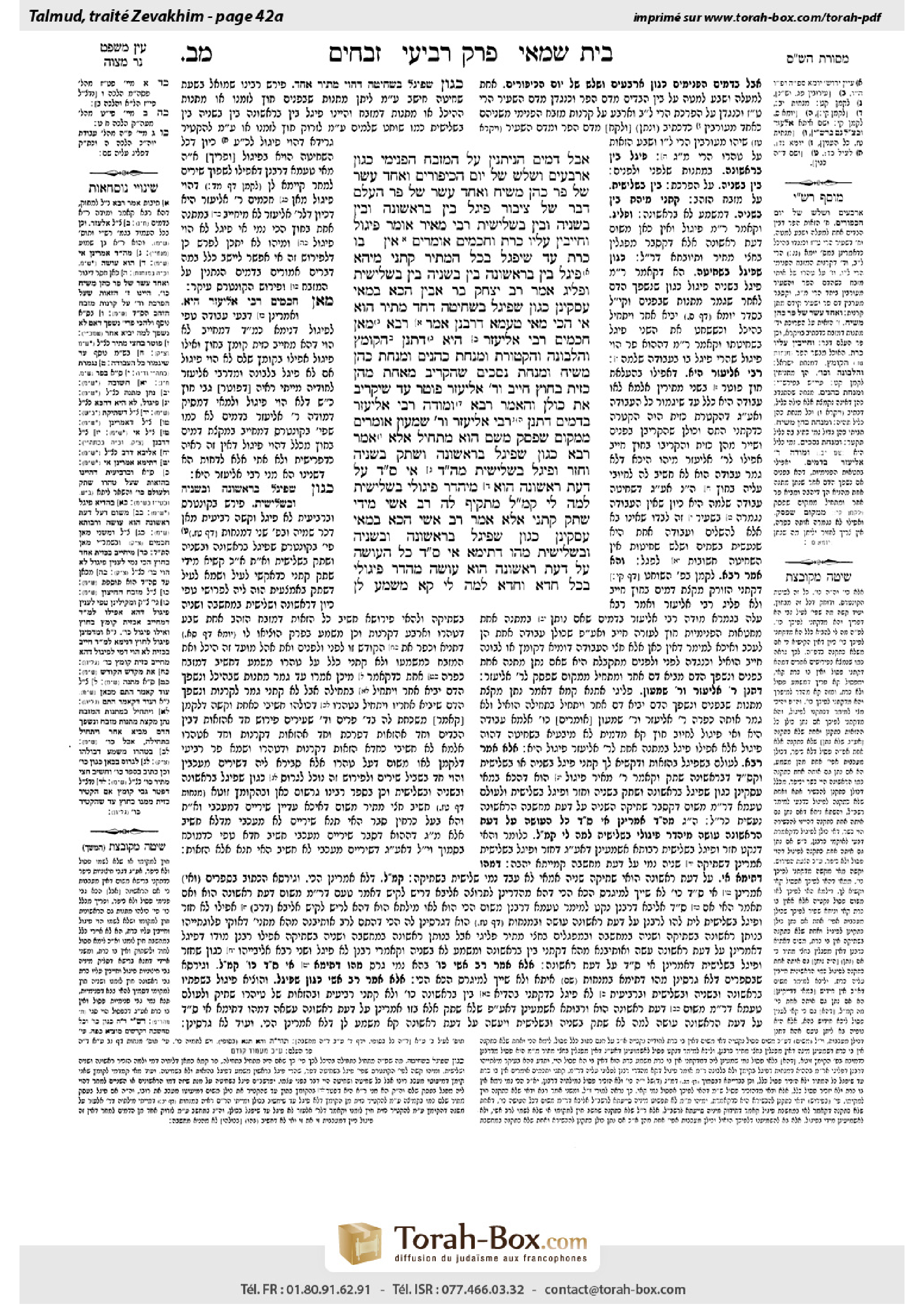
Zevachim 42a: Talmud study for Daf Yomi
Daf Yomi is the daily study of one Talmud folio. Explore 37 tractates with scans, Hebrew text, Sefaria English and AI-generated French translations where annotated.
Passage selection and English or AI-generated French translation are available where the scan has annotations. Daf Study is independent of Torah-Box and Sefaria.
Browse Zevachim · זבחים · All tractatesZevachim 42a text and translations
This page of Zevachim includes the Aramaic text, an English translation and an AI-generated French translation, alongside the scan above.
זבחים מ״ב א · Aramaic and Hebrew text
אֲבָל דָּמִים הַנִּיתָּנִין עַל הַמִּזְבֵּחַ הַפְּנִימִי – כְּגוֹן אַרְבָּעִים וְשָׁלֹשׁ שֶׁל יוֹם הַכִּיפּוּרִים, וְאַחַד עָשָׂר שֶׁל פַּר כֹּהֵן מָשִׁיחַ, וְאַחַד עָשָׂר שֶׁל פַּר הֶעְלֵם דָּבָר שֶׁל צִיבּוּר; פִּיגֵּל בֵּין בָּרִאשׁוֹנָה וּבֵין בַּשְּׁנִיָּה וּבֵין בַּשְּׁלִישִׁית – רַבִּי מֵאִיר אוֹמֵר: פִּיגּוּל, וְחַיָּיבִין עָלָיו כָּרֵת; וַחֲכָמִים אוֹמְרִים: אֵין בּוֹ כָּרֵת עַד שֶׁיְּפַגֵּל בְּכׇל הַמַּתִּיר.
קָתָנֵי מִיהָא פִּיגֵּל בֵּין בָּרִאשׁוֹנָה בֵּין בַּשְּׁנִיָּה בֵּין בַּשְּׁלִישִׁית – וּפְלִיג!
אָמַר רַב יִצְחָק בַּר אָבִין: הָכָא בְּמַאי עָסְקִינַן – כְּגוֹן שֶׁפִּיגֵּל בִּשְׁחִיטָה, דְּחַד מַתִּיר הוּא. אִי הָכִי, מַאי טַעְמָא דְּרַבָּנַן?
אָמַר רָבָא: מַאן חֲכָמִים – רַבִּי אֶלְיעָזָר הִיא. דִּתְנַן: הַקּוֹמֶץ, וְהַלְּבוֹנָה, וְהַקְּטוֹרֶת, וּמִנְחַת כֹּהֲנִים, וּמִנְחַת כֹּהֵן מָשִׁיחַ, וּמִנְחַת נְסָכִים; שֶׁהִקְרִיב מֵאַחַת מֵהֶן כְּזַיִת בַּחוּץ – חַיָּיב. וְרַבִּי אֶלְיעָזָר פּוֹטֵר, עַד שֶׁיַּקְרִיב אֶת כּוּלָּן.
וְהָאָמַר רָבָא: וּמוֹדֶה רַבִּי אֶלְיעָזָר בְּדָמִים; דִּתְנַן, רַבִּי אֶלְיעָזָר וְרַבִּי שִׁמְעוֹן אוֹמְרִים: מִמָּקוֹם שֶׁפָּסַק – מִשָּׁם הוּא מַתְחִיל!
אֶלָּא אָמַר רָבָא: כְּגוֹן שֶׁפִּיגֵּל בָּרִאשׁוֹנָה, וְשָׁתַק בַּשְּׁנִיָּה, וְחָזַר וּפִיגֵּל בַּשְּׁלִישִׁית.
מַהוּ דְּתֵימָא: אִי סָלְקָא דַעְתָּךְ עַל דַּעַת רִאשׁוֹנָה הוּא מִיהְדָּר – פִּיגּוּלֵי בַּשְּׁלִישִׁית לְמָה לִי? קָא מַשְׁמַע לַן. מַתְקֵיף לַהּ רַב אָשֵׁי: מִידֵּי ״שָׁתַק״ קָתָנֵי?!
אֶלָּא אָמַר רַב אָשֵׁי: הָכָא בְּמַאי עָסְקִינַן – כְּגוֹן שֶׁפִּיגֵּל בָּרִאשׁוֹנָה וּבַשְּׁנִיָּה וּבַשְּׁלִישִׁית; מַהוּ דְּתֵימָא: אִי סָלְקָא דַּעְתָּךְ כׇּל הָעוֹשֶׂה עַל דַּעַת רִאשׁוֹנָה הוּא עוֹשֶׂה – מִהְדָּר פִּיגּוּלֵי בְּכֹל חֲדָא וַחֲדָא לְמָה לִי? קָא מַשְׁמַע לַן.
Zevachim 42a · English translation
But with regard to the blood placed inside, i.e., in the Holy of Holies, on the Curtain, and on the inner altar, e.g., the forty-three presentations of the blood of the bull and goat of Yom Kippur, and the eleven presentations of the blood of the bull for an unwitting sin of the anointed priest, and the eleven presentations of the blood of the bull for an unwitting communal sin, if in those cases the priest had an intention that can render the offering piggul, whether during the first set of presentations, whether during the second set, or whether during the third set, i.e., in any of the requisite sets of presentations, Rabbi Meir says: The offering is piggul and one is liable to receive karet for its consumption. And the Rabbis say: There is no liability for karet unless he had an intention that can render the offering piggul during the performance of the entire permitting factor.
In any event, this baraita teaches: If the priest had an intention that can render the offering piggul, whether during the first set of presentations, whether during the second set, or whether during the third set, and yet Rabbi Meir disputes the ruling of the Rabbis and says that the offering is piggul. If the priest’s intent renders the offering piggul whether it was during the first, second, or third set of presentations, evidently Rabbi Meir’s ruling must be based on the consideration that one can render an offering piggul during half a permitting factor. According to Rabbi Shimon ben Lakish’s claim that Rabbi Meir’s reason is that anyone who performs an action performs it with his initial intent, the offering should be piggul only if the first set of presentations was performed with an improper intention while the rest were performed silently.
Rav Yitzḥak bar Avin says: What are we dealing with here? We are not dealing with a case of a priest who had improper intention in the presentations themselves, where the issue of half a permitting factor is relevent. Rather, we are dealing with a case where he had an improper intention that can render the offering piggul during the act of slaughter. In other words, after presenting the blood of the bull inside the Sanctuary, the rest of the blood spilled, and he had to slaughter another bull so that he could continue with the presentations, this time on the Curtain. The reason for Rabbi Meir’s ruling is that the act of slaughter is one permitting factor, and therefore the priest’s improper intent involved an entire service, not half a permitting factor. The Gemara asks: If so, what is the reason for the ruling of the Rabbis?
Rava says: Who are these Rabbis? This is the opinion of Rabbi Eliezer, as we learned in a mishna (109b): With regard to the handful of a meal offering, and the frankincense, and the incense, and the meal offering of priests, and the meal offering of the anointed priest, and the meal offering brought with the libations that accompany animal offerings, in a case where one sacrificed even an olive-bulk from any one of these, which should be sacrificed on the altar, outside the Temple, he is liable, as the burning of an olive-bulk is considered a proper burning. And Rabbi Eliezer deems him exempt unless he sacrifices the whole of any one of these items outside the Temple. This indicates that according to Rabbi Eliezer even when one performs a proper action he is not liable unless he completes the service. The same should apply to the slaughter of different bulls for different sets of presentations; one should be liable only if he rendered each of them piggul.
The Gemara raises a difficulty: How can you explain Rabbi Eliezer’s opinion with regard to the presentation of the blood in this manner? But doesn’t Rava say: And Rabbi Eliezer concedes with regard to blood that even one who sacrifices part of the blood outside the Temple is liable? As we learned in a mishna (Yoma 60a) that Rabbi Eliezer and Rabbi Shimon say: If the blood of the bull or goat of Yom Kippur spilled, even if this occurred in the middle of one of the sets of sprinklings, and the High Priest slaughtered another animal, nevertheless, from the place that he interrupted that particular rite, when the blood spilled, there he resumes performance of that rite. In Rabbi Eliezer’s opinion, each individual sprinkling in each of these rites is an act in and of itself, and therefore the offering can be rendered piggul through any one of them. This is certainly not the opinion of the Rabbis who disagree with Rabbi Meir in the baraita.
Rather, Rava says: Rabbi Shimon ben Lakish would explain that the baraita does not mean that the priest had an improper intention either during the first set of sprinklings or the second or the third. Instead, this is referring to a case where the High Priest had an improper intention that can render the offering piggul during the first set of sprinklings, in the Holy of Holies, and was silent during the second set of sprinklings, on the Curtain, and again had an improper intention that can render the offering piggul during the third set of sprinklings, on the inner altar. There is a certain novelty in this case according to the opinion of Rabbi Meir, who maintains that anyone who performs an action performs it with his initial intent.
Rava elaborates: Lest you say that if it enters your mind that when the priest performs the second set of sprinklings he does so with his initial intent, i.e., that which he had at the time of the first set of sprinklings, why do I need him once again to have an improper intention that can render the offering piggul during the third set of sprinklings? Doesn’t his explicit intent during the third set of sprinklings indicate that he did not have this intent during the second set of sprinklings? Therefore, the baraita teaches us that this is not so, but rather his silence during the second set is considered a continuation of his initial intent. Rav Ashi objects to this: Is it taught that he was silent during the second set of sprinklings? According to Rava’s interpretation this is the key detail of the case, and yet it is not mentioned in the baraita.
Rather, Rav Ashi said: What are we dealing with here? We are dealing with a case where the High Priest had an intention that can render the offering piggul during the first set of sprinklings, in the Holy of Holies, and during the second set, on the Curtain, and during the third, on the corners of the inner altar. But during the fourth set, the sprinklings on the top of the inner altar, he was silent. Lest you say that if it enters your mind to say that anyone who performs an action performs it with his initial intent, why do I need him once again to have an improper intention that can render the offering piggul during each and every set of sprinklings? Therefore, the baraita teaches us that even so he is considered to have performed all the sprinklings with his initial intent.
Zevachim 42a · Traduction française (IA)
Mais, en ce qui concerne le sang appliqué à l’intérieur, c’est-à-dire dans le Saint des Saints, sur le rideau et sur l’autel intérieur — par exemple les quarante-trois applications du sang du taureau et du bouc de Yom Kippour, les onze applications du sang du taureau offert pour une faute involontaire du prêtre oint, et les onze applications du sang du taureau offert pour une faute involontaire de la communauté —, si le prêtre a eu, dans ces cas, une intention susceptible de rendre l’offrande piggoul, que ce soit pendant la première série d’applications, la deuxième ou la troisième, c’est-à-dire pendant n’importe laquelle des séries d’applications requises, Rabbi Meïr dit : l’offrande est piggoul et celui qui en consomme est passible de karet. Les Sages disent : on n’est passible de karet que si le prêtre a eu une intention susceptible de rendre l’offrande piggoul pendant l’accomplissement de la totalité du facteur qui la rend permise.
Quoi qu’il en soit, cette baraïta enseigne que si le prêtre a eu une intention susceptible de rendre l’offrande piggoul, que ce soit pendant la première série d’applications, la deuxième ou la troisième, Rabbi Meïr conteste la décision des Sages et affirme que l’offrande est piggoul. Si, selon Rabbi Meïr, l’intention du prêtre rend l’offrande piggoul qu’elle ait été formulée pendant la première, la deuxième ou la troisième série d’applications, il est évident que sa décision repose sur l’idée qu’une offrande peut devenir piggoul pendant l’accomplissement de la moitié d’un facteur qui la rend permise. Selon l’affirmation de Rabbi Chimon ben Lakich, à savoir que Rabbi Meïr se fonde sur le principe selon lequel quiconque accomplit un acte l’accomplit avec son intention initiale, l’offrande ne devrait être piggoul que si la première série d’applications a été effectuée avec une intention impropre, tandis que les autres l’ont été sans intention particulière.
Rav Yitsḥak bar Avin dit : De quoi s’agit-il ici ? Il ne s’agit pas d’un cas où le prêtre a eu une intention impropre pendant les applications elles-mêmes, cas où se pose la question de la moitié d’un facteur qui rend l’offrande permise. Il s’agit plutôt d’un cas où il a eu, pendant l’abattage, une intention susceptible de rendre l’offrande piggoul. Autrement dit, après avoir appliqué à l’intérieur du Sanctuaire le sang du taureau, le reste du sang s’est répandu et le prêtre a dû abattre un autre taureau afin de pouvoir poursuivre les applications, cette fois sur le rideau. La raison de la décision de Rabbi Meïr est que l’abattage constitue à lui seul un facteur qui rend l’offrande permise ; l’intention impropre du prêtre concernait donc un service entier et non la moitié d’un facteur qui rend l’offrande permise. La Guemara demande : Si tel est le cas, quelle est la raison de la décision des Sages ?
Rava dit : Qui sont ces Sages ? C’est l’opinion de Rabbi Éliézer, comme nous l’avons appris dans une Michna (109b) : En ce qui concerne la poignée d’une offrande de farine, l’encens, l’encens composé, l’offrande de farine des prêtres, l’offrande de farine du prêtre oint et l’offrande de farine apportée avec les libations qui accompagnent les sacrifices animaux, si quelqu’un brûle à l’extérieur du Temple ne serait-ce qu’un volume d’olive de l’un de ces éléments qui doivent être brûlés sur l’autel, il est passible, car la combustion d’un volume d’olive est considérée comme une combustion valable. Rabbi Éliézer le déclare quitte, à moins qu’il ne brûle à l’extérieur du Temple la totalité de l’un de ces éléments. Cela indique que, selon Rabbi Éliézer, même lorsqu’on accomplit un acte valable, on n’est pas passible tant qu’on n’a pas achevé le service. Il devrait en aller de même pour l’abattage de différents taureaux destinés à différentes séries d’applications : on ne devrait être passible que si chacun d’eux a été rendu piggoul.
La Guemara soulève une difficulté : comment expliquer ainsi l’opinion de Rabbi Éliézer concernant l’application du sang ? Rava ne dit-il pas que Rabbi Éliézer reconnaît, en ce qui concerne le sang, que même celui qui en offre une partie à l’extérieur du Temple est passible ? En effet, nous avons appris dans une Michna (Yoma 60a) que Rabbi Éliézer et Rabbi Chimon disent : si le sang du taureau ou du bouc de Yom Kippour s’est répandu, même si cela s’est produit au milieu d’une série d’aspersion, et que le Grand Prêtre a abattu un autre animal, il reprend néanmoins le rite au point où il l’avait interrompu, lorsque le sang s’est répandu. Selon l’opinion de Rabbi Éliézer, chaque aspersion, dans chacun de ces rites, constitue un acte en soi ; l’offrande peut donc devenir piggoul à la suite de n’importe laquelle d’entre elles. Ce n’est certainement pas l’opinion des Sages qui contestent Rabbi Meïr dans la baraïta.
Rava dit plutôt : Rabbi Chimon ben Lakich expliquerait que la baraïta ne signifie pas que le prêtre a eu une intention impropre pendant la première, la deuxième ou la troisième série d’aspersion. Elle parle plutôt d’un cas où le Grand Prêtre a eu, pendant la première série d’aspersion, dans le Saint des Saints, une intention susceptible de rendre l’offrande piggoul, est resté silencieux pendant la deuxième série d’aspersion, sur le rideau, puis a de nouveau eu, pendant la troisième série, sur l’autel intérieur, une intention susceptible de rendre l’offrande piggoul. Ce cas présente une certaine nouveauté selon l’opinion de Rabbi Meïr, qui soutient que quiconque accomplit un acte l’accomplit avec son intention initiale.
Rava développe : De crainte que tu ne dises : si l’on considère que, lorsque le prêtre accomplit la deuxième série d’aspersion, il le fait avec son intention initiale, c’est-à-dire celle qu’il avait au moment de la première série, pourquoi faut-il qu’il ait de nouveau une intention impropre susceptible de rendre l’offrande piggoul pendant la troisième série ? Son intention explicite pendant la troisième série n’indique-t-elle pas qu’il n’avait pas cette intention pendant la deuxième série ? La baraïta nous enseigne donc qu’il n’en est pas ainsi : son silence pendant la deuxième série est considéré comme la continuation de son intention initiale. Rav Achi objecte : Est-il dit qu’il est resté silencieux pendant la deuxième série d’aspersion ? Selon l’interprétation de Rava, c’est là le détail essentiel du cas, et pourtant la baraïta ne le mentionne pas.
Rav Achi dit plutôt : De quoi s’agit-il ici ? Il s’agit d’un cas où le Grand Prêtre a eu une intention susceptible de rendre l’offrande piggoul pendant la première série d’aspersion, dans le Saint des Saints, pendant la deuxième série, sur le rideau, et pendant la troisième, sur les angles de l’autel intérieur. Mais, pendant la quatrième série, celle des aspersions sur le dessus de l’autel intérieur, il est resté silencieux. De crainte que tu ne dises : si l’on considère que quiconque accomplit un acte l’accomplit avec son intention initiale, pourquoi faut-il qu’il ait de nouveau une intention impropre susceptible de rendre l’offrande piggoul pendant chacune des séries d’aspersion ? La baraïta nous enseigne donc que, malgré cela, il est considéré comme ayant accompli toutes les aspersions avec son intention initiale.
Traduction française générée par IA à partir de l’édition anglaise de Sefaria. Vérifie toujours un passage avec le texte source.
Text from Sefaria: William Davidson Edition - Vocalized Aramaic (CC BY NC); William Davidson Edition - English (CC BY NC).