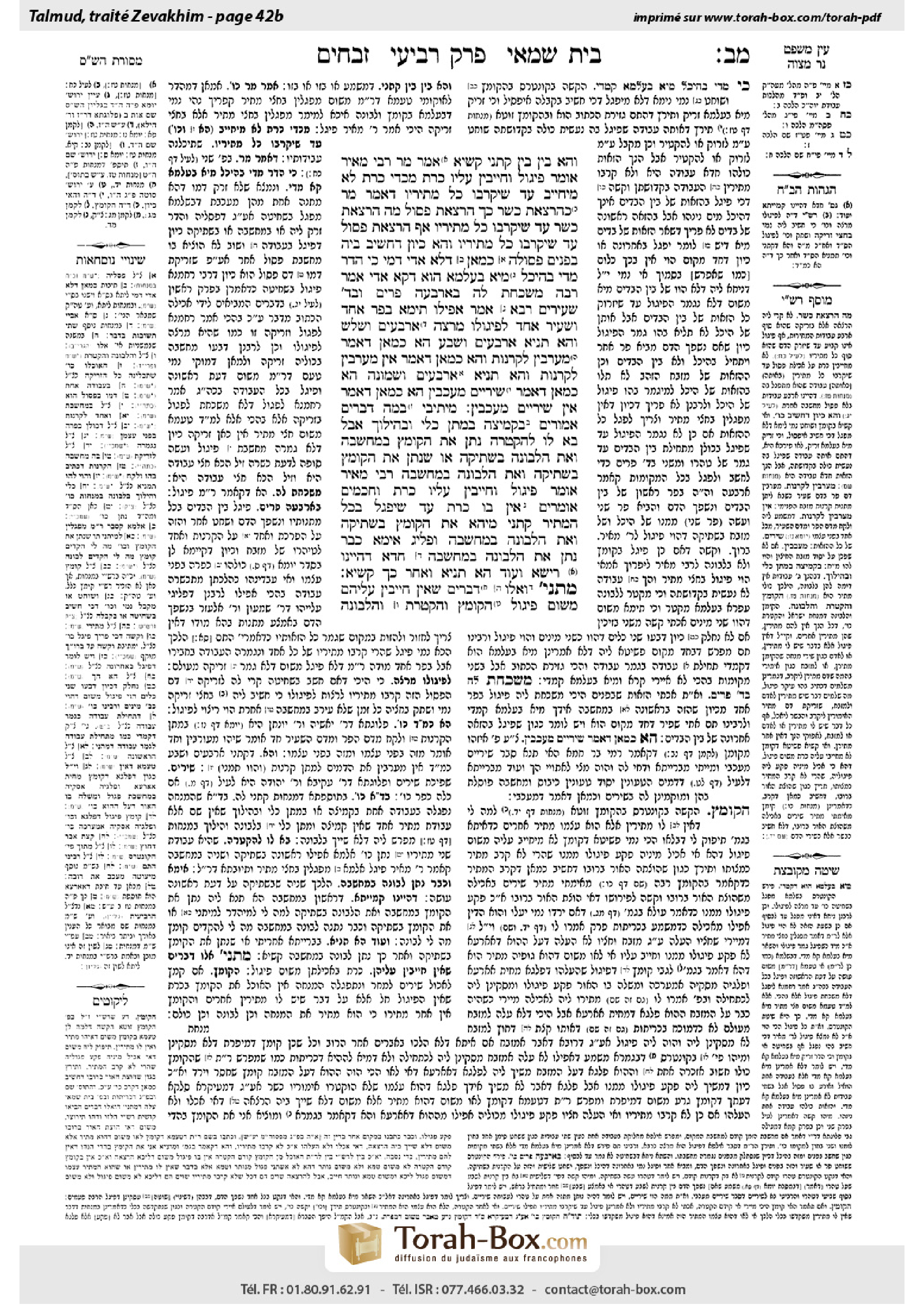
Zevachim 42b: Talmud study for Daf Yomi
Daf Yomi is the daily study of one Talmud folio. Explore 37 tractates with scans, Hebrew text, Sefaria English and AI-generated French translations where annotated.
Passage selection and English or AI-generated French translation are available where the scan has annotations. Daf Study is independent of Torah-Box and Sefaria.
Browse Zevachim · זבחים · All tractatesZevachim 42b text and translations
This page of Zevachim includes the Aramaic text, an English translation and an AI-generated French translation, alongside the scan above.
זבחים מ״ב ב · Aramaic and Hebrew text
וְהָא ״בֵּין בֵּין״ קָתָנֵי! קַשְׁיָא.
אָמַר מָר, רַבִּי מֵאִיר אוֹמֵר: פִּיגּוּל, וְחַיָּיבִין עָלָיו כָּרֵת. מִכְּדֵי כָּרֵת לָא מִיחַיַּיב עַד שֶׁיִּקְרְבוּ כׇּל מַתִּירָיו – דְּאָמַר מָר: כְּהַרְצָאַת כָּשֵׁר כָּךְ הַרְצָאַת פָּסוּל; מָה הַרְצָאַת כָּשֵׁר – עַד שֶׁיִּקְרְבוּ כׇּל מַתִּירָיו, אַף הַרְצָאַת פָּסוּל – עַד שֶׁיִּקְרְבוּ כׇּל מַתִּירָיו.
וְהָא כֵּיוָן דְּחַשֵּׁיב בֵּיהּ בִּפְנִים פְּסוּלָה – כְּמַאן דְּלָא אַדֵּי דָּמֵי; כִּי הָדַר מַדֵּי בַּהֵיכָל – מַיָּא בְּעָלְמָא הוּא דְּקָא מַדֵּי!
אָמַר רַבָּה: מַשְׁכַּחַתְּ לַהּ בְּאַרְבָּעָה פָּרִים וּבְאַרְבָּעָה שְׂעִירִים.
רָבָא אָמַר: אֲפִילּוּ תֵּימָא בְּפַר אֶחָד וְשָׂעִיר אֶחָד, לְפִיגּוּלוֹ מְרַצֶּה.
אַרְבָּעִים וְשָׁלֹשׁ. וְהָא תַּנְיָא אַרְבָּעִים וְשֶׁבַע! הָא כְּמַאן דְּאָמַר מְעָרְבִין לַקְּרָנוֹת, וְהָא כְּמַאן דְּאָמַר אֵין מְעָרְבִין לַקְּרָנוֹת.
וְהָא תַּנְיָא אַרְבָּעִים וּשְׁמוֹנֶה! הָא כְּמַאן דְּאָמַר שִׁירַיִים מְעַכְּבִין, הָא כְּמַאן דְּאָמַר אֵין שִׁירַיִים מְעַכְּבִין.
מֵיתִיבִי: בַּמֶּה דְּבָרִים אֲמוּרִים – בִּקְמִיצָה, בְּמַתַּן כְּלִי וּבְהִילּוּךְ;
אֲבָל בָּא לוֹ לְהַקְטָרָה – נָתַן אֶת הַקּוֹמֶץ בְּמַחְשָׁבָה וְאֶת הַלְּבוֹנָה בִּשְׁתִיקָה, אוֹ שֶׁנָּתַן אֶת הַקּוֹמֶץ בִּשְׁתִיקָה וְאֶת הַלְּבוֹנָה בְּמַחְשָׁבָה – רַבִּי מֵאִיר אוֹמֵר: פִּיגּוּל, וְחַיָּיבִין עָלָיו כָּרֵת. וַחֲכָמִים אוֹמְרִים: אֵין בּוֹ כָּרֵת עַד שֶׁיְּפַגֵּל בְּכׇל הַמַּתִּיר.
קָתָנֵי מִיהָא אֶת הַקּוֹמֶץ בִּשְׁתִיקָה וְאֶת הַלְּבוֹנָה בְּמַחְשָׁבָה – וּפְלִיג! אֵימָא: כְּבָר נָתַן אֶת הַלְּבוֹנָה בְּמַחְשָׁבָה.
חֲדָא, דְּהַיְינוּ רֵישָׁא! וְעוֹד, הָא תַּנְיָא: וְאַחַר כָּךְ! קַשְׁיָא.
מַתְנִי׳ וְאֵלּוּ דְּבָרִים שֶׁאֵין חַיָּיבִין עֲלֵיהֶם מִשּׁוּם פִּיגּוּל – הַקּוֹמֶץ, וְהַקְּטֹרֶת, וְהַלְּבוֹנָה,
Zevachim 42b · English translation
The Gemara raises a difficulty: How can Rav Ashi explain the baraita as referring to a case where the High Priest had an improper intention during the first, second, and third sets of sprinklings? But doesn’t the baraita teach: If the priest had an intention that can render the offering piggul, whether during the first set of presentations, whether during the second set, or whether during the third set? This indicates that he did not have improper intent during all the sprinklings but only in part of them. The Gemara comments: Indeed, this is difficult, as the wording of the baraita does not suit this interpretation.
§ The Gemara returns to discuss the baraita that addresses the blood presented inside the Sanctuary. The Master said that if the High Priest had an improper intention in one of the sets of presentations, e.g., inside the Holy of Holies, Rabbi Meir says: The offering is piggul and one is liable to receive karet for its consumption, despite the fact that he performed the rest of the rite silently. The Gemara asks: Now consider, one is not liable to receive karet unless all the permitting factors of the offering have been sacrificed, i.e., if the whole service is completed, including the presentation of the blood. As the Master said: As is the acceptance of a valid offering, so is the lack of acceptance of a disqualified offering: Just as there is no acceptance of a valid offering unless all its permitting factors have been sacrificed, so too, there is no lack of acceptance of a disqualified offering, i.e., it is not rendered piggul, unless all its permitting factors have been sacrificed. That is to say, in the absence of one of its permitting factors it does not become piggul.
But here, in the case of the bull or goat of Yom Kippur, since he intended to burn the offering beyond its designated time while he was sprinkling the blood inside the Holy of Holies, the sprinkling is not valid, and therefore the High Priest is considered like one who did not sprinkle the blood, as every one of the sprinklings of the blood of an inner sin offering is indispensable. If so, when he sprinkles the blood again later in the Sanctuary, on the Curtain and the inner altar, it is as though he is merely sprinkling water, and not the blood of the offering. Consequently, the permitting factors of the offering have not been sacrificed, and therefore the offering should not be rendered piggul.
Rabba says: You find it in a case of four bulls and of four goats. After sprinkling blood inside the Holy of Holies with the intent to burn the offering beyond its designated time, the blood spilled. Since the priest did not use that blood again, the service inside the Holy of Holies was completed, and that permitting factor was performed properly. He then had to slaughter another bull and goat for the other sprinklings inside the Sanctuary, which he again performed with improper intent and again the blood spilled. The same sequence repeated itself in the sprinklings on the inner altar and on the top of the altar. In this manner each permitting factor was performed properly.
Rava said: You may even say that this is a case where there is only one bull and one goat, as the sprinkling effects acceptance with regard to the offering’s status of piggul. In other words, even though the High Priest sprinkled the blood inside the Holy of Holies with an improper intention, and thereby disqualified the offering, nevertheless, since he completed the service, he is considered as having sacrificed all the permitting factors with regard to piggul.
§ The baraita mentioned that there are forty-three presentations of the blood of the bull and the goat of Yom Kippur. The Gemara asks: But isn’t it taught otherwise in a different baraita, that there are forty-seven presentations of that blood? The Gemara answers: This statement, that there are forty-three presentations, is in accordance with the opinion of the one who says that the High Priest mixes the blood of the bull and the goat before placing it on the corners of the inner altar, rather than placing the blood of each one separately. And that statement, that there are forty-seven presentations, is in accordance with the opinion of the one who says that the High Priest does not mix the two types of blood before placing them on the corners, but sprinkles four times from the blood of the bull and another four times from the blood of the goat, and only afterward mixes the blood of the two animals for placement on the top of the altar.
The Gemara raises another difficulty: But isn’t it taught in yet another baraita that there are forty-eight presentations? The Gemara answers: This statement, that there are forty-eight presentations, is in accordance with the opinion of the one who says that the pouring of the remainder of the blood on the base of the external altar is indispensable, and therefore this act is added to the total. That statement, that there are only forty-seven presentations, is in accordance with the opinion of the one who says that the pouring of the remainder of the blood is not indispensable.
The Gemara raises an objection to Rabbi Shimon ben Lakish’s understanding of Rabbi Meir’s opinion, that one cannot render an offering piggul with an improper intention during the performance of half a permitting factor, from a baraita discussing piggul of a meal offering, which states: In what case is this statement said, i.e., that if the priest had an improper intention during the performance of one of its services, the offering is piggul, despite the fact that he performed the rest of the services silently? When he had the improper intention in the removal of the handful, or in the placement of the handful in a service vessel, or in the walking with the handful to the altar.
But if he came to perform the burning of the handful and the frankincense, and he presented the handful on the altar with an improper intention and the frankincense he presented silently, or he presented the handful silently and the frankincense he presented with an improper intention, Rabbi Meir says: The offering is piggul and one is liable to receive karet for consuming it. And the Rabbis say: There is no liablility to receive karet unless the priest had an improper intention that can render the offering piggul during the performance of the entire permitting factor.
In any event, this baraita teaches: Or he presented the handful silently and the frankincense he presented with an improper intention, and yet Rabbi Meir disagrees with the ruling of the Rabbis and says that the offering is piggul. This indicates that the decisive factor according to Rabbi Meir is not that the priest continues his initial intent, but that one can render an offering piggul during the performance of half a permitting factor. The Gemara answers: Say and explain the baraita as follows: Or he presented the handful silently after he had already presented the frankincense with an improper intention. In this case the offering is piggul because he performed the second action with his initial intent.
The Gemara refutes this interpretation: One counterclaim is that if this is what the baraita is saying, this is exactly the same case as the first clause. And furthermore, isn’t it taught explicitly in another baraita: And afterward he presented the frankincense with an improper intention. The Gemara states: Indeed, this is difficult for the opinion of Rabbi Shimon ben Lakish, who claims that according to Rabbi Meir one cannot render an offering piggul during the performance of half a permitting factor.
MISHNA: And these are the items for which one is not liable to receive karet due to violation of the prohibition of piggul. One is liable to receive karet only if he partakes of an item that was permitted for consumption or for the altar by another item. As for the items listed here, either nothing else renders them permitted for consumption or for the altar, or they themselves render other items permitted. They are as follows: The handful of flour, which permits consumption of the meal offering; the incense, which is burned in its entirety, without another item rendering it permitted for the altar; the frankincense, which is burned together with the handful of the meal offering;
Zevachim 42b · Traduction française (IA)
La Guemara soulève une difficulté : comment Rav Ashi peut-il expliquer la baraïta comme portant sur un cas où le grand prêtre a eu une intention impropre pendant les première, deuxième et troisième séries d’aspersion ? La baraïta n’enseigne-t-elle pas : « Si le prêtre a eu une intention susceptible de rendre l’offrande piggul, que ce soit pendant la première série de présentations, pendant la deuxième série ou pendant la troisième série » ? Cela indique qu’il n’a pas eu d’intention impropre pendant toutes les aspersions, mais seulement pendant certaines d’entre elles. La Guemara fait remarquer : En effet, cela pose une difficulté, car la formulation de la baraïta ne convient pas à cette interprétation.
§ La Guemara revient sur la baraïta qui traite du sang présenté à l’intérieur du Sanctuaire. Le Maître a dit que si le grand prêtre a eu une intention impropre pendant l’une des séries de présentations, par exemple à l’intérieur du Saint des saints, Rabbi Meïr dit : « L’offrande est piggul et l’on est passible de karet pour en consommer », bien qu’il ait accompli le reste du rite sans intention particulière. La Guemara demande : Or, on n’est passible de karet que si tous les facteurs qui rendent l’offrande apte ont été sacrifiés, c’est-à-dire lorsque tout le service est achevé, y compris la présentation du sang. Car le Maître a dit : « De même que l’acceptation d’une offrande valide dépend de l’accomplissement de tous ses facteurs, de même le défaut d’acceptation d’une offrande disqualifiée : tout comme une offrande valide n’est pas acceptée tant que tous les facteurs qui la rendent apte n’ont pas été accomplis, une offrande disqualifiée n’est pas non plus rejetée, c’est-à-dire qu’elle n’est pas rendue piggul, tant que tous les facteurs qui la rendent apte n’ont pas été accomplis. » Autrement dit, en l’absence de l’un de ces facteurs, elle ne devient pas piggul.
Mais ici, dans le cas du taureau ou du bouc de Yom Kippour, puisqu’il a eu l’intention de brûler l’offrande après le délai qui lui était assigné alors qu’il aspergeait le sang à l’intérieur du Saint des saints, l’aspersion n’est pas valide. Le grand prêtre est donc considéré comme n’ayant pas aspergé le sang, puisque chacune des aspersions du sang d’un sacrifice expiatoire intérieur est indispensable. Dès lors, lorsqu’il asperge ensuite le sang dans le Sanctuaire, sur le rideau et sur l’autel intérieur, c’est comme s’il ne faisait qu’asperger de l’eau, et non le sang de l’offrande. Par conséquent, les facteurs qui rendent l’offrande apte n’ont pas été accomplis, et l’offrande ne devrait donc pas être rendue piggul.
Rabba dit : On peut expliquer cela dans le cas de quatre taureaux et de quatre boucs. Après avoir aspergé le sang à l’intérieur du Saint des saints avec l’intention de brûler l’offrande après le délai qui lui était assigné, le sang s’est répandu. Comme le prêtre n’a pas réutilisé ce sang, le service à l’intérieur du Saint des saints était achevé, et ce facteur qui rend l’offrande apte avait été accompli correctement. Il a alors dû abattre un autre taureau et un autre bouc pour les autres aspersions dans le Sanctuaire. Il les a de nouveau accomplies avec une intention impropre, et le sang s’est de nouveau répandu. La même séquence s’est répétée pour les aspersions sur l’autel intérieur et sur le sommet de l’autel. Ainsi, chacun des facteurs qui rendent l’offrande apte a été accompli correctement.
Rava dit : On peut même dire qu’il s’agit d’un cas où il n’y a qu’un seul taureau et un seul bouc, car l’aspersion produit un effet d’acceptation quant au statut de piggul de l’offrande. Autrement dit, bien que le grand prêtre ait aspergé le sang à l’intérieur du Saint des saints avec une intention impropre et ait ainsi disqualifié l’offrande, puisqu’il a néanmoins achevé le service, il est considéré comme ayant accompli tous les facteurs qui rendent l’offrande apte, en ce qui concerne le piggul.
§ La baraïta a mentionné qu’il y a quarante-trois présentations du sang du taureau et du bouc de Yom Kippour. La Guemara demande : Mais une autre baraïta n’enseigne-t-elle pas qu’il y a quarante-sept présentations de ce sang ? La Guemara répond : L’affirmation selon laquelle il y a quarante-trois présentations suit l’opinion de celui qui dit que le grand prêtre mélange le sang du taureau et celui du bouc avant de l’appliquer sur les angles de l’autel intérieur, au lieu d’appliquer séparément le sang de chacun. L’affirmation selon laquelle il y a quarante-sept présentations suit l’opinion de celui qui dit que le grand prêtre ne mélange pas les deux sangs avant de les appliquer sur les angles, mais asperge quatre fois avec le sang du taureau, puis quatre fois avec celui du bouc, et ne mélange les sangs des deux animaux qu’ensuite, pour les appliquer sur le sommet de l’autel.
La Guemara soulève une autre difficulté : Mais une autre baraïta n’enseigne-t-elle pas qu’il y a quarante-huit présentations ? La Guemara répond : L’affirmation selon laquelle il y a quarante-huit présentations suit l’opinion de celui qui dit que le déversement du reste du sang à la base de l’autel extérieur est indispensable ; cet acte est donc ajouté au total. L’affirmation selon laquelle il n’y a que quarante-sept présentations suit l’opinion de celui qui dit que le déversement du reste du sang n’est pas indispensable.
La Guemara soulève une objection contre l’interprétation que Rabbi Shimon ben Lakish donne de l’opinion de Rabbi Meïr, selon laquelle on ne peut pas rendre une offrande piggul par une intention impropre pendant l’accomplissement de la moitié d’un facteur qui la rend apte. Elle s’appuie sur une baraïta traitant du piggul d’une offrande végétale, qui enseigne : « Dans quel cas cette affirmation est-elle énoncée » — à savoir, que si le prêtre a eu une intention impropre pendant l’accomplissement de l’un de ses services, l’offrande est piggul, bien qu’il ait accompli les autres services sans intention particulière ? « Lorsqu’il a eu une intention impropre pendant le prélèvement de la poignée, pendant le dépôt de la poignée dans un ustensile de service, ou pendant le transport de la poignée jusqu’à l’autel. »
Mais s’il s’est présenté pour accomplir la combustion de la poignée et de l’encens, et qu’il a appliqué la poignée sur l’autel avec une intention impropre tandis qu’il a appliqué l’encens sans intention particulière, ou qu’il a appliqué la poignée sans intention particulière tandis qu’il a appliqué l’encens avec une intention impropre, Rabbi Meïr dit : « L’offrande est piggul et l’on est passible de karet pour en consommer. » Et les Sages disent : « On n’est passible de karet que si le prêtre a eu une intention impropre susceptible de rendre l’offrande piggul pendant l’accomplissement de la totalité du facteur qui la rend apte. »
En tout état de cause, cette baraïta enseigne : « Ou bien il a appliqué la poignée sans intention particulière et a appliqué l’encens avec une intention impropre » ; pourtant, Rabbi Meïr contredit la décision des Sages et dit que l’offrande est piggul. Cela indique que, selon Rabbi Meïr, le facteur décisif n’est pas que le prêtre poursuive son intention initiale, mais qu’on puisse rendre une offrande piggul pendant l’accomplissement de la moitié d’un facteur qui la rend apte. La Guemara répond : Il faut dire et expliquer la baraïta ainsi : « Ou bien il a appliqué la poignée sans intention particulière après avoir déjà appliqué l’encens avec une intention impropre. » Dans ce cas, l’offrande est piggul, car il a accompli la seconde action avec son intention initiale.
La Guemara réfute cette interprétation : une première objection est que, si tel était le sens de la baraïta, ce serait exactement le même cas que celui de la première clause. En outre, une autre baraïta n’enseigne-t-elle pas explicitement : « Et ensuite, il a appliqué l’encens avec une intention impropre » ? La Guemara déclare : En effet, cela pose une difficulté pour l’opinion de Rabbi Shimon ben Lakish, qui soutient que, selon Rabbi Meïr, on ne peut pas rendre une offrande piggul pendant l’accomplissement de la moitié d’un facteur qui la rend apte.
MICHNA : Voici les éléments dont la consommation ne rend pas passible de karet pour transgression de l’interdit du piggul. On n’est passible de karet que si l’on consomme un élément dont la consommation ou l’usage sur l’autel a été rendu permis par un autre élément. Quant aux éléments énumérés ici, soit aucun autre élément ne rend leur consommation ou leur usage sur l’autel permis, soit ce sont eux-mêmes qui rendent d’autres éléments permis. Les voici : la poignée de farine, qui permet la consommation de l’offrande végétale ; l’encens, qui est brûlé en entier sans qu’un autre élément rende son usage sur l’autel permis ; l’oliban, qui est brûlé avec la poignée de l’offrande végétale ;
Traduction française générée par IA à partir de l’édition anglaise de Sefaria. Vérifie toujours un passage avec le texte source.
Text from Sefaria: William Davidson Edition - Vocalized Aramaic (CC BY NC); William Davidson Edition - English (CC BY NC).