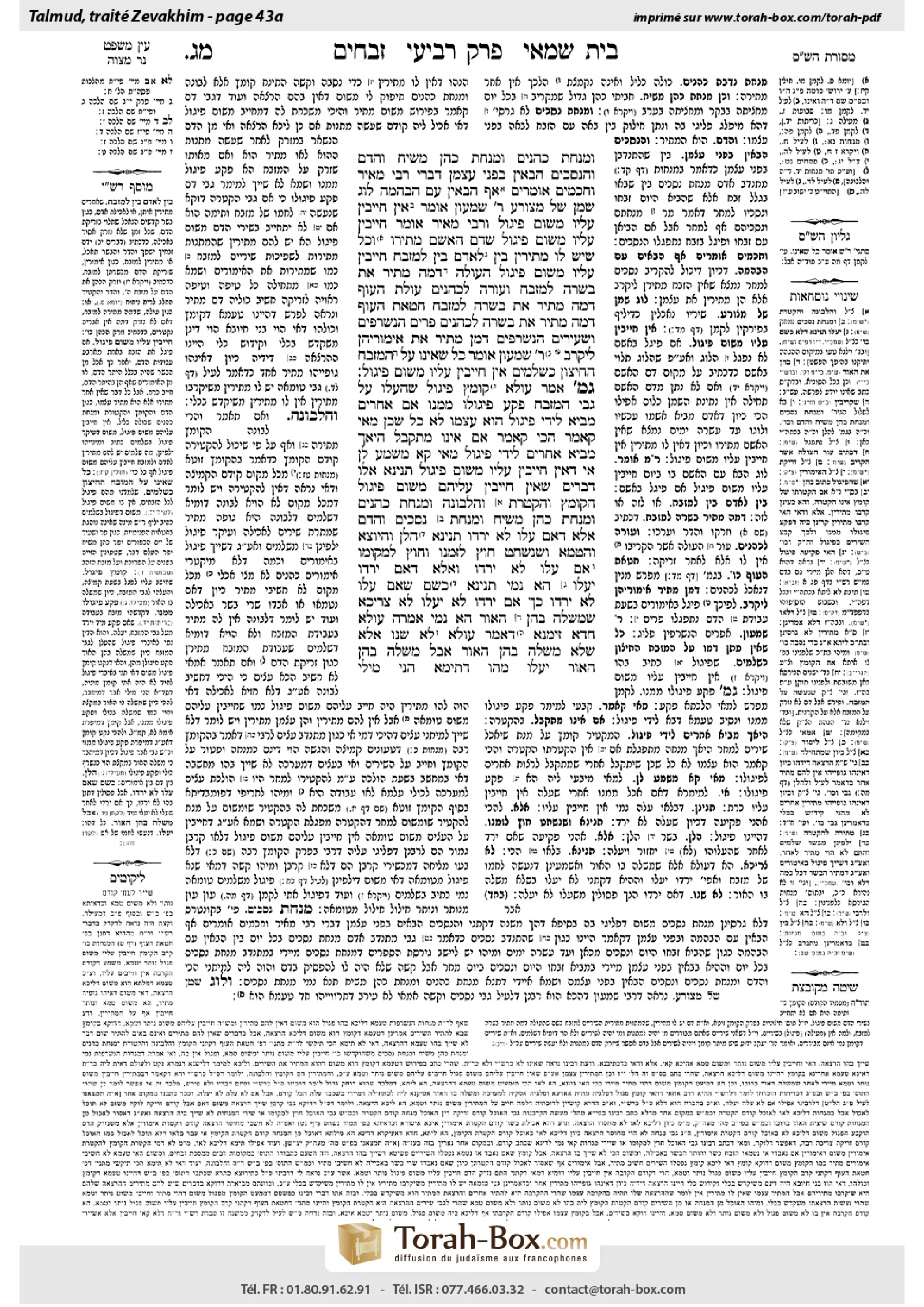
Zevachim 43a: Talmud study for Daf Yomi
Daf Yomi is the daily study of one Talmud folio. Explore 37 tractates with scans, Hebrew text, Sefaria English and AI-generated French translations where annotated.
Passage selection and English or AI-generated French translation are available where the scan has annotations. Daf Study is independent of Torah-Box and Sefaria.
Browse Zevachim · זבחים · All tractatesZevachim 43a text and translations
This page of Zevachim includes the Aramaic text, an English translation and an AI-generated French translation, alongside the scan above.
זבחים מ״ג א · Aramaic and Hebrew text
וּמִנְחַת כֹּהֲנִים, וּמִנְחַת כֹּהֵן מָשִׁיחַ, וְהַדָּם, וְהַנְּסָכִים הַבָּאִין בִּפְנֵי עַצְמָן. דִּבְרֵי רַבִּי מֵאִיר. וַחֲכָמִים אוֹמְרִים: אַף הַבָּאִין עִם הַבְּהֵמָה.
לוֹג שֶׁמֶן שֶׁל מְצוֹרָע – רַבִּי שִׁמְעוֹן אוֹמֵר: אֵין חַיָּיבִין עָלָיו מִשּׁוּם פִּיגּוּל, וְרַבִּי מֵאִיר אוֹמֵר: חַיָּיבִין עָלָיו מִשּׁוּם פִּיגּוּל; שֶׁדַּם הָאָשָׁם מַתִּירוֹ, וְכׇל שֶׁיֵּשׁ לוֹ מַתִּירִין בֵּין לָאָדָם בֵּין לַמִּזְבֵּחַ – חַיָּיבִין עָלָיו מִשּׁוּם פִּיגּוּל.
הָעוֹלָה – דָּמָהּ מַתִּיר אֶת בְּשָׂרָהּ לַמִּזְבֵּחַ וְעוֹרָהּ לַכֹּהֲנִים. עוֹלַת הָעוֹף – דָּמָהּ מַתִּיר אֶת בְּשָׂרָהּ לְמִזְבֵּחַ. חַטַּאת הָעוֹף – דָּמָהּ מַתִּיר אֶת בְּשָׂרָהּ לַכֹּהֲנִים. פָּרִים הַנִּשְׂרָפִים וּשְׂעִירִים הַנִּשְׂרָפִים – דָּמָן מַתִּיר אֶת אֵימוּרֵיהֶן לִיקָרֵב.
רַבִּי שִׁמְעוֹן אוֹמֵר: כֹּל שֶׁאֵינוֹ עַל הַמִּזְבֵּחַ הַחִיצוֹן כִּשְׁלָמִים, אֵין חַיָּיבִין עָלָיו מִשּׁוּם פִּיגּוּל.
גְּמָ׳ אָמַר עוּלָּא: קוֹמֶץ פִּיגּוּל שֶׁהֶעֱלוֹ עַל גַּבֵּי הַמִּזְבֵּחַ – פָּקַע פִּיגּוּלוֹ מִמֶּנּוּ; אִם אֲחֵרִים מֵבִיא לִידֵי פִּיגּוּל, הוּא עַצְמוֹ לֹא כׇּל שֶׁכֵּן?! מַאי קָאָמַר? הָכִי קָאָמַר: אִם אֵינוֹ מִתְקַבֵּל, הֵיאַךְ מֵבִיא אֲחֵרִים לִידֵי פִּיגּוּל?
מַאי קָא מַשְׁמַע לַן? אִי דְּאֵין חַיָּיבִין עָלָיו מִשּׁוּם פִּיגּוּל – תְּנֵינָא, אֵלּוּ דְּבָרִים שֶׁאֵין חַיָּיבִין עֲלֵיהֶם מִשּׁוּם פִּיגּוּל: הַקּוֹמֶץ, וְהַקְּטֹרֶת, וְהַלְּבוֹנָה, וּמִנְחַת כֹּהֲנִים, וּמִנְחַת כֹּהֵן מָשִׁיחַ, וּמִנְחַת נְסָכִים, וְהַדָּם!
אֶלָּא דְּאִם עָלוּ לֹא יֵרְדוּ – תְּנֵינָא: הַלָּן, וְהַיּוֹצֵא, וְהַטָּמֵא, וְשֶׁנִּשְׁחַט חוּץ לִזְמַנּוֹ וְחוּץ לִמְקוֹמוֹ – אִם עָלוּ לֹא יֵרְדוּ!
וְאֶלָּא דְּאִם יֵרְדוּ יַעֲלוּ – הָא נָמֵי תְּנֵינָא: כְּשֵׁם שֶׁאִם עָלוּ לֹא יֵרְדוּ, כָּךְ אִם יֵרְדוּ לֹא יַעֲלוּ! לָא צְרִיכָא, שֶׁמָּשְׁלָה בָּהֶן הָאוּר.
הָא נָמֵי אַמְרַהּ עוּלָּא חֲדָא זִימְנָא, דְּאָמַר עוּלָּא: לֹא שָׁנוּ אֶלָּא שֶׁלֹּא מָשְׁלָה בָּהֶן הָאוּר, אֲבָל מָשְׁלָה בָּהֶן הָאוּר – יַעֲלוּ!
Zevachim 43a · English translation
the meal offering of priests, from which no handful of flour is removed and which is burned in its entirety (see Leviticus 6:16); the meal offering of the anointed priest, which is sacrificed by the High Priest each day, half in the morning and half in the evening; the blood, which permits all the offerings; and the libations that are brought by themselves as a separate offering and do not accompany an animal offering; this is the statement of Rabbi Meir. And the Rabbis say: The same halakha applies even with regard to libations that are brought with an animal offering.
With regard to the log of oil that accompanies the guilt offering of a recovered leper, Rabbi Shimon says: One is not liable for consuming it due to violation of the prohibition of piggul, because it is not permitted by any other item. And Rabbi Meir says: One is liable for consuming it due to violation of the prohibition of piggul, as the blood of the guilt offering of the leper permits its use, as only after the blood’s sacrifice is the oil sprinkled and given to the priests. And the principle is: With regard to any item that has permitting factors, either for consumption by a person or for burning on the altar, one is liable for eating it due to violation of the prohibition of piggul.
The mishna elaborates: The burnt offering, its blood permits its flesh to be burned on the altar and its hide to be used by the priests. The bird burnt offering, its blood permits its flesh and its skin to be burned on the altar. The bird sin offering, its blood permits its meat for consumption by the priests. Bulls that are burned, e.g., the bull for an unwitting communal sin, and goats that are burned, e.g., the goats sacrificed for an unwitting communal sin of idol worship, their blood permits their sacrificial portions to be sacrificed on the altar.
Rabbi Shimon says: Those bulls and goats are not subject to piggul because their blood is presented in the Sanctuary, and in the case of any offering whose blood is not presented on the external altar like that of a peace offering, with regard to which the halakha of piggul was stated in the Torah, one is not liable for eating it due to violation of the prohibition of piggul.
GEMARA: Ulla says: With regard to a handful of a meal offering that is piggul that was offered up on the altar, its piggul status has left it. His reasoning is as follows: If this handful brings other items to a status of piggul, with regard to itself is it not all the more so? The Gemara asks: What is Ulla saying? This consideration does not explain why the status of piggul should leave the handful. The Gemara answers that this is what he is saying: If the handful is not accepted, i.e., if its sacrifice is disqualified, how can it bring other items to a status of piggul? A meal offering is considered piggul only if its handful is properly sacrificed.
The Gemara asks: What is Ulla teaching us? If he is teaching us that one is not liable for eating the handful due to violation of the prohibition of piggul, we learn this in the mishna: These are the items for which one is not liable due to piggul: The handful, the incense, the frankincense, the meal offering of priests, the meal offering of the anointed priest, the meal offering brought with the libations that accompany animal offerings, and the blood. If so, one is not liable for eating the handful even if it was not offered up on the altar.
Rather, Ulla is teaching that if items with piggul status ascended the altar, they shall not descend. But this too, we learn in a mishna (84a): With regard to sacrificial flesh that is left overnight, or that emerges from the Temple courtyard, or that is ritually impure, or an offering that was slaughtered with the intention of eating the meat beyond its designated time or outside its designated area, thereby acquiring the status of piggul, if any one of these ascended the altar they shall not descend.
Rather, Ulla is teaching that if items with piggul status descended from the altar after having been brought up there, they ascend once again. But we also learn in that same mishna (84b) that this is not so: Just as if they ascended the altar, they shall not descend, so too, if they descended from the altar they shall not ascend. The Gemara answers: No, Ulla’s ruling is necessary in a case where the fire has already taken hold of it, i.e., the handful began to burn before it came down from the altar. Ulla teaches that in such a case the priests should return the handful to the altar, as its piggul status has already left it.
The Gemara raises a difficulty: But this halakha too, Ulla already said it on another occasion. As Ulla says: The mishna taught that items that descended from the altar shall not ascend again only where the fire has not taken hold of them, but where the fire has already taken hold of them, they shall ascend. The Gemara explains: Even so, there is a novelty in Ulla’s ruling: Lest you say that this matter applies only
Zevachim 43a · Traduction française (IA)
l’offrande de farine des prêtres, dont on ne prélève aucune poignée et qui est entièrement brûlée (voir Lévitique 6:16) ; l’offrande de farine du prêtre oint, que le Grand Prêtre offre chaque jour, pour moitié le matin et pour moitié le soir ; le sang, qui rend toutes les offrandes permises ; et les libations apportées séparément, sans accompagner d’offrande animale : telle est l’opinion de Rabbi Meïr. Les Sages disent : la même halakha s’applique aussi aux libations apportées avec une offrande animale.
Au sujet du log d’huile qui accompagne le sacrifice de culpabilité du lépreux guéri, Rabbi Shimon dit : on n’est pas passible pour sa consommation au titre de l’interdiction de piggoul, car aucun autre élément ne le rend permis. Rabbi Meïr dit : on est passible pour sa consommation au titre de l’interdiction de piggoul, car le sang du sacrifice de culpabilité du lépreux en autorise l’usage ; en effet, ce n’est qu’après que le sang a été offert que l’huile est aspergée et remise aux prêtres. Le principe est le suivant : pour tout élément dont la consommation ou la combustion sur l’autel est rendue permise par des facteurs autorisants, on est passible pour sa consommation au titre de l’interdiction de piggoul.
La Michna développe : dans le cas de l’holocauste, son sang rend sa chair propre à être brûlée sur l’autel et sa peau propre à être utilisée par les prêtres. Dans le cas de l’holocauste d’oiseau, son sang rend sa chair et sa peau propres à être brûlées sur l’autel. Dans le cas du sacrifice expiatoire d’oiseau, son sang rend sa viande propre à la consommation des prêtres. Pour les taureaux destinés à être brûlés, par exemple le taureau offert pour une faute involontaire de la communauté, et les boucs destinés à être brûlés, par exemple les boucs sacrifiés pour une faute involontaire de la communauté liée au culte idolâtre, leur sang rend leurs parts sacrificielles propres à être offertes sur l’autel.
Rabbi Shimon dit : ces taureaux et ces boucs ne sont pas soumis au piggoul, car leur sang est présenté dans le Sanctuaire. Pour toute offrande dont le sang n’est pas présenté sur l’autel extérieur, comme celui d’une offrande de paix — à propos de laquelle la Torah a énoncé la halakha du piggoul —, on n’est pas passible pour sa consommation au titre de l’interdiction de piggoul.
GUEMARA : Oula dit : lorsqu’une poignée d’offrande de farine ayant le statut de piggoul est offerte sur l’autel, son statut de piggoul disparaît. Voici son raisonnement : si cette poignée confère le statut de piggoul à d’autres éléments, à plus forte raison en va-t-il ainsi pour elle-même. La Guemara demande : que veut dire Oula ? Cette considération n’explique pas pourquoi le statut de piggoul devrait disparaître de la poignée. La Guemara répond qu’il veut dire ceci : si la poignée n’est pas agréée, c’est-à-dire si son sacrifice est invalidé, comment pourrait-elle conférer à d’autres éléments le statut de piggoul ? Une offrande de farine n’est considérée comme piggoul que si sa poignée est offerte comme il se doit.
La Guemara demande : qu’est-ce qu’Oula nous apprend ? S’il veut nous apprendre qu’on n’est pas passible pour la consommation de la poignée au titre de l’interdiction de piggoul, nous l’apprenons de la Michna : voici les éléments dont la consommation n’entraîne pas de responsabilité au titre du piggoul : la poignée, l’encens, l’oliban, l’offrande de farine des prêtres, l’offrande de farine du prêtre oint, l’offrande de farine apportée avec les libations qui accompagnent les offrandes animales, et le sang. Dans ce cas, on n’est pas passible pour la consommation de la poignée, même si elle n’a pas été offerte sur l’autel.
Oula enseigne plutôt que si des éléments ayant le statut de piggoul sont montés sur l’autel, ils ne doivent pas en descendre. Mais cela aussi, nous l’apprenons d’une Michna (84a) : si de la chair sacrificielle ayant passé la nuit, ayant quitté l’enceinte du Temple ou rituellement impure, ou encore une offrande abattue avec l’intention d’en manger la viande au-delà du délai qui lui est assigné ou hors de l’endroit prescrit, acquérant ainsi le statut de piggoul, est montée sur l’autel, elle ne doit pas en descendre.
Oula enseigne plutôt que si des éléments ayant le statut de piggoul sont descendus de l’autel après y avoir été apportés, ils y remontent. Mais nous apprenons aussi dans cette même Michna (84b) qu’il n’en est rien : de même que s’ils sont montés sur l’autel, ils ne doivent pas en descendre, de même, s’ils en sont descendus, ils ne doivent pas y remonter. La Guemara répond : non, la décision d’Oula est nécessaire dans un cas où le feu s’en est déjà emparé, c’est-à-dire où la poignée a commencé à brûler avant de tomber de l’autel. Oula enseigne que, dans un tel cas, les prêtres doivent remettre la poignée sur l’autel, car son statut de piggoul a déjà disparu.
La Guemara soulève une difficulté : mais cette halakha aussi, Oula l’a déjà énoncée à une autre occasion. En effet, Oula dit : la Michna enseigne que les éléments descendus de l’autel ne doivent pas y remonter seulement lorsque le feu ne s’en est pas emparé ; mais si le feu s’en est déjà emparé, ils doivent y remonter. La Guemara explique : malgré cela, la décision d’Oula apporte une nouveauté : de peur que tu ne dises que cette règle ne s’applique qu’
Traduction française générée par IA à partir de l’édition anglaise de Sefaria. Vérifie toujours un passage avec le texte source.
Text from Sefaria: William Davidson Edition - Vocalized Aramaic (CC BY NC); William Davidson Edition - English (CC BY NC).