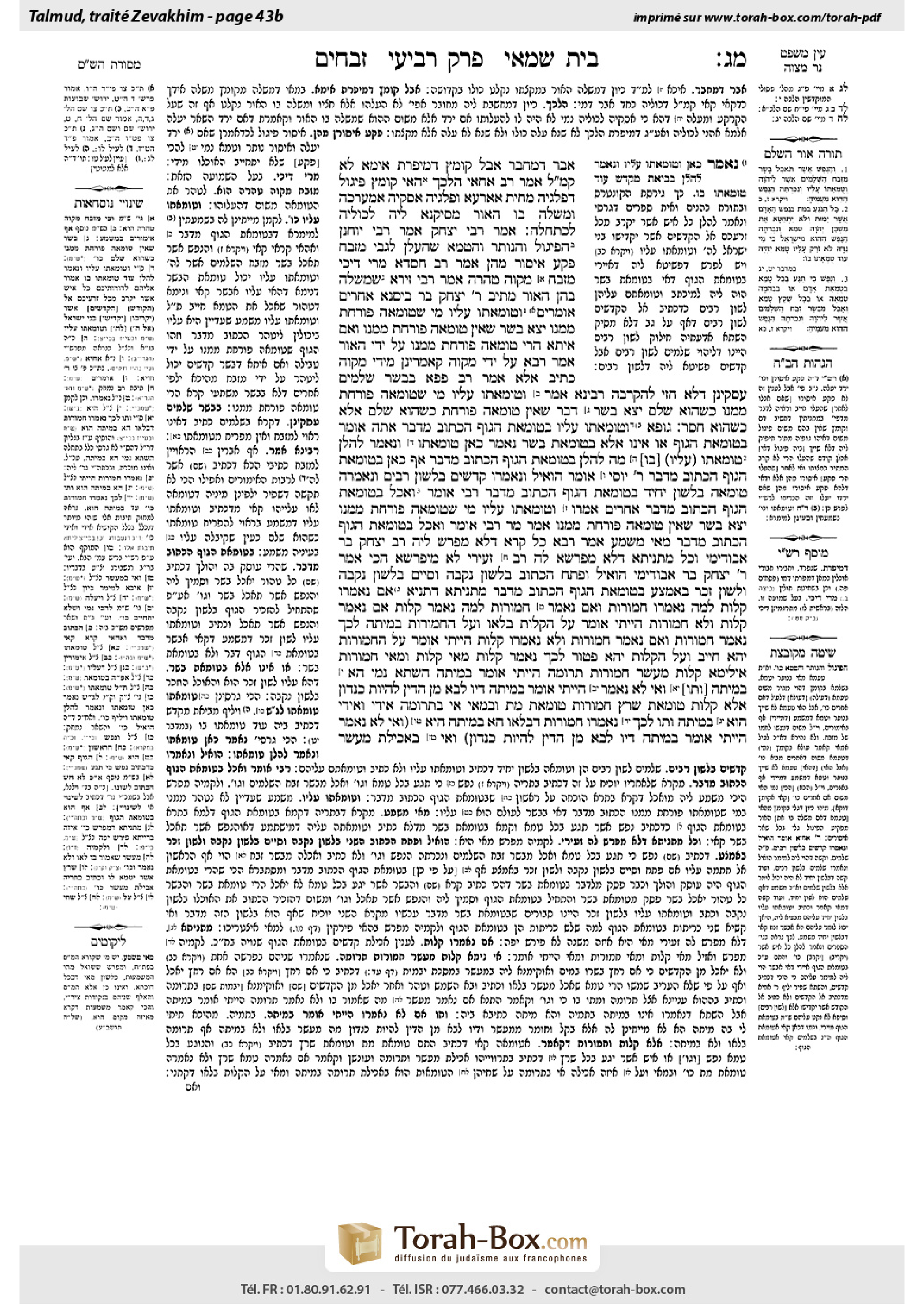
Zevachim 43b: Talmud study for Daf Yomi
Daf Yomi is the daily study of one Talmud folio. Explore 37 tractates with scans, Hebrew text, Sefaria English and AI-generated French translations where annotated.
Passage selection and English or AI-generated French translation are available where the scan has annotations. Daf Study is independent of Torah-Box and Sefaria.
Browse Zevachim · זבחים · All tractatesZevachim 43b text and translations
This page of Zevachim includes the Aramaic text, an English translation and an AI-generated French translation, alongside the scan above.
זבחים מ״ג ב · Aramaic and Hebrew text
מַהוּ דְּתֵימָא: הָנֵי מִילֵּי אֵבֶר – דִּמְחַבַּר; אֲבָל קוֹמֶץ, דְּמִיפְּרַת – אֵימָא לָא; קָא מַשְׁמַע לַן.
אָמַר רַב אַחַאי: הִלְכָּךְ, הַאי קוֹמֶץ פִּיגּוּל, דְּפַלְגֵיהּ מַחֵית אַאַרְעָא וּפַלְגֵיהּ אַסְּקֵיהּ אַמַּעֲרָכָה, וּמָשְׁלָה בּוֹ הָאוּר – מַסֵּיקְנָא לֵיהּ לְכוּלֵּיהּ לְכַתְּחִלָּה.
אָמַר רַבִּי יִצְחָק אָמַר רַבִּי יוֹחָנָן: הַפִּיגּוּל וְהַנּוֹתָר וְהַטָּמֵא שֶׁהֶעֱלָן לְגַבֵּי מִזְבֵּחַ – פָּקַע אִיסּוּר מֵהֶן. אָמַר רַב חִסְדָּא: מָרֵי דֵּיכִי; מִזְבֵּחַ – מִקְוֵה טָהֳרָה?! אָמַר רַבִּי זֵירָא: שֶׁמָּשְׁלָה בָּהֶן הָאוּר.
מֵתִיב רַבִּי יִצְחָק בַּר בִּיסְנָא: אֲחֵרִים אוֹמְרִים: ״וְטֻמְאָתוֹ עָלָיו״ – מִי שֶׁטּוּמְאָה פּוֹרַחַת מִמֶּנּוּ; יָצָא בָּשָׂר – שֶׁאֵין טוּמְאָה פּוֹרַחַת מִמֶּנּוּ. וְאִם אִיתָא, הֲרֵי טוּמְאָה פּוֹרַחַת מִמֶּנּוּ עַל יְדֵי הָאוּר!
אָמַר רָבָא: עַל יְדֵי מִקְוֶה קָאָמְרִינַן. מִידֵּי מִקְוֶה כְּתִיב?! אֶלָּא אָמַר רַב פָּפָּא: בִּבְשַׂר שְׁלָמִים עָסְקִינַן, דְּלָא חֲזֵי לְהַקְרָבָה.
רָבִינָא אָמַר: ״וְטֻמְאָתוֹ עָלָיו״ – מִי שֶׁטּוּמְאָה פּוֹרַחַת מִמֶּנּוּ כְּשֶׁהוּא שָׁלֵם; יָצָא בָּשָׂר – דָּבָר שֶׁאֵין טוּמְאָה פּוֹרַחַת כְּשֶׁהוּא שָׁלֵם, אֶלָּא כְּשֶׁהוּא חָסֵר.
גּוּפָא: ״וְטֻמְאָתוֹ עָלָיו״ – בְּטוּמְאַת הַגּוּף הַכָּתוּב מְדַבֵּר.
אַתָּה אוֹמֵר בְּטוּמְאַת הַגּוּף; אוֹ אֵינוֹ אֶלָּא בְּטוּמְאַת בָּשָׂר? נֶאֱמַר כָּאן: ״טֻמְאָתוֹ״, וְנֶאֱמַר לְהַלָּן: ״טֻמְאָתוֹ (עָלָיו) [בּוֹ]״ – מָה לְהַלָּן בְּטוּמְאַת הַגּוּף הַכָּתוּב מְדַבֵּר, אַף כָּאן בְּטוּמְאַת הַגּוּף הַכָּתוּב מְדַבֵּר.
רַבִּי יוֹסֵי אוֹמֵר: הוֹאִיל וְנֶאֶמְרוּ קָדָשִׁים בִּלְשׁוֹן רַבִּים, וְנֶאֶמְרָה טוּמְאָה בִּלְשׁוֹן יָחִיד – בְּטוּמְאַת הַגּוּף הַכָּתוּב מְדַבֵּר. רַבִּי אוֹמֵר: ״וְאָכַל״ – בְּטוּמְאַת הַגּוּף הַכָּתוּב מְדַבֵּר. אֲחֵרִים אָמְרוּ: ״וְטֻמְאָתוֹ עָלָיו״ – מִי שֶׁטּוּמְאָה פּוֹרַחַת מִמֶּנּוּ; יָצָא בָּשָׂר, שֶׁאֵין טוּמְאָה פּוֹרַחַת מִמֶּנּוּ.
אָמַר מָר: רַבִּי אוֹמֵר: ״וְאָכַל״ – בְּטוּמְאַת הַגּוּף הַכָּתוּב מְדַבֵּר. מַאי מַשְׁמַע? אָמַר רָבָא: כׇּל קְרָא דְּלָא מְפָרֵשׁ לֵיהּ רַב יִצְחָק בַּר אֲבוּדִימִי, וְכֹל מַתְנִיתָא דְּלָא מְפָרֵשׁא לַהּ (רַב) זְעֵירִי – לָא מִיפָּרְשָׁא.
הָכִי אָמַר רַב יִצְחָק בַּר אֲבוּדִימִי: הוֹאִיל וּפָתַח הַכָּתוּב בִּלְשׁוֹן נְקֵבָה וְסִיֵּים בִּלְשׁוֹן נְקֵבָה, וּלְשׁוֹן זָכָר בָּאֶמְצַע – בְּטוּמְאַת הַגּוּף הַכָּתוּב מְדַבֵּר.
מַתְנִיתָא – דְּתַנְיָא: אִם נֶאֶמְרוּ קַלּוֹת לָמָּה נֶאֶמְרוּ חֲמוּרוֹת, וְאִם (נאמר) [נֶאֶמְרוּ] חֲמוּרוֹת לָמָּה (נאמר) [נֶאֶמְרוּ] קַלּוֹת? אִם (נאמר) [נֶאֶמְרוּ] קַלּוֹת וְלֹא חֲמוּרוֹת – הָיִיתִי אוֹמֵר: עַל הַקַּלּוֹת בְּלָאו, וְעַל הַחֲמוּרוֹת בְּמִיתָה; לְכָךְ (נאמר) [נֶאֶמְרוּ] חֲמוּרוֹת. וְאִם (נאמר) [נֶאֶמְרוּ] חֲמוּרוֹת וְלֹא נֶאֶמְרוּ קַלּוֹת – הָיִיתִי אוֹמֵר: עַל הַחֲמוּרוֹת יְהֵא חַיָּיב, וְעַל הַקַּלּוֹת יְהֵא פָּטוּר; לְכָךְ נֶאֱמַר קַלּוֹת.
מַאי קַלּוֹת וּמַאי חֲמוּרוֹת? אִילֵימָא קַלּוֹת מַעֲשֵׂר, חֲמוּרוֹת תְּרוּמָה – הָיִיתִי אוֹמֵר בְּמִיתָה?! הַשְׁתָּא נָמֵי הָא בְּמִיתָה!
[וְתוּ], וְאִי לֹא (נאמר) [נֶאֶמְרוּ] – הָיִיתִי אוֹמֵר בְּמִיתָה?! דַּיּוֹ לַבָּא מִן הַדִּין – לִהְיוֹת כַּנִּדּוֹן!
אֶלָּא קַלּוֹת – טוּמְאַת שֶׁרֶץ, חֲמוּרוֹת – טוּמְאַת מֵת.
וּבְמַאי? אִי בִּתְרוּמָה – אִידֵּי וְאִידֵּי הוּא בְּמִיתָה! וְתוּ, לְכָךְ נֶאֶמְרוּ חֲמוּרוֹת – דִּבְלָאו?! הָא בְּמִיתָה הִיא! (וְאִי לֹא (נאמר) [נֶאֶמְרוּ], הָיִיתִי אוֹמֵר בְּמִיתָה?! דַּיּוֹ לַבָּא מִן הַדִּין – לִהְיוֹת כַּנִּדּוֹן!)
וְאִי בַּאֲכִילַת מַעֲשֵׂר –
Zevachim 43b · English translation
to a limb of an offering, which is all connected together so that it forms a single unit, and one can say that if fire took hold of part of it, all of it is considered the food of the altar, and therefore it is returned to the altar if it came down; but with regard to a handful, which consists of separate pieces, perhaps only the part that the fire took hold of is returned to the altar, but as for the rest you might say that it does not ascend again. Therefore, Ulla teaches us that the same halakha applies to the handful as to a limb, i.e., if it descended from the altar after fire already took hold of any part of it, it ascends once again in its entirety to the altar.
Rav Aḥai says: Since the handful is considered one unit, therefore, in the case of this handful of piggul, half of which lies on the ground and half of which was brought up to the wood arrangement on the altar and the fire took hold of it, one brings all of it up to the altar ab initio.
Rabbi Yitzḥak says that Rabbi Yoḥanan says: With regard to piggul, notar, i.e., offerings that remain after the time allotted for their consumption, and ritually impure flesh, where one brought them up to the altar, their prohibition has left them. Rav Ḥisda said in astonishment: Teacher of this halakha, is the altar a bath of ritual purification that can render an impure item pure? Rabbi Zeira says: This is referring to a case where the fire took hold of them, and therefore the item belongs to the altar and the prohibition lapses.
Rabbi Yitzḥak bar Bisna raises an objection from a baraita. Others say: The verse states: “But the soul that eats of the meat of the sacrifice of peace offerings, which pertain to the Lord, having his impurity upon him, that soul shall be cut off from his people” (Leviticus 7:20). Although this can also be read as: Having its impurity upon it, referring to the meat of the peace offerings, the verse in fact is referring to one whose impurity can depart from him, i.e., a person who is currently impure, but can attain a state of ritual purity by immersing in a ritual bath. This serves to exclude the impure flesh of offerings, as its impurity cannot depart from it, since ritually impure flesh cannot be purified. And if it is so that Rabbi Yoḥanan’s statement is correct, the impurity of flesh can in fact depart from it by means of the fire of the altar.
Rava says: When the baraita speaks of an item whose impurity cannot depart from it, we say it is referring to purification by means of a ritual bath, not through any other means. The Gemara raises a difficulty: Is the term ritual bath written in the baraita? It speaks only in general terms about impurity that can or cannot depart from an item. Rather, Rav Pappa says: In that verse we are dealing with the meat of peace offerings, which are not fit for sacrificing, as the meat of a peace offering is eaten rather than being burned on the altar. Therefore, bringing it up to the altar does not remove its impurity from it.
Ravina says there is a different answer: Even if the impurity of flesh leaves it when it is brought up to the altar, this verse cannot be referring to the impure meat of peace offerings, as the phrase “having his impurity upon him” is referring to one whose impurity departs from him when he is whole; the term “upon him” indicates that he is in a state of wholeness. This serves to exclude sacrificial flesh, which is an item whose impurity does not depart from it when it is whole, but only when it is deficient, i.e., when fire takes hold of it on the altar.
§ The Gemara proceeds to analyze the matter itself. In the baraita the Rabbis attempt to prove that the verse: “But the soul that eats of the meat of the sacrifice of peace offerings, which pertain to the Lord, having his impurity upon him, that soul shall be cut off from his people” (Leviticus 7:20), is referring to a ritually impure person, and not to impure flesh. The baraita states: “Having his impurity upon him”; the verse speaks of impurity of the body of the person, not the impurity of the flesh of the offering.
The question may be raised: Do you say that it is dealing with impurity of the body? Or is it speaking only of impurity of the flesh, as is suggested by the fact that the term for “meat” [basar] is masculine, matching the masculine pronominal suffix attached to the word “impurity,” whereas the word for “soul” [nefesh] is feminine? The answer is that here it is stated: “Having his impurity upon him,” and there it is stated: “Whoever touches the dead, the body of any man that has died, and does not purify himself, he has defiled the Tabernacle of the Lord; and that soul shall be cut off from Israel, because the water of sprinkling was not sprinkled upon him, he shall be impure, his impurity is yet upon him” (Numbers 19:13). Just as there, the verse is speaking of impurity of the body, so too here, the verse is speaking of impurity of the body.
Rabbi Yosei says there is a different proof: Since in this verse (Leviticus 7:20) the sacrificial animals are mentioned in the plural form, i.e., “peace offerings,” but the impurity is mentioned in the singular: “Upon him,” evidently the verse is speaking of impurity of the body, and not impurity of the peace offerings. Rabbi Yehuda HaNasi says there is yet another proof: Since the next verse states: “And when anyone shall touch any impure item…and eat of the meat of the sacrifice of peace offerings” (Leviticus 7:21), this indicates that the verse is speaking of impurity of the body, as will be explained. Others say that the phrase “having his impurity upon him” proves that the reference here is to one whose impurity can depart from him, i.e., a person. This serves to exclude the impure flesh of offerings, as its impurity cannot depart from it. This concludes the baraita.
The Gemara analyzes the baraita. The Master said: Rabbi Yehuda HaNasi says that the term “and eat” indicates that the verse is speaking of impurity of the body. The Gemara asks: From where is this inferred? How is the meaning of this verse derived from this term, which appears in a different verse? In this connection the Gemara notes that Rava said: Any verse that was not explained by Rav Yitzḥak bar Avudimi, and any baraita that was not explained by Rav Ze’eiri, was not explained, as these Sages are the most accomplished interpreters of verses and baraitot, respectively.
Rava cites the relevant explanation of the verse referred to by Rabbi Yehuda HaNasi: This is what Rav Yitzḥak bar Avudimi says: The next verse states: “And when anyone shall touch any impure item, whether it is the impurity of man, or an impure animal, or any impure detestable thing, and eat of the meat of the sacrifice of peace offerings, which pertain to the Lord, that soul shall be cut off from his people” (Leviticus 7:21). The beginning of that verse: “And when anyone shall touch,” and the end of that verse: “That soul shall be cut off,” are in the feminine form, whereas the middle of the verse: “And eat of the meat,” is in the masculine form, and yet it is clear that the verse is speaking of impurity of the body. The same may be said about the previous verse: Since the verse begins in the feminine form and ends in the feminine form, and the masculine form is used in the middle, the verse must be speaking of impurity of the body, despite the change from the feminine to the masculine.
The Gemara cites the baraita, alluded to by Rava, through which the interpretative prowess of Rav Ze’eiri is demonstrated. This baraita also discusses the topic of eating consecrated food while in a state of ritual impurity. As it is taught in a baraita: If the lenient are stated, why are the stringent stated; and if the stringent are stated, why are the lenient stated? If the lenient were stated and not the stringent, I would say: For the lenient, one is liable to receive lashes for violating a prohibition, and for the stringent, one is liable to be punished with death at the hand of Heaven. Therefore, the stringent are stated. And if the stringent were stated and the lenient were not stated, I would say: Only for the stringent should one be liable to receive a punishment; but for the lenient, one should be entirely exempt. Therefore, the lenient are stated. This concludes the baraita, the meaning of which is opaque.
The Gemara asks: What are the lenient, and what are the stringent? It is known that the baraita is discussing the broad topic of eating consecrated food in a state of impurity, but its precise meaning requires elucidation. If we say that the lenient is referring to the consumption of second tithe while one is impure, and the stringent is referring to the partaking of teruma, the portion of the produce designated for the priest, in a state of impurity, how can the baraita say that had the Torah stated only the prohibition against eating second tithe I would incorrectly have said that one who partakes of teruma is liable to be punished with death at the hand of Heaven? Now too, this is the halakha; one who partakes of teruma when he is in a state of impurity is indeed liable to be punished with death at the hand of Heaven.
And furthermore, is it correct to say: And if the Torah had not stated the stringent case of teruma but only the lenient case of second tithe, and I would learn the halakha in the stringent case from the halakha in the lenient case by way of an a fortiori inference, I would then say that the punishment in the stringent case is that of death at the hand of Heaven? This is impossible, as there is a principle with regard to a fortiori inferences that it is sufficient for the conclusion that emerges from an a fortiori inference to be like its source. In other words, a halakha derived by means of an a fortiori inference can be no more stringent than the source from which it is derived. In this instance, if an impure person who eats second tithe is flogged for violating a prohibition, then the punishment for partaking of teruma in a state of impurity, were it not stated in the Torah, could be no more severe than that.
Rather, when the baraita refers to the lenient it is referring to the impurity of the carcass of a creeping animal, while the stringent is referring to the impurity imparted by a corpse, as the Torah discusses both these cases in the context of eating consecrated foods in a state of ritual impurity: “And whoever touches anything that is impure by the dead, or a man whose semen goes from him, or whoever touches any creeping animal” (Leviticus 22:4–5).
The Gemara asks: But if so, to what food is this referring? If it is referring to the partaking of teruma, both this one who was rendered impure by the dead and that one who was rendered impure by a creeping animal are liable to be punished with death at the hand of Heaven. No matter how he became impure, if he partakes of teruma in a state of ritual impurity he is liable to be punished with death. And furthermore, how can the baraita state: Therefore, the stringent are stated, i.e., to teach that one is liable only to be flogged for violating a prohibition, and not to be punished with death. After all, one who partakes of teruma when impure is in fact liable to be punished with death at the hand of Heaven. Consequently, the reference to stringent and lenient cannot be referring to the partaking of teruma.
And if the baraita is referring to the eating of second tithe, this too is difficult.
Zevachim 43b · Traduction française (IA)
à un membre d’offrande, qui est entièrement relié et forme ainsi une seule unité. On peut donc dire que si le feu en a saisi une partie, le tout est considéré comme nourriture de l’autel et doit, par conséquent, être remis sur l’autel s’il en est tombé. Mais, dans le cas d’une poignée, composée de morceaux distincts, peut-être seule la partie que le feu a saisie doit-elle être remise sur l’autel, tandis que le reste, pourrait-on dire, n’y remonte pas. C’est pourquoi Oulla nous enseigne que la même halakha s’applique à la poignée et au membre : si elle est descendue de l’autel après que le feu en a déjà saisi une partie, elle remonte tout entière sur l’autel.
Rav Aḥai dit : Puisque la poignée est considérée comme une seule unité, dans le cas de cette poignée de piggoul, dont la moitié se trouve à terre et l’autre moitié a été placée sur le bûcher de l’autel et saisie par le feu, on la fait remonter tout entière sur l’autel a priori.
Rabbi Yitzḥak dit au nom de Rabbi Yoḥanan : En ce qui concerne le piggoul, le notar — c’est-à-dire les offrandes qui restent après le délai prévu pour leur consommation — et la chair rituellement impure, si on les a apportés sur l’autel, leur interdiction a disparu. Rav Ḥisda s’exclama, stupéfait : Maître, l’autel serait-il un bain rituel capable de rendre pur un objet impur ? Rabbi Zeira dit : Cela se rapporte à un cas où le feu les a saisis ; l’objet appartient alors à l’autel et l’interdiction disparaît.
Rabbi Yitzḥak bar Bisna soulève une objection à partir d’une baraïta. D’autres disent : Le verset énonce : « Mais la personne qui mange de la chair du sacrifice de paix, qui appartient à l’Éternel, alors qu’elle porte son impureté, cette personne sera retranchée de son peuple » (Lévitique 7:20). Bien que l’on puisse aussi comprendre « alors qu’elle porte son impureté » comme se rapportant à la chair des sacrifices de paix, le verset parle en réalité d’une personne dont l’impureté peut disparaître, c’est-à-dire d’une personne qui est actuellement impure, mais peut retrouver la pureté rituelle en s’immergeant dans un bain rituel. Cela exclut la chair impure des offrandes, car son impureté ne peut disparaître : la chair rituellement impure ne peut être purifiée. Or, si Rabbi Yoḥanan a raison, l’impureté de la chair peut bel et bien disparaître par le feu de l’autel.
Rava dit : Lorsque la baraïta parle d’un élément dont l’impureté ne peut disparaître, elle vise une purification au moyen d’un bain rituel, et non par un autre moyen. La Guemara soulève une difficulté : Le terme « bain rituel » figure-t-il dans la baraïta ? Celle-ci parle seulement, de manière générale, d’une impureté qui peut ou non disparaître d’un élément. Rav Pappa dit plutôt : Dans ce verset, il s’agit de la chair des sacrifices de paix, qui ne peut être offerte, puisque la chair d’un sacrifice de paix est consommée et non brûlée sur l’autel. Par conséquent, l’apporter sur l’autel ne fait pas disparaître son impureté.
Ravina donne une autre réponse : même si l’impureté de la chair la quitte lorsqu’on l’apporte sur l’autel, ce verset ne peut pas se rapporter à la chair impure des sacrifices de paix. En effet, l’expression « alors qu’elle porte son impureté » désigne une personne dont l’impureté disparaît alors qu’elle est entière ; le terme « sur elle » indique qu’elle se trouve dans un état d’intégrité. Cela exclut la chair des offrandes, dont l’impureté ne disparaît pas lorsqu’elle est entière, mais seulement lorsqu’elle est diminuée, c’est-à-dire lorsque le feu la saisit sur l’autel.
§ La Guemara examine à présent le sujet lui-même. Dans la baraïta, les Sages tentent de démontrer que le verset « Mais la personne qui mange de la chair du sacrifice de paix, qui appartient à l’Éternel, alors qu’elle porte son impureté, cette personne sera retranchée de son peuple » (Lévitique 7:20) se rapporte à une personne rituellement impure, et non à une chair impure. La baraïta déclare : « Alors qu’elle porte son impureté » ; le verset parle de l’impureté du corps de la personne, et non de celle de la chair de l’offrande.
On peut poser la question suivante : Dites-vous que le verset traite de l’impureté du corps ? Ou bien parle-t-il uniquement de l’impureté de la chair, comme le suggère le fait que le terme « chair » [basar] soit masculin, en accord avec le suffixe pronominal masculin attaché au mot « impureté », tandis que le mot « personne » [nefesh] est féminin ? La réponse est qu’ici il est dit : « Alors qu’elle porte son impureté », et que là il est dit : « Quiconque touche un mort, le corps de tout homme qui est mort, et ne se purifie pas, a rendu impur le Tabernacle de l’Éternel ; cette personne sera retranchée d’Israël, car l’eau d’aspersion n’a pas été aspergée sur elle ; elle sera impure, son impureté est encore sur elle » (Nombres 19:13). De même que là, le verset parle de l’impureté du corps, ici aussi, il parle de l’impureté du corps.
Rabbi Yosei donne une autre preuve : puisque, dans ce verset (Lévitique 7:20), les animaux offerts sont mentionnés au pluriel — « sacrifices de paix » — tandis que l’impureté est mentionnée au singulier — « sur elle » —, le verset parle manifestement de l’impureté du corps et non de celle des sacrifices de paix. Rabbi Yehouda HaNassi donne encore une autre preuve : puisque le verset suivant dit : « Et lorsqu’une personne touche un élément impur… et mange de la chair du sacrifice de paix » (Lévitique 7:21), cela indique que le verset parle de l’impureté du corps, comme on l’expliquera. D’autres disent que l’expression « alors qu’elle porte son impureté » prouve qu’il s’agit ici d’une personne dont l’impureté peut disparaître. Cela exclut la chair impure des offrandes, dont l’impureté ne peut disparaître. La baraïta s’achève ici.
La Guemara analyse la baraïta. Le Maître a dit : Rabbi Yehouda HaNassi affirme que le terme « et mange » indique que le verset parle de l’impureté du corps. La Guemara demande : De quoi le déduit-on ? Comment déduit-on le sens de ce verset à partir de ce terme, qui apparaît dans un autre verset ? À ce propos, la Guemara rapporte que Rava a dit : Tout verset qui n’a pas été expliqué par Rav Yitzḥak bar Avudimi, et toute baraïta qui n’a pas été expliquée par Rav Ze’eiri, n’ont pas été expliqués, car ces Sages sont les interprètes les plus accomplis des versets et des baraïtot, respectivement.
Rava cite l’explication pertinente du verset auquel Rabbi Yehouda HaNassi fait référence : Voici ce que dit Rav Yitzḥak bar Avudimi. Le verset suivant énonce : « Et lorsqu’une personne touche un élément impur, qu’il s’agisse de l’impureté humaine, d’un animal impur ou de toute chose répugnante impure, et mange de la chair du sacrifice de paix, qui appartient à l’Éternel, cette personne sera retranchée de son peuple » (Lévitique 7:21). Le début du verset, « Et lorsqu’une personne touche », et sa fin, « cette personne sera retranchée », sont au féminin, tandis que la partie centrale, « et mange de la chair », est au masculin ; pourtant, il est clair que le verset parle de l’impureté du corps. On peut en dire autant du verset précédent : puisqu’il commence et se termine au féminin, alors que le masculin est employé au milieu, il doit parler de l’impureté du corps, malgré le passage du féminin au masculin.
La Guemara cite la baraïta à laquelle Rava faisait allusion, qui met en évidence la maîtrise de Rav Ze’eiri dans l’interprétation. Cette baraïta traite elle aussi de la consommation d’aliments consacrés en état d’impureté rituelle. En effet, il est enseigné dans une baraïta : Si les cas indulgents sont énoncés, pourquoi énoncer les cas rigoureux ? Et si les cas rigoureux sont énoncés, pourquoi énoncer les cas indulgents ? Si les cas indulgents étaient énoncés sans les cas rigoureux, j’aurais dit : Pour les cas indulgents, on est passible de flagellation pour avoir transgressé une interdiction, et pour les cas rigoureux, on est passible de la mort par la main du Ciel. C’est pourquoi les cas rigoureux sont énoncés. Et si les cas rigoureux étaient énoncés sans les cas indulgents, j’aurais dit : Seuls les cas rigoureux entraînent une sanction ; pour les cas indulgents, on serait entièrement exempt. C’est pourquoi les cas indulgents sont énoncés. La baraïta s’achève ici, mais son sens est obscur.
La Guemara demande : Quels sont les cas indulgents et quels sont les cas rigoureux ? On sait que la baraïta traite, de manière générale, de la consommation d’aliments consacrés en état d’impureté, mais son sens précis doit être éclairci. Si l’on dit que le cas indulgent se rapporte à la consommation de la seconde dîme en état d’impureté, et le cas rigoureux à la consommation de terouma — la part des produits réservée au prêtre — en état d’impureté, comment la baraïta peut-elle dire que, si la Torah avait énoncé uniquement l’interdiction de manger la seconde dîme, j’aurais conclu à tort que celui qui consomme de la terouma est passible de la mort par la main du Ciel ? C’est pourtant bien la halakha : celui qui consomme de la terouma alors qu’il est en état d’impureté est effectivement passible de la mort par la main du Ciel.
De plus, est-il juste de dire que, si la Torah n’avait pas énoncé le cas rigoureux de la terouma, mais seulement le cas indulgent de la seconde dîme, et que j’avais déduit la halakha du cas rigoureux à partir de celle du cas indulgent au moyen d’une inférence a fortiori, j’aurais alors conclu que la sanction dans le cas rigoureux est la mort par la main du Ciel ? C’est impossible, car, selon un principe régissant les inférences a fortiori, la conclusion qui en découle ne peut être plus rigoureuse que son point de départ. Autrement dit, une halakha déduite au moyen d’une inférence a fortiori ne peut être plus rigoureuse que le cas dont elle est déduite. En l’occurrence, si une personne impure qui mange la seconde dîme est passible de flagellation pour avoir transgressé une interdiction, la sanction pour la consommation de terouma en état d’impureté, si la Torah ne l’avait pas énoncée, ne pourrait pas être plus sévère.
Il faut plutôt comprendre que, lorsque la baraïta parle du cas indulgent, elle fait référence à l’impureté d’une carcasse d’animal rampant, tandis que le cas rigoureux se rapporte à l’impureté transmise par un cadavre. La Torah traite de ces deux cas dans le contexte de la consommation d’aliments consacrés en état d’impureté rituelle : « Quiconque touche quelque chose d’impur par un mort, ou un homme dont le sperme s’écoule, ou quiconque touche un animal rampant » (Lévitique 22:4-5).
La Guemara demande : Mais, dans ce cas, de quel aliment s’agit-il ? S’il s’agit de la consommation de terouma, celui qui a été rendu impur par un mort comme celui qui a été rendu impur par un animal rampant sont tous deux passibles de la mort par la main du Ciel. Quelle que soit la cause de son impureté, s’il consomme de la terouma en état d’impureté rituelle, il est passible de la mort. De plus, comment la baraïta peut-elle dire : « C’est pourquoi les cas rigoureux sont énoncés », c’est-à-dire pour enseigner qu’on est passible uniquement de flagellation pour avoir transgressé une interdiction, et non de la mort ? Après tout, celui qui consomme de la terouma alors qu’il est impur est effectivement passible de la mort par la main du Ciel. Par conséquent, les cas rigoureux et indulgents ne peuvent pas se rapporter à la consommation de terouma.
Et si la baraïta se rapporte à la consommation de la seconde dîme, cela pose également une difficulté.
Traduction française générée par IA à partir de l’édition anglaise de Sefaria. Vérifie toujours un passage avec le texte source.
Text from Sefaria: William Davidson Edition - Vocalized Aramaic (CC BY NC); William Davidson Edition - English (CC BY NC).