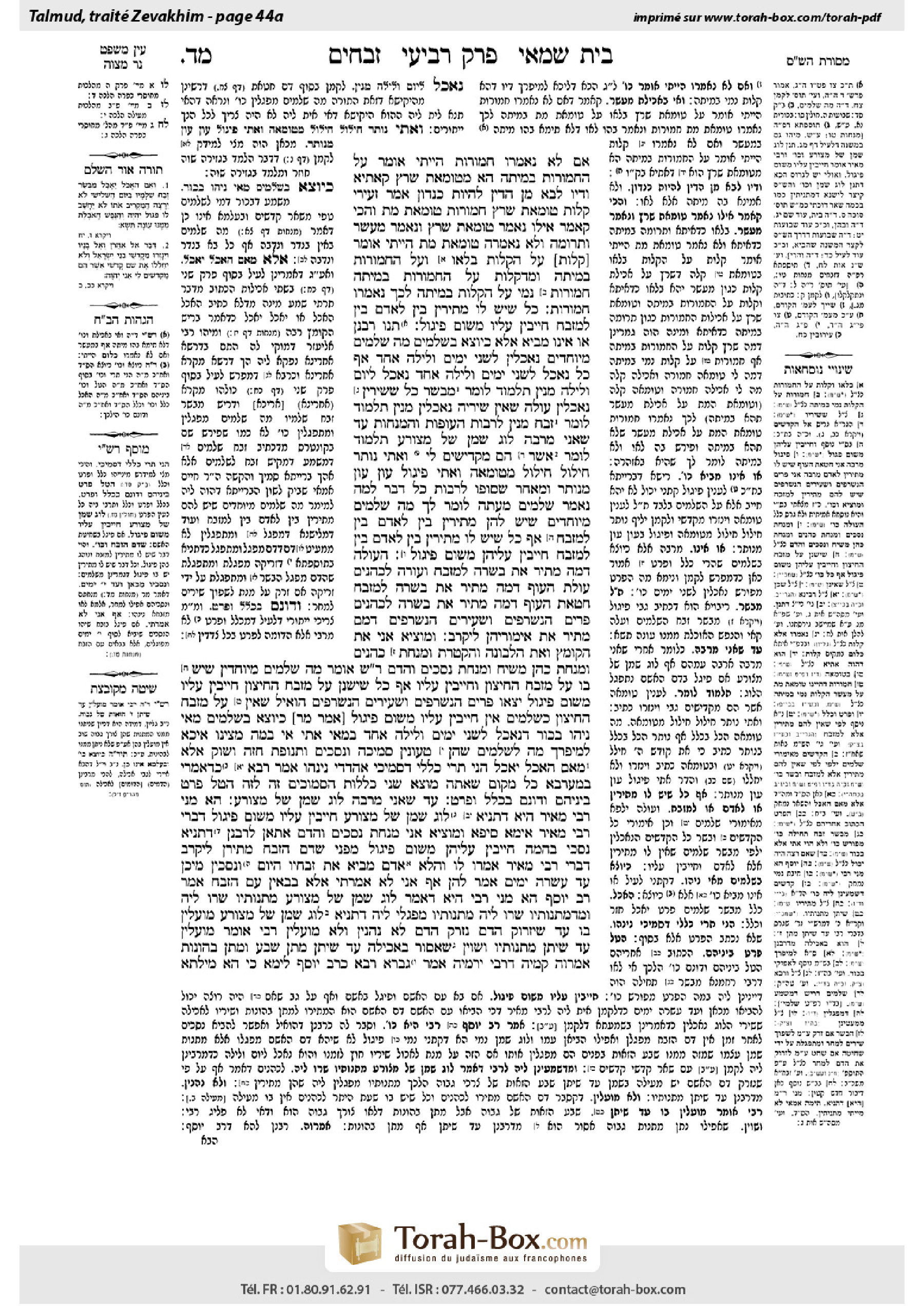
Zevachim 44a: Talmud study for Daf Yomi
Daf Yomi is the daily study of one Talmud folio. Explore 37 tractates with scans, Hebrew text, Sefaria English and AI-generated French translations where annotated.
Passage selection and English or AI-generated French translation are available where the scan has annotations. Daf Study is independent of Torah-Box and Sefaria.
Browse Zevachim · זבחים · All tractatesZevachim 44a text and translations
This page of Zevachim includes the Aramaic text, an English translation and an AI-generated French translation, alongside the scan above.
זבחים מ״ד א · Aramaic and Hebrew text
אִם לֹא נֶאֶמְרוּ חֲמוּרוֹת, הָיִיתִי אוֹמֵר עַל הַחֲמוּרוֹת בְּמִיתָה?! הָא מִטּוּמְאַת שֶׁרֶץ קָאָתְיָא, וְדַיּוֹ לַבָּא מִן הַדִּין לִהְיוֹת כַּנִּדּוֹן!
אָמַר זְעֵירִי: קַלּוֹת – טוּמְאַת שֶׁרֶץ, חֲמוּרוֹת – טוּמְאַת מֵת. וְהָכִי קָאָמַר: אִילּוּ נֶאֱמַר טוּמְאַת שֶׁרֶץ וְנֶאֱמַר מַעֲשֵׂר וּתְרוּמָה, וְלֹא נֶאֶמְרָה טוּמְאַת מֵת – הָיִיתִי אוֹמֵר: [קַלּוֹת] עַל הַקַּלּוֹת בְּלָאו, וְעַל הַחֲמוּרוֹת בְּמִיתָה;
וּמִדְּקַלּוֹת עַל הַחֲמוּרוֹת בְּמִיתָה – חֲמוּרוֹת נָמֵי עַל הַקַּלּוֹת בְּמִיתָה; לְכָךְ נֶאֶמְרוּ חֲמוּרוֹת.
כֹּל שֶׁיֵּשׁ לוֹ מַתִּירִין, בֵּין לְאָדָם בֵּין לְמִזְבֵּחַ – חַיָּיבִין עָלָיו מִשּׁוּם פִּיגּוּל.
תָּנוּ רַבָּנַן: אוֹ אֵינוֹ מֵבִיא אֶלָּא כַּיּוֹצֵא בִּשְׁלָמִים; מָה שְׁלָמִים מְיוּחָדִים – נֶאֱכָלִין לִשְׁנֵי יָמִים וְלַיְלָה אֶחָד, אַף כֹּל נֶאֱכָל לִשְׁנֵי יָמִים וְלַיְלָה אֶחָד;
נֶאֱכָל לְיוֹם וָלַיְלָה מִנַּיִן? תַּלְמוּד לוֹמַר: ״מִבְּשַׂר״ – כֹּל (שֶׁשִּׁירִין) [שֶׁשְּׁיָרָיו] נֶאֱכָלִין. עוֹלָה שֶׁאֵין שְׁיָרֶיהָ נֶאֱכָלִין, מִנַּיִן? תַּלְמוּד לוֹמַר: ״זֶבַח״.
מִנַּיִן לְרַבּוֹת הָעוֹפוֹת וְהַמְּנָחוֹת, עַד שֶׁאֲנִי מְרַבֶּה לוֹג שֶׁמֶן שֶׁל מְצוֹרָע? תַּלְמוּד לוֹמַר: ״אֲשֶׁר הֵם מַקְדִּישִׁים לִי״.
וְאָתֵי נוֹתָר ״חִילּוּל״–״חִילּוּל״ מִטּוּמְאָה, וְאָתֵי פִּיגּוּל ״עָוֹן״–״עָוֹן״ מִנּוֹתָר.
וּמֵאַחַר שֶׁסּוֹפוֹ לְרַבּוֹת כׇּל דָּבָר, לָמָּה נֶאֱמַר שְׁלָמִים מֵעַתָּה? לוֹמַר לָךְ: מָה שְׁלָמִים מְיוּחָדִים – שֶׁיֵּשׁ לָהֶן מַתִּירִין בֵּין לָאָדָם בֵּין לַמִּזְבֵּחַ, אַף כֹּל שֶׁיֵּשׁ לוֹ מַתִּירִין בֵּין לָאָדָם בֵּין לַמִּזְבֵּחַ – חַיָּיבִין עֲלֵיהֶן מִשּׁוּם פִּיגּוּל.
הָעוֹלָה – דָּמָהּ מַתִּיר אֶת בְּשָׂרָהּ לַמִּזְבֵּחַ, וְעוֹרָהּ לַכֹּהֲנִים. עוֹלַת הָעוֹף – דָּמָהּ מַתִּיר אֶת בְּשָׂרָהּ לַמִּזְבֵּחַ. חַטַּאת הָעוֹף – דָּמָהּ מַתִּיר אֶת בְּשָׂרָהּ לַכֹּהֲנִים. פָּרִים הַנִּשְׂרָפִים וּשְׂעִירִים הַנִּשְׂרָפִים – דָּמָם מַתִּיר אֶת אֵימוּרֵיהֶן לִיקְרַב.
וּמוֹצִיא אֲנִי אֶת הַקּוֹמֶץ, וְאֶת הַלְּבוֹנָה, וְהַקְּטֹרֶת, וּמִנְחַת כֹּהֲנִים, וּמִנְחַת כֹּהֵן מָשִׁיחַ, וּמִנְחַת נְסָכִים, וְהַדָּם.
רַבִּי שִׁמְעוֹן אוֹמֵר: מָה שְׁלָמִים מְיוּחָדִין – שֶׁיֵּשׁ בּוֹ עַל מִזְבֵּחַ הַחִיצוֹן וְחַיָּיבִין עָלָיו, אַף כֹּל שֶׁיֶּשְׁנָן עַל מִזְבֵּחַ הַחִיצוֹן – חַיָּיבִין עָלָיו מִשּׁוּם פִּיגּוּל. יָצְאוּ פָּרִים הַנִּשְׂרָפִים וּשְׂעִירִים הַנִּשְׂרָפִים, הוֹאִיל שֶׁאֵין עַל מִזְבֵּחַ הַחִיצוֹן כִּשְׁלָמִים – אֵין חַיָּיבִין עָלָיו מִשּׁוּם פִּיגּוּל.
אָמַר [מָר]: כַּיּוֹצֵא בִּשְׁלָמִים. מַאי נִיהוּ? בְּכוֹר, דְּנֶאֱכָל לִשְׁנֵי יָמִים וְלַיְלָה אֶחָד. בְּמַאי אָתֵי? אִי בְּמָה מָצִינוּ – אִיכָּא לְמִיפְרַךְ:
מָה לִשְׁלָמִים – שֶׁהֵן טְעוּנִין סְמִיכָה וּנְסָכִים, וּתְנוּפַת חָזֶה וָשׁוֹק!
אֶלָּא מֵ״אִם הֵאָכֹל יֵאָכֵל״.
הָנֵי תְּרֵי כְּלָלֵי דִּסְמִיכִי אַהֲדָדֵי נִינְהוּ! אָמַר רָבָא, כִּדְאָמְרִי בְּמַעְרְבָא: כׇּל מָקוֹם שֶׁאַתָּה מוֹצֵא שְׁנֵי כְּלָלוֹת הַסְּמוּכִים זֶה לָזֶה, הַטֵּל פְּרָט בֵּינֵיהֶם וְדוּנֵם בִּכְלָל וּפְרָט.
עַד שֶׁאֲנִי מְרַבֶּה לוֹג שֶׁמֶן שֶׁל מְצוֹרָע. הָא מַנִּי – רַבִּי מֵאִיר הִיא, דְּתַנְיָא: לוֹג שֶׁמֶן שֶׁל מְצוֹרָע – חַיָּיבִין עָלָיו מִשּׁוּם פִּיגּוּל, דִּבְרֵי רַבִּי מֵאִיר. אֵימָא סֵיפָא: וּמוֹצִיא אֲנִי מִנְחַת נְסָכִים וְהַדָּם – אֲתָאן לְרַבָּנַן!
דְּתַנְיָא: נִסְכֵי בְהֵמָה – חַיָּיבִין עֲלֵיהֶן מִשּׁוּם פִּיגּוּל, מִפְּנֵי שֶׁדַּם הַזֶּבַח מַתִּירָן לִיקָרֵב. דִּבְרֵי רַבִּי מֵאִיר. אָמְרוּ לוֹ: וַהֲלֹא אָדָם מֵבִיא אֶת זְבָחָיו הַיּוֹם, וּנְסָכִין מִיכָּן עַד עֲשָׂרָה יָמִים! אָמַר לָהֶן: אַף אֲנִי לֹא אָמַרְתִּי, אֶלָּא בְּבָאִין עִם הַזֶּבַח.
אָמַר רַב יוֹסֵף: הָא מַנִּי – רַבִּי הִיא, דְּאָמַר: לוֹג שֶׁמֶן שֶׁל מְצוֹרָע – מַתְּנוֹתָיו שָׁרוּ לֵיהּ; וּמִדְּמַתְּנוֹתָיו שָׁרוּ לֵיהּ – מַתְּנוֹתָיו מְפַגְּלִי לֵיהּ.
דְּתַנְיָא: לוֹג שֶׁמֶן שֶׁל מְצוֹרָע – מוֹעֲלִין בּוֹ, עַד שֶׁיִּזְרוֹק הַדָּם. נִזְרַק הַדָּם – לֹא נֶהֱנִין וְלֹא מוֹעֲלִין.
רַבִּי אוֹמֵר: מוֹעֲלִין, עַד שֶׁיִּתֵּן מַתְּנוֹתָיו. וְשָׁוִין שֶׁאָסוּר בַּאֲכִילָה עַד שֶׁיִּתֵּן מַתַּן שֶׁבַע וּמַתַּן בְּהוֹנוֹת.
אַמְרוּהָ קַמֵּיהּ דְּרַבִּי יִרְמְיָה, אָמַר: גַּבְרָא רַבָּא כְּרַב יוֹסֵף, לֵימָא כִּי הָא מִילְּתָא?!
Zevachim 44a · English translation
If the stringent case of impurity imparted by a corpse were not stated, but only the lenient case of the impurity of a creeping animal, would I say that the punishment in the stringent case is that of death at the hand of Heaven? Rather, the halakha in the case of impurity imparted by a corpse would be derived from the halakha in the case of the impurity of a creeping animal by means of an a fortiori inference, and it is sufficient for the conclusion that emerges from an a fortiori inference to be like its source, in this case that one is liable to be flogged for the violation of a prohibition, and no more.
Ze’eiri says: Indeed, the lenient case is referring to the impurity of a creeping animal, and the stringent case is referring to impurity imparted by a corpse. And this is what the baraita is saying: If the impurity of a creeping animal was stated, and it was stated that one who eats second tithe while impure with such impurity has violated a prohibition and one who partakes of teruma in that state is liable to be punished with death at the hand of Heaven, and the impurity imparted by a corpse was not stated in this context, I would say as follows: The lenient level of impurity, that of a creeping animal, with regard to food with lenient halakhot, second tithe, involves the violation of a prohibition, and with regard to food with stringent halakhot, teruma, it involves liability to be punished with death at the hand of Heaven.
Ze’eiri continues his explanation of the baraita: And from the fact that the lenient level of impurity, that of a creeping animal, with regard to food with stringent halakhot, teruma, involves liability to be punished with death at the hand of Heaven, it may be inferred that also in the analogous case of the stringent level of impurity, imparted by a corpse, with regard to food with lenient halakhot, there is liability to be punished with death at the hand of Heaven. Therefore, the stringent level of impurity, imparted by a corpse, was stated with regard to second tithe, which has lenient halakhot, to teach that even if one contracted impurity from a corpse, he has violated only a prohibition for eating second tithe, and is not liable to be punished with death at the hand of Heaven.
§ The mishna teaches: With regard to any item that has permitting factors, either for consumption by a person or for burning on the altar, one is liable for eating it due to violation of the prohibition of piggul. The Gemara cites a verse and a related baraita. The verse states: “And if any be at all eaten of the flesh of the sacrifice of his peace offering on the third day, it shall not be accepted, neither shall it be imputed to him who sacrifices it; it shall be piggul, and the soul that eats of it shall bear his iniquity” (Leviticus 7:18). The baraita first demonstrates that the halakha of piggul applies not only to a peace offering, with regard to which it is stated in the Torah, but to all offerings.
The Sages taught in a baraita: Or perhaps the halakha of piggul extends only to an offering that is similar to peace offerings: Just as peace offerings are notable in that they are eaten for two days and one night, so too, the halakha of piggul applies to any offering that is eaten for two days and one night.
But as for an offering that is eaten only for one day, i.e., the day the offering is sacrificed, and the following night, e.g., a sin offering, guilt offering, and firstborn offering, from where is it derived that the halakha of piggul applies to this offering as well? The verse states: “Of the flesh of the sacrifice of his peace offering,” which teaches that the status of piggul can apply to any offering whose remainder of meat is eaten after its sacrificial portions have been offered on the altar. The baraita asks: With regard to a burnt offering, whose remainder of meat is not eaten, as it is burned in its entirety on the altar, from where is this halakha derived? The verse states: “Sacrifice,” which includes any offering that is slaughtered.
The baraita asks: From where is it derived to include bird offerings, e.g., doves or pigeons, which are not slaughtered but whose napes of their necks are pinched, and meal offerings, until I include even the log of oil that accompanies the guilt offering of a recovered leper? The verse states with regard to the consumption of consecrated food in a state of ritual purity: “That they separate themselves from the sacred items of the children of Israel, which they consecrate to Me, and that they do not profane My holy name” (Leviticus 22:2).
The baraita clarifies this derivation: The halakha that the prohibition of notar applies to all these offerings is derived through a verbal analogy of profanation in the context of notar: “And if anything remains until the third day, it shall be burned in fire…and anyone who eats it shall bear his iniquity, because he has profaned the sacred item of the Lord” (Leviticus 19:6–8), and profanation stated in the verse discussing ritual impurity: “And that they do not profane My holy name.” And the halakha that piggul applies to all these offerings is subsequently derived through a verbal analogy of “iniquity” in the context of piggul and “iniquity” stated in the verse discussing notar. With regard to piggul, the verse states: “It shall be piggul, and the soul that eats of it shall bear his iniquity” (Leviticus 7:18), and with regard to notar, it is stated in the aforementioned verse: “And anyone who eats it shall bear his iniquity.”
The baraita asks: And since the verse eventually includes all items, even meal offerings and the log of oil of a leper, now one can ask: Why does the verse state piggul specifically with regard to peace offerings? The baraita answers: This serves to tell you that the offering must be similar to peace offerings in the following way: Just as peace offerings are notable in that they have permitting factors, either for consumption by a person or for burning on the altar, so too, with regard to any item that has permitting factors, either for a person or for the altar, one is liable for eating it due to violation of the prohibition of piggul.
The baraita specifies: With regard to the burnt offering, its blood renders its flesh permitted to be burned on the altar and its hide to be used by the priests. With regard to the bird burnt offering, its blood renders its flesh and its skin permitted to be burned on the altar. With regard to the bird sin offering, its blood renders its flesh permitted for consumption by the priests. With regard to bulls that are burned, e.g., the bull sacrificed for an unwitting communal transgression, and goats that are burned, e.g., the goat sacrificed for an unwitting communal sin of idol worship, their blood renders their sacrificial portions permitted to be sacrificed on the altar.
And I exclude, via the analogy to peace offerings, the handful of a meal offering, the frankincense, the incense, the meal offering of priests, the meal offering of the anointed priest, the meal offering brought with the libations that accompany animal offerings, and the blood. All these do not have an item that renders them permitted either for a person or for the altar.
The baraita concludes: Rabbi Shimon says that the fact that the verse specifies peace offerings as the standard case of piggul teaches: Just as peace offerings are notable in that they have a permitting factor that is sacrificed on the external altar, i.e., their blood, and one is liable for eating them due to violation of the prohibition of piggul, so too, with regard to any item that has a permitting factor that is sacrificed on the external altar, one is liable for eating it due to violation of the prohibition of piggul. This serves to exclude bulls that are burned and goats that are burned: Since their blood is not presented on the external altar like peace offerings, one is not liable for eating them due to violation of the prohibition of piggul.
The Gemara analyzes the baraita. The Master said: Perhaps the halakha of piggul extends only to an offering that is similar to peace offerings: What is this offering that is similar to a peace offering but not included in the category of peace offerings? The Gemara answers: The reference is to a firstborn offering, which is eaten for two days and one night, as is a peace offering. The Gemara raises a difficulty: By what hermeneutical principle is the halakha of the firstborn offering derived? If it is by the hermeneutical principle of: What do we find with regard to, a principle of inductive reasoning involving a comparison between cases that include similar details, i.e., since the peace offering and firstborn offering are similar with regard to the time designated for their eating, piggul status should apply to each, this can be refuted.
The Gemara clarifies the refutation: What is notable about peace offerings? They are notable in that they require placing hands on the head of the offering, libations, and waving of the breast and thigh. None of these apply in the case of a firstborn offering.
Rather, the halakha that piggul status applies to a firstborn offering is derived through the hermeneutical principle of a generalization and a detail and a generalization, from the following verse: “And if any be at all eaten of the flesh of the sacrifice of his peace offerings on the third day, it shall not be accepted” (Leviticus 7:18). The terms: “And if any” and “be at all eaten” are generalizations, while the words: “The flesh of the sacrifice of his peace offering” constitute a detail. According to the hermeneutical principle of a generalization and a detail and a generalization, in such a case one includes any item that is similar to the detail, and therefore one includes the firstborn offering.
The Gemara raises a difficulty: These two phrases are generalizations that are adjacent to one another, which means that this is not an instance of a generalization and a detail and a generalization, as they are not in that order. Rava said: The hermeneutical principle applies even in this case, as they say in the West, Eretz Yisrael: In every place that you find two generalizations that are adjacent to one another, cast the detail that is written afterward between them, and interpret them in the manner of a generalization and a detail and a generalization. Consequently, this verse is considered to state a generalization and a detail and a generalization.
§ The baraita teaches: Until I include even the log of oil of a leper. The Gemara asks: In accordance with whose opinion is this ruling? The Gemara answers that it is in accordance with the opinion of Rabbi Meir, as it is taught in a baraita: With regard to the log of oil of the leper, one is liable for consuming it due to violation of the prohibition of piggul, if the guilt offering that this oil accompanied became piggul; this is the statement of Rabbi Meir. The Gemara raises a difficulty: Say the latter clause: And I exclude the meal offering brought with the libations that accompany animal offerings, and the blood, as they do not have a permitting factor. Here we arrive at the opinion of the Rabbis, who dispute the ruling of Rabbi Meir.
The Gemara elaborates: As it is taught in another baraita: With regard to the libations of an animal offering, one is liable for consuming them due to violation of the prohibition of piggul, as the blood of the offering renders them permitted to be offered on the altar; this is the statement of Rabbi Meir. The Rabbis said to him: But a person may bring his offerings today and the accompanying libations from now until even ten days later. Evidently, then, the blood of the offering does not render the libations permitted. Rabbi Meir said to them: I too spoke only about libations that come to be sacrificed together with the offering. If so, the baraita under discussion represents two conflicting opinions.
Rav Yosef said: In accordance with whose opinion is this ruling, that even the log of oil of a leper is included in the prohibition of piggul? It is in accordance with the opinion of Rabbi Yehuda HaNasi, who agrees with the Rabbis that the libations of an animal offering are not permitted by the blood of the offering. And Rabbi Yehuda HaNasi says with regard to the log of oil of a leper that it is not the blood of the guilt offering that renders it permitted; rather, the placements of its oil “before the Lord” (Leviticus 14:16) render the remainder of the oil permitted to be eaten by the priests. And from the fact that the placements of its oil render the oil permitted, by the same token the placements of its oil render it piggul, i.e., if the oil was placed with the intent that the priests should consume its remainder on the following day, one who consumes the oil is liable for consuming piggul.
The Gemara cites the source for Rabbi Yehuda HaNasi’s opinion. As it is taught in a baraita: With regard to the log of oil of a leper, one who derives benefit from it is liable for misusing consecrated property if he derives benefit from it at any point after it has been consecrated in a service vessel, until the blood of the leper’s guilt offering is sprinkled. At this stage the oil is permitted to the priests, and therefore the prohibition against misusing property consecrated to the Temple no longer applies to it. Once the blood has been sprinkled, one may not derive benefit from the oil ab initio, by rabbinic law, as it must still be placed on the leper’s right ear, thumb, and big toe. But if one derived benefit from it, he is not liable for misuse.
Rabbi Yehuda HaNasi says: One who derives benefit from the oil is liable for misusing consecrated property until the priest places its own placements, i.e., until the oil is sprinkled seven times toward the Sanctuary, as these sprinklings render the remainder of the oil permitted to the priests. And the Rabbis and Rabbi Yehuda HaNasi agree that consumption of the log of oil is prohibited until the priest places the seven placements, i.e., sprinklings, of oil toward the Sanctuary, and performs the placing of the oil on the leper’s thumb and big toe.
They said this statement before Rabbi Yirmeya in Eretz Yisrael, whereupon he said: Would a great man such as Rav Yosef say such a matter, that the sprinkling of the oil renders the rest of the oil piggul?
Zevachim 44a · Traduction française (IA)
Si le cas sévère de l’impureté due à un cadavre n’avait pas été énoncé, mais seulement le cas moins sévère de l’impureté due à un animal rampant, aurais-je dit que, dans le cas sévère, la peine est la mort infligée par le Ciel ? Au contraire, la halakha relative à l’impureté due à un cadavre aurait été déduite de celle relative à l’impureté due à un animal rampant par un raisonnement a fortiori ; or, la conclusion tirée d’un raisonnement a fortiori ne peut aller au-delà de son point de départ : en l’occurrence, on serait passible de flagellation pour avoir transgressé une interdiction, et rien de plus.
Ze’eiri dit : En effet, le cas moins sévère concerne l’impureté due à un animal rampant, et le cas sévère, l’impureté due à un cadavre. Voici ce que dit la baraïta : si l’impureté due à un animal rampant avait été mentionnée, ainsi que la règle selon laquelle celui qui mange de la seconde dîme dans cet état d’impureté transgresse une interdiction et celui qui consomme de la terouma dans cet état est passible de mort infligée par le Ciel, tandis que l’impureté due à un cadavre n’avait pas été mentionnée dans ce contexte, j’aurais dit ceci : le degré moins sévère d’impureté, celui dû à un animal rampant, entraîne, pour les aliments soumis à des halakhot moins sévères — la seconde dîme —, la transgression d’une interdiction, et, pour les aliments soumis à des halakhot plus sévères — la terouma —, la peine de mort infligée par le Ciel.
Ze’eiri poursuit son explication de la baraïta : du fait que le degré moins sévère d’impureté, celui dû à un animal rampant, entraîne, pour les aliments soumis à des halakhot plus sévères — la terouma —, la peine de mort infligée par le Ciel, on peut déduire que, dans le cas analogue du degré sévère d’impureté, celui dû à un cadavre, la peine de mort infligée par le Ciel s’applique également aux aliments soumis à des halakhot moins sévères. C’est pourquoi le degré sévère d’impureté, celui dû à un cadavre, a été mentionné à propos de la seconde dîme, soumise à des halakhot moins sévères, pour enseigner que même si l’on a contracté l’impureté due à un cadavre, on ne transgresse qu’une interdiction en mangeant de la seconde dîme, et l’on n’est pas passible de mort infligée par le Ciel.
§ La Michna enseigne : pour tout élément qui possède des facteurs qui en permettent la consommation par une personne ou la combustion sur l’autel, on est passible d’avoir transgressé l’interdiction de piggul en le mangeant. La Guemara cite un verset et une baraïta qui s’y rapporte. Le verset dit : « Si l’on mange quoi que ce soit de la chair du sacrifice de son offrande de paix le troisième jour, elle ne sera pas agréée et ne sera pas imputée à celui qui l’offre ; ce sera du piggul, et la personne qui en mangera portera sa faute » (Lévitique 7,18). La baraïta montre d’abord que la halakha du piggul s’applique non seulement à l’offrande de paix, à propos de laquelle elle est énoncée dans la Torah, mais à toutes les offrandes.
Les Sages ont enseigné dans une baraïta : Ou peut-être la halakha du piggul ne s’étend-elle qu’à une offrande semblable aux offrandes de paix : de même que les offrandes de paix se distinguent par le fait qu’elles sont consommées pendant deux jours et une nuit, de même la halakha du piggul s’applique à toute offrande consommée pendant deux jours et une nuit.
Mais d’où sait-on que cette halakha s’applique aussi à une offrande consommée pendant un seul jour, c’est-à-dire le jour où elle est sacrifiée, et la nuit suivante, par exemple un sacrifice expiatoire, un sacrifice de culpabilité ou une offrande du premier-né ? Le verset dit : « De la chair du sacrifice de son offrande de paix », ce qui enseigne que le statut de piggul peut s’appliquer à toute offrande dont le reste de la viande est consommé après que les parties sacrificielles ont été offertes sur l’autel. La baraïta demande : d’où tire-t-on cette halakha pour l’holocauste, dont le reste de la viande n’est pas consommé, puisqu’il est entièrement brûlé sur l’autel ? Le verset dit : « sacrifice », terme qui inclut toute offrande qui est égorgée.
La baraïta demande : d’où tire-t-on que sont également incluses les offrandes d’oiseaux, par exemple des tourterelles ou des pigeons, qui ne sont pas égorgés mais dont la nuque est pincée, ainsi que les offrandes de farine, jusqu’à inclure même le log d’huile qui accompagne le sacrifice de culpabilité d’un lépreux guéri ? Le verset dit, à propos de la consommation d’aliments consacrés en état de pureté rituelle : « Qu’ils se séparent des choses saintes des enfants d’Israël, qu’ils me consacrent, et qu’ils ne profanent pas mon saint nom » (Lévitique 22,2).
La baraïta précise cette déduction : la halakha selon laquelle l’interdiction de notar s’applique à toutes ces offrandes est déduite par une analogie verbale entre « profaner », dans le contexte du notar : « Si quoi que ce soit en reste jusqu’au troisième jour, cela sera brûlé au feu… et quiconque en mangera portera sa faute, car il a profané ce qui est consacré au Seigneur » (Lévitique 19,6-8), et « profaner », dans le verset qui traite de l’impureté rituelle : « et qu’ils ne profanent pas mon saint nom ». La halakha selon laquelle le piggul s’applique à toutes ces offrandes est ensuite déduite par une analogie verbale entre « faute », dans le contexte du piggul, et « faute », dans le verset qui traite du notar. À propos du piggul, le verset dit : « Ce sera du piggul, et la personne qui en mangera portera sa faute » (Lévitique 7,18) ; et, à propos du notar, le verset précité dit : « quiconque en mangera portera sa faute ».
La baraïta demande : puisque le verset finit par inclure tous les éléments, même les offrandes de farine et le log d’huile d’un lépreux, pourquoi mentionne-t-il précisément le piggul à propos des offrandes de paix ? La baraïta répond : cela t’enseigne que l’offrande doit être semblable aux offrandes de paix de la manière suivante : de même que les offrandes de paix se distinguent par le fait qu’elles possèdent des facteurs qui en permettent la consommation par une personne ou la combustion sur l’autel, de même, pour tout élément qui possède de tels facteurs, permettant sa consommation par une personne ou sa combustion sur l’autel, on est passible d’avoir transgressé l’interdiction de piggul en le mangeant.
La baraïta précise : dans le cas de l’holocauste, son sang rend sa chair propre à être brûlée sur l’autel et sa peau propre à être utilisée par les prêtres. Dans le cas de l’holocauste d’oiseau, son sang rend sa chair et sa peau propres à être brûlées sur l’autel. Dans le cas du sacrifice expiatoire d’oiseau, son sang rend sa chair propre à être consommée par les prêtres. Dans le cas des taureaux que l’on brûle, par exemple le taureau sacrifié pour une transgression involontaire de la communauté, et des boucs que l’on brûle, par exemple le bouc sacrifié pour une faute involontaire de la communauté liée au culte des idoles, leur sang rend leurs parties sacrificielles propres à être offertes sur l’autel.
Par analogie avec les offrandes de paix, j’exclus la poignée d’une offrande de farine, l’encens, l’encens aromatique, l’offrande de farine des prêtres, l’offrande de farine du prêtre oint, l’offrande de farine apportée avec les libations qui accompagnent les offrandes animales, ainsi que le sang. Aucun de ces éléments ne possède un élément qui en permette la consommation par une personne ou la combustion sur l’autel.
La baraïta conclut : Rabbi Shimon dit que le fait que le verset présente les offrandes de paix comme cas type du piggul enseigne ceci : de même que les offrandes de paix se distinguent par le fait qu’elles possèdent un facteur qui en permet la consommation et qui est sacrifié sur l’autel extérieur, à savoir leur sang, et que l’on est passible d’avoir transgressé l’interdiction de piggul en les mangeant, de même, pour tout élément qui possède un facteur qui en permet la consommation et qui est sacrifié sur l’autel extérieur, on est passible d’avoir transgressé l’interdiction de piggul en le mangeant. Cela exclut les taureaux que l’on brûle et les boucs que l’on brûle : puisque leur sang n’est pas présenté sur l’autel extérieur comme celui des offrandes de paix, on n’est pas passible d’avoir transgressé l’interdiction de piggul en les mangeant.
La Guemara analyse la baraïta. Le Maître a dit : « Ou peut-être la halakha du piggul ne s’étend-elle qu’à une offrande semblable aux offrandes de paix. » Quelle est cette offrande semblable à une offrande de paix sans pour autant appartenir à la catégorie des offrandes de paix ? La Guemara répond : il s’agit de l’offrande du premier-né, qui est consommée pendant deux jours et une nuit, comme une offrande de paix. La Guemara soulève une difficulté : par quel principe herméneutique déduit-on la halakha relative à l’offrande du premier-né ? Si c’est selon le principe herméneutique « que constatons-nous à propos de… », un raisonnement inductif comparant des cas qui présentent des détails semblables — puisque l’offrande de paix et l’offrande du premier-né se ressemblent quant à la durée prévue pour leur consommation, le statut de piggul devrait s’appliquer à chacune —, on peut réfuter ce raisonnement.
La Guemara précise la réfutation : qu’est-ce qui caractérise les offrandes de paix ? Elles se distinguent par le fait qu’elles exigent l’imposition des mains sur la tête de l’offrande, des libations, ainsi que l’ondulation de la poitrine et de la cuisse. Aucune de ces pratiques ne s’applique à l’offrande du premier-né.
Au contraire, le statut de piggul de l’offrande du premier-né se déduit selon le principe herméneutique d’une généralisation, suivie d’un détail, puis d’une généralisation, à partir du verset suivant : « Si l’on mange quoi que ce soit de la chair du sacrifice de ses offrandes de paix le troisième jour, elle ne sera pas agréée » (Lévitique 7,18). Les expressions « si l’on » et « quoi que ce soit » sont des généralisations, tandis que les mots « la chair du sacrifice de son offrande de paix » constituent un détail. Selon le principe herméneutique d’une généralisation, suivie d’un détail, puis d’une généralisation, on inclut dans un tel cas tout élément semblable au détail ; on inclut donc l’offrande du premier-né.
La Guemara soulève une difficulté : ces deux expressions sont des généralisations contiguës, ce qui signifie qu’il ne s’agit pas d’une généralisation, suivie d’un détail, puis d’une généralisation, puisqu’elles ne se présentent pas dans cet ordre. Rava dit : le principe herméneutique s’applique même ici, car, comme on dit en Occident, en Eretz Israël : partout où l’on trouve deux généralisations contiguës, on insère entre elles le détail écrit ensuite et on interprète le passage selon le principe d’une généralisation, suivie d’un détail, puis d’une généralisation. Ce verset est donc considéré comme énonçant une généralisation, suivie d’un détail, puis d’une généralisation.
§ La baraïta enseigne : « jusqu’à inclure même le log d’huile d’un lépreux ». La Guemara demande : selon l’opinion de qui cette décision a-t-elle été énoncée ? La Guemara répond qu’elle est conforme à l’opinion de Rabbi Meïr, comme on l’enseigne dans une baraïta : pour le log d’huile du lépreux, on est passible d’avoir consommé du piggul si le sacrifice de culpabilité qu’accompagnait cette huile est devenu piggul ; telle est la déclaration de Rabbi Meïr. La Guemara soulève une difficulté : considérons la dernière partie : « Et j’exclus l’offrande de farine apportée avec les libations qui accompagnent les offrandes animales, ainsi que le sang, car ils n’ont pas de facteur qui en permette la consommation. » Ici, nous en arrivons à l’opinion des Rabbins, qui contestent la décision de Rabbi Meïr.
La Guemara développe : on l’enseigne dans une autre baraïta : pour les libations d’une offrande animale, on est passible d’avoir transgressé l’interdiction de piggul en les consommant, puisque le sang de l’offrande les rend propres à être offertes sur l’autel ; telle est la déclaration de Rabbi Meïr. Les Rabbins lui dirent : pourtant, une personne peut apporter ses offrandes aujourd’hui et leurs libations à tout moment, jusqu’à dix jours plus tard. Il apparaît donc que le sang de l’offrande ne rend pas les libations propres à être offertes. Rabbi Meïr leur dit : moi aussi, je n’ai parlé que des libations qui sont apportées pour être sacrifiées avec l’offrande. Dans ce cas, la baraïta en question présente deux opinions contradictoires.
Rav Yossef dit : selon l’opinion de qui cette décision a-t-elle été énoncée, selon laquelle même le log d’huile d’un lépreux est inclus dans l’interdiction de piggul ? Elle est conforme à l’opinion de Rabbi Yehouda HaNassi, qui est d’accord avec les Rabbins pour dire que le sang d’une offrande animale ne rend pas ses libations propres à être offertes. Et Rabbi Yehouda HaNassi dit, à propos du log d’huile d’un lépreux, que ce n’est pas le sang du sacrifice de culpabilité qui le rend propre à être consommé ; ce sont les applications de son huile « devant le Seigneur » (Lévitique 14,16) qui rendent le reste de l’huile propre à être consommé par les prêtres. Et puisque ces applications rendent l’huile propre à être consommée, de même, elles lui confèrent le statut de piggul : autrement dit, si l’huile a été appliquée avec l’intention que les prêtres consomment le reste le lendemain, celui qui consomme l’huile est passible pour avoir consommé du piggul.
La Guemara cite la source de l’opinion de Rabbi Yehouda HaNassi. On l’enseigne dans une baraïta : pour le log d’huile d’un lépreux, celui qui en tire profit est passible d’avoir détourné un bien consacré s’il en tire profit à tout moment après que l’huile a été consacrée dans un ustensile de service et jusqu’à l’aspersion du sang du sacrifice de culpabilité du lépreux. À ce stade, l’huile est permise aux prêtres, et l’interdiction de détourner un bien consacré au Temple ne s’applique donc plus à elle. Une fois le sang aspergé, il est interdit, a priori, d’en tirer profit selon la loi rabbinique, car l’huile doit encore être appliquée sur l’oreille droite, le pouce et le gros orteil du lépreux. Mais si quelqu’un en tire profit, il n’est pas passible d’avoir détourné un bien consacré.
Rabbi Yehouda HaNassi dit : celui qui tire profit de l’huile est passible d’avoir détourné un bien consacré jusqu’à ce que le prêtre accomplisse les applications propres à l’huile, c’est-à-dire jusqu’à ce que l’huile soit aspergée sept fois en direction du Sanctuaire, car ces aspersions rendent le reste de l’huile propre à être consommé par les prêtres. Les Rabbins et Rabbi Yehouda HaNassi sont d’accord pour dire que la consommation du log d’huile est interdite jusqu’à ce que le prêtre accomplisse les sept aspersions de l’huile en direction du Sanctuaire et applique l’huile sur le pouce et le gros orteil du lépreux.
Ils rapportèrent cette déclaration à Rabbi Yirmeya en Eretz Israël, et il dit alors : un grand homme tel que Rav Yossef aurait-il pu dire une telle chose, à savoir que l’aspersion de l’huile confère au reste de l’huile le statut de piggul ?
Traduction française générée par IA à partir de l’édition anglaise de Sefaria. Vérifie toujours un passage avec le texte source.
Text from Sefaria: William Davidson Edition - Vocalized Aramaic (CC BY NC); William Davidson Edition - English (CC BY NC).