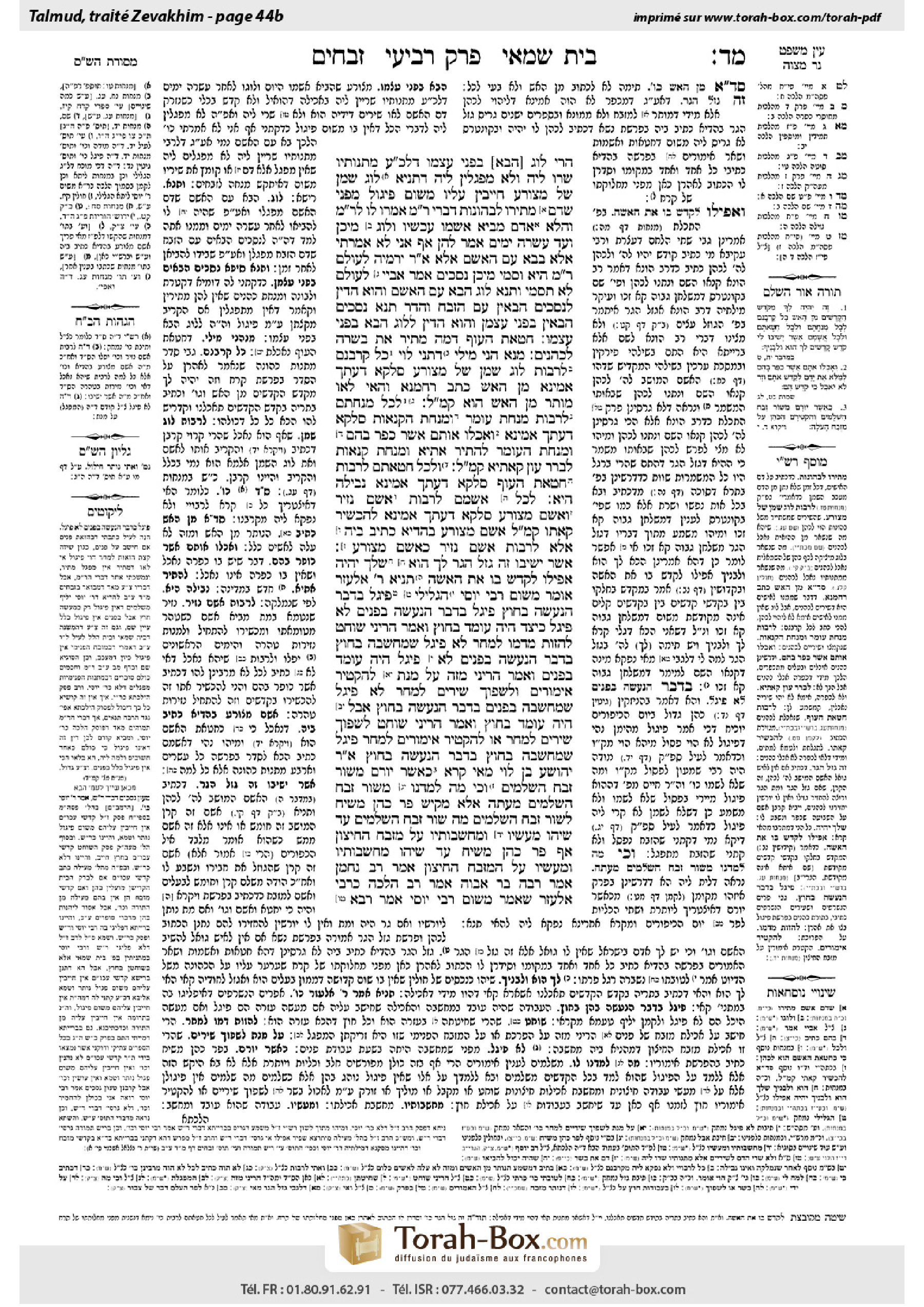
Zevachim 44b: Talmud study for Daf Yomi
Daf Yomi is the daily study of one Talmud folio. Explore 37 tractates with scans, Hebrew text, Sefaria English and AI-generated French translations where annotated.
Passage selection and English or AI-generated French translation are available where the scan has annotations. Daf Study is independent of Torah-Box and Sefaria.
Browse Zevachim · זבחים · All tractatesZevachim 44b text and translations
This page of Zevachim includes the Aramaic text, an English translation and an AI-generated French translation, alongside the scan above.
זבחים מ״ד ב · Aramaic and Hebrew text
הֲרֵי לוֹג [הַבָּא] בִּפְנֵי עַצְמוֹ – דִּלְכוּלֵּי עָלְמָא מַתְּנוֹתָיו שָׁרוּ לֵיהּ, וְלָא מְפַגְּלִין לֵיהּ! דְּתַנְיָא: לוֹג שֶׁמֶן שֶׁל מְצוֹרָע – חַיָּיבִין עָלָיו מִשּׁוּם פִּיגּוּל, מִפְּנֵי שֶׁדָּם מַתִּירוֹ לַבְּהוֹנוֹת. דִּבְרֵי רַבִּי מֵאִיר.
אָמְרוּ לוֹ לְרַבִּי מֵאִיר: וַהֲלֹא אָדָם מֵבִיא אֲשָׁמוֹ עַכְשָׁיו, וְלוֹג מִיכָּן וְעַד עֲשָׂרָה יָמִים! אָמַר לָהֶן: אַף אֲנִי לֹא אָמַרְתִּי, אֶלָּא בְּבָא עִם הָאָשָׁם.
אֶלָּא אָמַר רַבִּי יִרְמְיָה: לְעוֹלָם רַבִּי מֵאִיר הִיא, וּסְמִי מִיכָּן נְסָכִים. אָמַר אַבָּיֵי: לְעוֹלָם לָא תִּסְמֵי; וְתָנָא לוֹג הַבָּא עִם הָאָשָׁם – וְהוּא הַדִּין לִנְסָכִים הַבָּאִין עִם הַזֶּבַח, וַהֲדַר תָּנָא נְסָכִים הַבָּאִין בִּפְנֵי עַצְמָן – וְהוּא הַדִּין לְלוֹג הַבָּא לִפְנֵי עַצְמוֹ.
חַטַּאת הָעוֹף – דָּמָהּ מַתִּיר אֶת בְּשָׂרָהּ לַכֹּהֲנִים. מְנָא הָנֵי מִילֵּי? דְּתָנֵי לֵוִי:
״כׇּל קׇרְבָּנָם״ – לְרַבּוֹת לוֹג שֶׁמֶן שֶׁל מְצוֹרָע. סָלְקָא דַּעְתָּךְ אָמֵינָא: ״מִן הָאֵשׁ״ כְּתַב רַחֲמָנָא, וְהַאי לָאו מוֹתָר מִן הָאֵשׁ הוּא; קָא מַשְׁמַע לַן.
״לְכׇל מִנְחָתָם״ – לְרַבּוֹת מִנְחַת עוֹמֶר וּמִנְחַת הַקְּנָאוֹת. סָלְקָא דַּעְתָּךְ אָמֵינָא: ״וְאָכְלוּ אוֹתָם אֲשֶׁר כֻּפַּר בָּהֶם״ – וּמִנְחַת הָעוֹמֶר לְהַתִּיר אָתְיָא, וּמִנְחַת קְנָאוֹת לְבָרֵר עָוֹן קָאָתְיָא; קָא מַשְׁמַע לַן.
״וּלְכׇל חַטָּאתָם״ – לְרַבּוֹת חַטַּאת הָעוֹף. סָלְקָא דַּעְתָּךְ אָמֵינָא: נְבֵילָה הִיא.
״לְכׇל אֲשָׁמָם״ – לְרַבּוֹת אֲשַׁם נָזִיר וַאֲשַׁם מְצוֹרָע. סָלְקָא דַּעְתָּךְ אָמֵינָא: לְהַכְשִׁיר קָאָתוּ; קָא מַשְׁמַע לַן.
אֲשַׁם מְצוֹרָע – בְּהֶדְיָא כְּתִיב בֵּיהּ! אֶלָּא לְרַבּוֹת אֲשַׁם נָזִיר כַּאֲשַׁם מְצוֹרָע.
״אֲשֶׁר יָשִׁיבוּ״ – זֶה גֶּזֶל הַגֵּר. ״לְךָ הוּא״ – שֶׁלְּךָ יִהְיֶה, אֲפִילּוּ לְקַדֵּשׁ בּוֹ אֶת הָאִשָּׁה.
תַּנְיָא, רַבִּי אֶלְעָזָר אוֹמֵר מִשּׁוּם רַבִּי יוֹסֵי הַגְּלִילִי: פִּיגֵּל בְּדָבָר הַנַּעֲשֶׂה בַּחוּץ – פִּיגֵּל. בְּדָבָר הַנַּעֲשֶׂה בִּפְנִים – לֹא פִּיגֵּל.
כֵּיצַד? הָיָה עוֹמֵד בַּחוּץ, וְאָמַר: ״הֲרֵינִי שׁוֹחֵט לְהַזּוֹת מִדָּמוֹ לְמָחָר״ – לֹא פִּיגֵּל, שֶׁמַּחְשָׁבָה בַּחוּץ בְּדָבָר הַנַּעֲשֶׂה בִּפְנִים לֹא פִּיגֵּל. הָיָה עוֹמֵד בִּפְנִים, וְאָמַר: ״הֲרֵינִי מַזֶּה עַל מְנָת לְהַקְטִיר אֵימוּרִים וְלִשְׁפּוֹךְ שִׁירַיִם לְמָחָר״ – לֹא פִּיגֵּל, שֶׁמַּחְשָׁבָה בִּפְנִים בְּדָבָר הַנַּעֲשֶׂה בַּחוּץ.
אֲבָל הָיָה עוֹמֵד בַּחוּץ, וְאָמַר: ״הֲרֵינִי שׁוֹחֵט לִשְׁפּוֹךְ שִׁירַיִם לְמָחָר״, אוֹ ״לְהַקְטִיר אֵימוּרִים לְמָחָר״ – פִּיגֵּל, שֶׁמַּחְשָׁבָה בַּחוּץ בְּדָבָר הַנַּעֲשֶׂה בַּחוּץ.
אָמַר רַבִּי יְהוֹשֻׁעַ בֶּן לֵוִי: מַאי קְרָא? ״כַּאֲשֶׁר יוּרַם מִשּׁוֹר זֶבַח הַשְּׁלָמִים״ – וְכִי מָה לָמַדְנוּ מִשּׁוֹר זֶבַח הַשְּׁלָמִים מֵעַתָּה?
אֶלָּא מַקִּישׁ פַּר כֹּהֵן מָשִׁיחַ לְשׁוֹר זֶבַח הַשְּׁלָמִים; מָה שׁוֹר זֶבַח הַשְּׁלָמִים – עַד שֶׁיְּהוּ מַעֲשָׂיו וּמַחְשְׁבוֹתָיו עַל מִזְבֵּחַ הַחִיצוֹן, אַף פַּר כֹּהֵן מָשִׁיחַ – עַד שֶׁיְּהוּ מַחְשְׁבוֹתָיו וּמַעֲשָׂיו עַל הַמִּזְבֵּחַ הַחִיצוֹן.
אָמַר רַב נַחְמָן אָמַר רַבָּה בַּר אֲבוּהּ אָמַר רַב: הֲלָכָה כְּרַבִּי אֶלְעָזָר שֶׁאָמַר מִשּׁוּם רַבִּי יוֹסֵי.
אָמַר רָבָא:
Zevachim 44b · English translation
But there is the case of the log of oil that is brought by itself, i.e., where the leper brings it after he has sacrificed his offerings. There everyone agrees that its placements render the remainder of the oil permitted to the priests, and yet they do not render the oil piggul, as it is taught in a baraita: With regard to the log of oil of a leper, one is liable for consuming it due to violation of the prohibition of piggul, as the blood of the offering renders it permitted to be placed on the thumb and big toe of the leper. This is the statement of Rabbi Meir.
The Rabbis said to Rabbi Meir: But a person may bring his guilt offering today and the accompanying log of oil from now until even ten days later. Rabbi Meir said to them: I too spoke only about a log of oil that comes with the guilt offering. This indicates that even according to the opinion of Rabbi Meir, it is the blood of the offering that renders the oil piggul.
Rather, Rabbi Yirmeya says: Actually, the aforementioned baraita is in accordance with the opinion of Rabbi Meir, and omit the case of the meal offering brought with the libations that accompany animal offerings from the list of items that are not subject to the halakha of piggul. Abaye says: Actually, do not omit this item from the list, and the baraita can be explained in accordance with the opinion of Rabbi Meir as follows: The tanna first taught the halakha with regard to the log of oil that comes with the leper’s guilt offering, and the same is true of libations that come with an animal offering, as according to Rabbi Meir piggul status applies to both of these. And then the tanna taught that piggul does not apply to libations that come by themselves, and the same is true of a log of oil that comes by itself.
§ The mishna teaches: With regard to the bird burnt offering, its blood renders its meat and its skin permitted to be eaten by the priests. The Gemara asks: From where is this matter, that the meat of a bird burnt offering is eaten by the priests, derived? The Gemara cites a baraita that Levi teaches, with regard to a verse that discusses the gifts that are to be presented to the priests: “This shall be yours of the most sacred items, from the fire: Every offering of theirs, every meal offering of theirs, and every sin offering of theirs, and every guilt offering of theirs, which they shall render to Me, shall be most sacred for you and for your sons” (Numbers 18:9).
The baraita clarifies what is included by the term “every” in each of these clauses. The verse states: “Every offering of theirs,” which serves to include the log of oil of a leper; it too is given to the priests. The Gemara explains why it is necessary to derive from the verse that the oil is a gift to the priesthood: It might enter your mind to say that the oil should not be included, as the Merciful One writes in this same verse: “From the fire,” and this log of oil, notwithstanding its status as an offering, is not reserved from the fire. Only an item concerning which part of it is brought to the altar can be said to be reserved from the fire, and none of the oil is brought to the altar. Therefore, the verse teaches us by the phrase: “Every offering of theirs,” that the oil goes to the priests.
The phrase: “Every meal offering of theirs,” serves to include the omer meal offering, brought as a communal offering on the sixteenth of Nisan, and the meal offering of jealousy, brought by a sota. The Gemara elaborates: It might enter your mind to say that as the verse states with regard to the consumption of sacrificial food by the priests: “And they shall eat those items with which atonement is achieved” (Exodus 29:33), only those foods that facilitate atonement are given to the priests. And this would exclude the omer meal offering and the meal offering of jealousy, as the omer meal offering comes to permit the consumption of the new crop, and the meal offering of jealousy comes to clarify the transgression of the sota, as part of the ordeal undergone by the woman. Therefore, the verse teaches us by the phrase: “Every meal offering of theirs,” that even these meal offerings are eaten by the priests.
The phrase: “And every sin offering of theirs,” serves to include the bird sin offering; its meat too is given to the priests. The Gemara explains: It might enter your mind to say that this meat should not be eaten at all, as it is an unslaughtered animal carcass, since the bird is killed by pinching its nape (see Leviticus 5:8) rather than by slaughtering, which is the manner of ritual slaughter of non-sacred birds. Therefore, the phrase: “And every sin offering of theirs,” teaches that the bird sin offering is eaten by the priests.
The phrase: “Every guilt offering of theirs,” serves to include the guilt offering of a nazirite who contracted ritual impurity, and the guilt offering of a leper. The Gemara elaborates: It might enter your mind to say that these should not be given to the priests to eat, as they come to qualify these individuals, rather than to atone. The guilt offering of a nazirite renders him fit to restart his term of naziriteship, and the guilt offering of a leper qualifies him to eat sacrificial food, whereas the verse states: “And they shall eat those items with which atonement is achieved” (Exodus 29:33). Therefore, the verse teaches us by the phrase: “Every guilt offering of theirs,” that these offerings as well are eaten by the priests.
The Gemara challenges: It is explicitly written with regard to the guilt offering of a leper that it is consumed by the priests: “For as the sin offering is the priest’s, so is the guilt offering” (Leviticus 14:13). Why, then, is this derivation necessary? Rather, the baraita means to say that the phrase: “Every guilt offering of theirs,” serves to include the guilt offering of a nazirite, teaching that it is like the guilt offering of a leper, in that both are eaten by the priests.
The baraita continues: With regard to the phrase “which they shall render to Me,” this is referring to an item stolen from a convert. One who robs a convert who then dies with no heirs must give the stolen item and an additional one-fifth to the priests. Finally, the term “for you” teaches that it shall be yours, even to betroth a woman with it, i.e., these gifts are considered the priest’s property in all regards.
§ According to the first tanna of the mishna, the bulls that are burned and the goats that are burned, the blood of which is presented on the inner altar, are subject to piggul, whereas Rabbi Shimon rules that they are not subject to piggul. It is taught in a baraita that there is a third opinion concerning the matter: Rabbi Elazar says in the name of Rabbi Yosei HaGelili: If in his service of the bulls that are burned or the goats that are burned the priest had an intention that can render the offering piggul with regard to a matter that is performed outside the Sanctuary, i.e., in the Temple courtyard, he has rendered the offering piggul. If his intention was with regard to a matter that is performed inside the Sanctuary or the Holy of Holies, he has not rendered the offering piggul.
The baraita elaborates: How so? If he was standing outside when slaughtering the animal, and said: I hereby slaughter the animal with the intention of sprinkling its blood tomorrow inside the Sanctuary, he has not rendered the offering piggul. The reason is that in the case of an intention outside with regard to a matter that is performed inside, one has not rendered the offering piggul. Likewise, if he was standing inside when sprinkling, and said: I hereby sprinkle the blood of the sin offering in order to burn its sacrificial portions on the external altar and to pour out its remainder on the base of the altar tomorrow, he has not rendered the offering piggul, as this is an intention inside with regard to a matter that is performed outside.
But if he was standing outside, and said: I hereby slaughter the animal with the intention of pouring out the remainder of its blood tomorrow, or to burn its sacrificial portions tomorrow, he has rendered the offering piggul, as this is an intention outside with regard to a matter that is performed outside.
Rabbi Yehoshua ben Levi says: What is the verse from which this is derived? The verse states with regard to the sacrificial portions of a bull for an unwitting sin of the anointed priest, which is one of the bulls that are burned: “As it is taken off from the bull of the peace offering” (Leviticus 4:10). But what, then, do we learn from the bull of a peace offering? Everything that is specified with regard to a peace offering is stated with regard to this bull as well.
Rather, the verse juxtaposes the bull for an unwitting sin of the anointed priest with the bull of the peace offering: Just as the bull of the peace offering is not rendered piggul unless the priest’s actions and intentions relate to the service performed on the external altar, as that is where it is offered, so too, the bull for an unwitting sin of the anointed priest is not rendered piggul unless the priest’s intentions and actions relate to the service performed on the external altar.
Rav Naḥman says that Rabba bar Avuh says that Rav says: The halakha is in accordance with the opinion of Rabbi Elazar, who says his ruling in the name of Rabbi Yosei.
Rava said:
Zevachim 44b · Traduction française (IA)
Mais il y a le cas du log d’huile apporté séparément, c’est-à-dire lorsque le lépreux l’apporte après avoir offert ses sacrifices. Tous reconnaissent que les applications de l’huile rendent le reste permis aux prêtres, et pourtant elles ne rendent pas l’huile piggul, comme l’enseigne une baraïta : concernant le log d’huile d’un lépreux, on est passible pour sa consommation en raison de la transgression de l’interdit de piggul, car le sang du sacrifice rend cette huile apte à être appliquée sur le pouce et le gros orteil du lépreux. Telle est l’opinion de Rabbi Meïr.
Les Sages dirent à Rabbi Meïr : Pourtant, une personne peut apporter son sacrifice de culpabilité aujourd’hui et le log d’huile qui l’accompagne à tout moment jusqu’à dix jours plus tard. Rabbi Meïr leur dit : Moi aussi, je n’ai parlé que du log d’huile qui accompagne le sacrifice de culpabilité. Cela indique que même selon l’opinion de Rabbi Meïr, c’est le sang du sacrifice qui rend l’huile piggul.
Rabbi Yirmeya dit plutôt : En réalité, la baraïta susmentionnée est conforme à l’opinion de Rabbi Meïr ; il faut donc retirer de la liste des éléments auxquels ne s’applique pas la halakha de piggul l’offrande de farine apportée avec les libations qui accompagnent les sacrifices d’animaux. Abayé dit : En réalité, il ne faut pas retirer cet élément de la liste, et la baraïta peut s’expliquer comme suit, conformément à l’opinion de Rabbi Meïr : le tanna a d’abord enseigné la halakha concernant le log d’huile qui accompagne le sacrifice de culpabilité du lépreux ; il en va de même des libations qui accompagnent un sacrifice animal, car, selon Rabbi Meïr, piggul s’applique à ces deux éléments. Puis le tanna a enseigné que piggul ne s’applique pas aux libations apportées séparément ; il en va de même d’un log d’huile apporté séparément.
§ La Michna enseigne : Pour l’holocauste d’oiseau, son sang rend sa chair et sa peau permises à la consommation par les prêtres. La Guemara demande : D’où déduit-on que la chair d’un holocauste d’oiseau est consommée par les prêtres ? La Guemara cite une baraïta enseignée par Lévi au sujet d’un verset qui traite des dons à remettre aux prêtres : « Voici ce qui t’appartiendra parmi les choses très saintes, prises sur le feu : toutes leurs offrandes, toutes leurs offrandes de farine, tous leurs sacrifices expiatoires et tous leurs sacrifices de culpabilité qu’ils me remettront seront très saints pour toi et pour tes fils » (Nombres 18:9).
La baraïta précise ce qu’inclut le terme « toutes » dans chacune de ces clauses. Le verset dit : « Toutes leurs offrandes », ce qui sert à inclure le log d’huile d’un lépreux ; lui aussi est remis aux prêtres. La Guemara explique pourquoi il est nécessaire de déduire du verset que l’huile est un don destiné aux prêtres : on pourrait penser qu’elle ne doit pas être incluse, puisque le Miséricordieux écrit dans ce même verset : « prises sur le feu », alors que ce log d’huile, malgré son statut d’offrande, n’est pas prélevé sur le feu. Seul un élément dont une partie est apportée sur l’autel peut être considéré comme prélevé sur le feu, et aucune partie de l’huile n’est apportée sur l’autel. Le verset nous enseigne donc, par la formule « Toutes leurs offrandes », que l’huile revient aux prêtres.
La formule « Toutes leurs offrandes de farine » sert à inclure l’offrande de farine de l’omer, apportée comme offrande communautaire le seize Nissan, ainsi que l’offrande de farine de jalousie, apportée par une sota. La Guemara développe : on pourrait penser que, puisque le verset dit au sujet de la consommation des aliments sacrificiels par les prêtres : « Ils mangeront ces choses par lesquelles l’expiation est accomplie » (Exode 29:33), seuls les aliments qui contribuent à l’expiation leur sont remis. Cela exclurait l’offrande de farine de l’omer et celle de jalousie, car l’offrande de farine de l’omer sert à permettre la consommation de la nouvelle récolte, et celle de jalousie à établir la transgression de la sota, dans le cadre de l’épreuve qu’elle subit. Le verset nous enseigne donc, par la formule « Toutes leurs offrandes de farine », que ces offrandes aussi sont consommées par les prêtres.
La formule « Tous leurs sacrifices expiatoires » sert à inclure le sacrifice expiatoire d’oiseau ; sa chair aussi est remise aux prêtres. La Guemara explique : on pourrait penser que cette chair ne doit pas être consommée du tout, puisqu’il s’agit d’une carcasse d’animal qui n’a pas été abattu, car l’oiseau est tué par pincement de la nuque (voir Lévitique 5:8), et non par l’abattage rituel qui est la manière de tuer rituellement les oiseaux non consacrés. La formule « Tous leurs sacrifices expiatoires » enseigne donc que le sacrifice expiatoire d’oiseau est consommé par les prêtres.
La formule « Tous leurs sacrifices de culpabilité » sert à inclure le sacrifice de culpabilité d’un nazir qui a contracté une impureté rituelle, ainsi que le sacrifice de culpabilité d’un lépreux. La Guemara développe : on pourrait penser que ceux-ci ne doivent pas être remis aux prêtres pour être consommés, puisqu’ils servent à rendre ces personnes aptes, plutôt qu’à expier. Le sacrifice de culpabilité d’un nazir le rend apte à reprendre son naziréat, et celui d’un lépreux le rend apte à consommer des aliments sacrificiels, alors que le verset dit : « Ils mangeront ces choses par lesquelles l’expiation est accomplie » (Exode 29:33). Le verset nous enseigne donc, par la formule « Tous leurs sacrifices de culpabilité », que ces sacrifices aussi sont consommés par les prêtres.
La Guemara objecte : Il est explicitement écrit, au sujet du sacrifice de culpabilité d’un lépreux, qu’il est consommé par les prêtres : « Car, comme le sacrifice expiatoire, le sacrifice de culpabilité appartient au prêtre » (Lévitique 14:13). Pourquoi cette déduction est-elle donc nécessaire ? La baraïta veut plutôt dire que la formule « Tous leurs sacrifices de culpabilité » sert à inclure le sacrifice de culpabilité d’un nazir, enseignant qu’il est semblable au sacrifice de culpabilité d’un lépreux, en ce que tous deux sont consommés par les prêtres.
La baraïta poursuit : la formule « qu’ils me remettront » fait référence à un objet volé à un converti. Celui qui vole un converti, lequel meurt ensuite sans héritiers, doit remettre aux prêtres l’objet volé ainsi qu’un cinquième supplémentaire. Enfin, le terme « pour toi » enseigne que cela t’appartiendra, au point que tu peux même épouser une femme avec cette somme, c’est-à-dire que ces dons sont considérés à tous égards comme la propriété du prêtre.
§ Selon le premier tanna de la Michna, les taureaux et les boucs qui sont brûlés, dont le sang est présenté sur l’autel intérieur, sont soumis à piggul, tandis que Rabbi Shimon estime qu’ils n’y sont pas soumis. Une baraïta enseigne qu’il existe une troisième opinion à ce sujet : Rabbi Elazar dit au nom de Rabbi Yosei HaGelili que si, pendant le service des taureaux ou des boucs qui sont brûlés, le prêtre a eu une intention susceptible de rendre le sacrifice piggul concernant un acte accompli à l’extérieur du Sanctuaire, c’est-à-dire dans la cour du Temple, il a rendu le sacrifice piggul. Si son intention concernait un acte accompli à l’intérieur du Sanctuaire ou du Saint des saints, il n’a pas rendu le sacrifice piggul.
La baraïta développe : comment cela ? S’il se tenait à l’extérieur au moment d’abattre l’animal et disait : « Voici que j’abats l’animal avec l’intention d’asperger son sang demain à l’intérieur du Sanctuaire », il n’a pas rendu le sacrifice piggul. En effet, lorsqu’on a une intention à l’extérieur concernant un acte accompli à l’intérieur, on ne rend pas le sacrifice piggul. De même, s’il se tenait à l’intérieur au moment de l’aspersion et disait : « Voici que j’asperge le sang du sacrifice expiatoire afin de brûler ses parties sacrificielles sur l’autel extérieur et d’en verser le reste à la base de l’autel demain », il n’a pas rendu le sacrifice piggul, car il s’agit d’une intention formulée à l’intérieur concernant un acte accompli à l’extérieur.
Mais s’il se tenait à l’extérieur et disait : « Voici que j’abats l’animal avec l’intention de verser le reste de son sang demain », ou « de brûler ses parties sacrificielles demain », il a rendu le sacrifice piggul, car il s’agit d’une intention formulée à l’extérieur concernant un acte accompli à l’extérieur.
Rabbi Yehoshua ben Levi dit : Quel est le verset dont on déduit cela ? Au sujet des parties sacrificielles d’un taureau offert pour la faute involontaire du prêtre oint, qui est l’un des taureaux qui sont brûlés, le verset dit : « comme on le prélève sur le taureau du sacrifice de paix » (Lévitique 4:10). Mais alors, qu’apprend-on du taureau du sacrifice de paix ? Tout ce qui est précisé au sujet d’un sacrifice de paix est également énoncé au sujet de ce taureau.
Le verset établit plutôt un rapprochement entre le taureau offert pour la faute involontaire du prêtre oint et le taureau du sacrifice de paix : de même que le taureau du sacrifice de paix n’est rendu piggul que si les actes et les intentions du prêtre concernent le service accompli sur l’autel extérieur, puisque c’est là qu’il est offert, de même, le taureau offert pour la faute involontaire du prêtre oint n’est rendu piggul que si les intentions et les actes du prêtre concernent le service accompli sur l’autel extérieur.
Rav Naḥman dit que Rabba bar Avuh dit que Rav dit : La halakha est conforme à l’opinion de Rabbi Elazar, qui énonce sa décision au nom de Rabbi Yosei.
Rava dit :
Traduction française générée par IA à partir de l’édition anglaise de Sefaria. Vérifie toujours un passage avec le texte source.
Text from Sefaria: William Davidson Edition - Vocalized Aramaic (CC BY NC); William Davidson Edition - English (CC BY NC).