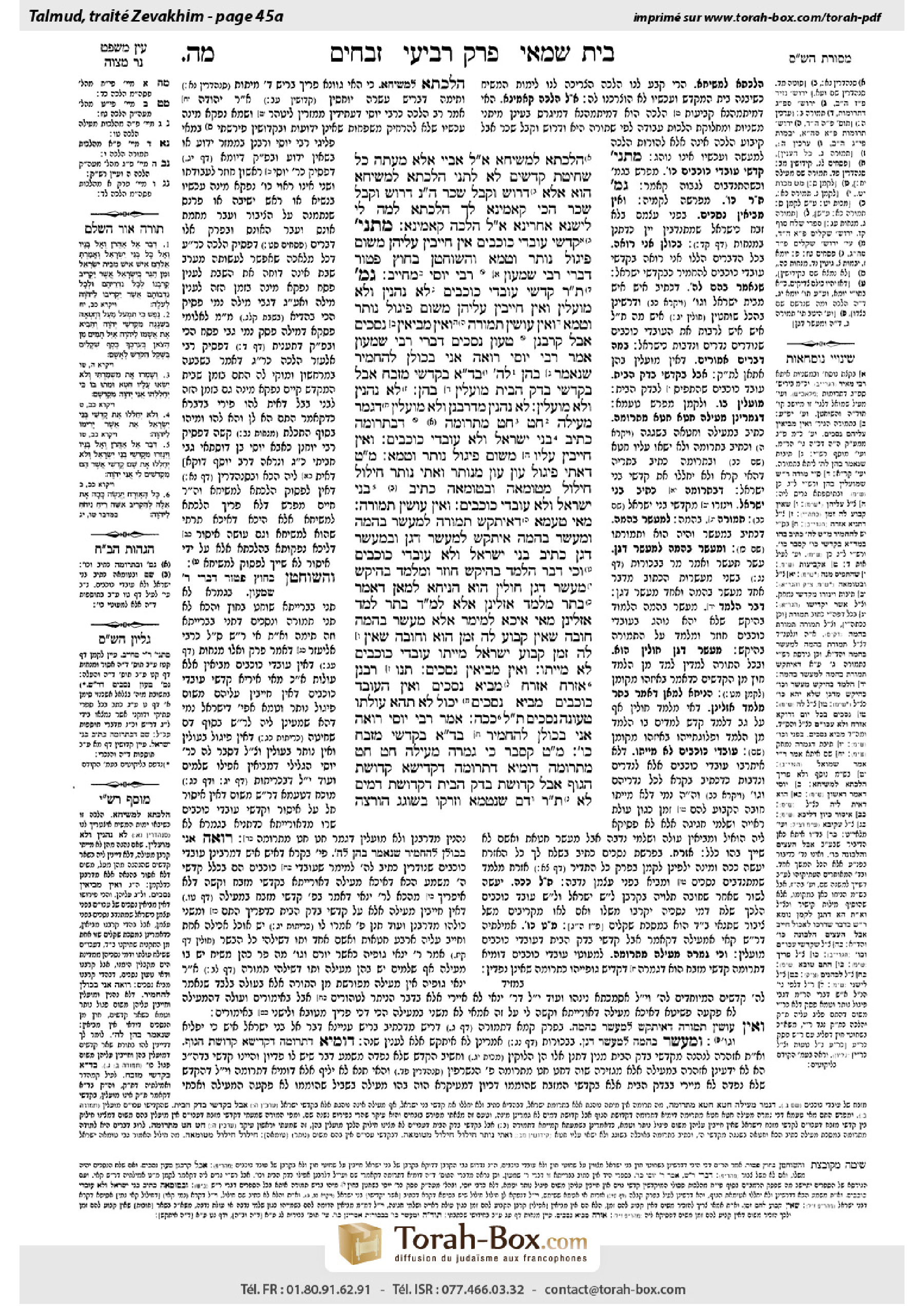
Zevachim 45a: Talmud study for Daf Yomi
Daf Yomi is the daily study of one Talmud folio. Explore 37 tractates with scans, Hebrew text, Sefaria English and AI-generated French translations where annotated.
Passage selection and English or AI-generated French translation are available where the scan has annotations. Daf Study is independent of Torah-Box and Sefaria.
Browse Zevachim · זבחים · All tractatesZevachim 45a text and translations
This page of Zevachim includes the Aramaic text, an English translation and an AI-generated French translation, alongside the scan above.
זבחים מ״ה א · Aramaic and Hebrew text
הִלְכְתָא לִמְשִׁיחָא?! אֲמַר לֵיהּ אַבָּיֵי: אֶלָּא מֵעַתָּה, כֹּל שְׁחִיטַת קֳדָשִׁים לָא לִתְנֵי – הִלְכְתָא לִמְשִׁיחָא הוּא! אֶלָּא דְּרוֹשׁ וְקַבֵּל שָׂכָר; הָכָא נָמֵי, דְּרוֹשׁ וְקַבֵּל שָׂכָר. הָכִי קָאָמֵינָא לָךְ: הִלְכְתָא לְמָה לִי? לִישָּׁנָא אַחֲרִינָא, אֲמַר לֵיהּ: הֲלָכָה קָאָמֵינָא.
מַתְנִי׳ קׇדְשֵׁי גוֹיִם – אֵין חַיָּיבִין עֲלֵיהֶם מִשּׁוּם פִּיגּוּל, נוֹתָר וְטָמֵא; וְהַשּׁוֹחֲטָן בַּחוּץ – פָּטוּר. דִּבְרֵי רַבִּי שִׁמְעוֹן. רַבִּי יוֹסֵי מְחַיֵּיב.
גְּמָ׳ תָּנוּ רַבָּנַן: קׇדְשֵׁי גוֹיִם – לֹא נֶהֱנִין וְלֹא מוֹעֲלִין, וְאֵין חַיָּיבִין עֲלֵיהֶן מִשּׁוּם פִּיגּוּל, נוֹתָר וְטָמֵא,
וְאֵין עוֹשִׂין תְּמוּרָה, וְאֵין מְבִיאִין נְסָכִים, אֲבָל קׇרְבָּנָן טָעוּן נְסָכִים. דִּבְרֵי רַבִּי שִׁמְעוֹן.
אָמַר רַבִּי יוֹסֵי: רוֹאֶה אֲנִי בְּכוּלָּן לְהַחְמִיר, שֶׁנֶּאֱמַר בָּהֶן ״לַה׳״. בַּמֶּה דְּבָרִים אֲמוּרִים – בְּקׇדְשֵׁי מִזְבֵּחַ, אֲבָל בְּקׇדְשֵׁי בֶּדֶק הַבַּיִת – מוֹעֲלִין בָּהֶן.
לֹא נֶהֱנִין וְלֹא מוֹעֲלִין. לֹא נֶהֱנִין – מִדְּרַבָּנַן.
וְלֹא מוֹעֲלִין – דְּגָמַר מְעִילָה ״חֵט״–״חֵט״ מִתְּרוּמָה, דְּבִתְרוּמָה כְּתִיב: ״בְּנֵי יִשְׂרָאֵל״ – וְלֹא גוֹיִם.
וְאֵין חַיָּיבִין עָלָיו מִשּׁוּם פִּיגּוּל, נוֹתָר וְטָמֵא. מַאי טַעְמָא? דְּאָתֵי פִּיגּוּל ״עָוֹן״–״עָוֹן״ מִנּוֹתָר,
וְאָתֵי נוֹתָר ״חִילּוּל״–״חִילּוּל״ מִטּוּמְאָה, וּבְטוּמְאָה כְּתִיב: ״בְּנֵי יִשְׂרָאֵל״ – וְלֹא גּוֹיִם.
וְאֵין עוֹשִׂין תְּמוּרָה. מַאי טַעְמָא? דְּאִיתַּקַּשׁ תְּמוּרָה לְמַעְשַׂר בְּהֵמָה, וּמַעְשַׂר בְּהֵמָה אִיתַּקַּשׁ לְמַעְשַׂר דָּגָן, וּבְמַעְשַׂר דָּגָן כְּתִיב: ״בְּנֵי יִשְׂרָאֵל״ – וְלֹא גּוֹיִם.
וְכִי דָּבָר הַלָּמֵד בְּהֶיקֵּשׁ חוֹזֵר וּמְלַמֵּד בְּהֶיקֵּשׁ?! מַעְשַׂר דָּגָן חוּלִּין הוּא.
הָנִיחָא לְמַאן דְּאָמַר בָּתַר מְלַמֵּד אָזְלִינַן; אֶלָּא לְמַאן דְּאָמַר בָּתַר לָמֵד אָזְלִינַן, מַאי אִיכָּא לְמֵימַר?
אֶלָּא מַעְשַׂר בְּהֵמָה חוֹבָה – שֶׁאֵין קָבוּעַ לָהּ זְמַן הוּא, וְחוֹבָה שֶׁאֵין לָהּ זְמַן קָבוּעַ – יִשְׂרָאֵל מַיְיתוּ, גּוֹיִם לָא מַיְיתוּ.
וְאֵין מְבִיאִין נְסָכִים. תָּנוּ רַבָּנַן: ״אֶזְרָח״ – אֶזְרָח מֵבִיא נְסָכִים, וְאֵין הַגּוֹי מֵבִיא נְסָכִים. יָכוֹל לֹא תְּהֵא עוֹלָתוֹ טְעוּנָה נְסָכִים? תַּלְמוּד לוֹמַר: ״כָּכָה״.
אָמַר רַבִּי יוֹסֵי: רוֹאֶה אֲנִי בְּכוּלָּן לְהַחְמִיר. בַּמֶּה דְּבָרִים אֲמוּרִים – בְּקׇדְשֵׁי מִזְבֵּחַ כּוּ׳. מַאי טַעְמָא?
קָסָבַר: כִּי גָּמְרָה מְעִילָה ״חֵט״–״חֵט״ מִתְּרוּמָה – דּוּמְיָא דִּתְרוּמָה, דְּקַדִּישָׁא קְדוּשַּׁת הַגּוּף; אֲבָל קְדוּשַּׁת בֶּדֶק הַבַּיִת, דִּקְדוּשַּׁת דָּמִים – לָא.
תָּנוּ רַבָּנַן: דָּם שֶׁנִּטְמָא וּזְרָקוֹ, בְּשׁוֹגֵג – הוּרְצָה,
Zevachim 45a · English translation
Does one issue a halakha for the messianic period, when the Temple will be rebuilt? Abaye said to him: If that is so, that such halakhot are not taught, let the tanna not teach all the halakhot of the slaughter of sacrificial animals, i.e., tractate Zevaḥim, as it is entirely a halakha for the messianic period. Rather, one studies these halakhot due to the principle of: Study Torah and receive reward, i.e., one is rewarded for the study of Torah regardless of its practical applicability. Here too, study Torah and receive reward. Rava said to him: This is what I am saying to you: Why do I need a practical ruling of halakha? According to another version, which presents the same answer in different terms, Rava said to him: I spoke in reference to the ruling of halakha, as it is puzzling that a halakhic ruling is given in this case.
MISHNA: With regard to offerings consecrated by gentiles for sacrifice to God, one is not liable for eating them, neither due to violation of the prohibition of piggul if the sacrificial rites were performed with the intent to eat the offering beyond its designated time, nor due to violation of the prohibition of notar, nor due to violation of the prohibition against eating the meat while ritually impure. And one who slaughters them outside the Temple courtyard is exempt; this is the statement of Rabbi Shimon. And Rabbi Yosei deems him liable.
GEMARA: The Sages taught in a baraita: With regard to offerings consecrated by gentiles, one may not derive benefit from them ab initio, but if one derived benefit from them, he is not liable after the fact for misusing consecrated property. And one is not liable for eating them, neither due to violation of the prohibition of piggul if the sacrificial rites were performed with the intent to eat the offering beyond its designated time, nor due to violation of the prohibition of notar, nor due to violation of the prohibition against eating the meat while ritually impure.
And gentiles cannot render an animal a substitute, i.e., if a gentile stated with regard to an animal that it should be the substitute of a consecrated animal, the substitution does not take effect. And gentiles cannot bring libations that are brought by themselves as a separate offering and do not accompany an animal offering, but their animal offerings require libations. This is the statement of Rabbi Shimon.
Rabbi Yosei says: I see the logic of the opinion that in all of these cases it is correct to be stringent about the offerings of gentiles, as it is stated with regard to them: “Any man of the house of Israel, or of the strangers in Israel that will sacrifice his offering…to the Lord” (Leviticus 22:18). This indicates that all offerings, even those of gentiles, are fully consecrated to God; therefore, the halakhot of misuse, piggul, notar, and eating the meat while ritually impure should all apply to the offerings of gentiles. In what case is this statement said? In the case of items consecrated for the altar. But with regard to items that are consecrated by gentiles for Temple maintenance, one who derives benefit from them is liable for misusing them. This concludes the baraita.
The Gemara begins to analyze this baraita in detail. The baraita taught that one may not derive benefit from items consecrated by gentiles ab initio, but if one derived benefit from them, he is not liable after the fact for misusing of consecrated property. The Gemara explains: One may not derive benefit from them by rabbinic law, as the Sages prohibited deriving benefit from any item that was consecrated to God.
The Gemara’s explanation continues: But if one derived benefit from them, he is not liable after the fact for misusing consecrated property, as the tanna of the baraita derives the halakha of misuse of consecrated property through a verbal analogy between “sin” stated with regard to misuse of consecrated items and the word “sin” stated with regard to teruma. With regard to misuse of consecrated property, the verse states: “If any one commits a trespass, and sins through error, in the sacred items of the Lord” (Leviticus 5:15). In the case of teruma, the verse states: “Lest they bear sin for it, and die due to it, if they profane it” (Leviticus 22:9). And with regard to teruma, it is written: “And they shall not profane the sacred items of the children of Israel” (Leviticus 22:15), which indicates: But not the sacred items of gentiles, i.e., one is not liable for partaking of the teruma of gentiles while he is in a state of ritual impurity.
The baraita further taught: And one is not liable for eating the offerings of gentiles due to violation of the prohibition of piggul, or notar, or eating the meat while ritually impure. The Gemara asks: What is the reason for this? The Gemara explains that the halakha of piggul is derived through a verbal analogy between the word “iniquity” stated with regard to piggul and the word “iniquity” stated with regard to notar. With regard to piggul, the verse states: “It shall be piggul, and the soul that eats it shall bear his iniquity” (Leviticus 7:18), and with regard to leftover sacrificial meat the verse states: “Therefore anyone who eats it shall bear his iniquity” (Leviticus 19:8).
And the halakha of notar itself is derived through a verbal analogy between profanation stated with regard to notar and profanation stated with regard to ritual impurity. With regard to notar the verse states: “Because he has profaned the sacred item of the Lord” (Leviticus 19:8), and with regard to impurity the verse states: “And that they do not profane My holy name” (Leviticus 22:2). And with regard to impurity it is written in that same verse: “That they separate themselves from the sacred items of the children of Israel,” which indicates: But not the sacred items of gentiles.
The baraita also teaches: And gentiles cannot render an animal a substitute. The Gemara asks: What is the reason for this? The Gemara explains: It is because substitution is juxtaposed in the Torah with animal tithe, as the verse states: “And concerning the tithe of the herd, or of the flock…the tenth shall be sacred to the Lord…neither shall he make a substitute for it” (Leviticus 27:32–33). And animal tithe is juxtaposed with the tithe of grains, as the verse states: “You shall tithe [asser te’asser] all the increase of your seed that the field brings forth year by year. And you shall eat before the Lord your God, in the place that He shall choose to place His name there, the tithe of your grain” (Deuteronomy 14:22–23). The doubled verb form, asser te’asser, is understood as an allusion to two tithes, grain tithe and animal tithe. And with regard to the tithe of grains it is written: “When you take of the children of Israel the tithes” (Numbers 18:24), which indicates: But not of gentiles.
The Gemara asks: But does a matter derived via a juxtaposition again teach via a juxtaposition? There is a principle that in consecrated matters, a halakha derived via a juxtaposition cannot teach another halakha via a juxtaposition. The Gemara answers: This derivation is not relevant exclusively to consecrated matters, as the tithe of grains is non-sacred food.
The Gemara raises a difficulty: This works out well according to the one who says that when implementing this principle we follow the source that teaches the halakha, i.e., if the matter that teaches the first juxtaposition involves non-sacred items, one can employ two juxtapositions even with regard to deriving the halakha for consecrated matters. But according to the one who says that we follow the matter that is taught the halakha, i.e., the case to which we wish to apply the halakha, and if that case involves offerings one cannot employ two juxtapositions, what can be said?
Rather, the reason why gentiles cannot bring an animal tithe offering is that animal tithe is an obligation for which there is no fixed time, and with regard to any obligation for which there is no fixed time, a Jew can bring it but gentiles cannot bring it. And as stated, substitution is juxtaposed with the animal tithe, and therefore gentiles can also not render an animal a substitute.
§ The baraita teaches: And gentiles cannot bring libations that are brought by themselves as a separate offering and do not accompany an animal offering, but their animal offerings require libations. The Gemara cites the source of these halakhot. The Sages taught in a baraita: The verse states with regard to libations: “All who are homeborn shall do these things after this manner” (Numbers 15:13), which teaches that those who are homeborn, i.e., Jews, can bring libations as a separate offering, but a gentile cannot bring such libations. One might consequently have thought that a gentile’s burnt offering should not require the standard accompanying libations. Therefore, the verse states: “So it shall be done for each bull” (Numbers 15:11), which indicates that every offering requires libations.
The baraita continues: Rabbi Yosei says: I see that in all of these cases it is correct to be stringent. In what case is this statement said? In the case of items consecrated for the altar. But with regard to items that are consecrated by gentiles for Temple maintenance, one who derives benefit from them is liable for misusing them. The Gemara asks: What is the reason of Rabbi Yosei?
The Gemara answers that Rabbi Yosei holds that when the halakha of misuse of consecrated property is derived through a verbal analogy between “sin” stated with regard to misuse of consecrated property and “sin” stated with regard to teruma, this is referring to items that are similar to teruma, which is sacred with inherent sanctity. But with regard to an item consecrated for Temple maintenance, which has no inherent sanctity, but only sanctity that inheres in its value, this exemption of gentiles does not apply.
The Gemara continues to analyze the opinion of Rabbi Yosei. The Sages taught in a baraita: With regard to blood that became impure and a priest sprinkled it on the altar, if he did so unwittingly, the offering is accepted.
Zevachim 45a · Traduction française (IA)
Édicte-t-on une halakha pour l’époque messianique, lorsque le Temple sera reconstruit ? Abayé lui dit : S’il en est ainsi, si de telles halakhot ne sont pas enseignées, que le tanna n’enseigne pas non plus toutes les halakhot de l’abattage des animaux sacrificiels, c’est-à-dire le traité Zevaḥim, puisqu’il porte entièrement sur l’époque messianique. On étudie plutôt ces halakhot en vertu du principe suivant : « Étudie la Torah et tu recevras une récompense », autrement dit, on est récompensé pour l’étude de la Torah, indépendamment de son application pratique. Ici aussi, étudie la Torah et tu recevras une récompense. Rava lui dit : C’est précisément ce que je te dis : pourquoi ai-je besoin d’une décision halakhique pratique ? Selon une autre version, qui présente la même réponse en d’autres termes, Rava lui dit : Je parlais de la décision halakhique, car il est étonnant qu’une décision halakhique soit donnée dans ce cas.
Michna : Concernant les offrandes consacrées par des non-Juifs pour être sacrifiées à Dieu, on n’encourt aucune responsabilité en les mangeant : ni pour avoir transgressé l’interdiction du piggoul, si les rites sacrificiels ont été accomplis avec l’intention de manger l’offrande après le délai qui lui est fixé, ni pour avoir transgressé l’interdiction du notar, ni pour avoir mangé la viande en état d’impureté rituelle. Celui qui les abat hors de la cour du Temple est exempt ; telle est l’opinion de Rabbi Shimon. Rabbi Yossi le déclare passible.
Guemara : Les Sages ont enseigné dans une baraïta : Concernant les offrandes consacrées par des non-Juifs, il est interdit d’en tirer profit a priori, mais si quelqu’un en a tiré profit, il n’est pas passible, après coup, pour détournement de biens consacrés. On n’encourt aucune responsabilité en les mangeant : ni pour avoir transgressé l’interdiction du piggoul, si les rites sacrificiels ont été accomplis avec l’intention de manger l’offrande après le délai qui lui est fixé, ni pour avoir transgressé l’interdiction du notar, ni pour avoir mangé la viande en état d’impureté rituelle.
Les non-Juifs ne peuvent pas non plus faire d’un animal le substitut d’un animal consacré : autrement dit, si un non-Juif déclare au sujet d’un animal qu’il doit être le substitut d’un animal consacré, la substitution ne prend pas effet. Les non-Juifs ne peuvent pas non plus apporter des libations indépendantes, qui ne sont pas jointes à une offrande animale, mais leurs offrandes animales doivent être accompagnées de libations. Telle est l’opinion de Rabbi Shimon.
Rabbi Yossi dit : Je trouve logique d’être rigoureux dans tous ces cas concernant les offrandes des non-Juifs, car il est dit à leur sujet : « Tout homme de la maison d’Israël, ou parmi les étrangers qui séjournent en Israël, qui présentera son offrande… à l’Éternel » (Lévitique 22:18). Cela indique que toutes les offrandes, même celles des non-Juifs, sont pleinement consacrées à Dieu ; par conséquent, les halakhot relatives au détournement de biens consacrés, au piggoul, au notar et à la consommation de la viande en état d’impureté rituelle devraient toutes s’appliquer aux offrandes des non-Juifs. Dans quel cas cette déclaration s’applique-t-elle ? Aux objets consacrés à l’autel. Mais si des non-Juifs consacrent des objets à l’entretien du Temple, celui qui en tire profit est passible pour détournement de biens consacrés. La baraïta s’achève ainsi.
La Guemara commence à analyser cette baraïta en détail. La baraïta a enseigné qu’il est interdit de tirer profit a priori des objets consacrés par des non-Juifs, mais que si quelqu’un en a tiré profit, il n’est pas passible, après coup, pour détournement de biens consacrés. La Guemara explique : il est interdit d’en tirer profit en vertu du droit rabbinique, car les Sages ont interdit de tirer profit de tout objet consacré à Dieu.
La Guemara poursuit son explication : si quelqu’un en a tiré profit, il n’est pas passible, après coup, pour détournement de biens consacrés, car le tanna de la baraïta déduit la halakha du détournement de biens consacrés au moyen d’une analogie verbale entre le mot « faute », énoncé au sujet du détournement d’objets consacrés, et le mot « faute », énoncé au sujet de la terouma. À propos du détournement de biens consacrés, le verset dit : « Si quelqu’un commet une infidélité et pèche par erreur au sujet des choses saintes de l’Éternel » (Lévitique 5:15). À propos de la terouma, le verset dit : « De peur qu’ils ne portent la faute qui en résulterait et n’en meurent, s’ils la profanaient » (Lévitique 22:9). Et au sujet de la terouma, il est écrit : « Ils ne profaneront pas les choses saintes des enfants d’Israël » (Lévitique 22:15), ce qui indique : mais pas les choses saintes des non-Juifs ; autrement dit, on n’est pas passible pour avoir consommé la terouma des non-Juifs en état d’impureté rituelle.
La baraïta a également enseigné qu’on n’encourt aucune responsabilité pour avoir mangé les offrandes des non-Juifs en transgressant l’interdiction du piggoul, du notar ou de la consommation de viande en état d’impureté rituelle. La Guemara demande : Quelle en est la raison ? La Guemara explique que la halakha du piggoul est déduite au moyen d’une analogie verbale entre le mot « faute », énoncé au sujet du piggoul, et le mot « faute », énoncé au sujet du notar. À propos du piggoul, le verset dit : « Il sera piggoul, et la personne qui en mangera portera sa faute » (Lévitique 7:18) ; et à propos de la viande sacrificielle restante, le verset dit : « Quiconque en mangera portera sa faute » (Lévitique 19:8).
La halakha du notar elle-même est déduite au moyen d’une analogie verbale entre le terme « profaner », énoncé au sujet du notar, et le même terme, énoncé au sujet de l’impureté rituelle. À propos du notar, le verset dit : « Car il a profané la chose sainte de l’Éternel » (Lévitique 19:8) ; et à propos de l’impureté, le verset dit : « afin qu’ils ne profanent pas Mon saint nom » (Lévitique 22:2). Et au sujet de l’impureté, il est écrit dans ce même verset : « qu’ils se séparent des choses saintes des enfants d’Israël », ce qui indique : mais pas des choses saintes des non-Juifs.
La baraïta enseigne également que les non-Juifs ne peuvent pas faire d’un animal le substitut d’un animal consacré. La Guemara demande : Quelle en est la raison ? La Guemara explique : c’est parce que la substitution est juxtaposée dans la Torah à la dîme animale, comme le dit le verset : « Quant à la dîme du gros et du petit bétail… le dixième sera consacré à l’Éternel… il ne le remplacera pas par un autre » (Lévitique 27:32-33). La dîme animale est, quant à elle, juxtaposée à la dîme des céréales, comme le dit le verset : « Tu prélèveras la dîme [asser te’asser] de tout le produit de tes semailles que le champ donne chaque année. Tu mangeras devant l’Éternel ton Dieu, dans le lieu qu’Il choisira pour y faire résider Son nom, la dîme de ton blé » (Deutéronome 14:22-23). La forme verbale redoublée, asser te’asser, est comprise comme une allusion à deux dîmes : la première dîme des céréales et la dîme animale. Or, à propos de la dîme des céréales, il est écrit : « Lorsque vous prélèverez les dîmes sur les enfants d’Israël » (Nombres 18:24), ce qui indique : mais pas sur celles des non-Juifs.
La Guemara demande : Mais une règle déduite par juxtaposition peut-elle à son tour en enseigner une autre par juxtaposition ? Un principe veut que, dans le domaine des choses consacrées, une halakha déduite par juxtaposition ne puisse pas servir à en enseigner une autre par juxtaposition. La Guemara répond : Cette déduction ne concerne pas exclusivement les choses consacrées, puisque la dîme des céréales est un aliment non consacré.
La Guemara soulève une difficulté : Cela fonctionne bien selon celui qui dit que, pour appliquer ce principe, on suit la source qui enseigne la halakha ; autrement dit, si la matière qui établit la première juxtaposition concerne des objets non consacrés, on peut recourir à deux juxtapositions même pour déduire une halakha concernant des choses consacrées. Mais que peut-on répondre selon celui qui dit qu’on suit la matière à laquelle la halakha s’applique, c’est-à-dire le cas auquel on souhaite appliquer la halakha, de sorte que si ce cas concerne des offrandes, on ne peut pas recourir à deux juxtapositions ?
La raison pour laquelle les non-Juifs ne peuvent pas apporter une offrande de dîme animale est plutôt que la dîme animale est une obligation sans échéance fixe et que, pour toute obligation sans échéance fixe, un Juif peut s’en acquitter, mais pas un non-Juif. Or, comme cela a été dit, la substitution est juxtaposée à la dîme animale ; les non-Juifs ne peuvent donc pas non plus faire d’un animal le substitut d’un animal consacré.
§ La baraïta enseigne que les non-Juifs ne peuvent pas apporter de libations indépendantes, qui ne sont pas jointes à une offrande animale, mais que leurs offrandes animales doivent être accompagnées de libations. La Guemara cite la source de ces halakhot. Les Sages ont enseigné dans une baraïta : Au sujet des libations, le verset dit : « Tous ceux qui sont nés dans le pays agiront ainsi » (Nombres 15:13), ce qui enseigne que ceux qui sont nés dans le pays, c’est-à-dire les Juifs, peuvent apporter des libations à titre d’offrande indépendante, mais qu’un non-Juif ne peut pas en apporter. On aurait donc pu penser que l’holocauste d’un non-Juif ne devait pas être accompagné des libations habituelles. Le verset dit donc : « Il en sera fait ainsi pour chaque taureau » (Nombres 15:11), ce qui indique que toute offrande doit être accompagnée de libations.
La baraïta poursuit : Rabbi Yossi dit : Je trouve qu’il est juste d’être rigoureux dans tous ces cas. Dans quel cas cette déclaration s’applique-t-elle ? Aux objets consacrés à l’autel. Mais si des non-Juifs consacrent des objets à l’entretien du Temple, celui qui en tire profit est passible pour détournement de biens consacrés. La Guemara demande : Quelle est la raison de Rabbi Yossi ?
La Guemara répond que, selon Rabbi Yossi, lorsque la halakha du détournement de biens consacrés est déduite au moyen d’une analogie verbale entre le mot « faute », énoncé au sujet du détournement de biens consacrés, et le mot « faute », énoncé au sujet de la terouma, cela concerne les objets comparables à la terouma, qui possède une sainteté intrinsèque. Mais pour un objet consacré à l’entretien du Temple, qui ne possède pas de sainteté intrinsèque et dont la sainteté réside uniquement dans sa valeur, cette exemption accordée aux non-Juifs ne s’applique pas.
La Guemara poursuit l’analyse de l’opinion de Rabbi Yossi. Les Sages ont enseigné dans une baraïta : Si du sang devenu impur est aspergé sur l’autel par un prêtre, l’offrande est agréée lorsque le prêtre l’a fait par inadvertance.
Traduction française générée par IA à partir de l’édition anglaise de Sefaria. Vérifie toujours un passage avec le texte source.
Text from Sefaria: William Davidson Edition - Vocalized Aramaic (CC BY NC); William Davidson Edition - English (CC BY NC).