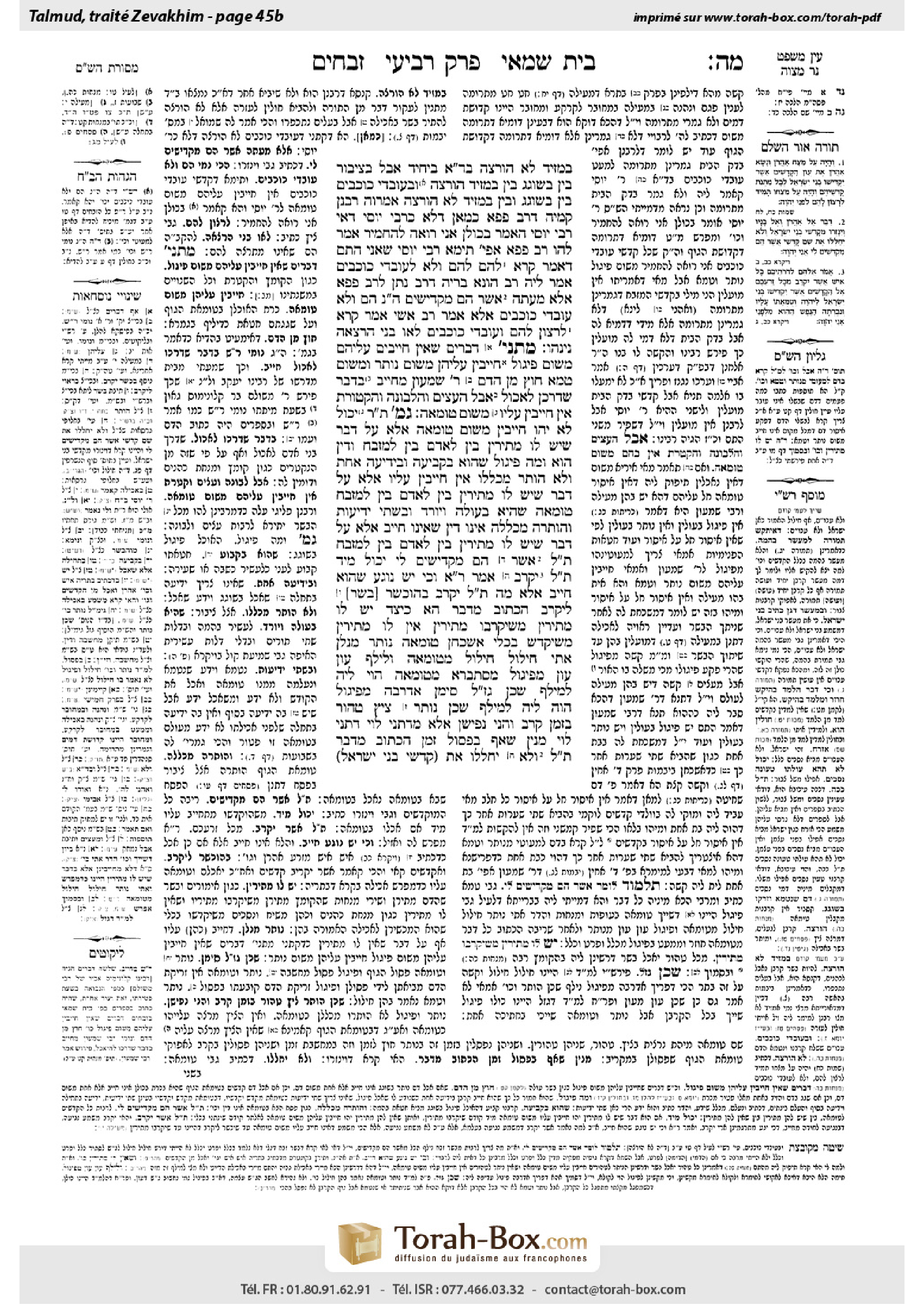
Zevachim 45b: Talmud study for Daf Yomi
Daf Yomi is the daily study of one Talmud folio. Explore 37 tractates with scans, Hebrew text, Sefaria English and AI-generated French translations where annotated.
Passage selection and English or AI-generated French translation are available where the scan has annotations. Daf Study is independent of Torah-Box and Sefaria.
Browse Zevachim · זבחים · All tractatesZevachim 45b text and translations
This page of Zevachim includes the Aramaic text, an English translation and an AI-generated French translation, alongside the scan above.
זבחים מ״ה ב · Aramaic and Hebrew text
בְּמֵזִיד – לֹא הוּרְצָה. בַּמֶּה דְּבָרִים אֲמוּרִים – בְּיָחִיד; אֲבָל בְּצִיבּוּר, בֵּין בְּשׁוֹגֵג בֵּין בְּמֵזִיד – הוּרְצָה. וּבְגוֹיִם, בֵּין בְּשׁוֹגֵג וּבֵין בְּמֵזִיד – לֹא הוּרְצָה.
אַמְרוּהָ רַבָּנַן קַמֵּיהּ דְּרַב פָּפָּא: כְּמַאן? דְּלָא כְּרַבִּי יוֹסֵי; דְּאִי רַבִּי יוֹסֵי, הָאָמַר: בְּכוּלָּן אֲנִי רוֹאֶה לְהַחְמִיר!
אֲמַר לְהוּ רַב פָּפָּא: אֲפִילּוּ תֵּימָא רַבִּי יוֹסֵי, שָׁאנֵי הָתָם דְּאָמַר קְרָא: ״לָהֶם״ – לָהֶם וְלֹא לְגוֹיִם.
אֲמַר לֵיהּ רַב הוּנָא בְּרֵיהּ דְּרַב נָתָן לְרַב פָּפָּא: אֶלָּא מֵעַתָּה, ״אֲשֶׁר הֵם מַקְדִּישִׁים״ – הָכִי נָמֵי, הֵם וְלֹא גּוֹיִם?!
אֶלָּא אָמַר רַב אָשֵׁי, אָמַר קְרָא: ״לְרָצוֹן לָהֶם״ – וְגוֹיִם לָאו בְּנֵי הַרְצָאָה נִינְהוּ.
מַתְנִי׳ דְּבָרִים שֶׁאֵין חַיָּיבִים עֲלֵיהֶם מִשּׁוּם פִּיגּוּל, חַיָּיבִין עֲלֵיהֶן מִשּׁוּם נוֹתָר וּמִשּׁוּם טָמֵא; חוּץ מִן הַדָּם. רַבִּי שִׁמְעוֹן מְחַיֵּיב בְּדָבָר שֶׁדַּרְכָּן לֶאֱכוֹל, אֲבָל הָעֵצִים וְהַלְּבוֹנָה וְהַקְּטוֹרֶת אֵין חַיָּיבִין עָלָיו מִשּׁוּם טוּמְאָה.
גְּמָ׳ תָּנוּ רַבָּנַן: יָכוֹל לֹא יְהוּ חַיָּיבִין מִשּׁוּם טוּמְאָה אֶלָּא עַל דָּבָר שֶׁיֵּשׁ לוֹ מַתִּירִין – בֵּין לְאָדָם בֵּין לְמִזְבֵּחַ?
וְדִין הוּא; וּמָה פִּיגּוּל, שֶׁהוּא בִּקְבִיעָה וּבִידִיעָה אַחַת וְלֹא הוּתַּר מִכְּלָלוֹ – אֵין חַיָּיבִין עָלָיו אֶלָּא עַל דָּבָר שֶׁיֵּשׁ לוֹ מַתִּירִין, בֵּין לְאָדָם בֵּין לְמִזְבֵּחַ;
טוּמְאָה, שֶׁהִיא בְּעוֹלֶה וְיוֹרֵד וּבִשְׁתֵּי יְדִיעוֹת וְהוּתְּרָה מִכְּלָלָהּ – אֵינוֹ דִּין שֶׁאֵינוֹ חַיָּיב אֶלָּא עַל דָּבָר שֶׁיֵּשׁ לוֹ מַתִּירִין, בֵּין לְאָדָם בֵּין לְמִזְבֵּחַ?
תַּלְמוּד לוֹמַר: ״אֲשֶׁר הֵם מַקְדִּישִׁים לִי״.
יָכוֹל מִיָּד? תַּלְמוּד לוֹמַר: ״יִקְרַב״. אָמַר רַבִּי אֶלְעָזָר: וְכִי יֵשׁ נוֹגֵעַ שֶׁהוּא חַיָּיב?!
אֶלָּא מָה תַּלְמוּד לוֹמַר ״יִקְרַב״? בְּהוּכְשַׁר [בָּשָׂר] לִיקָּרֵב הַכָּתוּב מְדַבֵּר. הָא כֵּיצַד? יֵשׁ לוֹ מַתִּירִין – מִשֶּׁיִּקְרָבוֹ מַתִּירִין, אֵין לוֹ מַתִּירִין – מִשֶּׁיִּקְדַּשׁ בִּכְלִי.
אַשְׁכְּחַן טוּמְאָה; נוֹתָר מְנָלַן? אָתֵי ״חִילּוּל״–״חִילּוּל״ מִטּוּמְאָה.
וְלֵילַף ״עָוֹן״–״עָוֹן״ מִפִּיגּוּל!
מִסְתַּבְּרָא מִטּוּמְאָה הָוֵי לֵיהּ לְמֵילַף, שֶׁכֵּן גֶזֶ״ל סִימָן.
אַדְּרַבָּה, מִפִּיגּוּל הֲוָה לֵיהּ לְמֵילַף – שֶׁכֵּן הוּתַּר, צִיץ, טָהוֹר, בִּזְמַן, קָרֵב; וְהָנֵי נְפִישָׁן!
אֶלָּא מִדְּתָנֵי לֵוִי. דְּתָנֵי לֵוִי: מִנַּיִן שֶׁאַף בִּפְסוּל זְמַן הַכָּתוּב מְדַבֵּר? תַּלְמוּד לוֹמַר: ״וְלֹא יְחַלְּלוּ אֶת קׇדְשֵׁי בְּנֵי יִשְׂרָאֵל״ –
Zevachim 45b · English translation
But if he sprinkled the blood intentionally, the offering is not accepted. In what case is this statement said? It is with regard to the offering of an individual. But with regard to the offering of the community, whether the priest sprinkled the blood unwittingly or he did so intentionally, the offering is accepted. And in the case of the offerings of gentiles, whether he sprinkled the blood unwittingly or he did so intentionally, the offering is not accepted.
The Sages said before Rav Pappa: In accordance with whose opinion was this baraita taught? Apparently, it was taught not in accordance with the opinion of Rabbi Yosei, as if it reflects the opinion of Rabbi Yosei, there is a difficulty: Doesn’t Rabbi Yosei say: I see the logic of the opinion that in all of these cases it is correct to be stringent about the offerings of gentiles? This indicates that Rabbi Yosei equates the halakhot applying to the offerings of gentiles with those governing the offerings of Jews.
Rav Pappa said to them: You may even say that the baraita is in accordance with the opinion of Rabbi Yosei, and it is different there, as the verse states with regard to the High Priest’s frontplate, which atones for ritual impurity contracted by offerings in the Temple without the knowledge of those offering them: “And it shall be always upon his forehead that it may be accepted for them before the Lord” (Exodus 28:38), which indicates that it is accepted for them, i.e., for Jews, but not for gentiles.
Rav Huna, son of Rav Natan, said to Rav Pappa: If that is so, with regard to the verse discussing ritually impure priests and consecrated items: “That they separate themselves from the sacred items of the children of Israel, which they consecrate to Me” (Leviticus 22:2), so too, would Rabbi Yosei say that the prohibition against eating consecrated items in a state of ritual impurity applies only to offerings which they, the Jews, consecrate, and not to those of gentiles? This cannot be, as Rabbi Yosei explicitly states in the baraita that in this regard the offerings of gentiles are like those of Jews.
Rather, Rav Ashi says that it is not from the words “for them” that one derives that the offering of a gentile is not accepted when the blood that was sprinkled had become impure. Rather, it is because the atonement achieved by way of the High Priest’s frontplate does not apply to gentiles, as the verse states: “That it may be accepted for them before the Lord” (Exodus 28:38), and gentiles are not subject to the acceptance of offerings.
MISHNA: Even with regard to those items enumerated in the previous mishna (42b) for which one is not liable for eating them due to violation of the prohibition of piggul, e.g., the handful, the frankincense, and the incense, one is, nevertheless, liable for eating them due to violation of the prohibition of notar, and due to violation of the prohibition against eating consecrated food while ritually impure, except for the blood. Rabbi Shimon deems one liable for an item whose typical manner is such that one eats it. But with regard to the wood, the frankincense, and the incense, one is not liable for eating them due to violation of the prohibition against eating a consecrated item while ritually impure.
GEMARA: The Sages taught in a baraita: It might have been thought that one should be liable due to violation of the prohibition against eating consecrated food while in a state of ritual impurity only for an item that has permitting factors, either for consumption by a person or for burning on the altar.
The baraita explains: And this may be derived via a logical derivation: Just as with regard to piggul, which renders one who unwittingly eats it liable to bring a fixed sin offering, and this liability is incurred with one change in his awareness, i.e., it suffices for the sinner to become aware after the fact that he had sinned unwittingly, and it has no permitted exceptions from its general prohibition, as there are no circumstances in which one is permitted to eat piggul, and yet one is liable due to violation of the prohibition against eating piggul only for an item that has permitting factors, either for consumption by a person or for burning on the altar, so too, the same should certainly apply to the more lenient case of ritual impurity.
The Gemara elaborates: Impurity is more lenient than piggul, as it renders the unwitting sinner liable only to bring a sliding-scale offering, which varies according to his financial circumstances: A poor person brings a bird offering or even a meal offering (see Leviticus 5:6–13). And liability is incurred only with two changes in his awareness, i.e., when the sinner was aware of his impurity beforehand, then forgot about it at the time of his sin, and then once again become aware of his impurity. And it has permitted exceptions from its general prohibition with regard to the community, as it is permitted to sacrifice communal offerings in the Temple in a state of impurity. With these leniencies in mind, is it not right that one should be liable due to violation of the prohibition against eating consecrated food while ritually impure only for an item that has permitting factors, either for a person or for the altar.
Therefore, the verse states, with regard to eating consecrated foods in a state of ritual impurity: “That they separate themselves from the sacred items of the children of Israel, which they consecrate to Me, and that they do not profane My holy name” (Leviticus 22:2). This teaches that a ritually impure person is liable for eating any item that has been consecrated.
One might have thought that one is liable for eating sacred items immediately after they have been consecrated. Therefore, the verse states: “Whoever he is of all your seed among your generations that approaches the sacred items” (Leviticus 22:3), and Rabbi Elazar said, in explanation of this verse: But is there one who merely touches, i.e., approaches, consecrated items, who is liable? Only one who eats consecrated food while in a state of ritual impurity is liable.
Rather, what is the meaning when the verse states: “Approaches [yikrav]”? This term alludes to sacrificing [hakrava], as though the verse has stated: Whoever sacrifices sacred items and eats them. This teaches that the verse is speaking of flesh that has been rendered fit to be sacrificed. How so? With regard to an item that has permitting factors, one is liable from when the permitting factors are sacrificed. In the case of an item that does not have permitting factors, one is liable from when it is sanctified in a service vessel for the purpose of its sacrifice.
The Gemara asks: We have found proof that the prohibition against eating consecrated food in a state of ritual impurity applies even to an item that does not have a permitting factor. From where do we derive that notar likewise applies to an item that does not have a permitting factor? The Gemara answers: This is derived through a verbal analogy between profanation stated in the context of notar and profanation stated in the context of ritual impurity. With regard to notar the verse states: “Because he has profaned the sacred item of the Lord” (Leviticus 19:8), and with regard to impurity the verse states: “And that they do not profane My holy name” (Leviticus 22:2).
The Gemara challenges: But let the halakha of notar be derived through a verbal analogy between “iniquity” stated in the context of notar and “iniquity” stated in the context of piggul. With regard to piggul, the verse states: “It shall be piggul, and the soul that eats of it shall bear his iniquity” (Leviticus 7:18), and with regard to leftover sacrificial meat the verse states: “Therefore anyone who eats it shall bear his iniquity” (Leviticus 19:8). If so, the halakha of notar should be similar to that of piggul, for which one is liable only for an item that has a permitting factor.
The Gemara answers that it is more reasonable to derive notar from ritual impurity, for several reasons, as indicated by the mnemonic: Gimmel, zayin, lamed. Both notar and impurity are disqualifications that apply to the body [guf ] of the offering itself, whereas piggul is caused by intent; unlike piggul, these two disqualifications are not determined by the sprinkling [zerika] of the blood, and in both cases the Torah uses the term profanation [ḥillul ].
The Gemara responds: On the contrary, it is more reasonable to derive notar from piggul, as like piggul it does not have permitted exceptions from its general prohibition, it has no atonement through the High Priest’s frontplate, both notar and piggul apply to a ritually pure offering, these disqualifications are dependent on time, and both of them are disqualifications of the item being sacrificed, not the priest performing the service. None of these features are true of ritual impurity. And these reasons for comparing notar to piggul are more numerous.
Rather, the halakha of notar is derived from that which Levi taught with regard to the verse: “That they separate themselves from the sacred items of the children of Israel, which they consecrate to Me, and that they do not profane My holy name” (Leviticus 22:2), which is referring to the eating of consecrated food in a state of ritual impurity. As Levi taught: From where is it derived that the verse is speaking even of a disqualification caused by time, and not only ritual impurity? The verse states profanation elsewhere: “And they shall not profane the sacred items of the children of Israel” (Leviticus 22:15).
Zevachim 45b · Traduction française (IA)
Mais s’il a aspergé le sang intentionnellement, l’offrande n’est pas agréée. Dans quel cas cette déclaration s’applique-t-elle ? À l’offrande d’un particulier. En revanche, pour une offrande communautaire, que le prêtre ait aspergé le sang par inadvertance ou intentionnellement, l’offrande est agréée. Quant aux offrandes des non-Juifs, que le prêtre ait aspergé le sang par inadvertance ou intentionnellement, l’offrande n’est pas agréée.
Les Sages dirent devant Rav Pappa : Selon l’opinion de qui cette baraïta a-t-elle été enseignée ? Apparemment, elle ne suit pas l’opinion de Rabbi Yosei, car si elle reflétait son opinion, une difficulté se poserait : Rabbi Yosei ne dit-il pas : « Je trouve logique l’opinion selon laquelle, dans tous ces cas, il convient d’être strict à l’égard des offrandes des non-Juifs » ? Cela indique que Rabbi Yosei assimile les halakhot relatives aux offrandes des non-Juifs à celles qui régissent les offrandes des Juifs.
Rav Pappa leur dit : Vous pouvez même dire que la baraïta suit l’opinion de Rabbi Yosei, car le cas présent est différent : le verset dit à propos du fronton du grand prêtre, qui expie l’impureté rituelle contractée par des offrandes dans le Temple à l’insu de ceux qui les présentent : « Il sera toujours sur son front, afin qu’elles soient agréées pour eux devant l’Éternel » (Exode 28:38). Cela indique qu’elles sont agréées pour eux, c’est-à-dire pour les Juifs, mais pas pour les non-Juifs.
Rav Huna, fils de Rav Natan, dit à Rav Pappa : Si tel est le cas, à propos du verset concernant les prêtres rituellement impurs et les objets consacrés : « Qu’ils se séparent des objets sacrés des enfants d’Israël, qu’ils consacrent à Moi » (Lévitique 22:2), Rabbi Yosei dirait-il également que l’interdiction de consommer des objets consacrés en état d’impureté rituelle ne s’applique qu’aux offrandes que les Juifs consacrent, et non à celles des non-Juifs ? Cela ne peut être le cas, puisque Rabbi Yosei affirme explicitement dans la baraïta qu’à cet égard, les offrandes des non-Juifs sont comme celles des Juifs.
Rav Ashi dit plutôt que ce n’est pas des mots « pour eux » que l’on déduit que l’offrande d’un non-Juif n’est pas agréée lorsque le sang aspergé était devenu impur. C’est plutôt parce que l’expiation obtenue grâce au fronton du grand prêtre ne s’applique pas aux non-Juifs, comme le dit le verset : « Afin qu’elles soient agréées pour eux devant l’Éternel » (Exode 28:38) ; les non-Juifs ne sont pas concernés par l’agrément des offrandes.
MICHNA : Même pour les éléments énumérés dans la Michna précédente (42b), dont la consommation n’entraîne pas de responsabilité pour violation de l’interdiction de piggul — par exemple, la poignée, l’encens et les aromates —, on est néanmoins responsable de leur consommation au titre de l’interdiction de notar et de celle de consommer un aliment consacré en état d’impureté rituelle, à l’exception du sang. Rabbi Shimon estime qu’on est responsable pour un élément que l’on a coutume de manger. Mais pour le bois, l’encens et les aromates, on n’est pas responsable de leur consommation au titre de l’interdiction de consommer un objet consacré en état d’impureté rituelle.
GUEMARA : Les Sages ont enseigné dans une baraïta : On aurait pu penser que l’on n’est responsable de la violation de l’interdiction de consommer des aliments consacrés en état d’impureté rituelle que pour un élément doté de facteurs qui le rendent permis, que ce soit à la consommation humaine ou à la combustion sur l’autel.
La baraïta explique : On peut le déduire par raisonnement a fortiori : de même que, pour le piggul, dont la consommation par inadvertance rend responsable d’apporter un sacrifice expiatoire fixe, cette responsabilité étant engagée après un seul changement de connaissance — c’est-à-dire qu’il suffit que le pécheur prenne conscience après coup qu’il a péché par inadvertance —, et qui ne connaît aucune exception autorisée à son interdiction générale, puisqu’il n’existe aucune circonstance où il soit permis de consommer du piggul, on n’est responsable de sa consommation que pour un élément doté de facteurs qui le rendent permis, que ce soit à la consommation humaine ou à la combustion sur l’autel ; à plus forte raison devrait-il en être ainsi dans le cas, plus indulgent, de l’impureté rituelle.
La Guemara développe : L’impureté rituelle est plus indulgente que le piggul, car elle ne rend le pécheur ayant agi par inadvertance passible que d’un sacrifice à valeur variable, qui dépend de sa situation financière : une personne pauvre apporte une offrande d’oiseaux, voire une offrande de farine (voir Lévitique 5:6–13). En outre, la responsabilité n’est engagée qu’après deux changements de connaissance : le pécheur savait auparavant qu’il était impur, l’a oublié au moment de sa faute, puis a de nouveau pris conscience de son impureté. Enfin, il existe une exception à l’interdiction générale pour la communauté, car il est permis de sacrifier des offrandes communautaires dans le Temple en état d’impureté. Compte tenu de ces allègements, n’est-il pas juste que l’on ne soit responsable de la violation de l’interdiction de consommer un aliment consacré en état d’impureté rituelle que pour un élément doté de facteurs qui le rendent permis, que ce soit pour une personne ou pour l’autel ?
C’est pourquoi le verset dit, au sujet de la consommation d’aliments consacrés en état d’impureté rituelle : « Qu’ils se séparent des objets sacrés des enfants d’Israël, qu’ils consacrent à Moi, et qu’ils ne profanent pas Mon saint nom » (Lévitique 22:2). Cela enseigne qu’une personne rituellement impure est responsable de la consommation de tout élément qui a été consacré.
On aurait pu penser que l’on est responsable de la consommation d’objets sacrés dès leur consécration. C’est pourquoi le verset dit : « Quiconque, parmi toute votre descendance au fil des générations, s’approche des objets sacrés » (Lévitique 22:3). Rabbi Elazar expliqua ce verset ainsi : Est-il donc quelqu’un qui soit responsable pour avoir simplement touché des objets consacrés, c’est-à-dire s’en être approché ? Seul celui qui consomme un aliment consacré en état d’impureté rituelle est responsable.
Que signifie donc le terme « s’approche » [yikrav] employé par le verset ? Ce terme fait allusion à l’acte de sacrifier [hakrava], comme si le verset disait : « Quiconque sacrifie des objets sacrés et les consomme. » Cela enseigne que le verset parle de chair qui a été rendue apte à être sacrifiée. Comment cela s’applique-t-il ? Pour un élément doté de facteurs qui le rendent permis, la responsabilité est engagée à partir du moment où ces facteurs sont sacrifiés. Pour un élément dépourvu de tels facteurs, la responsabilité est engagée à partir du moment où il est consacré dans un ustensile de service en vue de son sacrifice.
La Guemara demande : Nous avons trouvé une preuve que l’interdiction de consommer un aliment consacré en état d’impureté rituelle s’applique même à un élément qui n’a pas de facteur le rendant permis. D’où déduisons-nous que notar s’applique également à un élément qui n’a pas de facteur le rendant permis ? La Guemara répond : On le déduit par une analogie verbale entre le terme « profaner », employé à propos de notar, et celui employé à propos de l’impureté rituelle. À propos de notar, le verset dit : « Car il a profané ce qui est sacré pour l’Éternel » (Lévitique 19:8) ; à propos de l’impureté, le verset dit : « Et qu’ils ne profanent pas Mon saint nom » (Lévitique 22:2).
La Guemara objecte : Mais ne devrait-on pas déduire la halakha de notar par une analogie verbale entre « faute », employé à propos de notar, et « faute », employé à propos du piggul ? À propos du piggul, le verset dit : « Il sera piggul, et la personne qui en mangera portera sa faute » (Lévitique 7:18) ; à propos de la viande sacrificielle restante, le verset dit : « Quiconque en mangera portera sa faute » (Lévitique 19:8). Dans ce cas, la halakha de notar devrait être semblable à celle du piggul, pour lequel on n’est responsable que lorsqu’il s’agit d’un élément doté d’un facteur le rendant permis.
La Guemara répond qu’il est plus logique de déduire la halakha de notar de celle de l’impureté rituelle, pour plusieurs raisons, indiquées par le moyen mnémotechnique : guimel, zaïn, lamèd. Notar et l’impureté rituelle sont tous deux des invalidations qui touchent le corps [guf] de l’offrande elle-même, tandis que le piggul est dû à une intention ; contrairement au piggul, ces deux invalidations ne sont pas déterminées par l’aspersion [zerika] du sang et, dans les deux cas, la Torah emploie le terme « profanation » [ḥillul].
La Guemara réplique : Au contraire, il est plus logique de déduire la halakha de notar de celle du piggul, car, comme le piggul, notar ne connaît aucune exception autorisée à son interdiction générale, ne bénéficie d’aucune expiation par le fronton du grand prêtre, et s’applique à une offrande rituellement pure. En outre, ces invalidations dépendent du temps et concernent toutes deux l’objet sacrifié, et non le prêtre qui accomplit le service. Aucun de ces caractères ne s’applique à l’impureté rituelle. De plus, les raisons de comparer notar au piggul sont plus nombreuses.
On déduit plutôt la halakha de notar de ce que Levi a enseigné à propos du verset : « Qu’ils se séparent des objets sacrés des enfants d’Israël, qu’ils consacrent à Moi, et qu’ils ne profanent pas Mon saint nom » (Lévitique 22:2), qui se rapporte à la consommation d’aliments consacrés en état d’impureté rituelle. En effet, Levi a enseigné : D’où déduit-on que le verset parle également d’une invalidation due au temps, et pas seulement de l’impureté rituelle ? Le verset emploie ailleurs le terme « profaner » : « Ils ne profaneront pas les objets sacrés des enfants d’Israël » (Lévitique 22:15).
Traduction française générée par IA à partir de l’édition anglaise de Sefaria. Vérifie toujours un passage avec le texte source.
Text from Sefaria: William Davidson Edition - Vocalized Aramaic (CC BY NC); William Davidson Edition - English (CC BY NC).