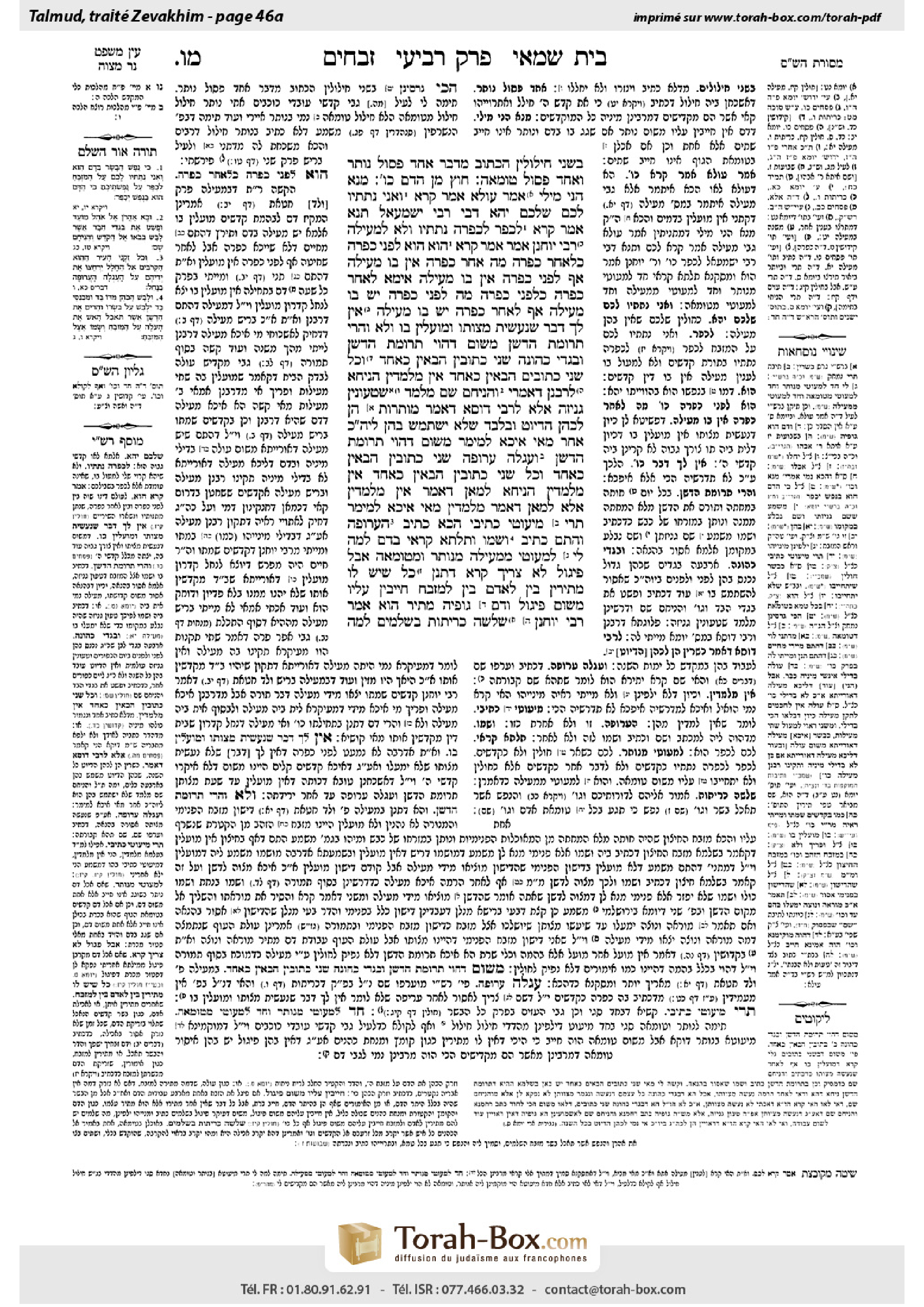
Zevachim 46a: Talmud study for Daf Yomi
Daf Yomi is the daily study of one Talmud folio. Explore 37 tractates with scans, Hebrew text, Sefaria English and AI-generated French translations where annotated.
Passage selection and English or AI-generated French translation are available where the scan has annotations. Daf Study is independent of Torah-Box and Sefaria.
Browse Zevachim · זבחים · All tractatesZevachim 46a text and translations
This page of Zevachim includes the Aramaic text, an English translation and an AI-generated French translation, alongside the scan above.
זבחים מ״ו א · Aramaic and Hebrew text
בִּשְׁנֵי חִילּוּלִין הַכָּתוּב מְדַבֵּר; אֶחָד פְּסוּל נוֹתָר, וְאֶחָד פְּסוּל טוּמְאָה.
חוּץ מִן הַדָּם כּוּ׳. מְנָא הָנֵי מִילֵּי? אָמַר עוּלָּא, אָמַר קְרָא: ״וַאֲנִי נְתַתִּיו לָכֶם״ – שֶׁלָּכֶם יְהֵא.
דְּבֵי רַבִּי יִשְׁמָעֵאל תָּנָא, אָמַר קְרָא: ״לְכַפֵּר״ – לְכַפָּרָה נְתַתִּיו, וְלֹא לִמְעִילָה.
רַבִּי יוֹחָנָן אָמַר, אָמַר קְרָא: ״הוּא״ – הוּא לִפְנֵי כַּפָּרָה כִּלְאַחַר כַּפָּרָה; מָה אַחַר כַּפָּרָה אֵין בּוֹ מְעִילָה, אַף לִפְנֵי כַּפָּרָה אֵין בּוֹ מְעִילָה.
אֵימָא לְאַחַר כַּפָּרָה כְּלִפְנֵי כַּפָּרָה – מָה לִפְנֵי כַּפָּרָה יֵשׁ בּוֹ מְעִילָה, אַף לְאַחַר כַּפָּרָה יֵשׁ בּוֹ מְעִילָה! אֵין לְךָ דָּבָר שֶׁנַּעֲשֵׂית מִצְוָתוֹ וּמוֹעֲלִין בּוֹ.
וְלָא?! וַהֲרֵי תְּרוּמַת הַדֶּשֶׁן!
מִשּׁוּם דְּהָוֵי תְּרוּמַת הַדֶּשֶׁן וּבִגְדֵי כְהוּנָּה שְׁנֵי כְּתוּבִין הַבָּאִין כְּאֶחָד, וְכׇל שְׁנֵי כְתוּבִים הַבָּאִין כְּאֶחָד אֵין מְלַמְּדִין.
הָנִיחָא לְרַבָּנַן דְּאָמְרִי ״וְהִנִּיחָם שָׁם״ – מְלַמֵּד שֶׁטְּעוּנִין גְּנִיזָה.
אֶלָּא לְרַבִּי דּוֹסָא, דְּאָמַר: מוּתָּרוֹת הֵן לְכֹהֵן הֶדְיוֹט, וּבִלְבַד שֶׁלֹּא יִשְׁתַּמֵּשׁ בָּהֶן לְיוֹם הַכִּפּוּרִים אַחֵר – מַאי אִיכָּא לְמֵימַר?
מִשּׁוּם דְּהָוֵי תְּרוּמַת הַדֶּשֶׁן וְעֶגְלָה עֲרוּפָה שְׁנֵי כְּתוּבִין הַבָּאִין כְּאֶחָד, וְכׇל שְׁנֵי כְּתוּבִין הַבָּאִין כְּאֶחָד אֵין מְלַמְּדִין.
הָנִיחָא לְמַאן דְּאָמַר אֵין מְלַמְּדִין, אֶלָּא לְמַאן דְּאָמַר מְלַמְּדִין מַאי אִיכָּא לְמֵימַר?
תְּרֵי מִיעוּטֵי כְּתִיבִי; הָכָא כְּתִיב: ״הָעֲרוּפָה״, וְהָתָם כְּתִיב: ״וְשָׂמוֹ״.
וּתְלָתָא קְרָאֵי בְּדָם לְמָה לִי?
לְמַעוֹטֵי מִמְּעִילָה, מִנּוֹתָר וּמִטּוּמְאָה.
אֲבָל פִּיגּוּל לָא צְרִיךְ קְרָא, דִּתְנַן: כֹּל שֶׁיֵּשׁ לוֹ מַתִּירִין, בֵּין לָאָדָם בֵּין לַמִּזְבֵּחַ – חַיָּיבִין עָלָיו מִשּׁוּם פִּיגּוּל. וְדָם גּוּפֵיהּ מַתִּיר הוּא.
אָמַר רַבִּי יוֹחָנָן: שְׁלֹשָׁה כָּרֵיתוֹת בִּשְׁלָמִים לָמָּה?
Zevachim 46a · English translation
The verse is speaking here of two profanations; one is the disqualification of notar and one is the disqualification of ritual impurity. This teaches that like impurity, notar applies even to an item that does not have a permitting factor.
§ The mishna teaches: Even with regard to the items for which one is not liable for eating them due to violation of the prohibition of piggul, one is, nevertheless, liable for eating them due to violation of the prohibition of notar, and due to violation of the prohibition against eating consecrated food while ritually impure, except for the blood. The Gemara asks: From where are these matters derived? Before answering this question, the Gemara cites another discussion as to why the halakha of misuse of consecrated property does not apply to blood. Ulla says: The verse states with regard to blood: “For the life of the flesh is in the blood, and I have given it to you upon the altar to make atonement for your souls” (Leviticus 17:11). “To you” indicates that it shall be yours; it is not the property of the Temple, so it is not subject to the prohibition of misuse of consecrated property.
The school of Rabbi Yishmael similarly taught: The verse states: “To make atonement,” teaching that God is saying: I gave it for atonement, and not for the prohibition of misuse of consecrated property.
Rabbi Yoḥanan says that this halakha is derived from the latter part of the verse, which states: “For it is the blood that makes atonement for the soul” (Leviticus 17:11). The term “it is” teaches that the status of the blood remains as it is, i.e., it is before atonement as it is after atonement. As the Gemara will state, there is a principle that once the mitzva involving a consecrated item has been performed, the item is no longer subject to the prohibition of misuse of consecrated property. Accordingly, the term “it is” teaches that just as after atonement, i.e., after the blood has been presented on the altar, it is not subject to the prohibition of misuse of consecrated property, as the mitzva has already been performed, so too, before atonement, i.e., before the blood has been presented on the altar, it is not subject to the prohibition of misuse of consecrated property.
The Gemara asks: But if the term “it is” teaches that the status of the blood remains the same before and after atonement, one can say just the opposite: It is after atonement as it is before atonement. Just as before atonement the blood is subject to the prohibition of misuse of consecrated property, so too after atonement it is subject to the prohibition of misuse of consecrated property. The Gemara rejects this: This cannot be the case, as there is a principle: There is no item whose mitzva has been performed that is still subject to the prohibition of misusing consecrated property.
The Gemara asks: And is there no such case? But there is the mitzva of the removal of the ashes of offerings burned on the altar. Any benefit derived from them between their removal and their required burial constitutes misuse of consecrated property, despite the fact that their mitzva has already been performed.
The Gemara answers: The principle does not apply in that case, because the matter of the removal of the ashes and the matter of the priestly vestments, the four white garments worn by the High Priest on Yom Kippur, are both subject to the halakha that misuse of consecrated property applies to them even after their mitzva has been performed. Consequently, they are two verses that come as one, i.e., they share a unique halakha not found elsewhere. And there is a principle: Any two verses that come as one do not teach their common element to apply to other cases. Instead, they are considered exceptional instances that cannot serve as models for other cases.
The Gemara raises a further difficulty: This works out well according to the opinion of the Rabbis, who say that the verse: “And he shall take off the linen garments, which he wore when he went into the Sanctuary, and shall leave them there” (Leviticus 16:23), teaches that the four white garments worn by the High Priest on Yom Kippur are not fit for further use, and they require interment.
But according to the opinion of Rabbi Dosa, who says that these priestly vestments are fit for an ordinary priest and do not require interment, provided that a High Priest does not use them on Yom Kippur in a different year, one does not misuse consecrated property by using them after their mitzva has been performed, and therefore what is there to say? In his opinion, the halakha of misuse of consecrated property after the performance of a mitzva applies only to the removal of ashes from the altar, not to the priestly vestments, which means it is stated in only a single case. Why, then, does this case not serve as a paradigm for other instances in the Torah?
The Gemara responds: It is because the cases of the removal of the ashes and the halakha of the heifer whose neck is broken are two verses that come as one, as it is prohibited to derive benefit from either of them even after their mitzva is completed, and any two verses that come as one do not teach their common element to apply to other cases.
The Gemara challenges this from a different angle: This works out well according to the one who says that two verses that come as one do not teach their common element to apply to other cases, but according to the one who says that two verses that come as one do teach their common element to apply to other cases, what is there to say?
The Gemara answers: Two exclusions are written in these two cases, which indicate that this halakha applies to them alone. Here, with regard to the heifer whose neck is broken, it is written: “Whose neck was broken” (Deuteronomy 21:6), and this superfluous description teaches that this halakha, that the prohibition of misuse of consecrated property is in effect even after the performance of a mitzva, applies solely to this case and should not be extended to others. And there, with regard to the removal of ashes, it is written: “And he shall put it” (Leviticus 6:3), indicating that this halakha applies to “it,” and nothing else.
The Gemara asks: And why do I need these three verses stated with regard to blood, from which it is derived that the prohibition of misuse of consecrated property does not apply to blood? The reference is to the three terms specified earlier, in the expositions of Ulla, the school of Rabbi Yishmael, and Rabbi Yoḥanan, from the verse: “I have given it to you upon the altar to make atonement for your souls, for it is the blood that makes atonement for the soul” (Leviticus 17:11).
The Gemara answers: One of those terms serves to exclude the blood from the prohibition of misuse of consecrated property. Another phrase serves to exclude blood from the prohibition of notar. If one consumed leftover blood, he is not liable for consuming notar. Rather, he is liable for violating only the prohibition against consuming blood. And the last phrase serves to exclude it from the prohibition of ritual impurity. If one consumed this blood in a state of ritual impurity, he is liable only for consuming blood, but not on account of consuming consecrated food while ritually impure.
But no verse is required to exclude this blood from the halakha of piggul, because this is already derived from another source, as we learned in the mishna (43a): With regard to any item that has permitting factors, either for consumption by a person or for burning on the altar, one is liable for eating it due to violation of the prohibition of piggul. The permitting factor itself is not subject to piggul. And consequently, piggul does not apply to blood itself, as it renders the offering permitted for human consumption or for the altar.
§ Rabbi Yoḥanan says: Why do I need three mentions of karet with regard to one who eats peace offerings in a state of ritual impurity? The three verses are: “But the soul that eats of the flesh of the sacrifice of peace offerings, that pertain to the Lord, having his impurity upon him, that soul shall be cut off [venikhreta] from his people” (Leviticus 7:20); “And when anyone shall touch any impure item, whether it is the impurity of man, or an impure animal, or any unclean detestable thing, and eat of the flesh of the sacrifice of peace offerings, that pertain to the Lord, that soul shall be cut off from his people” (Leviticus 7:21); and: “Whoever he is of all your seed among your generations that approaches the sacred items, which the children of Israel consecrate to the Lord, having his impurity upon him, that soul shall be cut off from before Me; I am the Lord” (Leviticus 22:3).
Zevachim 46a · Traduction française (IA)
Le verset parle ici de deux profanations : l’une désigne la disqualification due au notar, l’autre celle due à l’impureté rituelle. Cela enseigne que, comme l’impureté, le notar s’applique même à un élément qui n’a pas de facteur permissif.
§ La Michna enseigne : Même pour les éléments dont la consommation n’entraîne pas de responsabilité au titre de l’interdiction du piggoul, on est néanmoins responsable de leur consommation au titre de l’interdiction du notar et de celle de consommer des aliments consacrés en état d’impureté rituelle, à l’exception du sang. La Guemara demande : De quoi déduit-on ces règles ? Avant de répondre à cette question, la Guemara cite une autre discussion sur la raison pour laquelle la halakha du détournement d’un bien consacré ne s’applique pas au sang. Oula dit : À propos du sang, le verset dit : « Car la vie de la chair est dans le sang, et Je vous l’ai donné sur l’autel pour faire expiation pour vos âmes » (Lévitique 17:11). « À vous » indique que le sang vous appartient ; il n’est pas la propriété du Temple et n’est donc pas soumis à l’interdiction du détournement d’un bien consacré.
L’école de Rabbi Yichmaël a enseigné de même : Le verset dit : « Pour faire expiation », ce qui enseigne que Dieu dit : « Je l’ai donné pour l’expiation, et non pour qu’il soit soumis à l’interdiction du détournement d’un bien consacré. »
Rabbi Yoḥanan dit que cette halakha se déduit de la dernière partie du verset, qui dit : « Car c’est le sang qui fait expiation pour l’âme » (Lévitique 17:11). L’expression « c’est » enseigne que le statut du sang reste le même avant et après l’expiation. Comme la Guemara l’indiquera, selon un principe, une fois accomplie la mitsva liée à un élément consacré, celui-ci n’est plus soumis à l’interdiction du détournement d’un bien consacré. Par conséquent, l’expression « c’est » enseigne que, de même qu’après l’expiation, c’est-à-dire après que le sang a été présenté sur l’autel, il n’est pas soumis à cette interdiction, puisque la mitsva a déjà été accomplie, de même, avant l’expiation, c’est-à-dire avant que le sang ait été présenté sur l’autel, il n’y est pas soumis.
La Guemara demande : Mais si l’expression « c’est » enseigne que le statut du sang est identique avant et après l’expiation, on pourrait soutenir exactement le contraire : après l’expiation, il est comme avant l’expiation. De même qu’avant l’expiation le sang est soumis à l’interdiction du détournement d’un bien consacré, de même, après l’expiation, il y est soumis. La Guemara rejette cette possibilité : cela ne peut pas être le cas, car il existe un principe selon lequel aucun élément dont la mitsva a été accomplie ne reste soumis à l’interdiction du détournement d’un bien consacré.
La Guemara demande : N’existe-t-il donc aucun cas de ce genre ? Pourtant, il y a la mitsva du retrait des cendres des offrandes brûlées sur l’autel. Tout bénéfice tiré de ces cendres entre leur retrait et leur enfouissement obligatoire constitue un détournement d’un bien consacré, bien que leur mitsva ait déjà été accomplie.
La Guemara répond : Ce principe ne s’applique pas dans ce cas, car le retrait des cendres et les vêtements sacerdotaux — les quatre vêtements blancs que le Grand Prêtre porte à Yom Kippour — sont tous deux soumis à la règle selon laquelle le détournement d’un bien consacré reste possible même après l’accomplissement de leur mitsva. Ce sont donc deux versets qui viennent enseigner une même règle, c’est-à-dire qu’ils partagent une règle particulière qu’on ne trouve pas ailleurs. Or, un principe veut que deux versets qui viennent enseigner une même règle ne généralisent pas leur élément commun à d’autres cas. Ils sont plutôt considérés comme des cas exceptionnels, qui ne peuvent servir de modèle à d’autres cas.
La Guemara soulève une difficulté supplémentaire : cela fonctionne bien selon l’opinion des Rabbins, qui disent que le verset « Il retirera les vêtements de lin qu’il avait revêtus en entrant dans le Sanctuaire et les y laissera » (Lévitique 16:23) enseigne que les quatre vêtements blancs portés par le Grand Prêtre à Yom Kippour ne peuvent plus être utilisés et doivent être ensevelis.
Mais selon l’opinion de Rabbi Dossa, qui dit que ces vêtements sacerdotaux peuvent être portés par un prêtre ordinaire et ne doivent pas être ensevelis, à condition qu’un Grand Prêtre ne les porte pas à Yom Kippour une autre année, leur utilisation après l’accomplissement de leur mitsva ne constitue pas un détournement d’un bien consacré. Que peut-on alors répondre ? Selon lui, la règle du détournement d’un bien consacré après l’accomplissement d’une mitsva ne s’applique qu’au retrait des cendres de l’autel, et non aux vêtements sacerdotaux ; elle n’est donc énoncée que dans un seul cas. Pourquoi, alors, ce cas ne sert-il pas de modèle pour d’autres situations dans la Torah ?
La Guemara répond : C’est parce que le retrait des cendres et la règle de la génisse dont la nuque est brisée sont deux versets qui viennent enseigner une même règle : il est interdit de tirer bénéfice de l’un comme de l’autre, même après l’accomplissement de leur mitsva. Or, deux versets qui viennent enseigner une même règle ne généralisent pas leur élément commun à d’autres cas.
La Guemara soulève une difficulté sous un autre angle : cela fonctionne bien selon celui qui dit que deux versets qui viennent enseigner une même règle ne généralisent pas leur élément commun à d’autres cas ; mais que répondre selon celui qui dit qu’ils le généralisent ?
La Guemara répond : Dans ces deux cas, deux expressions d’exclusion indiquent que cette halakha ne s’applique qu’à eux. Ici, au sujet de la génisse dont la nuque est brisée, il est écrit : « Dont la nuque a été brisée » (Deutéronome 21:6). Cette description superflue enseigne que cette halakha — selon laquelle l’interdiction du détournement d’un bien consacré reste en vigueur même après l’accomplissement d’une mitsva — ne s’applique qu’à ce cas et ne doit pas être étendue à d’autres. Là, au sujet du retrait des cendres, il est écrit : « Il la déposera » (Lévitique 6:3), ce qui indique que cette halakha s’applique à « elle », et à rien d’autre.
La Guemara demande : Pourquoi faut-il ces trois expressions concernant le sang, desquelles on déduit que l’interdiction du détournement d’un bien consacré ne s’applique pas au sang ? Il s’agit des trois expressions mentionnées précédemment dans les interprétations d’Oula, de l’école de Rabbi Yichmaël et de Rabbi Yoḥanan, à partir du verset : « Je vous l’ai donné sur l’autel pour faire expiation pour vos âmes, car c’est le sang qui fait expiation pour l’âme » (Lévitique 17:11).
La Guemara répond : L’une de ces expressions sert à exclure le sang de l’interdiction du détournement d’un bien consacré. Une autre sert à l’exclure de l’interdiction du notar. Celui qui a consommé du sang restant n’est pas responsable d’avoir consommé du notar ; il est seulement responsable d’avoir enfreint l’interdiction de consommer du sang. La dernière expression sert à exclure le sang de l’interdiction liée à l’impureté rituelle. Si quelqu’un a consommé ce sang en état d’impureté rituelle, il est seulement responsable d’avoir consommé du sang, et non d’avoir consommé des aliments consacrés en état d’impureté rituelle.
Mais aucun verset n’est nécessaire pour exclure le sang de la halakha du piggoul, car cela se déduit déjà d’une autre source, comme nous l’avons appris dans la Michna (43a) : pour tout élément qui a des facteurs permissifs, que ce soit pour la consommation par une personne ou pour être brûlé sur l’autel, on est responsable de sa consommation au titre de l’interdiction du piggoul. Le facteur permissif lui-même n’est pas soumis au piggoul. Par conséquent, le piggoul ne s’applique pas au sang lui-même, puisqu’il rend l’offrande permise à la consommation humaine ou à l’autel.
§ Rabbi Yoḥanan dit : Pourquoi faut-il trois mentions de karet à propos de celui qui mange des offrandes de paix en état d’impureté rituelle ? Les trois versets sont : « Mais la personne qui mange de la chair du sacrifice des offrandes de paix appartenant au Seigneur, alors que son impureté est sur elle, cette personne sera retranchée [venikhreta] de son peuple » (Lévitique 7:20) ; « Et lorsqu’une personne touche quoi que ce soit d’impur, qu’il s’agisse de l’impureté humaine, d’un animal impur ou de quelque chose d’abominable et d’impur, et qu’elle mange de la chair du sacrifice des offrandes de paix appartenant au Seigneur, cette personne sera retranchée de son peuple » (Lévitique 7:21) ; et : « Quiconque, parmi toute votre descendance au fil des générations, s’approche des choses saintes que les enfants d’Israël consacrent au Seigneur, alors que son impureté est sur lui, cette personne sera retranchée de devant Moi ; Je suis le Seigneur » (Lévitique 22:3).
Traduction française générée par IA à partir de l’édition anglaise de Sefaria. Vérifie toujours un passage avec le texte source.
Text from Sefaria: William Davidson Edition - Vocalized Aramaic (CC BY NC); William Davidson Edition - English (CC BY NC).