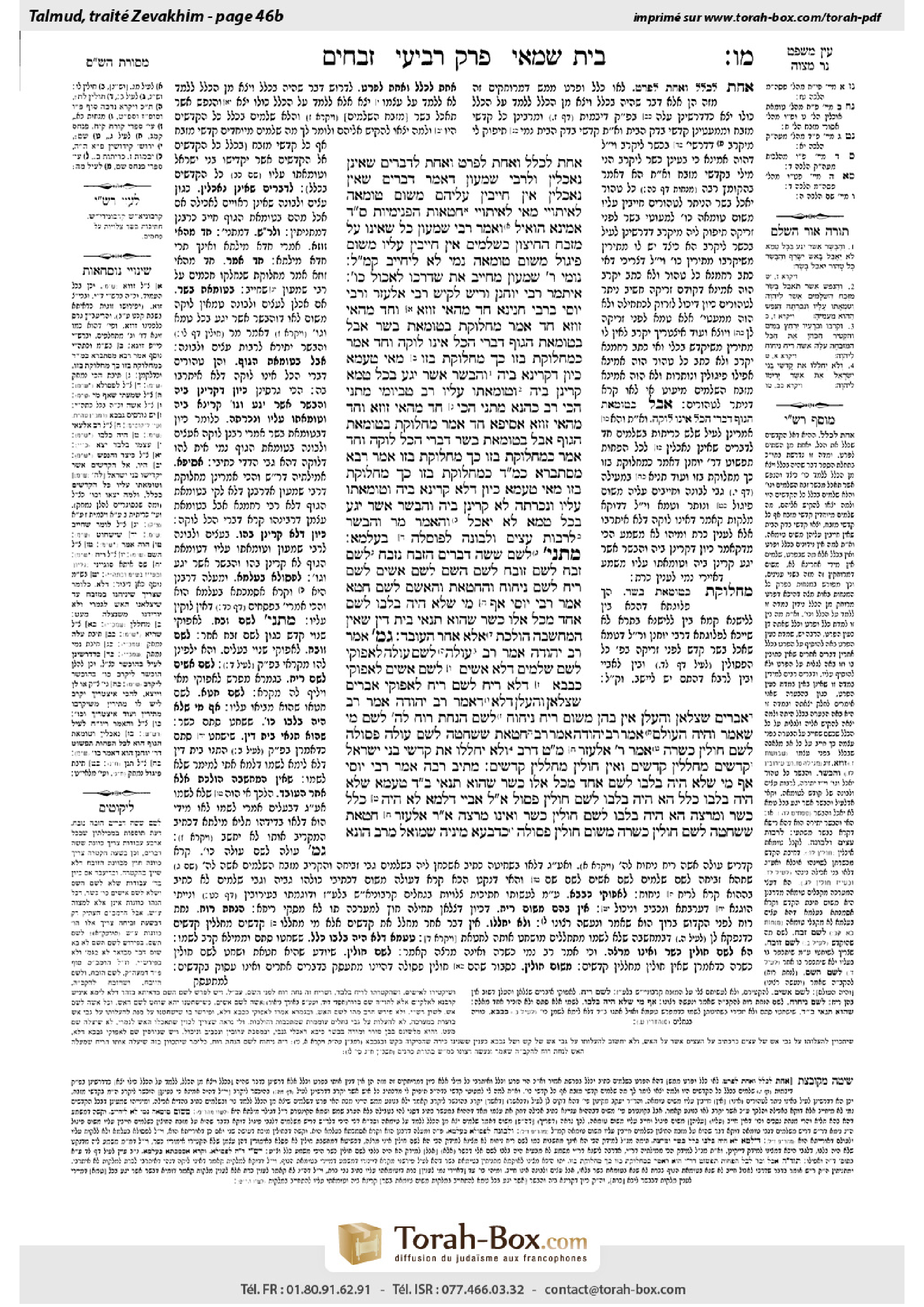
Zevachim 46b: Talmud study for Daf Yomi
Daf Yomi is the daily study of one Talmud folio. Explore 37 tractates with scans, Hebrew text, Sefaria English and AI-generated French translations where annotated.
Passage selection and English or AI-generated French translation are available where the scan has annotations. Daf Study is independent of Torah-Box and Sefaria.
Browse Zevachim · זבחים · All tractatesZevachim 46b text and translations
This page of Zevachim includes the Aramaic text, an English translation and an AI-generated French translation, alongside the scan above.
זבחים מ״ו ב · Aramaic and Hebrew text
אַחַת לִכְלָל, וְאַחַת לִפְרָט, וְאַחַת לִדְבָרִים שֶׁאֵינָן נֶאֱכָלִין.
וּלְרַבִּי שִׁמְעוֹן דְּאָמַר: דְּבָרִים שֶׁאֵין נֶאֱכָלִין – אֵין חַיָּיבִין עֲלֵיהֶם מִשּׁוּם טוּמְאָה, לְאֵיתוֹיֵי מַאי? לְאֵיתוֹיֵי חַטָּאוֹת הַפְּנִימִיּוֹת.
סָלְקָא דַּעְתָּךְ אָמֵינָא, הוֹאִיל וְאָמַר רַבִּי שִׁמְעוֹן: כֹּל שֶׁאֵינוֹ עַל מִזְבֵּחַ הַחִיצוֹן כִּשְׁלָמִים – אֵין חַיָּיבִין עָלָיו מִשּׁוּם פִּיגּוּל, מִשּׁוּם טוּמְאָה נָמֵי לָא לִיחַיַּיב; קָא מַשְׁמַע לַן.
נוּמִי רַבִּי שִׁמְעוֹן מְחַיֵּיב אֶת שֶׁדַּרְכּוֹ לֶאֱכוֹל כּוּ׳. אִיתְּמַר: רַבִּי יוֹחָנָן וְרֵישׁ לָקִישׁ, רַבִּי אֶלְעָזָר וְרַבִּי יוֹסֵי בְּרַבִּי חֲנִינָא – חַד מֵהַאי זוּזָא וְחַד מֵהַאי זוּזָא;
חַד אָמַר: מַחְלוֹקֶת בְּטוּמְאַת בָּשָׂר, אֲבָל בְּטוּמְאַת הַגּוּף – דִּבְרֵי הַכֹּל אֵינוֹ לוֹקֶה.
וְחַד אָמַר: כְּמַחְלוֹקֶת בָּזוֹ כָּךְ מַחְלוֹקֶת בָּזוֹ. מַאי טַעְמָא? כֵּיוָן דְּקָרֵינָא בֵּיהּ ״וְהַבָּשָׂר אֲשֶׁר יִגַּע בְּכׇל טָמֵא״, קָרֵינַן בֵּיהּ ״וְטֻמְאָתוֹ עָלָיו״.
רַב טָבְיוֹמֵי מַתְנֵי הָכִי; רַב כָּהֲנָא מַתְנֵי הָכִי: חַד מֵהַאי זוּזָא וְחַד מֵהַאי זוּזָא אַסֵּיפָא – חַד אָמַר: מַחְלוֹקֶת בְּטוּמְאַת הַגּוּף, אֲבָל בְּטוּמְאַת בָּשָׂר דִּבְרֵי הַכֹּל לוֹקֶה; וְחַד אָמַר: כְּמַחְלוֹקֶת בָּזוֹ כָּךְ מַחְלוֹקֶת בָּזוֹ.
אָמַר רָבָא: מִסְתַּבְּרָא כְּמַאן דְּאָמַר כְּמַחְלוֹקֶת בָּזוֹ כָּךְ מַחְלוֹקֶת בָּזוֹ. מַאי טַעְמָא? כֵּיוָן דְּלָא קָרֵינָא בֵּיהּ ״וְטֻמְאָתוֹ עָלָיו וְנִכְרְתָה״, לָא קָרֵינָא בֵּיהּ ״וְהַבָּשָׂר אֲשֶׁר יִגַּע בְּכׇל טָמֵא לֹא יֵאָכֵל״.
וְהָאָמַר מָר: ״וְהַבָּשָׂר״ – לְרַבּוֹת עֵצִים וּלְבוֹנָה! (לְפוֹסְלָהּ) [לִפְסוּלָא] בְּעָלְמָא.
מַתְנִי׳ לְשֵׁם שִׁשָּׁה דְּבָרִים הַזֶּבַח נִזְבָּח: לְשֵׁם זֶבַח, לְשֵׁם זוֹבֵחַ, לְשֵׁם הַשֵּׁם, לְשֵׁם אִשִּׁים, לְשֵׁם רֵיחַ, לְשֵׁם נִיחוֹחַ. וְהַחַטָּאת וְהָאָשָׁם – לְשֵׁם חֵטְא.
אָמַר רַבִּי יוֹסֵי: אַף מִי שֶׁלֹּא הָיָה בְּלִבּוֹ לְשֵׁם אֶחָד מִכׇּל אֵלּוּ – כָּשֵׁר; שֶׁהוּא תְּנַאי בֵּית דִּין, שֶׁאֵין הַמַּחְשָׁבָה הוֹלֶכֶת אֶלָּא אַחַר הָעוֹבֵד.
גְּמָ׳ אָמַר רַב יְהוּדָה אָמַר רַב: ״עוֹלָה״ – לְשֵׁם עוֹלָה, לְאַפּוֹקֵי לְשֵׁם שְׁלָמִים דְּלָא. ״אִשִּׁים״ – לְשֵׁם אִשִּׁים, לְאַפּוֹקֵי כְּבָבָא דְּלָא.
״רֵיחַ״ – לְשֵׁם רֵיחַ, לְאַפּוֹקֵי אֵבָרִים שֶׁצְּלָאָן וְהֶעֱלָן – דְּלָא. דְּאָמַר רַב יְהוּדָה אָמַר רַב: אֵבָרִים שֶׁצְּלָאָן וְהֶעֱלָן – אֵין בָּהֶן מִשּׁוּם רֵיחַ.
״נִיחוֹחַ״ – לְשֵׁם הֲנָחַת רוּחַ. ״לַה׳״ – לְשֵׁם מִי שֶׁאָמַר וְהָיָה הָעוֹלָם.
אָמַר רַב יְהוּדָה אָמַר רַב: חַטָּאת שֶׁשְּׁחָטָהּ לְשֵׁם עוֹלָה – פְּסוּלָה. לְשֵׁם חוּלִּין – כְּשֵׁרָה. אָמַר רַבִּי אֶלְעָזָר: מַאי טַעְמָא דְּרַב? ״וְלֹא יְחַלְּלוּ אֶת קׇדְשֵׁי בְּנֵי יִשְׂרָאֵל״ – קֳדָשִׁים מְחַלְּלִין קֳדָשִׁים, וְאֵין חוּלִּין מְחַלְּלִין קֳדָשִׁים.
מֵתִיב רַבָּה, אָמַר רַבִּי יוֹסֵי: אַף מִי שֶׁלֹּא הָיָה בְּלִבּוֹ לְשֵׁם אֶחָד מִכׇּל אֵלּוּ – כָּשֵׁר, שֶׁהוּא תְּנַאי בֵּית דִּין. טַעְמָא שֶׁלֹּא הָיָה בְּלִבּוֹ כְּלָל, הָא הָיָה בְּלִבּוֹ לְשֵׁם חוּלִּין – פָּסוּל!
אֲמַר לֵיהּ אַבָּיֵי: דִּלְמָא לֹא הָיָה כְּלָל – כָּשֵׁר וּמְרַצֶּה, הָא הָיָה בְּלִבּוֹ לְשֵׁם חוּלִּין – כָּשֵׁר וְאֵינוֹ מְרַצֶּה.
אָמַר רַבִּי אֶלְעָזָר: חַטָּאת שֶׁשְּׁחָטָהּ לְשֵׁם חוּלִּין – כְּשֵׁרָה. מִשּׁוּם חוּלִּין – פְּסוּלָה. כְּדִבְעָא מִינֵּיהּ שְׁמוּאֵל מֵרַב הוּנָא:
Zevachim 46b · English translation
One mention of karet in the verse: “That approaches the sacred items,” is for a generalization, and one mention in the verse: “Of the flesh of the sacrifice of peace offerings,” is for a detail. This detail serves to include all items consecrated to the altar, in accordance with the hermeneutical principle that any matter that was included in a generalization but was explicitly specified to teach a certain halakha was intended to teach not just about itself but about the entire generalization. And one mention of karet in the verse: “And when anyone shall touch any impure item,” serves to include items whose typical manner is such that they are not to be eaten, e.g., wood and frankincense, and teaches that one who eats even these items is liable to receive karet.
The Gemara asks: And according to the opinion of Rabbi Shimon, who says in the mishna with regard to items whose typical manner is such that they are not to be eaten, that one is not liable for eating them due to violation of the prohibition against eating consecrated items in a state of ritual impurity, what does this last mention of karet serve to include? The Gemara answers that it serves to include the sin offerings whose blood is presented inside the Sanctuary.
The Gemara explains why this inclusion is necessary. It might enter your mind to say: Since Rabbi Shimon says that concerning any offering whose blood is not presented on the external altar like that of a peace offering, one is not liable for eating it due to violation of the prohibition of piggul, one should likewise not be liable for eating it due to violation of the prohibition of ritual impurity. Therefore, the additional mention of karet teaches us that one who is impure is in fact liable for eating these sin offerings brought inside the Sanctuary.
§ The mishna teaches that Rabbi Shimon stated a ruling in which he deems one liable for eating in a state of ritual impurity an item whose typical manner is such that one eats it, but not for eating the wood, the frankincense, or the incense, whose typical manner is such that one does not eat it. The Rabbis disagree and deem him liable in all these cases. It was stated that two pairs of amora’im disagreed with regard to this issue; one pair is Rabbi Yoḥanan and Reish Lakish, and the other pair is Rabbi Elazar and Rabbi Yosei, son of Rabbi Ḥanina. The two different opinions that follow were respectively stated by one of this pair and one of that pair.
One says: The dispute between the Rabbis and Rabbi Shimon is with regard to the impurity of meat, i.e., the item that is eaten is impure. The Rabbis maintain that one who eats impure wood or frankincense is flogged, as derived from the two mentions of flesh in the verse: “And the meat that touches any impure item shall not be eaten; it shall be burned with fire. And as for the meat, everyone who is pure may eat of it” (Leviticus 7:19). But if one ate wood or frankincense in a state of impurity of the body, everyone agrees that he is not flogged.
And one says: As there is a dispute with regard to this case, when the item eaten is impure, so is there a dispute with regard to that case, when the one eating the wood or frankincense is impure. What is the reason for this opinion? Since one reads with regard to these inedible items: “And the flesh that touches any impure item” (Leviticus 7:19), as this phrase serves to include even items such as wood and frankincense in the prohibition against eating them when they are impure, one likewise reads with regard to them the next verse: “But the person that eats of the flesh of the sacrifice of peace offerings…having his impurity upon him, that soul shall be cut off from his people” (Leviticus 7:20), which discusses one in a state of impurity who eats consecrated items.
The Gemara notes: Rav Tavyumei teaches the discussion in this preceding manner, whereas Rav Kahana teaches it in this alternative manner: One of this pair of amora’im and one of that pair disagreed with regard to the latter clause in the mishna, i.e., the meaning of Rabbi Shimon’s statement. One says that Rabbi Shimon’s dispute with the Rabbis is with regard to the impurity of the body, as he maintains that an impure individual who eats wood or frankincense is exempt. But with regard to the impurity of flesh, i.e., these items themselves, everyone agrees that one is flogged. And one says: As there is a dispute with regard to this case, so is there a dispute with regard to that case, i.e., Rabbi Shimon holds that one is exempt in both cases.
Rava said: It stands to reason that the correct interpretation is like the one who says: As there is a dispute with regard to this case, so is there a dispute with regard to that case. What is the reason? Since one does not read with regard to these inedible items: “Having his impurity upon him, that soul shall be cut off,” as according to both alternative explanations Rabbi Shimon deems exempt one who eats these items when he is in a state of impurity, similarly one does not read with regard to them the previous verse: “And the flesh that touches any impure item shall not be eaten.”
The Gemara raises a difficulty: But doesn’t the Master say that the term: “And as for the flesh,” in the same verse, serves to include wood and frankincense? This indicates that even these items can become ritually impure, and the prohibition against eating consecrated items that are impure applies to them. The Gemara answers: This is referring merely to disqualification, i.e., this inclusion applies by rabbinic law, and the verse is cited in mere support.
MISHNA: The slaughtered offering is slaughtered for the sake of six matters, and one must have all of these matters in mind: For the sake of the particular type of offering being sacrificed; for the sake of the one who sacrifices the offering; for the sake of God; for the sake of consumption by the fires of the altar; for the sake of the aroma; for the sake of the pleasing of God, i.e., in fulfillment of God’s will; and, in the cases of a sin offering and a guilt offering, for the sake of atonement for the sin.
Rabbi Yosei says: Even in the case of one who did not have in mind to slaughter the offering for the sake of any one of these, the offering is valid, as it is a stipulation of the court that he should not state any intent ab initio. This is necessary because the intent follows only the one performing the sacrificial rite, and therefore if the one who slaughters the animal is not careful and states the wrong intent, the offering would be disqualified through his improper intent.
GEMARA: Rav Yehuda says that Rav says with regard to the verse: “A burnt offering, an offering made by fire, of a pleasing aroma to the Lord” (Leviticus 1:9), the term “a burnt offering” means that one must intend that it be for the sake of a burnt offering, to the exclusion of one who sacrifices a burnt offering for the sake of a peace offering, which one may not do. The mention of fires, i.e., the term “an offering made by fire,” teaches that the offering must be sacrificed for the sake of complete consumption by the fires of the altar, to the exclusion of one who intends that its portions should only be roasted on the fire, as one may not do so.
Rav continues to expound the verse. The term “aroma” indicates that the offering must be sacrificed for the sake of the aroma, to the exclusion of limbs that one first roasted and afterward took them up to the altar, which he may not do. As Rav Yehuda says that Rav says: With regard to limbs that one first roasted and afterward took them up to the altar, they do not constitute fulfillment of the requirement that the offering must be sacrificed for the sake of the aroma.
The term “pleasing” means for the sake of pleasing God’s spirit, i.e., that the offering should be accepted by God. Finally, the expression “to the Lord” indicates that it should be for the sake of the One Who spoke and the world came into being.
Rav Yehuda says that Rav says: With regard to a sin offering that one slaughtered with intent that the slaughter be for the sake of a burnt offering, it is disqualified. As explained (2a), a sin offering that was slaughtered for the sake of another offering is entirely disqualified. But if he intended the slaughter to be for the sake of a non-sacred animal, it is valid. Rabbi Elazar says: What is the reason of Rav? The verse states: “And they shall not profane the sacred items of the children of Israel” (Leviticus 22:15). This teaches that consecrated items, i.e., the intent to slaughter an offering for the sake of another type of offering, profane consecrated items, but the intent to slaughter an offering for the sake of a non-sacred animal does not profane consecrated items.
Rabba raises an objection from the mishna: Rabbi Yosei says: Even in the case of one who did not have in mind to slaughter the offering for the sake of any one of these, the offering is fit, as it is a stipulation of the court that one not state any intent ab initio. Rabba infers from this that the reason the offering is valid and it effects acceptance is that he did not have in mind any intent at all. But if he had in mind to slaughter the offering for the sake of a non-sacred animal, it is disqualified.
Abaye said to Rabba: Perhaps Rabbi Yosei means the following: If he did not have in mind any intent at all, the offering is valid and it effects acceptance, but if he had in mind to slaughter the offering for the sake of a non-sacred animal, the offering is valid, but it does not effect acceptance, as it is a flawed offering. Rav’s statement can be understood in a similar fashion.
Rabbi Elazar says: Indeed, a sin offering that one intentionally slaughtered for the sake of a non-sacred animal is valid, as stated by Rav. But if he slaughtered it as a non-sacred animal, actually thinking that it was non-sacred, it is disqualified, as when he slaughtered it, he did not intend to perform a sacrificial rite. This is like the dilemma that Shmuel raised before Rav Huna:
Zevachim 46b · Traduction française (IA)
Une occurrence de la peine de retranchement dans le verset « celui qui s’approche des choses sacrées » sert à énoncer une règle générale, et une occurrence dans le verset « de la chair du sacrifice de paix » sert à énoncer un cas particulier. Ce cas particulier permet d’inclure toutes les choses consacrées à l’autel, conformément au principe herméneutique selon lequel tout élément inclus dans une règle générale, mais explicitement désigné pour enseigner une halakha précise, l’a été non seulement à son propre sujet, mais aussi au sujet de toute la règle générale. Une autre occurrence de la peine de retranchement, dans le verset « Et si quelqu’un touche une chose impure », sert à inclure les choses qui, habituellement, ne sont pas destinées à être mangées, par exemple le bois et l’encens, et enseigne que celui qui mange même ces éléments est passible de la peine de retranchement.
La Guemara demande : Et selon l’opinion de Rabbi Shimon, qui dit dans la Michna, à propos des éléments qui, habituellement, ne sont pas destinés à être mangés, qu’on n’est pas passible pour les avoir mangés en transgressant l’interdiction de manger des choses consacrées en état d’impureté rituelle, qu’est-ce que cette dernière occurrence de la peine de retranchement vient inclure ? La Guemara répond qu’elle sert à inclure les sacrifices expiatoires dont le sang est présenté à l’intérieur du Sanctuaire.
La Guemara explique pourquoi cette inclusion est nécessaire. On aurait pu penser : puisque Rabbi Shimon dit que, pour tout sacrifice dont le sang n’est pas présenté sur l’autel extérieur comme celui d’un sacrifice de paix, on n’est pas passible pour l’avoir mangé en transgressant l’interdiction du piggoul, on ne devrait pas non plus être passible pour l’avoir mangé en transgressant l’interdiction liée à l’impureté rituelle. L’occurrence supplémentaire de la peine de retranchement nous enseigne donc qu’une personne impure est effectivement passible pour avoir mangé ces sacrifices expiatoires offerts à l’intérieur du Sanctuaire.
§ La Michna enseigne que Rabbi Shimon a énoncé une décision selon laquelle on est passible pour avoir mangé en état d’impureté rituelle un élément qui, habituellement, est destiné à être mangé, mais non pour avoir mangé le bois, l’encens ou l’encens composé, qui, habituellement, ne sont pas destinés à être mangés. Les Sages ne sont pas d’accord et estiment qu’on est passible dans tous ces cas. Il a été rapporté que deux paires d’amoraïm sont en désaccord sur cette question : l’une est formée de Rabbi Yoḥanan et de Reish Lakish, l’autre de Rabbi Elazar et de Rabbi Yosei, fils de Rabbi Ḥanina. Les deux opinions qui suivent ont été respectivement énoncées par l’un des membres de l’une de ces paires et par l’un des membres de l’autre.
L’un dit : Le désaccord entre les Sages et Rabbi Shimon concerne l’impureté de la viande, c’est-à-dire le cas où l’élément mangé est impur. Les Sages soutiennent que celui qui mange du bois ou de l’encens impurs est passible de flagellation, comme on le déduit des deux occurrences du mot « viande » dans le verset : « La viande qui touche une chose impure ne sera pas mangée ; elle sera brûlée par le feu. Quant à la viande, toute personne pure peut en manger » (Lévitique 7, 19). Mais si quelqu’un mange du bois ou de l’encens alors qu’il est lui-même impur, tous conviennent qu’il ne reçoit pas de flagellation.
Et l’autre dit : De même qu’il y a un désaccord dans ce cas, où l’élément mangé est impur, il y a aussi un désaccord dans l’autre cas, où celui qui mange le bois ou l’encens est impur. Quelle est la raison de cette opinion ? Puisqu’on applique à ces éléments non comestibles le verset « La chair qui touche une chose impure » (Lévitique 7, 19), cette expression servant à inclure même des éléments comme le bois et l’encens dans l’interdiction de les manger lorsqu’ils sont impurs, on leur applique également le verset suivant : « Mais la personne qui mange de la chair du sacrifice de paix […] alors que son impureté est sur elle, cette personne sera retranchée de son peuple » (Lévitique 7, 20), qui traite d’une personne en état d’impureté qui mange des choses consacrées.
La Guemara note : Rav Tavyumei enseigne la discussion précédente sous cette forme, tandis que Rav Kahana l’enseigne sous une autre forme : l’un des membres d’une paire d’amoraïm et l’un des membres de l’autre paire sont en désaccord sur la dernière partie de la Michna, c’est-à-dire sur le sens de la déclaration de Rabbi Shimon. L’un dit que le désaccord de Rabbi Shimon avec les Sages concerne l’impureté du corps, car il soutient qu’une personne impure qui mange du bois ou de l’encens est exemptée. Mais, concernant l’impureté de la viande, c’est-à-dire de ces éléments eux-mêmes, tous conviennent qu’on est passible de flagellation. Et l’autre dit : De même qu’il y a un désaccord dans ce cas, il y en a aussi dans l’autre cas, c’est-à-dire que Rabbi Shimon estime qu’on est exempté dans les deux cas.
Rava dit : Il semble que l’interprétation correcte soit celle de celui qui dit : De même qu’il y a un désaccord dans ce cas, il y en a aussi dans l’autre cas. Pour quelle raison ? Puisqu’on n’applique pas à ces éléments non comestibles l’expression « alors que son impureté est sur elle, cette personne sera retranchée », car, selon les deux explications alternatives, Rabbi Shimon estime qu’est exemptée la personne qui mange ces éléments alors qu’elle est en état d’impureté, on ne leur applique pas non plus le verset précédent : « La chair qui touche une chose impure ne sera pas mangée. »
La Guemara soulève une difficulté : Mais le Maître ne dit-il pas que l’expression « Quant à la viande », dans le même verset, sert à inclure le bois et l’encens ? Cela indique que même ces éléments peuvent devenir rituellement impurs et que l’interdiction de manger des choses consacrées impures s’applique à eux. La Guemara répond : il s’agit simplement d’une disqualification, c’est-à-dire que cette inclusion relève de la loi rabbinique, et le verset n’est cité qu’à l’appui.
MICHNA : Le sacrifice est égorgé en vue de six choses, et il faut avoir chacune d’elles à l’esprit : en vue du type particulier de sacrifice offert ; en vue de celui qui offre le sacrifice ; en vue de Dieu ; en vue de sa consommation par les feux de l’autel ; en vue de son parfum ; en vue de l’agrément de Dieu, c’est-à-dire pour accomplir la volonté de Dieu ; et, dans le cas d’un sacrifice expiatoire ou d’un sacrifice de culpabilité, en vue de l’expiation de la faute.
Rabbi Yosei dit : Même si quelqu’un n’a pas eu à l’esprit d’égorger le sacrifice en vue de l’une de ces choses, le sacrifice est valide, car le tribunal a stipulé qu’il ne formule d’emblée aucune intention. Cette stipulation est nécessaire, car l’intention dépend uniquement de la personne qui accomplit le rite sacrificiel ; par conséquent, si celui qui égorge l’animal ne fait pas attention et formule une intention erronée, le sacrifice serait invalidé par cette intention incorrecte.
GUEMARA : Rav Yehuda dit au nom de Rav, à propos du verset « Un holocauste, une offrande consumée par le feu, d’une odeur agréable pour le Seigneur » (Lévitique 1, 9), que l’expression « un holocauste » signifie qu’il faut avoir l’intention de l’offrir comme holocauste, à l’exclusion de celui qui offre un holocauste en vue d’un sacrifice de paix, ce qu’il ne peut pas faire. La mention des feux, c’est-à-dire l’expression « une offrande consumée par le feu », enseigne que le sacrifice doit être offert en vue d’une consommation complète par les feux de l’autel, à l’exclusion de celui qui a l’intention que ses portions soient seulement rôties au feu, ce qu’il ne peut pas faire.
Rav poursuit son commentaire du verset. Le terme « odeur » indique que le sacrifice doit être offert en vue de son parfum, à l’exclusion des membres que l’on a d’abord rôtis avant de les porter sur l’autel, ce qu’il ne peut pas faire. En effet, Rav Yehuda dit au nom de Rav : pour des membres que l’on a d’abord rôtis avant de les porter sur l’autel, on ne satisfait pas à l’exigence selon laquelle le sacrifice doit être offert en vue de son parfum.
Le terme « agréable » signifie : en vue d’agréer l’esprit de Dieu, c’est-à-dire que le sacrifice soit accepté par Dieu. Enfin, l’expression « pour le Seigneur » indique qu’il faut l’offrir en vue de Celui qui a parlé et par la parole de qui le monde est venu à l’existence.
Rav Yehuda dit au nom de Rav : un sacrifice expiatoire qu’on a égorgé avec l’intention de l’égorger en vue d’un holocauste est invalidé. Comme cela a été expliqué (2a), un sacrifice expiatoire égorgé en vue d’un autre sacrifice est entièrement invalidé. Mais si l’intention était de l’égorger en vue d’un animal profane, il est valide. Rabbi Elazar dit : Quelle est la raison de Rav ? Le verset dit : « Ils ne profaneront pas les choses sacrées des enfants d’Israël » (Lévitique 22, 15). Cela enseigne que l’intention d’égorger un sacrifice en vue d’un autre type de sacrifice profane les choses consacrées ; mais l’intention d’égorger un sacrifice en vue d’un animal profane ne profane pas les choses consacrées.
Rabba soulève une objection tirée de la Michna : Rabbi Yosei dit : Même si quelqu’un n’a pas eu à l’esprit d’égorger le sacrifice en vue de l’une de ces choses, le sacrifice est valide, car le tribunal a stipulé qu’on ne formule d’emblée aucune intention. Rabba en déduit que le sacrifice est valide et produit son effet d’acceptation parce qu’il n’a eu absolument aucune intention à l’esprit. Mais s’il avait eu l’intention d’égorger le sacrifice en vue d’un animal profane, il serait invalidé.
Abaye dit à Rabba : Rabbi Yosei veut peut-être dire ceci : s’il n’a eu absolument aucune intention à l’esprit, le sacrifice est valide et produit son effet d’acceptation ; mais s’il a eu l’intention d’égorger le sacrifice en vue d’un animal profane, le sacrifice est valide, mais ne produit pas son effet d’acceptation, car il est défectueux. On peut comprendre de manière semblable la déclaration de Rav.
Rabbi Elazar dit : En effet, un sacrifice expiatoire qu’on a intentionnellement égorgé en vue d’un animal profane est valide, comme Rav l’a déclaré. Mais si on l’a égorgé comme un animal profane, en pensant réellement qu’il était profane, il est invalidé, car au moment de l’égorger, on n’avait pas l’intention d’accomplir un rite sacrificiel. Cela correspond au dilemme que Shmuel a soumis à Rav Huna :
Traduction française générée par IA à partir de l’édition anglaise de Sefaria. Vérifie toujours un passage avec le texte source.
Text from Sefaria: William Davidson Edition - Vocalized Aramaic (CC BY NC); William Davidson Edition - English (CC BY NC).