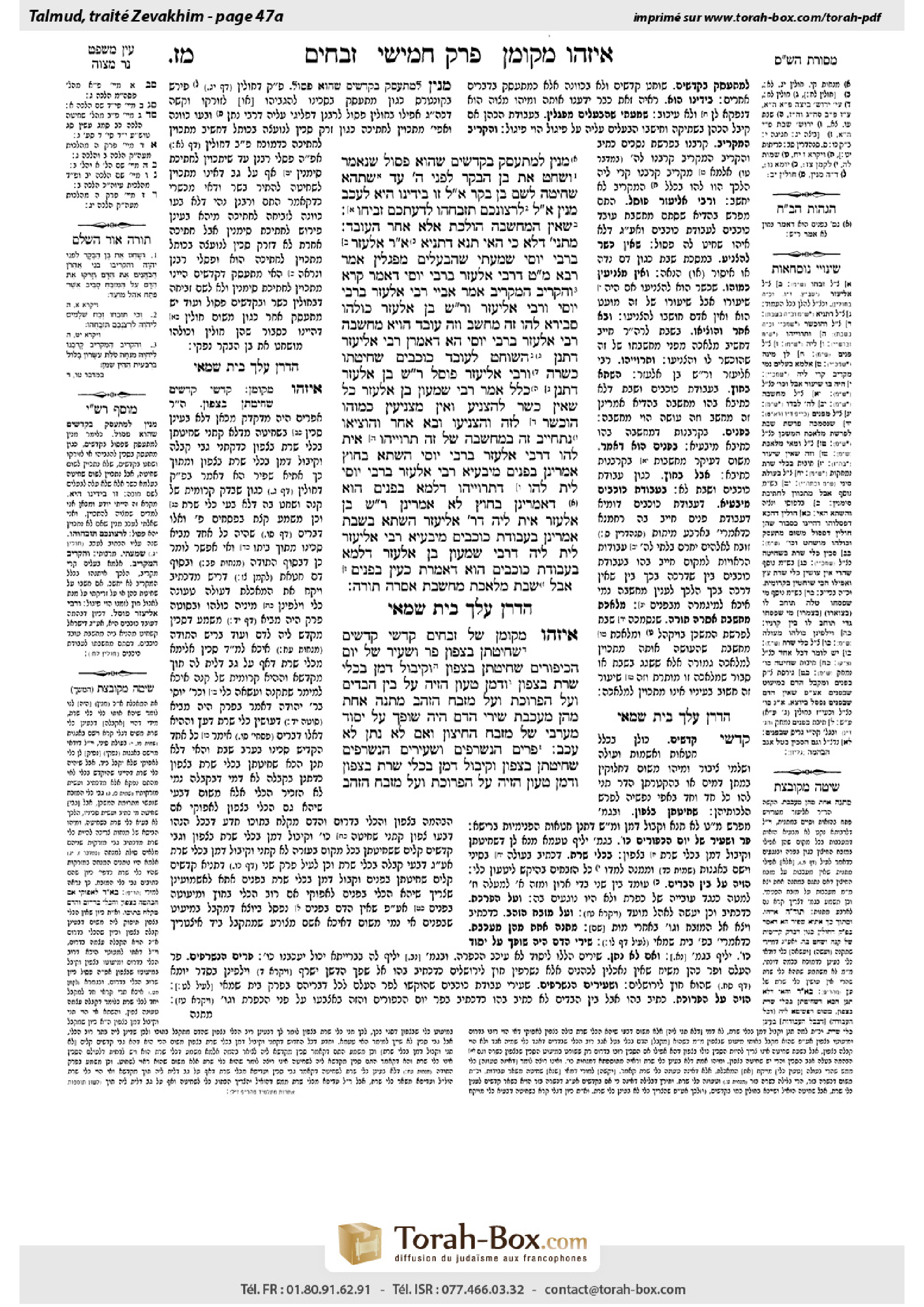
Zevachim 47a: Talmud study for Daf Yomi
Daf Yomi is the daily study of one Talmud folio. Explore 37 tractates with scans, Hebrew text, Sefaria English and AI-generated French translations where annotated.
Passage selection and English or AI-generated French translation are available where the scan has annotations. Daf Study is independent of Torah-Box and Sefaria.
Browse Zevachim · זבחים · All tractatesZevachim 47a text and translations
This page of Zevachim includes the Aramaic text, an English translation and an AI-generated French translation, alongside the scan above.
זבחים מ״ז א · Aramaic and Hebrew text
מִנַּיִן לַמִּתְעַסֵּק בְּקָדָשִׁים שֶׁהוּא פָּסוּל? שֶׁנֶּאֱמַר ״וְשָׁחַט אֶת בֶּן הַבָּקָר לִפְנֵי ה׳״ – עַד שֶׁתְּהֵא שְׁחִיטָה לְשֵׁם בֶּן בָּקָר.
אֲמַר לֵיהּ: זוֹ בְּיָדֵינוּ הִיא; לְעַכֵּב מִנַּיִן? אֲמַר לֵיהּ: ״לִרְצֹנְכֶם תִּזְבָּחֻהוּ״ – לְדַעְתְּכֶם זְבֻיחוּ.
שֶׁאֵין הַמַּחְשָׁבָה הוֹלֶכֶת אֶלָּא אַחַר הָעוֹבֵד. מַתְנִיתִין דְּלָא כִּי הַאי תַּנָּא – דְּתַנְיָא, אָמַר רַבִּי אֶלְעָזָר בְּרַבִּי יוֹסֵי: שָׁמַעְתִּי שֶׁהַבְּעָלִים מְפַגְּלִין. אָמַר רָבָא: מַאי טַעְמָא דְּרַבִּי אֶלְעָזָר בְּרַבִּי יוֹסֵי? דְּאָמַר קְרָא: ״וְהִקְרִיב הַמַּקְרִיב״.
אָמַר אַבָּיֵי: רַבִּי אֶלְעָזָר בְּרַבִּי יוֹסֵי וְרַבִּי אֱלִיעֶזֶר וְרַבִּי שִׁמְעוֹן בֶּן אֶלְעָזָר כּוּלְּהוּ סְבִירָא לְהוּ: זֶה מְחַשֵּׁב וְזֶה עוֹבֵד – הָוְיָא מַחְשָׁבָה. רַבִּי אֶלְעָזָר בְּרַבִּי יוֹסֵי – הָא דַּאֲמַרַן.
רַבִּי אֱלִיעֶזֶר – דִּתְנַן: הַשּׁוֹחֵט לְגוֹי – שְׁחִיטָתוֹ כְּשֵׁרָה, וְרַבִּי אֱלִיעֶזֶר פּוֹסֵל.
רַבִּי שִׁמְעוֹן בֶּן אֶלְעָזָר – דִּתְנַן, כְּלָל אָמַר רַבִּי שִׁמְעוֹן בֶּן אֶלְעָזָר: כֹּל שֶׁאֵין כָּשֵׁר לְהַצְנִיעַ, וְאֵין מַצְנִיעִין כָּמוֹהוּ; הוּכְשַׁר לָזֶה וְהִצְנִיעוֹ, וּבָא אַחֵר וְהוֹצִיאוֹ – נִתְחַיֵּיב זֶה בְּמַחְשָׁבָה שֶׁל זֶה.
תַּרְוַיְיהוּ אִית לְהוּ דְּרַבִּי אֶלְעָזָר בְּרַבִּי יוֹסֵי – הַשְׁתָּא בַּחוּץ אָמְרִינַן, בִּפְנִים מִיבַּעְיָא?!
רַבִּי אֶלְעָזָר בְּרַבִּי יוֹסֵי לֵית לְהוּ דְּתַרְוַיְיהוּ – דִּלְמָא בִּפְנִים הוּא דְּאָמְרִינַן, בַּחוּץ לָא אָמְרִינַן.
רַבִּי שִׁמְעוֹן בֶּן אֶלְעָזָר אִית לֵיהּ דְּרַבִּי אֱלִיעֶזֶר – הַשְׁתָּא בְּשַׁבָּת אָמְרִינַן, בַּעֲבוֹדָה זָרָה מִיבַּעְיָא?!
רַבִּי אֱלִיעֶזֶר לֵית לֵיהּ דְּרַבִּי שִׁמְעוֹן בֶּן אֶלְעָזָר – דִּלְמָא בַּעֲבוֹדָה זָרָה הוּא דְּאָמְרַתְּ כְּעֵין בִּפְנִים, אֲבָל שַׁבָּת – מְלֶאכֶת מַחְשֶׁבֶת אָסְרָה תּוֹרָה.
הֲדַרַן עֲלָךְ בֵּית שַׁמַּאי
מַתְנִי׳ אֵיזֶהוּ מְקוֹמָן שֶׁל זְבָחִים? קׇדְשֵׁי קָדָשִׁים – שְׁחִיטָתָן בַּצָּפוֹן.
פַּר וְשָׂעִיר שֶׁל יוֹם הַכִּיפּוּרִים – שְׁחִיטָתָן בַּצָּפוֹן, וְקִיבּוּל דָּמָן בִּכְלֵי שָׁרֵת בַּצָּפוֹן; וְדָמָן טָעוּן הַזָּיָה עַל בֵּין הַבַּדִּים, וְעַל הַפָּרוֹכֶת, וְעַל מִזְבַּח הַזָּהָב – מַתָּנָה אַחַת מֵהֶן מְעַכֶּבֶת. שְׁיָרֵי הַדָּם הָיָה שׁוֹפֵךְ עַל יְסוֹד מַעֲרָבִי שֶׁל מִזְבֵּחַ הַחִיצוֹן, וְאִם לֹא נָתַן לֹא עִכֵּב.
פָּרִים הַנִּשְׂרָפִים וּשְׂעִירִים הַנִּשְׂרָפִים – שְׁחִיטָתָן בַּצָּפוֹן, וְקִיבּוּל דָּמָן בִּכְלִי שָׁרֵת בַּצָּפוֹן; וְדָמָן טָעוּן הַזָּיָה עַל הַפָּרוֹכֶת וְעַל מִזְבַּח הַזָּהָב –
Zevachim 47a · English translation
From where is it derived with regard to one who acts unawares in the case of consecrated items, i.e., if one slaughtered an offering without intending to perform the act of slaughter at all, but rather like one occupied with other matters, that the offering is disqualified? Rav Huna said to Shmuel: It is derived from a verse, as it is stated: “And he shall slaughter the young bull before the Lord” (Leviticus 1:5), teaching that the mitzva is not performed properly unless the slaughter is for the sake of a young bull, i.e., knowing that he is performing an act of slaughter.
Shmuel said to Rav Huna: We have this as an established halakha already, that it is a mitzva to slaughter the offering for the sake of a bull, but from where is it derived that this requirement is indispensable? Rav Huna said to him that the verse states: “With your will you shall slaughter it” (Leviticus 19:5), i.e., with your full awareness you shall slaughter it, in the form of a purposeful action.
§ The mishna teaches: Because the intent follows only the one performing the sacrificial rite. The Gemara comments: The mishna is not in accordance with the opinion of this tanna, as it is taught in a baraita that Rabbi Elazar, son of Rabbi Yosei, says: I heard that even the owner of an offering can render it piggul through improper intention. Rava says: What is the reason of Rabbi Elazar, son of Rabbi Yosei? As the verse states: “Then he who sacrifices shall sacrifice his offering to the Lord” (Numbers 15:4). The term “he who sacrifices” is a reference to the owner; since the owner is considered one who sacrifices, he too can render his offering piggul with an improper intention.
Abaye says: Rabbi Elazar, son of Rabbi Yosei, and Rabbi Eliezer, and Rabbi Shimon ben Elazar all hold that even in a case involving two people, where this one has intention and that one performs the service, it is the intention that is relevant, i.e., it is as though the one performing the service had the intention. The Gemara explains: The statement of Rabbi Elazar, son of Rabbi Yosei, is that which we just said, that the owner can render his offering piggul through improper intention despite the fact that it is the priest who performs the service.
The statement of Rabbi Eliezer is as we learned in a mishna (Ḥullin 38b): With regard to one who slaughters an animal on behalf of a gentile, his slaughter is valid and a Jew may eat the meat of this animal. But Rabbi Eliezer deems it unfit, as the intention of the gentile, which is presumably to use the animal for idol worship, invalidates the act of slaughter performed by the Jew.
The statement of Rabbi Shimon ben Elazar is as we learned in a baraita: Rabbi Shimon ben Elazar stated a principle: In the case of any item that is not fit to be stored, and therefore people do not typically store items like it, but it was deemed fit for storage by this person and he stored it, and another person came and carried out on Shabbat the item that was stored, that one who carried it out is rendered liable by the thought of this one who stored it.
The Gemara notes: These two Sages, Rabbi Eliezer and Rabbi Shimon ben Elazar, although their rulings are stated in the context of entirely different matters, accept as halakha the ruling of Rabbi Elazar, son of Rabbi Yosei. The Gemara explains: Now that concerning matters outside the Temple, i.e., non-sacred slaughter and carrying on Shabbat, with regard to which the Torah makes no reference to intention, we say that the intention of one person is effective for the action of another, is it necessary to state that the same halakha applies to matters inside the Temple, i.e., offerings, with regard to which it is explicitly stated that intention is effective, as indicated by the verse: “With your will you shall slaughter it” (Leviticus 19:5)?
But Rabbi Elazar, son of Rabbi Yosei, does not necessarily accept as halakha the rulings of these two Sages, Rabbi Eliezer and Rabbi Shimon ben Elazar. The Gemara explains: Perhaps it is only concerning inside the Temple that we say that one person’s intention is effective for the action of another, whereas concerning outside the Temple, we do not say this.
The Gemara further differentiates between the opinions of those two Sages themselves. Rabbi Shimon ben Elazar accepts as halakha the ruling of Rabbi Eliezer: Now that with regard to Shabbat we say that the intention of one person is effective for the action of another, is it necessary to say that the same applies concerning idol worship, where the actions are somewhat similar to those performed in the Temple?
But Rabbi Eliezer does not necessarily accept as halakha the ruling of Rabbi Shimon ben Elazar: Perhaps it is only with regard to idol worship that you say that one person’s intention is effective for the action of another, as idol worship is somewhat similar to service performed inside the Temple. Consequently, it is reasonable that one person’s intention is effective for the action of another in the case of idolatry, as it does for offerings. But with regard to Shabbat, the Torah prohibited only planned, constructive labor, i.e., one is liable only for an action that includes the creative intent of the doer, and here the one who took the item out did not intend to perform a labor.
MISHNA: What is the location of the slaughtering and consumption of offerings? The principle is that with regard to offerings of the most sacred order, their slaughter is in the north of the Temple courtyard.
Specifically, with regard to the bull and the goat of Yom Kippur, their slaughter is in the north and the collection of their blood in a service vessel is in the north, and their blood requires sprinkling between the staves of the Ark in the Holy of Holies, and upon the Curtain separating the Sanctuary and Holy of Holies, and on the golden altar. Concerning all those sprinklings, failure to perform even one placement of their blood disqualifies the offering. As to the remainder of the blood, which is left after those sprinklings, a priest would pour it onto the western base of the external altar. But if he did not place the remainder of the blood on the western base, it does not disqualify the offering.
With regard to bulls that are burned and goats that are burned, their slaughter is in the north of the Temple courtyard, and the collection of their blood in a service vessel is in the north, and their blood requires sprinkling upon the Curtain separating the Sanctuary and Holy of Holies, and upon the golden altar,
Zevachim 47a · Traduction française (IA)
D’où déduit-on que, pour les objets consacrés, celui qui agit sans en avoir conscience — c’est-à-dire s’il égorge une offrande sans avoir l’intention d’accomplir un acte d’égorgement, mais comme quelqu’un qui est occupé à autre chose — disqualifie l’offrande ? Rav Houna dit à Chmouel : Cela se déduit d’un verset, comme il est dit : « Il égorgera le jeune taureau devant le Seigneur » (Lévitique 1, 5), ce qui enseigne que la mitsva n’est pas accomplie correctement à moins que l’égorgement ne soit effectué en sachant qu’il s’agit d’un jeune taureau, c’est-à-dire en sachant qu’on accomplit un acte d’égorgement.
Chmouel dit à Rav Houna : Nous savons déjà, comme halakha établie, que l’offrande doit être égorgée pour un taureau ; mais d’où déduit-on que cette exigence est indispensable ? Rav Houna lui répondit que le verset dit : « Tu l’égorgeras selon ton agrément » (Lévitique 19, 5), c’est-à-dire que tu l’égorgeras en pleine conscience, dans le cadre d’un acte intentionnel.
§ La Michna enseigne : Car l’intention ne dépend que de celui qui accomplit le rite sacrificiel. La Guemara fait remarquer que la Michna ne suit pas l’opinion de ce tanna, car il est enseigné dans une baraïta que Rabbi Elazar, fils de Rabbi Yossi, dit : « J’ai entendu que même le propriétaire d’une offrande peut la rendre piggoul par une intention incorrecte. » Rava dit : Quelle est la raison de Rabbi Elazar, fils de Rabbi Yossi ? Le verset dit : « Alors celui qui apporte son sacrifice apportera son offrande au Seigneur » (Nombres 15, 4). L’expression « celui qui apporte son sacrifice » désigne le propriétaire ; puisque celui-ci est considéré comme celui qui apporte le sacrifice, il peut lui aussi rendre son offrande piggoul par une intention incorrecte.
Abayé dit : Rabbi Elazar, fils de Rabbi Yossi, Rabbi Eliezer et Rabbi Chimon ben Elazar soutiennent tous que, même lorsque deux personnes sont impliquées — l’une ayant l’intention et l’autre accomplissant le service —, c’est l’intention qui compte, autrement dit, c’est comme si celui qui accomplit le service avait cette intention. La Guemara explique : L’opinion de Rabbi Elazar, fils de Rabbi Yossi, est celle que nous venons d’énoncer : le propriétaire peut rendre son offrande piggoul par une intention incorrecte, bien que ce soit le prêtre qui accomplisse le service.
L’opinion de Rabbi Eliezer est celle que nous avons apprise dans une Michna (Houllin 38b) : celui qui égorge un animal pour le compte d’un non-Juif accomplit un égorgement valide, et un Juif peut manger la viande de cet animal. Mais Rabbi Eliezer le déclare impropre, car l’intention du non-Juif — qui est vraisemblablement d’utiliser l’animal pour le culte idolâtre — invalide l’acte d’égorgement accompli par le Juif.
L’opinion de Rabbi Chimon ben Elazar est celle que nous avons apprise dans une baraïta : Rabbi Chimon ben Elazar a énoncé un principe : si un objet ne se prête pas à être conservé, et que les gens n’ont donc pas l’habitude de conserver des objets de ce type, mais qu’une personne le juge digne d’être conservé et le garde, puis qu’une autre personne vient sortir cet objet conservé pendant Chabbat, celui qui l’a sorti devient passible en raison de l’intention de celui qui l’avait conservé.
La Guemara fait remarquer que ces deux sages, Rabbi Eliezer et Rabbi Chimon ben Elazar, bien que leurs décisions portent sur des sujets tout à fait différents, acceptent comme halakha la décision de Rabbi Elazar, fils de Rabbi Yossi. La Guemara explique : Si, pour des questions extérieures au Temple — c’est-à-dire l’égorgement profane et le transport pendant Chabbat —, auxquelles la Torah ne rattache aucune intention, nous disons que l’intention d’une personne peut compter pour l’acte d’une autre, faut-il préciser que la même halakha s’applique aux questions qui concernent l’intérieur du Temple, c’est-à-dire les offrandes, pour lesquelles il est explicitement indiqué que l’intention compte, comme le montre le verset : « Tu l’égorgeras selon ton agrément » (Lévitique 19, 5) ?
Mais Rabbi Elazar, fils de Rabbi Yossi, n’accepte pas nécessairement comme halakha les décisions de ces deux sages, Rabbi Eliezer et Rabbi Chimon ben Elazar. La Guemara explique : Peut-être disons-nous seulement que, dans le Temple, l’intention d’une personne peut compter pour l’acte d’une autre, tandis qu’à l’extérieur du Temple, nous ne le disons pas.
La Guemara établit en outre une distinction entre les opinions de ces deux sages eux-mêmes. Rabbi Chimon ben Elazar accepte comme halakha la décision de Rabbi Eliezer : si, à propos de Chabbat, nous disons que l’intention d’une personne peut compter pour l’acte d’une autre, faut-il préciser que cela s’applique également au culte idolâtre, dont les actes ressemblent quelque peu à ceux qui sont accomplis dans le Temple ?
Mais Rabbi Eliezer n’accepte pas nécessairement comme halakha la décision de Rabbi Chimon ben Elazar : peut-être dis-tu seulement que, pour le culte idolâtre, l’intention d’une personne peut compter pour l’acte d’une autre, car le culte idolâtre ressemble quelque peu au service accompli dans le Temple. Il est donc raisonnable que, dans le cas de l’idolâtrie, l’intention d’une personne compte pour l’acte d’une autre, comme c’est le cas pour les offrandes. Mais, pour Chabbat, la Torah n’interdit que les travaux planifiés et constructifs, c’est-à-dire qu’on n’est passible que pour un acte qui comporte l’intention créatrice de son auteur ; or, ici, celui qui a sorti l’objet n’avait pas l’intention d’accomplir un travail.
MICHNA : Où se déroulent l’égorgement et la consommation des offrandes ? Le principe est que, pour les offrandes de sainteté suprême, l’égorgement a lieu au nord du parvis du Temple.
Plus précisément, pour le taureau et le bouc de Yom Kippour, l’égorgement a lieu au nord et le recueil de leur sang dans un récipient de service a lieu au nord ; leur sang doit être aspergé entre les barres de l’Arche, dans le Saint des saints, sur le rideau qui sépare le Sanctuaire du Saint des saints, et sur l’autel d’or. Pour toutes ces aspersions, l’omission d’une seule application de leur sang disqualifie l’offrande. Quant au reste du sang, qui demeure après ces aspersions, un prêtre le versait sur la base occidentale de l’autel extérieur. Mais si le reste du sang n’était pas déposé sur la base occidentale, cela ne disqualifiait pas l’offrande.
Pour les taureaux que l’on brûle et les boucs que l’on brûle, l’égorgement a lieu au nord du parvis du Temple, et le recueil de leur sang dans un récipient de service a lieu au nord ; leur sang doit être aspergé sur le rideau qui sépare le Sanctuaire du Saint des saints et sur l’autel d’or,
Traduction française générée par IA à partir de l’édition anglaise de Sefaria. Vérifie toujours un passage avec le texte source.
Text from Sefaria: William Davidson Edition - Vocalized Aramaic (CC BY NC); William Davidson Edition - English (CC BY NC).