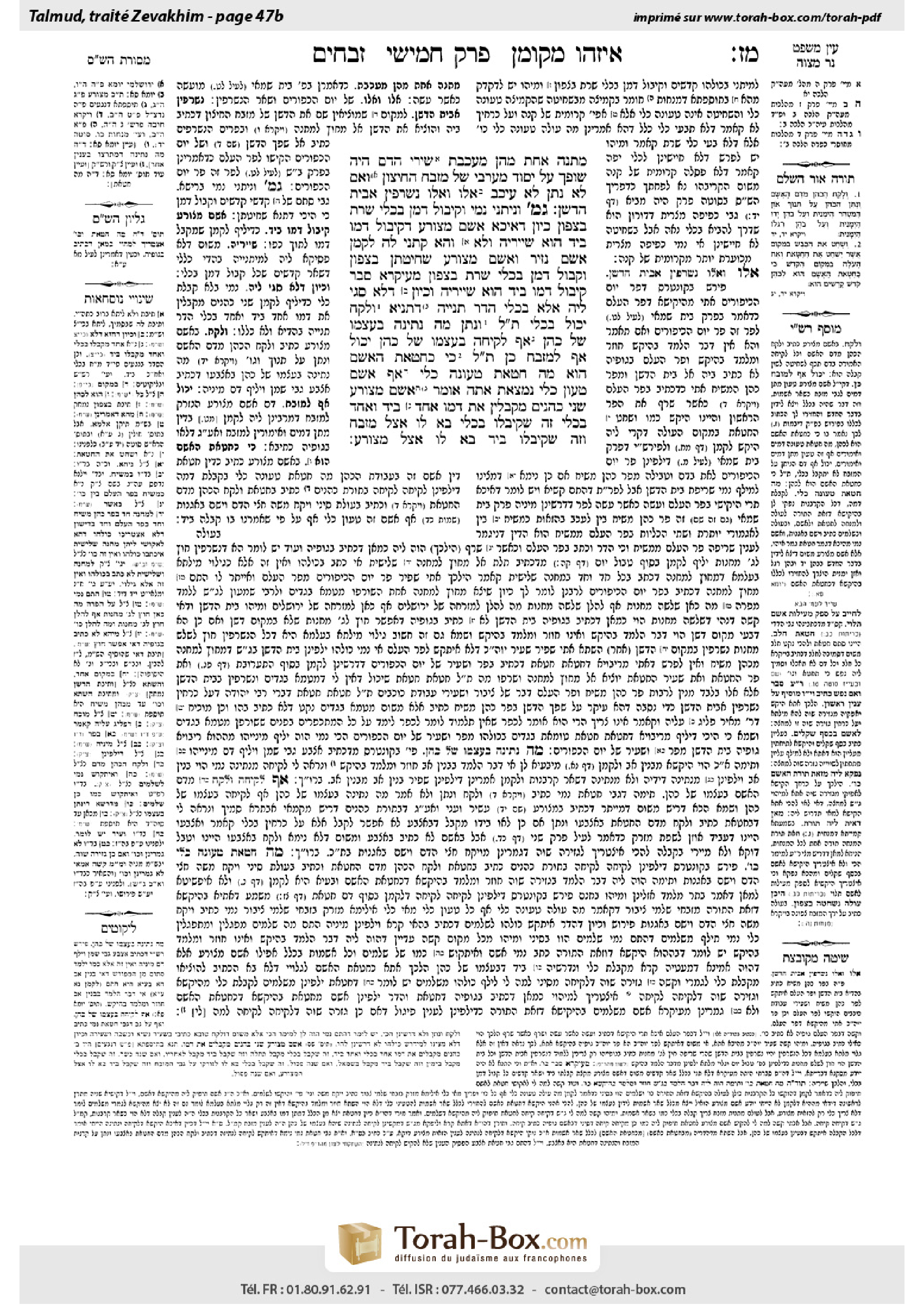
Zevachim 47b: Talmud study for Daf Yomi
Daf Yomi is the daily study of one Talmud folio. Explore 37 tractates with scans, Hebrew text, Sefaria English and AI-generated French translations where annotated.
Passage selection and English or AI-generated French translation are available where the scan has annotations. Daf Study is independent of Torah-Box and Sefaria.
Browse Zevachim · זבחים · All tractatesZevachim 47b text and translations
This page of Zevachim includes the Aramaic text, an English translation and an AI-generated French translation, alongside the scan above.
זבחים מ״ז ב · Aramaic and Hebrew text
מַתָּנָה אַחַת מֵהֶן מְעַכֶּבֶת. שְׁיָרֵי הַדָּם הָיָה שׁוֹפֵךְ עַל יְסוֹד מַעֲרָבִי שֶׁל מִזְבֵּחַ הַחִיצוֹן, וְאִם לֹא נָתַן לֹא עִיכֵּב. אֵלּוּ וָאֵלּוּ נִשְׂרָפִין אַבֵּית הַדֶּשֶׁן.
גְּמָ׳ וְנִיתְנֵי נָמֵי: וְקִיבּוּל דָּמָן בִּכְלִי שָׁרֵת בַּצָּפוֹן! כֵּיוָן דְּאִיכָּא אֲשַׁם מְצוֹרָע דְּקִיבּוּל דָּמוֹ בַּיָּד הוּא – שַׁיְּירֵיהּ.
וְלָא?! וְהָא קָתָנֵי לַהּ לְקַמַּן: אֲשַׁם נָזִיר וַאֲשַׁם מְצוֹרָע – שְׁחִיטָתָן בַּצָּפוֹן, וְקִבּוּל דָּמָן בִּכְלִי שָׁרֵת בַּצָּפוֹן!
מֵעִיקָּרָא סָבַר קִיבּוּל דָּמוֹ בַּיָּד הוּא; שַׁיְּירֵיהּ. וְכֵיוָן דְּלָא סַגִּי לֵיהּ אֶלָּא בִּכְלִי – הֲדַר תַּנְיֵיהּ.
דְּתַנְיָא: ״וְלָקַח״ – יָכוֹל בִּכְלִי? תַּלְמוּד לוֹמַר: ״וְנָתַן״ – מָה נְתִינָה בְּעַצְמוֹ שֶׁל כֹּהֵן, אַף לְקִיחָה בְּעַצְמוֹ שֶׁל כֹּהֵן.
יָכוֹל אַף לְמִזְבֵּחַ כֵּן? תַּלְמוּד לוֹמַר: ״כִּי כַּחַטָּאת הָאָשָׁם הוּא״ – מָה חַטָּאת טְעוּנָה כְּלִי, אַף אָשָׁם טָעוּן כְּלִי. נִמְצֵאתָ אַתָּה אוֹמֵר: אֲשַׁם מְצוֹרָע – שְׁנֵי כֹּהֲנִים מְקַבְּלִין אֶת דָּמוֹ, אֶחָד בַּיָּד וְאֶחָד בִּכְלִי. זֶה שֶׁקִּיבְּלוֹ בִּכְלִי – בָּא לוֹ אֵצֶל מִזְבֵּחַ, וְזֶה שֶׁקִּיבְּלוֹ בַּיָּד – בָּא לוֹ אֵצֶל מְצוֹרָע.
Zevachim 47b · English translation
and failure to perform even one placement of their blood disqualifies the offering. As for the remainder of the blood that is left after those sprinklings, a priest would pour it onto the western base of the external altar, but if he did not pour the remainder it does not disqualify the offering. These, the bull and the goat of Yom Kippur, and those, the bulls and the goats that are burned, are then burned in the place of the ashes, a place outside of Jerusalem where the priests would bring the ashes from the altar.
GEMARA: The mishna opens with a principle that the slaughter of offerings of the most sacred order is in the north of the Temple courtyard. The Gemara inquires: And let the mishna also teach as a principle: And the collection of their blood in a service vessel is in the north of the Temple courtyard. Since collecting the blood is an indispensable part of the service, why is it not listed in this clause of the mishna? The Gemara explains: Since there is among the offerings of the most sacred order the guilt offering of a leper, for which the collection of its blood is in the hand, the mishna could not state this as a principle. Therefore, the tanna omitted this from the requirements for offerings of the most sacred order.
The Gemara challenges: And is the blood of the guilt offering of a leper not collected in a service vessel? But the mishna teaches this halakha later (54b): With regard to the guilt offering of a nazirite brought for his purification and the guilt offering of a leper brought for his purification, their slaughter is in the north of the Temple courtyard and collection of their blood in a service vessel is in the north. Apparently, the tanna maintains that the blood of the guilt offering of a leper must be collected in a service vessel.
The Gemara answers: Initially, the tanna held that since collection of the blood of the guilt offering of a leper must also be in the priest’s hand, not exclusively in a service vessel, he omitted it. But since it is the case that it is possible for one to collect some of the blood only in a service vessel, the tanna subsequently taught it.
This is as it is taught in a baraita (Tosefta, Nega’im 9:2): The Torah states with regard to the guilt offering of a leper: “And the priest shall take of the blood of the guilt offering, and the priest shall put it upon the tip of the right ear of him who is to be purified, and upon the thumb of his right hand, and upon the big toe of his right foot” (Leviticus 14:14). One might have thought that he should take it in a vessel; therefore, the verse states: “And the priest shall put.” Just as putting the blood on the ear, thumb, and big toe must be performed with the priest’s own body, so too, taking of the blood is performed with the priest’s own body, not with a service vessel.
The baraita continues: One might have thought that even with regard to the blood of the leper’s guilt offering that he presents on the altar, like the blood of other guilt offerings, it is so, that he collects the blood in his hand rather than with a vessel. To counter this, the verse states: “For as the sin offering is, so is the guilt offering” (Leviticus 14:13). This teaches that just as a sin offering requires a vessel for collection of its blood, so too, the blood of a guilt offering requires a vessel for collection of its blood. You consequently say: In the case of a leper’s guilt offering, two priests collect its blood; one collects the blood by hand, and the other one collects the blood in a vessel. This one, who collected the blood in a vessel, comes to the altar and sprinkles some of the blood on it. And that one, who collected the blood by hand, comes to the leper and places some of the blood on his right ear, right thumb, and right big toe.
Zevachim 47b · Traduction française (IA)
et l’omission d’une seule aspersion de leur sang disqualifie le sacrifice. Quant au reste du sang, celui qui demeure après ces aspersions, un prêtre le versait sur la base occidentale de l’autel extérieur ; s’il ne versait pas le reste, cela ne disqualifiait pas le sacrifice. Ceux-ci, le taureau et le bouc de Yom Kippour, ainsi que ceux-là, les taureaux et les boucs qui sont brûlés, sont ensuite brûlés à l’emplacement des cendres, un lieu situé hors de Jérusalem où les prêtres apportaient les cendres de l’autel.
GUEMARA : La Michna commence par énoncer comme principe que l’abattage des sacrifices de sainteté supérieure a lieu au nord de la cour du Temple. La Guemara demande : Pourquoi la Michna n’enseigne-t-elle pas également comme principe que le recueil de leur sang dans un ustensile de service a lieu au nord de la cour du Temple ? Puisque le recueil du sang est une partie indispensable du service, pourquoi cette clause de la Michna ne le mentionne-t-elle pas ? La Guemara explique : Parmi les sacrifices de sainteté supérieure figure le sacrifice de culpabilité d’un lépreux, dont le sang est recueilli dans la main du prêtre. La Michna ne pouvait donc pas énoncer cette règle comme principe. Le tanna a par conséquent omis cette exigence des conditions applicables aux sacrifices de sainteté supérieure.
La Guemara objecte : Le sang du sacrifice de culpabilité d’un lépreux n’est-il donc pas recueilli dans un ustensile de service ? Pourtant, la Michna enseigne plus loin (54b) cette halakha : le sacrifice de culpabilité d’un nazir apporté pour sa purification et le sacrifice de culpabilité d’un lépreux apporté pour sa purification sont abattus au nord de la cour du Temple, et leur sang est recueilli dans un ustensile de service au nord. Il apparaît donc que, selon le tanna, le sang du sacrifice de culpabilité d’un lépreux doit être recueilli dans un ustensile de service.
La Guemara répond : Au départ, le tanna estimait que, puisque le sang du sacrifice de culpabilité d’un lépreux doit aussi être recueilli dans la main du prêtre, et non exclusivement dans un ustensile de service, il fallait omettre cette règle. Mais, puisqu’il est possible d’en recueillir une partie uniquement dans un ustensile de service, le tanna l’a ensuite enseignée.
C’est ce qui est enseigné dans une baraïta (Tossefta, Negaïm 9:2) : au sujet du sacrifice de culpabilité d’un lépreux, la Torah dit : « Le prêtre prendra du sang du sacrifice de culpabilité, et le prêtre en mettra sur le lobe de l’oreille droite de celui qui doit être purifié, sur le pouce de sa main droite et sur le gros orteil de son pied droit » (Lévitique 14:14). On aurait pu penser qu’il doit le prendre dans un ustensile ; le verset dit donc : « Et le prêtre en mettra. » De même que le sang doit être appliqué sur l’oreille, le pouce et le gros orteil par le prêtre lui-même, de même le sang doit être pris par le prêtre lui-même, et non au moyen d’un ustensile de service.
La baraïta poursuit : On aurait pu penser que, même pour le sang du sacrifice de culpabilité du lépreux qu’il présente sur l’autel, comme pour le sang des autres sacrifices de culpabilité, il en va ainsi : il recueille le sang dans sa main plutôt que dans un ustensile. Pour écarter cette possibilité, le verset dit : « Car le sacrifice expiatoire est comme le sacrifice de culpabilité » (Lévitique 14:13). Cela enseigne que, de même qu’un sacrifice expiatoire exige un ustensile pour recueillir son sang, de même le sang d’un sacrifice de culpabilité exige un ustensile pour être recueilli. On en conclut que, dans le cas du sacrifice de culpabilité d’un lépreux, deux prêtres recueillent le sang : l’un le recueille à la main, l’autre dans un ustensile. Celui qui a recueilli le sang dans un ustensile se rend à l’autel et y asperge une partie du sang. Celui qui l’a recueilli à la main se rend auprès du lépreux et applique une partie du sang sur son oreille droite, son pouce droit et son gros orteil droit.
Traduction française générée par IA à partir de l’édition anglaise de Sefaria. Vérifie toujours un passage avec le texte source.
Text from Sefaria: William Davidson Edition - Vocalized Aramaic (CC BY NC); William Davidson Edition - English (CC BY NC).