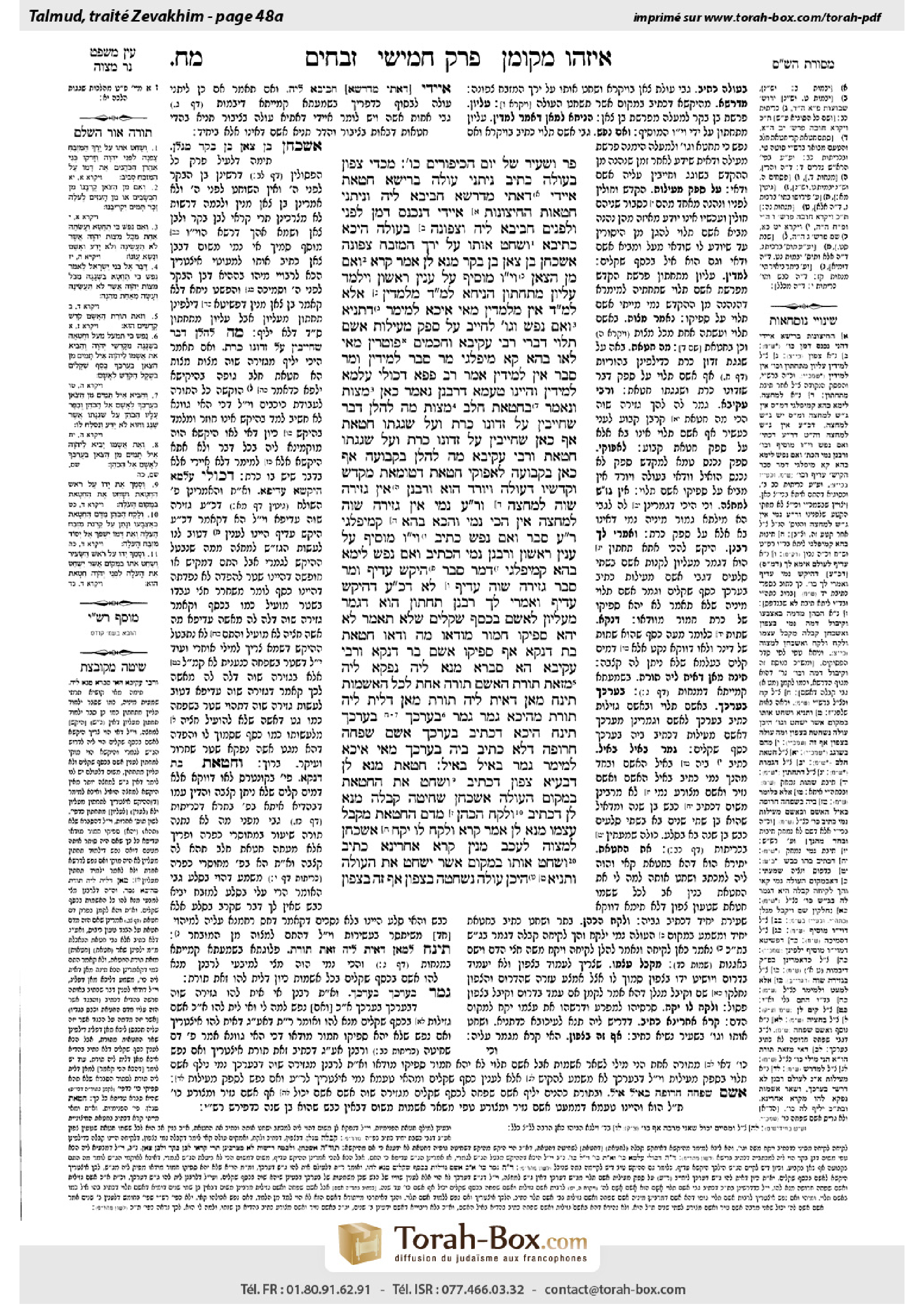
Zevachim 48a: Talmud study for Daf Yomi
Daf Yomi is the daily study of one Talmud folio. Explore 37 tractates with scans, Hebrew text, Sefaria English and AI-generated French translations where annotated.
Passage selection and English or AI-generated French translation are available where the scan has annotations. Daf Study is independent of Torah-Box and Sefaria.
Browse Zevachim · זבחים · All tractatesZevachim 48a text and translations
This page of Zevachim includes the Aramaic text, an English translation and an AI-generated French translation, alongside the scan above.
זבחים מ״ח א · Aramaic and Hebrew text
פַּר וְשָׂעִיר שֶׁל יוֹם הַכִּיפּוּרִים כּוּ׳. מִכְּדֵי צָפוֹן בְּעוֹלָה כְּתִיב, נִיתְנֵי עוֹלָה בְּרֵישָׁא!
חַטָּאת – אַיְּידֵי דְּאָתֵי מִדְּרָשָׁא, חַבִּיבָא לֵיהּ.
וְנִיתְנֵי חַטָּאוֹת הַחִיצוֹנוֹת! אַיְּידֵי דְּנִכְנַס דָּמָן לִפְנַי וְלִפְנִים, חַבִּיבָא לֵיהּ.
וְצָפוֹנָה בְּעוֹלָה הֵיכָא כְּתִיבָא? ״וְשָׁחַט אֹתוֹ עַל יֶרֶךְ הַמִּזְבֵּחַ צָפֹנָה״.
אַשְׁכְּחַן בֶּן צֹאן, בֶּן בָּקָר מְנָא לַן? אָמַר קְרָא: ״וְאִם מִן הַצֹּאן״ – וָי״ו מוֹסִיף עַל עִנְיָן רִאשׁוֹן, וְיִלְמַד עֶלְיוֹן מִתַּחְתּוֹן.
הָנִיחָא לְמַאן דְּאָמַר מְלַמְּדִין; אֶלָּא לְמַאן דְּאָמַר אֵין מְלַמְּדִין, מַאי אִיכָּא לְמֵימַר?
דְּתַנְיָא: ״וְאִם נֶפֶשׁ וְגוֹ׳״ – לְחַיֵּיב עַל סְפֵק מְעִילוֹת אָשָׁם תָּלוּי. דִּבְרֵי רַבִּי עֲקִיבָא. וַחֲכָמִים פּוֹטְרִין. מַאי, לָאו בְּהָא קָא מִיפַּלְגִי: מָר סָבַר לְמֵידִין, וּמַר סָבַר אֵין לְמֵידִין?
אָמַר רַב פָּפָּא: דְּכוּלֵּי עָלְמָא לְמֵידִין; וְהַיְינוּ טַעְמָא דְּרַבָּנַן: נֶאֱמַר כָּאן ״מִצְוֹת״, וְנֶאֱמַר בְּחַטַּאת חֵלֶב ״מִצְוֹת״;
מָה לְהַלָּן – דָּבָר שֶׁחַיָּיבִין עַל זְדוֹנוֹ כָּרֵת וְעַל שִׁגְגָתוֹ חַטָּאת, אַף כָּאן – שֶׁחַיָּיבִין עַל זְדוֹנוֹ כָּרֵת וְעַל שִׁגְגָתוֹ חַטָּאת.
וְרַבִּי עֲקִיבָא – מָה לְהַלָּן בִּקְבוּעָה, אַף כָּאן בִּקְבוּעָה; לְאַפּוֹקֵי חַטָּאת דְּטוּמְאַת מִקְדָּשׁ וְקָדָשָׁיו, דְּעוֹלֶה וְיוֹרֵד הוּא.
וְרַבָּנַן – אֵין גְּזֵירָה שָׁוָה לְמֶחֱצָה. וְרַבִּי עֲקִיבָא נָמֵי, אֵין גְּזֵירָה שָׁוָה לְמֶחֱצָה!
אִין הָכִי נָמֵי; וְהָכָא בְּהָא קָמִיפַּלְגִי: רַבִּי עֲקִיבָא סָבַר: ״וְאִם נֶפֶשׁ״ כְּתִיב – וָי״ו מוֹסִיף עַל עִנְיָן רִאשׁוֹן;
וְרַבָּנַן נָמֵי, הָכְתִיב ״וְאִם נֶפֶשׁ״! לֵימָא בְּהָא קָמִיפַּלְגִי – דְּמָר סָבַר הֶיקֵּשׁ עֲדִיף, וּמָר סָבַר גְּזֵירָה שָׁוָה עֲדִיף?
לָא, דְּכוּלֵּי עָלְמָא – דְּהֶיקֵּשׁ עֲדִיף; וְאָמְרִי לָךְ רַבָּנַן: תַּחְתּוֹן הוּא דְּגָמַר מֵעֶלְיוֹן –
לְאָשָׁם בְּכֶסֶף שְׁקָלִים. שֶׁלֹּא תֹּאמַר: לֹא יְהֵא סְפֵיקוֹ חָמוּר מִוַּדָּאוֹ; מָה וַדָּאוֹ חַטָּאת בַּת דַּנְקָא, אַף סְפֵיקוֹ אָשָׁם בַּר דַּנְקָא.
וְרַבִּי עֲקִיבָא, הָא סְבָרָא מְנָא לֵיהּ? נָפְקָא לֵיהּ מִ״זֹּאת תּוֹרַת הָאָשָׁם״ – תּוֹרָה אַחַת לְכׇל הָאֲשָׁמוֹת.
תִּינַח מַאן דְּאִית לֵיהּ ״תּוֹרַת״; מַאן דְּלֵית לֵיהּ ״תּוֹרַת״ מֵהֵיכָא גָּמַר? גָּמַר ״בְּעֶרְכְּךָ״–״בְּעֶרְכְּךָ״.
תִּינַח הֵיכָא דִּכְתִיב ״בְּעֶרְכְּךָ״; אֲשַׁם שִׁפְחָה חֲרוּפָה דְּלָא כְּתִיב בֵּיהּ ״בְּעֶרְכְּךָ״, מַאי אִיכָּא לְמֵימַר?
גָּמַר ״בְּאֵיל״–״בְּאֵיל״.
חַטָּאת מְנָא לַן דְּבָעֲיָא צָפוֹן? דִּכְתִיב: ״וְשָׁחַט אֶת הַחַטָּאת בִּמְקוֹם הָעוֹלָה״.
אַשְׁכְּחַן שְׁחִיטָה, קַבָּלָה מְנָא לַן? דִּכְתִיב: ״וְלָקַח הַכֹּהֵן מִדַּם הַחַטָּאת״.
מְקַבֵּל עַצְמוֹ מְנָא לַן? אָמַר קְרָא: ״וְלָקַח״ – ״לוֹ יִקַּח״.
אַשְׁכְּחַן לְמִצְוָה, לְעַכֵּב מִנַּיִן? קְרָא אַחְרִינָא כְּתִיב: ״וְשָׁחַט אוֹתוֹ בִּמְקוֹם אֲשֶׁר יִשְׁחַט אֶת הָעוֹלָה״, וְתַנְיָא: הֵיכָן עוֹלָה [נִשְׁחֶטֶת] – בַּצָּפוֹן; אַף זֶה בַּצָּפוֹן.
Zevachim 48a · English translation
§ The mishna teaches: With regard to the bull and the goat of Yom Kippur, their slaughter is in the north and the collection of their blood in a service vessel is in the north. The Gemara asks: Why does the mishna list these sin offerings first? After all, while the halakha that slaughter must be in the north of the Temple courtyard is written in the Torah with regard to a burnt offering (Leviticus 1:11), the Torah does not explicitly state that the other offerings must be slaughtered in the north. Therefore, let the tanna of the mishna teach the halakha of a burnt offering first.
The Gemara answers: Since the location for slaughtering the sin offering is derived through interpretation, it is dear to the tanna, and therefore he gives it precedence. The verse states: “Speak to Aaron and to his sons, saying: This is the law of the sin offering: In the place where the burnt offering is slaughtered shall the sin offering be slaughtered before the Lord; it is most holy” (Leviticus 6:18). The Gemara (55a) derives from this verse that the sin offering must be slaughtered in the same place as the burnt offering, i.e., in the north of the Temple courtyard.
The Gemara challenges: But let the tanna of the mishna teach first the halakha of the external sin offerings, since those are the offerings to which the verse is referring. The Gemara explains: Since the blood of the Yom Kippur sin offerings enters the innermost sanctum, these offerings are dear to the tanna, and he taught them first.
The Gemara asks: And where is it written that a burnt offering must be slaughtered in the north of the Temple courtyard? The Gemara answers that with regard to a sheep that is brought as a burnt offering the Torah states: “And he shall slaughter it on the side of the altar northward before the Lord; and Aaron’s sons, the priests, shall dash its blood against the altar round about” (Leviticus 1:11).
The Gemara clarifies: We have found that this verse provides a source that a young sheep burnt offering must be slaughtered in the north. From where do we derive that a young bull burnt offering must also be slaughtered in the north? The Gemara answers: The verse states: “And if his offering be of the flock, whether of the sheep, or of the goats, for a burnt offering, he shall offer it a male without blemish” (Leviticus 1:10). The conjunctive “and” represented by the letter vav adds to the previous matter. The previous passage addresses cattle offerings. And let the upper passage, the place of the slaughter of a bull, be learned from the lower passage, the place of slaughtering a sheep.
The Gemara comments: This works out well according to the one who says that we learn halakhot in this manner. But according to the one who says that we do not learn halakhot in this manner, what is there to say?
As it is taught in a baraita: Immediately following the passage in the Torah addressing a guilt offering for misuse of consecrated property, the Torah discusses the halakhot of a provisional guilt offering, brought by one who is uncertain as to whether he committed a sin that requires a sin offering. The verse states: “And if anyone sin, and does any of the commandments which the Lord has commanded not to be done, though he did not know it, yet is he guilty, and shall bear his iniquity” (Leviticus 5:17). This serves to render him liable to bring a provisional guilt offering for uncertain misuse of consecrated property; this is the statement of Rabbi Akiva. And the Rabbis deem him exempt in such a case. The Gemara suggests: What, is it not that they disagree with regard to this: One Sage, Rabbi Akiva, holds that we learn halakhot of the upper passage from the lower passage, and the other Sage, i.e., the Rabbis, holds that we do not learn halakhot in this manner?
Rav Pappa said: This is not correct, as everyone holds that we learn halakhot of the upper passage from the lower passage. And this is the reason that the Rabbis exempt from bringing an offering one who is uncertain whether he misused consecrated property: They learn a verbal analogy. It is stated here: “And if anyone sin, and does any of the commandments which the Lord has commanded not to be done” (Leviticus 5:17). And it is stated with regard to the sin offering for eating forbidden fat: “And if any one of the common people sin through error, in doing any of the commandments which the Lord has commanded not to be done, and be guilty” (Leviticus 4:27).
The verbal analogy teaches that just as there, the sin offering is brought only for an act that for its intentional violation one is liable to be punished with karet, and for its unwitting violation one is liable to bring a sin offering, so too here, one brings a provisional guilt offering only for an act that for its intentional violation one is liable to be punished with karet, and for its unwitting violation one is liable to bring a sin offering, which is not the case concerning misuse of consecrated property.
The Gemara asks: And what does Rabbi Akiva derive from this verbal analogy? He learns that just as there the verse obligates one to bring a fixed sin offering, so too here, with regard to the provisional guilt offering, one brings it for a case of uncertain transgression of a prohibition for which one would be liable to bring a fixed sin offering, to exclude a sin offering brought for uncertain transgression of the defiling of the Temple or sacrificial foods, as the sin offering for that transgression is not fixed, but is a sliding-scale offering. If the sinner is poor he brings a meal offering or a bird offering; if he is rich he brings an animal offering. In a case of uncertainty one does not bring a provisional guilt offering.
And as for the Rabbis, who derived a different halakha from the verbal analogy, they hold that there is no verbal analogy for half of a matter. Once a provisional guilt offering is compared to a sin offering, it must be completely similar, and both matters are derived from the verbal analogy. The Gemara asks: But Rabbi Akiva also must hold that there is no verbal analogy for half of a matter, so why does he not agree with the derivation of the Rabbis?
The Gemara reconsiders: Yes, this is indeed so. And here they disagree with regard to this: Rabbi Akiva holds that it is written with regard to the provisional guilt offering: “And if anyone sin, and does any of the commandments which the Lord has commanded not to be done, though he did not know it, yet is he guilty, and shall bear his iniquity” (Leviticus 5:17). The word “and” represented by the letter vav adds to the previous matter. When a phrase begins with the conjunction vav, it is a continuation of the previous matter, and the halakhot of the previous passage can be learned from the subsequent passage. Therefore one brings a provisional guilt offering for uncertain misuse of consecrated property.
The Gemara asks: But according to the opinion of the Rabbis also, isn’t it written: “And if anyone sin”? Let us say that they disagree about this: As one Sage, Rabbi Akiva, holds that a derivation from a juxtaposition is preferable, and derives from the juxtaposition of the halakhot of misuse of consecrated property to the halakhot of a provisional guilt offering that one is liable to bring a provisional guilt offering if he is not certain whether he misused consecrated property. And one Sage, i.e., the Rabbis, holds that a derivation from a verbal analogy is preferable, and therefore derives from a verbal analogy between the passage of misuse of consecrated property and the passage of a sin offering for eating forbidden fat that one is not liable to bring a provisional guilt offering if he is not certain whether he misused consecrated property.
The Gemara rejects this: No, it may be that everyone agrees that a derivation from a juxtaposition is preferable. And the Rabbis would say to you that the reason one is exempt from bringing a provisional guilt offering in a case of uncertain misuse of consecrated property is that the juxtaposition should be understood in the opposite manner. It is the lower passage that is derived from the upper passage.
The juxtaposition teaches that a provisional guilt offering must be a ram worth a minimum of two silver shekels, as is the halakha with regard to the offering brought for misuse of consecrated property. This derivation is needed so that you should not say that a provisional guilt offering, brought for his uncertain transgression, should not be more stringent than the offering one brings in a case of his definite transgression. According to that claim, one would say that just as for his definite transgression one may bring a sin offering worth only one-sixth [danka] of a dinar, so too, for his uncertain transgression one may bring a provisional guilt offering worth only one-sixth of a dinar.
The Gemara asks: And from where does Rabbi Akiva derive this conclusion? The Gemara answers: He derives it from the verse that states: “And this is the law of the guilt offering” (Leviticus 7:1), which teaches that there is one law for all of the guilt offerings and they must all be worth at least two shekels, provisional guilt offerings included.
The Gemara asks: This works out well according to one who holds that there is a derivation from the word “law,” but according to the one who does not hold that there is a derivation from the word “law,” from where does he learn that all guilt offerings must have the same minimum value? The Gemara answers: He learns it from a verbal analogy between the term “according to your valuation” stated with regard to a guilt offering for misuse of consecrated property (Leviticus 5:15) and the term “according to your valuation” stated with regard to a provisional guilt offering (Leviticus 5:18) and a guilt offering for robbery (Leviticus 5:25).
The Gemara asks: This works out well concerning guilt offerings where it is written “according to your valuation,” but with regard to a guilt offering brought for engaging in sexual intercourse with an espoused maidservant, concerning which it is not written in the Torah “according to your valuation,” what is there to say? How does one derive that the guilt offering brought for engaging in sexual intercourse with an espoused maidservant must be worth a minimum of two silver shekels?
The Gemara answers that it is derived from a verbal analogy between the term “with the ram” stated with regard to a guilt offering for misuse of consecrated property (Leviticus 5:16) and the term “with the ram” stated with regard to the guilt offering for engaging in sexual intercourse with an espoused maidservant (Leviticus 19:22).
§ The Gemara returns to discuss the mishna. From where do we derive that a sin offering requires slaughter in the north of the Temple courtyard? The Gemara answers: As it is written with regard to an individual sin offering: “And he shall place his hand upon the head of the sin offering, and slaughter the sin offering in the place of the burnt offering” (Leviticus 4:29). Just as a burnt offering must be slaughtered in the north of the Temple courtyard, so too, a sin offering must also be slaughtered in the north.
The Gemara asks: We have found from this verse that the slaughter must be in the north. From where do we derive that collection of the blood must also be in the north? The Gemara answers: As it is written: “And the priest shall take of the blood of the sin offering with his finger and place it upon the corners of the altar of burnt offering, and all its remaining blood he shall pour out at the base of the altar” (Leviticus 4:34). As this verse immediately follows the verse discussing the slaughter of a sin offering, evidently the taking of the blood is performed in the same place as the slaughter.
The Gemara asks: From where do we derive that the one collecting the blood must himself stand in the north of the Temple courtyard? Perhaps he may stand near the north and extend his arm to collect the blood. The Gemara answers that the verse states: “And the priest shall take [velakaḥ]” (Leviticus 4:34), which can be read, as: He will take himself [lo yikkaḥ].
The Gemara asks: We have found that the offering must be slaughtered in the north and the blood collected in the north to perform the mitzva in the optimal manner. From where is it derived that if one slaughters the offering or collects the blood anywhere else the offering is disqualified? The Gemara answers: It is written in another verse which speaks of a goat sin offering brought by a king who sins: “And he shall place his hand upon the head of the goat and slaughter it in the place where they slaughter the burnt offering before the Lord; it is a sin offering” (Leviticus 4:24). And it is taught in a baraita: Where is the burnt offering slaughtered? In the north. This sin offering of a king must also be slaughtered in the north of the Temple courtyard.
Zevachim 48a · Traduction française (IA)
§ La Michna enseigne : Pour le taureau et le bouc de Yom Kippour, l’abattage a lieu au nord et le recueil de leur sang dans un ustensile de service a lieu au nord. La Guemara demande : Pourquoi la Michna énumère-t-elle d’abord ces sacrifices expiatoires ? Après tout, si la halakha selon laquelle l’abattage doit avoir lieu au nord du parvis du Temple est écrite dans la Torah à propos d’un holocauste (Lévitique 1,11), la Torah ne précise pas explicitement que les autres sacrifices doivent être abattus au nord. Le tanna de la Michna devrait donc enseigner d’abord la halakha relative à un holocauste.
La Guemara répond : Puisque l’emplacement de l’abattage du sacrifice expiatoire est établi par une interprétation, il est cher au tanna, qui le mentionne donc en premier. Le verset dit : « Parle à Aaron et à ses fils, en disant : Voici la loi du sacrifice expiatoire : c’est à l’endroit où l’on abat l’holocauste que l’on abattra le sacrifice expiatoire devant le Seigneur ; il est très saint » (Lévitique 6,18). La Guemara (55a) déduit de ce verset que le sacrifice expiatoire doit être abattu au même endroit que l’holocauste, c’est-à-dire au nord du parvis du Temple.
La Guemara objecte : Mais le tanna de la Michna devrait enseigner d’abord la halakha concernant les sacrifices expiatoires extérieurs, puisque ce sont ces sacrifices auxquels le verset fait référence. La Guemara explique : Puisque le sang des sacrifices expiatoires de Yom Kippour pénètre dans le sanctuaire le plus intérieur, ces sacrifices sont chers au tanna, qui les a donc enseignés en premier.
La Guemara demande : Et où est-il écrit qu’un holocauste doit être abattu au nord du parvis du Temple ? La Guemara répond que, concernant un mouton offert en holocauste, la Torah dit : « Il l’abattra au nord, sur le côté de l’autel, devant le Seigneur ; et les fils d’Aaron, les prêtres, aspergeront son sang tout autour de l’autel » (Lévitique 1,11).
La Guemara précise : Nous avons trouvé que ce verset fournit une source établissant qu’un holocauste de mouton doit être abattu au nord. D’où déduisons-nous qu’un holocauste de taureau doit lui aussi être abattu au nord ? La Guemara répond : Le verset dit : « Et si son offrande provient du petit bétail, qu’il s’agisse de moutons ou de chèvres, pour un holocauste, il offrira un mâle sans défaut » (Lévitique 1,10). Le « et » conjonctif, représenté par la lettre vav, ajoute au sujet précédent. Le passage précédent traite des offrandes de gros bétail. Et que le passage supérieur, qui concerne l’endroit où l’on abat un taureau, soit déduit du passage inférieur, qui concerne l’endroit où l’on abat un mouton.
La Guemara fait remarquer : Cela convient selon celui qui affirme que l’on déduit les halakhot de cette manière. Mais selon celui qui affirme qu’on ne les déduit pas ainsi, que peut-on répondre ?
Comme il est enseigné dans une baraïta : Immédiatement après le passage de la Torah traitant du sacrifice de culpabilité pour l’usage profane de biens consacrés, la Torah expose les halakhot du sacrifice de culpabilité provisoire, apporté par celui qui ne sait pas avec certitude s’il a commis un péché exigeant un sacrifice expiatoire. Le verset dit : « Si quelqu’un pèche et fait l’une des choses que le Seigneur a commandé de ne pas faire, sans le savoir, il est néanmoins coupable et portera sa faute » (Lévitique 5,17). Cela le rend passible d’apporter un sacrifice de culpabilité provisoire en cas d’incertitude concernant l’usage profane de biens consacrés ; telle est la déclaration de Rabbi Akiva. Les Sages, eux, l’en exemptent dans un tel cas. La Guemara suggère : N’est-ce pas sur ce point qu’ils sont en désaccord : un Sage, Rabbi Akiva, estime que l’on déduit les halakhot du passage supérieur à partir du passage inférieur, tandis que l’autre Sage, c’est-à-dire les Sages, estime que l’on ne déduit pas les halakhot de cette manière ?
Rav Pappa dit : Ce n’est pas exact, car tous estiment que l’on déduit les halakhot du passage supérieur à partir du passage inférieur. Si les Sages exemptent d’offrande celui qui doute d’avoir fait un usage profane de biens consacrés, c’est parce qu’ils établissent une analogie verbale. Il est dit ici : « Si quelqu’un pèche et fait l’une des choses que le Seigneur a commandé de ne pas faire » (Lévitique 5,17). Et il est dit, à propos du sacrifice expiatoire pour la consommation de graisse interdite : « Si quelqu’un du peuple pèche involontairement en faisant l’une des choses que le Seigneur a commandé de ne pas faire, et devient coupable » (Lévitique 4,27).
L’analogie verbale enseigne que, de même que là, le sacrifice expiatoire n’est apporté que pour un acte dont la transgression intentionnelle rend passible de karet et dont la transgression involontaire rend passible d’apporter un sacrifice expiatoire, de même ici, on n’apporte un sacrifice de culpabilité provisoire que pour un acte dont la transgression intentionnelle rend passible de karet et dont la transgression involontaire rend passible d’apporter un sacrifice expiatoire. Or, ce n’est pas le cas pour l’usage profane de biens consacrés.
La Guemara demande : Et que déduit Rabbi Akiva de cette analogie verbale ? Il apprend que, de même que là, le verset impose d’apporter un sacrifice expiatoire fixe, de même ici, on apporte le sacrifice de culpabilité provisoire lorsqu’il y a incertitude quant à la transgression d’une interdiction qui rendrait passible d’un sacrifice expiatoire fixe. Cela exclut le sacrifice expiatoire apporté en cas d’incertitude concernant la souillure du Temple ou des aliments sacrificiels, car le sacrifice expiatoire correspondant à cette transgression n’est pas fixe, mais dépend de la fortune du fautif. Si le pécheur est pauvre, il apporte une offrande de farine ou une offrande d’oiseaux ; s’il est riche, il apporte une offrande animale. En cas d’incertitude, on n’apporte pas de sacrifice de culpabilité provisoire.
Quant aux Sages, qui ont déduit une autre halakha de l’analogie verbale, ils estiment qu’il n’existe pas d’analogie verbale portant sur la moitié d’un sujet. Puisqu’un sacrifice de culpabilité provisoire est comparé à un sacrifice expiatoire, il doit lui être entièrement semblable, et les deux éléments sont déduits de l’analogie verbale. La Guemara demande : Mais Rabbi Akiva doit lui aussi estimer qu’il n’existe pas d’analogie verbale portant sur la moitié d’un sujet ; pourquoi n’accepte-t-il donc pas la déduction des Sages ?
La Guemara reconsidère la question : Oui, c’est bien ainsi. Et voici sur quoi ils sont en désaccord : Rabbi Akiva estime qu’il est écrit à propos du sacrifice de culpabilité provisoire : « Si quelqu’un pèche et fait l’une des choses que le Seigneur a commandé de ne pas faire, sans le savoir, il est néanmoins coupable et portera sa faute » (Lévitique 5,17). Le « et », représenté par la lettre vav, ajoute au sujet précédent. Lorsqu’une expression commence par la conjonction vav, elle prolonge le sujet précédent, et l’on peut donc déduire les halakhot du passage précédent à partir du passage qui le suit. Par conséquent, on apporte un sacrifice de culpabilité provisoire en cas d’incertitude concernant l’usage profane de biens consacrés.
La Guemara demande : Mais, selon l’opinion des Sages, n’est-il pas écrit également : « Si quelqu’un pèche » ? Ne faut-il pas dire qu’ils sont en désaccord sur ce point : un Sage, Rabbi Akiva, estime qu’une déduction fondée sur une juxtaposition est préférable, et déduit de la juxtaposition des halakhot de l’usage profane de biens consacrés à celles du sacrifice de culpabilité provisoire qu’on est passible d’apporter un sacrifice de culpabilité provisoire si l’on ne sait pas avec certitude si l’on a fait un usage profane de biens consacrés. L’autre Sage, c’est-à-dire les Sages, estime qu’une déduction fondée sur une analogie verbale est préférable, et déduit donc de l’analogie verbale entre le passage sur l’usage profane de biens consacrés et celui sur le sacrifice expiatoire pour la consommation de graisse interdite qu’on n’est pas passible d’apporter un sacrifice de culpabilité provisoire si l’on ne sait pas avec certitude si l’on a fait un usage profane de biens consacrés.
La Guemara rejette cette proposition : Non, il se peut que tous s’accordent à dire qu’une déduction fondée sur une juxtaposition est préférable. Les Sages te diraient que la raison pour laquelle on est exempt d’apporter un sacrifice de culpabilité provisoire en cas d’incertitude concernant l’usage profane de biens consacrés est que la juxtaposition doit être comprise dans le sens inverse : c’est le passage inférieur qui est déduit du passage supérieur.
La juxtaposition enseigne qu’un sacrifice de culpabilité provisoire doit être un bélier d’une valeur minimale de deux sicles d’argent, conformément à la halakha concernant l’offrande apportée pour l’usage profane de biens consacrés. Cette déduction est nécessaire pour éviter que l’on ne dise qu’un sacrifice de culpabilité provisoire, apporté pour une transgression incertaine, ne devrait pas être plus exigeant que l’offrande apportée pour une transgression certaine. Selon cette affirmation, on dirait que, de même que pour une transgression certaine on peut apporter un sacrifice expiatoire ne valant qu’un sixième [danka] de dinar, de même, pour une transgression incertaine, on peut apporter un sacrifice de culpabilité provisoire ne valant qu’un sixième de dinar.
La Guemara demande : Et d’où Rabbi Akiva déduit-il cette conclusion ? La Guemara répond : Il la déduit du verset qui dit : « Et voici la loi du sacrifice de culpabilité » (Lévitique 7,1), qui enseigne qu’il existe une seule loi pour tous les sacrifices de culpabilité et que chacun doit valoir au moins deux sicles, y compris les sacrifices de culpabilité provisoires.
La Guemara demande : Cela convient selon celui qui estime qu’il existe une déduction à partir du mot « loi », mais, selon celui qui n’estime pas qu’on puisse déduire quelque chose du mot « loi », d’où apprend-il que tous les sacrifices de culpabilité doivent avoir la même valeur minimale ? La Guemara répond : Il l’apprend d’une analogie verbale entre l’expression « selon ton évaluation », employée à propos du sacrifice de culpabilité pour l’usage profane de biens consacrés (Lévitique 5,15), et l’expression « selon ton évaluation », employée à propos du sacrifice de culpabilité provisoire (Lévitique 5,18) et du sacrifice de culpabilité pour vol (Lévitique 5,25).
La Guemara demande : Cela convient pour les sacrifices de culpabilité à propos desquels l’expression « selon ton évaluation » est écrite. Mais que répondre au sujet du sacrifice de culpabilité apporté pour avoir eu des relations sexuelles avec une servante fiancée, à propos duquel la Torah n’emploie pas l’expression « selon ton évaluation » ? Comment déduit-on que le sacrifice de culpabilité apporté pour avoir eu des relations sexuelles avec une servante fiancée doit valoir au moins deux sicles d’argent ?
La Guemara répond qu’on le déduit d’une analogie verbale entre l’expression « avec le bélier », employée à propos du sacrifice de culpabilité pour l’usage profane de biens consacrés (Lévitique 5,16), et l’expression « avec le bélier », employée à propos du sacrifice de culpabilité pour avoir eu des relations sexuelles avec une servante fiancée (Lévitique 19,22).
§ La Guemara revient à la discussion de la Michna. D’où déduisons-nous que l’abattage d’un sacrifice expiatoire doit avoir lieu au nord du parvis du Temple ? La Guemara répond : Comme il est écrit à propos du sacrifice expiatoire individuel : « Il posera sa main sur la tête du sacrifice expiatoire et abattra le sacrifice expiatoire à l’endroit où l’on abat l’holocauste » (Lévitique 4,29). De même qu’un holocauste doit être abattu au nord du parvis du Temple, de même un sacrifice expiatoire doit lui aussi être abattu au nord.
La Guemara demande : Nous avons trouvé dans ce verset que l’abattage doit avoir lieu au nord. D’où déduisons-nous que le recueil du sang doit lui aussi avoir lieu au nord ? La Guemara répond : Comme il est écrit : « Le prêtre prendra du sang du sacrifice expiatoire avec son doigt et le mettra sur les cornes de l’autel de l’holocauste ; et tout le sang restant, il le versera à la base de l’autel » (Lévitique 4,34). Comme ce verset suit immédiatement celui qui traite de l’abattage d’un sacrifice expiatoire, il est évident que le prélèvement du sang s’effectue au même endroit que l’abattage.
La Guemara demande : D’où déduisons-nous que celui qui recueille le sang doit lui-même se tenir au nord du parvis du Temple ? Peut-être peut-il se tenir près du côté nord et tendre le bras pour recueillir le sang. La Guemara répond que le verset dit : « Le prêtre prendra [velakaḥ] » (Lévitique 4,34), ce qui peut se lire : « Il se prendra lui-même » [lo yikkaḥ].
La Guemara demande : Nous avons établi que, pour accomplir la mitsva de la manière optimale, l’offrande doit être abattue au nord et son sang recueilli au nord. D’où déduit-on que si l’on abat l’offrande ou en recueille le sang ailleurs, l’offrande est invalidée ? La Guemara répond : Il est écrit dans un autre verset, qui parle du sacrifice expiatoire de chèvre apporté par un roi qui pèche : « Il posera sa main sur la tête du bouc et l’abattra à l’endroit où l’on abat l’holocauste devant le Seigneur ; c’est un sacrifice expiatoire » (Lévitique 4,24). Et il est enseigné dans une baraïta : Où abat-on l’holocauste ? Au nord. Ce sacrifice expiatoire du roi doit lui aussi être abattu au nord du parvis du Temple.
Traduction française générée par IA à partir de l’édition anglaise de Sefaria. Vérifie toujours un passage avec le texte source.
Text from Sefaria: William Davidson Edition - Vocalized Aramaic (CC BY NC); William Davidson Edition - English (CC BY NC).