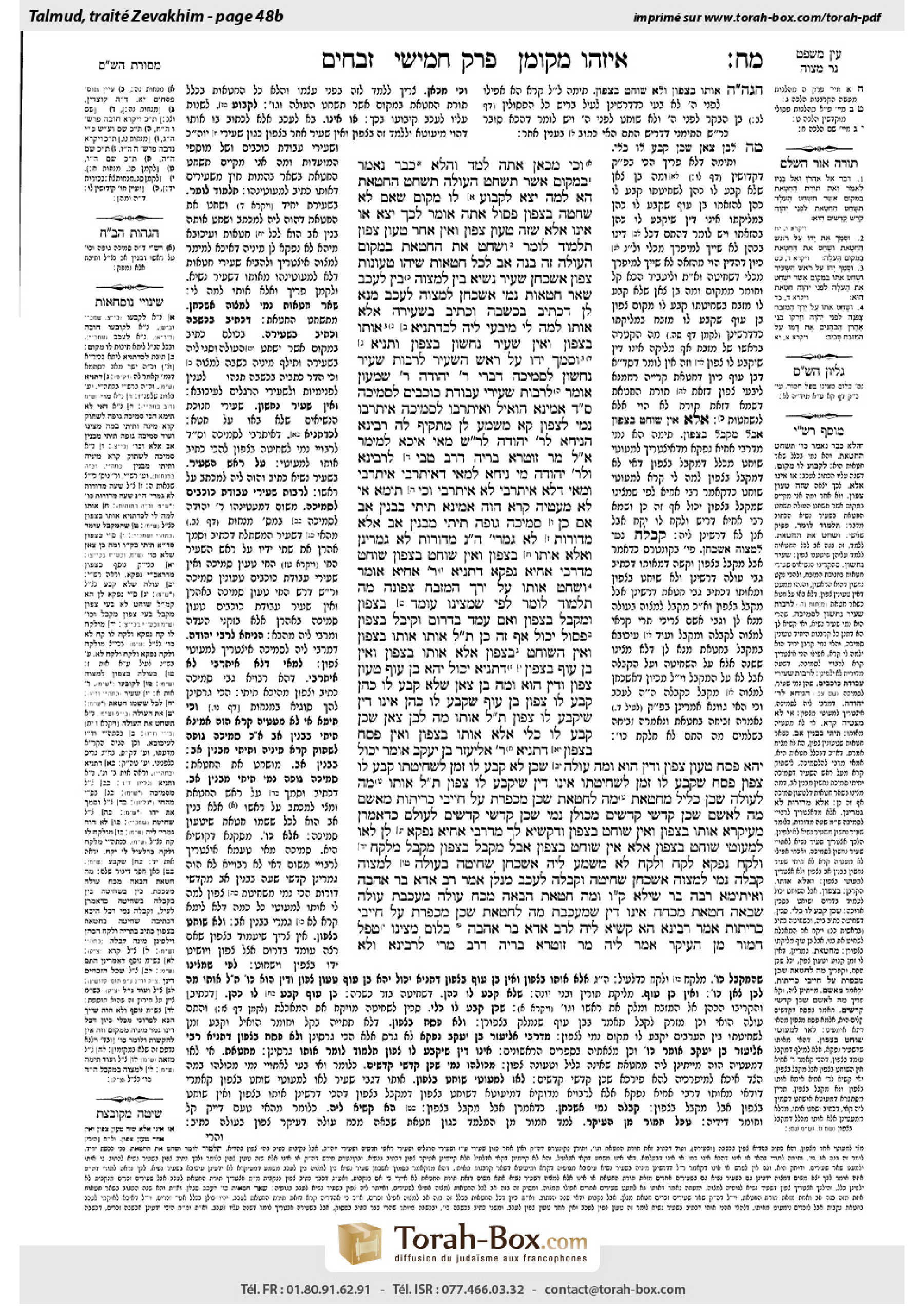
Zevachim 48b: Talmud study for Daf Yomi
Daf Yomi is the daily study of one Talmud folio. Explore 37 tractates with scans, Hebrew text, Sefaria English and AI-generated French translations where annotated.
Passage selection and English or AI-generated French translation are available where the scan has annotations. Daf Study is independent of Torah-Box and Sefaria.
Browse Zevachim · זבחים · All tractatesZevachim 48b text and translations
This page of Zevachim includes the Aramaic text, an English translation and an AI-generated French translation, alongside the scan above.
זבחים מ״ח ב · Aramaic and Hebrew text
וְכִי מִכָּאן אַתָּה לָמֵד?! וַהֲלֹא כְּבָר נֶאֱמַר: ״בִּמְקוֹם אֲשֶׁר תִּשָּׁחֵט הָעוֹלָה תִּשָּׁחֵט הַחַטָּאת״! הָא לְמָה יָצָא – לִקְבּוֹעַ לוֹ מָקוֹם, שֶׁאִם לֹא שְׁחָטָהּ בַּצָּפוֹן פָּסוּל.
אַתָּה אוֹמֵר לְכָךְ יָצָא; אוֹ אֵינוֹ אֶלָּא שֶׁזֶּה טָעוּן צָפוֹן, וְאֵין אַחֵר טָעוּן צָפוֹן? תַּלְמוּד לוֹמַר: ״וְשָׁחַט אֶת הַחַטָּאת בִּמְקוֹם הָעוֹלָה״ – זֶה בָּנָה אָב לְכׇל חַטָּאוֹת, שֶׁיְּהוּ טְעוּנוֹת צָפוֹן.
אַשְׁכְּחַן שְׂעִיר נָשִׂיא – בֵּין לְמִצְוָה בֵּין לְעַכֵּב; שְׁאָר חַטָּאוֹת נָמֵי – אַשְׁכְּחַן לְמִצְוָה; לְעַכֵּב מְנָא לַן?
דִּכְתִיב בְּכִשְׂבָּה וּכְתִיב בִּשְׂעִירָה.
אֶלָּא ״אוֹתוֹ״ לְמָה לִי?
מִיבְּעֵי לֵיהּ לְכִדְתַנְיָא: ״אוֹתוֹ בַּצָּפוֹן״ – וְאֵין שְׂעִיר נַחְשׁוֹן בַּצָּפוֹן.
וְתַנְיָא: ״וְסָמַךְ יָדוֹ עַל רֹאשׁ הַשָּׂעִיר״ – לְרַבּוֹת שָׂעִיר נַחְשׁוֹן לִסְמִיכָה. דִּבְרֵי רַבִּי יְהוּדָה. רַבִּי שִׁמְעוֹן אוֹמֵר: לְרַבּוֹת שְׂעִירֵי עֲבוֹדָה זָרָה לִסְמִיכָה.
סָלְקָא דַּעְתָּךְ אָמֵינָא: הוֹאִיל וְאִיתְרַבּוֹ לִסְמִיכָה – אִיתְרַבּוֹ נָמֵי לְצָפוֹן; קָא מַשְׁמַע לַן.
מַתְקֵיף לַהּ רָבִינָא: הָנִיחָא לְרַבִּי יְהוּדָה; לְרַבִּי שִׁמְעוֹן מַאי אִיכָּא לְמֵימַר?
אֲמַר לֵיהּ מָר זוּטְרָא בְּרֵיהּ דְּרַב טָבִי לְרָבִינָא: וּלְרַבִּי יְהוּדָה מִי נִיחָא?! לְמַאי דְּאִיתְרַבִּי אִיתְרַבִּי, וּמַאי דְּלָא אִיתְרַבִּי לָא אִיתְרַבִּי!
וְכִי תֵּימָא, אִי לָא מַעֲטֵיהּ קְרָא – הֲוָה אָמֵינָא תֵּיתֵי בְּבִנְיַן אָב; אִם כֵּן, סְמִיכָה גּוּפַהּ תֵּיתֵי מִבִּנְיַן אָב! אֶלָּא מִדּוֹרוֹת לָא גָּמְרִינַן; הָכָא נָמֵי מִדּוֹרוֹת לָא גָּמְרִינַן!
וְאֶלָּא ״אוֹתוֹ בַּצָּפוֹן״ – וְאֵין שׁוֹחֵט בַּצָּפוֹן?
שׁוֹחֵט – מִדְּרַבִּי אַחִיָּא נָפְקָא! דְּתַנְיָא, רַבִּי אַחִיָּא אוֹמֵר: ״וְשָׁחַט אֹתוֹ עַל יֶרֶךְ הַמִּזְבֵּחַ צָפוֹנָה״ – מָה תַּלְמוּד לוֹמַר?
לְפִי שֶׁמָּצִינוּ עוֹמֵד בַּצָּפוֹן וּמְקַבֵּל בַּצָּפוֹן, וְאִם עָמַד בַּדָּרוֹם וְקִיבֵּל בַּצָּפוֹן פָּסוּל; יָכוֹל אַף זֶה כֵּן? תַּלְמוּד לוֹמַר ״אֹתוֹ״ – אוֹתוֹ בַּצָּפוֹן, וְאֵין הַשּׁוֹחֵט בַּצָּפוֹן.
אֶלָּא ״אוֹתוֹ בַּצָּפוֹן״ – וְאֵין בֶּן עוֹף בַּצָּפוֹן. דְּתַנְיָא: יָכוֹל יְהֵא בֶּן עוֹף טָעוּן צָפוֹן? וְדִין הוּא; וּמָה בֶּן צֹאן, שֶׁלֹּא קָבַע לוֹ כֹּהֵן – קָבַע לוֹ צָפוֹן; בֶּן עוֹף, שֶׁקָּבַע לוֹ כֹּהֵן – אֵינוֹ דִּין שֶׁיִּקְבַּע לוֹ צָפוֹן? תַּלְמוּד לוֹמַר: ״אֹתוֹ״.
מָה לְבֶן צֹאן, שֶׁכֵּן קָבַע לוֹ כְּלִי!
אֶלָּא, ״אוֹתוֹ בַּצָּפוֹן״ – וְאֵין פֶּסַח בַּצָּפוֹן.
דְּתַנְיָא, רַבִּי אֱלִיעֶזֶר בֶּן יַעֲקֹב אוֹמֵר: יָכוֹל יְהֵא פֶּסַח טָעוּן צָפוֹן? וְדִין הוּא; וּמָה עוֹלָה, שֶׁכֵּן לָא קָבַע לוֹ זְמַן לִשְׁחִיטָתוֹ – קָבַע לוֹ צָפוֹן; פֶּסַח, שֶׁקָּבַע לוֹ זְמַן לִשְׁחִיטָתוֹ – אֵינוֹ דִּין שֶׁיִּקְבַּע לוֹ צָפוֹן? תַּלְמוּד לוֹמַר: ״אֹתוֹ״.
מָה לְעוֹלָה, שֶׁכֵּן כָּלִיל!
מֵחַטָּאת – מָה לְחַטָּאת, שֶׁכֵּן מְכַפֶּרֶת עַל חַיָּיבֵי כָרֵיתוֹת!
מֵאָשָׁם – מָה לְאָשָׁם, שֶׁכֵּן קׇדְשֵׁי קָדָשִׁים! מִכּוּלָּן נָמֵי – שֶׁכֵּן קׇדְשֵׁי קָדָשִׁים!
לְעוֹלָם כְּדַאֲמַרַן מֵעִיקָּרָא: ״אוֹתוֹ בַּצָּפוֹן״ – וְאֵין שׁוֹחֵט בַּצָּפוֹן. וּדְקַשְׁיָא לָךְ מִדְּרַבִּי אַחִיָּא נָפְקָא לַן – לָאו לְמַעוֹטֵי שׁוֹחֵט בַּצָּפוֹן; אֶלָּא אֵין שׁוֹחֵט בַּצָּפוֹן, אֲבָל מְקַבֵּל בַּצָּפוֹן.
מְקַבֵּל מִ״לָּקַח״–״וְלָקַח״ נָפְקָא! ״לָקַח״–״וְלָקַח״ לָא מַשְׁמַע לֵיהּ.
אַשְׁכְּחַן שְׁחִיטָה בְּעוֹלָה – לְמִצְוָה, קַבָּלָה נָמֵי – לְמִצְוָה אַשְׁכְּחַן; שְׁחִיטָה וְקַבָּלָה לְעַכֵּב מְנָלַן?
אָמַר רַב אַדָּא בַּר אַהֲבָה, וְאִיתֵּימָא רַבָּה בַּר שֵׁילָא: קַל וָחוֹמֶר; וּמָה חַטָּאת, הַבָּאָה מִכֹּחַ עוֹלָה – מְעַכֶּבֶת; עוֹלָה, שֶׁבָּאָה חַטָּאת מִכֹּחָהּ – אֵינוֹ דִּין שֶׁמְּעַכֶּבֶת?
מָה לְחַטָּאת, שֶׁכֵּן מְכַפֶּרֶת עַל חַיָּיבֵי כָרֵיתוֹת!
אָמַר רָבִינָא: הָא קַשְׁיָא לֵיהּ לְרַב אַדָּא בַּר אַהֲבָה – כְּלוּם מָצִינוּ טָפֵל חָמוּר מִן הָעִיקָּר?!
אֲמַר לֵיהּ מָר זוּטְרָא בְּרֵיהּ דְּרַב מָרִי לְרָבִינָא: וְלָא?!
Zevachim 48b · English translation
The Gemara asks: And do you learn this halakha from here? But isn’t it already stated: “Speak to Aaron and to his sons, saying: This is the law of the sin offering: In the place where the burnt offering is slaughtered shall the sin offering be slaughtered before the Lord; it is most holy” (Leviticus 6:18)? If so, to what purpose was this singled out? Why did the Torah state explicitly that the sin offering of the king requires slaughter in the north? The Gemara answers: To fix a place for it, that this is the only place where a sin offering may be slaughtered, teaching that if it was not slaughtered in the north of the Temple courtyard, the offering is disqualified even after the fact.
The Gemara asks: Do you say that it is singled out for this purpose, to teach that even after the fact a sin offering slaughtered anywhere other than in the north is disqualified? Or perhaps it is only to teach that this goat sin offering requires slaughter in the north but no other goat sin offering requires slaughter in the north. The Gemara answers: The verse states: “And he shall place his hand upon the head of the sin offering, and slaughter the sin offering in the place of the burnt offering” (Leviticus 4:29). This established a paradigm for all sin offerings, teaching that they require slaughter in the north.
The Gemara continues its explanation: We have found that the Torah writes with regard to the goat sin offering of a king that it requires slaughter in the north both to perform the mitzva in the optimal manner and to disqualify the offering even after the fact. We have also found with regard to the other sin offerings that the Torah states that to perform the mitzva in the optimal manner they must be slaughtered in the north of the Temple courtyard. From where do we derive the halakha to disqualify other sin offerings if they were not slaughtered in the north?
The Gemara explains: As it is written with regard to a lamb sin offering that it must be slaughtered in the north: “And slaughter the sin offering in the place of the burnt offering” (Leviticus 4:33) and it is also written with regard to a she-goat sin offering: “And he shall place his hand upon the head of the sin offering, and slaughter it for a sin offering in the place of the burnt offering” (Leviticus 4:29). This repetition teaches that a sin offering is disqualified if it is not slaughtered in the north.
§ Having derived from these verses that all sin offerings are disqualified if they are slaughtered not in the north, the Gemara questions its earlier explanation. Rather, why do I need the term “it” stated with regard to the sin offering of a king in the verse: “And he shall place his hand upon the head of the goat, and slaughter it in the place where they slaughter the burnt offering before the Lord; it is a sin offering” (Leviticus 4:24)?
The Gemara answers: It is required for that which is taught in a baraita: It, the goat sin offering of a king, is slaughtered in the north of the Tabernacle, but the goat offered by Nahshon and the other princes was not slaughtered in the north. Nahshon was the prince of the tribe of Judah. He, along with all the other princes of the tribes, brought offerings to inaugurate the altar and the Tabernacle, as recorded in the Torah (Numbers, chapter 7). Although the offerings were classified as sin offerings because they shared some characteristics of sin offerings, they were not brought to atone for any particular sin. Therefore, the term “it” teaches that the offerings of the princes did not require slaughter in the north.
And the reason that it is necessary for the Torah to exclude Nahshon’s sin offering from the requirement of slaughter in the north is because it is taught in a baraita: The verse states with regard to the sin offering of a king: “And he shall place his hand upon the head of the goat, and slaughter it in the place where they slaughter the burnt offering before the Lord; it is a sin offering” (Leviticus 4:24). The verse could have stated: Upon its head. The reason it adds “of the goat” is to include the goat brought as a sin offering by Nahshon in the requirement of placing hands on the head of an offering. This is the statement of Rabbi Yehuda. Rabbi Shimon says: The term “of the goat” serves to include the goats brought as sin offerings for communal idol worship in the requirement of placing hands on the head of an offering.
The Gemara explains: It might enter your mind to say that since the sin offerings of the princes are included in the requirement of placing hands, they are also included in the requirement of being slaughtered in the north. Therefore, the term “it” teaches us that for the goat brought as a sin offering by Nahshon and the other princes there was no requirement of slaughter in the north.
Ravina objects to this interpretation: This works out well according to the opinion of Rabbi Yehuda, who says that the offering of Nahshon required him to place his hands on the head of the animal. But according to the opinion of Rabbi Shimon, what is there to say? Why should the Torah write the term “it,” since there is no reason to assume that it would require slaughter in the north?
Mar Zutra, son of Rav Tavi, said to Ravina: And according to the opinion of Rabbi Yehuda, does it work out well? Why is it necessary for the Torah to specifically exclude the offerings of the princes from the requirement of slaughter in the north? Why not say that for that for which it was included, i.e., placing hands on the head of an animal, it was included, and for that which it was not included, i.e., slaughter in the north, it was not included.
And if you would say that if the verse had not excluded the offerings of the princes I would say that one could derive the requirement for slaughter in the north via a paradigm from all other sin offerings, if so, one could also derive the requirement for placing hands on the head of an animal itself via the same paradigm. Rather, the reason that the requirement of placing hands cannot be derived via a paradigm is that we do not learn the requirements of the sin offering of Nahshon, which was only for the time of the inauguration of the Tabernacle alone, from the requirement of sin offerings applicable to all generations. So too, the requirement of slaughter in the north cannot be derived via a paradigm because we do not learn the requirements of the sin offering of Nahshon from the requirement of sin offerings applicable to all generations.
Rather, the term “it” stated with regard to the sin offering of a king serves to teach that it must be slaughtered in the north of the Temple courtyard, but the one who slaughters it does not need to stand in the north when he slaughters it.
The Gemara challenges this: The halakha of the one who slaughters the offering has already been derived from the statement of Rabbi Aḥiyya, as it is taught in a baraita: Rabbi Aḥiyya says: The verse states with regard to the burnt offering: “And he shall slaughter it on the side of the altar northward before the Lord” (Leviticus 1:11). Why must the verse state the exclusionary term “it”?
He explains: Since we have found that the priest stands in the north and collects the blood from the neck of the animal in the north, and if he stood in the south and collected the blood in the north the offering is disqualified, one might have thought that this is so also with regard to this one who slaughters the offering. Therefore, the verse states: “And he shall slaughter it,” to teach that it, the animal, must be in the north, but the one who slaughters it is not required to be standing in the north of the Temple courtyard when he slaughters the animal. Therefore, the question must be addressed: What is derived from the exclusionary term “it” stated with regard to the sin offering of a king?
The Gemara explains: Rather, the term “it” stated with regard to the sin offering of a king serves to teach that it, a goat brought as a sin offering, must be slaughtered in the north, but a young bird brought as an offering does not need to be killed in the north. This is as it is taught in a baraita: One might have thought that a male bird requires pinching of the nape in the north of the Temple courtyard. And this can be derived through a logical inference: Just as a young sheep brought as a burnt offering is an offering for which the Torah did not fix that its slaughter must be performed by a priest but nevertheless fixed that its slaughter must be in the north, with regard to a young bird brought as an offering, for which the Torah did fix that its killing must be performed by a priest, is it not logical that the Torah should also fix its slaughter in the north? Therefore, the verse states “it,” to exclude a male bird from the requirement of being killed in the north.
The Gemara questions the logical inference. One cannot derive the halakha of a bird offering from the halakha of a sheep offering, as what is notable about a young sheep offering? It is notable in that the Torah fixed the requirement that it be slaughtered with a utensil, i.e., a knife. A bird, by contrast, is killed by the priest using his fingernail. Therefore, the term “it” cannot serve to counter this derivation.
The Gemara explains: Rather, the term “it” stated with regard to the sin offering of a king serves to teach that it, the goat of the king, is slaughtered in the north, but the Paschal offering is not slaughtered in the north.
As it is taught in a baraita: Rabbi Eliezer ben Yaakov says: One might have thought that a Paschal offering requires slaughter in the north. And this can be derived through a logical inference: Just as a burnt offering is an offering for which the Torah did not fix a time for its slaughter but fixed that it requires slaughter in the north, with regard to a Paschal offering, for which the Torah fixed a time for its slaughter, as it must be slaughtered in the afternoon of the fourteenth day of Nisan, is it not logical that the Torah would fix that it must be slaughtered in the north? Therefore, the verse states “it,” to exclude the Paschal offering from the requirement of slaughter in the north.
The Gemara questions the logical inference. One cannot derive the halakha of a Paschal offering from the halakha of a burnt offering, as what is notable about a burnt offering? It is notable in that the Torah teaches that it is entirely burned on the altar. This is not so with regard to a Paschal offering.
The Gemara continues: If you would suggest a logical inference from the halakha of a sin offering, which is not entirely burned upon the altar but is slaughtered only in the north, this too can be refuted. As what is notable about a sin offering? It is notable in that it atones for those sins that render one liable for punishment by karet, which is not so with regard to a Paschal offering.
The Gemara continues: If you would suggest a logical inference from the halakha of a guilt offering, which is not entirely burned, which does not atone for those sins punishable by karet, and which is slaughtered only in the north, this too can be refuted. As what is notable about a guilt offering? It is notable in that it has the status of an offering of the most sacred order, which is not so with regard to a Paschal offering. The Gemara adds: Having noted this distinction between a guilt offering and a Paschal offering, one can say that for all of the three offerings as well, the halakha of a Paschal offering cannot be derived from them, since they all have the status of offerings of the most sacred order.
The Gemara returns to the earlier inference: Actually, the term “it” teaches as we said initially: It, i.e., the animal, must be standing in the north, but the one who slaughters the animal does not have to stand in the north. And that which is difficult for you, that we derive this halakha from the statement of Rabbi Aḥiyya, is in fact not difficult. The derivation from the term “it” is not to exclude one who slaughters from the requirement to slaughter in the north, since that halakha is known already from the statement of Rabbi Aḥiyya. Rather, the derivation is that it is only one who slaughters the animal who does not have to stand in the north, but by inference, the one who collects the blood from the neck of the animal must stand in the north.
The Gemara questions this inference: The halakha that the one who collects the blood from the neck of the animal must stand in the north is derived from the fact that the Torah could have written: The priest shall take, and instead writes: “And the priest shall take” [velakaḥ] (Leviticus 4:34), which may be read as: He will take himself [lo yikaḥ], as explained on the previous amud. The Gemara explains: This tanna does not learn anything from this distinction between: The priest shall take, and: “And the priest shall take.” He does not agree with this derivation, and therefore he must derive the requirement to collect the blood while standing in the north from a different verse.
§ The Gemara asks: We found a source for the requirement of slaughter in the north with regard to a burnt offering in order to perform the mitzva in the optimal manner. We also found a source for the requirement of collecting the blood while standing in the north in order to perform the mitzva in the optimal manner. From where do we derive that slaughter and collection of the blood are disqualified if they are not performed in the north?
Rav Adda bar Ahava says, and some say it was Rabba bar Sheila who says: It is derived via an a fortiori inference: Just as the halakha that the slaughter and blood collection of a sin offering be performed in the north comes by virtue of a comparison to the halakha of a burnt offering, as the verse states: “And slaughter the sin offering in the place of the burnt offering” (Leviticus 4:29), yet if the animal was not slaughtered or its blood was not collected in the north it disqualifies the offering, with regard to the burnt offering itself, as the halakha that the slaughter and blood collection of a sin offering be in the north comes by virtue of it, is it not logical that if it was not slaughtered or its blood was not collected in the north, this should disqualify the offering?
The Gemara rejects this logical inference: What is notable about a sin offering? It is notable in that it atones for those sins that render one liable for punishment by karet, which is not so with regard to a burnt offering.
Ravina said: This is what is difficult for Rav Adda bar Ahava. In other words, regardless of the notable characteristic of a sin offering, he still is of the opinion that his logical inference stands. Have we ever found that a secondary prohibition is more stringent than a primary prohibition? Since the halakha of a sin offering is derived via a comparison to the halakha of a burnt offering, the former cannot have stringencies that the latter lacks.
Mar Zutra, son of Rav Mari, said to Ravina: But have we not found a secondary prohibition that is more stringent than the primary one?
Zevachim 48b · Traduction française (IA)
La Guemara demande : Est-ce donc d’ici que l’on apprend cette halakha ? Pourtant, il est déjà dit : « Parle à Aaron et à ses fils, en disant : Voici la loi du sacrifice expiatoire : à l’endroit où l’on égorge l’holocauste, on égorgera le sacrifice expiatoire devant l’Éternel ; il est très saint » (Lévitique 6,18). À quoi bon, dès lors, avoir distingué ce cas ? Pourquoi la Torah a-t-elle précisé que le sacrifice expiatoire du roi doit être égorgé au nord ? La Guemara répond : Pour lui fixer un emplacement, c’est-à-dire enseigner que c’est le seul endroit où un sacrifice expiatoire peut être égorgé ; ainsi, s’il n’a pas été égorgé au nord de la cour du Temple, l’offrande est invalide même après coup.
La Guemara demande : Dis-tu que ce cas a été distingué à cette fin, pour enseigner que même après coup, un sacrifice expiatoire égorgé ailleurs qu’au nord est invalide ? Ou peut-être est-ce seulement pour enseigner que ce sacrifice expiatoire de bouc doit être égorgé au nord, mais qu’aucun autre sacrifice expiatoire de bouc n’a besoin de l’être ? La Guemara répond : Le verset dit : « Il posera sa main sur la tête du sacrifice expiatoire, et on égorgera le sacrifice expiatoire à l’endroit de l’holocauste » (Lévitique 4,29). Cela établit un modèle pour tous les sacrifices expiatoires, enseignant qu’ils doivent être égorgés au nord.
La Guemara poursuit son explication : Nous avons établi que, concernant le sacrifice expiatoire de bouc du roi, la Torah indique qu’il doit être égorgé au nord à la fois pour accomplir la mitsva de la manière optimale et pour rendre l’offrande invalide même après coup. Nous avons également établi que, concernant les autres sacrifices expiatoires, la Torah enseigne qu’ils doivent être égorgés au nord de la cour du Temple pour accomplir la mitsva de la manière optimale. D’où déduit-on la halakha selon laquelle les autres sacrifices expiatoires sont invalides s’ils n’ont pas été égorgés au nord ?
La Guemara explique : Il est écrit, au sujet du sacrifice expiatoire d’agneau, qu’il doit être égorgé au nord : « On égorgera le sacrifice expiatoire à l’endroit de l’holocauste » (Lévitique 4,33), et il est aussi écrit, au sujet du sacrifice expiatoire de chèvre : « Il posera sa main sur la tête du sacrifice expiatoire, et on l’égorgera comme sacrifice expiatoire à l’endroit de l’holocauste » (Lévitique 4,29). Cette répétition enseigne qu’un sacrifice expiatoire est invalide s’il n’est pas égorgé au nord.
§ Puisqu’on a déduit de ces versets que tous les sacrifices expiatoires sont invalides s’ils sont égorgés ailleurs qu’au nord, la Guemara remet en question son explication précédente. Dès lors, pourquoi le terme « le » est-il nécessaire au sujet du sacrifice expiatoire du roi, dans le verset : « Il posera sa main sur la tête du bouc, et l’égorgera à l’endroit où l’on égorge l’holocauste devant l’Éternel ; c’est un sacrifice expiatoire » (Lévitique 4,24) ?
La Guemara répond : Cela est nécessaire pour enseigner ce qui suit dans une baraïta : Lui, le sacrifice expiatoire de bouc du roi, est égorgé au nord du Tabernacle, mais le bouc offert par Nahshon et les autres princes n’était pas égorgé au nord. Nahshon était le prince de la tribu de Juda. Lui et tous les autres princes des tribus apportèrent des offrandes pour inaugurer l’autel et le Tabernacle, comme le rapporte la Torah (Nombres, chapitre 7). Bien que ces offrandes fussent classées parmi les sacrifices expiatoires parce qu’elles en partageaient certaines caractéristiques, elles n’étaient pas offertes pour expier une faute particulière. Le terme « le » enseigne donc que les offrandes des princes n’exigeaient pas d’être égorgées au nord.
Et si la Torah doit exclure le sacrifice expiatoire de Nahshon de l’obligation d’être égorgé au nord, c’est parce qu’une baraïta enseigne : Au sujet du sacrifice expiatoire du roi, le verset dit : « Il posera sa main sur la tête du bouc, et l’égorgera à l’endroit où l’on égorge l’holocauste devant l’Éternel ; c’est un sacrifice expiatoire » (Lévitique 4,24). Le verset aurait pu dire : « Sur sa tête ». La raison pour laquelle il ajoute « du bouc » est d’inclure le bouc apporté par Nahshon comme sacrifice expiatoire dans l’obligation d’imposer les mains sur la tête d’une offrande. Telle est la déclaration de Rabbi Yehuda. Rabbi Shimon dit : Le terme « du bouc » sert à inclure les boucs apportés comme sacrifices expiatoires pour l’idolâtrie collective dans l’obligation d’imposer les mains sur la tête d’une offrande.
La Guemara explique : On aurait pu penser que, puisque les sacrifices expiatoires des princes sont inclus dans l’obligation d’imposer les mains, ils sont également inclus dans l’obligation d’être égorgés au nord. Le terme « le » nous enseigne donc que le bouc apporté comme sacrifice expiatoire par Nahshon et les autres princes n’avait pas à être égorgé au nord.
Ravina objecte à cette interprétation : Cela tient selon l’opinion de Rabbi Yehuda, qui dit que Nahshon devait imposer les mains sur la tête de l’animal. Mais, selon l’opinion de Rabbi Shimon, que peut-on répondre ? Pourquoi la Torah aurait-elle écrit le terme « le », puisqu’il n’y a aucune raison de supposer que l’offrande devait être égorgée au nord ?
Mar Zutra, fils de Rav Tavi, dit à Ravina : Et selon l’opinion de Rabbi Yehuda, cela tient-il ? Pourquoi la Torah doit-elle exclure expressément les offrandes des princes de l’obligation d’être égorgées au nord ? Ne pourrait-on pas dire que, là où elles ont été incluses, c’est-à-dire pour l’imposition des mains sur la tête d’un animal, elles ont été incluses, mais que là où elles ne l’ont pas été, c’est-à-dire pour l’égorgement au nord, elles ne l’ont pas été ?
Et si tu dis que, sans l’exclusion des offrandes des princes par le verset, on aurait déduit l’obligation d’égorger au nord par analogie avec tous les autres sacrifices expiatoires, alors on aurait aussi pu déduire par la même analogie l’obligation d’imposer les mains sur la tête de l’animal. Au contraire, si l’on ne peut pas déduire l’obligation d’imposer les mains par analogie, c’est parce que nous ne déduisons pas les règles du sacrifice expiatoire de Nahshon, qui ne concernait que l’inauguration du Tabernacle, des règles des sacrifices expiatoires applicables à toutes les générations. De même, on ne peut pas déduire l’obligation d’égorger au nord par analogie, car nous ne déduisons pas les règles du sacrifice expiatoire de Nahshon de celles des sacrifices expiatoires applicables à toutes les générations.
Au contraire, le terme « le » au sujet du sacrifice expiatoire du roi enseigne qu’il doit être égorgé au nord de la cour du Temple, mais que celui qui l’égorge n’a pas besoin de se tenir au nord au moment de l’égorgement.
La Guemara conteste cela : La halakha concernant celui qui égorge l’offrande a déjà été déduite de la déclaration de Rabbi Aḥiyya, comme l’enseigne une baraïta : Rabbi Aḥiyya dit : Au sujet de l’holocauste, le verset dit : « On l’égorgera sur le côté nord de l’autel, devant l’Éternel » (Lévitique 1,11). Pourquoi le verset emploie-t-il le terme exclusif « le » ?
Il explique : Nous avons établi que le prêtre se tient au nord et recueille le sang du cou de l’animal au nord ; s’il se tenait au sud et recueillait le sang au nord, l’offrande serait invalide. On aurait pu penser que la même règle s’applique aussi à celui qui égorge l’offrande. Le verset dit donc : « On l’égorgera », pour enseigner que l’animal, lui, doit se trouver au nord, mais que celui qui l’égorge n’est pas tenu de se tenir au nord de la cour du Temple lorsqu’il égorge l’animal. Il faut donc répondre à la question : que déduit-on du terme exclusif « le » au sujet du sacrifice expiatoire du roi ?
La Guemara explique : Au contraire, le terme « le » au sujet du sacrifice expiatoire du roi enseigne que lui, le bouc apporté comme sacrifice expiatoire, doit être égorgé au nord, mais qu’un jeune oiseau offert en sacrifice n’a pas besoin d’être mis à mort au nord. C’est ce qu’enseigne une baraïta : On aurait pu penser qu’un oiseau mâle doit subir la mélika au nord de la cour du Temple. On pourrait le déduire par raisonnement a fortiori : de même qu’un jeune mouton offert en holocauste est une offrande pour laquelle la Torah n’a pas fixé que l’égorgement devait être accompli par un prêtre, mais a néanmoins fixé qu’il devait avoir lieu au nord, à plus forte raison, concernant un jeune oiseau offert en sacrifice, pour lequel la Torah a fixé que la mise à mort devait être accomplie par un prêtre, n’est-il pas logique que la Torah fixe aussi qu’elle doit avoir lieu au nord ? Le verset dit donc « le », pour exclure l’oiseau mâle de l’obligation d’être mis à mort au nord.
La Guemara remet en question ce raisonnement a fortiori. On ne peut pas déduire la halakha d’une offrande d’oiseau de celle d’une offrande de mouton, car qu’est-ce qui caractérise l’offrande d’un jeune mouton ? La Torah a fixé qu’il doit être égorgé à l’aide d’un ustensile, c’est-à-dire un couteau. L’oiseau, en revanche, est mis à mort par le prêtre avec son ongle. Le terme « le » ne peut donc pas servir à réfuter cette déduction.
La Guemara explique : Au contraire, le terme « le » au sujet du sacrifice expiatoire du roi enseigne que lui, le bouc du roi, doit être égorgé au nord, mais que le sacrifice pascal n’a pas à être égorgé au nord.
Comme l’enseigne une baraïta : Rabbi Eliezer ben Yaakov dit : On aurait pu penser que le sacrifice pascal doit être égorgé au nord. On pourrait le déduire par raisonnement a fortiori : de même qu’un holocauste est une offrande pour laquelle la Torah n’a pas fixé de moment pour l’égorgement, mais a fixé qu’il doit être égorgé au nord, à plus forte raison, concernant le sacrifice pascal, pour lequel la Torah a fixé un moment pour l’égorgement, puisqu’il doit être égorgé l’après-midi du quatorzième jour de Nisan, n’est-il pas logique que la Torah fixe qu’il doit être égorgé au nord ? Le verset dit donc « le », pour exclure le sacrifice pascal de l’obligation d’être égorgé au nord.
La Guemara remet en question ce raisonnement a fortiori. On ne peut pas déduire la halakha du sacrifice pascal de celle de l’holocauste, car qu’est-ce qui caractérise l’holocauste ? La Torah enseigne qu’il est entièrement brûlé sur l’autel. Il n’en va pas de même pour le sacrifice pascal.
La Guemara poursuit : Si tu proposes de déduire cette halakha de celle du sacrifice expiatoire, qui n’est pas entièrement brûlé sur l’autel mais doit être égorgé uniquement au nord, cette déduction peut elle aussi être réfutée. Car qu’est-ce qui caractérise le sacrifice expiatoire ? Il expie les fautes passibles de la peine de karet, ce qui n’est pas le cas du sacrifice pascal.
La Guemara poursuit : Si tu proposes de déduire cette halakha de celle du sacrifice de culpabilité, qui n’est pas entièrement brûlé, n’expie pas les fautes passibles de la peine de karet et doit être égorgé uniquement au nord, cette déduction peut elle aussi être réfutée. Car qu’est-ce qui caractérise le sacrifice de culpabilité ? Il a le statut d’une offrande de sainteté supérieure, ce qui n’est pas le cas du sacrifice pascal. La Guemara ajoute : Puisqu’on a relevé cette distinction entre le sacrifice de culpabilité et le sacrifice pascal, on peut également dire qu’on ne peut déduire la halakha du sacrifice pascal d’aucune des trois autres offrandes, car elles ont toutes le statut d’offrandes de sainteté supérieure.
La Guemara revient à la déduction précédente : En réalité, le terme « le » enseigne ce que nous avons dit au début : lui, c’est-à-dire l’animal, doit se tenir au nord, mais celui qui l’égorge n’a pas à se tenir au nord. Et ce qui te pose difficulté — le fait que nous déduisions cette halakha de la déclaration de Rabbi Aḥiyya — n’est en réalité pas difficile. La déduction du terme « le » ne vise pas à exclure celui qui égorge de l’obligation d’égorger au nord, puisque cette halakha est déjà connue par la déclaration de Rabbi Aḥiyya. Elle enseigne plutôt que seul celui qui égorge l’animal n’a pas à se tenir au nord ; on en déduit que celui qui recueille le sang du cou de l’animal doit, lui, se tenir au nord.
La Guemara met en question cette déduction : La halakha selon laquelle celui qui recueille le sang du cou de l’animal doit se tenir au nord se déduit du fait que la Torah aurait pu écrire : « Le prêtre prendra », mais écrit plutôt : « Et le prêtre prendra » [velakaḥ] (Lévitique 4,34), ce qui peut se lire : « Il prendra lui-même » [lo yikaḥ], comme cela a été expliqué au daf précédent. La Guemara explique : Ce tanna ne déduit rien de cette distinction entre « Le prêtre prendra » et « Et le prêtre prendra ». Il n’admet pas cette déduction ; il doit donc déduire d’un autre verset l’obligation de recueillir le sang en se tenant au nord.
§ La Guemara demande : Nous avons trouvé une source établissant que, pour accomplir la mitsva de la manière optimale, l’égorgement d’un holocauste doit avoir lieu au nord. Nous avons également trouvé une source établissant que, pour accomplir la mitsva de la manière optimale, le sang doit être recueilli par quelqu’un qui se tient au nord. D’où déduit-on que l’égorgement et le recueil du sang sont invalides s’ils ne sont pas accomplis au nord ?
Rav Adda bar Ahava dit, et certains disent que c’est Rabba bar Sheila qui le dit : Cela se déduit par raisonnement a fortiori. De même que, pour un sacrifice expiatoire, l’obligation d’égorger l’animal et de recueillir son sang au nord découle de la comparaison avec l’holocauste, comme le dit le verset : « On égorgera le sacrifice expiatoire à l’endroit de l’holocauste » (Lévitique 4,29), et que, si l’animal n’a pas été égorgé au nord ou si son sang n’y a pas été recueilli, l’offrande est invalide, à plus forte raison, concernant l’holocauste lui-même — puisque c’est de lui que découle l’obligation d’égorger et de recueillir le sang du sacrifice expiatoire au nord —, n’est-il pas logique que l’offrande soit invalide si elle n’a pas été égorgée au nord ou si son sang n’y a pas été recueilli ?
La Guemara rejette ce raisonnement a fortiori : Qu’est-ce qui caractérise le sacrifice expiatoire ? Il expie les fautes passibles de la peine de karet, ce qui n’est pas le cas de l’holocauste.
Ravina dit : Voilà ce qui pose difficulté à Rav Adda bar Ahava. Autrement dit, malgré la caractéristique particulière du sacrifice expiatoire, il estime toujours que son raisonnement a fortiori tient. A-t-on jamais trouvé qu’une interdiction secondaire soit plus stricte qu’une interdiction principale ? Puisque la halakha du sacrifice expiatoire est déduite par comparaison avec celle de l’holocauste, le premier ne peut pas comporter des exigences plus strictes que le second.
Mar Zutra, fils de Rav Mari, dit à Ravina : Mais n’avons-nous pas trouvé une interdiction secondaire plus stricte que l’interdiction principale ?
Traduction française générée par IA à partir de l’édition anglaise de Sefaria. Vérifie toujours un passage avec le texte source.
Text from Sefaria: William Davidson Edition - Vocalized Aramaic (CC BY NC); William Davidson Edition - English (CC BY NC).