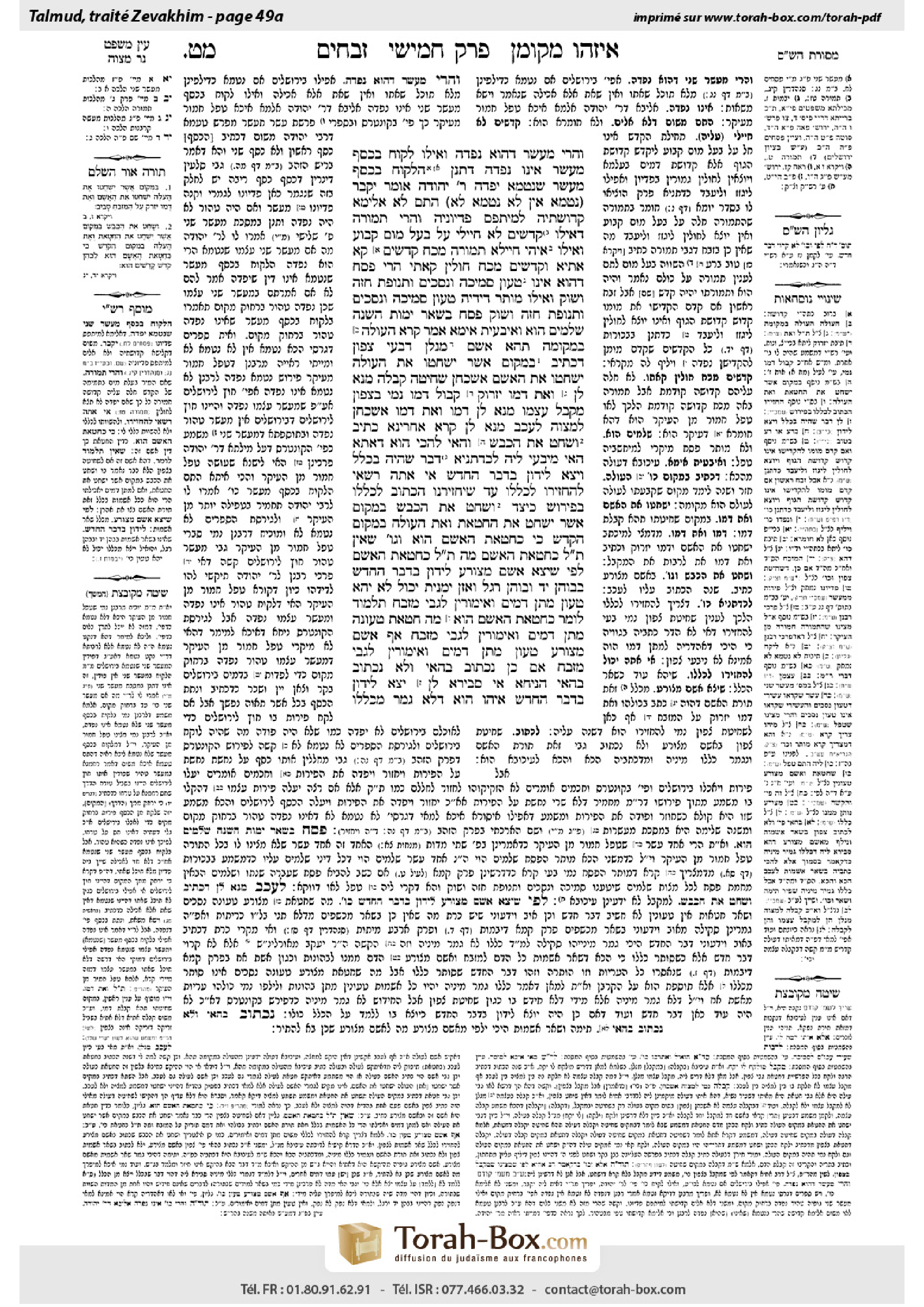
Zevachim 49a: Talmud study for Daf Yomi
Daf Yomi is the daily study of one Talmud folio. Explore 37 tractates with scans, Hebrew text, Sefaria English and AI-generated French translations where annotated.
Passage selection and English or AI-generated French translation are available where the scan has annotations. Daf Study is independent of Torah-Box and Sefaria.
Browse Zevachim · זבחים · All tractatesZevachim 49a text and translations
This page of Zevachim includes the Aramaic text, an English translation and an AI-generated French translation, alongside the scan above.
זבחים מ״ט א · Aramaic and Hebrew text
וַהֲרֵי מַעֲשֵׂר – דְּהוּא נִפְדֶּה, וְאִילּוּ לָקוּחַ בְּכֶסֶף מַעֲשֵׂר אֵינוֹ נִפְדֶּה – דִּתְנַן: הַלָּקוּחַ בְּכֶסֶף מַעֲשֵׂר שֶׁנִּטְמָא – יִפָּדֶה. רַבִּי יְהוּדָה אוֹמֵר: יִקָּבֵר. נִטְמָא אִין, לֹא נִטְמָא לָא!
הָתָם לָא אַלִּימָא קְדוּשָּׁתֵיהּ לְמִיתְפַּס פִּדְיוֹנֵיהּ.
וַהֲרֵי תְּמוּרָה – דְּאִילּוּ קֳדָשִׁים לָא חָיְילִי עַל בַּעַל מוּם קָבוּעַ, וְאִילּוּ אִיהִי חָיְילָא!
תְּמוּרָה מִכֹּחַ קָדָשִׁים קָא אָתְיָא, וְקָדָשִׁים מִכֹּחַ חוּלִּין (קָאָתֵי) [קָאָתוּ].
הֲרֵי פֶּסַח – דְּהוּא אֵינוֹ טָעוּן סְמִיכָה וּנְסָכִים וּתְנוּפַת חָזֶה וָשׁוֹק, וְאִילּוּ מוֹתָר דִּידֵיהּ טָעוּן סְמִיכָה וּנְסָכִים וּתְנוּפַת חָזֶה וָשׁוֹק!
פֶּסַח בִּשְׁאָר יְמוֹת הַשָּׁנָה – שְׁלָמִים הוּא.
וְאִיבָּעֵית אֵימָא, אָמַר קְרָא: ״הָעוֹלָה״ – בִּמְקוֹמָהּ תְּהֵא.
אָשָׁם מְנָלַן דְּבָעֵי צָפוֹן? דִּכְתִיב: ״בִּמְקוֹם אֲשֶׁר יִשְׁחֲטוּ אֶת הָעֹלָה יִשְׁחֲטוּ אֶת הָאָשָׁם״.
אַשְׁכְּחַן שְׁחִיטָה, קַבָּלָה מְנָא לַן? ״וְאֶת דָּמוֹ יִזְרוֹק״ – קִבּוּל דָּמוֹ נָמֵי בַּצָּפוֹן.
מְקַבֵּל עַצְמוֹ מְנָא לַן? ״דָּמוֹ״–״וְאֶת דָּמוֹ״.
אַשְׁכְּחַן לְמִצְוָה, לְעַכֵּב מְנָא לַן? קְרָא אַחֲרִינָא כְּתִיב: ״וְשָׁחַט אֶת הַכֶּבֶשׂ״.
וְהַאי לְהָכִי הוּא דַּאֲתָא?! הַאי מִיבְּעֵי לֵיהּ לְכִדְתַנְיָא: דָּבָר שֶׁהָיָה בַּכְּלָל וְיָצָא לִידּוֹן בְּדָבָר הֶחָדָשׁ, אִי אַתָּה רַשַּׁאי לְהַחְזִירוֹ לִכְלָלוֹ עַד שֶׁיַּחְזִירֶנּוּ הַכָּתוּב לִכְלָלוֹ בְּפֵירוּשׁ.
כֵּיצַד? ״וְשָׁחַט אֶת הַכֶּבֶשׂ בִּמְקוֹם אֲשֶׁר יִשְׁחַט אֶת הַחַטָּאת וְאֶת הָעוֹלָה בִּמְקוֹם הַקֹּדֶשׁ, כִּי כַּחַטָּאת הָאָשָׁם הוּא וְגוֹ׳״ – שֶׁאֵין תַּלְמוּד לוֹמַר ״כַּחַטָּאת הָאָשָׁם״; מָה תַּלְמוּד לוֹמַר ״כַּחַטָּאת הָאָשָׁם״?
לְפִי שֶׁיָּצָא אֲשַׁם מְצוֹרָע לִידּוֹן בְּדָבָר הֶחָדָשׁ – בְּבוֹהֶן יָד וּבוֹהֶן רֶגֶל וְאֹזֶן יְמָנִית; יָכוֹל לֹא יְהֵא טָעוּן מַתַּן דָּמִים וְאֵימוּרִין לְגַבֵּי מִזְבֵּחַ?
תַּלְמוּד לוֹמַר: ״כַּחַטָּאת הָאָשָׁם הוּא״ – מָה חַטָּאת טְעוּנָה מַתַּן דָּמִים וְאֵימוּרִין לְגַבֵּי מִזְבֵּחַ, אַף אֲשַׁם מְצוֹרָע טָעוּן מַתַּן דָּמִים וְאֵימוּרִין לְגַבֵּי מִזְבֵּחַ.
אִם כֵּן, נִכְתּוֹב בְּהַאי וְלָא נִכְתּוֹב בְּהַאי.
הָנִיחָא אִי סְבִירָא לַן יָצָא לִידּוֹן בְּדָבָר הֶחָדָשׁ – אִיהוּ הוּא דְּלָא גָּמַר מִכְּלָלוֹ,
Zevachim 49a · English translation
But there is the case of the second tithe, which may be redeemed, whereas food that is purchased with second-tithe redemption money may not be redeemed. As we learned in a mishna (Ma’aser Sheni 10:10): With regard to food that was purchased with second-tithe money and that then became ritually impure, this ritually impure food must be redeemed with money, with which one must purchase other food. Rabbi Yehuda says: The food must be buried. The Gemara infers from the mishna: If the food purchased with the second-tithe money became impure, yes, it may be redeemed, but if it did not become impure, it may not be redeemed. If so, according to Rabbi Yehuda, the halakha that food purchased with second-tithe money must be buried if it becomes impure is more stringent than the halakha for second-tithe produce itself, which may be redeemed if it becomes impure.
The Gemara answers: There, the reason one may not redeem food that was purchased with second-tithe money and that then became ritually impure is not that the halakha is more stringent. Rather, there is a different reason. Since this food was merely purchased with second-tithe money, its sanctity is not as strong as the tithe itself and is unable to grasp its redemption money. Its status as second tithe is weak, and cannot be transferred to a third item. Consequently, if it becomes impure, according to Rabbi Yehuda it cannot be redeemed for money but must be buried, as an item that one is prohibited to derive benefit from.
Mar Zutra asks: But there is the case of a substitution, as the status of an offering does not take effect with regard to a permanently blemished animal, while consecration performed via substitution does take effect with regard to an animal with a permanent blemish. Although the animal cannot be sacrificed as an offering and must be redeemed, even after its redemption it may not be used for labor and its wool may not be used.
The Gemara answers: The sanctity of a substitution comes by virtue of a consecrated animal; therefore it has a stronger sanctity. But the sanctity of a consecrated animal itself comes by virtue of a non-sacred animal, as there was no consecrated animal by which the owner extended the sanctity to this animal.
Mar Zutra asks: But there is the case of a Paschal offering, as it does not require the placing of hands on its head, or wine libations to accompany the offering, or waving of the breast and thigh. While its remainder, an animal that was designated as a Paschal offering but was not sacrificed at the right time, which is then sacrificed as a peace offering, has more stringent halakhot, because it requires the placing of hands on its head, and wine libations to accompany the offering, and waving of the breast and thigh.
The Gemara answers: A Paschal offering on the rest of the days of the year is the same as a peace offering, and the animal is no longer considered to be a Paschal offering. Since it is a peace offering, all the halakhot of a peace offering apply to it, and the fact that it was once designated as a Paschal offering is irrelevant. The conclusion of the Gemara is that there are no cases where a secondary status is more stringent than the corresponding primary status. Therefore, the derivation from the halakha of a sin offering to the halakha of a burnt offering, that the latter should be disqualified if it was not slaughtered in the north or if its blood was not collected in the north, remains.
And if you wish, say there is a different proof that even after the fact a burnt offering that was not slaughtered in the north is disqualified. The verse states: “And slaughter the sin offering in the place of the burnt offering” (Leviticus 4:29). Since the earlier verse (Leviticus 4:24) already stated: “In the place of the burnt offering,” the repetition in this verse stresses that it shall be in its place, meaning that the offering is disqualified if it is slaughtered anywhere else.
§ The Gemara asks: From where do we derive that a guilt offering, which is an offering of the most sacred order, requires slaughter in the north? The Gemara answers: As it is written: “In the place where they slaughter the burnt offering they shall slaughter the guilt offering, and its blood shall be sprinkled around the altar” (Leviticus 7:2). Since the burnt offering must be slaughtered in the north, the guilt offering must also be slaughtered in the north.
The Gemara asks: We have found a source that the slaughter must be in the north. From where do we derive that the collection of the blood must also be in the north? The Gemara answers that the second half of the verse states: “And its blood shall be sprinkled around the altar.” Since the blood must be collected immediately after the slaughter and before the sprinkling, just as the slaughter must be in the north, so the collection of its blood must also be in the north.
The Gemara asks: From where do we derive that the one who collects the blood must himself stand in the north? The Gemara answers: It is derived from the fact that the verse does not only state: “Its blood shall be sprinkled,” but states: “And its blood shall be sprinkled” (Leviticus 7:2). The conjunction “and [ve’et]” serves to include the one who collects the blood.
The Gemara asks: We have found a verse teaching that in order to perform the mitzva in the optimal manner, the slaughtering of the guilt offering is in the north. From where do we derive to disqualify after the fact an offering slaughtered elsewhere, not in the north? The Gemara answers: Another verse is written, referring to a guilt offering, which states: “And he shall slaughter the sheep in the place where they slaughter the sin offering and the burnt offering, in the place of the Sanctuary; for as the sin offering, so is the guilt offering; to the priest, it is most holy” (Leviticus 14:13). This teaches that all guilt offerings are disqualified if they are not slaughtered in the north.
The Gemara asks: But does this verse come to teach this halakha? This verse is necessary for that which is taught in a baraita: With regard to a matter that was included in a general category but left to discuss a new matter, i.e., if a novel aspect or special ruling is taught with regard to a specific case within a broader general category, you may not return it to its general category even for other matters, and this case is understood to have been entirely removed from the general category, until the verse explicitly returns it to its general category.
The Gemara explains: How so? The verse states: “And he shall slaughter the sheep in the place where they slaughter the sin offering and the burnt offering, in the place of the Sanctuary; for as the sin offering, so is the guilt offering; to the priest, it is most holy” (Leviticus 14:13). As there is no need for the verse to state: “As the sin offering, so is the guilt offering,” since the verse had already equated the guilt offering with the sin offering, why does the verse state: “As the sin offering, so is the guilt offering”? What does it serve to teach?
Since the guilt offering of a leper left the general category of guilt offerings to teach a new matter, as there is a halakha unique to the guilt offering of a leper in that blood of the offering is placed on the right thumb of the hand and the right big toe of the foot and the right ear of the leper, one might have thought that this guilt offering does not require placement of blood or the burning of sacrificial portions on the altar, as the halakhot of this guilt offering are unique.
To counter this reasoning, the verse states: “As the sin offering, so is the guilt offering.” Just as the sin offering requires the placement of the blood and the burning of sacrificial portions on the altar, so too, the guilt offering of a leper requires placement of the blood and the burning of sacrificial portions on the altar. Similarly, just as the verse had to teach these two halakhot, so too, the verse had to state: “And he shall slaughter the sheep in the place where they slaughter the sin offering and the burnt offering,” to teach that it requires slaughter in the north. It cannot serve as a source for the general halakha that a guilt offering slaughtered in a place other than in the north is disqualified.
The Gemara explains: If so, that the optimal manner to perform the mitzva is to slaughter a guilt offering in the north but failure to do so does not disqualify the offering, let the Torah write the requirement to slaughter in the north in this context, i.e., in the context of the guilt offering of a leper, and not write it in that context, i.e., that of the standard guilt offering. The requirement for slaughter in the north for all other guilt offerings could be derived from the guilt offering of the leper. The repetition of the requirement to slaughter in the north serves to disqualify a guilt offering whose slaughter is not in the north.
The Gemara comments: This works out well if we hold that with regard to a matter that left its category to teach a new matter, the following principle applies: That matter itself does not learn halakhot from its general category until the Torah explicitly returns it to that category,
Zevachim 49a · Traduction française (IA)
Mais il y a le cas de la seconde dîme, qui peut être rachetée, alors que les aliments achetés avec l’argent du rachat de la seconde dîme ne peuvent pas être rachetés. En effet, nous avons appris dans une Michna (Ma’aser Sheni 10:10) : les aliments achetés avec l’argent de la seconde dîme et devenus ensuite rituellement impurs doivent être rachetés contre de l’argent, avec lequel on doit acheter d’autres aliments. Rabbi Yehouda dit : les aliments doivent être enterrés. La Guemara déduit de la Michna que si les aliments achetés avec l’argent de la seconde dîme sont devenus impurs, ils peuvent être rachetés, mais que s’ils ne sont pas devenus impurs, ils ne peuvent pas l’être. Ainsi, selon Rabbi Yehouda, la halakha selon laquelle les aliments achetés avec l’argent de la seconde dîme doivent être enterrés s’ils deviennent impurs est plus rigoureuse que celle qui s’applique aux produits de la seconde dîme eux-mêmes, qui peuvent être rachetés s’ils deviennent impurs.
La Guemara répond : dans ce cas, si l’on ne peut pas racheter des aliments achetés avec l’argent de la seconde dîme et devenus ensuite rituellement impurs, ce n’est pas parce que la halakha est plus rigoureuse. La raison est différente : comme ces aliments ont seulement été achetés avec l’argent de la seconde dîme, leur sainteté n’est pas aussi forte que celle de la dîme elle-même et ne peut s’attacher à l’argent du rachat. Leur statut de seconde dîme est faible et ne peut être transféré à un troisième objet. Par conséquent, s’ils deviennent impurs, ils ne peuvent pas, selon Rabbi Yehouda, être rachetés contre de l’argent, mais doivent être enterrés, comme un objet dont il est interdit de tirer profit.
Mar Zoutra demande : mais il y a le cas d’une substitution : le statut d’offrande ne prend pas effet pour un animal atteint d’un défaut permanent, alors que la consécration par substitution prend effet pour un animal atteint d’un défaut permanent. Bien que l’animal ne puisse pas être offert et doive être racheté, même après son rachat, il ne peut pas être utilisé pour le travail et sa laine ne peut pas être utilisée.
La Guemara répond : la sainteté d’un animal substitué lui vient d’un animal consacré ; sa sainteté est donc plus forte. En revanche, la sainteté de l’animal consacré lui-même lui vient d’un animal profane, puisqu’il n’y avait pas d’animal consacré par lequel le propriétaire aurait étendu la sainteté à cet animal.
Mar Zoutra demande : mais il y a le cas de l’offrande pascale, qui n’exige ni imposition des mains sur sa tête, ni libations de vin accompagnant l’offrande, ni balancement de la poitrine et de la cuisse. En revanche, ce qui en reste — un animal désigné comme offrande pascale, mais qui n’a pas été offert au moment prévu et qui est alors offert comme sacrifice de paix — est soumis à des halakhot plus rigoureuses, puisqu’il exige l’imposition des mains sur sa tête, des libations de vin accompagnant l’offrande, ainsi que le balancement de la poitrine et de la cuisse.
La Guemara répond : une offrande pascale offerte pendant le reste de l’année est identique à un sacrifice de paix, et l’animal n’est plus considéré comme une offrande pascale. Puisqu’il s’agit d’un sacrifice de paix, toutes les halakhot du sacrifice de paix s’appliquent à lui, et le fait qu’il ait autrefois été désigné comme offrande pascale n’a aucune pertinence. La conclusion de la Guemara est qu’il n’existe aucun cas où un statut secondaire est plus rigoureux que le statut primaire correspondant. Par conséquent, la déduction tirée de la halakha du sacrifice expiatoire à celle de l’holocauste — selon laquelle ce dernier devrait être invalidé s’il n’a pas été égorgé au nord ou si son sang n’a pas été recueilli au nord — reste valable.
Et, si tu le souhaites, dis qu’il existe une autre preuve qu’un holocauste qui n’a pas été égorgé au nord est invalidé même après coup. Le verset dit : « On égorgera le sacrifice expiatoire à l’endroit où l’on égorge l’holocauste » (Lévitique 4:29). Puisque le verset précédent (Lévitique 4:24) disait déjà : « À l’endroit où l’on égorge l’holocauste », la répétition dans ce verset souligne que l’offrande doit se trouver à cet endroit, c’est-à-dire qu’elle est invalidée si elle est égorgée ailleurs.
§ La Guemara demande : d’où déduit-on qu’un sacrifice de culpabilité, qui est une offrande de sainteté suprême, doit être égorgé au nord ? La Guemara répond : ainsi qu’il est écrit : « À l’endroit où l’on égorge l’holocauste, on égorgera le sacrifice de culpabilité, et l’on aspergera son sang autour de l’autel » (Lévitique 7:2). Puisque l’holocauste doit être égorgé au nord, le sacrifice de culpabilité doit lui aussi y être égorgé.
La Guemara demande : nous avons trouvé une source indiquant que l’égorgement doit avoir lieu au nord. D’où déduit-on que le recueil du sang doit lui aussi avoir lieu au nord ? La Guemara répond que la seconde moitié du verset dit : « Et l’on aspergera son sang autour de l’autel. » Puisque le sang doit être recueilli immédiatement après l’égorgement et avant l’aspersion, de même que l’égorgement doit avoir lieu au nord, le sang doit lui aussi y être recueilli.
La Guemara demande : d’où déduit-on que celui qui recueille le sang doit lui-même se tenir au nord ? La Guemara répond : cela se déduit du fait que le verset ne dit pas seulement : « On aspergera son sang », mais : « Et l’on aspergera son sang » (Lévitique 7:2). La conjonction « et [ve’et] » vient inclure celui qui recueille le sang.
La Guemara demande : nous avons trouvé un verset enseignant que, pour accomplir la mitsva de la manière optimale, le sacrifice de culpabilité doit être égorgé au nord. D’où déduit-on qu’une offrande égorgée ailleurs qu’au nord est invalidée après coup ? La Guemara répond : un autre verset concernant un sacrifice de culpabilité est écrit : « Il égorgera l’agneau à l’endroit où l’on égorge le sacrifice expiatoire et l’holocauste, à l’endroit du Sanctuaire ; car, comme le sacrifice expiatoire, ainsi est le sacrifice de culpabilité ; il appartient au prêtre, il est très saint » (Lévitique 14:13). Cela enseigne que tous les sacrifices de culpabilité sont invalidés s’ils ne sont pas égorgés au nord.
La Guemara demande : mais ce verset vient-il enseigner cette halakha ? Ce verset est nécessaire pour expliquer ce qui est enseigné dans une baraïta : lorsqu’un élément, inclus dans une catégorie générale, en est extrait pour enseigner une règle nouvelle — c’est-à-dire lorsqu’un aspect inédit ou une règle particulière est enseigné à propos d’un cas précis appartenant à une catégorie générale plus large — on ne peut pas le réintégrer dans sa catégorie générale, même pour d’autres questions. Ce cas est considéré comme entièrement sorti de la catégorie générale, jusqu’à ce que le verset le réintègre explicitement dans cette catégorie.
La Guemara explique : comment cela s’applique-t-il ? Le verset dit : « Il égorgera l’agneau à l’endroit où l’on égorge le sacrifice expiatoire et l’holocauste, à l’endroit du Sanctuaire ; car, comme le sacrifice expiatoire, ainsi est le sacrifice de culpabilité ; il appartient au prêtre, il est très saint » (Lévitique 14:13). Il n’est pas nécessaire que le verset dise : « Comme le sacrifice expiatoire, ainsi est le sacrifice de culpabilité », puisque le verset avait déjà assimilé le sacrifice de culpabilité au sacrifice expiatoire. Pourquoi le verset répète-t-il : « Comme le sacrifice expiatoire, ainsi est le sacrifice de culpabilité » ? Que vient-il enseigner ?
Étant donné que le sacrifice de culpabilité du lépreux a été extrait de la catégorie générale des sacrifices de culpabilité pour enseigner une règle nouvelle — car une halakha propre au sacrifice de culpabilité du lépreux veut que le sang de l’offrande soit placé sur le pouce de la main droite, le gros orteil du pied droit et l’oreille droite du lépreux — on aurait pu penser que ce sacrifice de culpabilité n’exige ni le placement du sang ni la combustion des portions sacrificielles sur l’autel, puisque ses halakhot lui sont propres.
Pour écarter ce raisonnement, le verset dit : « Comme le sacrifice expiatoire, ainsi est le sacrifice de culpabilité. » De même que le sacrifice expiatoire exige le placement du sang et la combustion des portions sacrificielles sur l’autel, de même le sacrifice de culpabilité du lépreux exige le placement du sang et la combustion des portions sacrificielles sur l’autel. De même, tout comme le verset devait enseigner ces deux halakhot, il devait aussi dire : « Il égorgera l’agneau à l’endroit où l’on égorge le sacrifice expiatoire et l’holocauste », pour enseigner que l’égorgement doit avoir lieu au nord. Ce verset ne peut donc pas servir de source à la halakha générale selon laquelle un sacrifice de culpabilité égorgé ailleurs qu’au nord est invalidé.
La Guemara explique : si tel est le cas, si la manière optimale d’accomplir la mitsva consiste à égorger un sacrifice de culpabilité au nord, mais que le fait de ne pas le faire n’invalide pas l’offrande, que la Torah écrive l’obligation d’égorger au nord dans ce contexte, c’est-à-dire celui du sacrifice de culpabilité du lépreux, et non dans l’autre contexte, celui du sacrifice de culpabilité ordinaire. L’obligation d’égorger au nord pour tous les autres sacrifices de culpabilité pourrait être déduite du sacrifice de culpabilité du lépreux. La répétition de l’obligation d’égorger au nord sert à invalider un sacrifice de culpabilité dont l’égorgement n’a pas lieu au nord.
La Guemara fait remarquer : cela fonctionne bien si nous soutenons que, lorsqu’un élément sort de sa catégorie pour enseigner une règle nouvelle, le principe suivant s’applique : cet élément lui-même ne tire pas de halakhot de sa catégorie générale tant que la Torah ne l’a pas explicitement réintégré dans cette catégorie,
Traduction française générée par IA à partir de l’édition anglaise de Sefaria. Vérifie toujours un passage avec le texte source.
Text from Sefaria: William Davidson Edition - Vocalized Aramaic (CC BY NC); William Davidson Edition - English (CC BY NC).