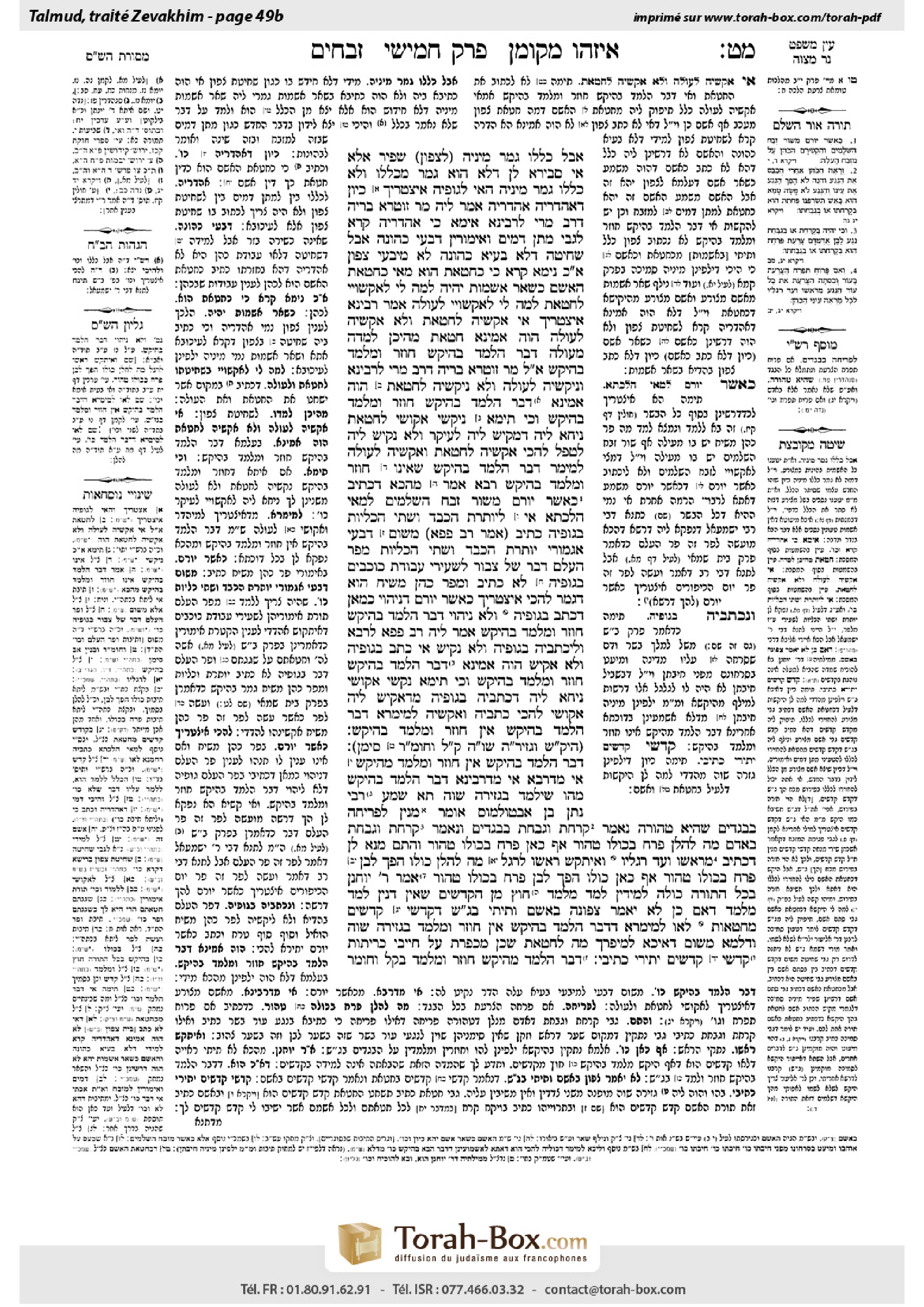
Zevachim 49b: Talmud study for Daf Yomi
Daf Yomi is the daily study of one Talmud folio. Explore 37 tractates with scans, Hebrew text, Sefaria English and AI-generated French translations where annotated.
Passage selection and English or AI-generated French translation are available where the scan has annotations. Daf Study is independent of Torah-Box and Sefaria.
Browse Zevachim · זבחים · All tractatesZevachim 49b text and translations
This page of Zevachim includes the Aramaic text, an English translation and an AI-generated French translation, alongside the scan above.
זבחים מ״ט ב · Aramaic and Hebrew text
אֲבָל כְּלָלוֹ גָּמַר מִינֵּיהּ (לְצָפוֹן) שַׁפִּיר. אֶלָּא אִי סְבִירָא לַן דְּלָא הוּא גָּמַר מִכְּלָלוֹ וְלָא כְּלָלוֹ גָּמַר מִינֵּיהּ – הַאי לְגוּפֵיהּ אִיצְטְרִיךְ!
כֵּיוָן דְּאַהְדְּרֵיהּ, אַהְדְּרֵיהּ.
אֲמַר לֵיהּ מָר זוּטְרָא בְּרֵיהּ דְּרַב מָרִי לְרָבִינָא: אֵימָא כִּי אַהְדְּרֵיהּ קְרָא – לְגַבֵּי מַתַּן דָּמִים וְאֵימוּרִין, דְּבָעֵי כְּהוּנָּה; אֲבָל שְׁחִיטָה, דְּלָא בָּעֲיָא כְּהוּנָּה – לָא מִיבְּעֵי צָפוֹן!
אִם כֵּן, נֵימָא קְרָא ״כִּי כְּחַטָּאת הוּא״; מַאי ״כְּחַטָּאת הָאָשָׁם״? כִּשְׁאָר אֲשָׁמוֹת יִהְיֶה.
לְמָה לִי לְאַקְשׁוֹיֵי לְחַטָּאת, לְמָה לִי לְאַקְשׁוֹיֵי לְעוֹלָה?
אָמַר רָבִינָא: אִיצְטְרִיךְ; אִי אַקְּשֵׁיהּ לְחַטָּאת וְלָא אַקְּשֵׁיהּ לְעוֹלָה – הֲוָה אָמֵינָא: חַטָּאת מֵהֵיכָן לָמְדָה – מֵעוֹלָה; דָּבָר הַלָּמֵד בְּהֶיקֵּשׁ חוֹזֵר וּמְלַמֵּד בְּהֶיקֵּשׁ.
אֲמַר לֵיהּ מָר זוּטְרָא בְּרֵיהּ דְּרַב מָרִי לְרָבִינָא: וְנַיקְּשֵׁיה לְעוֹלָה, וְלָא נַיקְּשֵׁיה לְחַטָּאת!
הֲוָה אָמֵינָא: דָּבָר הַלָּמֵד בְּהֶיקֵּשׁ – חוֹזֵר וּמְלַמֵּד בְּהֶיקֵּשׁ; וְכִי תֵּימָא: (ניקשי) [נַיקְּשֵׁיהּ] אַקּוֹשֵׁי לְחַטָּאת, נִיחָא לֵיהּ דְּמַקֵּישׁ לֵיהּ לְעִיקָּר וְלָא נַקֵּישׁ לֵיהּ לְטָפֵל; לְהָכִי אַקְּשֵׁיהּ לְחַטָּאת וְאַקְּשֵׁיהּ לְעוֹלָה – לְמֵימַר דָּבָר הַלָּמֵד בְּהֶיקֵּשׁ שֶׁאֵינוֹ חוֹזֵר וּמְלַמֵּד בְּהֶיקֵּשׁ.
רָבָא אָמַר מֵהָכָא, דִּכְתִיב: ״כַּאֲשֶׁר יוּרַם מִשּׁוֹר זֶבַח הַשְּׁלָמִים״ – לְמַאי הִלְכְתָא? אִי לְיוֹתֶרֶת הַכָּבֵד וּשְׁתֵּי הַכְּלָיוֹת – בְּגוּפֵיהּ כְּתִיב!
מִשּׁוּם דְּבָעֵי אַגְמוֹרֵי יוֹתֶרֶת הַכָּבֵד וּשְׁתֵּי הַכְּלָיוֹת מִפַּר הֶעְלֵם דָּבָר שֶׁל צִבּוּר לִשְׂעִירֵי עֲבוֹדָה זָרָה; בְּגוּפֵיהּ לָא כְּתִיב, וּמִפַּר כֹּהֵן מָשִׁיחַ הוּא דְּגָמַר;
לְהָכִי אִיצְטְרִיךְ ״כַּאֲשֶׁר יוּרַם״ – דְּנֶיהְוֵי כְּמַאן דִּכְתִב בְּגוּפֵיהּ, וְלָא נִיהְוֵי דָּבָר הַלָּמֵד בְּהֶיקֵּשׁ חוֹזֵר וּמְלַמֵּד בְּהֶיקֵּשׁ.
אֲמַר לֵיהּ רַב פָּפָּא לְרָבָא: וְלִיכְתְּבֵיהּ בְּגוּפֵיהּ, וְלָא נַקֵּישׁ!
אִי כְּתַב בְּגוּפֵיהּ וְלָא אַקֵּישׁ – הֲוָה אָמֵינָא דָּבָר הַלָּמֵד בְּהֶיקֵּשׁ חוֹזֵר וּמְלַמֵּד בְּהֶיקֵּשׁ; וְכִי תֵּימָא (נקשי) [נַקְּשֵׁיהּ] אַקּוֹשֵׁי – נִיחָא לֵיהּ דְּכַתְבֵיהּ בְּגוּפֵיהּ מִדְּאַקֵּישׁ לֵיהּ אַקּוֹשֵׁי; לְהָכִי כַּתְבֵיהּ וְאַקְּשֵׁיהּ, לְמֵימְרָא דָּבָר הַלָּמֵד בְּהֶיקֵּשׁ אֵין חוֹזֵר וּמְלַמֵּד בְּהֶיקֵּשׁ.
(הֶיקֵּשׁ, וּגְזֵירָה שָׁוָה, קַל וָחוֹמֶר – סִימָן)
דָּבָר הַלָּמֵד בְּהֶיקֵּשׁ, אֵין חוֹזֵר וּמְלַמֵּד מֵהֶיקֵּשׁ – אִי מִדְּרָבָא, אִי מִדְּרָבִינָא. דָּבָר הַלָּמֵד בְּהֶיקֵּשׁ, מַהוּ שֶׁיְּלַמֵּד בִּגְזֵירָה שָׁוָה?
תָּא שְׁמַע, רַבִּי נָתָן בֶּן אַבְטוּלְמוֹס אוֹמֵר: מִנַּיִן לִפְרִיחָה בִּבְגָדִים שֶׁהִיא טְהוֹרָה? נֶאֱמַר קָרַחַת וְגַבַּחַת בַּבְּגָדִים, וְנֶאֱמַר קָרַחַת וְגַבַּחַת בָּאָדָם;
מָה לְהַלָּן – פָּרַח בְּכוּלּוֹ טָהוֹר, אַף כָּאן – פָּרַח בְּכוּלּוֹ טָהוֹר.
וְהָתָם מְנָא לַן? דִּכְתִיב: ״מֵרֹאשׁוֹ וְעַד רַגְלָיו״ – וְאִיתַּקַּשׁ רֹאשׁוֹ (לרגל) [לְרַגְלָיו]; מָה לְהַלָּן, כּוּלּוֹ הָפַךְ לָבָן פֶּרַח בְּכוּלּוֹ – טָהוֹר; אַף כָּאן, כּוּלּוֹ הָפַךְ לָבָן פָּרַח בְּכוּלּוֹ – טָהוֹר.
אָמַר רַבִּי יוֹחָנָן: בְּכׇל הַתּוֹרָה כּוּלָּהּ לְמֵידִין לָמֵד מִלָּמֵד, חוּץ מִן הַקֳּדָשִׁים – שֶׁאֵין דָּנִין לָמֵד מִלָּמֵד.
דְּאִם כֵּן – לֹא יֵאָמֵר צָפוֹנָה בְּאָשָׁם, וְתֵיתֵי בִּגְזֵירָה שָׁוָה דְּ״קׇדְשֵׁי קָדָשִׁים״ מֵחַטָּאוֹת;
לָאו לְמֵימְרָא דְּדָבָר הַלָּמֵד בְּהֶיקֵּשׁ אֵין חוֹזֵר וּמְלַמֵּד בִּגְזֵירָה שָׁוָה?
וְדִלְמָא מִשּׁוּם דְּאִיכָּא לְמִיפְרַךְ: מָה לְחַטָּאת, שֶׁכֵּן מְכַפֶּרֶת עַל חַיָּיבֵי כָרֵיתוֹת!
״קׇדְשֵׁי קָדָשִׁים״ יַתִּירֵי כְּתִיבִי.
דָּבָר הַלָּמֵד מֵהֶיקֵּשׁ, חוֹזֵר וּמְלַמֵּד בְּקַל וָחוֹמֶר –
Zevachim 49b · English translation
but other matters in its general category learn halakhot from it; in this case with regard to the halakha of slaughtering a guilt offering in the north, it is well. Although some of the halakhot of the guilt offering of a leper do not apply to the category of guilt offerings in general, it can still serve as the source for the halakha that any guilt offering is disqualified if slaughtered not in the north. But if we hold that in the case of a matter that left its category to teach a new matter, it, the original matter, does not learn halakhot from its general category and its general category does not learn halakhot from it, then this verse is necessary to teach its own halakha.
The Gemara answers: Once the verse returned the halakha of the guilt offering of a leper to the general category by stating “as the sin offering, so is the guilt offering,” it returned it completely. Therefore, when the verse states that it requires slaughter in the north of the Temple courtyard, the phrase is not needed to teach the halakha about the guilt offering of a leper, and it can be used to teach the halakha about guilt offerings in general.
Mar Zutra, son of Rav Mari, said to Ravina: Say that when the verse returned the guilt offering of a leper to the class of standard guilt offerings, that is only with regard to placement of blood on the altar and burning the sacrificial portions, which require priesthood, i.e., only a priest may perform those rites. As the verse states: “For as the sin offering, so is the guilt offering; to the priest” (Leviticus 14:13). But say that slaughter, which does not require priesthood, as even a non-priest may slaughter an offering, does not require that it be done in the north of the Temple courtyard.
Ravina answered him: If so, let the verse state: For as the sin offering, so is it. What is added by the expanded phrase: “For as the sin offering, so is the guilt offering”? It teaches that the guilt offering of a leper will be like the rest of the guilt offerings.
§ The Gemara asks: Why do I need to juxtapose the guilt offering of a leper to a sin offering to teach the halakha that it must be slaughtered in the north, and why do I need to juxtapose it to a burnt offering to teach the same halakha? The verse states: “And he shall slaughter the sheep in the place where they slaughter the sin offering and the burnt offering, in the place of the Sanctuary” (Leviticus 14:13).
Ravina said: It was necessary to juxtapose the guilt offering to both of them, as, if the verse had juxtaposed it only to a sin offering but had not juxtaposed it to a burnt offering, I would say: From where is the requirement to slaughter a sin offering in the north derived? It is from the halakha of a burnt offering, as explained on 48a. I would then assume that a matter derived via a juxtaposition, i.e., the halakha of a sin offering, which was derived via a juxtaposition to the halakha of a burnt offering, then teaches that halakha to another case via a juxtaposition. But there is a principle that with regard to matters of consecration the halakha may not be derived via a juxtaposition from another halakha that was itself derived via a juxtaposition. To prevent this incorrect assumption, the verse had to specifically teach the juxtaposition to a burnt offering.
Mar Zutra, son of Rav Mari, said to Ravina: But let the verse juxtapose the guilt offering of a leper only to a burnt offering and not juxtapose it to a sin offering. The juxtaposition to a sin offering appears superfluous.
Ravina answered: If that had been so, I would still say that a matter derived via a juxtaposition then teaches its halakha via a juxtaposition. And if you would say that if that were to be so, let the verse juxtapose the guilt offering of a leper only to a sin offering, one could answer that it is preferable for the Torah that it juxtaposes the guilt offering to the primary offering about which it states that it must be slaughtered in the north, i.e., the burnt offering, and not juxtapose it to the secondary offering, the sin offering. For this reason, i.e., to prevent the incorrect assumption that a matter derived via a juxtaposition then teaches its halakha via a juxtaposition, the verse juxtaposed it to a sin offering and also juxtaposed it to a burnt offering, to say that a matter derived via a juxtaposition does not then teach its halakha via a juxtaposition.
Rava says: The principle that a matter derived via a juxtaposition cannot then teach its halakha via a juxtaposition is derived from here, as it is written with regard to the sin offering brought by the High Priest: “And the two kidneys, and the fat that is upon them, which is by the loins, and the diaphragm with the liver, which he shall take away by the kidneys. As it is taken off from the ox of the sacrifice of peace offerings; and the priest shall make them smoke upon the altar of burnt offering” (Leviticus 4:9–10). One can ask: For what halakha is this offering juxtaposed to that of a peace offering? If it is to teach that the priest must sacrifice the diaphragm with the liver and the two kidneys from the offering, that is written with regard to the offering itself, in the previous verse. This does not need to be derived via a juxtaposition.
It is written due to the fact that the verse wants to teach the halakha of the diaphragm with the liver and the two kidneys, deriving it from the halakha of the offering of the bull for an unwitting communal sin, then teaching it to apply it to the halakha of the goats brought as sin offerings for communal idol worship. It is not written explicitly in the passage discussing the bull for an unwitting communal sin itself, and it is derived from the halakha of the bull for an unwitting sin of an anointed priest, i.e., the High Priest. The offering for an unwitting communal sin is juxtaposed to the sin offering brought by the High Priest in the verse: “So shall he do with the bull; as he did with the bull of the sin offering, so shall he do with this” (Leviticus 4:20).
For this reason it was necessary for the verse to state: “As it is taken off from the ox” (Leviticus 4:10), so that it is as though it wrote explicitly in the passage discussing the bull for an unwitting communal sin itself. One of the hermeneutical principles applied to understanding verses in the Torah is: If the halakha stated is not required for the matter in which it is written, apply it to another matter. When this principle is employed, the halakha written in one context is viewed as if it were written elsewhere. In this case, as it was not necessary for the verse to write the juxtaposition to a peace offering in the context of the sin offering brought by the High Priest, it is applied to the case of the bull for an unwitting communal sin. And therefore it will not be a case of a matter derived via a juxtaposition that then teaches its halakha via a juxtaposition.
Rav Pappa said to Rava: But why not let the Torah write explicitly in the passage discussing the bull for an unwitting communal sin itself that the diaphragm with the liver and two kidneys must be removed from the ox, and not juxtapose it to a peace offering in this convoluted manner?
Rava answered: If the Torah had written it in that passage itself, and not juxtaposed it, I would say that in general a matter derived via a juxtaposition then teaches via a juxtaposition, as one would not have this instance to serve as a counterexample to that principle. And if you would say: If so, why not simply juxtapose the case of the bull for an unwitting communal sin to the case of the bull of the anointed priest, I would answer: It is preferable for the verse that it writes it in the passage itself rather than to juxtapose it alone. It is for this reason that it wrote it and juxtaposed it, to say that a matter derived via a juxtaposition cannot then teach its halakha via a juxtaposition.
§ Before beginning a lengthy discussion concerning derivations via compounded methodologies of the hermeneutical principles, the Gemara presents a mnemonic for its forthcoming discussion: Juxtaposition, verbal analogy, an a fortiori inference.
The principle that a matter derived via a juxtaposition cannot then teach its halakha via a juxtaposition is indicated either from the proof of Rava or from the proof of Ravina, both cited earlier. The Gemara asks: What is the halakha with regard to whether a matter derived via a juxtaposition can then teach its halakha to another matter via a verbal analogy?
The Gemara suggests: Come and hear a proof from a baraita: Rabbi Natan ben Avtolemos says: From where is it derived that if leprosy of garments spreads throughout an entire garment that it is pure? It is derived via a verbal analogy: A bareness within [karaḥat] and a bareness without [gabbaḥat] are stated with regard to leprosy of garments: “And the priest shall look, after that the mark is washed; and behold, if the mark has not changed its color, and the mark has not spread, it is impure; you shall burn it in the fire; it is a fret, whether the bareness be within or without” (Leviticus 13:55); and a bald head [karaḥat] and a bald forehead [gabbaḥat] are stated with regard to leprosy of a person: “But if there be in the bald head, or the bald forehead, a reddish-white plague, it is leprosy breaking out in his bald head, or his bald forehead” (Leviticus 13:42).
Just as there, with regard to a person, if the leprosy spread throughout him entirely he is pure, as the verse states: “Then the priest shall look; and behold, if the leprosy has covered all of his flesh, he shall pronounce the one who has the mark pure; it is all turned white: He is pure” (Leviticus 13:13), so too here with regard to garments, if the leprosy spread throughout the entire garment it is pure.
The Gemara continues its proof: But there, with regard to the head, which serves as the source for this verbal analogy, from where do we derive that if the leprosy spreads throughout the head he is pure? As it is written: “And if the leprosy breaks out on the skin, and the leprosy covers all the skin of the one who has the mark, from his head to his feet, as far as it appears to the priest” (Leviticus 13:12). And the verse thereby juxtaposes leprosy on his head to leprosy on his foot, teaching the following halakha: Just as there, with regard to leprosy of the body and foot, if its entirety turned white, and it spread all over him, he is pure, so too here, in the case of leprosy of the head, if its entirety turned white and it spread over all his head, he is pure. Evidently, a matter derived via a juxtaposition can then teach its halakha to another matter via a verbal analogy.
Rabbi Yoḥanan says: This cannot serve as a proof with regard to the halakhot of consecrated matters. With regard to the entire Torah, one derives a halakha derived via a verbal analogy from a halakha derived via a juxtaposition, apart from with regard to consecrated matters, where one does not derive a halakha derived via a verbal analogy from a halakha derived via a juxtaposition.
Rabbi Yoḥanan explains: As if it were to be so that one could derive a halakha in this manner even concerning consecrated matters, the verse should not state the requirement for slaughter in the north with regard to a guilt offering, as stated from the explicit juxtaposition of a burnt offering and a sin offering, and instead derive it through a verbal analogy. The verse describes a guilt offering as an offering of the most sacred order (see Leviticus 7:1), and its halakha can be derived via a verbal analogy from that of a sin offering, which is described in the same manner (see Leviticus 6:18).
Rabbi Yoḥanan continues: Is this not to say, at least with regard to consecrated matters, that a matter derived via a juxtaposition cannot then teach its halakha to another matter via a verbal analogy?
The Gemara rejects Rabbi Yoḥanan’s proof: But perhaps the requirement to slaughter a guilt offering in the north must be written explicitly because the verbal analogy can be refuted as follows: What is notable about a sin offering? It is notable in that it atones for those sins liable for punishment by karet, which is not so with regard to a guilt offering.
The Gemara rejects this claim: There are additional descriptions of a guilt offering and a sin offering as offerings of the most sacred order written in the verses: “This shall be yours of the most sacred items, reserved from the fire: Every offering of theirs, every meal offering of theirs, and every sin offering of theirs, and every guilt offering of theirs, which they may offer to Me, shall be most holy for you and for your sons” (Numbers 18:9). A verbal analogy derived from extra phrases in the verse cannot be refuted with a logical claim. Therefore, Rabbi Yoḥanan’s claim stands, and, at least with regard to consecrated matters, a matter derived via a juxtaposition cannot then teach its halakha to another matter via a verbal analogy.
The Gemara states: That a matter derived via a juxtaposition then teaches its halakha via an a fortiori inference
Zevachim 49b · Traduction française (IA)
mais les autres éléments de sa catégorie générale en tirent des halakhot. En l’occurrence, pour la halakha selon laquelle un sacrifice de culpabilité doit être égorgé au nord, cela convient. Bien que certaines halakhot du sacrifice de culpabilité du lépreux ne s’appliquent pas à la catégorie générale des sacrifices de culpabilité, celui-ci peut néanmoins servir de source pour la halakha selon laquelle tout sacrifice de culpabilité est invalidé s’il est égorgé ailleurs qu’au nord. Mais si l’on soutient que, lorsqu’un élément sort de sa catégorie pour enseigner une nouvelle règle, ni cet élément d’origine ne tire de halakhot de sa catégorie générale, ni sa catégorie générale n’en tire de lui, alors ce verset est nécessaire pour enseigner sa propre halakha.
La Guemara répond : dès lors que le verset a réintégré la halakha du sacrifice de culpabilité du lépreux dans la catégorie générale en disant : « Comme le sacrifice expiatoire, ainsi le sacrifice de culpabilité », il l’y a réintégrée complètement. Par conséquent, lorsque le verset indique qu’il doit être égorgé au nord de la cour du Temple, cette expression n’est pas nécessaire pour enseigner la halakha concernant le sacrifice de culpabilité du lépreux ; elle peut donc servir à enseigner la halakha concernant les sacrifices de culpabilité en général.
Mar Zutra, fils de Rav Mari, dit à Ravina : Dis plutôt que, lorsque le verset a réintégré le sacrifice de culpabilité du lépreux dans la catégorie des sacrifices de culpabilité ordinaires, cela ne concerne que le placement du sang sur l’autel et la combustion des parties sacrificielles, qui requièrent l’intervention d’un prêtre, c’est-à-dire que seul un prêtre peut accomplir ces rites. En effet, le verset dit : « Car comme le sacrifice expiatoire, ainsi le sacrifice de culpabilité ; au prêtre » (Lévitique 14,13). Mais dis plutôt que l’égorgement, qui ne requiert pas l’intervention d’un prêtre, puisqu’un non-prêtre peut également égorger une offrande, n’a pas à se faire au nord de la cour du Temple.
Ravina lui répondit : Dans ce cas, que le verset dise : « Car comme le sacrifice expiatoire, ainsi est-il. » Pourquoi ajouter la formulation développée : « Car comme le sacrifice expiatoire, ainsi le sacrifice de culpabilité » ? Cela enseigne que le sacrifice de culpabilité du lépreux sera comme les autres sacrifices de culpabilité.
§ La Guemara demande : Pourquoi faut-il rapprocher le sacrifice de culpabilité du lépreux d’un sacrifice expiatoire pour enseigner la halakha selon laquelle il doit être égorgé au nord, et pourquoi faut-il le rapprocher d’un holocauste pour enseigner la même halakha ? Le verset dit : « Il égorgera l’agneau à l’endroit où l’on égorge le sacrifice expiatoire et l’holocauste, dans le lieu du Sanctuaire » (Lévitique 14,13).
Ravina dit : Il fallait le rapprocher des deux, car si le verset l’avait rapproché uniquement d’un sacrifice expiatoire, sans le rapprocher d’un holocauste, j’aurais dit : D’où déduit-on que le sacrifice expiatoire doit être égorgé au nord ? De la halakha de l’holocauste, comme expliqué en 48a. J’aurais alors supposé qu’une règle déduite par rapprochement — c’est-à-dire la halakha du sacrifice expiatoire, déduite par rapprochement de la halakha de l’holocauste — enseigne à son tour cette halakha à un autre cas par rapprochement. Or, il existe un principe selon lequel, en matière d’offrandes consacrées, on ne peut pas déduire une halakha par rapprochement à partir d’une autre halakha elle-même déduite par rapprochement. Pour éviter cette conclusion erronée, le verset devait expressément enseigner le rapprochement avec un holocauste.
Mar Zutra, fils de Rav Mari, dit à Ravina : Mais que le verset rapproche le sacrifice de culpabilité du lépreux uniquement d’un holocauste, sans le rapprocher d’un sacrifice expiatoire. Le rapprochement avec le sacrifice expiatoire semble superflu.
Ravina répondit : Même dans ce cas, j’aurais encore dit qu’une règle déduite par rapprochement enseigne ensuite sa halakha par rapprochement. Et si tu dis : dans ce cas, que le verset rapproche le sacrifice de culpabilité du lépreux uniquement d’un sacrifice expiatoire, on pourrait répondre que la Torah préfère rapprocher le sacrifice de culpabilité de l’offrande principale, dont elle dit qu’elle doit être égorgée au nord — c’est-à-dire l’holocauste — plutôt que de l’offrande secondaire, le sacrifice expiatoire. C’est pourquoi, afin d’empêcher la conclusion erronée qu’une règle déduite par rapprochement enseigne ensuite sa halakha par rapprochement, le verset le rapproche d’un sacrifice expiatoire et aussi d’un holocauste, pour enseigner qu’une règle déduite par rapprochement n’enseigne pas ensuite sa halakha par rapprochement.
Rava dit : Le principe selon lequel une règle déduite par rapprochement ne peut ensuite enseigner sa halakha par rapprochement se déduit d’ici, comme il est écrit au sujet du sacrifice expiatoire apporté par le Grand Prêtre : « Les deux rognons et la graisse qui les recouvre, près des flancs, ainsi que le lobe du foie, qu’il enlèvera avec les rognons. Comme on les prélève sur le taureau du sacrifice de paix, le prêtre les fera fumer sur l’autel de l’holocauste » (Lévitique 4,9-10). On peut demander : pour quelle halakha cette offrande est-elle rapprochée d’un sacrifice de paix ? Si c’est pour enseigner que le prêtre doit prélever sur l’offrande le lobe du foie et les deux rognons, cela est écrit à propos de l’offrande elle-même, dans le verset précédent. Il n’est pas nécessaire de le déduire par rapprochement.
Cela est écrit parce que le verset veut enseigner la halakha concernant le lobe du foie et les deux rognons, en la déduisant de la halakha de l’offrande du taureau apporté pour une faute involontaire de la communauté, puis en l’appliquant aux boucs apportés comme sacrifices expiatoires pour l’idolâtrie de la communauté. Cette règle n’est pas écrite explicitement dans le passage qui traite du taureau pour une faute involontaire de la communauté lui-même ; elle est déduite de la halakha du taureau pour la faute involontaire d’un prêtre oint, c’est-à-dire du Grand Prêtre. L’offrande pour une faute involontaire de la communauté est rapprochée du sacrifice expiatoire apporté par le Grand Prêtre dans le verset : « Il fera ainsi avec le taureau ; comme il a fait avec le taureau du sacrifice expiatoire, ainsi fera-t-il avec celui-ci » (Lévitique 4,20).
C’est pourquoi le verset devait dire : « Comme on le prélève sur le taureau » (Lévitique 4,10), de sorte que ce soit comme si cela était écrit explicitement dans le passage traitant du taureau pour une faute involontaire de la communauté lui-même. Parmi les principes herméneutiques appliqués à l’interprétation des versets de la Torah figure le suivant : si la halakha énoncée n’est pas nécessaire dans le contexte où elle est écrite, on l’applique à un autre cas. Lorsqu’on applique ce principe, la halakha écrite dans un contexte est considérée comme si elle était écrite ailleurs. Ici, puisque le verset n’avait pas besoin d’écrire le rapprochement avec un sacrifice de paix dans le contexte du sacrifice expiatoire apporté par le Grand Prêtre, on l’applique au cas du taureau pour une faute involontaire de la communauté. Il ne s’agit donc pas d’une règle déduite par rapprochement qui enseignerait ensuite sa halakha par rapprochement.
Rav Pappa dit à Rava : Mais pourquoi la Torah n’écrit-elle pas explicitement, dans le passage traitant du taureau pour une faute involontaire de la communauté lui-même, qu’il faut prélever sur le taureau le lobe du foie et les deux rognons, au lieu de le rapprocher d’un sacrifice de paix de cette manière détournée ?
Rava répondit : Si la Torah l’avait écrit dans ce passage même, sans le rapprocher d’un autre texte, j’aurais dit qu’en général une règle déduite par rapprochement enseigne ensuite sa halakha par rapprochement, car on n’aurait pas eu cet exemple pour servir de contre-exemple à ce principe. Et si tu dis : dans ce cas, pourquoi ne pas simplement rapprocher le cas du taureau pour une faute involontaire de la communauté de celui du taureau du prêtre oint ? Je répondrais que le verset préfère l’écrire dans le passage même plutôt que de le rapprocher seulement d’un autre cas. C’est pourquoi il l’a écrit et l’a rapproché, pour enseigner qu’une règle déduite par rapprochement ne peut ensuite enseigner sa halakha par rapprochement.
§ Avant d’entamer une longue discussion sur les déductions combinant plusieurs méthodes herméneutiques, la Guemara présente un aide-mémoire pour la discussion à venir : rapprochement, analogie verbale, raisonnement a fortiori.
Le principe selon lequel une règle déduite par rapprochement ne peut ensuite enseigner sa halakha par rapprochement est indiqué soit par la preuve de Rava, soit par celle de Ravina, toutes deux citées précédemment. La Guemara demande : quelle est la halakha quant à savoir si une règle déduite par rapprochement peut ensuite enseigner sa halakha à un autre cas par analogie verbale ?
La Guemara propose : Venons entendre une preuve tirée d’une baraïta. Rabbi Natan ben Avtolemos dit : D’où déduit-on que, si la lèpre des vêtements s’étend à tout un vêtement, celui-ci est pur ? On le déduit par analogie verbale : les termes « zone dénudée à l’intérieur » [karaḥat] et « zone dénudée à l’extérieur » [gabbaḥat] sont employés à propos de la lèpre des vêtements : « Le prêtre examinera, après que la marque aura été lavée ; et si la marque n’a pas changé de couleur et ne s’est pas étendue, elle est impure ; tu la brûleras au feu ; c’est une déchirure, que la zone dénudée soit à l’intérieur ou à l’extérieur » (Lévitique 13,55). Les termes « tête chauve » [karaḥat] et « front chauve » [gabbaḥat] sont employés à propos de la lèpre d’une personne : « Mais s’il y a sur la tête chauve ou sur le front chauve une tache rougeâtre blanchâtre, c’est une lèpre qui fait éruption sur sa tête chauve ou sur son front chauve » (Lévitique 13,42).
De même que là, dans le cas d’une personne, si la lèpre s’est étendue sur tout son corps, elle est pure, comme le verset dit : « Le prêtre examinera ; et si la lèpre a couvert toute sa chair, il déclarera pur celui qui porte la marque ; tout est devenu blanc : il est pur » (Lévitique 13,13), de même ici, dans le cas des vêtements, si la lèpre s’est étendue à tout le vêtement, celui-ci est pur.
La Guemara poursuit sa démonstration : Mais là, concernant la tête, qui sert de source à cette analogie verbale, d’où déduit-on que, si la lèpre s’étend à toute la tête, la personne est pure ? Car il est écrit : « Si la lèpre fait éruption sur la peau et que la lèpre couvre toute la peau de celui qui porte la marque, de la tête aux pieds, partout où le prêtre peut voir » (Lévitique 13,12). Le verset rapproche ainsi la lèpre de sa tête de celle de son pied et enseigne la halakha suivante : de même que là, pour la lèpre du corps et du pied, si toute la peau devient blanche et que la lèpre s’étend partout sur lui, il est pur, de même ici, dans le cas de la lèpre de la tête, si toute la tête devient blanche et que la lèpre s’étend sur toute sa tête, il est pur. Il ressort donc qu’une règle déduite par rapprochement peut ensuite enseigner sa halakha à un autre cas par analogie verbale.
Rabbi Yoḥanan dit : Cela ne peut servir de preuve concernant les halakhot des offrandes consacrées. Pour l’ensemble de la Torah, on déduit une halakha établie par analogie verbale à partir d’une halakha établie par rapprochement, sauf en matière d’offrandes consacrées, où l’on ne déduit pas une halakha établie par analogie verbale à partir d’une halakha établie par rapprochement.
Rabbi Yoḥanan explique : S’il était possible de déduire une halakha de cette manière, même au sujet des offrandes consacrées, le verset n’aurait pas dû énoncer, à propos d’un sacrifice de culpabilité, l’obligation de l’égorger au nord, comme cela ressort du rapprochement explicite entre l’holocauste et le sacrifice expiatoire ; on aurait pu la déduire par analogie verbale. Le verset décrit le sacrifice de culpabilité comme une offrande de sainteté suprême (voir Lévitique 7,1), et sa halakha pourrait être déduite par analogie verbale de celle du sacrifice expiatoire, décrit de la même manière (voir Lévitique 6,18).
Rabbi Yoḥanan poursuit : N’est-il donc pas établi que, du moins en matière d’offrandes consacrées, une règle déduite par rapprochement ne peut ensuite enseigner sa halakha à un autre cas par analogie verbale ?
La Guemara rejette la preuve de Rabbi Yoḥanan : Mais peut-être l’obligation d’égorger un sacrifice de culpabilité au nord doit-elle être écrite explicitement parce que l’analogie verbale peut être réfutée ainsi : qu’est-ce qui distingue le sacrifice expiatoire ? Il se distingue par le fait qu’il expie des fautes passibles de karet, ce qui n’est pas le cas du sacrifice de culpabilité.
La Guemara rejette cet argument : les versets décrivent aussi le sacrifice de culpabilité et le sacrifice expiatoire comme des offrandes de sainteté suprême : « Voici ce qui te revient des choses très saintes, réservées au feu : toutes leurs offrandes, toutes leurs offrandes végétales, tous leurs sacrifices expiatoires et tous leurs sacrifices de culpabilité qu’ils m’offrent seront très saints pour toi et pour tes fils » (Nombres 18,9). Une analogie verbale fondée sur des expressions supplémentaires dans le verset ne peut être réfutée par un raisonnement logique. La thèse de Rabbi Yoḥanan tient donc : du moins en matière d’offrandes consacrées, une règle déduite par rapprochement ne peut ensuite enseigner sa halakha à un autre cas par analogie verbale.
La Guemara énonce : qu’une règle déduite par rapprochement enseigne ensuite sa halakha par un raisonnement a fortiori.
Traduction française générée par IA à partir de l’édition anglaise de Sefaria. Vérifie toujours un passage avec le texte source.
Text from Sefaria: William Davidson Edition - Vocalized Aramaic (CC BY NC); William Davidson Edition - English (CC BY NC).