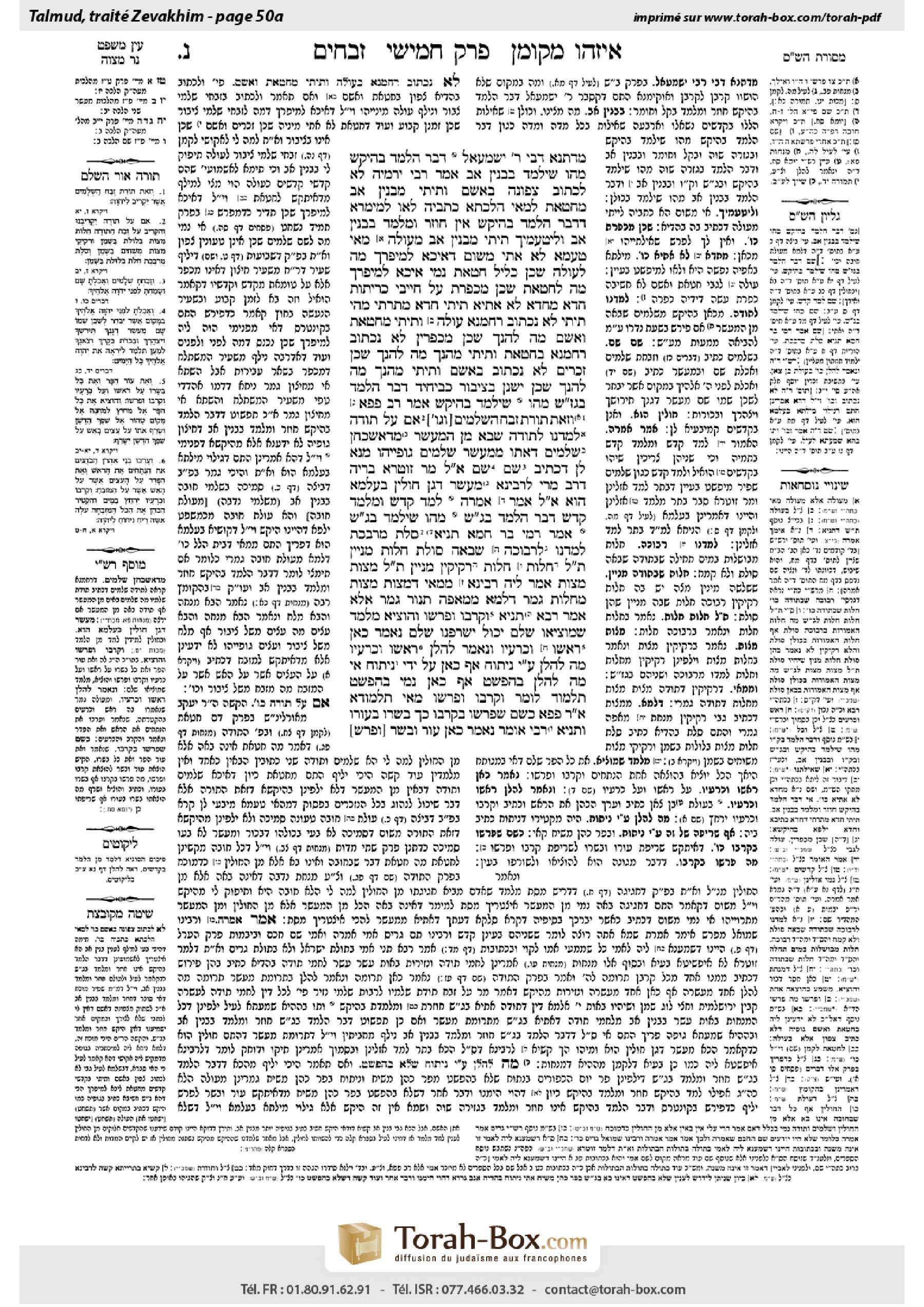
Zevachim 50a: Talmud study for Daf Yomi
Daf Yomi is the daily study of one Talmud folio. Explore 37 tractates with scans, Hebrew text, Sefaria English and AI-generated French translations where annotated.
Passage selection and English or AI-generated French translation are available where the scan has annotations. Daf Study is independent of Torah-Box and Sefaria.
Browse Zevachim · זבחים · All tractatesZevachim 50a text and translations
This page of Zevachim includes the Aramaic text, an English translation and an AI-generated French translation, alongside the scan above.
זבחים נ׳ א · Aramaic and Hebrew text
מִדְּתָנָא דְּבֵי רַבִּי יִשְׁמָעֵאל.
דָּבָר הַלָּמֵד בְּהֶיקֵּשׁ, מַהוּ שֶׁיְּלַמֵּד בְּבִנְיַן אָב? אָמַר רַבִּי יִרְמְיָה: לָא לִכְתּוֹב צָפוֹנָה בְּאָשָׁם, וְתֵיתֵי מִבִּנְיַן אָב מֵחַטָּאת; לְמַאי הִלְכְתָא כַּתְבֵיהּ? לָאו לְמֵימְרָא דְּדָבָר הַלָּמֵד בְּהֶיקֵּשׁ אֵין חוֹזֵר וּמְלַמֵּד בְּבִנְיַן אָב?
וְלִיטַעְמָיךְ, תֵּיתֵי מִבִּנְיַן אָב מֵעוֹלָה! מַאי טַעְמָא לָא אָתֵי – מִשּׁוּם דְּאִיכָּא לְמִיפְרַךְ: מָה לְעוֹלָה שֶׁכֵּן כָּלִיל; חַטָּאת נָמֵי אִיכָּא לְמִיפְרַךְ: מָה לְחַטָּאת שֶׁכֵּן מְכַפֶּרֶת עַל חַיָּיבֵי כָרֵיתוֹת.
חֲדָא מֵחֲדָא – לָא אָתְיָא; תֵּיתֵי חֲדָא מִתַּרְתֵּי!
מֵהֵי תֵּיתֵי? לָא נִכְתּוֹב רַחֲמָנָא עוֹלָה, וְתֵיתֵי מֵחַטָּאת וְאָשָׁם? מָה לְהָנָךְ שֶׁכֵּן מְכַפְּרִין.
לָא נִכְתּוֹב רַחֲמָנָא בְּחַטָּאת, וְתֵיתֵי מֵהָנָךְ? מָה לְהָנָךְ שֶׁכֵּן זְכָרִים.
לָא נִכְתּוֹב בְּאָשָׁם, וְתֵיתֵי מֵהָנָךְ? מָה לְהָנָךְ שֶׁכֵּן יֶשְׁנָן בְּצִיבּוּר כִּבְיָחִיד.
דָּבָר הַלָּמֵד בִּגְזֵירָה שָׁוָה, מַהוּ שֶׁיְּלַמֵּד בְּהֶיקֵּשׁ? אָמַר רַב פָּפָּא: ״וְזֹאת תּוֹרַת זֶבַח הַשְּׁלָמִים [וְגוֹ׳] אִם עַל תּוֹדָה״ – לָמַדְנוּ לְתוֹדָה שֶׁבָּא מִן הַמַּעֲשֵׂר, מִדְּאַשְׁכְּחַן שְׁלָמִים דְּאָתוּ מִמַּעֲשֵׂר.
שְׁלָמִים גּוּפַיְיהוּ מְנָא לַן? דִּכְתִיב ״שָׁם״–״שָׁם״.
אֲמַר לֵיהּ מָר זוּטְרָא בְּרֵיהּ דְּרַב מָרִי לְרָבִינָא: מַעְשַׂר דָּגָן חוּלִּין בְּעָלְמָא הוּא!
אֲמַר לֵיהּ, אָמַר אָמְרַהּ: לָמֵד קֹדֶשׁ וּמְלַמֵּד קֹדֶשׁ?!
דָּבָר הַלָּמֵד בִּגְזֵירָה שָׁוָה, מַהוּ שֶׁיְּלַמֵּד בִּגְזֵירָה שָׁוָה? אָמַר רָמֵי בַּר חָמָא, תַּנְיָא: ״סֹלֶת מֻרְבֶּכֶת״ – לָמַדְנוּ לִרְבוּכָה שֶׁבָּאָה סוֹלֶת.
חַלּוֹת מִנַּיִין? תַּלְמוּד לוֹמַר: ״חַלּוֹת״–״חַלּוֹת״. רְקִיקִין מִנַּיִין? תַּלְמוּד לוֹמַר: ״מַצּוֹת״–״מַצּוֹת״.
אֲמַר לֵיהּ רָבִינָא: מִמַּאי דְּ״מַצּוֹת״–״מַצּוֹת״ מֵחַלּוֹת גָּמַר? דִּלְמָא מִמַּאֲפֵה תַנּוּר גָּמַר!
אֶלָּא אָמַר רָבָא, תַּנְיָא: ״וְקִרְבּוֹ וּפִרְשׁוֹ וְהוֹצִיא״ – מְלַמֵּד שֶׁמּוֹצִיאוֹ שָׁלֵם.
יָכוֹל יִשְׂרְפֶנּוּ שָׁלֵם? נֶאֱמַר כָּאן: ״רֹאשׁוֹ וּכְרָעָיו״, וְנֶאֱמַר לְהַלָּן: ״רֹאשׁוֹ וּכְרָעָיו״; מָה לְהַלָּן עַל יְדֵי נִיתּוּחַ, אַף כָּאן עַל יְדֵי נִיתּוּחַ.
אִי – מָה לְהַלָּן בְּהֶפְשֵׁט, אַף כָּאן נָמֵי בְּהֶפְשֵׁט?! תַּלְמוּד לוֹמַר: ״וְקִרְבּוֹ וּפִרְשׁוֹ״. מַאי תַּלְמוּדָא? אָמַר רַב פָּפָּא: כְּשֵׁם שֶׁפִּרְשׁוֹ בְּקִרְבּוֹ, כָּךְ בְּשָׂרוֹ בְּעוֹרוֹ.
וְתַנְיָא, רַבִּי אוֹמֵר: נֶאֱמַר כָּאן עוֹר וּבָשָׂר [וָפֶרֶשׁ],
Zevachim 50a · English translation
is apparent from that which the school of Rabbi Yishmael taught, discussed in the previous chapter (41a).
The Gemara asks: What is the halakha as to whether a matter derived via a juxtaposition can teach its halakha in another context via a paradigm? Rabbi Yirmeya says: It must be that it cannot, as, if it could, let the Torah not write the requirement to slaughter an offering in the north of the Temple courtyard with regard to a guilt offering (see Leviticus 14:13), and one can derive it via a paradigm from the halakha of a sin offering, since they are both offerings of the most sacred order. For what halakha did the verse write it with regard to a guilt offering as well? Is this not to say that a matter derived via a juxtaposition cannot then teach its halakha in another context via a paradigm?
The Gemara questions this proof: But according to your reasoning, why not derive the halakha that a guilt offering must be slaughtered in the north from the halakha of a burnt offering, via a paradigm? What is the reason that this halakha is not derived from there? It must be because it can be refuted with the following claim: What is notable about a burnt offering? It is notable in that the Torah teaches that it is entirely burned on the altar, which is not so with regard to a guilt offering. The Gemara now states its objection: In that case, the derivation from a sin offering via a paradigm can also be refuted: What is notable about a sin offering? It is notable in that it atones for those sins liable for punishment by karet, which is not so with regard to a guilt offering. If so, there is no proof from here.
The Gemara suggests an alternative paradigm: Although the requirement to slaughter one of these three offerings, i.e., a burnt offering, sin offering, or guilt offering, in the north cannot be derived from any one of the others, one can derive the halakha concerning one of them from the other two.
The Gemara clarifies: From which two could one derive the third? Let the Merciful One not write the requirement to slaughter the offering in the north with regard to a burnt offering, and derive this halakha from the halakhot of a sin offering and a guilt offering. The Gemara refutes this derivation: What is notable about these two offerings? They are notable in that they atone for transgressions, whereas a burnt offering does not atone for any sin.
The Gemara suggests: Let the Merciful One not write the requirement to slaughter an offering in the north with regard to a sin offering, and derive this halakha from the halakhot of these others, the burnt offering and the guilt offering. The Gemara refutes this derivation: What is notable about these two offerings? They are notable in that they are brought only from male animals, whereas an individual’s sin offering is a female animal.
The Gemara suggests: Let the Merciful One not write the requirement to slaughter an offering in the north with regard to a guilt offering, and derive this halakha from the halakhot of these other two. The Gemara refutes this derivation: What is notable about these two offerings? They are notable in that they are brought by a community just as they are brought by an individual, whereas a guilt offering can be brought only by an individual.
The Gemara returns to its discussion of hermeneutical principles. What is the halakha as to whether a matter derived via a verbal analogy can teach its halakha to another matter via a juxtaposition? Rav Pappa says: The verse states: “And this is the law of the sacrifice of peace offerings, which one may offer to the Lord. If he sacrifices it for a thanks offering, then he shall offer with the thanks offering unleavened cakes mingled with oil, and unleavened wafers spread with oil, and cakes mingled with oil, of fine flour soaked” (Leviticus 7:11–12). From this juxtaposition we have learned that the money to purchase a thanks offering can come from money used to redeem the second tithe, since we find that the money to purchase a peace offering can come from money used to redeem the second tithe.
The Gemara asks: From where do we derive that the money to purchase peace offerings themselves can come from money used to redeem the second tithe? As it is written with regard to peace offerings: “And you shall sacrifice peace offerings and shall eat there” (Deuteronomy 27:7). And it is written with regard to second tithe: “And you shall eat before the Lord your God, in the place which He shall choose to cause His name to dwell there” (Deuteronomy 14:23). The usage of the term “there” in both passages serves as a verbal analogy, and demonstrates that a halakha derived via a verbal analogy, that of a peace offering, can then teach a halakha via its juxtaposition to a thanks offering.
Mar Zutra, son of Rav Mari, said to Ravina: This is not a proof, because the tithe of grain, including the second tithe, is merely non-sacred. Therefore, it cannot be used to prove that in the realm of consecrated matters a halakha derived via a verbal analogy can teach a halakha via a juxtaposition.
Ravina said to him: Does the one who said that in the realm of consecrated matters a halakha derived via one of the hermeneutical principles cannot teach via another of those principles say this only when the halakha that is derived is in the realm of consecrated matters and the halakha that teaches is in the realm of consecrated matters as well? He holds that even if that which is derived is in the realm of consecrated matters it cannot teach its halakha via one of the hermeneutical principles. Therefore, since peace offerings are in the realm of consecrated matters, the halakha derived from the juxtaposition of thanks offerings to peace offerings serves as a source that a matter derived via a verbal analogy can teach its halakha to another matter via a juxtaposition.
§ The Gemara asks: What is the halakha as to whether a matter derived via a verbal analogy can teach its halakha to another matter via another verbal analogy? Rami bar Ḥama says: It is taught in a baraita with regard to the types of bread that accompany a thanks offering: “If he sacrifices it for a thanks offering, then he shall sacrifice with the thanks offering unleavened loaves mingled with oil, and unleavened wafers spread with oil, and loaves mingled with oil, of fine flour cooked with oil” (Leviticus 7:12). We have derived from here that the poached breads accompanying the thanks offering come from fine flour.
The baraita continues: From where is it derived that the loaves accompanying a thanks offering are also prepared with fine flour? The verse states: “Loaves mingled with oil, of fine flour cooked with oil” (Leviticus 7:12), and it also states in the same verse: “Unleavened loaves mingled with oil.” From where is it derived that the unleavened wafers accompanying a thanks offering are also prepared with fine flour? The verse states: “Unleavened cakes mingled with oil” (Leviticus 7:12), and the verse also states: “Unleavened wafers spread with oil.” The baraita derives via a verbal analogy that the unleavened loaves mingled with oil are prepared with fine flour, and then teaches the halakha concerning unleavened wafers using a verbal analogy from the halakha of unleavened loaves.
Ravina said to Rami bar Ḥama: From where do you know that the tanna of the baraita learns the verbal analogy of “unleavened” and “unleavened” from loaves of the thanks offering? Perhaps the tanna learns the verbal analogy from the word “unleavened” stated with regard to meal offerings baked in an oven, about which the verse states explicitly that they are prepared with fine flour: “And when you bring a meal offering baked in the oven, it shall be unleavened cakes of fine flour mingled with oil, or unleavened wafers spread with oil” (Leviticus 2:4). If so, there is no source that a halakha derived via a verbal analogy can teach a halakha via a verbal analogy.
Rather, Rava says that the source is from a different baraita, as it is taught in a baraita with regard to the bull offering of a High Priest: “And the skin of the bull and all its flesh, with its head and with its legs, and its innards, and its dung, the whole bull shall he carry out of the camp to a pure place, where the ashes are poured out, and burn it on wood with fire” (Leviticus 4:11–12). This teaches that he brings the offering out whole.
The baraita continues: One might have thought that he should burn it whole as well. It is stated here: “Its head and its legs,” and it is stated there, with regard to a burnt offering: “And he shall cut it into its pieces; and the priest shall lay them, with its head and its fats, in order on the wood that is on the fire which is upon the altar. But the innards and the legs shall he wash with water” (Leviticus 1:12–13). Just as there, the burnt offering is burned by means of cutting the offering into pieces, as explicitly stated in the verse, so too here, it is burned by means of cutting the offering into pieces.
The Gemara clarifies: If these are compared, one could say that just as there, the burnt offering is prepared for being burned by first flaying it, so too here, the bull offering of a High Priest should also be prepared for being burned by first flaying it. To counter this reasoning, the verse states: “And its innards and its dung” (Leviticus 4:11). The Gemara asks: What is the biblical derivation? How do these words teach that there is no requirement to flay the animal? Rav Pappa says: Just as the dung remains inside the animal when the animal is burned, so the animal’s flesh remains inside its skin. In any event, the halakha that the bull offering of a High Priest is cut into pieces before it is burned is derived via a verbal analogy.
Rava continues: And it is taught in a baraita that Rabbi Yehuda HaNasi says: It is stated here, with regard to the bull and goat offered by the High Priest on Yom Kippur, the terms skin, flesh, and dung, in the verse: “And the bull of the sin offering, and the goat of the sin offering, whose blood was brought in to make atonement in the Sanctuary, shall be carried out of the camp; and they shall burn in the fire their skin, and their flesh, and their dung” (Leviticus 16:27).
Zevachim 50a · Traduction française (IA)
Cela ressort de ce que l’école de Rabbi Yishmael a enseigné, comme on l’a vu au chapitre précédent (41a).
La Guemara demande : Quelle est la halakha : une règle déduite par juxtaposition peut-elle transmettre sa halakha à un autre contexte au moyen d’une analogie ? Rabbi Yirmeya dit : Il faut conclure que non. En effet, si elle le pouvait, que la Torah n’écrive pas l’obligation d’égorger un sacrifice au nord de la cour du Temple à propos d’un sacrifice de culpabilité (voir Lévitique 14:13) ; on pourrait déduire cette obligation par analogie de la halakha du sacrifice expiatoire, puisque les deux sont des sacrifices de sainteté éminente. Pourquoi le verset l’écrit-il également à propos d’un sacrifice de culpabilité ? N’est-ce pas pour enseigner qu’une règle déduite par juxtaposition ne peut ensuite transmettre sa halakha à un autre contexte au moyen d’une analogie ?
La Guemara conteste cette preuve : Mais, selon ton raisonnement, pourquoi ne pas déduire par analogie la halakha selon laquelle un sacrifice de culpabilité doit être égorgé au nord, à partir de la halakha du holocauste ? Pour quelle raison cette halakha n’est-elle pas déduite de là ? C’est nécessairement parce que l’on peut réfuter cette déduction ainsi : Qu’a de particulier le holocauste ? Il a ceci de particulier que la Torah enseigne qu’il est entièrement brûlé sur l’autel, ce qui n’est pas le cas du sacrifice de culpabilité. La Guemara formule alors son objection : dans ce cas, on peut également réfuter la déduction par analogie à partir du sacrifice expiatoire : Qu’a de particulier le sacrifice expiatoire ? Il a ceci de particulier qu’il expie les péchés passibles de karet, ce qui n’est pas le cas du sacrifice de culpabilité. Il n’y a donc aucune preuve à tirer de là.
La Guemara propose une autre analogie : Même si l’obligation d’égorger au nord l’un de ces trois sacrifices — le holocauste, le sacrifice expiatoire ou le sacrifice de culpabilité — ne peut être déduite de l’un des deux autres pris isolément, on peut déduire la halakha concernant l’un d’eux à partir des deux autres.
La Guemara précise : Desquels deux pourrait-on déduire le troisième ? Que le Miséricordieux n’écrive pas l’obligation d’égorger le sacrifice au nord à propos du holocauste ; on pourrait alors déduire cette halakha des règles du sacrifice expiatoire et du sacrifice de culpabilité. La Guemara réfute cette déduction : Qu’ont de particulier ces deux sacrifices ? Ils ont ceci de particulier qu’ils expient des transgressions, contrairement au holocauste, qui n’expie aucun péché.
La Guemara propose : Que le Miséricordieux n’écrive pas l’obligation d’égorger un sacrifice au nord à propos du sacrifice expiatoire ; on pourrait alors déduire cette halakha des règles des deux autres, le holocauste et le sacrifice de culpabilité. La Guemara réfute cette déduction : Qu’ont de particulier ces deux sacrifices ? Ils ont ceci de particulier qu’ils ne sont offerts qu’à partir d’animaux mâles, tandis que le sacrifice expiatoire d’un particulier est un animal femelle.
La Guemara propose : Que le Miséricordieux n’écrive pas l’obligation d’égorger un sacrifice au nord à propos du sacrifice de culpabilité ; on pourrait alors déduire cette halakha des règles des deux autres. La Guemara réfute cette déduction : Qu’ont de particulier ces deux sacrifices ? Ils ont ceci de particulier qu’ils sont offerts par une collectivité aussi bien que par un particulier, tandis qu’un sacrifice de culpabilité ne peut être offert que par un particulier.
La Guemara revient à son examen des principes herméneutiques. Quelle est la halakha : une règle déduite par analogie verbale peut-elle transmettre sa halakha à un autre sujet par juxtaposition ? Rav Pappa dit : Le verset énonce : « Voici la loi du sacrifice de paix que l’on peut offrir à l’Éternel. Si l’on offre un sacrifice d’action de grâce, on offrira avec ce sacrifice d’action de grâce des gâteaux azymes pétris à l’huile, des galettes azymes enduites d’huile et des gâteaux pétris à l’huile, de fleur de farine trempée » (Lévitique 7:11–12). Cette juxtaposition nous apprend que l’argent servant à acheter un sacrifice d’action de grâce peut provenir de l’argent utilisé pour racheter la seconde dîme, puisque nous trouvons que l’argent servant à acheter un sacrifice de paix peut provenir de l’argent utilisé pour racheter la seconde dîme.
La Guemara demande : D’où déduisons-nous que l’argent servant à acheter les sacrifices de paix eux-mêmes peut provenir de l’argent utilisé pour racheter la seconde dîme ? Car il est écrit à propos des sacrifices de paix : « Tu offriras des sacrifices de paix et tu mangeras là » (Deutéronome 27:7). Et il est écrit à propos de la seconde dîme : « Tu mangeras devant l’Éternel ton Dieu, dans le lieu qu’Il choisira pour y faire résider Son nom » (Deutéronome 14:23). L’emploi du terme « là » dans les deux passages constitue une analogie verbale et montre qu’une halakha déduite par analogie verbale — celle du sacrifice de paix — peut ensuite transmettre une halakha par sa juxtaposition avec celle du sacrifice d’action de grâce.
Mar Zutra, fils de Rav Mari, dit à Ravina : Ce n’est pas une preuve, car la dîme des céréales, y compris la seconde dîme, est simplement profane. Elle ne peut donc servir à prouver que, dans le domaine des choses consacrées, une halakha déduite par analogie verbale peut transmettre une halakha par juxtaposition.
Ravina lui dit : Celui qui affirme que, dans le domaine des choses consacrées, une halakha déduite au moyen de l’un des principes herméneutiques ne peut en transmettre une au moyen d’un autre de ces principes, ne le dit-il que lorsque la halakha déduite relève du domaine des choses consacrées et que celle qui transmet la halakha en relève également ? Il soutient que, même si la règle déduite relève du domaine des choses consacrées, elle ne peut transmettre sa halakha au moyen de l’un des principes herméneutiques. Par conséquent, puisque les sacrifices de paix relèvent du domaine des choses consacrées, la halakha déduite de la juxtaposition des sacrifices d’action de grâce aux sacrifices de paix sert de source pour enseigner qu’une règle déduite par analogie verbale peut transmettre sa halakha à un autre sujet par juxtaposition.
§ La Guemara demande : Quelle est la halakha : une règle déduite par analogie verbale peut-elle transmettre sa halakha à un autre sujet au moyen d’une autre analogie verbale ? Rami bar Ḥama dit : Une baraïta enseigne, à propos des sortes de pain qui accompagnent un sacrifice d’action de grâce : « Si l’on offre un sacrifice d’action de grâce, on offrira avec ce sacrifice d’action de grâce des pains azymes pétris à l’huile, des galettes azymes enduites d’huile et des pains pétris à l’huile, de fleur de farine cuite à l’huile » (Lévitique 7:12). Nous en avons déduit que les pains bouillis qui accompagnent le sacrifice d’action de grâce sont faits de fleur de farine.
La baraïta poursuit : D’où déduit-on que les pains qui accompagnent un sacrifice d’action de grâce sont également préparés avec de la fleur de farine ? Le verset dit : « Des pains pétris à l’huile, de fleur de farine cuite à l’huile » (Lévitique 7:12), et il dit aussi, dans le même verset : « Des pains azymes pétris à l’huile ». D’où déduit-on que les galettes azymes qui accompagnent un sacrifice d’action de grâce sont également préparées avec de la fleur de farine ? Le verset dit : « Des gâteaux azymes pétris à l’huile » (Lévitique 7:12), et il dit aussi : « Des galettes azymes enduites d’huile ». La baraïta déduit par analogie verbale que les pains azymes pétris à l’huile sont préparés avec de la fleur de farine, puis enseigne la halakha concernant les galettes azymes au moyen d’une analogie verbale fondée sur la halakha des pains azymes.
Ravina dit à Rami bar Ḥama : D’où sais-tu que le tanna de la baraïta tire l’analogie verbale entre « azyme » et « azyme » des pains du sacrifice d’action de grâce ? Peut-être le tanna tire-t-il cette analogie verbale du terme « azyme » employé à propos des offrandes de farine cuites au four, dont le verset précise qu’elles sont préparées avec de la fleur de farine : « Lorsque tu apporteras une offrande de farine cuite au four, ce seront des gâteaux azymes de fleur de farine pétris à l’huile, ou des galettes azymes enduites d’huile » (Lévitique 2:4). Dans ce cas, aucune source ne démontre qu’une halakha déduite par analogie verbale peut transmettre une halakha au moyen d’une analogie verbale.
Rava dit plutôt que la source se trouve dans une autre baraïta, car une baraïta enseigne à propos du taureau offert par le Grand Prêtre : « La peau du taureau, toute sa chair, sa tête et ses pattes, ses entrailles et sa fiente, on emportera le taureau entier hors du camp, en un lieu pur où l’on répand les cendres, et on le brûlera sur du bois, au feu » (Lévitique 4:11–12). Cela enseigne que le sacrifice est emporté entier.
La baraïta poursuit : On aurait pu penser qu’il fallait également le brûler entier. Il est dit ici : « Sa tête et ses pattes », et il est dit ailleurs, à propos d’un holocauste : « Il le découpera en morceaux ; le prêtre les disposera, avec sa tête et ses graisses, sur le bois qui est sur le feu de l’autel. Mais il lavera à l’eau les entrailles et les pattes » (Lévitique 1:12–13). De même que là, le holocauste est brûlé après avoir été découpé en morceaux, comme le verset le dit explicitement, de même ici, il est brûlé après avoir été découpé en morceaux.
La Guemara précise : Si l’on établit cette comparaison, on pourrait dire que, de même que là le holocauste est préparé pour être brûlé en étant d’abord dépouillé de sa peau, de même ici le taureau offert par le Grand Prêtre devrait lui aussi être préparé pour être brûlé en étant d’abord dépouillé de sa peau. Pour contrer ce raisonnement, le verset dit : « Et ses entrailles et sa fiente » (Lévitique 4:11). La Guemara demande : Quelle est la déduction scripturaire ? Comment ces mots enseignent-ils qu’il n’est pas nécessaire de dépouiller l’animal de sa peau ? Rav Pappa dit : De même que la fiente reste à l’intérieur de l’animal lorsqu’il est brûlé, sa chair reste à l’intérieur de sa peau. Quoi qu’il en soit, la halakha selon laquelle le taureau offert par le Grand Prêtre est découpé en morceaux avant d’être brûlé est déduite par analogie verbale.
Rava poursuit : Une baraïta enseigne que Rabbi Yehuda HaNasi dit : Il est écrit ici, à propos du taureau et du bouc offerts par le Grand Prêtre à Yom Kippour, les termes « peau », « chair » et « fiente », dans le verset : « Le taureau du sacrifice expiatoire et le bouc du sacrifice expiatoire, dont le sang a été introduit pour faire l’expiation dans le Sanctuaire, seront emportés hors du camp ; on brûlera au feu leur peau, leur chair et leur fiente » (Lévitique 16:27).
Traduction française générée par IA à partir de l’édition anglaise de Sefaria. Vérifie toujours un passage avec le texte source.
Text from Sefaria: William Davidson Edition - Vocalized Aramaic (CC BY NC); William Davidson Edition - English (CC BY NC).