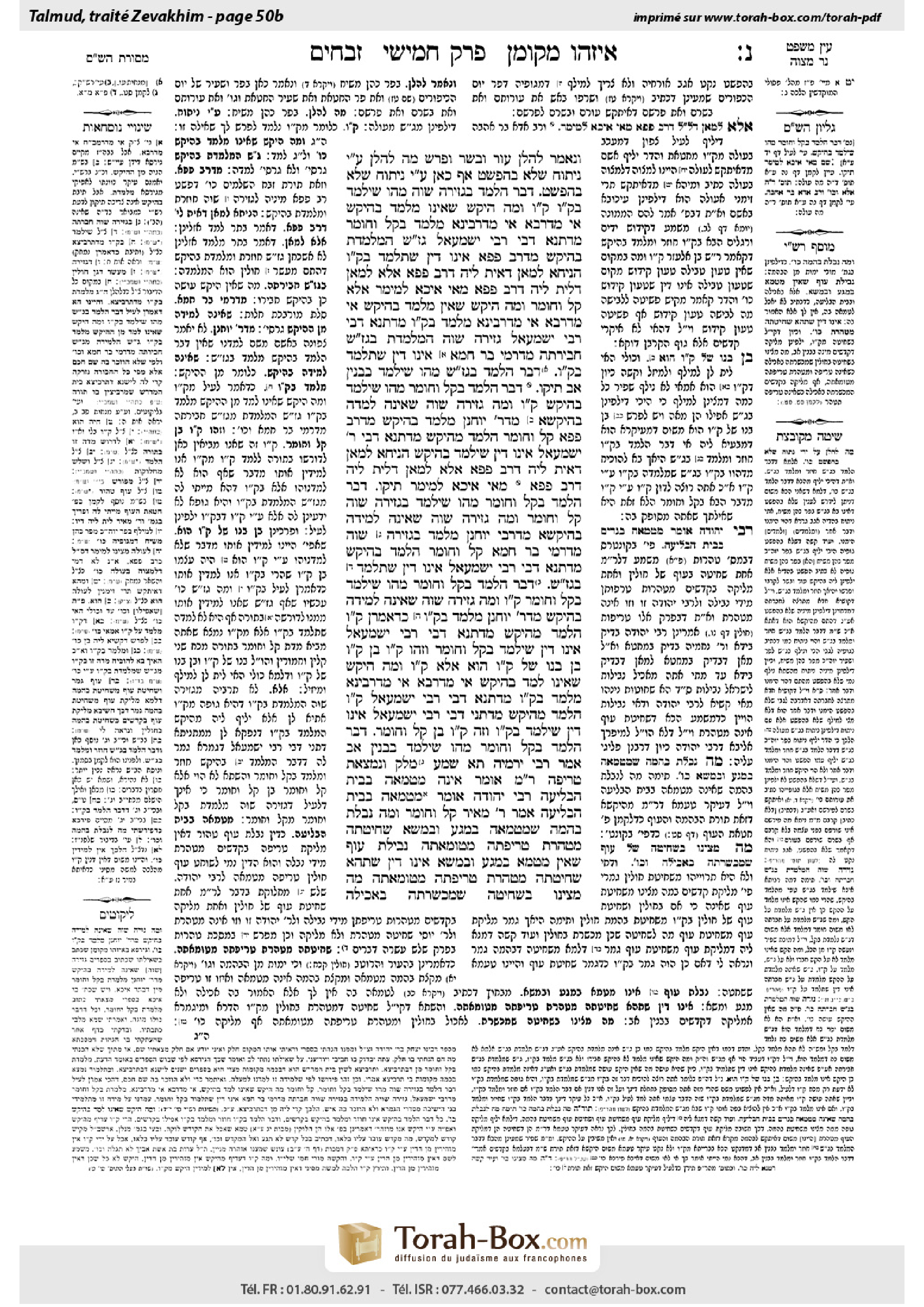
Zevachim 50b: Talmud study for Daf Yomi
Daf Yomi is the daily study of one Talmud folio. Explore 37 tractates with scans, Hebrew text, Sefaria English and AI-generated French translations where annotated.
Passage selection and English or AI-generated French translation are available where the scan has annotations. Daf Study is independent of Torah-Box and Sefaria.
Browse Zevachim · זבחים · All tractatesZevachim 50b text and translations
This page of Zevachim includes the Aramaic text, an English translation and an AI-generated French translation, alongside the scan above.
זבחים נ׳ ב · Aramaic and Hebrew text
וְנֶאֱמַר לְהַלָּן עוֹר וּבָשָׂר וָפֶרֶשׁ; מָה לְהַלָּן – עַל יְדֵי נִיתּוּחַ שֶׁלֹּא בְּהֶפְשֵׁט, אַף כָּאן – עַל יְדֵי נִיתּוּחַ שֶׁלֹּא בְּהֶפְשֵׁט.
דָּבָר הַלָּמֵד בִּגְזֵירָה שָׁוָה, מַהוּ שֶׁיְּלַמֵּד בְּקַל וָחוֹמֶר? קַל וָחוֹמֶר: וּמָה הֶיקֵּשׁ, שֶׁאֵינוֹ מְלַמֵּד בְּהֶיקֵּשׁ – אִי מִדְּרָבָא אִי מִדְּרָבִינָא, מְלַמֵּד בְּקַל וָחוֹמֶר מִדְּתָנָא דְּבֵי רַבִּי יִשְׁמָעֵאל; גְּזֵירָה שָׁוָה, הַמְלַמֶּדֶת בְּהֶיקֵּשׁ מִדְּרַב פָּפָּא, אֵינוֹ דִּין שֶׁתְּלַמֵּד בְּקַל וָחוֹמֶר?!
הָנִיחָא לְמַאן דְּאִית לֵיהּ דְּרַב פָּפָּא; אֶלָּא לְמַאן דְּלֵית לֵיהּ דְּרַב פָּפָּא, מַאי אִיכָּא לְמֵימַר?
אֶלָּא קַל וָחוֹמֶר: וּמָה הֶיקֵּשׁ, שֶׁאֵין מְלַמֵּד בְּהֶיקֵּשׁ – אִי מִדְּרָבָא אִי מִדְּרָבִינָא, מְלַמֵּד בְּקַל וָחוֹמֶר מִדְּתָנָא דְּבֵי רַבִּי יִשְׁמָעֵאל; גְּזֵירָה שָׁוָה, הַמְלַמֶּדֶת בִּגְזֵירָה שָׁוָה חֲבֶירְתָּהּ – מִדְּרָמֵי בַּר חָמָא, אֵינוֹ דִּין שֶׁתְּלַמֵּד בְּקַל וָחוֹמֶר?!
דָּבָר הַלָּמֵד בִּגְזֵירָה שָׁוָה, מַהוּ שֶׁיְּלַמֵּד בְּבִנְיַן אָב? תֵּיקוּ.
דָּבָר הַלָּמֵד בְּקַל וָחוֹמֶר, מַהוּ שֶׁיְּלַמֵּד בְּהֶיקֵּשׁ? קַל וָחוֹמֶר: וּמָה גְּזֵירָה שָׁוָה, שֶׁאֵינָהּ לְמֵדָה בְּהֶיקֵּשָׁא מִדְּרַבִּי יוֹחָנָן – מְלַמֵּד בְּהֶיקֵּשׁ מִדְּרַב פָּפָּא; קַל וָחוֹמֶר, הַלָּמֵד מֵהֶיקֵּשׁ מִדְּתָנָא דְּבֵי רַבִּי יִשְׁמָעֵאל – אֵינוֹ דִּין שֶׁיְּלַמֵּד בְּהֶיקֵּשׁ?!
הָנִיחָא – לְמַאן דְּאִית לֵיהּ דְּרַב פָּפָּא; אֶלָּא לְמַאן דְּלֵית לֵיהּ דְּרַב פָּפָּא, מַאי אִיכָּא לְמֵימַר? תֵּיקוּ.
דָּבָר הַלָּמֵד בְּקַל וָחוֹמֶר, מַהוּ שֶׁיְּלַמֵּד בִּגְזֵירָה שָׁוָה? קַל וָחוֹמֶר: וּמָה גְּזֵירָה שָׁוָה, שֶׁאֵינָהּ לְמֵידָה בְּהֶיקֵּשָׁא מִדְּרַבִּי יוֹחָנָן – מְלַמֵּד בִּגְזֵירָה שָׁוָה מִדְּרָמֵי בַּר חָמָא; קַל וָחוֹמֶר, הַלָּמֵד בְּהֶיקֵּשׁ מִדְּתָנָא דְּבֵי רַבִּי יִשְׁמָעֵאל – אֵינוֹ דִּין שֶׁתְּלַמֵּד בִּגְזֵירָה שָׁוָה?!
דָּבָר הַלָּמֵד בְּקַל וָחוֹמֶר, מַהוּ שֶׁיְּלַמֵּד בְּקַל וָחוֹמֶר? קַל וָחוֹמֶר: וּמָה גְּזֵירָה שָׁוָה, שֶׁאֵינָהּ לְמֵידָה בְּהֶיקֵּשׁ מִדְּרַבִּי יוֹחָנָן – מְלַמֵּד בְּקַל וָחוֹמֶר כְּדַאֲמַרַן; קַל וָחוֹמֶר, הַלָּמֵד מֵהֶיקֵּשׁ מִדְּתָנָא דְּבֵי רַבִּי יִשְׁמָעֵאל – אֵינוֹ דִּין שֶׁיְּלַמֵּד בְּקַל וָחוֹמֶר?!
וְזֶהוּ קַל וָחוֹמֶר בֶּן קַל וָחוֹמֶר. בֶּן בְּנוֹ שֶׁל קַל וָחוֹמֶר הוּא!
אֶלָּא קַל וָחוֹמֶר: וּמָה הֶיקֵּשׁ, שֶׁאֵינוֹ לָמֵד בְּהֶיקֵּשׁ – אִי מִדְּרָבָא אִי מִדְּרָבִינָא, מְלַמֵּד בְּקַל וָחוֹמֶר מִדְּתָנָא דְּבֵי רַבִּי יִשְׁמָעֵאל; קַל וָחוֹמֶר, הַלָּמֵד מֵהֶיקֵּשׁ מִדְּתָנֵי דְּבֵי רַבִּי יִשְׁמָעֵאל, אֵינוֹ דִּין שֶׁיְּלַמֵּד בְּקַל וָחוֹמֶר?! וְזֶהוּ קַל וָחוֹמֶר בֶּן קַל וָחוֹמֶר.
דָּבָר הַלָּמֵד בְּקַל וָחוֹמֶר, מַהוּ שֶׁיְּלַמֵּד בְּבִנְיַן אָב? אָמַר רַבִּי יִרְמְיָה, תָּא שְׁמַע: מָלַק וְנִמְצֵאת טְרֵיפָה, רַבִּי מֵאִיר אוֹמֵר: אֵינָהּ מְטַמְּאָה בְּבֵית הַבְּלִיעָה. רַבִּי יְהוּדָה אוֹמֵר: מְטַמְּאָה בְּבֵית הַבְּלִיעָה.
אָמַר רַבִּי מֵאִיר, קַל וָחוֹמֶר: וּמָה נִבְלַת בְּהֵמָה, שֶׁמְּטַמְּאָה בְּמַגָּע וּבְמַשָּׂא – שְׁחִיטָתָהּ מְטַהֶרֶת טְרֵיפָתָהּ מִטּוּמְאָתָהּ; נְבֵילַת עוֹף, שֶׁאֵין מְטַמֵּא בְּמַגָּע וּבְמַשָּׂא – אֵינוֹ דִּין שֶׁתְּהֵא שְׁחִיטָתָהּ מְטַהֶרֶת טְרֵיפָתָהּ מִטּוּמְאָתָהּ?! מָה מָצִינוּ בִּשְׁחִיטָה, שֶׁמַּכְשַׁרְתָּהּ בַּאֲכִילָה –
Zevachim 50b · English translation
And it is stated below, with regard to the bull sin offerings that are burned, the terms skin, flesh, and dung, in the verse: “But the skin of the bull, and all its flesh, with its head, and with its legs, and its innards, and its dung” (Leviticus 4:11). Just as below it is prepared for burning by means of cutting it into pieces but not by means of flaying, as derived by the verbal analogy, so too here it is prepared for burning by means of cutting it into pieces but not by means of flaying. Evidently, a halakha derived via a verbal analogy can then teach another halakha via a verbal analogy.
§ The Gemara asks: What is the halakha as to whether a matter derived via a verbal analogy can teach its halakha to another matter via an a fortiori inference? The Gemara answers: That question itself can be answered with an a fortiori inference: And just as a matter derived via a juxtaposition, which cannot then teach its halakha via a juxtaposition, as proven either from the statement of Rava or from the statement of Ravina (49b), can nevertheless teach its halakha via an a fortiori inference, as proven from the statement that the school of Rabbi Yishmael taught (50a), with regard to a matter derived via a verbal analogy, which can teach its halakha via a juxtaposition, as proven from the statement of Rav Pappa (50a), is it not logical that it should teach its halakha via an a fortiori inference?
The Gemara clarifies: This works out well according to the one who accepts the statement of Rav Pappa. But according to the one who does not accept the statement of Rav Pappa, i.e., Mar Zutra, son of Rav Mari, what is there to say?
Rather, this can be derived through a different a fortiori inference: And just as a matter derived via a juxtaposition, which cannot then teach its halakha via a juxtaposition, as proven either from the statement of Rava or from the statement of Ravina (49b), can nevertheless teach its halakha via an a fortiori inference, as proven from the statement that the school of Rabbi Yishmael taught (50a), with regard to a matter derived via a verbal analogy, which can teach its halakha via another verbal analogy, as proven from the statement of Rami bar Ḥama (50a), is it not logical that it should teach its halakha via an a fortiori inference?
The Gemara asks: What is the halakha as to whether a matter derived via a verbal analogy can teach its halakha to another matter via a paradigm? The question shall stand unresolved.
§ The Gemara asks: What is the halakha as to whether a matter derived via an a fortiori inference can teach its halakha to another matter via a juxtaposition? The Gemara answers that this itself can be derived via an a fortiori inference: And just as a halakha derived via a verbal analogy, which cannot be derived from another halakha derived via a juxtaposition, as proven from the statement of Rabbi Yoḥanan (49b), can nevertheless teach its halakha to another matter via a juxtaposition, as proven from the statement of Rav Pappa (50a), with regard to a halakha derived via an a fortiori inference, which can be derived from another halakha derived via a juxtaposition, as proven from the statement that the school of Rabbi Yishmael taught (50a), is it not logical that it should teach its halakha via a juxtaposition?
The Gemara clarifies: This works out well according to the one who accepts the statement of Rav Pappa. But according to the one who does not accept the statement of Rav Pappa, i.e., Mar Zutra, son of Rav Mari, what is there to say? The Gemara comments: The question shall stand unresolved.
The Gemara asks: What is the halakha as to whether a matter derived via an a fortiori inference can teach its halakha to another matter via a verbal analogy? The Gemara answers that this itself can be derived via an a fortiori inference. And just as a halakha derived via a verbal analogy, which cannot be derived from another halakha derived via a juxtaposition, as proven from the statement of Rabbi Yoḥanan (49b), can nevertheless teach its halakha to another matter via a verbal analogy, as proven from the statement of Rami bar Ḥama (50a), with regard to a halakha derived via an a fortiori inference, which can be derived from another halakha derived via a juxtaposition, as proven from the statement that the school of Rabbi Yishmael taught (50a), is it not logical that it should teach its halakha via a verbal analogy?
The Gemara asks: What is the halakha as to whether a matter derived via an a fortiori inference can teach its halakha to another matter via an a fortiori inference? The Gemara answers that this itself can be derived via an a fortiori inference. And just as a halakha derived via a verbal analogy, which cannot be derived from another halakha derived via a juxtaposition, as proven from the statement of Rabbi Yoḥanan (49b), can nevertheless teach its halakha to another matter via an a fortiori inference, as we have said, with regard to a halakha derived via an a fortiori inference, which can be derived from another halakha derived via a juxtaposition, as proven from the statement that the school of Rabbi Yishmael taught (50a), is it not logical that it should teach its halakha via an a fortiori inference?
The Gemara comments: And this is an a fortiori inference that is the son of, i.e., is derived from, another a fortiori inference. The Gemara challenges this last statement: It is not the son of an a fortiori inference, but the grandson of an a fortiori inference, which cannot be used. The very fact that a matter derived via a verbal analogy can then teach its halakha via an a fortiori inference is itself derived from an a fortiori inference, as the Gemara stated.
Rather, the halakha as to whether a matter derived via an a fortiori inference can teach its halakha to another matter via an a fortiori inference can be derived via another a fortiori inference. And just as a matter derived via a juxtaposition, which cannot be derived via a juxtaposition, as proven either from the statement of Rava or from the statement of Ravina (49b), can nevertheless teach its halakha via an a fortiori inference, as proven from the statement that the school of Rabbi Yishmael taught (50a), with regard to a halakha derived via an a fortiori inference, which can be derived from another halakha derived via a juxtaposition, as proven from the statement that the school of Rabbi Yishmael taught (50a), is it not logical that it should teach its halakha via an a fortiori inference? The Gemara comments: And this is an a fortiori inference that is the son of another a fortiori inference.
The Gemara asks: What is the halakha as to whether a matter derived via an a fortiori inference can teach its halakha to another matter via a paradigm? Rabbi Yirmeya says: Come and hear a proof from a mishna (69a–b): If a priest pinched the nape of a bird offering properly and it was then found to be a bird with a wound that would have caused it to die within twelve months [tereifa], which disqualifies it from being used as an offering and renders it prohibited for consumption by the priests, Rabbi Meir says: An olive-bulk of its meat does not render one who swallows it ritually impure when it is in the throat, as is the halakha concerning a bird carcass, as the fact that it underwent pinching means that it is not in the category of a carcass. Rabbi Yehuda says: Its status is like that of any other carcass of a kosher bird, and its meat renders one who swallows it ritually impure when it is in the throat.
The mishna continues: Rabbi Meir said: My opinion can be proved via an a fortiori inference. And just as with regard to the carcass of an animal, which transmits impurity to a person through touching it and carrying it, its slaughter nevertheless purifies its tereifa from its impurity, with regard to the carcass of a bird, which possesses less severe impurity, as it does not transmit impurity through touching it and carrying it, but only when it is in the throat, is it not logical that its slaughter purifies its tereifa from its impurity? And once it is established that slaughter purifies a bird that is a tereifa, it can be derived: Just as we found with regard to a bird’s slaughter that it permits it for consumption
Zevachim 50b · Traduction française (IA)
Et plus loin, à propos des sacrifices expiatoires de taureaux qui sont brûlés, les termes « peau », « chair » et « excréments » apparaissent dans le verset : « Mais la peau du taureau, toute sa chair, avec sa tête, ses pattes, ses entrailles et ses excréments » (Lévitique 4:11). De même que, dans ce passage, on le prépare à être brûlé en le découpant en morceaux, mais sans l’écorcher, comme on le déduit de l’analogie verbale, de même, ici, on le prépare à être brûlé en le découpant en morceaux, mais sans l’écorcher. Il est donc manifeste qu’une halakha déduite par analogie verbale peut ensuite en enseigner une autre par analogie verbale.
§ La Guemara demande : quelle est la halakha concernant la possibilité qu’une règle déduite par analogie verbale transmette sa halakha à un autre cas au moyen d’un raisonnement a fortiori ? La Guemara répond que cette question elle-même peut être résolue par un raisonnement a fortiori : de même qu’une règle déduite par juxtaposition, qui ne peut ensuite transmettre sa halakha par juxtaposition, comme le montrent soit la déclaration de Rava, soit celle de Ravina (49b), peut néanmoins transmettre sa halakha par un raisonnement a fortiori, comme le montre l’enseignement de l’école de Rabbi Yishmael (50a), à propos d’une règle déduite par analogie verbale, qui peut transmettre sa halakha par juxtaposition, comme le montre la déclaration de Rav Pappa (50a), à plus forte raison peut-elle transmettre sa halakha par un raisonnement a fortiori.
La Guemara précise : Cela convient selon celui qui accepte la déclaration de Rav Pappa. Mais que peut-on dire selon celui qui ne l’accepte pas, à savoir Mar Zutra, fils de Rav Mari ?
Il faut plutôt le déduire par un autre raisonnement a fortiori : de même qu’une règle déduite par juxtaposition, qui ne peut ensuite transmettre sa halakha par juxtaposition, comme le montrent soit la déclaration de Rava, soit celle de Ravina (49b), peut néanmoins transmettre sa halakha par un raisonnement a fortiori, comme le montre l’enseignement de l’école de Rabbi Yishmael (50a), à propos d’une règle déduite par analogie verbale, qui peut transmettre sa halakha par une autre analogie verbale, comme le montre la déclaration de Rami bar Ḥama (50a), à plus forte raison peut-elle transmettre sa halakha par un raisonnement a fortiori.
La Guemara demande : quelle est la halakha concernant la possibilité qu’une règle déduite par analogie verbale transmette sa halakha à un autre cas au moyen d’un paradigme ? La question reste sans réponse.
§ La Guemara demande : quelle est la halakha concernant la possibilité qu’une règle déduite par raisonnement a fortiori transmette sa halakha à un autre cas par juxtaposition ? La Guemara répond que cela même peut être déduit par un raisonnement a fortiori : de même qu’une halakha déduite par analogie verbale, qui ne peut être déduite d’une autre halakha déduite par juxtaposition, comme le montre la déclaration de Rabbi Yoḥanan (49b), peut néanmoins transmettre sa halakha à un autre cas par juxtaposition, comme le montre la déclaration de Rav Pappa (50a), à propos d’une halakha déduite par raisonnement a fortiori, qui peut être déduite d’une autre halakha déduite par juxtaposition, comme le montre l’enseignement de l’école de Rabbi Yishmael (50a), à plus forte raison peut-elle transmettre sa halakha par juxtaposition.
La Guemara précise : Cela convient selon celui qui accepte la déclaration de Rav Pappa. Mais que peut-on dire selon celui qui ne l’accepte pas, à savoir Mar Zutra, fils de Rav Mari ? La Guemara conclut : La question reste sans réponse.
La Guemara demande : quelle est la halakha concernant la possibilité qu’une règle déduite par raisonnement a fortiori transmette sa halakha à un autre cas par analogie verbale ? La Guemara répond que cela même peut être déduit par un raisonnement a fortiori. De même qu’une halakha déduite par analogie verbale, qui ne peut être déduite d’une autre halakha déduite par juxtaposition, comme le montre la déclaration de Rabbi Yoḥanan (49b), peut néanmoins transmettre sa halakha à un autre cas par analogie verbale, comme le montre la déclaration de Rami bar Ḥama (50a), à propos d’une halakha déduite par raisonnement a fortiori, qui peut être déduite d’une autre halakha déduite par juxtaposition, comme le montre l’enseignement de l’école de Rabbi Yishmael (50a), à plus forte raison peut-elle transmettre sa halakha par analogie verbale.
La Guemara demande : quelle est la halakha concernant la possibilité qu’une règle déduite par raisonnement a fortiori transmette sa halakha à un autre cas par raisonnement a fortiori ? La Guemara répond que cela même peut être déduit par un raisonnement a fortiori. De même qu’une halakha déduite par analogie verbale, qui ne peut être déduite d’une autre halakha déduite par juxtaposition, comme le montre la déclaration de Rabbi Yoḥanan (49b), peut néanmoins transmettre sa halakha à un autre cas par raisonnement a fortiori, comme nous l’avons dit, à propos d’une halakha déduite par raisonnement a fortiori, qui peut être déduite d’une autre halakha déduite par juxtaposition, comme le montre l’enseignement de l’école de Rabbi Yishmael (50a), à plus forte raison peut-elle transmettre sa halakha par raisonnement a fortiori.
La Guemara commente : Il s’agit là d’un raisonnement a fortiori qui est le fils, c’est-à-dire qui est déduit, d’un autre raisonnement a fortiori. La Guemara conteste cette dernière affirmation : ce n’est pas le fils d’un raisonnement a fortiori, mais son petit-fils, ce qui ne peut être utilisé. En effet, le fait même qu’une règle déduite par analogie verbale puisse ensuite transmettre sa halakha par raisonnement a fortiori est lui-même déduit par raisonnement a fortiori, comme l’a indiqué la Guemara.
Il faut plutôt déduire par un autre raisonnement a fortiori la halakha concernant la possibilité qu’une règle déduite par raisonnement a fortiori transmette sa halakha à un autre cas par raisonnement a fortiori : de même qu’une règle déduite par juxtaposition, qui ne peut être déduite par juxtaposition, comme le montrent soit la déclaration de Rava, soit celle de Ravina (49b), peut néanmoins transmettre sa halakha par raisonnement a fortiori, comme le montre l’enseignement de l’école de Rabbi Yishmael (50a), à propos d’une halakha déduite par raisonnement a fortiori, qui peut être déduite d’une autre halakha déduite par juxtaposition, comme le montre l’enseignement de l’école de Rabbi Yishmael (50a), à plus forte raison peut-elle transmettre sa halakha par raisonnement a fortiori. La Guemara commente : Il s’agit là d’un raisonnement a fortiori qui est le fils d’un autre raisonnement a fortiori.
La Guemara demande : quelle est la halakha concernant la possibilité qu’une règle déduite par raisonnement a fortiori transmette sa halakha à un autre cas au moyen d’un paradigme ? Rabbi Yirmeya dit : Viens entendre une preuve tirée d’une Michna (69a–b) : si un prêtre a correctement pratiqué la mélika sur la nuque d’un oiseau offert, puis qu’on a constaté que l’oiseau était atteint d’une blessure qui aurait entraîné sa mort dans les douze mois [tereifa], ce qui le disqualifie comme offrande et interdit sa consommation aux prêtres, Rabbi Meïr dit : un volume d’olive de sa chair ne rend pas rituellement impur, lorsqu’il se trouve dans la gorge, celui qui l’avale, contrairement à la halakha relative à la carcasse d’un oiseau ; en effet, le fait qu’il ait subi la mélika signifie qu’il n’entre pas dans la catégorie des carcasses. Rabbi Yehouda dit : son statut est celui de toute autre carcasse d’oiseau cachère, et sa chair rend rituellement impur, lorsqu’elle se trouve dans la gorge, celui qui l’avale.
La Michna poursuit : Rabbi Meïr a dit : Mon opinion peut être démontrée par un raisonnement a fortiori. De même que, pour la carcasse d’un animal, qui transmet l’impureté à une personne par contact et par port, l’abattage rituel soustrait néanmoins à son impureté l’animal tereifa, à plus forte raison l’abattage rituel d’une carcasse d’oiseau, dont l’impureté est moins grave puisqu’elle ne se transmet pas par contact ni par port, mais seulement lorsqu’elle se trouve dans la gorge, devrait-il la soustraire à son impureté. Et dès lors qu’il est établi que l’abattage rituel purifie un oiseau tereifa, on peut en déduire ceci : de même que nous avons constaté que l’abattage rituel d’un oiseau le rend propre à la consommation
Traduction française générée par IA à partir de l’édition anglaise de Sefaria. Vérifie toujours un passage avec le texte source.
Text from Sefaria: William Davidson Edition - Vocalized Aramaic (CC BY NC); William Davidson Edition - English (CC BY NC).