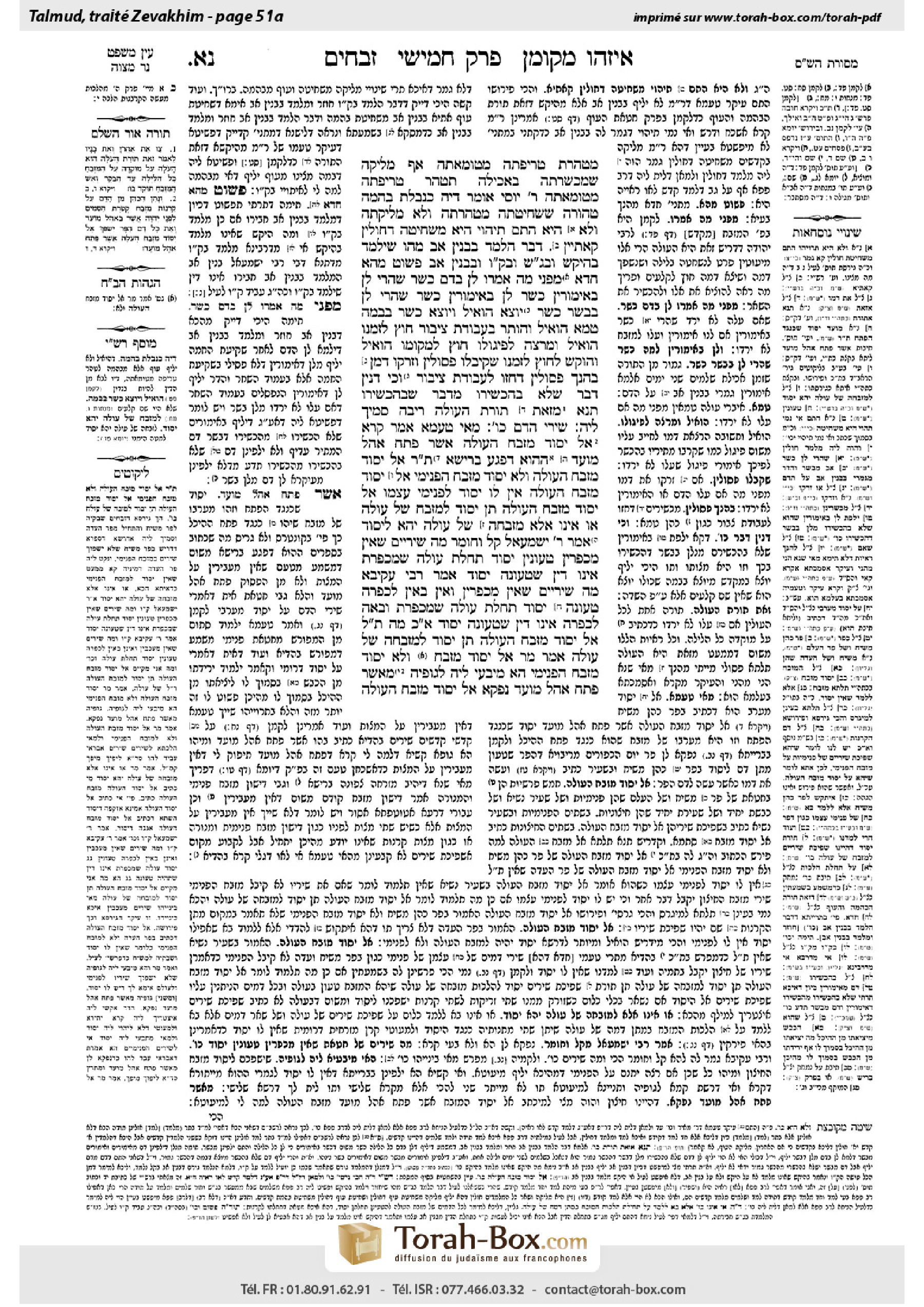
Zevachim 51a: Talmud study for Daf Yomi
Daf Yomi is the daily study of one Talmud folio. Explore 37 tractates with scans, Hebrew text, Sefaria English and AI-generated French translations where annotated.
Passage selection and English or AI-generated French translation are available where the scan has annotations. Daf Study is independent of Torah-Box and Sefaria.
Browse Zevachim · זבחים · All tractatesZevachim 51a text and translations
This page of Zevachim includes the Aramaic text, an English translation and an AI-generated French translation, alongside the scan above.
זבחים נ״א א · Aramaic and Hebrew text
מְטַהֶרֶת טְרֵיפָתָהּ מִטּוּמְאָתָהּ; אַף מְלִיקָה, שֶׁמַּכְשַׁרְתָּהּ בַּאֲכִילָה – תְּטַהֵר טְרֵיפָתָהּ מִטּוּמְאָתָהּ.
רַבִּי יוֹסֵי אוֹמֵר: דַּיָּהּ כְּנִבְלַת בְּהֵמָה טְהוֹרָה – שֶׁשְּׁחִיטָתָהּ מְטַהַרְתָּהּ, וְלֹא מְלִיקָתָהּ.
וְלָא הִיא; הָתָם תֶּיהְוֵי הִיא, מִשְּׁחִיטָה דְּחוּלִּין קָאָתְיָין.
דָּבָר הַלָּמֵד בְּבִנְיַן אָב, מַהוּ שֶׁיְּלַמֵּד בְּהֶיקֵּשׁ וּבִגְזֵירָה שָׁוָה וּבְקַל וָחוֹמֶר וּבְבִנְיַן אָב?
פְּשׁוֹט מִיהָא חֲדָא – מִפְּנֵי מָה אָמְרוּ: לָן בַּדָּם – כָּשֵׁר? שֶׁהֲרֵי לָן בָּאֵימוּרִין כָּשֵׁר. לָן בְּאֵימוּרִין כָּשֵׁר – שֶׁהֲרֵי לָן בַּבָּשָׂר כָּשֵׁר.
יוֹצֵא – הוֹאִיל וְיוֹצֵא כָּשֵׁר בְּבָמָה.
טָמֵא – הוֹאִיל וְהוּתַּר בַּעֲבוֹדַת צִיבּוּר.
חוּץ לִזְמַנּוֹ – הוֹאִיל וּמְרַצֶּה לְפִיגּוּלוֹ.
חוּץ לִמְקוֹמוֹ – הוֹאִיל וְהוּקַּשׁ לְחוּץ לִזְמַנּוֹ.
שֶׁקִּיבְּלוּ פְּסוּלִין וְזָרְקוּ דָּמָן – בְּהָנָךְ פְּסוּלִין דַּחֲזוּ לַעֲבוֹדַת צִיבּוּר.
וְכִי דָּנִין דָּבָר שֶׁלֹּא בְּהֶכְשֵׁירוֹ, מִדָּבָר שֶׁבְּהֶכְשֵׁירוֹ?!
תַּנָּא מִ״זֹּאת תּוֹרַת הָעוֹלָה״ רִיבָּה סָמֵיךְ לֵיהּ.
שְׁיָרֵי הַדָּם כּוּ׳. מַאי טַעְמָא? אָמַר קְרָא: ״אֶל יְסוֹד מִזְבַּח הָעֹלָה אֲשֶׁר פֶּתַח אֹהֶל מוֹעֵד״ – הַהוּא דְּפָגַע בְּרֵישָׁא.
תָּנוּ רַבָּנַן: ״אֶל יְסוֹד מִזְבַּח הָעֹלָה״ – וְלֹא יְסוֹד מִזְבֵּחַ הַפְּנִימִי.
״אֶל יְסוֹד מִזְבַּח הָעֹלָה״ – אֵין לוֹ יְסוֹד לַפְּנִימִי עַצְמוֹ.
״אֶל יְסוֹד מִזְבַּח הָעֹלָה״ – תֵּן יְסוֹד לַמִּזְבֵּחַ שֶׁל עוֹלָה.
אוֹ אֵינוֹ אֶלָּא מִזְבְּחָהּ שֶׁל עוֹלָה – יְהֵא לַיְסוֹד? אָמַר רַבִּי יִשְׁמָעֵאל: קַל וָחוֹמֶר; מָה שִׁירַיִים, שֶׁאֵין מְכַפְּרִין – טְעוּנִין יְסוֹד; תְּחִלַּת עוֹלָה, שֶׁמְּכַפֶּרֶת – אֵינוֹ דִּין שֶׁטְּעוּנָה יְסוֹד?!
אָמַר רַבִּי עֲקִיבָא: מָה שִׁירַיִים, שֶׁאֵין מְכַפְּרִין וְאֵין בָּאִין לְכַפָּרָה – טְעוּנָה יְסוֹד; תְּחִלַּת עוֹלָה, שֶׁמְּכַפֶּרֶת וּבָאָה לְכַפָּרָה – אֵינוֹ דִּין שֶׁטְּעוּנָה יְסוֹד?
אִם כֵּן, מָה תַּלְמוּד לוֹמַר ״אֶל יְסוֹד מִזְבַּח הָעֹלָה״? תֵּן יְסוֹד לְמִזְבְּחָהּ שֶׁל עוֹלָה.
אָמַר מָר: ״אֶל יְסוֹד מִזְבַּח״ – וְלֹא יְסוֹד מִזְבֵּחַ הַפְּנִימִי. הָא מִיבְּעֵי לֵיהּ לְגוּפֵיהּ! מֵ״אֲשֶׁר פֶּתַח אֹהֶל מוֹעֵד״ נָפְקָא.
״אֶל יְסוֹד מִזְבַּח הָעוֹלָה״ –
Zevachim 51a · English translation
and it purifies its tereifa from its impurity, so too its pinching, which permits bird offerings with regard to consumption, should purify its tereifa from its impurity.
Rabbi Yosei says: Although one can derive from the case of an animal that slaughter purifies the tereifa of a bird from its impurity, that derivation cannot be extended to pinching. The same restriction that applies to every a fortiori inference, namely, that a halakha derived by means of an a fortiori inference is no more stringent than the source from which it is derived, applies here: It is sufficient for the halakhic status of the carcass of a bird that is a tereifa to be like that of the carcass of an animal of a kosher species that is a tereifa; i.e., that only its slaughter purifies it, but not its pinching.
The Gemara rejects this proof: And that is not so. Let it remain there, i.e., one cannot learn from it, as that is a case that comes from the slaughter of non-sacred animals. The halakha of the pinching of a consecrated bird is derived through a paradigm from the halakha of the slaughter of a non-sacred bird, and the halakha of the slaughter of a non-sacred bird is derived through an a fortiori inference from the halakha of the slaughter of a non-sacred animal. Outside of the realm of consecrated matters there is no question that a matter derived via one of the hermeneutical principles can then teach its halakha via another principle. The entire question under discussion is only with regard to the realm of consecrated matters.
§ The Gemara asks: What is the halakha as to whether a matter derived via a paradigm can teach its halakha to another matter via a juxtaposition or via a verbal analogy or via an a fortiori inference or via a paradigm?
The Gemara states: Resolve at least one of those questions. The Gemara cites a lengthy baraita before stating the resolution inferred from that baraita. For what reason did the Sages say that in the case of blood left overnight it is fit, i.e., if blood of an offering had been left overnight and was then placed on the altar it need not be removed? This is as it is in the case of sacrificial portions, where if they are left overnight they are fit. From where is it derived that in the case of sacrificial portions which are left overnight, they are fit? This is as it is in the case of meat, where if it is left overnight it is fit, because the meat of a peace offering may be eaten for two days and one night.
From where is it derived that if an offering that has left the Temple courtyard is then placed on the altar it need not be removed? This is derived by a paradigm, since an offering that leaves its area is fit in the case of an offering brought on a private altar.
From where is it derived that if an offering that has become ritually impure is placed on the altar it need not be removed? This is derived by a paradigm, since one is permitted to offer an impure offering in the case of communal rites, i.e., communal offerings. In cases of necessity, the communal offerings may be sacrificed even if they are ritually impure.
From where is it derived that in the case of an offering that was disqualified due to the intention of the priest who slaughtered it to consume it beyond its designated time [piggul], if it was placed on the altar it need not be removed? The halakha applies there since the sprinkling of its blood effects acceptance of the offering notwithstanding its status of piggul. The status of piggul takes effect only if the sacrificial rites involving that offering were otherwise performed properly. This indicates that it still has the status of an offering, so it need not be removed from the altar.
From where is it derived that in the case of an offering that was disqualified due to the intention of the priest who slaughtered it to consume it outside its designated area, if it was placed on the altar it need not be removed? This is derived by a paradigm, since it is juxtaposed to an offering that was slaughtered with intent to consume it beyond its designated time.
From where is it derived that in the case of an offering for which priests who are disqualified collected and sprinkled its blood, if it was placed on the altar it need not be removed? This is derived from the halakha of these priests who are generally disqualified because they are impure, yet who are fit to perform the communal rites, i.e., to sacrifice communal offerings, when all the priests or the majority of the Jewish people are impure. In any event, the halakha of the sacrificial portions was derived via a paradigm from the halakha of meat that was left overnight, and then the halakha of blood was derived via a paradigm from the halakha of the sacrificial portions. Evidently, a matter derived via a paradigm can teach its halakha to another matter via a paradigm.
The Gemara questions the derivations of the baraita: But can one deduce the halakha of a matter that is not fit, i.e., sacrificial portions that are disqualified due to having been left overnight, from the halakha of a matter that is fit, i.e., the peace offering, which is permitted to be eaten for two days and one night? Similarly, how can the baraita derive the halakha of meat that was removed from the Temple courtyard from the halakha of a private altar, which has no sacred area surrounding it?
The Gemara answers: The tanna relied on the verse: “Command Aaron and his sons, saying: This is the law of the burnt offering: It is that which goes up on its firewood upon the altar all night until the morning; and the fire of the altar shall thereby be kept burning” (Leviticus 6:2), which amplified it, teaching that many types of disqualified offerings may be left upon the altar. The derivations written in the baraita are mere supports for those halakhot.
§ The mishna teaches with regard to the sin offerings whose blood is presented inside the Sanctuary: As to the remainder of the blood which is left after the sprinklings, a priest would pour it onto the western base of the external altar. But if he did not place the remainder of the blood on the western base, it does not disqualify the offering. The Gemara asks: What is the reason that it must be poured on the western base? The Gemara answers: The verse states with regard to the bull offering of the High Priest: “And the priest shall sprinkle the blood upon the corners of the altar of sweet incense before the Lord, which is in the Tent of Meeting; and all the remaining blood of the bull he shall pour out at the base of the altar of burnt offering, which is at the entrance of the Tent of Meeting” (Leviticus 4:7). This means that he must pour it on that base which he encounters first when he leaves the Tent of Meeting, which is the western base.
The Sages taught in a baraita: There are three verses that contain the same phrase. With regard to pouring the remainder of the blood of a bull offering of the High Priest, the verse states: “All the remaining blood of the bull he shall pour out at the base of the altar of burnt offering” (Leviticus 4:7). This teaches that it must be on the base of the external altar, but not on the base of the inner altar, where he had sprinkled the blood.
The baraita continues: With regard to the bull sacrificed for an unwitting communal sin the verse states: “And he shall sprinkle the blood upon the corners of the altar which is before the Lord, that is in the Tent of Meeting, and all the remaining blood shall he pour out at the base of the altar of burnt offering, which is at the entrance of the Tent of Meeting” (Leviticus 4:18). This teaches that the inner altar itself has no base at all.
Finally, the verse states with regard to the sin offering of a king: “And the priest shall take of the blood of the sin offering with his finger and place it upon the corners of the altar of burnt offering, and the remaining blood thereof shall he pour out at the base of the altar of the burnt offering” (Leviticus 4:25). This teaches that you must give a base to the altar of the burnt offering, i.e., that the remainder of any blood placed on the altar must be poured on the base.
The baraita continues: Or perhaps it is not so, but rather the verse serves to teach that any sprinkling of blood on the corners of the altar of the burnt offering will be done on a part of the altar where there is a base. Rabbi Yishmael said: There is no need for the verse to teach that halakha, because it can be derived via an a fortiori inference: Just as the remainder of the blood, which does not effect atonement, requires pouring on the base of the altar, with regard to the initial sprinkling of the blood of a burnt offering, which effects atonement, is it not logical that it requires a part of the altar where there is a base?
Similarly, Rabbi Akiva said: Just as the remainder of the blood, which does not effect atonement and does not come for atonement, nevertheless requires pouring on the base of the altar, with regard to the initial sprinkling of the blood of a burnt offering, which effects atonement and comes for atonement, is it not logical that it requires a part of the altar where there is a base?
The baraita concludes: If so, why must the verse state: “At the base of the altar of burnt offering” (Leviticus 4:25)? It is to teach that you must give a base to the altar of the burnt offering, i.e., that the remainder of the blood of the offering must be poured on the base.
The Gemara discusses this baraita. The Master says: The verse states: “At the base of the altar of burnt offering, which is at the entrance of the Tent of Meeting” (Leviticus 4:18). This teaches that it must be on the base of the external altar, but not the base of the inner altar. The Gemara asks: Isn’t that necessary for the matter itself, to teach that the remainder of the blood must be poured onto the base of the external altar? The Gemara answers: That halakha is derived from: “Which is at the entrance of the Tent of Meeting” (Leviticus 4:18), referring to the external altar. Therefore, the verse mentions the altar of burnt offering to exclude the base of the inner altar.
The baraita teaches with regard to the sin offering of a king: The verse states: “And the priest shall take of the blood of the sin offering with his finger, and place it upon the corners of the altar of burnt offering, and the remaining blood thereof shall he pour out at the base of the altar of burnt offering” (Leviticus 4:25).
Zevachim 51a · Traduction française (IA)
et elle purifie de son impureté la carcasse de son animal tréfa ; de même, sa mélika, qui rend les offrandes d’oiseaux permises à la consommation, devrait purifier de son impureté la carcasse de son animal tréfa.
Rabbi Yosei dit : Bien que l’on puisse déduire du cas d’un animal que l’abattage purifie de son impureté la carcasse d’un oiseau tréfa, cette déduction ne peut pas être étendue à la mélika. La même restriction qui s’applique à toute inférence a fortiori — à savoir qu’une halakha déduite par inférence a fortiori n’est pas plus rigoureuse que sa source — s’applique ici : il suffit que le statut halakhique de la carcasse d’un oiseau tréfa soit semblable à celui de la carcasse d’un animal d’une espèce cachère qui est tréfa ; autrement dit, seul son abattage la purifie, et non sa mélika.
La Guemara rejette cette preuve : Mais il n’en est pas ainsi. Que ce cas reste à part, c’est-à-dire qu’on ne puisse rien en déduire, car il relève de l’abattage d’animaux non consacrés. La halakha de la mélika d’un oiseau consacré est déduite, par le biais d’un paradigme, de la halakha de l’abattage d’un oiseau non consacré ; et la halakha de l’abattage d’un oiseau non consacré est déduite par inférence a fortiori de la halakha de l’abattage d’un animal non consacré. En dehors du domaine des choses consacrées, il ne fait aucun doute qu’une règle déduite au moyen d’un des principes herméneutiques peut ensuite transmettre sa halakha à une autre règle au moyen d’un autre principe. Toute la question débattue ici ne concerne que le domaine des choses consacrées.
§ La Guemara demande : Quelle est la halakha quant à savoir si une règle déduite au moyen d’un paradigme peut transmettre sa halakha à une autre règle au moyen d’un rapprochement scripturaire, d’une analogie verbale, d’une inférence a fortiori ou d’un paradigme ?
La Guemara déclare : Résolvons au moins l’une de ces questions. Avant d’énoncer la réponse déduite de cette baraïta, la Guemara cite une longue baraïta. Pour quelle raison les Sages ont-ils dit que, dans le cas du sang laissé toute la nuit, il reste valide, c’est-à-dire que si le sang d’une offrande a été laissé toute la nuit puis placé sur l’autel, il n’est pas nécessaire de l’en retirer ? C’est comme dans le cas des portions sacrificielles : si elles sont laissées toute la nuit, elles restent valides. D’où déduit-on que les portions sacrificielles laissées toute la nuit restent valides ? C’est comme dans le cas de la viande : si elle est laissée toute la nuit, elle reste valide, car la viande d’une offrande de paix peut être consommée pendant deux jours et une nuit.
D’où déduit-on que, si une offrande qui a quitté la cour du Temple est ensuite placée sur l’autel, il n’est pas nécessaire de l’en retirer ? Cela se déduit au moyen d’un paradigme, puisque, dans le cas d’une offrande apportée sur un autel privé, une offrande qui quitte son périmètre reste valide.
D’où déduit-on que, si une offrande devenue rituellement impure est placée sur l’autel, il n’est pas nécessaire de l’en retirer ? Cela se déduit au moyen d’un paradigme, puisque, dans le cas des rites communautaires, c’est-à-dire des offrandes communautaires, il est permis d’offrir une offrande impure. En cas de nécessité, les offrandes communautaires peuvent être sacrifiées même si elles sont rituellement impures.
D’où déduit-on que, dans le cas d’une offrande disqualifiée parce que le prêtre qui l’a abattue avait l’intention de la consommer après le délai prévu [piggul], si elle a été placée sur l’autel, il n’est pas nécessaire de l’en retirer ? La règle s’applique dans ce cas, car l’aspersion de son sang rend l’offrande agréée malgré son statut de piggul. Le statut de piggul ne prend effet que si les rites sacrificiels concernant cette offrande ont par ailleurs été accomplis correctement. Cela indique qu’elle conserve le statut d’offrande et qu’il n’est donc pas nécessaire de la retirer de l’autel.
D’où déduit-on que, dans le cas d’une offrande disqualifiée parce que le prêtre qui l’a abattue avait l’intention de la consommer hors du périmètre prévu, si elle a été placée sur l’autel, il n’est pas nécessaire de l’en retirer ? Cela se déduit au moyen d’un paradigme, car elle est rapprochée d’une offrande abattue avec l’intention de la consommer après le délai prévu.
D’où déduit-on que, dans le cas d’une offrande dont des prêtres disqualifiés ont recueilli et aspergé le sang, s’ils l’ont placée sur l’autel, il n’est pas nécessaire de l’en retirer ? Cela se déduit de la halakha concernant ces prêtres, généralement disqualifiés parce qu’ils sont impurs, mais aptes à accomplir les rites communautaires, c’est-à-dire à sacrifier les offrandes communautaires, lorsque tous les prêtres ou la majorité du peuple juif sont impurs. Quoi qu’il en soit, la halakha concernant les portions sacrificielles a été déduite au moyen d’un paradigme de la halakha concernant la viande laissée toute la nuit ; ensuite, la halakha concernant le sang a été déduite au moyen d’un paradigme de la halakha concernant les portions sacrificielles. Il est donc évident qu’une règle déduite au moyen d’un paradigme peut transmettre sa halakha à une autre règle au moyen d’un paradigme.
La Guemara remet en question les déductions de la baraïta : Mais peut-on déduire la halakha d’une chose qui n’est pas valide — c’est-à-dire des portions sacrificielles disqualifiées parce qu’elles ont été laissées toute la nuit — de la halakha d’une chose qui est valide, c’est-à-dire l’offrande de paix, qu’il est permis de consommer pendant deux jours et une nuit ? De même, comment la baraïta peut-elle déduire la halakha concernant la viande qui a quitté la cour du Temple de celle d’une offrande sur un autel privé, où il n’y a aucun espace sacré autour de l’autel ?
La Guemara répond : Le tanna s’est appuyé sur le verset : « Ordonne à Aaron et à ses fils, en disant : Voici la loi de l’holocauste : c’est ce qui reste sur son brasier, sur l’autel, toute la nuit jusqu’au matin ; le feu de l’autel sera ainsi entretenu » (Lévitique 6:2). Ce verset élargit la portée de la règle et enseigne que de nombreuses catégories d’offrandes disqualifiées peuvent rester sur l’autel. Les déductions consignées dans la baraïta ne sont que des appuis à ces halakhot.
§ La Michna enseigne au sujet des sacrifices expiatoires dont le sang est appliqué à l’intérieur du Sanctuaire : quant au reste du sang après les aspersions, un prêtre le versait sur la base occidentale de l’autel extérieur. Mais s’il ne déposait pas le reste du sang sur la base occidentale, cela ne disqualifiait pas l’offrande. La Guemara demande : Pourquoi faut-il le verser sur la base occidentale ? La Guemara répond : Le verset dit au sujet du taureau offert par le grand prêtre : « Le prêtre aspergera le sang sur les cornes de l’autel de l’encens, devant le Seigneur, qui se trouve dans la tente d’assignation ; et tout le reste du sang du taureau, il le versera à la base de l’autel de l’holocauste, qui est à l’entrée de la tente d’assignation » (Lévitique 4:7). Cela signifie qu’il doit le verser sur la base qu’il rencontre en premier en sortant de la tente d’assignation, à savoir la base occidentale.
Les Sages ont enseigné dans une baraïta : Trois versets contiennent la même expression. Au sujet du versement du reste du sang du taureau offert par le grand prêtre, le verset dit : « Tout le reste du sang du taureau, il le versera à la base de l’autel de l’holocauste » (Lévitique 4:7). Cela enseigne qu’il doit le verser à la base de l’autel extérieur, et non à celle de l’autel intérieur, où il avait aspergé le sang.
La baraïta poursuit : Au sujet du taureau sacrifié pour un péché involontaire de la communauté, le verset dit : « Il aspergera le sang sur les cornes de l’autel qui est devant le Seigneur, dans la tente d’assignation, et tout le reste du sang, il le versera à la base de l’autel de l’holocauste, qui est à l’entrée de la tente d’assignation » (Lévitique 4:18). Cela enseigne que l’autel intérieur lui-même n’a aucune base.
Enfin, au sujet du sacrifice expiatoire d’un roi, le verset dit : « Le prêtre prendra avec son doigt du sang du sacrifice expiatoire et le mettra sur les cornes de l’autel de l’holocauste ; il versera le reste de son sang à la base de l’autel de l’holocauste » (Lévitique 4:25). Cela enseigne qu’il faut donner une base à l’autel de l’holocauste, c’est-à-dire que le reste de tout sang placé sur l’autel doit être versé à la base.
La baraïta poursuit : Ou peut-être n’en est-il pas ainsi, et le verset enseigne plutôt que toute aspersion du sang sur les cornes de l’autel de l’holocauste doit se faire sur une partie de l’autel qui possède une base. Rabbi Yishmael dit : Il n’est pas nécessaire que le verset enseigne cette halakha, car on peut la déduire par inférence a fortiori : si le reste du sang, qui n’accomplit pas l’expiation, doit être versé à la base de l’autel, l’aspersion initiale du sang d’un holocauste, qui accomplit l’expiation, ne doit-elle pas, à plus forte raison, se faire sur une partie de l’autel qui possède une base ?
De même, Rabbi Akiva dit : Si le reste du sang, qui n’accomplit pas l’expiation et n’est pas apporté en vue de l’expiation, doit néanmoins être versé à la base de l’autel, l’aspersion initiale du sang d’un holocauste, qui accomplit l’expiation et est apporté en vue de l’expiation, ne doit-elle pas, à plus forte raison, se faire sur une partie de l’autel qui possède une base ?
La baraïta conclut : Si tel est le cas, pourquoi le verset doit-il dire : « À la base de l’autel de l’holocauste » (Lévitique 4:25) ? Pour enseigner qu’il faut donner une base à l’autel de l’holocauste, c’est-à-dire que le reste du sang de l’offrande doit être versé à la base.
La Guemara examine cette baraïta. Le Maître dit : Le verset dit : « À la base de l’autel de l’holocauste, qui est à l’entrée de la tente d’assignation » (Lévitique 4:18). Cela enseigne qu’il doit le verser à la base de l’autel extérieur, et non à celle de l’autel intérieur. La Guemara demande : N’est-ce pas nécessaire pour enseigner la règle elle-même, à savoir que le reste du sang doit être versé à la base de l’autel extérieur ? La Guemara répond : Cette halakha se déduit des mots « qui est à l’entrée de la tente d’assignation » (Lévitique 4:18), qui désignent l’autel extérieur. Le verset mentionne donc l’autel de l’holocauste pour exclure la base de l’autel intérieur.
La baraïta enseigne au sujet du sacrifice expiatoire d’un roi : Le verset dit : « Le prêtre prendra avec son doigt du sang du sacrifice expiatoire, le mettra sur les cornes de l’autel de l’holocauste, et il versera le reste de son sang à la base de l’autel de l’holocauste » (Lévitique 4:25).
Traduction française générée par IA à partir de l’édition anglaise de Sefaria. Vérifie toujours un passage avec le texte source.
Text from Sefaria: William Davidson Edition - Vocalized Aramaic (CC BY NC); William Davidson Edition - English (CC BY NC).