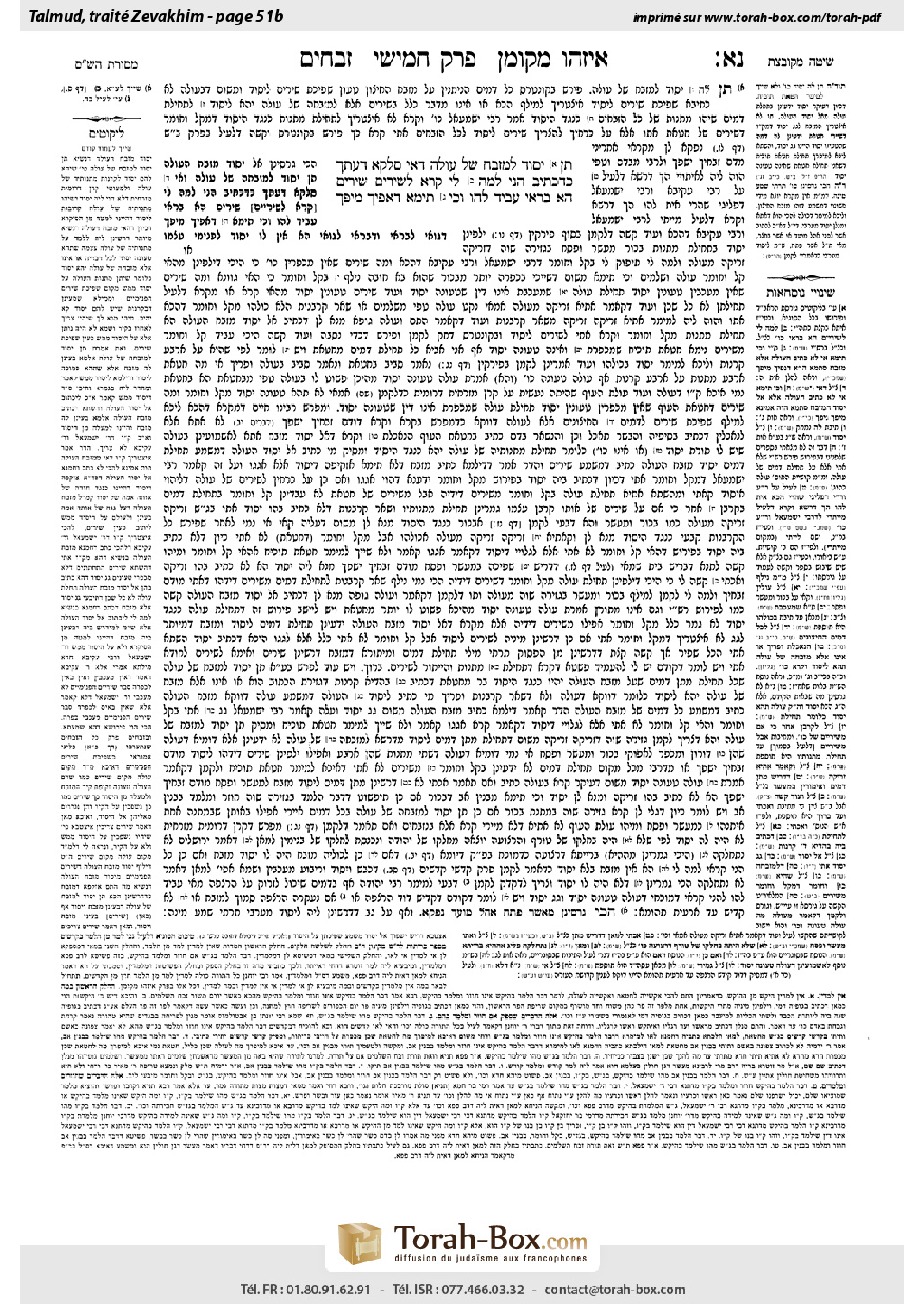
Zevachim 51b: Talmud study for Daf Yomi
Daf Yomi is the daily study of one Talmud folio. Explore 37 tractates with scans, Hebrew text, Sefaria English and AI-generated French translations where annotated.
Passage selection and English or AI-generated French translation are available where the scan has annotations. Daf Study is independent of Torah-Box and Sefaria.
Browse Zevachim · זבחים · All tractatesZevachim 51b text and translations
This page of Zevachim includes the Aramaic text, an English translation and an AI-generated French translation, alongside the scan above.
זבחים נ״א ב · Aramaic and Hebrew text
תֵּן יְסוֹד לַמִּזְבֵּחַ שֶׁל עוֹלָה.
דְּאִי סָלְקָא דַעְתָּךְ כְּדִכְתִיב; הָנֵי לְמָה לִי קְרָא – לְשִׁירַיִם?! שִׁירַיִם הָא בָּרַאי עָבֵיד לְהוּ!
וְכִי תֵּימָא דְּאָפֵיךְ מֵיפָךְ –
Zevachim 51b · English translation
This teaches that you must give a base to the altar of the burnt offering, i.e., that the remainder of any blood placed on the altar must be poured on the base.
The Gemara explains: Because if it enters your mind that the verse states this simply to teach as it is written, concerning this offering alone, why do I need these verses with regard to the sin offering of a king? If you would answer: The verses are needed to teach the halakha that the remainder of the blood must be poured on the external altar rather than on the inner altar, then the question remains: Is there any need for the Torah to teach this about the remainder? But the sprinklings of blood themselves are performed on the external altar, so why would one think that the remainder of the blood should be poured on the inner altar?
And if you would say that one might mistakenly say that the priest reverses the sprinklings,
Zevachim 51b · Traduction française (IA)
Cela enseigne qu’il faut donner une base à l’autel de l’holocauste, c’est-à-dire que le reste de tout sang déposé sur l’autel doit être versé à sa base.
La Guemara explique : Car, si l’on pensait que le verset énonce cela simplement pour enseigner ce qui est écrit, au sujet de cette offrande seulement, pourquoi aurait-on besoin de ces versets concernant le sacrifice expiatoire d’un roi ? Si l’on répondait que ces versets sont nécessaires pour enseigner la halakha selon laquelle le reste du sang doit être versé sur l’autel extérieur plutôt que sur l’autel intérieur, la question demeure : La Torah aurait-elle besoin d’enseigner cela à propos du reste ? En effet, les aspersions de sang elles-mêmes sont effectuées sur l’autel extérieur ; pourquoi penserait-on donc que le reste du sang doit être versé sur l’autel intérieur ?
Et si l’on disait que l’on pourrait penser à tort que le prêtre inverse l’ordre des aspersions,
Traduction française générée par IA à partir de l’édition anglaise de Sefaria. Vérifie toujours un passage avec le texte source.
Text from Sefaria: William Davidson Edition - Vocalized Aramaic (CC BY NC); William Davidson Edition - English (CC BY NC).