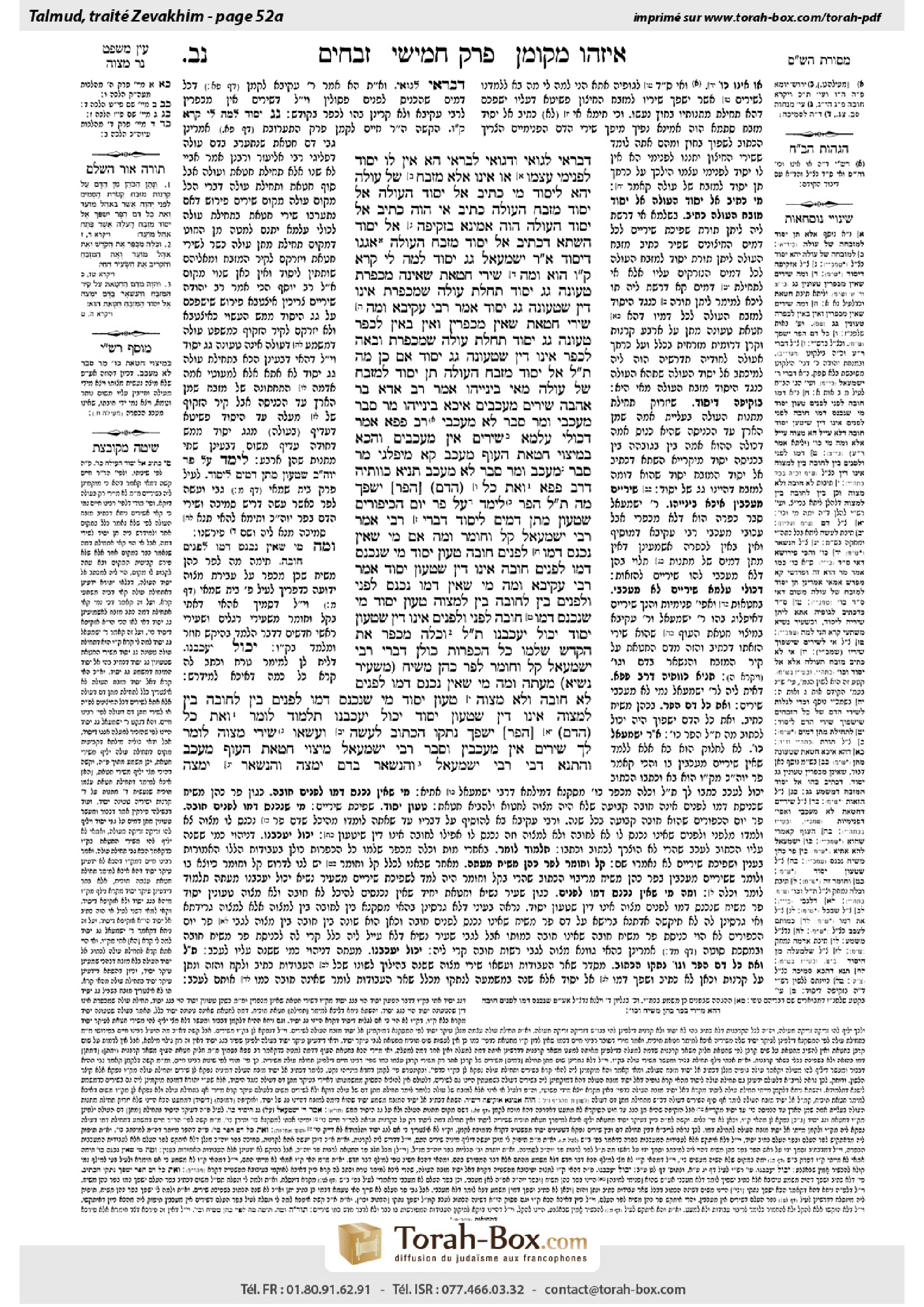
Zevachim 52a: Talmud study for Daf Yomi
Daf Yomi is the daily study of one Talmud folio. Explore 37 tractates with scans, Hebrew text, Sefaria English and AI-generated French translations where annotated.
Passage selection and English or AI-generated French translation are available where the scan has annotations. Daf Study is independent of Torah-Box and Sefaria.
Browse Zevachim · זבחים · All tractatesZevachim 52a text and translations
This page of Zevachim includes the Aramaic text, an English translation and an AI-generated French translation, alongside the scan above.
זבחים נ״ב א · Aramaic and Hebrew text
דְּבָרַאי לְגַוַּאי וּדְגַוַּאי לְבָרַאי; הָא אֵין לוֹ יְסוֹד לִפְנִימִי עַצְמוֹ!
אוֹ אֵינוֹ אֶלָּא מִזְבְּחָהּ שֶׁל עוֹלָה יְהֵא לַיְסוֹד. מִי כְּתִיב ״אֶל יְסוֹד הָעוֹלָה״?! ״אֶל יְסוֹד מִזְבַּח הָעוֹלָה״ כְּתִיב!
אִי הֲוָה כְּתִיב ״אֶל יְסוֹד הָעוֹלָה״ – הֲוָה אָמֵינָא: בִּזְקִיפָה אֶל יְסוֹד; הַשְׁתָּא דִּכְתִיב: ״אֶל יְסוֹד מִזְבַּח הָעוֹלָה״ – אַגַּגּוֹ דִּיסוֹד.
אָמַר רַבִּי יִשְׁמָעֵאל: גַּג יְסוֹד לְמָה לִי קְרָא? קַל וָחוֹמֶר הוּא: וּמָה שְׁיָרֵי חַטָּאת, שֶׁאֵינָהּ מְכַפֶּרֶת – טְעוּנָה גַּג יְסוֹד; תְּחִלַּת עוֹלָה, שֶׁמְּכַפֶּרֶת – אֵינוֹ דִּין שֶׁטְּעוּנָה גַּג יְסוֹד?!
אָמַר רַבִּי עֲקִיבָא: וּמָה שְׁיָרֵי חַטָּאת, שֶׁאֵין מְכַפְּרִין וְאֵין בָּאִין לְכַפֵּר – טְעוּנָה גַּג יְסוֹד; תְּחִלַּת עוֹלָה, שֶׁמְּכַפֶּרֶת וּבָאָה לְכַפֵּר – אֵינוֹ דִּין שֶׁטְּעוּנָה גַּג יְסוֹד?! אִם כֵּן, מָה תַּלְמוּד לוֹמַר ״אֶל יְסוֹד מִזְבַּח הָעוֹלָה״? תֵּן יְסוֹד (למזבח) [לְמִזְבְּחָהּ] שֶׁל עוֹלָה.
מַאי בֵּינַיְיהוּ? אָמַר רַב אַדָּא בַּר אַהֲבָה: שִׁירַיִם מְעַכְּבִים אִיכָּא בֵּינַיְיהוּ – מָר סָבַר מְעַכְּבִי, וּמָר סָבַר לָא מְעַכְּבִי.
רַב פָּפָּא אָמַר: דְּכוּלֵּי עָלְמָא – שִׁירַיִם אֵין מְעַכְּבִים; וְהָכָא בְּמִיצּוּי חַטַּאת הָעוֹף מְעַכֵּב קָא מִיפַּלְגִי – מָר סָבַר מְעַכֵּב, וּמָר סָבַר לָא מְעַכֵּב.
תַּנְיָא כְּוָותֵיהּ דְּרַב פָּפָּא: ״וְאֵת כׇּל הַדָּם יִשְׁפֹּךְ״ – מָה תַּלְמוּד לוֹמַר ״הַפָּר״? לִימֵּד עַל פַּר יוֹם הַכִּיפּוּרִים, שֶׁטָּעוּן מַתַּן דָּמִים לַיְסוֹד. דִּבְרֵי רַבִּי.
אָמַר רַבִּי יִשְׁמָעֵאל: קַל וָחוֹמֶר; וּמָה אִם מִי שֶׁאֵין נִכְנָס דָּמוֹ לִפְנִים חוֹבָה – טָעוּן יְסוֹד, מִי שֶׁנִּכְנַס דָּמוֹ לִפְנִים חוֹבָה – אֵינוֹ דִּין שֶׁטָּעוּן יְסוֹד?!
אָמַר רַבִּי עֲקִיבָא: וּמָה מִי שֶׁאֵין דָּמוֹ נִכְנַס לִפְנַי וְלִפְנִים, בֵּין לְחוֹבָה בֵּין לְמִצְוָה – טָעוּן יְסוֹד, מִי שֶׁנִּכְנַס דָּמוֹ חוֹבָה לִפְנַי וְלִפְנִים – אֵינוֹ דִּין שֶׁטָּעוּן יְסוֹד?!
יָכוֹל יְעַכְּבֶנּוּ? תַּלְמוּד לוֹמַר: ״וְכִלָּה מִכַּפֵּר אֶת הַקֹּדֶשׁ״ – שָׁלְמוּ כָּל הַכַּפָּרוֹת כּוּלָּן. דִּבְרֵי רַבִּי יִשְׁמָעֵאל.
קַל וָחוֹמֶר לְפַר כֹּהֵן מָשִׁיחַ מִשְּׂעִיר נָשִׂיא, מֵעַתָּה: וּמָה מִי שֶׁאֵין נִכְנָס דָּמוֹ לִפְנִים, לֹא חוֹבָה וְלָא מִצְוָה – טָעוּן יְסוֹד, מִי שֶׁנִּכְנַס דָּמוֹ לִפְנִים בֵּין לְחוֹבָה בֵּין לְמִצְוָה – אֵינוֹ דִּין שֶׁטָּעוּן יְסוֹד?!
יָכוֹל יְעַכְּבֶנּוּ? תַּלְמוּד לוֹמַר: ״וְאֶת כׇּל (הַדָּם) [דַּם הַפָּר] יִשְׁפֹּךְ״ –
נִתְּקוֹ הַכָּתוּב לַעֲשֵׂה, וַעֲשָׂאוֹ שְׁיָרֵי מִצְוָה; לוֹמַר לְךָ: שִׁירַיִם אֵין מְעַכְּבִין.
וְסָבַר רַבִּי יִשְׁמָעֵאל: מִיצּוּי חַטַּאת הָעוֹף מְעַכֵּב?! וְהָתָנָא דְּבֵי רַבִּי יִשְׁמָעֵאל: ״וְהַנִּשְׁאָר בַּדָּם יִמָּצֵה״ – וְהַנִּשְׁאָר יִמָּצֵה,
Zevachim 52a · English translation
such that with regard to an offering for which he sprinkles the blood on the external altar he should pour the remainder of the blood on the inner altar, and this is analogous to the halakha that he pours the remainder of the blood sprinkled on the inner altar on the base of the external altar, this is not possible. But the inner altar itself does not have a base, and therefore it is not possible to pour the remainder of the blood on the base of the inner altar. Therefore, the verse must teach that the remainder of the blood of the burnt offering is poured on the base of the external altar.
The Gemara analyzes the next clause of the baraita: Or perhaps it is not so, but rather the verse serves to teach that any sprinkling of blood on the corners of the altar of the burnt offering will be done on a part of the altar where there is a base. The Gemara asks: How can the verse mean that? Is it written: At the base of the burnt offering? This would indicate that the blood of the burnt offering must be placed where there is a base. It is written in the verse: “At the base of the altar of burnt offering” (Leviticus 4:25).
The Gemara answers: Even if the verse were to be speaking about sprinkling the blood of the burnt offering and is not referring to pouring the remainder of the blood, the term “altar of” is necessary, because if it were written: At the base of the burnt offering, I would say that the priest must sprinkle the blood on the upright wall of the base of the altar, i.e., the side of the base, rather than on the upper surface of the base. Now that it is written: “At the base of the altar of the burnt offering,” it means that the blood must be sprinkled on the upper surface of the base.
The Gemara explains the next clause of the baraita based on this understanding: Rabbi Yishmael said: Why do I need a verse to teach that the blood must be sprinkled on the upper surface of the base of the altar? It can be derived via an a fortiori inference: Just as the remainder of the blood of a sin offering, which does not effect atonement, nevertheless requires that it must be poured on the upper surface of the base of the altar, with regard to the initial sprinkling of the blood of a burnt offering, which effects atonement, is it not logical that it requires the upper surface of the base of the altar?
Rabbi Akiva explained similarly and said: And just as the remainder of the blood of a sin offering, which does not effect atonement and does not come for atonement, nevertheless requires that it must be poured on the upper surface of the base, with regard to the initial sprinkling of the blood of a burnt offering, which effects atonement and comes for atonement, is it not logical that it requires the upper surface of the base of the altar? The baraita concludes: If so, why must the verse state: “At the base of the altar of burnt offering” (Leviticus 4:25)? It is to teach that you must give a base to the altar of the burnt offering, i.e., that the remainder of any blood sprinkled on the altar must be poured on the base.
The Gemara asks: What is the difference between the explanations of Rabbi Yishmael and Rabbi Akiva? Rav Adda bar Ahava says: The difference between them is whether failure to pour the remainder of the blood disqualifies the offering, so that all the sprinklings must be done again. One Sage, Rabbi Yishmael, holds that failure to pour the remainder of the blood does disqualify the offering. And one Sage, Rabbi Akiva, who adds the words: Which does not come for atonement, holds that failure to pour the remainder of the blood does not disqualify the offering.
Rav Pappa says: Everyone agrees that failure to pour the remainder of the blood on the base does not disqualify the offering. But here they disagree with regard to the issue of whether failure to squeeze the blood from a bird sin offering after sprinkling the blood disqualifies the offering or not. One Sage, Rabbi Yishmael, holds that it does disqualify the offering, and one Sage, Rabbi Akiva, holds that it does not disqualify the offering.
It is taught in a baraita in accordance with the opinion of Rav Pappa that even Rabbi Yishmael agrees that failure to pour the remainder of the blood on the base does not disqualify the offering. The verse states: “And the priest shall sprinkle the blood upon the corners of the altar of sweet incense before the Lord, which is in the Tent of Meeting; and all the remaining blood of the bull he shall pour out at the base of the altar of burnt offering, which is at the entrance of the Tent of Meeting” (Leviticus 4:7). What is the meaning when the verse states “of the bull”? This seems superfluous, as the entire passage is referring to the bull. This serves to teach the halakha of another bull, i.e., the bull of Yom Kippur, which also requires placement of blood on the base of the external altar. This is the statement of Rabbi Yehuda HaNasi.
The baraita continues: Rabbi Yishmael said: It is not necessary for the Torah to write that the blood of the bull of Yom Kippur requires placement of blood on the base of the external altar. This is because it can be derived via an a fortiori inference: And just as if the bull of the anointed priest, i.e., the sin offering of a High Priest, with regard to which it is not obligatory to bring its blood inside the Sanctuary, i.e., it is not an obligatory offering, as he brings it only if he sins, nevertheless requires sprinkling blood on the base of the altar; with regard to the bull of Yom Kippur, with regard to which it is obligatory to bring its blood inside the Sanctuary, i.e., it must be brought every year, is it not logical that it requires sprinkling of its blood on the base of the altar?
Rabbi Akiva said: Just as the bull of a High Priest, with regard to which its blood does not enter the innermost sanctum, whether as a fixed obligation or as a mitzva, nevertheless requires pouring of blood on the base of the altar, concerning the bull of Yom Kippur, with regard to which its blood enters the innermost sanctum as an obligation, is it not logical that it requires pouring of blood on the base of the altar?
The baraita continues: One might have thought that the reason the Torah writes the phrase “of the bull” is to teach that failure to place the blood on the base of the external altar disqualifies the offering. Therefore, the verse states with regard to the service of Yom Kippur, after sprinkling the blood in the Sanctuary: “And when he has made an end of atoning for the Sanctuary, and the Tent of Meeting, and the altar, he shall present the live goat” (Leviticus 16:20). This teaches that once he has sprinkled the blood in the innermost sanctum all the atonements are completed. This is the statement of Rabbi Yishmael.
The baraita continues: From now, i.e., based on this, one can state an a fortiori inference to derive the halakha of the bull of the anointed priest from the halakha of the goat of the king. Just as the goat sin offering of a king, with regard to which its blood does not enter inside the Sanctuary, whether as a fixed obligation or as a mitzva, but is sprinkled, like other individual sin offerings, on the external altar, requires that the blood be poured on the base of the altar (see Leviticus 4:25); with regard to the sin offering of a High Priest, the blood of which enters inside the Sanctuary, whether as a fixed obligation or as a mitzva, is it not logical that it should require pouring on the base of the altar?
If so, the verse that states that there is a requirement that the blood of the sin offering of a High Priest is poured on the base of the altar is apparently superfluous. One might have thought that the reason the Torah writes it is to teach that failure to pour the blood there disqualifies the offering. Therefore, the verse states: “And the priest shall sprinkle of the blood upon the corners of the altar of sweet incense before the Lord, which is in the Tent of Meeting, and all the remaining blood of the bull he shall pour out at the base of the altar of burnt offering, which is at the entrance of the Tent of Meeting” (Leviticus 4:7).
The baraita explains: Since the verse inverted the terms in the clause, writing: “And all the remaining blood of the bull he shall pour out,” and not: He shall pour out all the remaining blood of the bull, the verse detaches this positive mitzva of pouring the remaining blood from the other mitzvot in the verse. And the verse thereby made this a non-essential mitzva, to tell you that failure to pour the remainder of the blood on the base of the altar does not disqualify the offering. This baraita supports Rav Pappa’s interpretation, that Rabbi Yishmael agrees that failure to pour the remainder of the blood on the base of the altar does not disqualify the offering.
The Gemara asks: But does Rabbi Yishmael hold that failure to squeeze out the blood of a bird sin offering disqualifies the offering, as Rav Pappa explained? But the school of Rabbi Yishmael taught: The verse states: “And he shall sprinkle of the blood of the sin offering upon the side of the altar; and the remainder of the blood shall be squeezed out at the base of the altar; it is a sin offering” (Leviticus 5:9). This means: And the remainder shall be squeezed out, i.e., it needs to be squeezed out only if some blood remains.
Zevachim 52a · Traduction française (IA)
De sorte que, pour une offrande dont le sang est aspergé sur l’autel extérieur, il faudrait verser le reste du sang sur l’autel intérieur, par analogie avec la halakha selon laquelle le reste du sang aspergé sur l’autel intérieur est versé au soubassement de l’autel extérieur : cela n’est pas possible. En effet, l’autel intérieur lui-même n’a pas de soubassement ; il est donc impossible de verser le reste du sang au soubassement de l’autel intérieur. Par conséquent, le verset doit enseigner que le reste du sang de l’holocauste est versé au soubassement de l’autel extérieur.
La Guemara analyse la clause suivante de la baraïta : « Ou peut-être n’en est-il pas ainsi, mais le verset vient plutôt enseigner que toute aspersion de sang sur les cornes de l’autel de l’holocauste doit se faire sur une partie de l’autel dotée d’un soubassement. » La Guemara demande : Comment le verset pourrait-il signifier cela ? Est-il écrit : « Au soubassement de l’holocauste » ? Cela indiquerait que le sang de l’holocauste doit être placé là où il y a un soubassement. Or le verset dit : « Au soubassement de l’autel de l’holocauste » (Lévitique 4, 25).
La Guemara répond : Même si le verset parlait de l’aspersion du sang de l’holocauste et ne faisait pas référence au versement du reste du sang, les mots « de l’autel » sont nécessaires. En effet, s’il était écrit : « Au soubassement de l’holocauste », j’aurais dit que le prêtre doit asperger le sang sur la paroi verticale du soubassement de l’autel, c’est-à-dire sur son côté, et non sur sa surface supérieure. Maintenant qu’il est écrit : « Au soubassement de l’autel de l’holocauste », cela signifie que le sang doit être aspergé sur la surface supérieure du soubassement.
La Guemara explique, à partir de cette compréhension, la clause suivante de la baraïta : Rabbi Yishmael a dit : Pourquoi ai-je besoin d’un verset pour enseigner que le sang doit être aspergé sur la surface supérieure du soubassement de l’autel ? On peut le déduire par raisonnement a fortiori : de même que le reste du sang d’un sacrifice expiatoire, qui n’opère pas l’expiation, doit néanmoins être versé sur la surface supérieure du soubassement de l’autel, à plus forte raison l’aspersion initiale du sang d’un holocauste, qui opère l’expiation, doit-elle se faire sur la surface supérieure du soubassement de l’autel.
Rabbi Akiva a expliqué de manière semblable et a dit : « De même que le reste du sang d’un sacrifice expiatoire, qui n’opère pas l’expiation et ne vient pas pour obtenir l’expiation, doit néanmoins être versé sur la surface supérieure du soubassement, à plus forte raison l’aspersion initiale du sang d’un holocauste, qui opère l’expiation et vient pour obtenir l’expiation, doit-elle se faire sur la surface supérieure du soubassement de l’autel. » La baraïta conclut : Si tel est le cas, pourquoi le verset doit-il dire : « Au soubassement de l’autel de l’holocauste » (Lévitique 4, 25) ? C’est pour enseigner qu’il faut donner un soubassement à l’autel de l’holocauste, c’est-à-dire que le reste de tout sang aspergé sur l’autel doit être versé au soubassement.
La Guemara demande : Quelle est la différence entre les explications de Rabbi Yishmael et de Rabbi Akiva ? Rav Adda bar Ahava dit : La différence entre eux porte sur la question de savoir si l’omission du versement du reste du sang invalide l’offrande, de sorte qu’il faudrait refaire toutes les aspersions. Un Sage, Rabbi Yishmael, considère que l’omission du versement du reste du sang invalide l’offrande. L’autre Sage, Rabbi Akiva, qui ajoute les mots « qui ne vient pas pour obtenir l’expiation », considère que cette omission n’invalide pas l’offrande.
Rav Pappa dit : Tous conviennent que l’omission du versement du reste du sang au soubassement n’invalide pas l’offrande. Mais ils sont ici en désaccord sur la question de savoir si l’omission de l’extraction du sang d’un sacrifice expiatoire d’oiseau après l’aspersion du sang invalide ou non l’offrande. Rabbi Yishmael considère que cela l’invalide, tandis que Rabbi Akiva considère que cela ne l’invalide pas.
Une baraïta enseigne conformément à l’opinion de Rav Pappa, selon laquelle même Rabbi Yishmael convient que l’omission du versement du reste du sang au soubassement n’invalide pas l’offrande. Le verset dit : « Le prêtre aspergera le sang sur les cornes de l’autel de l’encens parfumé, devant le Seigneur, qui se trouve dans la Tente d’assignation ; et tout le reste du sang du taureau, il le versera au soubassement de l’autel de l’holocauste, qui est à l’entrée de la Tente d’assignation » (Lévitique 4, 7). Que signifie l’expression « du taureau » dans le verset ? Elle semble superflue, puisque tout le passage parle du taureau. Elle sert à enseigner la halakha concernant un autre taureau, celui de Yom Kippour, dont le sang doit lui aussi être placé au soubassement de l’autel extérieur. Telle est la déclaration de Rabbi Yehuda HaNasi.
La baraïta poursuit : Rabbi Yishmael a dit : Il n’est pas nécessaire que la Torah écrive que le sang du taureau de Yom Kippour doit être placé au soubassement de l’autel extérieur. En effet, on peut le déduire par raisonnement a fortiori : de même que le taureau du prêtre oint, c’est-à-dire le sacrifice expiatoire d’un grand prêtre, dont le sang n’a pas à être porté à l’intérieur du Sanctuaire — autrement dit, il ne s’agit pas d’une offrande obligatoire, puisqu’il ne l’apporte que s’il commet une faute —, doit néanmoins avoir son sang aspergé au soubassement de l’autel, à plus forte raison le taureau de Yom Kippour, dont le sang doit obligatoirement être porté à l’intérieur du Sanctuaire, c’est-à-dire que cela doit être fait chaque année, doit-il avoir son sang aspergé au soubassement de l’autel.
Rabbi Akiva a dit : De même que le taureau d’un grand prêtre, dont le sang ne pénètre pas dans le sanctuaire le plus intérieur, que ce soit à titre d’obligation fixe ou de mitsva, exige néanmoins que le sang soit versé au soubassement de l’autel, à plus forte raison le taureau de Yom Kippour, dont le sang pénètre dans le sanctuaire le plus intérieur à titre d’obligation, exige-t-il que le sang soit versé au soubassement de l’autel.
La baraïta poursuit : On aurait pu penser que la raison pour laquelle la Torah écrit l’expression « du taureau » est d’enseigner que l’omission du placement du sang au soubassement de l’autel extérieur invalide l’offrande. Le verset dit donc, au sujet du service de Yom Kippour, après l’aspersion du sang dans le Sanctuaire : « Quand il aura achevé d’expier le Sanctuaire, la Tente d’assignation et l’autel, il présentera le bouc vivant » (Lévitique 16, 20). Cela enseigne qu’une fois le sang aspergé dans le sanctuaire le plus intérieur, toutes les expiations sont achevées. Telle est la déclaration de Rabbi Yishmael.
La baraïta poursuit : Dès lors, on peut établir un raisonnement a fortiori pour déduire la halakha du taureau du prêtre oint à partir de celle du bouc du roi. De même que le sacrifice expiatoire de bouc d’un roi, dont le sang ne pénètre pas dans le Sanctuaire, que ce soit à titre d’obligation fixe ou de mitsva, mais est aspergé sur l’autel extérieur, comme celui des autres sacrifices expiatoires individuels, exige que le sang soit versé au soubassement de l’autel (voir Lévitique 4, 25), à plus forte raison le sacrifice expiatoire d’un grand prêtre, dont le sang pénètre dans le Sanctuaire, que ce soit à titre d’obligation fixe ou de mitsva, exige-t-il que le sang soit versé au soubassement de l’autel.
Si tel est le cas, le verset qui énonce que le sang du sacrifice expiatoire d’un grand prêtre doit être versé au soubassement de l’autel semble superflu. On aurait pu penser que la Torah l’écrit pour enseigner que l’omission du versement du sang à cet endroit invalide l’offrande. Le verset dit donc : « Le prêtre aspergera du sang sur les cornes de l’autel de l’encens parfumé, devant le Seigneur, qui se trouve dans la Tente d’assignation, et tout le reste du sang du taureau, il le versera au soubassement de l’autel de l’holocauste, qui est à l’entrée de la Tente d’assignation » (Lévitique 4, 7).
La baraïta explique : Puisque le verset a inversé les termes dans cette clause, en écrivant : « Et tout le reste du sang du taureau, il le versera », et non : « Il versera tout le reste du sang du taureau », le verset détache cette mitsva positive du versement du reste du sang des autres mitsvot mentionnées dans le verset. Le verset en fait ainsi une mitsva non indispensable, pour t’enseigner que l’omission du versement du reste du sang au soubassement de l’autel n’invalide pas l’offrande. Cette baraïta étaye l’interprétation de Rav Pappa, selon laquelle Rabbi Yishmael convient que l’omission du versement du reste du sang au soubassement de l’autel n’invalide pas l’offrande.
La Guemara demande : Mais Rabbi Yishmael considère-t-il que l’omission de l’extraction du sang d’un sacrifice expiatoire d’oiseau invalide l’offrande, comme Rav Pappa l’a expliqué ? Pourtant, l’école de Rabbi Yishmael a enseigné : Le verset dit : « Il aspergera du sang du sacrifice expiatoire sur le côté de l’autel ; et le reste du sang sera extrait au soubassement de l’autel ; c’est un sacrifice expiatoire » (Lévitique 5, 9). Cela signifie : « Et le reste sera extrait », c’est-à-dire qu’il ne faut l’extraire que s’il reste du sang.
Traduction française générée par IA à partir de l’édition anglaise de Sefaria. Vérifie toujours un passage avec le texte source.
Text from Sefaria: William Davidson Edition - Vocalized Aramaic (CC BY NC); William Davidson Edition - English (CC BY NC).