Zevachim 52b: Talmud study for Daf Yomi
Daf Yomi is the daily study of one Talmud folio. Explore 37 tractates with scans, Hebrew text, Sefaria English and AI-generated French translations where annotated.
Passage selection and English or AI-generated French translation are available where the scan has annotations. Daf Study is independent of Torah-Box and Sefaria.
Browse Zevachim · זבחים · All tractatesZevachim 52b text and translations
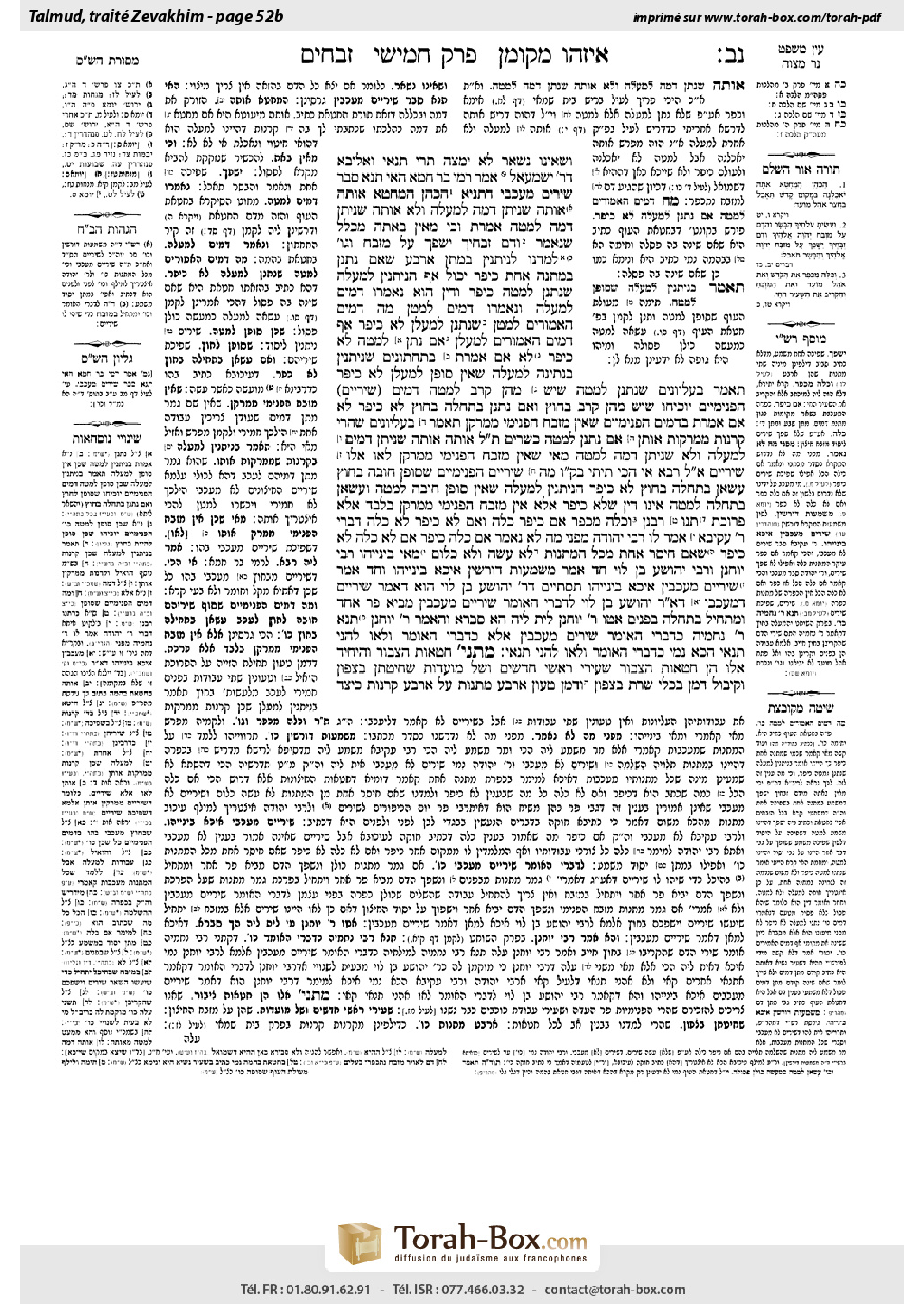
This page of Zevachim includes the Aramaic text, an English translation and an AI-generated French translation, alongside the scan above.
זבחים נ״ב ב · Aramaic and Hebrew text
וְשֶׁאֵינוֹ נִשְׁאָר לֹא יִמָּצֵה! תְּרֵי תַּנָּאֵי וְאַלִּיבָּא דְּרַבִּי יִשְׁמָעֵאל.
אָמַר רָמֵי בַּר חָמָא, הַאי תַּנָּא סָבַר: שִׁירַיִם מְעַכְּבִי. דְּתַנְיָא: ״הַכֹּהֵן הַמְחַטֵּא אֹתָהּ״ – אוֹתָהּ שֶׁנִּיתָּן דָּמָהּ לְמַעְלָה, וְלֹא אוֹתָהּ שֶׁנִּיתָּן דָּמָהּ לְמַטָּה.
אָמַרְתָּ: וְכִי מֵאַיִן בָּאתָה? מִכְּלָל שֶׁנֶּאֱמַר: ״וְדַם זְבָחֶיךָ יִשָּׁפֵךְ עַל מִזְבַּח וְגוֹ׳״ – לָמַדְנוּ לַנִּיתָּנִין בְּמַתַּן אַרְבַּע, שֶׁאִם נְתָנָן בְּמַתָּנָה אַחַת – כִּיפֵּר. יָכוֹל אַף הַנִּיתָּנִין לְמַעְלָה שֶׁנְּתָנָן לְמַטָּה כִּיפֵּר?
וְדִין הוּא – נֶאֶמְרוּ דָּמִים לְמַעְלָה, וְנֶאֶמְרוּ דָּמִים לְמַטָּן; מָה דָּמִים הָאֲמוּרִים לְמַטָּן שֶׁנְּתָנָן לְמַעְלָן – לֹא כִּיפֵּר, אַף דָּמִים הָאֲמוּרִים לְמַעְלָן – אִם נָתַן לְמַטָּה לֹא כִּיפֵּר!
לֹא; אִם אָמַרְתָּ בַּתַּחְתּוֹנִים שֶׁנִּיתָּנִין בִּנְתִינָה לְמַעְלָה שֶׁאֵין סוֹפָן לְמַעְלָן – לֹא כִּיפֵּר; תֹּאמַר בָּעֶלְיוֹנִים שֶׁנְּתָנָן לְמַטָּה, שֶׁיֵּשׁ מֵהֶן קָרֵב לְמַטָּה?!
דָּמִים (שִׁירַיִים) הַפְּנִימִיִּים יוֹכִיחוּ – שֶׁיֵּשׁ מֵהֶן קָרֵב בַּחוּץ, וְאִם נְתָנָן בַּתְּחִלָּה בַּחוּץ לֹא כִּיפֵּר!
לֹא; אִם אָמַרְתָּ בְּדָמִים הַפְּנִימִיִּים – שֶׁאֵין מִזְבֵּחַ הַפְּנִימִי מְמָרְקָן; תֹּאמַר בְּעֶלְיוֹנִים – שֶׁהֲרֵי קְרָנוֹת מְמָרְקוֹת אוֹתָן; אִם נְתָנָן לְמַטָּה – כְּשֵׁרִים!
תַּלְמוּד לוֹמַר: ״אוֹתָהּ״ – אוֹתָהּ שֶׁנִּיתָּן דָּמִים לְמַעְלָה, וְלֹא שֶׁנִּיתָּן דָּמָהּ לְמַטָּה.
מַאי שֶׁאֵין מִזְבֵּחַ הַפְּנִימִי מְמָרְקָן? לָאו אֵלּוּ שִׁירַיִים?!
אֲמַר לֵיהּ רָבָא: אִי הָכִי, תֵּיתֵי בְּקַל וָחוֹמֶר:
מָה שִׁירַיִים הַפְּנִימִיִּים, שֶׁסּוֹפָן חוֹבָה בַּחוּץ – עֲשָׂאָן בַּתְּחִלָּה בַּחוּץ לֹא כִּיפֵּר; הַנִּיתָּנִין לְמַעְלָה, שֶׁאֵין סוֹפָן חוֹבָה לְמַטָּה, וַעֲשָׂאָן בַּתְּחִלָּה לְמַטָּה – אֵינוֹ דִּין שֶׁלֹּא כִּיפֵּר?!
אֶלָּא אֵין מִזְבֵּחַ הַפְּנִימִי מְמָרְקָן בִּלְבַד, אֶלָּא פָּרוֹכֶת.
תָּנוּ רַבָּנַן: ״וְכִלָּה מִכַּפֵּר״ – אִם כִּיפֵּר כִּלָּה, וְאִם לֹא כִּיפֵּר לָא כִּלָּה. דִּבְרֵי רַבִּי עֲקִיבָא. אָמַר לוֹ רַבִּי יְהוּדָה, מִפְּנֵי מָה לֹא נֹאמַר: אִם כִּלָּה כִּיפֵּר, אִם לֹא כִּלָּה לֹא כִּיפֵּר? שֶׁאִם חִיסַּר אַחַת מִכׇּל הַמַּתָּנוֹת – לֹא עָשָׂה וְלֹא כְלוּם.
מַאי בֵּינַיְיהוּ? רַבִּי יוֹחָנָן וְרַבִּי יְהוֹשֻׁעַ בֶּן לֵוִי; חַד אָמַר: מַשְׁמָעוּת דּוֹרְשִׁין אִיכָּא בֵּינַיְיהוּ, וְחַד אָמַר: שִׁירַיִים מְעַכְּבִין אִיכָּא בֵּינַיְיהוּ.
תִּסְתַּיֵּים דְּרַבִּי יְהוֹשֻׁעַ בֶּן לֵוִי הוּא דְּאָמַר: שִׁירַיִים דִּמְעַכְּבִי; דְּאָמַר רַבִּי יְהוֹשֻׁעַ בֶּן לֵוִי: לְדִבְרֵי הָאוֹמֵר שִׁירַיִים מְעַכְּבִין – מֵבִיא פַּר אֶחָד, וּמַתְחִיל בַּתְּחִלָּה בִּפְנִים.
אַטּוּ רַבִּי יוֹחָנָן לֵית לֵיהּ הָא סְבָרָא?! וְהָאָמַר רַבִּי יוֹחָנָן: תַּנָּא רַבִּי נְחֶמְיָה כְּדִבְרֵי הָאוֹמֵר שִׁירַיִם מְעַכְּבִין!
אֶלָּא כְּדִבְרֵי הָאוֹמֵר – וְלָאו לְהָנֵי תַּנָּאֵי; הָכָא נָמֵי, כְּדִבְרֵי הָאוֹמֵר – וְלָאו לְהָנֵי תַּנָּאֵי.
מַתְנִי׳ חַטּאוֹת הַצִּבּוּר וְהַיָּחִיד – אֵלּוּ הֵן חַטְּאוֹת הַצִּבּוּר? שְׂעִירֵי רָאשֵׁי חֳדָשִׁים וְשֶׁל מוֹעֲדוֹת. שְׁחִיטָתָן בַּצָּפוֹן, וְקִיבּוּל דָּמָן בִּכְלִי שָׁרֵת בַּצָּפוֹן, וְדָמָן טָעוּן אַרְבַּע מַתָּנוֹת עַל אַרְבַּע קְרָנוֹת. כֵּיצַד?
Zevachim 52b · English translation
And that which does not remain, i.e., if there is no blood remaining, he shall not squeeze it out. This indicates that failure to squeeze the blood does not disqualify the offering. The Gemara answers: There are two tanna’im, and they disagree with regard to the opinion of Rabbi Yishmael.
The Gemara continues its discussion of the remainder of the blood. Rami bar Ḥama says: This following tanna holds that failure to pour the remainder of the blood of offerings whose blood is sprinkled inside the Sanctuary disqualifies the offering, as it is taught in a baraita: “The priest that sacrifices it for sin shall eat it” (Leviticus 6:19). The verse states the word “it” to teach that it, the offering whose blood was sprinkled correctly, above the red line of the altar, is valid, and the priest may eat the meat. But this is not so for an offering whose blood was sprinkled below the red line, which is disqualified.
The baraita continues: You said this, but from where did you come? In other words, why would one think that such an offering is valid, so that the verse needs to teach that it is not? The baraita explains: From the fact that it is stated: “And you shall offer your burnt offerings, the flesh and the blood, upon the altar of the Lord your God; and the blood of your offerings shall be poured out against the altar of the Lord your God, and you shall eat the flesh” (Deuteronomy 12:27), we learned that with regard to those offerings whose blood is placed with four placements on the corners of the altar, that if the priest placed them with only one placement, he has effected atonement. Therefore, since it is derived that if the priest does not present the blood on the specified corners of the altar, the offering is nevertheless valid, one might have thought that blood that should have been placed above the red line but that one placed below the red line effects atonement as well, and the offering is valid.
The baraita continues: And it would seem there is a logical inference to counter this logic. It is stated that blood is to be sprinkled above the red line, referring to the blood of an animal sin offering, which is to be sprinkled on the corners on the upper half of the altar, and it is stated that blood is to be sprinkled below the red line, referring to the blood of a bird sin offering, which is to be sprinkled on the lower half of the altar. Just as with regard to the blood about which it is stated that it is to be below the red line, if it is a case where one placed it above the red line, it does not effect atonement, as the Sages derived from the verse: “And he shall sprinkle of the blood of the sin offering upon the side of the altar, and the remainder of the blood shall be squeezed out at the base of the altar; it is a sin offering” (Leviticus 5:9), so too, with regard to the blood, about which it is stated that it is to be above the red line, if it is a case where one placed it below the red line, it does not effect atonement.
This logical inference is rejected: No, if you said that this is the halakha with regard to the blood of a bird sin offering, which is to be sprinkled below the red line that was placed with a placement above the red line, that may be because they will not ultimately be sprinkled above. For this reason it does not effect atonement. Shall you also say that this is the halakha with regard to the blood that is to be sprinkled above the red line, i.e., the blood of an animal sin offering, but which one placed below the red line, that it will not effect atonement? The blood that is to be sprinkled above the red line is different, as some of it is sacrificed below the red line, when the remainder of the blood is poured on the base of the altar.
The baraita responds: The blood that is placed inside the Sanctuary will prove it, as some of it is sacrificed outside, but if the priest initially placed the blood on the altar outside the Sanctuary it does not effect atonement.
The baraita rejects this proof: No, if you said that this is the halakha with regard to the blood that is placed inside the Sanctuary, concerning which the inner altar does not complete the atonement, as they require additional blood placements, shall you also say that this is the halakha with regard to the blood offered above the red line, i.e., the blood of an animal sin offering, concerning which the corners of the altar complete the atonement? Accordingly, it is possible to say that if one placed them below the red line they are valid.
The baraita concludes: To counter this reasoning, the verse states with regard to an animal sin offering that is sacrificed outside: “The priest that sacrifices it for sin shall eat it” (Leviticus 6:19), to emphasize that it, the offering whose blood was placed correctly, above the red line of the altar, is valid, and the priest may eat the meat. But this is not so for an offering whose blood was placed below the red line, which is disqualified.
Rami bar Ḥama proves his point: What does the baraita mean when it says: If you said that this is the halakha with regard to the blood that is placed inside the Sanctuary, concerning which the inner altar does not complete the atonement? What is required to complete the atonement? Is it not referring to this remainder of the blood and is teaching that failure to pour the remainder of the blood on the base of the altar disqualifies the offering?
Rava said to Rami bar Ḥama: If so, that the tanna of the baraita holds that failure to pour the remainder of the blood of the offerings whose blood is sprinkled inside the Sanctuary disqualifies the offering, you could derive the halakha that if the priest sprinkled the blood below the red line the offering is disqualified via an a fortiori inference.
Just as it is with regard to the remainder of the blood of the offerings of the inner altar, concerning which their ultimate rite, pouring on the base of the altar, is obligatory on the external altar, but if the priest initially performed the rite of placing the blood on the external altar, it does not effect atonement, with regard to those offerings whose blood is placed above the red line, concerning which their ultimate rite, pouring on the base of the altar, is not obligatory below the red line of the altar, and the priest initially performed the rite of placing the blood below the red line, is it not logical that it does not effect atonement? Since the baraita does not advance this claim, but derived the halakha from a verse, this indicates that pouring the remainder of the blood is not obligatory.
Rava continues: Rather, when the baraita states that the blood of the offerings offered inside the Sanctuary are those concerning which the inner altar does not complete the atonement it means that the inner altar does not complete the atonement alone, but rather requires that blood also be sprinkled inside the Sanctuary on the Curtain separating the Sanctuary and Holy of Holies.
§ The Sages taught in a baraita: The verse states concerning the sacrificial rite performed by the High Priest on Yom Kippur: “And when he has finished atoning for the Sanctuary, and the Tent of Meeting, and the altar, he shall present the live goat” (Leviticus 16:20). This verse indicates that if he performed the atonement, he has finished the service, but if he did not perform the atonement, he has not finished. This is the statement of Rabbi Akiva. Rabbi Yehuda said to him: For what reason do we not say: If he finished, he has performed atonement, but if he did not finish, he has not performed atonement? This derivation would indicate that if one of any of the blood placements is lacking it is as though he did nothing.
The Gemara clarifies the two opinions: What is the difference between them? Rabbi Yoḥanan and Rabbi Yehoshua ben Levi engaged in a dispute concerning this. One says that interpretation of the meaning of the verse is the difference between them, i.e., there is no halakhic difference between them but only a dispute as to how to interpret the verses. And one says that there is a difference between them with regard to whether failure to pour the remainder of the blood at the base of the altar disqualifies the offering. According to Rabbi Akiva, it does not disqualify the offering, whereas Rabbi Yehuda maintains that it does disqualify the offering.
The Gemara suggests: It may be concluded that Rabbi Yehoshua ben Levi is the one who says that Rabbi Akiva and Rabbi Yehuda disagree as to whether or not failure to pour the remainder of the blood on the altar disqualifies the offering. As Rabbi Yehoshua ben Levi says: According to the statement of the one who says that failure to pour the remainder of the blood on the base of the altar disqualifies the offering, if the priest finished placing the blood on the inner altar and the blood was spilled before he poured the remainder on the external altar, he must bring one bull and slaughter it, and begin the sprinkling of the blood as he did initially on the inner altar, so that there will be blood remaining from the sprinkling, and then he pours the remainder of the blood on the external altar. Rabbi Yehoshua ben Levi discusses the opinion that failure to pour the remainder of the blood on the base of the altar disqualifies the offering, apparently in reference to the baraita cited here.
The Gemara asks: Is that to say that Rabbi Yoḥanan does not agree with this reasoning? But doesn’t Rabbi Yoḥanan himself say (111a): Rabbi Neḥemya taught a halakha in accordance with the statement of the one who says that failure to pour the remainder of blood disqualifies the offering? Rabbi Yoḥanan also discusses the opinion of a tanna who holds that failure to pour the remainder of blood disqualifies the offering, apparently in reference to the baraita cited here.
Rather, there is no proof that Rabbi Yoḥanan is referring to the dispute between Rabbi Akiva and Rabbi Yehuda. He is stating a halakha in accordance with the statement of the one who says that it disqualifies the offering, whichever tanna that may be, but he is not referring to the dispute between these tanna’im. Here too, Rabbi Yehoshua ben Levi is stating a halakha in accordance with the statement of the one who says that it disqualifies the offering, whichever tanna that may be, but he is not referring to the dispute between these tanna’im.
MISHNA: These are the halakhot of the communal and the individual sin offerings. These are the communal sin offerings: Goats of the New Moon and of the Festivals. Their slaughter is in the north of the Temple courtyard, and the collection of their blood in a service vessel is in the north, and their blood requires four placements on the four corners of the altar. How did the priest do so?
Zevachim 52b · Traduction française (IA)
Et ce qui ne reste pas, c’est-à-dire que, s’il ne reste pas de sang, il ne doit pas le presser. Cela indique que le fait de ne pas presser le sang ne rend pas le sacrifice invalide. La Guemara répond : Il y a deux tannaïm, qui sont en désaccord sur l’opinion de Rabbi Yishmael.
La Guemara poursuit son examen du reste du sang. Rami bar Ḥama dit : Ce tanna considère que le fait de ne pas verser le reste du sang des sacrifices dont le sang est aspergé à l’intérieur du Sanctuaire rend le sacrifice invalide, comme l’enseigne une baraïta : « Le prêtre qui l’offre en sacrifice expiatoire en mangera » (Lévitique 6:19). Le verset emploie le mot « l’ » pour enseigner que ce sacrifice — celui dont le sang a été aspergé comme il convient, au-dessus de la ligne rouge de l’autel — est valide et que le prêtre peut en manger la viande. Mais il n’en va pas ainsi d’un sacrifice dont le sang a été aspergé au-dessous de la ligne rouge : il est invalide.
La baraïta poursuit : Tu as dit cela, mais d’où tiens-tu cette idée ? Autrement dit, pourquoi penserait-on qu’un tel sacrifice est valide, au point que le verset doive enseigner qu’il ne l’est pas ? La baraïta explique : Du fait qu’il est écrit : « Vous offrirez vos holocaustes, la chair et le sang, sur l’autel de l’Éternel votre Dieu ; le sang de vos sacrifices sera répandu contre l’autel de l’Éternel votre Dieu, et vous mangerez la chair » (Deutéronome 12:27), nous avons appris que, pour les sacrifices dont le sang doit être déposé en quatre endroits sur les angles de l’autel, si le prêtre ne le dépose qu’à un seul endroit, il a obtenu l’expiation. Par conséquent, puisqu’il est établi que même si le prêtre ne présente pas le sang aux angles déterminés de l’autel, le sacrifice est néanmoins valide, on aurait pu penser que le sang qui devait être déposé au-dessus de la ligne rouge, mais qui a été déposé au-dessous, procure également l’expiation et que le sacrifice est valide.
La baraïta poursuit : Il semblerait qu’un raisonnement logique permette de réfuter cette idée. Il est dit que le sang doit être aspergé au-dessus de la ligne rouge — il s’agit du sang d’un sacrifice expiatoire d’animal, qui doit être aspergé sur les angles de la moitié supérieure de l’autel — et il est dit que le sang doit être aspergé au-dessous de la ligne rouge — il s’agit du sang d’un sacrifice expiatoire d’oiseau, qui doit être aspergé sur la moitié inférieure de l’autel. De même que, pour le sang dont il est dit qu’il doit être déposé au-dessous de la ligne rouge, s’il est déposé au-dessus de cette ligne, il ne procure pas l’expiation, comme les Sages l’ont déduit du verset : « Il aspergera du sang du sacrifice expiatoire sur le côté de l’autel, et le reste du sang sera pressé à la base de l’autel ; c’est un sacrifice expiatoire » (Lévitique 5:9), de même, pour le sang dont il est dit qu’il doit être déposé au-dessus de la ligne rouge, s’il est déposé au-dessous, il ne procure pas l’expiation.
Ce raisonnement logique est rejeté : Non. Si tu dis que telle est la halakha pour le sang d’un sacrifice expiatoire d’oiseau, qui doit être aspergé au-dessous de la ligne rouge, lorsqu’il a été déposé au-dessus de cette ligne, c’est peut-être parce qu’il ne sera finalement pas aspergé au-dessus de la ligne rouge. C’est pourquoi il ne procure pas l’expiation. Dirais-tu aussi que telle est la halakha pour le sang qui doit être aspergé au-dessus de la ligne rouge, c’est-à-dire le sang d’un sacrifice expiatoire d’animal, mais qui a été déposé au-dessous de cette ligne, et qu’il ne procurera pas l’expiation ? Le sang qui doit être aspergé au-dessus de la ligne rouge est différent, car une partie en est offerte au-dessous de cette ligne, lorsque le reste du sang est versé à la base de l’autel.
La baraïta répond : Le sang déposé à l’intérieur du Sanctuaire le prouve : une partie en est offerte à l’extérieur, mais si le prêtre a d’abord déposé le sang sur l’autel, à l’extérieur du Sanctuaire, il ne procure pas l’expiation.
La baraïta rejette cette preuve : Non. Si tu dis que telle est la halakha pour le sang déposé à l’intérieur du Sanctuaire, pour lequel l’autel intérieur ne complète pas l’expiation, puisqu’il faut des dépôts de sang supplémentaires, dirais-tu aussi que telle est la halakha pour le sang offert au-dessus de la ligne rouge, c’est-à-dire le sang d’un sacrifice expiatoire d’animal, pour lequel les angles de l’autel complètent l’expiation ? Il est donc possible de dire que, si le sang a été déposé au-dessous de la ligne rouge, il est valide.
La baraïta conclut : Pour réfuter ce raisonnement, le verset dit, au sujet d’un sacrifice expiatoire d’animal offert à l’extérieur : « Le prêtre qui l’offre en sacrifice expiatoire en mangera » (Lévitique 6:19), afin de souligner que ce sacrifice — celui dont le sang a été déposé comme il convient, au-dessus de la ligne rouge de l’autel — est valide et que le prêtre peut en manger la viande. Mais il n’en va pas ainsi d’un sacrifice dont le sang a été déposé au-dessous de la ligne rouge : il est invalide.
Rami bar Ḥama prouve son point : Que veut dire la baraïta lorsqu’elle dit : « Si tu dis que telle est la halakha pour le sang déposé à l’intérieur du Sanctuaire, pour lequel l’autel intérieur ne complète pas l’expiation » ? Qu’est-ce qui est nécessaire pour compléter l’expiation ? N’est-il pas question de ce reste du sang, et n’enseigne-t-elle pas que le fait de ne pas verser le reste du sang à la base de l’autel rend le sacrifice invalide ?
Rava dit à Rami bar Ḥama : Si tel est le cas, si le tanna de la baraïta considère que le fait de ne pas verser le reste du sang des sacrifices dont le sang est aspergé à l’intérieur du Sanctuaire rend le sacrifice invalide, tu pourrais déduire par raisonnement a fortiori que, si le prêtre a aspergé le sang au-dessous de la ligne rouge, le sacrifice est invalide.
De même que, pour le reste du sang des sacrifices de l’autel intérieur, dont le rite final — le versement à la base de l’autel — doit être accompli sur l’autel extérieur, si le prêtre a d’abord effectué le rite en déposant le sang sur l’autel extérieur, cela ne procure pas l’expiation, de même, pour les sacrifices dont le sang est déposé au-dessus de la ligne rouge, dont le rite final — le versement à la base de l’autel — ne doit pas être accompli au-dessous de la ligne rouge de l’autel, si le prêtre a d’abord effectué le rite en déposant le sang au-dessous de la ligne rouge, n’est-il pas logique que cela ne procure pas l’expiation ? Puisque la baraïta n’avance pas cet argument et déduit la halakha d’un verset, cela indique que verser le reste du sang n’est pas obligatoire.
Rava poursuit : En réalité, lorsque la baraïta dit que l’autel intérieur ne complète pas l’expiation pour le sang des sacrifices offerts à l’intérieur du Sanctuaire, elle veut dire que l’autel intérieur ne complète pas l’expiation à lui seul ; il faut aussi que le sang soit aspergé à l’intérieur du Sanctuaire, sur le rideau qui sépare le Sanctuaire du Saint des Saints.
§ Les Sages ont enseigné dans une baraïta : Le verset dit, au sujet du rite sacrificiel accompli par le grand prêtre le jour de Yom Kippour : « Lorsqu’il aura achevé l’expiation du Sanctuaire, de la Tente d’assignation et de l’autel, il présentera le bouc vivant » (Lévitique 16:20). Ce verset indique que s’il a accompli l’expiation, il a achevé le service, mais que s’il n’a pas accompli l’expiation, il ne l’a pas achevé. Telle est la déclaration de Rabbi Akiva. Rabbi Yehuda lui dit : Pour quelle raison ne disons-nous pas plutôt : « S’il a achevé, c’est qu’il a accompli l’expiation ; mais s’il n’a pas achevé, c’est qu’il n’a pas accompli l’expiation » ? Cette déduction indiquerait que si l’un des dépôts de sang fait défaut, c’est comme s’il n’avait rien fait.
La Guemara précise les deux opinions : Quelle est la différence entre elles ? Rabbi Yoḥanan et Rabbi Yehoshua ben Levi ont débattu de cette question. Selon l’un, leur différence porte sur l’interprétation du sens du verset ; autrement dit, il n’y a entre eux aucune différence halakhique, mais seulement un désaccord sur la manière d’interpréter les versets. Selon l’autre, leur différence porte sur la question de savoir si le fait de ne pas verser le reste du sang à la base de l’autel rend le sacrifice invalide. Selon Rabbi Akiva, cela ne rend pas le sacrifice invalide, tandis que Rabbi Yehuda considère que cela le rend invalide.
La Guemara suggère : On peut conclure que c’est Rabbi Yehoshua ben Levi qui dit que Rabbi Akiva et Rabbi Yehuda sont en désaccord sur la question de savoir si le fait de ne pas verser le reste du sang sur l’autel rend le sacrifice invalide. En effet, Rabbi Yehoshua ben Levi dit : Selon celui qui considère que le fait de ne pas verser le reste du sang à la base de l’autel rend le sacrifice invalide, si le prêtre a achevé de déposer le sang sur l’autel intérieur et que le sang s’est répandu avant qu’il ne verse le reste sur l’autel extérieur, il doit prendre un taureau, l’égorger et recommencer l’aspersion du sang comme il l’avait faite initialement sur l’autel intérieur, afin qu’il reste du sang après l’aspersion ; il verse ensuite le reste du sang sur l’autel extérieur. Rabbi Yehoshua ben Levi évoque l’opinion selon laquelle le fait de ne pas verser le reste du sang à la base de l’autel rend le sacrifice invalide, apparemment en référence à la baraïta citée ici.
La Guemara demande : Faut-il en déduire que Rabbi Yoḥanan n’est pas d’accord avec ce raisonnement ? Pourtant, Rabbi Yoḥanan lui-même dit (111a) : Rabbi Neḥemya a enseigné une halakha conformément à l’opinion de celui qui considère que le fait de ne pas verser le reste du sang rend le sacrifice invalide. Rabbi Yoḥanan évoque lui aussi l’opinion d’un tanna qui considère que le fait de ne pas verser le reste du sang rend le sacrifice invalide, apparemment en référence à la baraïta citée ici.
En réalité, rien ne prouve que Rabbi Yoḥanan fasse référence au désaccord entre Rabbi Akiva et Rabbi Yehuda. Il énonce une halakha conformément à l’opinion de celui qui considère que cela rend le sacrifice invalide, quel que soit le tanna dont il s’agit ; il ne fait pas référence au désaccord entre ces tannaïm. De même ici, Rabbi Yehoshua ben Levi énonce une halakha conformément à l’opinion de celui qui considère que cela rend le sacrifice invalide, quel que soit le tanna dont il s’agit ; il ne fait pas référence au désaccord entre ces tannaïm.
MICHNA : Voici les halakhot des sacrifices expiatoires collectifs et individuels. Voici les sacrifices expiatoires collectifs : les boucs de la nouvelle lune et des fêtes. Ils sont égorgés dans la partie nord de la cour du Temple, leur sang est recueilli dans un récipient de service au nord, et leur sang requiert quatre dépôts sur les quatre angles de l’autel. Comment le prêtre procédait-il ?
Traduction française générée par IA à partir de l’édition anglaise de Sefaria. Vérifie toujours un passage avec le texte source.
Text from Sefaria: William Davidson Edition - Vocalized Aramaic (CC BY NC); William Davidson Edition - English (CC BY NC).