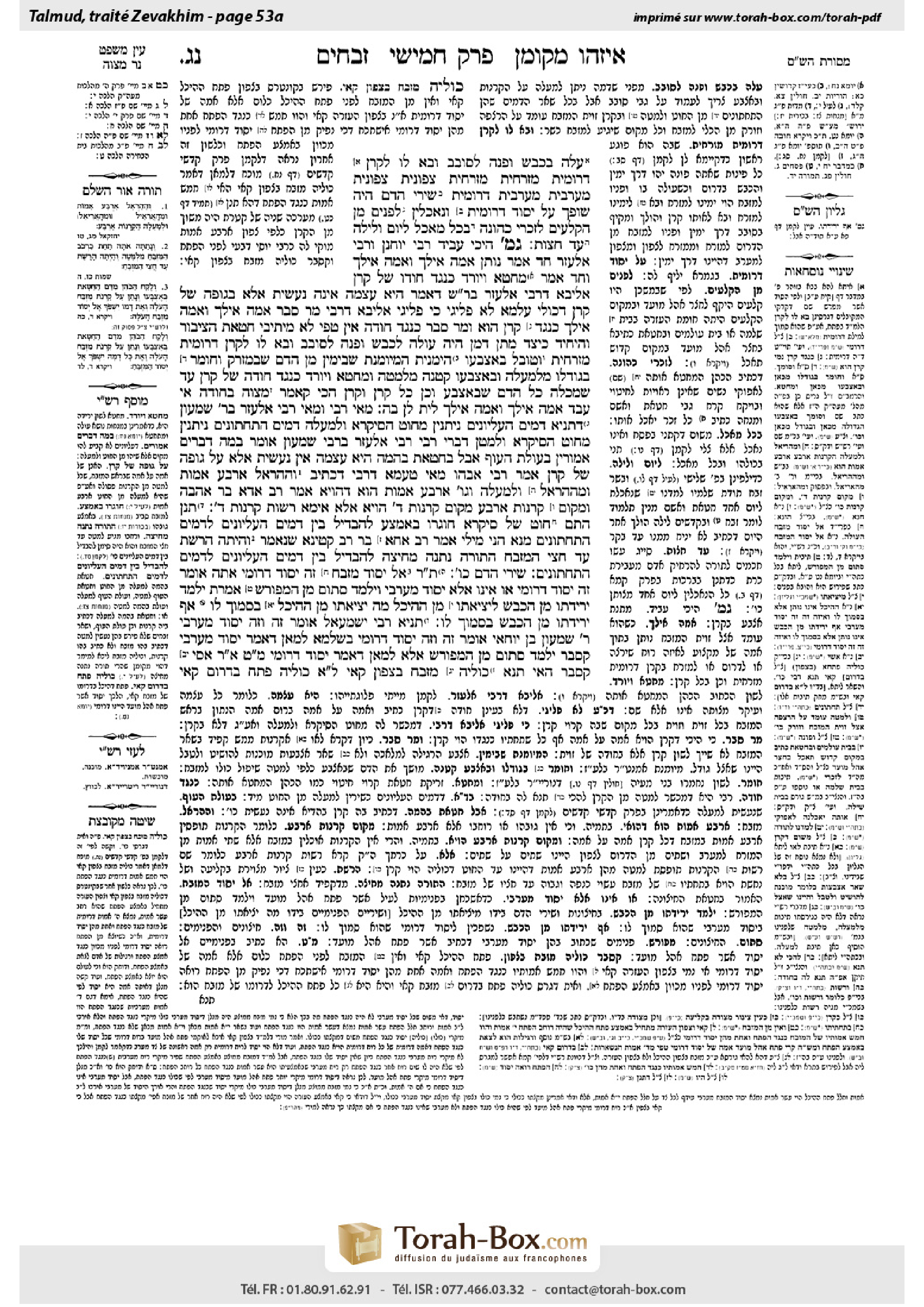
Zevachim 53a: Talmud study for Daf Yomi
Daf Yomi is the daily study of one Talmud folio. Explore 37 tractates with scans, Hebrew text, Sefaria English and AI-generated French translations where annotated.
Passage selection and English or AI-generated French translation are available where the scan has annotations. Daf Study is independent of Torah-Box and Sefaria.
Browse Zevachim · זבחים · All tractatesZevachim 53a text and translations
This page of Zevachim includes the Aramaic text, an English translation and an AI-generated French translation, alongside the scan above.
זבחים נ״ג א · Aramaic and Hebrew text
עָלָה בַּכֶּבֶשׁ וּפָנָה לַסּוֹבֵב, וּבָא לוֹ לְקֶרֶן דְּרוֹמִית מִזְרָחִית, מִזְרָחִית צְפוֹנִית, צְפוֹנִית מַעֲרָבִית, מַעֲרָבִית דְּרוֹמִית. שְׁיָרֵי הַדָּם הָיָה שׁוֹפֵךְ עַל יְסוֹד דְּרוֹמִית, וְנֶאֱכָלִין לִפְנִים מִן הַקְּלָעִים לְזִכְרֵי כְהוּנָּה בְּכׇל מַאֲכָל, לְיוֹם וָלַיְלָה עַד חֲצוֹת.
גְּמָ׳ הֵיכִי עָבֵיד? רַבִּי יוֹחָנָן וְרַבִּי אֶלְעָזָר; חַד אָמַר: נוֹתֵן אַמָּה אֵילָךְ וְאַמָּה אֵילָךְ, וְחַד אָמַר: מְחַטֵּא וְיוֹרֵד כְּנֶגֶד חוּדּוֹ שֶׁל קֶרֶן.
אַלִּיבָּא דְּרַבִּי אֶלְעָזָר בְּרַבִּי שִׁמְעוֹן, דְּאָמַר: הִיא עַצְמָהּ אֵינָהּ נַעֲשֵׂית אֶלָּא בְּגוּפָהּ שֶׁל קֶרֶן – דְּכוּלֵּי עָלְמָא לָא פְּלִיגִי; כִּי פְּלִיגִי – אַלִּיבָּא דְּרַבִּי. מָר סָבַר: אַמָּה אֵילָךְ וְאַמָּה אֵילָךְ – כְּנֶגֶד קֶרֶן הוּא; וּמָר סָבַר: כְּנֶגֶד חוּדָּהּ אִין, טְפֵי לָא.
מֵיתִיבִי: חַטַּאת הַצִּיבּוּר וְהַיָּחִיד – כֵּיצַד מַתַּן דָּמָן? הָיָה עוֹלֶה לַכֶּבֶשׁ וּפָנָה לַסּוֹבֵב, וּבָא לוֹ לְקֶרֶן דְּרוֹמִית מִזְרָחִית; וְטוֹבֵל בְּאֶצְבָּעוֹ הַיְמָנִית – הַמְיוּמֶּנֶת שֶׁבַּיָּמִין – מִן הַדָּם שֶׁבַּמִּזְרָק; וְחוֹמֵר בְּגוּדָלוֹ מִלְּמַעְלָה וּבְאֶצְבָּעוֹ קְטַנָּה מִלְּמַטָּה, וּמְחַטֵּא וְיוֹרֵד כְּנֶגֶד חוּדָּהּ שֶׁל קֶרֶן, עַד שֶׁמְּכַלֶּה כָּל הַדָּם שֶׁבָּאֶצְבַּע. וְכֵן כׇּל קֶרֶן וָקֶרֶן.
הָכִי קָאָמַר: מִצְוָה בְּחוּדָּהּ; אִי עֲבַד אַמָּה אֵילָךְ וְאַמָּה אֵילָךְ – לֵית לַן בַּהּ.
מַאי רַבִּי וּמַאי רַבִּי אֶלְעָזָר בְּרַבִּי שִׁמְעוֹן? דְּתַנְיָא: דָּמִים הָעֶלְיוֹנִים נִיתָּנִין מִחוּט הַסִּיקְרָא וּלְמַעְלָה, דָּמִים הַתַּחְתּוֹנִים נִיתָּנִין מִחוּט הַסִּיקְרָא וּלְמַטָּן. דִּבְרֵי רַבִּי.
רַבִּי אֶלְעָזָר בְּרַבִּי שִׁמְעוֹן אוֹמֵר: בַּמֶּה דְּבָרִים אֲמוּרִין – בְּעוֹלַת הָעוֹף, אֲבָל בְּחַטַּאת בְּהֵמָה – הִיא עַצְמָהּ אֵין נַעֲשֵׂית אֶלָּא עַל גּוּפָהּ שֶׁל קֶרֶן.
אָמַר רַבִּי אֲבָהוּ: מַאי טַעְמָא דְּרַבִּי? דִּכְתִיב: ״וְהַהַרְאֵל אַרְבַּע אַמּוֹת, וּמֵהַהַרְאֵל וּלְמַעְלָה וְגוֹ׳״. אַרְבַּע אַמּוֹת הוּא דְּהָוְיָא?! אָמַר רַב אַדָּא בַּר אַהֲבָה: וּמְקוֹם קְרָנוֹת אַרְבַּע. מְקוֹם קְרָנוֹת אַרְבַּע הָוְיָא?! אֶלָּא אֵימָא: רְשׁוּת קְרָנוֹת אַרְבַּע.
תְּנַן הָתָם: חוּט שֶׁל סִיקְרָא חוֹגְרוֹ בָּאֶמְצַע, לְהַבְדִּיל בֵּין דָּמִים הָעֶלְיוֹנִים לְדָמִים הַתַּחְתּוֹנִים. מְנָא הָנֵי מִילֵּי? אָמַר רַב אַחָא בַּר רַב קַטִּינָא, שֶׁנֶּאֱמַר: ״וְהָיְתָה הָרֶשֶׁת עַד חֲצִי הַמִּזְבֵּחַ״ – הַתּוֹרָה נָתְנָה מְחִיצָה לְהַבְדִּיל בֵּין דָּמִים הָעֶלְיוֹנִים לְדָמִים הַתַּחְתּוֹנִים.
שְׁיָרֵי הַדָּם כּוּ׳. תָּנוּ רַבָּנַן: ״אֶל יְסוֹד מִזְבֵּחַ״ – זֶה יְסוֹד דְּרוֹמִי. אַתָּה אוֹמֵר זֶה יְסוֹד דְּרוֹמִי; אוֹ אֵינוֹ אֶלָּא יְסוֹד מַעֲרָבִי,
וְיִלְמַד סָתוּם מִן הַמְפוֹרָשׁ? אָמַרְתָּ: יִלְמַד יְרִידָתוֹ מִן הַכֶּבֶשׁ לִיצִיאָתוֹ מִן הַהֵיכָל; מָה יְצִיאָתוֹ מִן הַהֵיכָל – בְּסָמוּךְ לוֹ, אַף יְרִידָתוֹ מִן הַכֶּבֶשׁ – בְּסָמוּךְ לוֹ.
תַּנְיָא, רַבִּי יִשְׁמָעֵאל אוֹמֵר: זֶה וָזֶה יְסוֹד מַעֲרָבִי. רַבִּי שִׁמְעוֹן בֶּן יוֹחַאי אוֹמֵר: זֶה וָזֶה יְסוֹד דְּרוֹמִי.
בִּשְׁלָמָא לְמַאן דְּאָמַר יְסוֹד מַעֲרָבִי – קָסָבַר: יִלְמַד סָתוּם מִן הַמְפוֹרָשׁ.
אֶלָּא לְמַאן דְּאָמַר יְסוֹד דְּרוֹמִי, מַאי טַעְמָא? אָמַר רַבִּי אַסִּי, קָסָבַר הַאי תַּנָּא: כּוּלֵּיהּ מִזְבֵּחַ בְּצָפוֹן קָאֵי. לִישָּׁנָא אַחֲרִינָא: כּוּלֵּיהּ פֶּתַח בְּדָרוֹם קָאֵי.
Zevachim 53a · English translation
He ascended the ramp of the altar and turned right to the surrounding ledge and he continued east, and he came to the southeast corner and sprinkled the blood of the sin offering there and then to the northeast corner and sprinkled the blood there, and then to the northwest corner and sprinkled the blood there, and the southwest corner, where he performed the fourth sprinkling and descended from the altar. He would pour the remainder of the blood on the southern base of the altar. And the meat portions of the offering are eaten within the curtains, i.e., in the Temple courtyard, by the males of the priesthood. And they are eaten prepared in any form of food preparation, on the day the offering is sacrificed and during the night that follows, until midnight.
GEMARA: How does the priest perform the rite of sprinkling the blood on the corners of the altar? There is a dispute between Rabbi Yoḥanan and Rabbi Elazar. One says that the priest places the blood within a cubit on this side or a cubit on that side. He places the blood wherever he wants, provided that it is within one cubit of the corner of the altar. And one says that he sprinkles the blood on the outer edge of the corner of the altar, and it flows down on both sides of the altar.
The Gemara comments: According to the opinion of Rabbi Elazar, son of Rabbi Shimon, who says that the sprinkling of the blood of a sin offering itself is performed only on the actual corner, the one-by-one-cubit projection above each corner of the altar, everyone agrees that the blood may be sprinkled anywhere on the corner, and this will be a fulfillment of the verse: “And put it upon the corners of the altar of burnt offering” (Leviticus 4:25). When they disagree is only according to the opinion of Rabbi Yehuda HaNasi, who holds that the blood may be sprinkled anywhere above the red line on the edge of the altar. One Sage holds that the blood may be sprinkled on the cubit on either side of the edge, because a cubit on this side and a cubit on that side is still considered to be on the corner. And one Sage holds that on its edge, yes, it is fit, but any further on either side is not.
The Gemara raises an objection to the opinion that one cubit on either side of the edge is still considered on the edge, from a baraita: With regard to communal sin offerings and individual sin offerings, how is the placement of their blood on the altar performed? The priest would ascend the ramp of the altar and turn right to the surrounding ledge and continue east, and he would come to the southeast corner. And he would then dip with his right [haymanit] finger, the most dexterous [hamyumenet] of the right hand, i.e., the index finger, of the blood that is in the bowl, and would gather the blood with his thumb above and his smallest finger below, so that it would remain on his finger. And he would sprinkle the blood and move his hand down on the outer edge of the corner, until he would finish sprinkling all the blood that was on his finger. And he would act similarly at each and every corner. This baraita states explicitly that the blood must be sprinkled on the actual edge.
The Gemara answers: This is what the baraita is saying: The optimal manner to perform the mitzva is to sprinkle the blood on the edge of the corner. But if he did the sprinkling on the cubit on this side, or the cubit on that side, we have no problem with it, and he has still fulfilled the mitzva.
The Gemara discusses the aforementioned dispute. What is the opinion of Rabbi Yehuda HaNasi, and what is the opinion of Rabbi Elazar, son of Rabbi Shimon? This is as it is taught in a baraita (Tosefta 6:11): The blood that must be placed on the upper half of the altar, e.g., the blood of a sin offering, is placed anywhere from the red line that circumscribed the middle of the altar and above. The blood that must be placed on the lower half of the altar is placed anywhere from the red line or below it. This is the statement of Rabbi Yehuda HaNasi.
The baraita continues: Rabbi Elazar, son of Rabbi Shimon says: In what case is this statement said? It is said with regard to a bird burnt offering, as its blood may be placed anywhere above the red line. But with regard to an animal sin offering, the placement itself may be performed only on the actual corner of the altar. This is based on the verse that states: “And the priest shall take of the blood of the sin offering with his finger, and put it upon the corners of the altar of burnt offering” (Leviticus 4:25).
Rabbi Abbahu says: What is the reason for the opinion of Rabbi Yehuda HaNasi? As it is written: “And the altar shall be four cubits; and from the altar and above there shall be four corners” (Ezekiel 43:15). The Gemara asks: Was the altar only four cubits wide? Rav Adda bar Ahava said: And the total area of the four corners, which were each one square cubit, was four cubits. The Gemara asks: Was the area of the corners four square cubits? If the four corners would be placed together the area would be only two square cubits. Rather, say that the domain of the corners is four cubits. In other words, the verse means that the blood may be sprinkled up to four cubits beneath the actual corners of the altar.
We learned in a mishna there (Middot 35b): A red line circumscribed the altar in the middle, to separate between the area for the blood that must be placed on the upper part of the altar and the area for the blood that must be placed on the lower part of the altar. The Gemara asks: From where is this matter derived? Rav Aḥa bar Rav Ketina said it is derived from a verse, as it is stated: “And you shall put it under the ledge round the altar beneath, and the net will reach halfway up the altar” (Exodus 27:5). The Torah provided for a separation on the altar, to separate between the area for the blood placed on the upper part of the altar and the area for the blood placed on the lower part of the altar.
§ The mishna teaches: He would pour the remainder of the blood on the southern base of the altar. The Sages taught in a baraita: Concerning the phrase: “At the base of the altar” (Leviticus 4:30), mentioned with regard to pouring the remainder of the blood of the sin offering of a king, this is referring to the southern base of the altar. The baraita challenges: Do you say that this is referring to the southern base, or is it referring only to the western base?
The baraita suggests: And one can derive the meaning of this unspecified phrase from the meaning of the explicit phrase, as follows: You said that one can derive the location of the priest’s descent from the ramp of the external altar after sprinkling blood of the sin offering by comparing it to his exit from the Sanctuary with the blood that remained after having sprinkled blood inside the Sanctuary. The verse states with regard to the bull offering of the High Priest: “And all the remaining blood of the bull he shall pour out at the base of the altar of burnt offering, which is at the entrance of the Tent of Meeting” (Leviticus 4:7). Just as upon his exit from the Sanctuary the priest pours the remainder of the blood on the side closest to him, the western side, so too, upon his descent from the ramp of the external altar after sprinkling blood from the sin offering, he pours the blood on the side closest to him, which is the southern side.
It is taught in another baraita: Rabbi Yishmael says: This and that, both the remainder of the blood sprinkled inside the Sanctuary and the remainder of the blood sprinkled on the external altar, are poured on the western base of the altar. Rabbi Shimon ben Yoḥai says: This and that are poured on the southern base of the altar.
The Gemara clarifies: Granted, according to the one who says that the blood is poured on the western base of the altar, it is clear how he derived his halakha. He holds that one can derive the meaning of an unspecified phrase from the meaning of the explicit phrase. Therefore, just as the remainder of the blood sprinkled inside the Sanctuary is poured on the western base of the external altar, the same is done with the remainder of the blood sprinkled on the external altar.
But according to the one who says that the blood is poured on the southern base of the altar, what is the reason? Rabbi Asi said: This tanna holds that the entire external altar stands in the north of the Temple courtyard. Therefore, the southern base is in the center of the courtyard, opposite the entrance to the Sanctuary. This is what the verse is referring to when it states: “At the entrance of the Tent of Meeting” (Leviticus 4:7). The Gemara presents another formulation of Rabbi Asi’s explanation: The entire entrance of the Sanctuary stands in the south of the altar. Accordingly, when the priest exits the Sanctuary the southern base is the first one he encounters.
Zevachim 53a · Traduction française (IA)
Il montait par la rampe de l’autel, tournait à droite vers la saillie qui l’entourait, puis avançait vers l’est. Arrivé à l’angle sud-est, il y aspergeait le sang du sacrifice expiatoire, puis se rendait à l’angle nord-est et y aspergeait le sang, ensuite à l’angle nord-ouest où il aspergeait le sang, et enfin à l’angle sud-ouest, où il effectuait la quatrième aspersion avant de descendre de l’autel. Il versait le reste du sang sur la base sud de l’autel. Les morceaux de viande de l’offrande sont mangés à l’intérieur des tentures, c’est-à-dire dans la cour du Temple, par les prêtres de sexe masculin. Ils sont consommés préparés de n’importe quelle manière, le jour où l’offrande est sacrifiée et durant la nuit qui suit, jusqu’à minuit.
GUEMARA : Comment le prêtre accomplit-il le rite de l’aspersion du sang sur les angles de l’autel ? Rabbi Yoḥanan et Rabbi Elazar sont en désaccord. Selon l’un, le prêtre dépose le sang à moins d’une coudée de l’angle, d’un côté ou de l’autre. Il le dépose où il le souhaite, à condition que ce soit à moins d’une coudée de l’angle de l’autel. Selon l’autre, il asperge le sang sur l’arête extérieure de l’angle de l’autel, et le sang s’écoule des deux côtés de l’autel.
La Guemara commente : Selon l’opinion de Rabbi Elazar, fils de Rabbi Shimon, qui dit que l’aspersion du sang d’un sacrifice expiatoire lui-même s’effectue uniquement sur l’angle proprement dit, c’est-à-dire sur la saillie d’une coudée sur une coudée au-dessus de chaque angle de l’autel, tous conviennent que le sang peut être aspergé n’importe où sur l’angle, et que cela accomplit le verset : « Et il en mettra sur les angles de l’autel de l’holocauste » (Lévitique 4:25). Leur désaccord ne porte que sur l’opinion de Rabbi Yehuda HaNasi, qui considère que le sang peut être aspergé n’importe où au-dessus de la ligne rouge, sur le bord de l’autel. Selon un Sage, le sang peut être aspergé sur la coudée située de part et d’autre du bord, car la coudée de ce côté et celle de l’autre côté sont encore considérées comme faisant partie de l’angle. Selon l’autre Sage, l’arête même convient, mais pas au-delà, de l’un ou l’autre côté.
La Guemara soulève une objection contre l’opinion selon laquelle la coudée située de part et d’autre du bord est encore considérée comme faisant partie du bord, à partir d’une baraïta : En ce qui concerne les sacrifices expiatoires communautaires et les sacrifices expiatoires individuels, comment leur sang est-il appliqué sur l’autel ? Le prêtre montait par la rampe de l’autel, tournait à droite vers la saillie qui l’entourait, puis avançait vers l’est jusqu’à l’angle sud-est. Il trempait alors dans le sang contenu dans le récipient son doigt droit [haymanit], le plus habile [hamyumenet] de la main droite, c’est-à-dire l’index. Il recueillait le sang avec son pouce au-dessus et son petit doigt au-dessous, afin qu’il reste sur son doigt. Puis il aspergeait le sang en faisant descendre sa main le long de l’arête extérieure de l’angle, jusqu’à avoir aspergé tout le sang qui se trouvait sur son doigt. Il procédait de même à chacun des angles. Cette baraïta précise explicitement que le sang doit être aspergé sur l’arête même.
La Guemara répond : Voici ce que dit la baraïta : la manière optimale d’accomplir la mitsva consiste à asperger le sang sur l’arête de l’angle. Mais s’il l’a aspergé à une coudée de ce côté ou à une coudée de l’autre côté, cela ne pose pas de problème et il a tout de même accompli la mitsva.
La Guemara examine le désaccord susmentionné. Quelle est l’opinion de Rabbi Yehuda HaNasi, et quelle est celle de Rabbi Elazar, fils de Rabbi Shimon ? C’est ce qui est enseigné dans une baraïta (Tosefta 6:11) : Le sang qui doit être placé sur la moitié supérieure de l’autel, par exemple le sang d’un sacrifice expiatoire, peut être placé n’importe où à partir de la ligne rouge qui ceint le milieu de l’autel et au-dessus. Le sang qui doit être placé sur la moitié inférieure de l’autel peut être placé n’importe où à partir de la ligne rouge et en dessous. Telle est la déclaration de Rabbi Yehuda HaNasi.
La baraïta poursuit : Rabbi Elazar, fils de Rabbi Shimon, dit : Dans quel cas cette déclaration a-t-elle été faite ? Elle concerne un holocauste d’oiseau, dont le sang peut être placé n’importe où au-dessus de la ligne rouge. Mais dans le cas d’un sacrifice expiatoire animal, l’application du sang elle-même ne peut se faire que sur l’angle proprement dit de l’autel. Cela se fonde sur le verset : « Le prêtre prendra avec son doigt du sang du sacrifice expiatoire et en mettra sur les angles de l’autel de l’holocauste » (Lévitique 4:25).
Rabbi Abbahu dit : Quelle est la raison de l’opinion de Rabbi Yehuda HaNasi ? Car il est écrit : « L’autel aura quatre coudées, et, à partir de l’autel vers le haut, il y aura quatre angles » (Ézéchiel 43:15). La Guemara demande : L’autel ne faisait-il que quatre coudées de large ? Rav Adda bar Ahava dit : Et la superficie totale des quatre angles, qui mesuraient chacun une coudée carrée, était de quatre coudées carrées. La Guemara demande : La superficie des angles était-elle de quatre coudées carrées ? Si l’on plaçait ensemble les quatre angles, leur superficie ne serait que de deux coudées carrées. Il faut plutôt dire que l’étendue des angles est de quatre coudées. Autrement dit, le verset signifie que le sang peut être aspergé jusqu’à quatre coudées sous les angles mêmes de l’autel.
Nous avons appris dans une Michna, là-bas (Middot 35b) : Une ligne rouge ceignait le milieu de l’autel, afin de séparer la zone réservée au sang qui doit être placé sur la partie supérieure de l’autel de celle réservée au sang qui doit être placé sur sa partie inférieure. La Guemara demande : D’où déduit-on cela ? Rav Aḥa bar Rav Ketina dit que cela se déduit d’un verset, comme il est dit : « Tu le placeras sous la corniche qui fait le tour de l’autel, en bas, et le filet atteindra la moitié de la hauteur de l’autel » (Exode 27:5). La Torah a prévu une séparation sur l’autel afin de distinguer la zone où l’on place le sang sur sa partie supérieure de celle où l’on place le sang sur sa partie inférieure.
§ La Michna enseigne : Il versait le reste du sang sur la base sud de l’autel. Les Sages ont enseigné dans une baraïta : L’expression « à la base de l’autel » (Lévitique 4:30), mentionnée à propos du versement du reste du sang du sacrifice expiatoire d’un roi, désigne la base sud de l’autel. La baraïta objecte : Dis-tu qu’elle désigne la base sud, ou bien désigne-t-elle uniquement la base ouest ?
La baraïta propose : On peut déduire le sens de cette expression non précisée du sens de l’expression explicite, de la manière suivante : Tu as dit que l’on peut déduire le lieu où le prêtre descend de la rampe de l’autel extérieur après avoir aspergé le sang du sacrifice expiatoire en le comparant au lieu où il sort du Sanctuaire avec le sang qui reste après qu’il a aspergé le sang à l’intérieur du Sanctuaire. Le verset dit à propos du taureau offert par le grand prêtre : « Tout le reste du sang du taureau, il le versera à la base de l’autel de l’holocauste, qui se trouve à l’entrée de la Tente d’assignation » (Lévitique 4:7). De même qu’en sortant du Sanctuaire, le prêtre verse le reste du sang du côté le plus proche de lui, le côté ouest, de même, lorsqu’il descend de la rampe de l’autel extérieur après avoir aspergé le sang du sacrifice expiatoire, il verse le sang du côté le plus proche de lui, c’est-à-dire le côté sud.
Une autre baraïta enseigne : Rabbi Yishmael dit : Les deux, le reste du sang aspergé à l’intérieur du Sanctuaire et le reste du sang aspergé sur l’autel extérieur, sont versés sur la base ouest de l’autel. Rabbi Shimon ben Yoḥai dit : Les deux sont versés sur la base sud de l’autel.
La Guemara précise : Il est clair comment celui qui dit que le sang est versé sur la base ouest de l’autel déduit sa halakha. Il considère que l’on peut déduire le sens d’une expression non précisée de celui d’une expression explicite. Par conséquent, de même que le reste du sang aspergé à l’intérieur du Sanctuaire est versé sur la base ouest de l’autel extérieur, on fait de même avec le reste du sang aspergé sur l’autel extérieur.
Mais selon celui qui dit que le sang est versé sur la base sud de l’autel, quelle en est la raison ? Rabbi Asi dit : Ce tanna considère que l’autel extérieur tout entier se trouve au nord de la cour du Temple. La base sud se situe donc au centre de la cour, en face de l’entrée du Sanctuaire. C’est à cela que le verset fait référence lorsqu’il dit : « À l’entrée de la Tente d’assignation » (Lévitique 4:7). La Guemara présente une autre formulation de l’explication de Rabbi Asi : Toute l’entrée du Sanctuaire se trouve au sud de l’autel. Ainsi, lorsque le prêtre sort du Sanctuaire, la base sud est la première qu’il rencontre.
Traduction française générée par IA à partir de l’édition anglaise de Sefaria. Vérifie toujours un passage avec le texte source.
Text from Sefaria: William Davidson Edition - Vocalized Aramaic (CC BY NC); William Davidson Edition - English (CC BY NC).