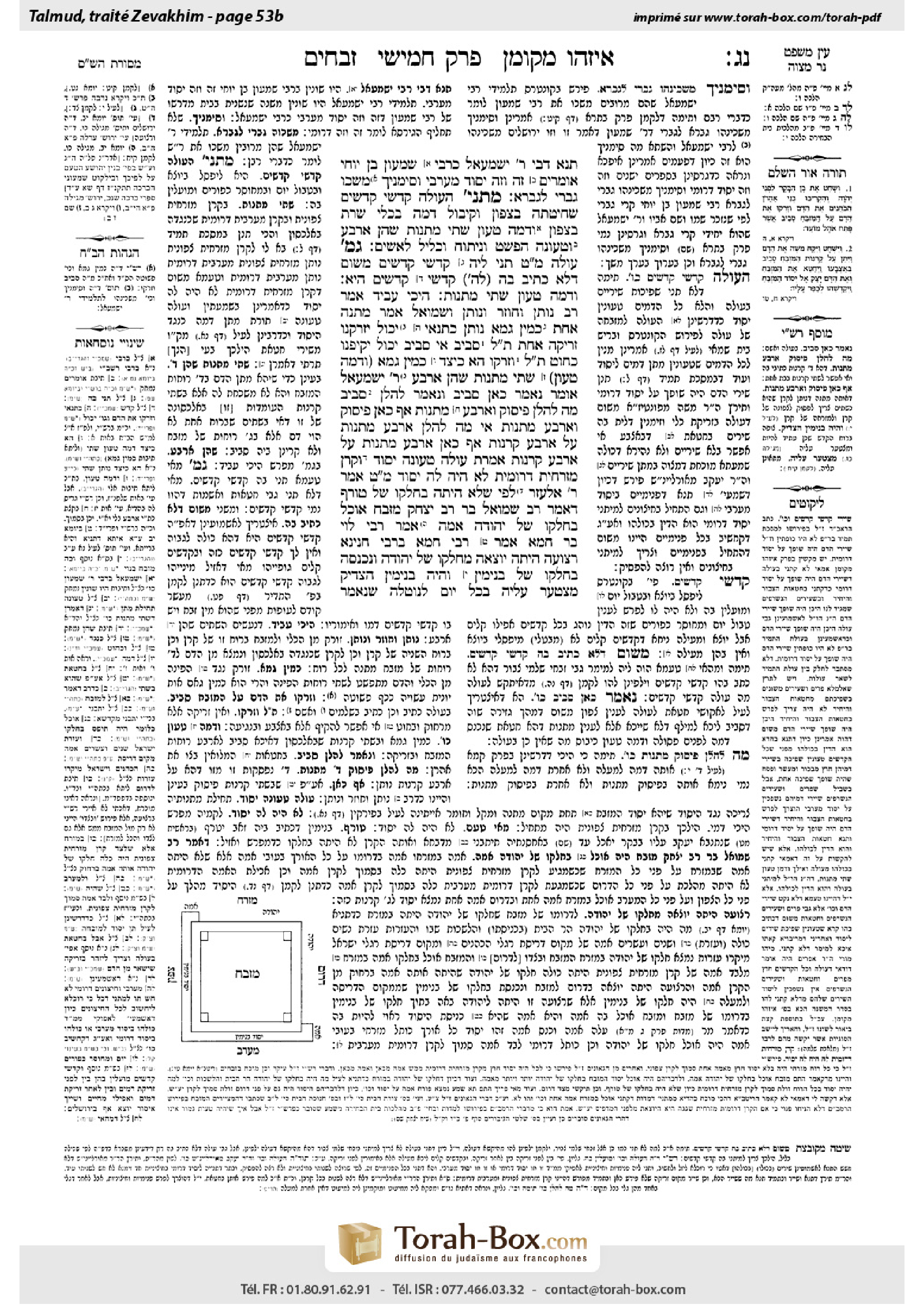
Zevachim 53b: Talmud study for Daf Yomi
Daf Yomi is the daily study of one Talmud folio. Explore 37 tractates with scans, Hebrew text, Sefaria English and AI-generated French translations where annotated.
Passage selection and English or AI-generated French translation are available where the scan has annotations. Daf Study is independent of Torah-Box and Sefaria.
Browse Zevachim · זבחים · All tractatesZevachim 53b text and translations
This page of Zevachim includes the Aramaic text, an English translation and an AI-generated French translation, alongside the scan above.
זבחים נ״ג ב · Aramaic and Hebrew text
תָּנָא דְּבֵי רַבִּי יִשְׁמָעֵאל כְּרַבִּי שִׁמְעוֹן בֶּן יוֹחַי אוֹמְרִים: זֶה וָזֶה יְסוֹד מַעֲרָבִי. וְסִימָנֵיךְ: מָשְׁכוּ גַּבְרֵי לְגַבְרָא.
מַתְנִי' הָעוֹלָה קׇדְשֵׁי קָדָשִׁים, שְׁחִיטָתָהּ בַּצָּפוֹן, וְקִיבּוּל דָּמָהּ בִּכְלֵי שָׁרֵת בַּצָּפוֹן, וְדָמָהּ טָעוּן שְׁתֵּי מַתָּנוֹת שֶׁהֵן אַרְבַּע, וּטְעוּנָה הֶפְשֵׁט וְנִיתּוּחַ, וְכָלִיל לָאִשִּׁים.
גְּמָ׳ עוֹלָה מַאי טַעְמָא תָּנֵי לֵיהּ קׇדְשֵׁי קָדָשִׁים? מִשּׁוּם דְּלָא כְּתִיב בַּהּ ״(לַה׳) קׇדְשֵׁי קָדָשִׁים הִיא״.
וְדָמָהּ טָעוּן שְׁתֵּי מַתָּנוֹת. הֵיכִי עָבֵיד? אָמַר רַב: נוֹתֵן וְחוֹזֵר וְנוֹתֵן. וּשְׁמוּאֵל אָמַר: מַתָּנָה אַחַת כְּמִין גַּמָּא נוֹתֵן.
כְּתַנָּאֵי – יָכוֹל יִזְרְקֶנּוּ זְרִיקָה אַחַת? תַּלְמוּד לוֹמַר: ״סָבִיב״. אִי סָבִיב, יָכוֹל יַקִּיפֶנּוּ כְּחוּט? תַּלְמוּד לוֹמַר: ״וְזָרְקוּ״. הָא כֵּיצַד? כְּמִין גַּמָּא – וְדָמָהּ טָעוּן שְׁתֵּי מַתָּנוֹת שֶׁהֵן אַרְבַּע.
רַבִּי יִשְׁמָעֵאל אוֹמֵר: נֶאֱמַר כָּאן ״סָבִיב״, וְנֶאֱמַר לְהַלָּן ״סָבִיב״; מָה לְהַלָּן – פִּיסּוּק וְאַרְבַּע מַתָּנוֹת, אַף כָּאן – פִּיסּוּק וְאַרְבַּע מַתָּנוֹת.
אִי – מָה לְהַלָּן אַרְבַּע מַתָּנוֹת עַל אַרְבַּע קְרָנוֹת, אַף כָּאן אַרְבַּע מַתָּנוֹת עַל אַרְבַּע קְרָנוֹת?! אָמַרְתָּ: עוֹלָה טְעוּנָה יְסוֹד; וְקֶרֶן מִזְרָחִית דְּרוֹמִית לֹא הָיָה לָהּ יְסוֹד.
מַאי טַעְמָא? אָמַר רַבִּי אֶלְעָזָר: לְפִי שֶׁלֹּא הָיְתָה בְּחֶלְקוֹ שֶׁל טוֹרֵף. דְּאָמַר רַב שְׁמוּאֵל בַּר רַב יִצְחָק: מִזְבֵּחַ אוֹכֵל בְּחֶלְקוֹ שֶׁל יְהוּדָה אַמָּה.
אָמַר רַבִּי לֵוִי בַּר חָמָא אָמַר רַבִּי חָמָא בְּרַבִּי חֲנִינָא: רְצוּעָה הָיְתָה יוֹצְאָה מֵחֶלְקוֹ שֶׁל יְהוּדָה וְנִכְנֶסֶת בְּחֶלְקוֹ שֶׁל בִּנְיָמִין, וְהָיָה בִּנְיָמִין הַצַּדִּיק מִצְטַעֵר עָלֶיהָ בְּכׇל יוֹם לְנוֹטְלָהּ, שֶׁנֶּאֱמַר:
Zevachim 53b · English translation
The school of Rabbi Yishmael, in accordance with the opinion of Rabbi Shimon ben Yoḥai, says: Both this and that, i.e., the blood of an inner sin offering and that of an external sin offering, were poured at the western base of the altar. According to this version, Rabbi Shimon ben Yoḥai agrees with the opinion of Rabbi Yishmael. The Gemara comments: And your mnemonic to remember this change in opinion is: The men pulled the man. In this case, the numerous students of Rabbi Yishmael claim that Rabbi Shimon ben Yoḥai agrees with their teacher.
MISHNA: The burnt offering is an offering of the most sacred order. Its slaughter is in the north of the Temple courtyard and the collection of its blood in a service vessel is in the north, and its blood requires two placements that are four, and it requires flaying of its carcass and the cutting of the sacrificial animal into pieces, and it is consumed in its entirety, with the exception of its hide, by the fire of the altar.
GEMARA: What is the reason that the tanna taught that a burnt offering is an offering of the most sacred order, when the mishna earlier (52b) did not mention that a sin offering is of the most sacred order? The Gemara answers: It is because in the Torah it is not written explicitly with regard to the burnt offering: It is most sacred, as it states concerning the sin offering and the guilt offering in a verse concerning a meal offering: “It shall not be baked with leaven. I have given it as their portion of My offerings made by fire; it is most sacred, as the sin offering, and as the guilt offering” (Leviticus 6:10). Consequently, the tanna explicitly states that a burnt offering is likewise of the most sacred order.
The mishna teaches: And its blood requires two placements that are four. How does the priest perform the placements? Rav says: He places the blood on one side of the corner of the altar, and places it again on the other side of the corner of the altar. He repeats this on the diagonally opposite corner, so that he places on two corners but on all four sides of the altar. And Shmuel says: He places one placement on each of the two diagonally opposite corners, so that each placement is similar to the shape of the Greek letter gamma, which is bent at a right angle.
The Gemara comments: This dispute between Rav and Shmuel is like a dispute between tanna’im: One might have thought that a priest should sprinkle one sprinkling with the blood of a burnt offering. To counter this possibility, the verse states: “And sprinkle the blood around against the altar that is at the entrance of the Tent of Meeting” (Leviticus 1:5). If the blood must be sprinkled around the altar, one might have thought that he should circumscribe the altar as one would do with a thread, and sprinkle the blood all around. To counter this possibility, the verse states: “Shall present the blood, and sprinkle the blood around against the altar” (Leviticus 1:5), and one cannot have the blood circumscribe the altar as a thread would without directly applying it with a finger. How can these verses be reconciled? He applies the blood in a shape that is similar to that of the Greek letter gamma, and its blood requires two sprinklings that are four. This opinion accords with the opinion of Shmuel.
The baraita continues: Rabbi Yishmael says: It is stated here: “Shall present the blood, and sprinkle the blood around against the altar” (Leviticus 1:5), and it is stated there, with regard to the sin offering sacrificed at the inauguration of the Tabernacle: “And when it was slain, Moses took the blood, and put it upon the corners of the altar around with his finger” (Leviticus 8:15). Just as there, with regard to the sin offering, the blood was placed discretely and with four placements, one on each corner, so too here, with regard to a burnt offering, it must be placed discretely and with four placements. This opinion accords with the opinion of Rav.
If these offerings are compared to each other, why not say that just as there, the blood of the sin offering must have four placements on the four corners, so too here, the blood of the burnt offering requires four placements on the four corners? You said that a burnt offering requires that the blood be placed on a part of the altar that has a base, and the southeast corner of the altar had no base beneath it. Therefore, the blood had to be placed on the northeast corner and the southwest corner.
The Gemara asks: What is the reason that there was no base on the southeast corner of the altar? Rabbi Elazar says: Because it was not in the portion of land of the one who tears, i.e., the tribe of Benjamin, as he is described in the following manner: “Benjamin is a wolf that tears apart; in the morning he devours the prey, and in the evening he divides the spoil” (Genesis 49:27). As Rav Shmuel, son of Rav Yitzḥak, says: The altar would consume, i.e., occupy, one cubit of the portion of Judah. The part of the altar in Judah’s portion was the southeast corner of the base, and therefore there was no base on that corner.
Rabbi Levi bar Ḥama says that Rabbi Ḥama, son of Rabbi Ḥanina, says: A strip of land emerged from the portion of Judah and entered into the portion of Benjamin, and the southeast corner of the base was on that strip. And the tribe of Benjamin the righteous would agonize over it every day, desiring to take it into its portion, due to its unique sanctity. As it is stated in Moses’ blessing to the tribe of Benjamin:
Zevachim 53b · Traduction française (IA)
L’école de Rabbi Yishmaël, conformément à l’opinion de Rabbi Shimon ben Yoḥai, dit : Les deux, c’est-à-dire le sang du sacrifice expiatoire intérieur et celui du sacrifice expiatoire extérieur, étaient versés au pied occidental de l’autel. Selon cette version, Rabbi Shimon ben Yoḥai est d’accord avec l’opinion de Rabbi Yishmaël. La Guemara commente : Le moyen mnémotechnique pour se souvenir de ce renversement d’opinion est : « Les hommes ont tiré l’homme. » Dans ce cas, les nombreux élèves de Rabbi Yishmaël affirment que Rabbi Shimon ben Yoḥai est d’accord avec leur maître.
MICHNA : L’holocauste est une offrande de très haute sainteté. Son abattage a lieu au nord du parvis du Temple et la collecte de son sang dans un récipient de service a lieu au nord. Son sang requiert deux aspersions correspondant à quatre, sa carcasse doit être dépouillée et l’animal sacrificiel découpé en morceaux ; il est entièrement consumé par le feu de l’autel, à l’exception de sa peau.
GUEMARA : Pourquoi le tanna enseigne-t-il que l’holocauste est une offrande de très haute sainteté, alors que la Michna précédente (52b) ne précisait pas que le sacrifice expiatoire appartient à cette catégorie ? La Guemara répond : C’est parce que la Torah ne dit pas explicitement, au sujet de l’holocauste, qu’il est de très haute sainteté, contrairement à ce qu’elle dit du sacrifice expiatoire et du sacrifice de culpabilité dans un verset concernant une offrande végétale : « Elle ne sera pas cuite avec du levain. Je la leur ai donnée comme leur part de mes offrandes consumées par le feu ; elle est de très haute sainteté, comme le sacrifice expiatoire et comme le sacrifice de culpabilité » (Lévitique 6:10). Par conséquent, le tanna précise explicitement que l’holocauste appartient lui aussi à cette catégorie.
La Michna enseigne : Son sang requiert deux aspersions correspondant à quatre. Comment le prêtre procède-t-il aux aspersions ? Rav dit : Il applique le sang sur un côté de l’angle de l’autel, puis sur l’autre côté de cet angle. Il répète cela à l’angle diagonalement opposé, de sorte qu’il applique le sang sur deux angles, mais sur les quatre côtés de l’autel. Et Shmuel dit : Il fait une aspersion sur chacun des deux angles diagonalement opposés, chaque aspersion ayant la forme de la lettre grecque gamma, coudée à angle droit.
La Guemara commente : Cette controverse entre Rav et Shmuel correspond à une controverse entre tannaïm. On aurait pu penser que le prêtre devait faire une seule aspersion avec le sang d’un holocauste. Pour écarter cette possibilité, le verset dit : « Il présentera le sang et aspergera le sang tout autour, contre l’autel qui se trouve à l’entrée de la Tente d’assignation » (Lévitique 1:5). Si le sang doit être aspergé tout autour de l’autel, on aurait pu penser qu’il devait en faire le tour comme un fil et asperger tout le pourtour. Pour écarter cette possibilité, le verset dit : « Il présentera le sang et aspergera le sang tout autour, contre l’autel » (Lévitique 1:5) ; or, le sang ne peut faire le tour de l’autel comme un fil sans être appliqué directement avec un doigt. Comment concilier ces versets ? Il applique le sang selon une forme semblable à celle de la lettre grecque gamma, et le sang de l’holocauste requiert deux aspersions correspondant à quatre. Cette opinion concorde avec celle de Shmuel.
La baraïta poursuit : Rabbi Yishmaël dit : Il est écrit ici : « Il présentera le sang et aspergera le sang tout autour, contre l’autel » (Lévitique 1:5), et il est écrit là, au sujet du sacrifice expiatoire offert lors de l’inauguration du Tabernacle : « Lorsqu’il fut abattu, Moïse prit le sang et en mit avec son doigt sur les angles de l’autel, tout autour » (Lévitique 8:15). De même que là, pour le sacrifice expiatoire, le sang fut appliqué séparément en quatre aspersions, une sur chaque angle, de même ici, pour l’holocauste, il doit être appliqué séparément en quatre aspersions. Cette opinion concorde avec celle de Rav.
Si l’on compare ces offrandes, pourquoi ne pas dire que, de même que là, le sang du sacrifice expiatoire doit être appliqué en quatre aspersions sur les quatre angles, de même ici, le sang de l’holocauste requiert quatre aspersions sur les quatre angles ? On a dit qu’un holocauste exige que le sang soit appliqué sur une partie de l’autel reposant sur un socle, et l’angle sud-est de l’autel n’avait pas de socle en dessous. Le sang devait donc être appliqué sur l’angle nord-est et l’angle sud-ouest.
La Guemara demande : Pourquoi l’angle sud-est de l’autel n’avait-il pas de socle ? Rabbi Elazar dit : Parce qu’il ne se trouvait pas sur le territoire de celui qui déchire, c’est-à-dire la tribu de Benjamin, qui est décrite ainsi : « Benjamin est un loup qui déchire ; le matin, il dévore sa proie, et le soir, il partage le butin » (Genèse 49:27). Rav Shmuel, fils de Rav Yitzḥak, dit en effet : L’autel occupait une coudée du territoire de Juda. La partie de l’autel située sur le territoire de Juda était l’angle sud-est du socle ; c’est pourquoi cet angle n’avait pas de socle.
Rabbi Levi bar Ḥama dit au nom de Rabbi Ḥama, fils de Rabbi Ḥanina : Une bande de terre sortait du territoire de Juda et pénétrait dans celui de Benjamin, et l’angle sud-est du socle se trouvait sur cette bande. La tribu de Benjamin le Juste en était affligée chaque jour, désirant l’intégrer à son territoire en raison de sa sainteté particulière. Comme il est dit dans la bénédiction de Moïse à la tribu de Benjamin :
Traduction française générée par IA à partir de l’édition anglaise de Sefaria. Vérifie toujours un passage avec le texte source.
Text from Sefaria: William Davidson Edition - Vocalized Aramaic (CC BY NC); William Davidson Edition - English (CC BY NC).