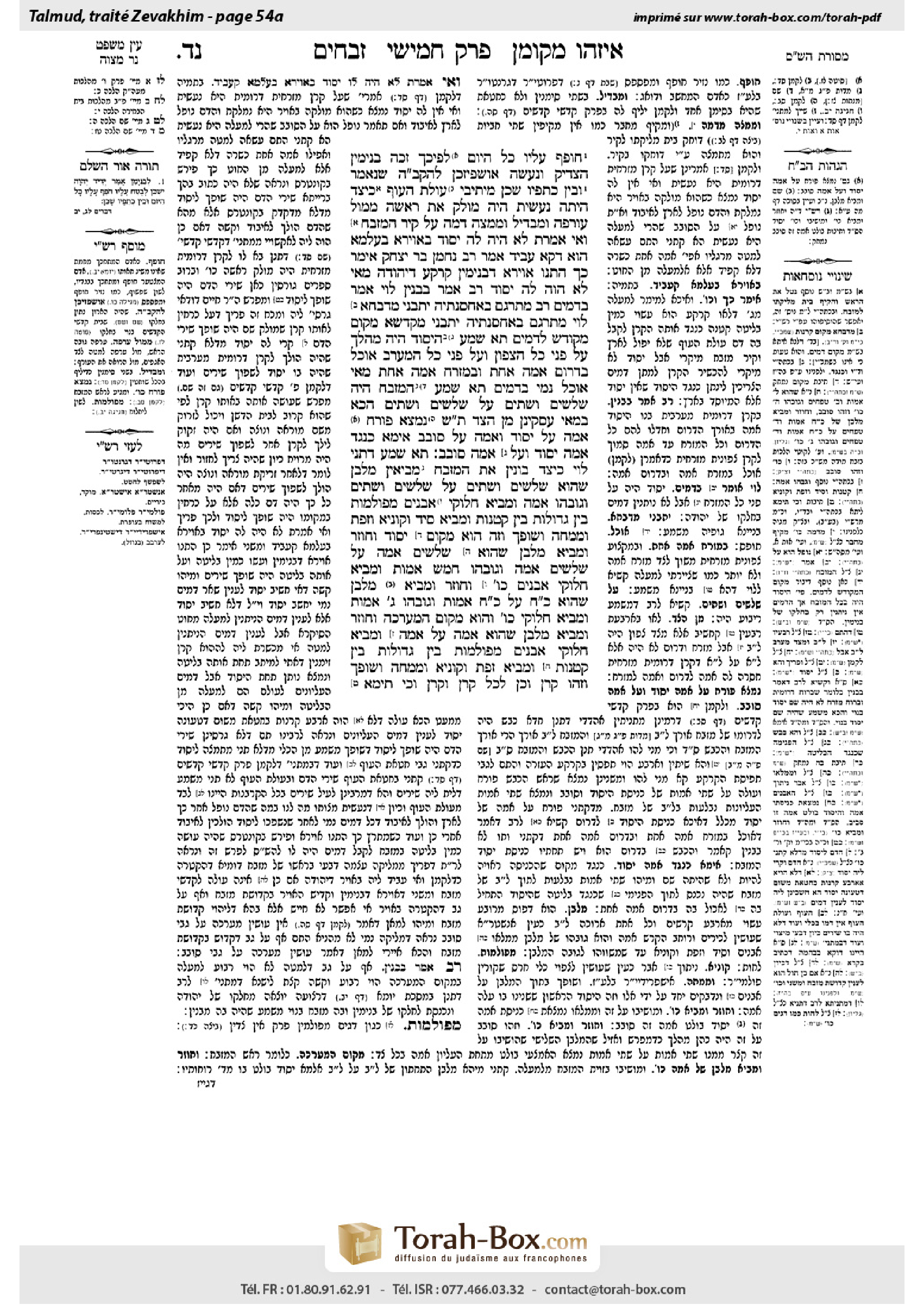
Zevachim 54a: Talmud study for Daf Yomi
Daf Yomi is the daily study of one Talmud folio. Explore 37 tractates with scans, Hebrew text, Sefaria English and AI-generated French translations where annotated.
Passage selection and English or AI-generated French translation are available where the scan has annotations. Daf Study is independent of Torah-Box and Sefaria.
Browse Zevachim · זבחים · All tractatesZevachim 54a text and translations
This page of Zevachim includes the Aramaic text, an English translation and an AI-generated French translation, alongside the scan above.
זבחים נ״ד א · Aramaic and Hebrew text
״חֹפֵף עָלָיו כׇּל הַיּוֹם״. לְפִיכָךְ זָכָה בִּנְיָמִין הַצַּדִּיק וְנַעֲשָׂה אוּשְׁפִּיזְכָן לְהַקָּדוֹשׁ בָּרוּךְ הוּא, שֶׁנֶּאֱמַר: ״וּבֵין כְּתֵפָיו שָׁכֵן״.
מֵיתִיבִי: עוֹלַת הָעוֹף כֵּיצַד הָיְתָה נַעֲשֵׂית? הָיָה מוֹלֵק אֶת רֹאשָׁהּ מִמּוּל עוֹרְפָּהּ, וּמַבְדִּיל, וּמְמַצֶּה דָּמָהּ עַל קִיר הַמִּזְבֵּחַ.
וְאִי אָמְרַתְּ לֹא הָיָה לָהּ יְסוֹד – בְּאַוֵּירָא בְּעָלְמָא הוּא דְּקָא עָבֵיד! אָמַר רַב נַחְמָן בַּר יִצְחָק: אֵימַר כָּךְ הִתְנוּ – אַוֵּירָא דְּבִנְיָמִין, קַרְקַע דִּיהוּדָה.
מַאי לֹא (הֲוָה) [הָיָה] לָהּ יְסוֹד? רַב אָמַר: בְּבִנְיָן, לֵוִי אָמַר: בְּדָמִים. רַב מְתַרְגֵּם: ״בְּאַחְסָנְתֵּיהּ יִתְבְּנֵי מַדְבְּחָא״, לֵוִי מְתַרְגֵּם: ״בְּאַחְסָנְתֵּיהּ יִתְבְּנֵי מַקְדְּשָׁא״ – מְקוֹם מְקוּדָּשׁ לְדָמִים.
תָּא שְׁמַע: הַיְסוֹד הָיָה מְהַלֵּךְ עַל פְּנֵי כׇּל הַצָּפוֹן וְעַל פְּנֵי כׇּל הַמַּעֲרָב, אוֹכֵל בַּדָּרוֹם אַמָּה אַחַת וּבַמִּזְרָח אַמָּה אַחַת! מַאי ״אוֹכֵל״ נָמֵי – בְּדָמִים.
תָּא שְׁמַע: הַמִּזְבֵּחַ הָיָה שְׁלֹשִׁים וּשְׁתַּיִם עַל שְׁלֹשִׁים וּשְׁתַּיִם! הָכָא בְּמַאי עָסְקִינַן – מִן הַצַּד.
תָּא שְׁמַע: נִמְצָא פּוֹרֵחַ אַמָּה עַל יְסוֹד וְאַמָּה עַל סוֹבֵב! אֵימָא כְּנֶגֶד אַמָּה יְסוֹד, וְעַל אַמָּה סוֹבֵב.
תָּא שְׁמַע, דְּתָנֵי לֵוִי: כֵּיצַד בּוֹנִין אֶת הַמִּזְבֵּחַ? מְבִיאִין מַלְבֵּן שֶׁהוּא שְׁלֹשִׁים וּשְׁתַּיִם עַל שְׁלֹשִׁים וּשְׁתַּיִם וְגוֹבְהוֹ אַמָּה, וּמֵבִיא חֲלוּקֵי אֲבָנִים מְפוּלָּמוֹת – בֵּין גְּדוֹלוֹת בֵּין קְטַנּוֹת, וּמֵבִיא סִיד וְקוּנְיָא וָזֶפֶת, וּמְמַחֶה וְשׁוֹפֵךְ. וְזֶה הוּא מְקוֹם יְסוֹד.
וְחוֹזֵר וּמֵבִיא מַלְבֵּן שֶׁהוּא שְׁלֹשִׁים אַמָּה עַל שְׁלֹשִׁים אַמָּה וְגוֹבְהוֹ חָמֵשׁ אַמּוֹת, וּמֵבִיא חֲלוּקֵי אֲבָנִים כּוּ׳. וְחוֹזֵר וּמֵבִיא מַלְבֵּן שֶׁהוּא עֶשְׂרִים וּשְׁמוֹנֶה עַל עֶשְׂרִים וּשְׁמוֹנֶה אַמּוֹת וְגוֹבְהוֹ שָׁלֹשׁ אַמּוֹת, וּמֵבִיא חֲלוּקֵי כּוּ׳. וְהוּא מְקוֹם הַמַּעֲרָכָה.
וְחוֹזֵר וּמֵבִיא מַלְבֵּן שֶׁהוּא אַמָּה עַל אַמָּה, וּמֵבִיא חֲלוּקֵי אֲבָנִים מְפוּלָּמוֹת בֵּין גְּדוֹלוֹת בֵּין קְטַנּוֹת, וּמֵבִיא זֶפֶת וְקוּנְיָא, וּמְמַחֶה וְשׁוֹפֵךְ. וְזֶהוּ קֶרֶן. וְכֵן לְכׇל קֶרֶן וָקֶרֶן.
וְכִי תֵּימָא
Zevachim 54a · English translation
“He covers it throughout the day, and He dwells between his shoulders” (Deuteronomy 33:12). The term “covers it” is understood to mean that Benjamin is continually focused upon that site. Therefore, Benjamin the righteous was privileged and became the host of the Holy One, Blessed be He, as the Holy of Holies was built in his portion. As it is stated: “And He dwells between his shoulders.”
The Gemara raises an objection from a baraita: How was the rite of a bird burnt offering performed? The priest ascended the ramp and turned to the surrounding ledge. When he arrived at the southeast corner, the priest would pinch the bird’s head by pinching at its nape with his thumbnail and sever the bird’s head from its body, and would squeeze out its blood on the wall of the altar.
The Gemara states its objection: And if you say that the southeast corner of the altar had no base, is he merely performing the rite in the air, i.e., not within the domain of the altar? Rav Naḥman bar Yitzḥak said: Say that when Eretz Yisrael was apportioned, they made this condition: The airspace of what would become the southeast part of the altar is in the portion of the tribe of Benjamin, so the pinching of the bird offering was performed within the domain of the altar. But the land was in the portion of the tribe of Judah.
§ The Gemara asks: What does the baraita mean when it states that the southeast corner of the altar had no base? Rav says: It is with regard to the fact that it had no base built on those sides. Levi says: It is with regard to the fact that no blood was sprinkled on that side, as the blood was not permitted to be presented there, even though there was a physical base. Based on this dispute, each of them disagreed as to the correct Aramaic translation of the verse: “Benjamin is a wolf that tears apart; in the morning he devours the prey, and in the evening he divides the spoil” (Genesis 49:27). Rav translates this as: In his portion will the altar be built. Levi translates this as: In his portion will the Sanctuary be built, which means: A place sanctified for blood.
The Gemara brings proof for each opinion: Come and hear a proof for the explanation of Rav from a mishna (Middot 35b): The base of the altar would extend along all of the northern side and along all of the western side. It consumed one cubit on the southern side and one cubit on the eastern side. This indicates that there was no base on most of the southern or eastern sides of the altar. The Gemara comments: Levi would explain: What is the meaning of the term: Consume? The baraita, as well, is stated with regard to consuming blood of the offerings.
The Gemara suggests: Come and hear a proof for the explanation of Levi from that same mishna: The altar was thirty-two cubits by thirty-two cubits. This indicates that there was a base on all four sides, in accordance with the opinion of Levi. Rav could answer: Here we are dealing with the measurement from the side. In other words, only the northern and western sides were thirty-two cubits in length.
The Gemara suggests: Come and hear a proof for the explanation of Levi from a baraita: It turns out the top of the ramp of the altar would overhang one cubit in the air over the base of the altar and one cubit over the surrounding ledge. This indicates that it had a base on all four sides, as the ramp was on the southern side. Rav could answer: Say that the baraita means it would overhang toward the place where the base of a cubit would have been, and one cubit over the surrounding ledge.
The Gemara suggests: Come and hear a proof, as Levi teaches in a baraita: How does one build the altar? He brings a square wooden frame, which is thirty-two cubits by thirty-two cubits, and its height is one cubit. And he brings pieces of damp [mefulamot] stone, both large and small, which are the main components of the altar, which is described as: “An altar of stone” (Exodus 20:22). And he brings plaster and molten lead and tar, and melts them and pours the mixture into the gaps between the stones. And this is the place of the base of the altar.
And then he brings a square wooden frame, which is thirty cubits by thirty cubits, and its height is five cubits. And he brings pieces of damp stone, both large and small. And he brings plaster and molten lead and tar, and melts them and pours the mixture into the gaps between the stones. And then he brings a square wooden frame, which is twenty-eight cubits by twenty-eight cubits, and its height is three cubits. And he brings pieces of damp stone, both large and small. And he brings plaster and molten lead and tar, and melts them and pours the mixture into the gaps between the stones. And this is the place of the arrangement of wood on the altar.
And then he brings a square wooden frame, which is one cubit by one cubit. And he brings pieces of damp stone, both large and small. And he brings plaster and molten lead and tar, and melts them and pours the mixture into the frame. And this is the corner of the altar. And so he does this for each and every corner. This baraita indicates that the altar had a base around all four sides.
The Gemara comments: And if you would say
Zevachim 54a · Traduction française (IA)
« Il le couvre tout au long du jour, et Il demeure entre ses épaules » (Deutéronome 33, 12). L’expression « il le couvre » signifie que Benjamin est constamment tourné vers cet endroit. Ainsi, Benjamin le juste eut le privilège de devenir l’hôte du Saint, béni soit-Il, puisque le Saint des Saints fut construit sur son territoire. Comme il est dit : « Et Il demeure entre ses épaules. »
La Guemara soulève une objection à partir d’une baraïta : comment accomplissait-on le rite de l’holocauste d’un oiseau ? Le prêtre montait par la rampe et se dirigeait vers la corniche qui entourait l’autel. Arrivé à l’angle sud-est, il pinçait la tête de l’oiseau en enfonçant l’ongle de son pouce dans sa nuque, séparait la tête du corps, puis faisait couler son sang sur le mur de l’autel.
La Guemara formule son objection : si tu dis que l’angle sud-est de l’autel n’avait pas de socle, le rite était-il simplement accompli dans les airs, c’est-à-dire hors du domaine de l’autel ? Rav Naḥman bar Yitzḥak dit : dis plutôt que, lors du partage d’Eretz Yisrael, ils avaient posé cette condition : l’espace aérien de ce qui deviendrait la partie sud-est de l’autel appartenait au territoire de la tribu de Benjamin, de sorte que la pince de l’oiseau sacrificiel était pratiquée dans le domaine de l’autel. Mais le sol appartenait au territoire de la tribu de Juda.
§ La Guemara demande : que veut dire la baraïta lorsqu’elle affirme que l’angle sud-est de l’autel n’avait pas de socle ? Rav dit : cela signifie qu’aucun socle n’était construit sur ces côtés. Levi dit : cela signifie qu’on ne répandait pas de sang sur ce côté, car il n’était pas permis d’y présenter le sang, même si un socle s’y trouvait matériellement. À partir de ce désaccord, chacun propose une traduction araméenne différente du verset : « Benjamin est un loup qui déchire ; le matin, il dévore sa proie, et le soir, il partage le butin » (Genèse 49, 27). Rav traduit ainsi : « Dans son territoire, l’autel sera construit. » Levi traduit ainsi : « Dans son territoire, le Sanctuaire sera construit », c’est-à-dire un lieu consacré au sang.
La Guemara apporte une preuve à l’appui de chacune des opinions. Viens et entends une preuve en faveur de l’explication de Rav, tirée d’une Michna (Middot 35b) : le socle de l’autel s’étendait sur toute la longueur du côté nord et sur toute celle du côté ouest. Il empiétait d’une coudée sur le côté sud et d’une coudée sur le côté est. Cela indique qu’il n’y avait pas de socle sur la majeure partie des côtés sud et est de l’autel. La Guemara commente : Levi expliquerait le terme « empiéter » ainsi : la baraïta aussi traite de la consommation du sang des offrandes.
La Guemara suggère : viens et entends une preuve en faveur de l’explication de Levi, tirée de cette même Michna : l’autel mesurait trente-deux coudées sur trente-deux coudées. Cela indique qu’il y avait un socle sur les quatre côtés, conformément à l’opinion de Levi. Rav pourrait répondre : ici, il s’agit de la mesure prise depuis le côté. Autrement dit, seuls les côtés nord et ouest mesuraient trente-deux coudées de long.
La Guemara suggère : viens et entends une preuve en faveur de l’explication de Levi, tirée d’une baraïta : il s’avère que le sommet de la rampe de l’autel surplombait d’une coudée le socle de l’autel, dans les airs, et d’une coudée la corniche qui l’entourait. Cela indique qu’il y avait un socle sur les quatre côtés, puisque la rampe se trouvait du côté sud. Rav pourrait répondre : dis plutôt que la baraïta signifie que la rampe surplombait l’endroit où se serait trouvé le socle d’une coudée, ainsi que la corniche d’une coudée.
La Guemara suggère : viens et entends une preuve, car Levi enseigne dans une baraïta : comment construit-on l’autel ? On apporte un coffrage carré en bois, de trente-deux coudées sur trente-deux, et d’une coudée de hauteur. On apporte des morceaux de pierre humides [mefulamot], grands et petits, qui constituent les principaux éléments de l’autel, désigné comme « un autel de pierre » (Exode 20, 22). On apporte du plâtre, du plomb fondu et du goudron, on les fait fondre et on verse le mélange dans les interstices entre les pierres. C’est là l’emplacement du socle de l’autel.
Puis on apporte un coffrage carré en bois, de trente coudées sur trente, et de cinq coudées de hauteur. On apporte des morceaux de pierre humides, grands et petits. On apporte du plâtre, du plomb fondu et du goudron, on les fait fondre et on verse le mélange dans les interstices entre les pierres. Puis on apporte un coffrage carré en bois, de vingt-huit coudées sur vingt-huit, et de trois coudées de hauteur. On apporte des morceaux de pierre humides, grands et petits. On apporte du plâtre, du plomb fondu et du goudron, on les fait fondre et on verse le mélange dans les interstices entre les pierres. C’est là l’emplacement du bûcher sur l’autel.
Puis on apporte un coffrage carré en bois, d’une coudée sur une coudée. On apporte des morceaux de pierre humides, grands et petits. On apporte du plâtre, du plomb fondu et du goudron, on les fait fondre et on verse le mélange dans le coffrage. C’est là l’angle de l’autel. On procède ainsi pour chacun des angles. Cette baraïta indique que l’autel avait un socle sur ses quatre côtés.
La Guemara commente : et si tu dis
Traduction française générée par IA à partir de l’édition anglaise de Sefaria. Vérifie toujours un passage avec le texte source.
Text from Sefaria: William Davidson Edition - Vocalized Aramaic (CC BY NC); William Davidson Edition - English (CC BY NC).