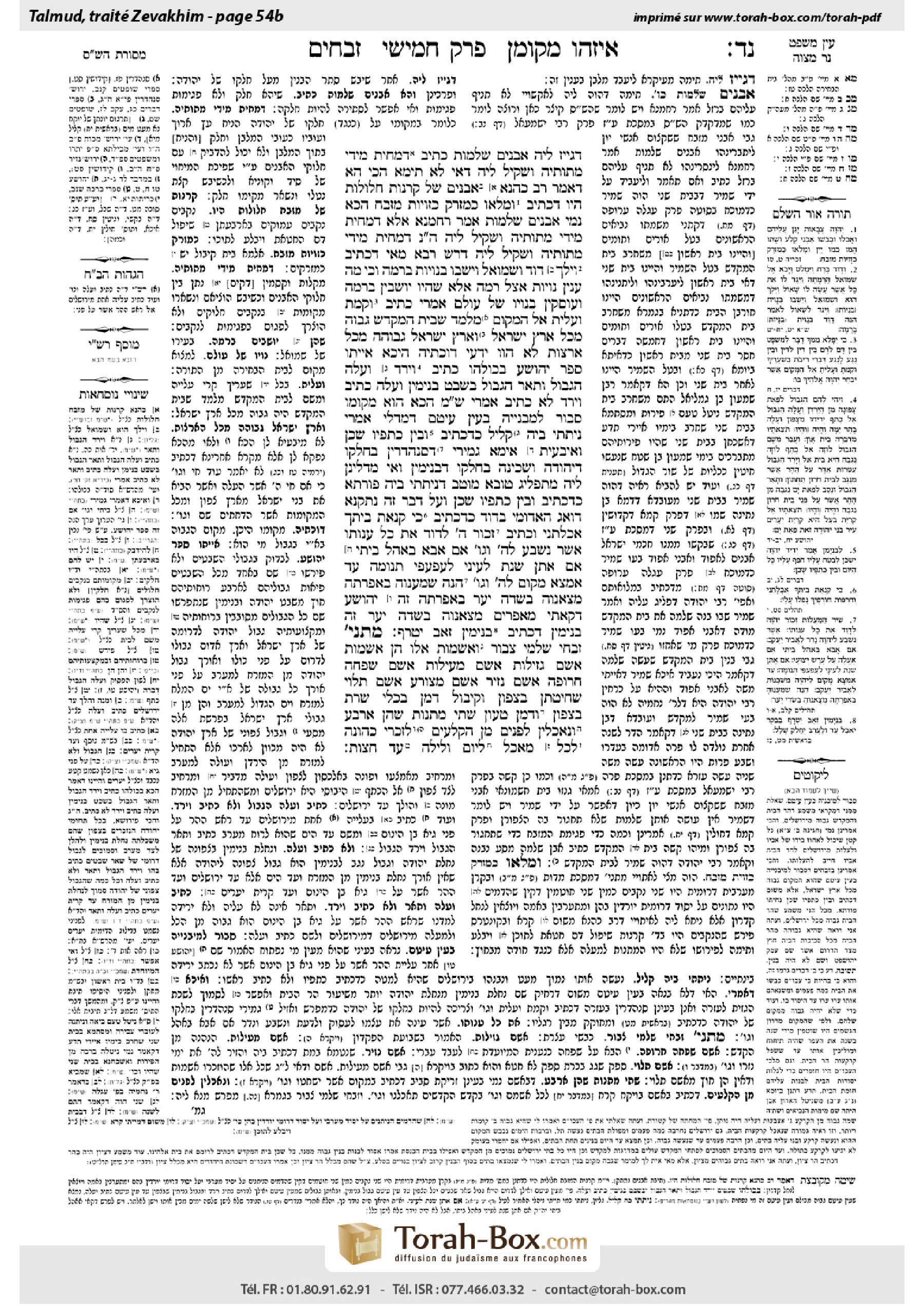
Zevachim 54b: Talmud study for Daf Yomi
Daf Yomi is the daily study of one Talmud folio. Explore 37 tractates with scans, Hebrew text, Sefaria English and AI-generated French translations where annotated.
Passage selection and English or AI-generated French translation are available where the scan has annotations. Daf Study is independent of Torah-Box and Sefaria.
Browse Zevachim · זבחים · All tractatesZevachim 54b text and translations
This page of Zevachim includes the Aramaic text, an English translation and an AI-generated French translation, alongside the scan above.
זבחים נ״ד ב · Aramaic and Hebrew text
דְּגָיֵיז לֵיהּ, ״אֲבָנִים שְׁלֵמוֹת״ כְּתִיב!
דְּמַחֵית מִידֵּי מִתּוּתֵיהּ, וְשָׁקֵיל לֵיהּ. דְּאִי לָא תֵּימָא הָכִי, הָא דְּאָמַר רַב כָּהֲנָא: אֲבָנִים שֶׁל קְרָנוֹת חֲלוּלוֹת הָיוּ – דִּכְתִיב: ״וּמָלְאוּ כַּמִּזְרָק כְּזָוִיֹּת מִזְבֵּחַ״; הָכָא נָמֵי ״אֲבָנִים שְׁלֵמוֹת״ אָמַר רַחֲמָנָא! אֶלָּא דְּמַחֵית מִידֵּי מִתּוּתֵיהּ וְשָׁקֵיל לֵיהּ; הָכָא נָמֵי, דְּמַחֵית מִידֵּי מִתּוּתֵיהּ וְשָׁקֵיל לֵיהּ.
דָּרֵשׁ רָבָא, מַאי דִּכְתִיב: ״וַיֵּלֶךְ דָּוִד וּשְׁמוּאֵל וַיֵּשְׁבוּ בְּנוֹיוֹת בָּרָמָה״? וְכִי מָה עִנְיַן נוֹיוֹת אֵצֶל רָמָה? אֶלָּא שֶׁהָיוּ יוֹשְׁבִין בָּרָמָה וְעוֹסְקִין בְּנוֹיוֹ שֶׁל עוֹלָם.
אָמְרִי, כְּתִיב: ״וְקַמְתָּ וְעָלִיתָ אֶל הַמָּקוֹם״ – מְלַמֵּד שֶׁבֵּית הַמִּקְדָּשׁ גָּבוֹהַּ מִכׇּל אֶרֶץ יִשְׂרָאֵל, וְאֶרֶץ יִשְׂרָאֵל גְּבוֹהָה מִכׇּל אֲרָצוֹת. לָא הֲווֹ יָדְעִי דּוּכְתֵּיהּ הֵיכָא;
אַיְיתוֹ סֵפֶר יְהוֹשֻׁעַ, בְּכוּלְּהוּ כְּתִיב: ״וְיָרַד (וְעָלָה) הַגְּבוּל״, ״וְתָאַר הַגְּבוּל״; בְּשֵׁבֶט בִּנְיָמִין ״וְעָלָה״ כְּתִיב, ״וְיָרַד״ לָא כְּתִיב. אָמְרִי, שְׁמַע מִינַּהּ: הָכָא הוּא מְקוֹמוֹ.
סְבוּר לְמִבְנְיֵיהּ בְּעֵין עֵיטָם – דְּמִדְּלֵי; אָמְרִי: נִיתַתֵּי בֵּיהּ קַלִּיל, כְּדִכְתִיב: ״וּבֵין כְּתֵפָיו שָׁכֵן״.
וְאִיבָּעֵית אֵימָא: גְּמִירִי דְּסַנְהֶדְרִין בְּחֶלְקוֹ דִּיהוּדָה וּשְׁכִינָה בְּחֶלְקוֹ דְּבִנְיָמִין, וְאִי מְדַלִּינַן לֵיהּ – מִתְפְּלֵיג טוּבָא; מוּטָב דְּנִיתַתֵּי בֵּיהּ פּוּרְתָּא, כְּדִכְתִיב: ״וּבֵין כְּתֵפָיו שָׁכֵן״.
וְעַל דָּבָר זֶה נִתְקַנֵּא דּוֹאֵג הָאֲדוֹמִי בְּדָוִד, כְּדִכְתִיב: ״כִּי קִנְאַת בֵּיתְךָ אֲכָלָתְנִי״, וּכְתִיב: ״זְכוֹר ה׳ לְדָוִד אֵת כׇּל עֻנּוֹתוֹ אֲשֶׁר נִשְׁבַּע לַה׳ וְגוֹ׳, אִם אָבֹא בְּאֹהֶל בֵּיתִי וְגוֹ׳, אִם אֶתֵּן שְׁנַת לְעֵינָי לְעַפְעַפַּי תְּנוּמָה עַד אֶמְצָא מָקוֹם לַה׳ וְגוֹ׳״.
״הִנֵּה שְׁמַעֲנוּהָ בְאֶפְרָתָה מְצָאנוּהָ בִּשְׂדֵה יַעַר״; ״בְּאֶפְרָתָה״ – זֶה יְהוֹשֻׁעַ, דְּקָאָתֵי מֵאֶפְרַיִם. ״מְצָאנוּהָ בִּשְׂדֵה יַעַר״ – זֶה בִּנְיָמִין, דִּכְתִיב: ״בִּנְיָמִין זְאֵב יִטְרָף״.
מַתְנִי׳ זִבְחֵי שַׁלְמֵי צִבּוּר וַאֲשָׁמוֹת; אֵלּוּ הֵן אֲשָׁמוֹת – אֲשַׁם גְּזֵילוֹת, אֲשַׁם מְעִילוֹת, אֲשַׁם שִׁפְחָה חֲרוּפָה, אֲשַׁם נָזִיר, אֲשַׁם מְצוֹרָע, אָשָׁם תָּלוּי;
שְׁחִיטָתָן בַּצָּפוֹן וְקִיבּוּל דָּמָן בִּכְלֵי שָׁרֵת בַּצָּפוֹן, וְדָמָן טָעוּן שְׁתֵּי מַתָּנוֹת שֶׁהֵן אַרְבַּע, וְנֶאֱכָלִין לִפְנִים מִן הַקְּלָעִים – לְזִכְרֵי כְהוּנָּה, לְכׇל מַאֲכָל, לְיוֹם וָלַיְלָה עַד חֲצוֹת.
Zevachim 54b · English translation
that he cuts the base on the southern and western sides after he has poured the mixture for the altar and it has dried, it is written concerning the altar: “You shall build the altar of the Lord your God of unhewn stones; and you shall offer burnt offerings on it to the Lord your God” (Deuteronomy 27:6), so it cannot be cut.
Rav could answer: This means that he places something under the frame, in the place where there is to be no base, and after the poured mixture has dried he removes it, leaving the space empty. As if you do not say so, how will you explain that which Rav Kahana says: The stone interiors of the corners were hollow, i.e., there were gaps between the stones, as it is written: “And they shall be filled like the basins, like the corners of the altar” (Zechariah 9:15)? The verse compares the corners to hollow basins. Here too, doesn’t the Merciful One state that the altar must be made of “unhewn stones”? If so, how could the corners be hollow? Rather, it must be that he places something, e.g., sticks and twigs, under the frame and pours the mixture for the corners over it, and when it has hardened, removes the sticks and twigs, leaving the corners somewhat hollow. Here too, he places something under the frame and later removes it.
§ Apropos the altar and the Temple, the Gemara relates that Rava taught: What is the meaning of that which is written concerning David: “And he and Samuel went and dwelt in Naioth. And it was told Saul, saying: Behold, David is at Naioth [beNayot] in Ramah” (I Samuel 19:18–19)? But what does Naioth have to do with Ramah? They are in two distinct places. Rather, this means that they were sitting in Ramah and were involved in discussing the beauty [benoyo] of the world, i.e., the Temple.
David and Samuel said: It is written: “Then you shall arise, and get you up unto the place which the Lord your God shall choose” (Deuteronomy 17:8). This teaches that the Temple is higher than all places in Eretz Yisrael. And Eretz Yisrael is higher than all countries. They did not know where the highest place in Eretz Yisrael was.
They brought the book of Joshua. With regard to all of the borders of the tribes it is written: “And went down” (see Joshua 15:10, 16:3, 17:9), and it is written: “And the border went up to Beth Hoglah.” (Joshua 15:6), and: “And the border was drawn from the top of the mountain to the fountain of the waters of Nephtoah” (Joshua 15:9). The verse uses different terms to describe the borders of the portion of each tribe. And with regard to the borders of the tribe of Benjamin it is written only: “And went up” (Joshua 18:11), but it is not written: “And went down.” They said: Conclude from the verses that the Temple’s place is here, in the portion of Benjamin.
They thought to build it at Ein Eitam, which is higher than any other place in the portion of Benjamin. They said: Let us lower it a bit, as it is written: “He covers it throughout the day, and He dwells between his shoulders” (Deuteronomy 33:12). This indicates that the Temple is situated slightly lower, between two peaks.
And if you wish, say instead that it is learned as a tradition that the Sanhedrin is to be located in the portion of Judah, and the place of the Divine Presence is to be located in the portion of Benjamin. They said: And if we raise it and place it near Ein Eitam it will be too distant from the portion of Judah. They said: It is preferable that we lower it a bit, as it is written: “He covers it throughout the day, and He dwells between his shoulders” (Deuteronomy 33:12).
And with regard to this matter, that David and Samuel discovered the location of the Temple, Doeg the Edomite was jealous of David, as it is written: “Because jealousy for Your House has eaten me up” (Psalms 69:10), and it is written: “Lord, remember for David all his affliction; how he swore to the Lord, and vowed unto the Mighty One of Jacob: I will not come into the tent of my house, nor go up into the bed that is spread for me; if I will give sleep to my eyes, or slumber to my eyelids; until I find a place for the Lord, a dwelling place for the Mighty One of Jacob” (Psalms 132:1–5).
The verse following those verses states: “We heard of it as being in Ephrath; we found it in the field of the wood” (Psalms 132:6). Rava explains the meaning of these words: “In Ephrath”; this is a reference to Joshua, who came from the tribe of Ephraim. This alludes to the fact that David and Samuel were able to locate the highest place in Eretz Yisrael based on the book of Joshua. “We found it in the field of the wood”; this is a reference to Benjamin, as it is written concerning him: “Benjamin is a wolf that tears apart; in the morning he devours the prey, and in the evening he divides the spoil” (Genesis 49:27). A wolf is a wild animal living in the field, and David and Samuel found the location of the Temple in the portion of Benjamin.
MISHNA: These are the halakhot of communal peace offerings and guilt offerings. These are guilt offerings: The guilt offering for robbery, brought by one from whom another demanded payment of a debt and he denied it and took a false oath (see Leviticus 5:20–26); the guilt offering for unwitting misuse of consecrated property (see Leviticus 5:14–16); the guilt offering of an espoused maidservant, brought by one who engaged in sexual intercourse with a Canaanite maidservant betrothed to a Hebrew slave (see Leviticus 19:20–22); the guilt offering of a nazirite who became impure via contact with a corpse (see Numbers 6:12); the guilt offering of a leper, brought for his purification (see Leviticus 14:12); and the provisional guilt offering, brought by one who is uncertain as to whether he committed a sin that requires a sin offering (see Leviticus 5:17–18).
Concerning all of these, their slaughter is in the north of the Temple courtyard and collection of their blood in a service vessel is in the north, and their blood requires two placements that are four. And the meat portions of the offering are eaten within the curtains, i.e., in the Temple courtyard, by male priests. And they are eaten prepared in any manner of food preparation, on the day the offering was sacrificed and during the night that follows, until midnight.
Zevachim 54b · Traduction française (IA)
qu'il coupe la base sur les côtés sud et ouest après avoir versé le mortier pour l'autel et qu'il a séché, il est écrit au sujet de l'autel : « Tu construiras l'autel de l'Éternel, ton Dieu, de pierres non taillées ; et tu offriras des holocaustes dessus à l'Éternel, ton Dieu » (Deutéronome 27:6), donc il ne peut pas être coupé.
Rav pouvait répondre : Cela signifie qu'il place quelque chose sous le cadre, à l'endroit où il ne doit pas y avoir de base, et après que le mortier versé a séché, il le retire, laissant l'espace vide. Si vous ne le dites pas, comment expliquerez-vous ce que Rav Kahana dit : Les intérieurs en pierre des coins étaient creux, c'est-à-dire qu'il y avait des espaces entre les pierres, comme il est écrit : « Et ils seront remplis comme les bassins, comme les coins de l'autel » (Zacharie 9:15) ? Le verset compare les coins à des bassins creux. Ici aussi, n'est-ce pas le Tout-Puissant qui déclare que l'autel doit être fait de « pierres non taillées » ? Si c'est le cas, comment les coins pouvaient-ils être creux ? Plutôt, il doit être qu'il place quelque chose, par exemple des bâtons et des brindilles, sous le cadre et verse le mortier pour les coins dessus, et quand il a durci, retire les bâtons et les brindilles, laissant les coins quelque peu creux. Ici aussi, il place quelque chose sous le cadre et le retire plus tard.
§ À propos de l'autel et du Temple, la Guemara rapporte que Rava a enseigné : Quel est le sens de ce qui est écrit au sujet de David : « Et lui et Samuel allèrent et demeurèrent à Naïoth. Et il fut dit à Saül, disant : Voici, David est à Naïoth [beNayot] en Rama » (I Samuel 19:18–19) ? Mais qu'est-ce que Naïoth a à voir avec Rama ? Ils sont dans deux lieux distincts. Plutôt, cela signifie qu'ils étaient assis à Rama et étaient impliqués dans la discussion de la beauté [benoyo] du monde, c'est-à-dire le Temple.
David et Samuel dirent : Il est écrit : « Alors tu te lèveras, et tu iras au lieu que l'Éternel, ton Dieu, choisira » (Deutéronome 17:8). Cela enseigne que le Temple est plus élevé que tous les lieux en Terre d'Israël. Et la Terre d'Israël est plus élevée que tous les pays. Ils ne savaient pas où était le lieu le plus élevé en Terre d'Israël.
Ils apportèrent le livre de Josué. Concernant toutes les frontières des tribus, il est écrit : « Et descendit » (voir Josué 15:10, 16:3, 17:9), et il est écrit : « Et la frontière monta jusqu'à Beth Hoglah » (Josué 15:6), et : « Et la frontière fut tirée du sommet de la montagne à la source des eaux de Nephtoah » (Josué 15:9). Le verset utilise des termes différents pour décrire les frontières de la portion de chaque tribu. Et concernant les frontières de la tribu de Benjamin, il est écrit seulement : « Et monta » (Josué 18:11), mais il n'est pas écrit : « Et descendit ». Ils dirent : Concluez des versets que le lieu du Temple est ici, dans la portion de Benjamin.
Ils pensèrent à le construire à Ein Eitam, qui est plus élevé que tout autre lieu dans la portion de Benjamin. Ils dirent : Abaissons-le un peu, comme il est écrit : « Il le couvre tout le jour, et Il demeure entre ses épaules » (Deutéronome 33:12). Cela indique que le Temple est situé légèrement plus bas, entre deux sommets.
Et si vous le souhaitez, dites plutôt que c'est appris par tradition que le Sanhédrin doit être situé dans la portion de Juda, et que le lieu de la Présence Divine doit être situé dans la portion de Benjamin. Ils dirent : Et si nous l'élevons et le plaçons près d'Ein Eitam, il sera trop éloigné de la portion de Juda. Ils dirent : Il est préférable que nous l'abaissions un peu, comme il est écrit : « Il le couvre tout le jour, et Il demeure entre ses épaules » (Deutéronome 33:12).
Et à propos de cette affaire, à savoir que David et Samuel découvrirent l'emplacement du Temple, Doeg l'Iduméen était jaloux de David, comme il est écrit : « Car la jalousie pour Ta Maison m'a dévoré » (Psaumes 69:10), et il est écrit : « Éternel, souviens-Toi pour David de toute son affliction ; comment il jura à l'Éternel, et fit vœu au Puissant de Jacob : Je n'entrerai pas dans la tente de ma maison, ni ne monterai sur le lit qui est étendu pour moi ; si je donnerai le sommeil à mes yeux, ou la sieste à mes paupières ; jusqu'à ce que je trouve un lieu pour l'Éternel, un lieu de demeure pour le Puissant de Jacob » (Psaumes 132:1–5).
Le verset suivant ces versets dit : « Nous en avons entendu parler comme étant à Ephrath ; nous l'avons trouvé dans le champ du bois » (Psaumes 132:6). Rava explique le sens de ces mots : « À Ephrath » ; c'est une référence à Josué, qui vint de la tribu d'Éphraïm. Cela fait allusion au fait que David et Samuel purent localiser le lieu le plus élevé en Terre d'Israël sur la base du livre de Josué. « Nous l'avons trouvé dans le champ du bois » ; c'est une référence à Benjamin, comme il est écrit à son sujet : « Benjamin est un loup qui déchire ; le matin il dévore la proie, et le soir il partage le butin » (Genèse 49:27). Un loup est un animal sauvage vivant dans le champ, et David et Samuel trouvèrent l'emplacement du Temple dans la portion de Benjamin.
MICHNA : Voici les halakhot des sacrifices de paix communaux et des sacrifices de culpabilité. Voici les sacrifices de culpabilité : le sacrifice de culpabilité pour le vol, offert par celui à qui un autre a exigé le paiement d'une dette et qui l'a nié en prêtant un faux serment (voir Lévitique 5:20–26) ; le sacrifice de culpabilité pour l'usage involontaire de biens consacrés (voir Lévitique 5:14–16) ; le sacrifice de culpabilité d'une servante fiancée, offert par celui qui a eu des relations sexuelles avec une servante cananéenne fiancée à un esclave hébreu (voir Lévitique 19:20–22) ; le sacrifice de culpabilité d'un nazir qui est devenu impur par contact avec un cadavre (voir Nombres 6:12) ; le sacrifice de culpabilité d'un lépreux, offert pour sa purification (voir Lévitique 14:12) ; et le sacrifice de culpabilité provisoire, offert par celui qui est incertain quant au fait d'avoir commis un péché qui nécessite un sacrifice expiatoire (voir Lévitique 5:17–18).
Concernant tous ces sacrifices, leur immolation s'effectue dans la partie nord de la cour du Temple, et la collecte de leur sang dans un récipient de service se fait également au nord. Leur sang requiert deux placements, qui en totalisent quatre. Les portions de viande de l'offrande sont consommées à l'intérieur des rideaux, c'est-à-dire dans la cour du Temple, par des prêtres mâles. Elles sont consommées préparées de n'importe quelle manière, le jour où l'offrande a été sacrifiée et pendant la nuit qui suit, jusqu'à minuit.
Traduction française générée par IA à partir de l’édition anglaise de Sefaria. Vérifie toujours un passage avec le texte source.
Text from Sefaria: William Davidson Edition - Vocalized Aramaic (CC BY NC); William Davidson Edition - English (CC BY NC).