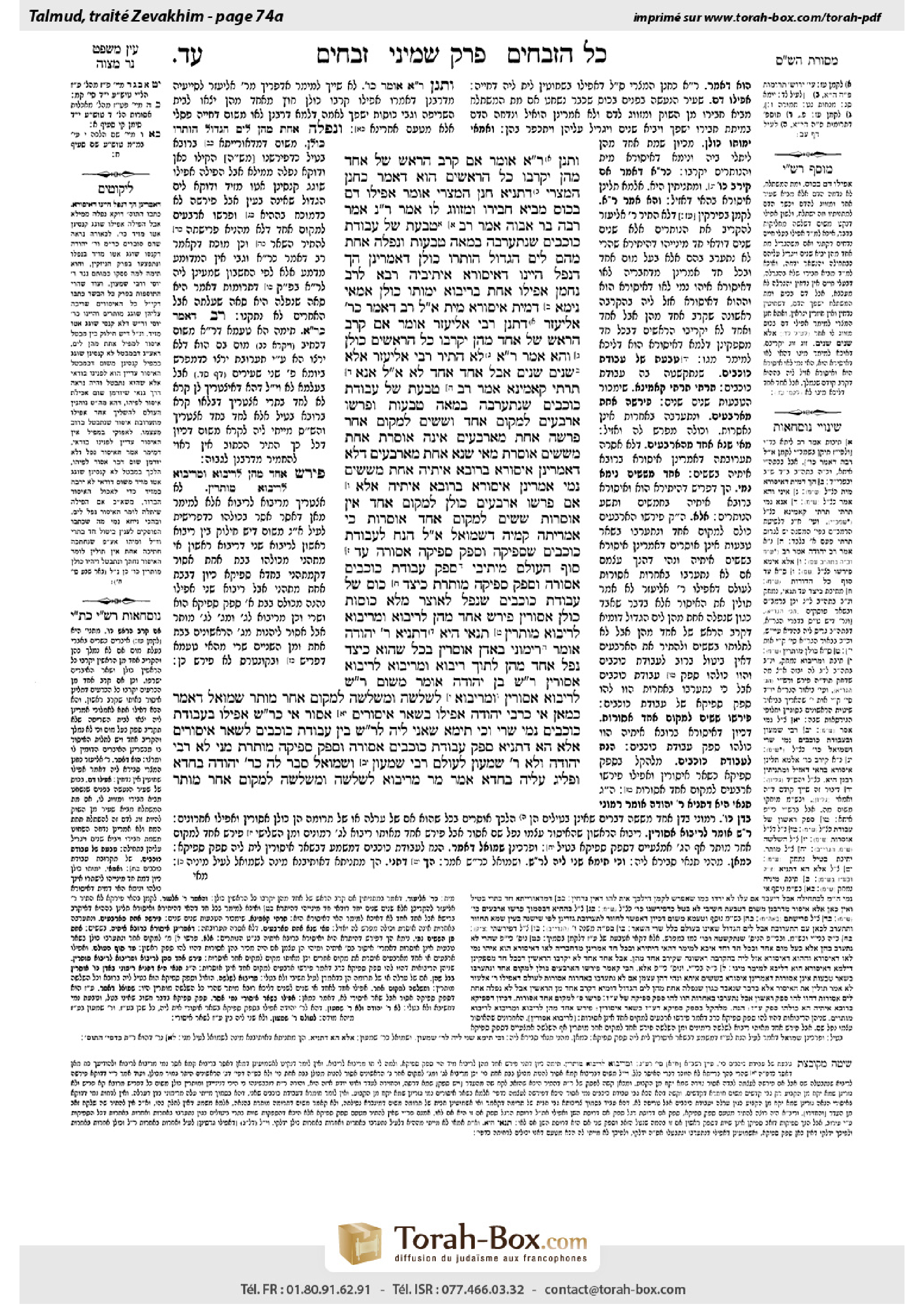
Zevachim 74a: Talmud study for Daf Yomi
Daf Yomi is the daily study of one Talmud folio. Explore 37 tractates with scans, Hebrew text, Sefaria English and AI-generated French translations where annotated.
Passage selection and English or AI-generated French translation are available where the scan has annotations. Daf Study is independent of Torah-Box and Sefaria.
Browse Zevachim · זבחים · All tractatesZevachim 74a text and translations
This page of Zevachim includes the Aramaic text, an English translation and an AI-generated French translation, alongside the scan above.
זבחים ע״ד א · Aramaic and Hebrew text
וּתְנַן, רַבִּי אֱלִיעֶזֶר אוֹמֵר: אִם קָרַב הָרֹאשׁ שֶׁל אֶחָד מֵהֶן – יִקְרְבוּ כָּל הָרָאשִׁים!
הוּא דְּאָמַר – כְּחָנָן הַמִּצְרִי; דְּתַנְיָא, חָנָן הַמִּצְרִי אוֹמֵר: אֲפִילּוּ דָּם בְּכוֹס – מֵבִיא חֲבֵירוֹ וּמְזַוֵּוג לוֹ.
אָמַר רַב נַחְמָן אָמַר רַבָּה בַּר אֲבוּהּ אָמַר רַב: טַבַּעַת שֶׁל עֲבוֹדָה זָרָה שֶׁנִּתְעָרְבָה בְּמֵאָה טַבָּעוֹת, וְנָפְלָה אַחַת מֵהֶם לַיָּם הַגָּדוֹל – הוּתְּרוּ כּוּלָּן; דְּאָמְרִינַן: הָךְ דִּנְפַל הַיְינוּ דְּאִיסּוּרָא.
אֵיתִיבֵיהּ רָבָא לְרַב נַחְמָן: אֲפִילּוּ אַחַת בְּרִיבּוֹא – יָמוּתוּ כּוּלָּן. אַמַּאי? נֵימָא: דְּמִית – אִיסּוּרָא מִית!
אֲמַר לֵיהּ: רַב דְּאָמַר – כְּרַבִּי אֱלִיעֶזֶר; דִּתְנַן, רַבִּי אֱלִיעֶזֶר אוֹמֵר: אִם קָרַב הָרֹאשׁ שֶׁל אֶחָד מֵהֶן – יִקְרְבוּ כָּל הָרָאשִׁים כּוּלָּן.
וְהָא אָמַר רַבִּי אֶלְעָזָר: לֹא הִתִּיר רַבִּי אֱלִיעֶזֶר אֶלָּא שְׁנַיִם שְׁנַיִם, אֲבָל אֶחָד אֶחָד – לָא! אֲמַר לֵיהּ: אֲנָא תַּרְתֵּי קָאָמֵינָא.
אָמַר רַב: טַבַּעַת שֶׁל עֲבוֹדָה זָרָה שֶׁנִּתְעָרְבָה בְּמֵאָה טַבָּעוֹת, וּפֵרְשׁוּ אַרְבָּעִים לְמָקוֹם אֶחָד וְשִׁשִּׁים לְמָקוֹם אַחֵר; פֵּרְשָׁה אַחַת מֵאַרְבָּעִים – אֵינָהּ אוֹסֶרֶת, אַחַת מִשִּׁשִּׁים – אוֹסֶרֶת.
מַאי שְׁנָא אַחַת מֵאַרְבָּעִים דְּלָא – דְּאָמְרִינַן אִיסּוּרָא בְּרוּבָּא אִיתֵיהּ; אַחַת מִשִּׁשִּׁים נָמֵי – אָמְרִינַן אִיסּוּרָא בְּרוּבָּא אִיתֵיהּ! אֶלָּא אִם פֵּרְשׁוּ אַרְבָּעִים כּוּלָּן לְמָקוֹם אֶחָד – אֵין אוֹסְרוֹת, שִׁשִּׁים לְמָקוֹם אֶחָד – אוֹסְרוֹת.
כִּי אַמְרִיתַהּ קַמֵּיהּ דִּשְׁמוּאֵל, אָמַר לִי: הַנַּח לַעֲבוֹדָה זָרָה – שֶׁסְּפֵיקָהּ וּסְפֵק סְפֵיקָהּ אֲסוּרָה עַד סוֹף הָעוֹלָם.
מֵיתִיבִי: סְפֵק עֲבוֹדָה זָרָה אֲסוּרָה, וּסְפֵק סְפֵיקָהּ מוּתֶּרֶת. כֵּיצַד? כּוֹס שֶׁל עֲבוֹדָה זָרָה שֶׁנָּפַל לְאוֹצָר מָלֵא כּוֹסוֹת – כּוּלָּן אֲסוּרִין; פֵּירַשׁ אֶחָד מֵהֶן לְרִיבּוֹא, וּמֵרִיבּוֹא לְרִיבּוֹא – מוּתָּרִין!
תַּנָּאֵי הִיא; דְּתַנְיָא, רַבִּי יְהוּדָה אוֹמֵר: רִימּוֹנֵי בָאדָן – אוֹסְרִין בְּכׇל שֶׁהוּא. כֵּיצַד? נָפַל אֶחָד מֵהֶן לְתוֹךְ רִיבּוֹא, וּמֵרִיבּוֹא לְרִיבּוֹא – אֲסוּרִין.
רַבִּי שִׁמְעוֹן בֶּן יְהוּדָה אוֹמֵר מִשּׁוּם רַבִּי שִׁמְעוֹן: לְרִיבּוֹא – אֲסוּרִין, וּמֵרִיבּוֹא לִשְׁלֹשָׁה וּמִשְּׁלֹשָׁה לְמָקוֹם אַחֵר – מוּתָּר.
שְׁמוּאֵל דְּאָמַר כְּמַאן? אִי כְּרַבִּי יְהוּדָה – אֲפִילּוּ בִּשְׁאָר אִיסּוּרִים אָסוּר! אִי כְּרַבִּי שִׁמְעוֹן – אֲפִילּוּ בַּעֲבוֹדָה זָרָה נָמֵי שְׁרֵי!
וְכִי תֵּימָא שָׁאנֵי לֵיהּ לְרַבִּי שִׁמְעוֹן בֵּין עֲבוֹדָה זָרָה לִשְׁאָר אִיסּוּרִים; אֶלָּא הָא דְּתַנְיָא: סְפֵק עֲבוֹדָה זָרָה אֲסוּרָה, וּסְפֵק סְפֵיקָהּ מוּתֶּרֶת – מַנִּי? לָא רַבִּי יְהוּדָה וְלָא רַבִּי שִׁמְעוֹן!
לְעוֹלָם רַבִּי שִׁמְעוֹן; וּשְׁמוּאֵל סָבַר לַהּ כְּרַבִּי יְהוּדָה בַּחֲדָא, וּפְלִיג עֲלֵיהּ בַּחֲדָא.
אָמַר מָר: מֵרִיבּוֹא לִשְׁלֹשָׁה וּמִשְּׁלֹשָׁה לְמָקוֹם אַחֵר – מוּתָּר.
Zevachim 74a · English translation
And we learned in a mishna (77b) that in a case where sacrificial portions from unblemished burnt offerings became mixed with sacrificial portions from blemished burnt offerings, which are disqualified, Rabbi Eliezer says: If the head of one of them was sacrificed on the altar before they knew of the blemish, all the heads should be sacrificed, as it is assumed that the head of the disqualified animal was the one already sacrificed on the altar. This indicates that even with regard to slaughtered animals, if they were rejected from the altar due to being in a mixture, they are not permanently rejected, but are fit after the fact.
The Gemara explains that this mishna affords no proof, as Rabbi Eliezer states his ruling in accordance with the opinion of Ḥanan the Egyptian, who maintains that even slaughtered animals are not permanently rejected. As it is taught in a baraita that Ḥanan the Egyptian says, with regard to the two goats of Yom Kippur, the one sacrificed to God and the scapegoat designated to be sent to Azazel: Even if the blood of the sacrificed goat is already in the cup where it was collected and the scapegoat dies, the sacrificed goat is still a fit offering, and the priest brings another goat and joins it to this slaughtered goat to serve as the scapegoat. By contrast, the other tanna’im, who maintain that slaughtered animals are rejected, hold that once they have become rejected due to being in a mixture they are no longer fit for sacrifice, as stated by Rava.
§ Concerning a similar case, Rav Naḥman says that Rava bar Avuh says that Rav says: With regard to a ring used in idol worship, from which it is prohibited to derive benefit and which is not nullified even in a ratio of one in one hundred, that was intermingled with one hundred permitted rings, and subsequently one of them fell into the Great Sea [Yam HaGadol], they are all permitted. The reason is that we say: That ring that fell into the Great Sea is the prohibited ring.
Rava raised an objection to Rav Naḥman from the mishna: With regard to all the offerings that were intermingled with animals from which deriving benefit is prohibited, even if the ratio is one in ten thousand, they all must die. According to the opinion of Rav, that we say the one that was lost is the prohibited item, why must they all die? Let us say, with regard to the first animal that died, that the prohibited animal died, and the rest should be permitted.
Rav Naḥman said to Rava: Rav states his ruling in accordance with the opinion of Rabbi Eliezer, as we learned in the mishna that Rabbi Eliezer says: If the head of one of them is sacrificed on the altar before the priests knew of the blemish, all the heads should be sacrificed, as it is assumed that the head of the disqualified animal was the one already sacrificed on the altar.
Rava asked Rav Naḥman: But doesn’t Rabbi Elazar say: Rabbi Eliezer permitted the sacrifice of all the heads only if they were sacrificed two by two, as at least one of them is certainly permitted; but he did not permit them to be sacrificed one by one, in case the priest sacrifices the prohibited head by itself? How, then, can Rav Naḥman permit the rings without qualification? Rav Naḥman said to Rava: I too am saying that Rav permits the rings only if they are sold two at a time, in which case one of them is certainly not from idol worship.
The Gemara discusses a similar case. Rav says: With regard to a ring used in idol worship that was intermingled with one hundred permitted rings, and then forty of them became separated to one place, and the other sixty became separated to another place, so that they are now two distinct groups of rings, if one ring from the group of forty became separated from them and then became intermingled with other rings, it does not render them prohibited. But if one ring from the other sixty became separated from its group and became mixed with other rings, it renders them prohibited.
The Gemara asks: What is different concerning the case in which one ring from the group of forty separated, that it does not render the other rings prohibited? The reason is that we say: The prohibited ring is in the group that contains the majority of the rings, i.e., it is in the group of sixty. If so, in the case where one ring from the group of sixty became separated and became intermingled with the other rings, we should also say that the prohibited ring is still in the group that contains the majority of the rings, i.e., it is one of the fifty-nine remaining rings. Rather, Rav’s statement was as follows: If all forty became separated to one place, where they became intermingled with other rings, the forty rings do not render those other rings prohibited, as it is assumed that the prohibited ring is in the group of sixty. Conversely, if all of the sixty rings became separated to one place, where they became intermingled with other rings, the sixty rings render those other rings prohibited.
Rav Yehuda, who said this statement citing Rav, added: When I said this ruling in the presence of Shmuel, that if the forty rings became intermingled with others they do not render them prohibited, he said to me: Disregard this halakha with regard to the case of idol worship, as this prohibition is so stringent that its uncertainty and its compound uncertainty are prohibited forever, i.e., no matter how many uncertainties are added they are all prohibited.
The Gemara raises an objection to the opinion of Shmuel from a baraita: An uncertainty of idol worship is prohibited, but its compound uncertainty is permitted. How so? With regard to a cup used in idol worship that fell into a storeroom full of cups, they are all prohibited. If one of these cups separated from the rest and fell into a group of ten thousand other cups, and from that ten thousand cups a single cup fell into ten thousand other cups, they are permitted. This baraita teaches that only one uncertainty is prohibited, not a compound uncertainty.
The Gemara explains: This is a dispute between tanna’im, as it is taught in a baraita (Tosefta, Terumot 5:10) that Rabbi Yehuda says: Prohibited pomegranates from Badan, which are too significant to be nullified, prohibit a mixture in any amount. How so? If one of them fell into a group of ten thousand other pomegranates, and one of that group fell from that ten thousand into another ten thousand, they are all prohibited, despite the fact that this is a compound uncertainty.
The baraita continues: Rabbi Shimon ben Yehuda says in the name of Rabbi Shimon: If a prohibited pomegranate fell into a group of ten thousand pomegranates, they are all prohibited, as he concedes that these pomegranates are not nullified in a majority. But if one pomegranate from the ten thousand fell into a group of three pomegranates, and one of these three pomegranates fell into a different place, it is permitted, as this is a compound uncertainty.
The Gemara inquires: In accordance with the opinion of which of these tanna’im does Shmuel state his opinion that an item used in idol worship remains prohibited no matter how many uncertainties are involved? If you say that he stated his ruling in accordance with the opinion of Rabbi Yehuda, then even with regard to other prohibitions a compound uncertainty should be prohibited, as Rabbi Yehuda stated his ruling with regard to a prohibited pomegranate, not an item of idol worship. And if Shmuel stated his ruling in accordance with the opinion of Rabbi Shimon, then even in the case of idol worship a compound uncertainty should be permitted, as Rabbi Shimon did not differentiate between different types of prohibitions.
And if you would say that there is a difference according to the opinion of Rabbi Shimon between idol worship and other prohibitions, and he prohibits compound uncertainties only in the case of idol worship, then if so, that which is taught in the baraita cited previously: An uncertainty of idol worship is prohibited but its compound uncertainty is permitted, whose opinion does this represent? It is neither the opinion of Rabbi Yehuda nor the opinion of Rabbi Shimon.
The Gemara answers: Actually, that baraita is in accordance with the opinion of Rabbi Shimon, as he permits a compound uncertainty in all cases. And Shmuel holds in accordance with the opinion of Rabbi Yehuda with regard to one matter, that a compound uncertainty is prohibited in the case of idol worship, and disagrees with him with regard to one matter, as Shmuel does not apply this stringency to other prohibitions.
§ The Gemara continues its analysis. The Master, Rabbi Shimon ben Yehuda citing Rabbi Shimon, says above: If one pomegranate from the ten thousand fell into a group of three pomegranates, and one of these three pomegranates fell into a different place, the mixture is permitted.
Zevachim 74a · Traduction française (IA)
Et nous avons appris dans une Michna (77b) que, lorsque des portions sacrificielles d’holocaustes sans défaut se mélangent à des portions sacrificielles d’holocaustes présentant un défaut, qui sont disqualifiés, Rabbi Eliezer dit : si la tête de l’un d’eux a été offerte sur l’autel avant que l’on ait connaissance du défaut, toutes les têtes doivent être offertes, car on présume que la tête de l’animal disqualifié est celle qui a déjà été offerte sur l’autel. Cela indique que même pour des animaux abattus, s’ils ont été écartés de l’autel à cause d’un mélange, ils ne sont pas définitivement rejetés, mais restent aptes a posteriori.
La Guemara explique que cette Michna ne constitue pas une preuve, car Rabbi Eliezer énonce sa décision conformément à l’opinion de Ḥanan l’Égyptien, qui soutient que même les animaux abattus ne sont pas définitivement rejetés. En effet, il est enseigné dans une baraïta que Ḥanan l’Égyptien dit, au sujet des deux boucs de Yom Kippour, celui offert à Dieu et le bouc émissaire destiné à être envoyé à Azazel : même si le sang du bouc sacrifié se trouve déjà dans le récipient où il a été recueilli et que le bouc émissaire meurt, le bouc sacrifié reste apte à être offert ; le prêtre prend alors un autre bouc et l’associe à ce bouc déjà abattu pour qu’il serve de bouc émissaire. En revanche, les autres tannaïm, qui soutiennent que les animaux abattus sont rejetés, estiment qu’une fois écartés à cause d’un mélange, ils ne sont plus aptes à être sacrifiés, comme l’a dit Rava.
§ À propos d’un cas similaire, Rav Naḥman dit que Rava bar Avuh dit au nom de Rav : si un anneau utilisé dans le culte idolâtre, dont il est interdit de tirer profit et qui n’est pas annulé même dans une proportion d’un pour cent, se mélange à cent anneaux permis, puis que l’un d’eux tombe dans la Grande Mer [Yam HaGadol], tous les anneaux sont permis. En effet, nous disons que l’anneau tombé dans la Grande Mer est l’anneau interdit.
Rava objecta à Rav Naḥman en citant la Michna : tous les sacrifices qui se sont mélangés à des animaux dont il est interdit de tirer profit, même dans une proportion d’un pour dix mille, doivent tous mourir. Selon l’opinion de Rav, d’après laquelle nous disons que l’élément perdu est l’élément interdit, pourquoi doivent-ils tous mourir ? Disons, au sujet du premier animal mort, que c’était l’animal interdit qui est mort, et que les autres sont permis.
Rav Naḥman dit à Rava : Rav énonce sa décision conformément à l’opinion de Rabbi Eliezer, comme nous l’avons appris dans la Michna : Rabbi Eliezer dit que si la tête de l’un d’eux a été offerte sur l’autel avant que les prêtres aient eu connaissance du défaut, toutes les têtes doivent être offertes, car on présume que la tête de l’animal disqualifié est celle qui a déjà été offerte sur l’autel.
Rava demanda à Rav Naḥman : Mais Rabbi Elazar ne dit-il pas que Rabbi Eliezer n’a permis d’offrir toutes les têtes que si elles étaient offertes deux par deux, car au moins l’une d’elles est certainement permise, mais qu’il n’a pas autorisé à les offrir une par une, de crainte que le prêtre n’offre la tête interdite à elle seule ? Comment Rav Naḥman peut-il donc autoriser les anneaux sans restriction ? Rav Naḥman dit à Rava : Moi aussi, je dis que Rav n’autorise les anneaux que s’ils sont vendus deux à la fois, auquel cas au moins l’un d’eux ne provient certainement pas du culte idolâtre.
La Guemara examine un cas similaire. Rav dit : si un anneau utilisé dans le culte idolâtre se mélange à cent anneaux permis, puis que quarante d’entre eux sont séparés et placés à un endroit, tandis que les soixante autres sont séparés et placés ailleurs, de sorte qu’il y a maintenant deux groupes distincts d’anneaux, un anneau du groupe de quarante qui en est séparé puis se mélange à d’autres anneaux ne les rend pas interdits. En revanche, si un anneau de l’autre groupe, celui de soixante, en est séparé et se mélange à d’autres anneaux, il les rend interdits.
La Guemara demande : En quoi le cas où un anneau du groupe de quarante est séparé est-il différent, de sorte qu’il ne rend pas les autres anneaux interdits ? C’est parce que nous disons que l’anneau interdit se trouve dans le groupe qui contient la majorité des anneaux, c’est-à-dire le groupe de soixante. Si tel est le cas, lorsque l’un des anneaux du groupe de soixante est séparé et se mélange aux autres anneaux, nous devrions également dire que l’anneau interdit se trouve encore dans le groupe qui contient la majorité des anneaux, c’est-à-dire parmi les cinquante-neuf anneaux restants. Il faut plutôt comprendre ainsi la déclaration de Rav : si les quarante anneaux sont tous séparés et placés à un endroit, où ils se mélangent à d’autres anneaux, ils ne rendent pas ces autres anneaux interdits, car on présume que l’anneau interdit se trouve dans le groupe de soixante. À l’inverse, si les soixante anneaux sont tous séparés et placés à un endroit, où ils se mélangent à d’autres anneaux, ils rendent ces autres anneaux interdits.
Rav Yehuda, qui a rapporté cette déclaration au nom de Rav, ajouta : lorsque j’ai énoncé cette décision devant Shmuel — à savoir que si les quarante anneaux se mélangeaient à d’autres, ils ne les rendaient pas interdits —, il m’a dit : écarte cette halakha dans le cas du culte idolâtre, car cette interdiction est si rigoureuse que l’incertitude et l’incertitude composée sont interdites à jamais, c’est-à-dire que, quel que soit le nombre d’incertitudes ajoutées, tout reste interdit.
La Guemara objecte à l’opinion de Shmuel en citant une baraïta : une incertitude concernant le culte idolâtre est interdite, mais une incertitude composée est permise. Comment cela ? Si une coupe utilisée dans le culte idolâtre tombe dans une réserve remplie de coupes, elles sont toutes interdites. Si l’une de ces coupes est séparée des autres et tombe dans un groupe de dix mille autres coupes, puis qu’une seule coupe de ce groupe de dix mille tombe dans un autre groupe de dix mille coupes, elles sont permises. Cette baraïta enseigne que seule une incertitude simple est interdite, et non une incertitude composée.
La Guemara explique : c’est une controverse entre tannaïm, comme il est enseigné dans une baraïta (Tosefta, Teroumot 5:10) que Rabbi Yehuda dit : des grenades interdites de Badan, trop importantes pour être annulées, rendent tout mélange interdit, quelle qu’en soit la quantité. Comment cela ? Si l’une d’elles tombe dans un groupe de dix mille autres grenades, puis que l’une de ces dix mille grenades tombe dans un autre groupe de dix mille, elles sont toutes interdites, bien qu’il s’agisse d’une incertitude composée.
La baraïta poursuit : Rabbi Shimon ben Yehuda dit au nom de Rabbi Shimon : si une grenade interdite tombe dans un groupe de dix mille grenades, elles sont toutes interdites, car il reconnaît que ces grenades ne sont pas annulées par la majorité. Mais si l’une des dix mille grenades tombe dans un groupe de trois grenades, puis que l’une de ces trois grenades tombe en un autre endroit, elle est permise, car il s’agit d’une incertitude composée.
La Guemara demande : Selon l’opinion de lequel de ces tannaïm Shmuel énonce-t-il sa position, selon laquelle un objet utilisé dans le culte idolâtre reste interdit quel que soit le nombre d’incertitudes en jeu ? Si tu dis qu’il énonce sa décision conformément à l’opinion de Rabbi Yehuda, alors une incertitude composée devrait être interdite même pour les autres interdictions, car Rabbi Yehuda a énoncé sa décision à propos d’une grenade interdite, et non d’un objet lié au culte idolâtre. Et si Shmuel énonce sa décision conformément à l’opinion de Rabbi Shimon, alors une incertitude composée devrait être permise même dans le cas du culte idolâtre, car Rabbi Shimon n’a pas distingué les différents types d’interdictions.
Et si tu dis que, selon l’opinion de Rabbi Shimon, il existe une différence entre le culte idolâtre et les autres interdictions, et qu’il interdit les incertitudes composées uniquement dans le cas du culte idolâtre, alors, dans ce cas, à qui correspond l’opinion enseignée dans la baraïta citée précédemment : une incertitude concernant le culte idolâtre est interdite, mais une incertitude composée est permise ? Elle ne correspond ni à l’opinion de Rabbi Yehuda ni à celle de Rabbi Shimon.
La Guemara répond : en réalité, cette baraïta est conforme à l’opinion de Rabbi Shimon, puisqu’il permet une incertitude composée dans tous les cas. Shmuel s’accorde avec Rabbi Yehuda sur un point : une incertitude composée est interdite dans le cas du culte idolâtre ; mais il est en désaccord avec lui sur un autre point, car Shmuel n’applique pas cette rigueur aux autres interdictions.
§ La Guemara poursuit son analyse. Le Maître, Rabbi Shimon ben Yehuda citant Rabbi Shimon, dit plus haut : si l’une des dix mille grenades tombe dans un groupe de trois grenades, puis que l’une de ces trois grenades tombe en un autre endroit, le mélange est permis.
Traduction française générée par IA à partir de l’édition anglaise de Sefaria. Vérifie toujours un passage avec le texte source.
Text from Sefaria: William Davidson Edition - Vocalized Aramaic (CC BY NC); William Davidson Edition - English (CC BY NC).