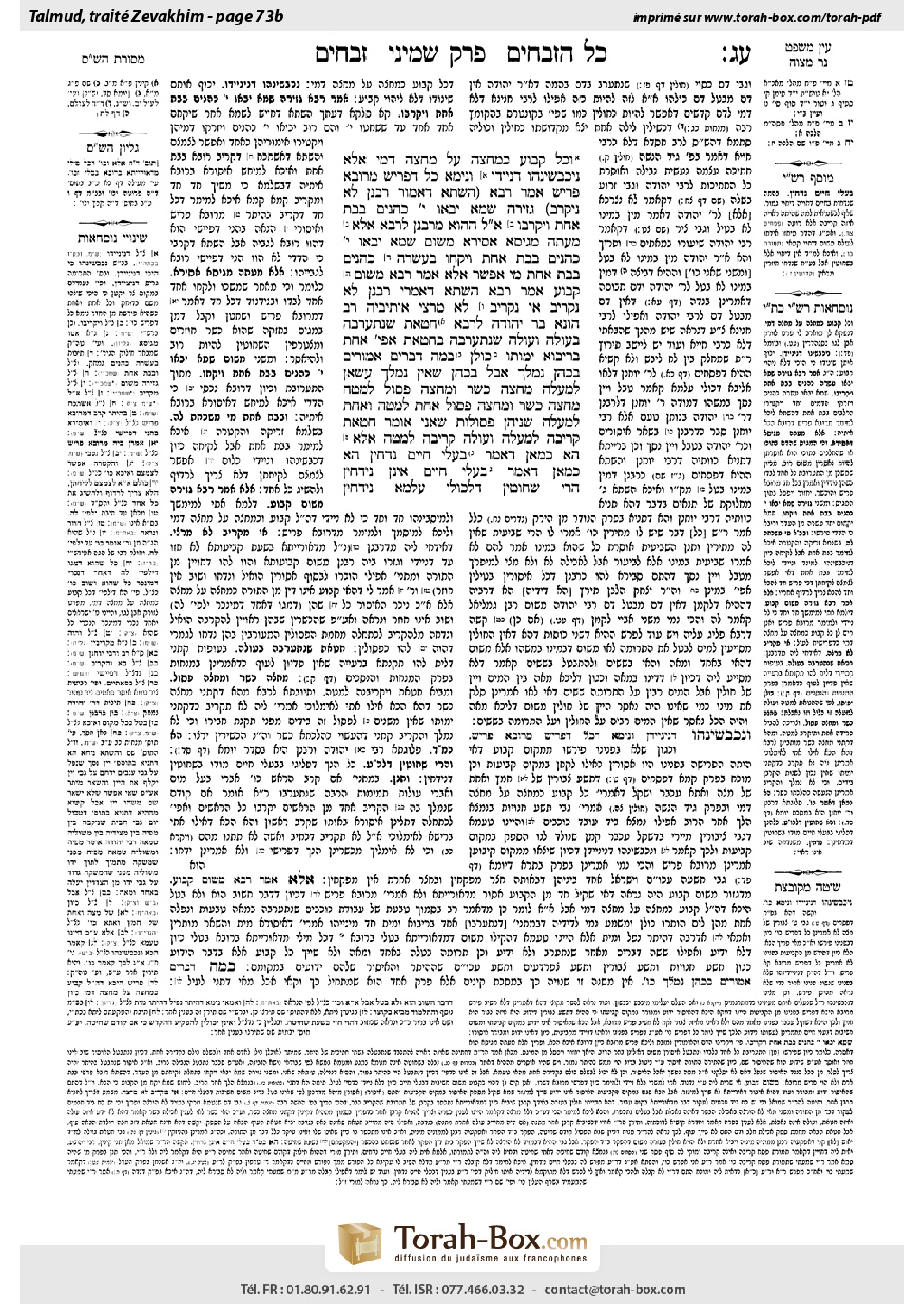
Zevachim 73b: Talmud study for Daf Yomi
Daf Yomi is the daily study of one Talmud folio. Explore 37 tractates with scans, Hebrew text, Sefaria English and AI-generated French translations where annotated.
Passage selection and English or AI-generated French translation are available where the scan has annotations. Daf Study is independent of Torah-Box and Sefaria.
Browse Zevachim · זבחים · All tractatesZevachim 73b text and translations
This page of Zevachim includes the Aramaic text, an English translation and an AI-generated French translation, alongside the scan above.
זבחים ע״ג ב · Aramaic and Hebrew text
וְכׇל קָבוּעַ כְּמֶחֱצָה עַל מֶחֱצָה דָּמֵי! אֶלָּא נִיכְבְּשִׁינְהוּ (דְּנָיְידִי) [דְּנִינַיְידָּן], וְנֵימָא: כֹּל דְּפָרֵישׁ – מֵרוּבָּא פָּרֵישׁ!
אָמַר רָבָא: הַשְׁתָּא דַּאֲמוּר רַבָּנַן לָא נִיקְרַב, גְּזֵירָה שֶׁמָּא יָבֹאוּ עֲשָׂרָה כֹּהֲנִים בְּבַת אַחַת וְיַקְרִבוּ.
אֲמַר לֵיהּ הָהוּא מֵרַבָּנַן לְרָבָא: אֶלָּא מֵעַתָּה, מְגִיסָא אֲסִירָא?!
מִשּׁוּם שֶׁמָּא יָבֹאוּ עֲשָׂרָה כֹּהֲנִים בְּבַת אַחַת וְיִקְחוּ. בַּעֲשָׂרָה כֹּהֲנִים בְּבַת אַחַת מִי אֶפְשָׁר?! אֶלָּא אָמַר רָבָא: מִשּׁוּם קָבוּעַ.
אָמַר רָבָא: הַשְׁתָּא דְּאָמְרִי רַבָּנַן לָא נַקְרֵיב, אִי (נַקְרֵיב) [מַקְרֵיב] – לָא מְרַצֵּי. אֵיתִיבֵיהּ רַב הוּנָא בַּר יְהוּדָה לְרָבָא: חַטָּאת שֶׁנִּתְעָרְבָה בְּעוֹלָה, וְעוֹלָה שֶׁנִּתְעָרְבָה בְּחַטָּאת, אֲפִילּוּ אַחַת בְּרִיבּוֹא – יָמוּתוּ כּוּלָּן.
בַּמֶּה דְּבָרִים אֲמוּרִים – בְּכֹהֵן נִמְלָךְ; אֲבָל בְּכֹהֵן שֶׁאֵין נִמְלָךְ, עֲשָׂאָן לְמַעְלָה – מֶחֱצָה כָּשֵׁר וּמֶחֱצָה פָּסוּל.
לְמַטָּה – מֶחֱצָה כָּשֵׁר וּמֶחֱצָה פָּסוּל. אַחַת לְמַטָּה וְאַחַת לְמַעְלָה – (שְׁנֵיהֶן) [שְׁתֵּיהֶן] פְּסוּלוֹת, שֶׁאֲנִי אוֹמֵר: חַטָּאת קְרֵיבָה לְמַעְלָה וְעוֹלָה קְרֵיבָה לְמַטָּה.
אֶלָּא הָא כְּמַאן דְּאָמַר בַּעֲלֵי חַיִּים נִדְחִין, הָא כְּמַאן דְּאָמַר בַּעֲלֵי חַיִּים אֵינָן נִידְחִין.
הֲרֵי שְׁחוּטִין – דִּלְכוּלֵּי עָלְמָא נִידְחִין;
Zevachim 73b · English translation
and there is a principle that anything fixed is considered as though it was half and half, i.e., equally balanced, and it remains a case of uncertainty. The Gemara clarifies its suggestion: Rather, let us push the intermingled animals so that they all move from their places, which negates the fixed status of the prohibited item. And accordingly, let us say with regard to each animal: Any item that separates from a group is assumed to have separated from the majority.
Rava says: Now that the Sages have said that we do not sacrifice any of them, this is evidently a rabbinic decree, lest ten priests come simultaneously and sacrifice all the animals in the mixture together, not one at a time. Therefore, the fact that there could be a method to permit the animals is immaterial.
One of the Sages said to Rava: If that is so, do you hold that the large basin [megisa] on which the sacrificial portions of the animal are placed is prohibited? In other words, is it possible that these animals, which were slaughtered when they were initially declared permitted after being separated from their places, could later become prohibited again when their sacrificial portions are ready to be burned on the altar?
Rava responded that he did not mean there is a concern that ten priests would sacrifice their sacrificial portions simultaneously. Rather, the decree is due to the concern lest when the animals move, ten priests will come simultaneously and take them from the mixture. As all or most of the animals were separated simultaneously in this case, it is assumed that the prohibited animal is among those that were separated. The Gemara asks: Is it possible for ten priests to take these scattered animals simultaneously? Rather, Rava says that one may not allow the animals to be sacrificed by moving them due to a decree that if this is allowed, one may, in another circumstance, allow them to be sacrificed even when they are taken from a fixed location.
§ Rava said: Now that the Sages say in the mishna that we do not sacrifice any of the animals, if we did sacrifice one of them, the offering does not effect acceptance for the owner. Rav Huna bar Yehuda raised an objection to Rava from a mishna (Kinnim 22b): With regard to a bird sin offering that was intermingled with a bird burnt offering, or a bird burnt offering that was intermingled with a bird sin offering, even if the ratio is one in ten thousand, they all must die, as there is no remedy for these birds. It is not known which is which, and their sacrificial rites are performed differently.
The mishna continues: In what case is this statement said? In the case of a priest who consulted the court to ask how he should proceed. But in the case of a priest who did not consult the court, but sacrificed them of his own accord, if there was an equal number of bird sin offerings and burnt offerings, and he performed all their sacrificial rites above the red line that circumscribes the altar at its midpoint, as required for a burnt offering, half of the birds are fit, as in any event the burnt offerings were sacrificed properly, and half are unfit.
Likewise, if he performed all of their sacrificial rites below the red line, half are fit, as in any event the sin offerings were sacrificed properly, and half are unfit. If he performed the sacrificial rites of one of the birds below the red line and one of the birds above the red line, they are both unfit, as I say that the sin offering was sacrificed above the red line and the burnt offering was sacrificed below. This mishna proves that an offering that is prohibited to be sacrificed as part of a mixture is fit after the fact, which contradicts the statement of Rava.
Rather, Rava would claim that this matter depends on a dispute between tanna’im. This statement of Rava is in accordance with the opinion of the one who says that living creatures that become disqualified are permanently rejected from being sacrificed on the altar, and this animal was rejected when it was part of the mixture. That ruling of the mishna in Kinnim is in accordance with the opinion of the one who says that living creatures are not permanently rejected from the altar. Therefore, if the animal was sacrificed it is fit.
The Gemara raises a difficulty: But there is the case of slaughtered offerings that are rejected from the altar, concerning which everyone agrees that these are rejected. Even those who say that living creatures generally are not rejected agree that, in this case, they should be rejected.
Zevachim 73b · Traduction française (IA)
Et il existe un principe selon lequel tout élément fixe est considéré comme étant à parts égales, c’est-à-dire en équilibre, et le cas demeure incertain. La Guemara précise sa suggestion : Faisons plutôt sortir les animaux mêlés de leurs emplacements, de sorte qu’ils se déplacent tous, ce qui supprime le statut d’élément fixe de l’objet interdit. Disons alors, à propos de chaque animal : tout élément qui se sépare d’un groupe est présumé s’être séparé de la majorité.
Rava dit : Puisque les Sages ont dit que nous ne sacrifions aucun de ces animaux, il s’agit manifestement d’un décret rabbinique, de crainte que dix prêtres ne se présentent simultanément et ne sacrifient ensemble tous les animaux du mélange, et non un à un. Il est donc sans importance qu’il existe une manière de rendre ces animaux permis.
L’un des Sages dit à Rava : Si tel est le cas, tiens-tu donc pour interdit le grand bassin [megisa] sur lequel sont déposées les parties sacrificielles de l’animal ? Autrement dit, est-il possible que ces animaux, qui ont été abattus après avoir été initialement déclarés permis parce qu’ils s’étaient éloignés de leurs emplacements, deviennent ensuite de nouveau interdits lorsque leurs parties sacrificielles sont prêtes à être brûlées sur l’autel ?
Rava répondit qu’il ne voulait pas dire que l’on craignait que dix prêtres ne sacrifient simultanément les parties sacrificielles des animaux. Le décret tient plutôt à la crainte que, lorsque les animaux se déplacent, dix prêtres ne se présentent simultanément et ne les prélèvent du mélange. Comme tous, ou la plupart, des animaux se sont séparés simultanément dans ce cas, on présume que l’animal interdit figure parmi ceux qui se sont séparés. La Guemara demande : Est-il possible que dix prêtres prélèvent simultanément ces animaux dispersés ? Rava dit plutôt qu’on ne peut pas autoriser le sacrifice des animaux en les faisant se déplacer, en raison d’un décret : si on l’autorisait, on pourrait, dans une autre situation, autoriser leur sacrifice même lorsqu’ils sont prélevés à un emplacement fixe.
§ Rava dit : Puisque les Sages enseignent dans la Michna qu’on ne sacrifie aucun de ces animaux, si l’on en a sacrifié un, l’offrande n’obtient pas l’acceptation pour son propriétaire. Rav Houna bar Yehouda souleva contre Rava une objection tirée d’une Michna (Kinnim 22b) : dans le cas d’un sacrifice expiatoire d’oiseau mêlé à un holocauste d’oiseau, ou d’un holocauste d’oiseau mêlé à un sacrifice expiatoire d’oiseau, même s’il n’y en a qu’un pour dix mille, tous doivent mourir, car il n’existe aucun moyen de remédier à la situation de ces oiseaux. On ne sait pas lequel est lequel, et leurs rites sacrificiels diffèrent.
La Michna poursuit : Dans quel cas cette affirmation a-t-elle été énoncée ? Dans le cas d’un prêtre qui a consulté le tribunal pour demander comment procéder. Mais, dans le cas d’un prêtre qui n’a pas consulté le tribunal et les a sacrifiés de sa propre initiative, si le nombre de sacrifices expiatoires d’oiseaux était égal à celui des holocaustes, et qu’il a accompli tous leurs rites sacrificiels au-dessus de la ligne rouge qui entoure l’autel en son milieu, comme l’exige un holocauste, la moitié des oiseaux sont valides, puisque les holocaustes ont de toute façon été sacrifiés correctement, et l’autre moitié est invalide.
De même, s’il a accompli tous leurs rites sacrificiels au-dessous de la ligne rouge, la moitié sont valides, puisque les sacrifices expiatoires ont de toute façon été sacrifiés correctement, et l’autre moitié est invalide. S’il a accompli les rites sacrificiels de l’un des oiseaux au-dessous de la ligne rouge et ceux d’un autre au-dessus de la ligne rouge, ils sont tous deux invalides, car on considère que le sacrifice expiatoire a été sacrifié au-dessus de la ligne rouge et que l’holocauste a été sacrifié au-dessous. Cette Michna prouve qu’une offrande qu’il est interdit de sacrifier en tant qu’élément d’un mélange est valide après coup, ce qui contredit l’affirmation de Rava.
Rava soutiendrait plutôt que cette question dépend d’un désaccord entre tannaïm. Son affirmation est conforme à l’opinion de celui qui dit que les créatures vivantes qui deviennent inaptes sont définitivement écartées de la possibilité d’être sacrifiées sur l’autel ; cet animal a été écarté lorsqu’il faisait partie du mélange. La décision de la Michna de Kinnim est conforme à l’opinion de celui qui dit que les créatures vivantes ne sont pas définitivement écartées de l’autel. Par conséquent, si l’animal a été sacrifié, il est valide.
La Guemara soulève une difficulté : Mais il y a le cas des offrandes abattues qui sont écartées de l’autel, au sujet desquelles tous conviennent qu’elles le sont. Même ceux qui disent que les créatures vivantes ne sont généralement pas écartées conviennent que, dans ce cas, elles doivent l’être.
Traduction française générée par IA à partir de l’édition anglaise de Sefaria. Vérifie toujours un passage avec le texte source.
Text from Sefaria: William Davidson Edition - Vocalized Aramaic (CC BY NC); William Davidson Edition - English (CC BY NC).