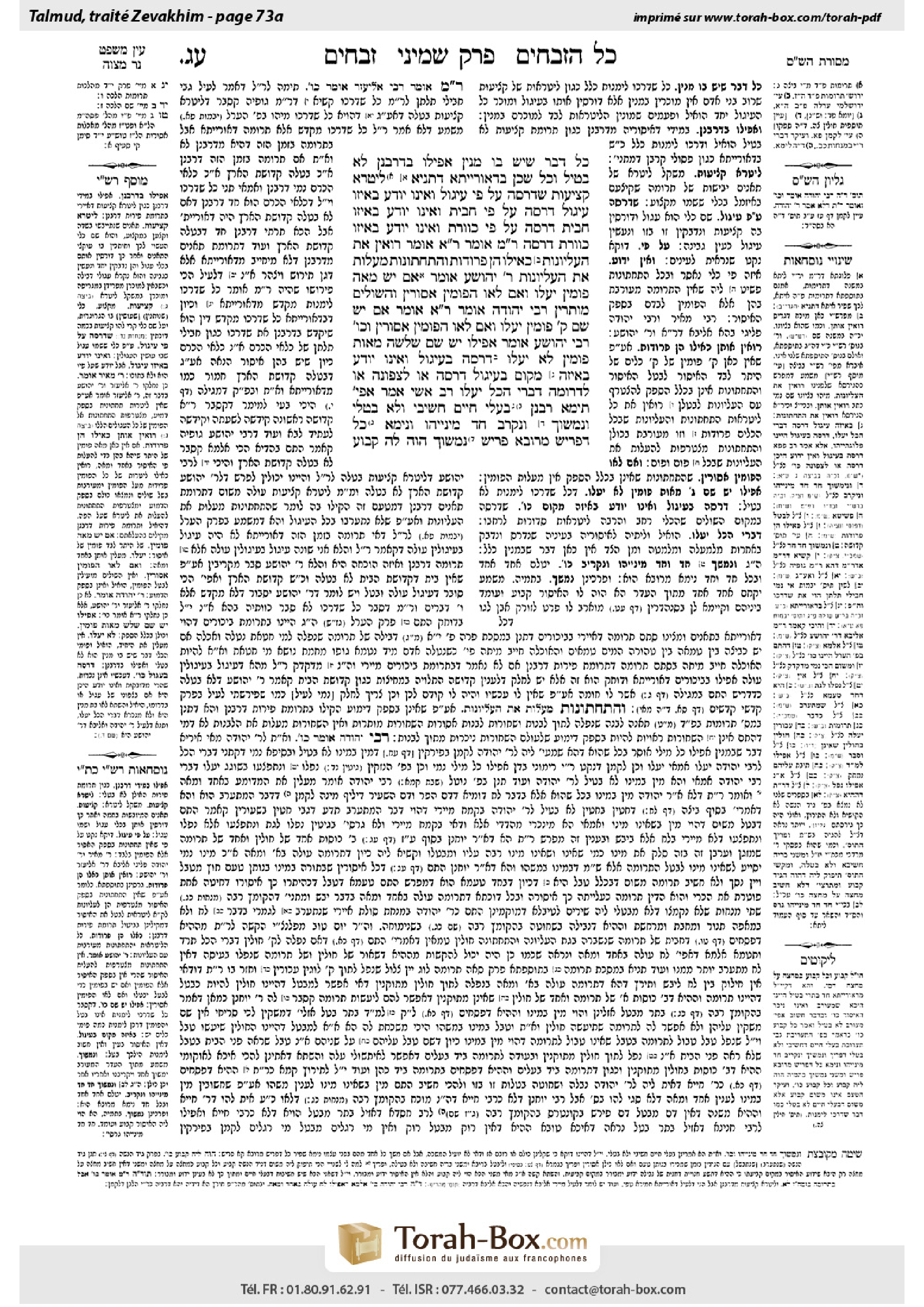
Zevachim 73a: Talmud study for Daf Yomi
Daf Yomi is the daily study of one Talmud folio. Explore 37 tractates with scans, Hebrew text, Sefaria English and AI-generated French translations where annotated.
Passage selection and English or AI-generated French translation are available where the scan has annotations. Daf Study is independent of Torah-Box and Sefaria.
Browse Zevachim · זבחים · All tractatesZevachim 73a text and translations
This page of Zevachim includes the Aramaic text, an English translation and an AI-generated French translation, alongside the scan above.
זבחים ע״ג א · Aramaic and Hebrew text
כׇּל דָּבָר שֶׁיֵּשׁ בּוֹ מִנְיָן – אֲפִילּוּ בִּדְרַבָּנַן לָא בָּטֵיל, וְכׇל שֶׁכֵּן בִּדְאוֹרָיְיתָא.
דְּתַנְיָא: לִיטְרָא קְצִיעוֹת שֶׁדְּרָסָהּ עַל פִּי עִיגּוּל, וְאֵינוֹ יוֹדֵעַ בְּאֵיזוֹ עִיגּוּל דְּרָסָהּ; עַל פִּי חָבִית, וְאֵינוֹ יוֹדֵעַ בְּאֵיזוֹ חָבִית דְּרָסָהּ; עַל פִּי כַּוֶּורֶת, וְאֵינוֹ יוֹדֵעַ בְּאֵיזוֹ כַּוֶּורֶת דְּרָסָהּ –
רַבִּי מֵאִיר אוֹמֵר, רַבִּי אֱלִיעֶזֶר אוֹמֵר: רוֹאִין אֶת הָעֶלְיוֹנוֹת כְּאִילּוּ הֵן פְּרוּדוֹת, וְהַתַּחְתּוֹנוֹת מַעֲלוֹת אֶת הָעֶלְיוֹנוֹת.
רַבִּי יְהוֹשֻׁעַ אוֹמֵר: אִם יֵשׁ מֵאָה פּוּמִּין – יַעֲלוּ, וְאִם לָאו – הַפּוּמִּין אֲסוּרִין וְהַשּׁוּלַיִם מוּתָּרִין.
רַבִּי יְהוּדָה אוֹמֵר, רַבִּי אֱלִיעֶזֶר אוֹמֵר: אִם יֵשׁ שָׁם מֵאָה פּוּמִּין – יַעֲלוּ, וְאִם לָאו – הַפּוּמִּין אֲסוּרִין וְכוּ׳.
רַבִּי יְהוֹשֻׁעַ אוֹמֵר: אֲפִילּוּ יֵשׁ שָׁם שְׁלֹשָׁה מֵאוֹת פּוּמִּין – לֹא יַעֲלוּ.
דְּרָסָהּ בְּעִיגּוּל, וְאֵינוֹ יוֹדֵעַ בְּאֵיזֶה מְקוֹם בְּעִיגּוּל דְּרָסָהּ – אוֹ לִצְפוֹנָהּ אוֹ לִדְרוֹמָהּ, דִּבְרֵי הַכֹּל יַעֲלוּ.
רַב אָשֵׁי אָמַר: אֲפִילּוּ תֵּימָא רַבָּנַן, בַּעֲלֵי חַיִּים חֲשִׁיבִי וְלָא בָּטְלִי.
וְנִמְשׁוֹךְ וְנַקְרֵב חַד מִינַּיְיהוּ, וְנֵימָא: כֹּל דְּפָרֵישׁ – מֵרוּבָּא פָּרֵישׁ! נִמְשׁוֹךְ?! הָוֵה לֵיהּ קָבוּעַ,
Zevachim 73a · English translation
Any item that is counted, even if it is prohibited by rabbinic law, e.g., teruma of fruit, cannot be nullified, and all the more so items prohibited by Torah law, such as animals that are disqualified for the altar, as in the mishna.
This is as it is taught in a baraita (Tosefta, Terumot 5:11): The baraita discusses three cases, all of which relate to the tithing of figs, which is an obligation by rabbinic law. The first is the case of a litra of untithed dried figs that were pressed in different vessels and shaped into circles, that one placed into a barrel containing tithed figs, and during the process of producing a circle he pressed the figs onto the opening of one of the circular vessels in which the circles are formed, and he does not know into which circular vessel he pressed it. The second is the case in which he recalls that he pressed it on the opening of a barrel containing tithed figs, but he does not know into which barrel he pressed it. The third case is that he recalls that he pressed it on the opening of a straw receptacle containing tithed figs, but he does not know into which receptacle he pressed it. In all of these cases, there is a dispute between Rabbi Meir and Rabbi Yehuda as to the details of a dispute between Rabbi Eliezer and Rabbi Yehoshua.
Rabbi Meir says that Rabbi Eliezer says: One views the upper layers of possibly untithed dried figs as though they are separate pieces, rather than one unit. And the lower ones, which were there beforehand and have certainly been tithed, nullify the upper ones, as there are enough circles of figs to nullify the upper layer. One does not need to tithe the figs at the top of any of the containers.
Rabbi Meir continues: By contrast, Rabbi Yehoshua says: If there are one hundred openings of containers present there, the untithed litra of figs on the opening of one of the containers is nullified in a ratio of one part of untithed figs to one hundred parts of similar, tithed figs. But if not, all of the layers of figs at the openings of the containers are prohibited, i.e., viewed as untithed, as one of them certainly contains an untithed litra that has not been nullified. And the figs on the insides of the vessels are permitted, as the untithed figs certainly did not reach there. This is Rabbi Meir’s version of the dispute.
The baraita continues: Rabbi Yehuda says that Rabbi Eliezer says: If there are one hundred openings of containers with tithed figs present there, in addition to the untithed figs, it is nullified in the one hundred. But if not, all of the layers of figs at the openings of the containers are prohibited, i.e., viewed as untithed, as one of them certainly contains an untithed litra that has not been nullified. And the figs on the insides of the vessels are permitted, as the untithed figs certainly did not reach there.
Rabbi Yehuda continues his statement: By contrast, Rabbi Yehoshua says: Even if there are three hundred openings present there, the layer at the top of the container is not nullified. This litra cannot be nullified in any manner, as Rabbi Yehoshua maintains that even an item occasionally sold by unit, such as a circle of dried figs, can never be nullified.
Rabbi Yehuda continues: But if one pressed the litra of dried figs into a circular vessel along with other dried figs, but does not know onto which place, i.e., which side, of the circular vessel he pressed it, whether, e.g., to its northern side or to its southern side, in this case, as the prohibited litra is not located in a defined place and it cannot be distinguished from the others, it is not considered an item of significance, and everyone agrees that it is nullified. Accordingly, the ruling of the mishna that animals that are disqualified from being sacrificed are not nullified is in accordance with the opinion of Rabbi Yehoshua as stated by Rabbi Eliezer, that an item occasionally sold by unit is not nullified. Rabbi Yoḥanan’s statement, that only an item whose manner is exclusively to be counted is significant and cannot be nullified, is in accordance with the opinion of Rabbi Meir.
Rav Ashi says: You may even say that the mishna is in accordance with the opinion of the Rabbis, i.e., Rabbi Meir, who maintains that an item that is not always counted is nullified in a majority. The reason is that living creatures are significant, and therefore they are not nullified.
§ The Gemara raises a difficulty with the ruling of the mishna that all of the animals are prohibited. And let us draw out and sacrifice one animal from the mixture, and say, i.e., apply the principle: Any item that separates from a group is assumed to have separated from the majority. Accordingly, the animal that was sacrificed is presumed to be fit. One can continue in this manner until only two animals from the mixture remain. The Gemara questions this suggestion: Should we draw out an animal from the mixture? But this is the removal of an item from its fixed place,
Zevachim 73a · Traduction française (IA)
Tout élément dénombrable, même s’il est interdit par décret rabbinique, comme la terouma des fruits, ne peut être annulé ; à plus forte raison en va-t-il ainsi des éléments interdits par la Torah, comme les animaux impropres à l’autel, conformément à la Michna.
C’est ce qui est enseigné dans une baraïta (Tossefta, Teroumot 5:11) : la baraïta expose trois cas, qui concernent tous le prélèvement de la dîme sur des figues, obligation d’ordre rabbinique. Le premier est le cas d’un litra de figues sèches dont la dîme n’a pas été prélevée, pressées dans différents récipients et façonnées en galettes : on en a placé une dans un tonneau contenant des figues dont la dîme a été prélevée. Lors de la confection d’une galette, on a pressé les figues sur l’ouverture de l’un des récipients circulaires dans lesquels les galettes sont formées, sans savoir dans lequel. Le deuxième cas est celui où l’on se souvient les avoir pressées sur l’ouverture d’un tonneau contenant des figues dont la dîme a été prélevée, mais sans savoir dans quel tonneau. Le troisième cas est celui où l’on se souvient les avoir pressées sur l’ouverture d’un récipient en paille contenant des figues dont la dîme a été prélevée, mais sans savoir dans lequel. Dans tous ces cas, Rabbi Meïr et Rabbi Yehouda divergent sur les détails d’une controverse entre Rabbi Éliézer et Rabbi Yehoshoua.
Rabbi Meïr rapporte que Rabbi Éliézer dit : on considère les couches supérieures de figues sèches dont on ignore si la dîme a été prélevée comme des éléments distincts, et non comme un seul ensemble. Les couches inférieures, qui étaient là auparavant et dont la dîme a certainement été prélevée, annulent les couches supérieures, car il y a suffisamment de galettes de figues pour annuler la couche supérieure. Il n’est pas nécessaire de prélever la dîme sur les figues qui se trouvent au sommet de l’un quelconque des récipients.
Rabbi Meïr poursuit : en revanche, Rabbi Yehoshoua dit : s’il y a là cent ouvertures de récipients, le litra de figues dont la dîme n’a pas été prélevée, posé sur l’ouverture de l’un des récipients, est annulé dans une proportion d’une part de figues dont la dîme n’a pas été prélevée pour cent parts de figues semblables dont la dîme a été prélevée. Sinon, toutes les couches de figues situées aux ouvertures des récipients sont interdites, c’est-à-dire considérées comme n’ayant pas été soumises au prélèvement de la dîme, car l’une d’elles contient certainement un litra dont la dîme n’a pas été prélevée et qui n’a pas été annulé. Les figues à l’intérieur des récipients sont permises, puisque les figues dont la dîme n’a pas été prélevée ne les ont certainement pas atteintes. Telle est la version de Rabbi Meïr de cette controverse.
La baraïta poursuit : Rabbi Yehouda rapporte que Rabbi Éliézer dit : s’il y a là, en plus des figues dont la dîme n’a pas été prélevée, cent ouvertures de récipients contenant des figues dont la dîme a été prélevée, le litra est annulé parmi les cent. Sinon, toutes les couches de figues situées aux ouvertures des récipients sont interdites, c’est-à-dire considérées comme n’ayant pas été soumises au prélèvement de la dîme, car l’une d’elles contient certainement un litra dont la dîme n’a pas été prélevée et qui n’a pas été annulé. Les figues à l’intérieur des récipients sont permises, puisque les figues dont la dîme n’a pas été prélevée ne les ont certainement pas atteintes.
Rabbi Yehouda poursuit son propos : en revanche, Rabbi Yehoshoua dit : même s’il y a là trois cents ouvertures, la couche au sommet du récipient n’est pas annulée. Ce litra ne peut être annulé d’aucune manière, car Rabbi Yehoshoua estime qu’un élément parfois vendu à l’unité, comme une galette de figues sèches, ne peut jamais être annulé.
Rabbi Yehouda poursuit : mais si l’on a pressé le litra de figues sèches dans un récipient circulaire avec d’autres figues sèches, sans savoir à quel endroit, c’est-à-dire de quel côté du récipient — par exemple au nord ou au sud — on l’a pressé, alors, puisque le litra interdit ne se trouve pas à un endroit déterminé et qu’on ne peut pas le distinguer des autres, il n’est pas considéré comme un élément important, et tous conviennent qu’il est annulé. Par conséquent, la décision de la Michna selon laquelle les animaux impropres au sacrifice ne sont pas annulés suit l’opinion de Rabbi Yehoshoua telle que la rapporte Rabbi Éliézer : un élément parfois vendu à l’unité n’est pas annulé. La déclaration de Rabbi Yoḥanan, selon laquelle seul un élément qui se vend exclusivement au compte est important et ne peut être annulé, suit l’opinion de Rabbi Meïr.
Rav Ashi dit : on peut même dire que la Michna suit l’opinion des rabbins, c’est-à-dire celle de Rabbi Meïr, qui estime qu’un élément qui n’est pas toujours vendu à l’unité est annulé au sein d’une majorité. La raison en est que les êtres vivants sont importants et ne sont donc pas annulés.
§ La Guemara soulève une difficulté à propos de la décision de la Michna selon laquelle tous les animaux sont interdits. Ne pourrait-on pas tirer un animal du mélange et dire — c’est-à-dire appliquer le principe selon lequel tout élément qui se sépare d’un groupe est présumé provenir de la majorité ? L’animal sacrifié serait alors présumé apte. On pourrait procéder ainsi jusqu’à ce qu’il ne reste que deux animaux du mélange. La Guemara objecte à cette suggestion : tirer un animal du mélange ? Mais cela reviendrait à retirer un élément de son emplacement fixe,
Traduction française générée par IA à partir de l’édition anglaise de Sefaria. Vérifie toujours un passage avec le texte source.
Text from Sefaria: William Davidson Edition - Vocalized Aramaic (CC BY NC); William Davidson Edition - English (CC BY NC).