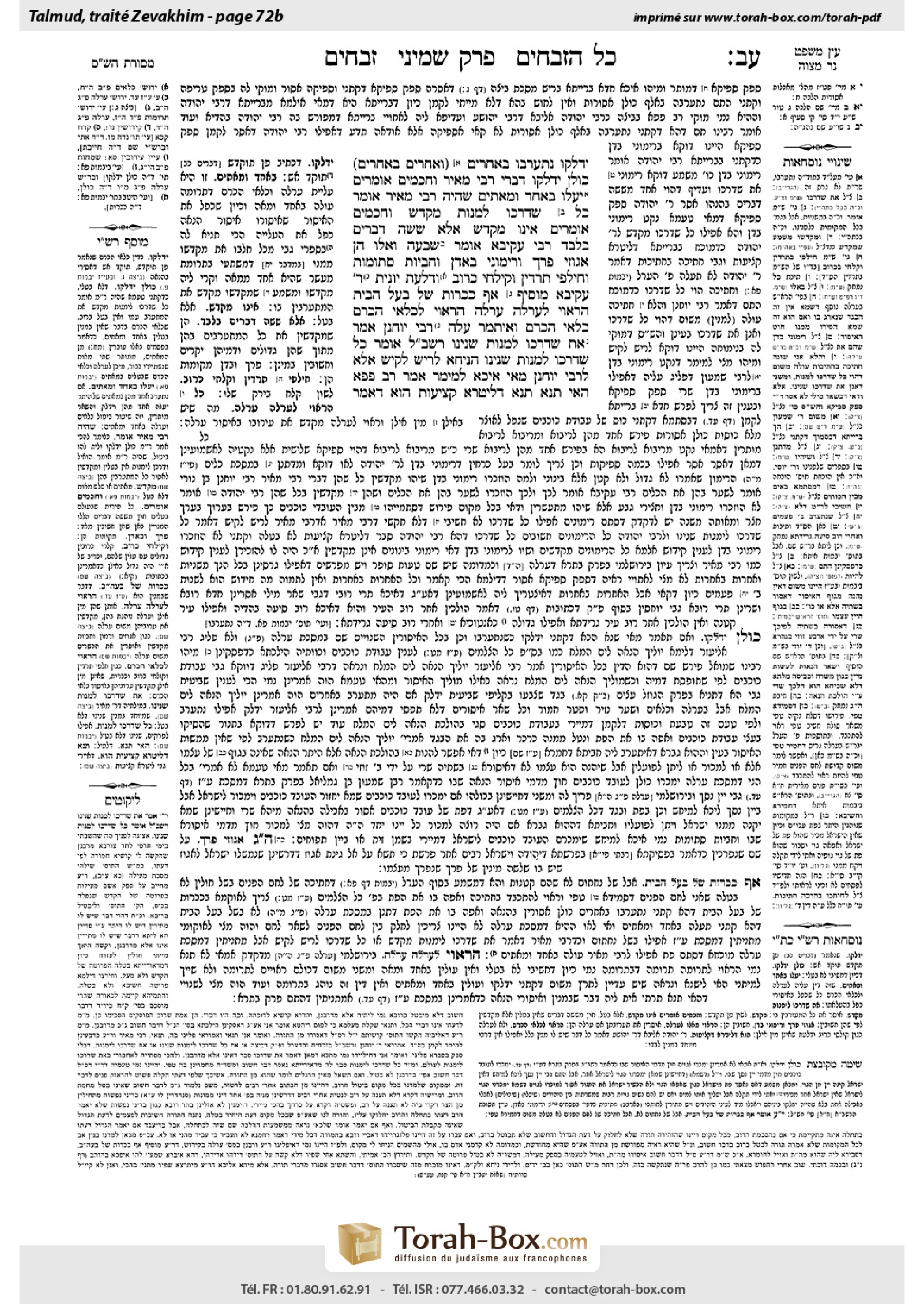
Zevachim 72b: Talmud study for Daf Yomi
Daf Yomi is the daily study of one Talmud folio. Explore 37 tractates with scans, Hebrew text, Sefaria English and AI-generated French translations where annotated.
Passage selection and English or AI-generated French translation are available where the scan has annotations. Daf Study is independent of Torah-Box and Sefaria.
Browse Zevachim · זבחים · All tractatesZevachim 72b text and translations
This page of Zevachim includes the Aramaic text, an English translation and an AI-generated French translation, alongside the scan above.
זבחים ע״ב ב · Aramaic and Hebrew text
יִדָּלְקוּ. נִתְעָרְבוּ בַּאֲחֵרִים (וַאֲחֵרִים בַּאֲחֵרִים) – כּוּלָּן יִדָּלְקוּ. דִּבְרֵי רַבִּי מֵאִיר. וַחֲכָמִים אוֹמְרִים: יַעֲלוּ בְּאֶחָד וּמָאתַיִם.
שֶׁהָיָה רַבִּי מֵאִיר אוֹמֵר: כֹּל שֶׁדַּרְכּוֹ לִמָּנוֹת – מְקַדֵּשׁ. וַחֲכָמִים אוֹמְרִים: אֵינוֹ מְקַדֵּשׁ אֶלָּא שִׁשָּׁה דְּבָרִים בִּלְבַד. רַבִּי עֲקִיבָא אוֹמֵר: שִׁבְעָה, וְאֵלּוּ הֵן: אֱגוֹזֵי פֶרֶךְ, וְרִימּוֹנֵי בָאדָן, וְחָבִיּוֹת סְתוּמוֹת, וְחִילְפֵי תְרָדִין, וְקִילְחֵי כְרוּב, וְדַלַּעַת יְוָנִית. רַבִּי עֲקִיבָא מוֹסִיף: אַף כִּכָּרוֹת שֶׁל בַּעַל הַבַּיִת.
הָרָאוּי לְעׇרְלָה – עׇרְלָה, הָרָאוּי לְכִלְאֵי הַכֶּרֶם – כִּלְאֵי הַכֶּרֶם.
וְאִיתְּמַר עֲלַהּ, רַבִּי יוֹחָנָן אָמַר: ״אֶת שֶׁדַּרְכּוֹ לִמָּנוֹת״ שָׁנִינוּ, רַבִּי שִׁמְעוֹן בֶּן לָקִישׁ אוֹמֵר: ״כׇּל שֶׁדַּרְכּוֹ לִמָּנוֹת״ שָׁנִינוּ.
הָנִיחָא לְרֵישׁ לָקִישׁ, אֶלָּא לְרַבִּי יוֹחָנָן מַאי אִיכָּא לְמֵימַר? אָמַר רַב פָּפָּא: הַאי תַּנָּא – תַּנָּא דְּלִיטְרָא קְצִיעוֹת הוּא, דְּאָמַר:
Zevachim 72b · English translation
those bundles must be burned. If the bundles were intermingled with others, and those others were intermingled with others, they all must be burned. This is the statement of Rabbi Meir. And the Rabbis say: They can be nullified when the total is 201 items, i.e., one prohibited item intermingled with two hundred permitted ones.
The mishna continues: Rabbi Meir holds that they all must be burned, as Rabbi Meir would say: Any item whose manner is to be counted renders its mixture prohibited, as it is considered significant and cannot be nullified. And the Rabbis say: Only six items are sufficiently significant to render their mixture prohibited. Rabbi Akiva says: There are seven. And they are: Nuts with brittle shells, and pomegranates from Badan, and sealed barrels of wine, and beet greens, and cabbage stalks, and Greek gourd. Rabbi Akiva adds: Loaves of a homeowner are also in this category.
The mishna continues: Different prohibitions apply to these items. That which is fit to be forbidden due to the prohibition against eating the fruit of a tree during the first three years after its planting [orla], i.e., nuts, pomegranates, and sealed barrels of wine, prohibit their mixture as orla. That which is fit to be forbidden due to diverse kinds planted in a vineyard, i.e., beets, cabbage, and gourd, prohibit their mixture as diverse kinds in a vineyard.
And it was stated that there is a dispute between amora’im with regard to the wording of Rabbi Meir’s opinion in this mishna. Rabbi Yoḥanan says that we learned: Only an item whose manner is exclusively to be counted is significant and cannot be nullified, and it therefore renders its mixture prohibited according to the opinion of Rabbi Meir. And Rabbi Shimon ben Lakish says that we learned: Any item whose manner is also to be counted is significant and cannot be nullified.
The Gemara reiterates its question: This works out well according to the opinion of Reish Lakish, but according to the opinion of Rabbi Yoḥanan, what can be said? According to his opinion, since animals are not sold exclusively by unit, they are not sufficiently significant. Therefore, a prohibited animal should be nullified in a simple majority. Rav Pappa says: According to Rabbi Yoḥanan, this tanna, who says that a prohibited animal cannot be nullified, is the tanna of the halakha concerning a litra of dried figs, who says:
Zevachim 72b · Traduction française (IA)
Ces bottes doivent être brûlées. Si les bottes se sont mêlées à d’autres, et que celles-ci se sont mêlées à d’autres encore, toutes doivent être brûlées. Telle est l’opinion de Rabbi Meïr. Les Sages disent : elles peuvent être annulées lorsque le total atteint 201 éléments, c’est-à-dire lorsqu’un élément interdit est mêlé à deux cents éléments permis.
La Michna poursuit : Rabbi Meïr estime qu’elles doivent toutes être brûlées, car Rabbi Meïr disait : tout élément que l’on a coutume de compter rend le mélange dans lequel il se trouve interdit, puisqu’il est considéré comme important et ne peut être annulé. Les Sages disent : seuls six éléments sont suffisamment importants pour rendre le mélange dans lequel ils se trouvent interdit. Rabbi Akiva dit : il y en a sept. Ce sont les noix à coque friable, les grenades de Badan, les tonneaux de vin scellés, les feuilles de betterave, les tiges de chou et les courges grecques. Rabbi Akiva ajoute : les pains appartenant à un particulier entrent également dans cette catégorie.
La Michna poursuit : des interdictions différentes s’appliquent à ces éléments. Ceux qui peuvent être interdits en raison de l’interdiction de consommer le fruit d’un arbre pendant les trois premières années suivant sa plantation [orla], c’est-à-dire les noix, les grenades et les tonneaux de vin scellés, rendent le mélange dans lequel ils se trouvent interdit au titre de l’orla. Ceux qui peuvent être interdits en raison de l’interdiction des espèces végétales différentes plantées dans une vigne, c’est-à-dire les betteraves, les choux et les courges, rendent le mélange dans lequel ils se trouvent interdit au titre des espèces différentes dans une vigne.
Il a été rapporté qu’il existe un désaccord entre les amoraïm quant à la formulation de l’opinion de Rabbi Meïr dans cette Michna. Rabbi Yoḥanan dit que nous avons appris : seul un élément que l’on a exclusivement coutume de compter est important et ne peut être annulé ; selon l’opinion de Rabbi Meïr, il rend donc le mélange dans lequel il se trouve interdit. Rabbi Shimon ben Lakish dit que nous avons appris : tout élément que l’on a également coutume de compter est important et ne peut être annulé.
La Guemara réitère sa question : cela s’explique bien selon l’opinion de Reish Lakish, mais que peut-on dire selon l’opinion de Rabbi Yoḥanan ? Selon lui, puisque les animaux ne se vendent pas exclusivement à l’unité, ils ne sont pas suffisamment importants. Par conséquent, un animal interdit devrait être annulé par une simple majorité. Rav Pappa dit : selon Rabbi Yoḥanan, ce tanna, qui affirme qu’un animal interdit ne peut pas être annulé, est le tanna de la halakha concernant une livre de figues sèches, qui dit :
Traduction française générée par IA à partir de l’édition anglaise de Sefaria. Vérifie toujours un passage avec le texte source.
Text from Sefaria: William Davidson Edition - Vocalized Aramaic (CC BY NC); William Davidson Edition - English (CC BY NC).