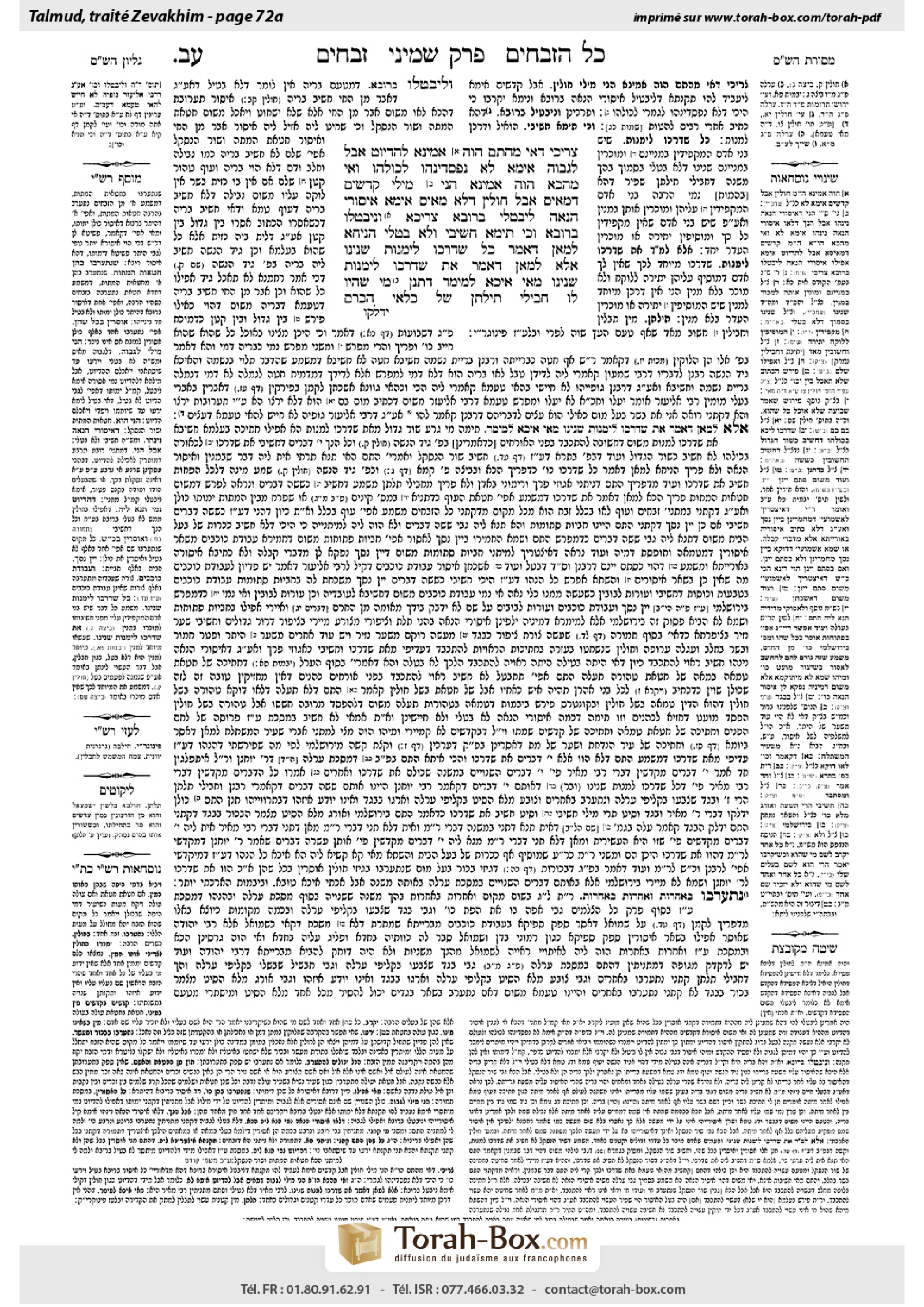
Zevachim 72a: Talmud study for Daf Yomi
Daf Yomi is the daily study of one Talmud folio. Explore 37 tractates with scans, Hebrew text, Sefaria English and AI-generated French translations where annotated.
Passage selection and English or AI-generated French translation are available where the scan has annotations. Daf Study is independent of Torah-Box and Sefaria.
Browse Zevachim · זבחים · All tractatesZevachim 72a text and translations
This page of Zevachim includes the Aramaic text, an English translation and an AI-generated French translation, alongside the scan above.
זבחים ע״ב א · Aramaic and Hebrew text
צְרִיכִי; דְּאִי מֵהָתָם, הֲוָה אָמֵינָא: לְהֶדְיוֹט, אֲבָל לְגָבוֹהַּ אֵימָא לָא נַפְסְדִינְהוּ לְכוּלְּהוּ;
וְאִי מֵהָכָא, הֲוָה אָמֵינָא: הָנֵי מִילֵּי קָדָשִׁים – דִּמְאִיס, אֲבָל חוּלִּין דְּלָא מְאִיס – אֵימָא: אִיסּוּרֵי הֲנָאָה (לִיבְטְלֵי) [לִיבְטְלוּ] בְּרוּבָּא; צְרִיכָא.
וְנִיבְטְלוּ בְּרוּבָּא! וְכִי תֵּימָא חֲשִׁיבִי וְלָא בָּטְלִי – הָנִיחָא לְמַאן דְּאָמַר: ״כׇּל שֶׁדַּרְכּוֹ לִימָּנוֹת״ שָׁנִינוּ;
אֶלָּא לְמַאן דְּאָמַר: ״אֶת שֶׁדַּרְכּוֹ לִימָּנוֹת״ שָׁנִינוּ, מַאי אִיכָּא לְמֵימַר? דִּתְנַן: מִי שֶׁהָיוּ לוֹ חֲבִילֵי תִּילְתָּן שֶׁל כִּלְאֵי הַכֶּרֶם –
Zevachim 72a · English translation
The Gemara explains that both the mishna here and the mishna in Avoda Zara are necessary, as, if this halakha had been learned only from there, the mishna in Avoda Zara, I would say that this applies only if the prohibited animal is intermingled with a non-sacred animal and thereby becomes prohibited to an ordinary person. But if it is intermingled with offerings that are designated to the Most High so a loss to the Temple would ensue, one might say that we should not lose all the valid offerings, and therefore the prohibited animal should be nullified in a simple majority. Accordingly, the ruling of the mishna here was necessary, to teach that the same applies to a mixture involving offerings.
The Gemara continues: And conversely, if this halakha were learned only from here I would say that this statement, that the entire mixture is prohibited, applies specifically to sacrificial animals, as it is repulsive to sacrifice to God an animal from a mixture that includes a prohibited animal. But with regard to deriving benefit from a non-sacred animal from this mixture, which is not a repulsive act, one might say: Let the items from which deriving benefit is prohibited be nullified in a majority. Therefore, the mishna in Avoda Zara is also necessary.
The Gemara questions the ruling of the mishna: But let the prohibited animals be nullified in a majority, as is the halakha concerning other matters, in which the minority items assume the status of the majority. And if you would say in response that animals are significant, as they are counted individually and therefore they are not nullified in a majority, this answer is unsatisfactory. The Gemara elaborates: This suggested answer works out well according to the one who says that we learned in the mishna discussing nullification in a majority (see Orla 3:6–7): Any item whose manner is also to be counted, i.e., that are sometimes sold by unit rather than weight or volume, is considered significant. This definition includes animals, as they are sometimes sold as individual animals, and therefore they would be considered significant.
But according to the one who says that we learned in that mishna: An item whose manner is exclusively to be counted, i.e., one that is always sold by unit, is considered significant, what can be said? Although animals are often sold by unit, they are occasionally sold as part of a herd, and would therefore not be considered significant. The Gemara cites the mishna in which this dispute appears. As we learned (Orla 3:6–7): With regard to one who had bundles of fenugreek, a type of legume, that were diverse kinds planted in a vineyard, from which it is prohibited to derive benefit,
Zevachim 72a · Traduction française (IA)
La Guemara explique que la Michna ici et celle d’Avoda Zara sont toutes deux nécessaires. En effet, si cette halakha n’avait été enseignée que dans la Michna d’Avoda Zara, j’aurais dit qu’elle ne s’applique que si l’animal interdit est mélangé à un animal non consacré et devient ainsi interdit à une personne ordinaire. Mais s’il est mélangé à des offrandes consacrées au Très-Haut, entraînant ainsi une perte pour le Temple, on pourrait dire qu’il ne faut pas perdre toutes les offrandes valides et que l’animal interdit est donc annulé dans une simple majorité. La décision de la Michna ici était donc nécessaire pour enseigner qu’il en va de même pour un mélange comportant des offrandes.
La Guemara poursuit : inversement, si cette halakha n’avait été enseignée qu’ici, j’aurais dit que cette affirmation, selon laquelle tout le mélange est interdit, s’applique spécifiquement aux animaux destinés aux sacrifices, car il est répugnant d’offrir à Dieu un animal provenant d’un mélange qui comprend un animal interdit. Mais, s’agissant de tirer profit d’un animal non consacré provenant de ce mélange, ce qui n’est pas un acte répugnant, on pourrait dire : que les éléments dont il est interdit de tirer profit soient annulés dans une majorité. La Michna d’Avoda Zara est donc également nécessaire.
La Guemara conteste la décision de la Michna : mais que les animaux interdits soient annulés dans une majorité, comme c’est la halakha dans d’autres domaines, où les éléments minoritaires prennent le statut de la majorité. Et si tu réponds que les animaux ont une importance particulière, puisqu’ils sont comptés individuellement et ne sont donc pas annulés dans une majorité, cette réponse ne convient pas. La Guemara développe : cette réponse proposée convient selon celui qui dit que nous avons appris dans la Michna traitant de l’annulation dans une majorité (voir Orla 3:6–7) : tout élément qu’il est également courant de compter, c’est-à-dire qui est parfois vendu à l’unité plutôt qu’au poids ou au volume, est considéré comme important. Cette définition inclut les animaux, puisqu’ils sont parfois vendus individuellement ; ils seraient donc considérés comme importants.
Mais selon celui qui dit que nous avons appris dans cette Michna : un élément qu’il est exclusivement d’usage de compter, c’est-à-dire qui est toujours vendu à l’unité, est considéré comme important, que peut-on répondre ? Bien que les animaux soient souvent vendus à l’unité, ils sont parfois vendus en troupeau et ne seraient donc pas considérés comme importants. La Guemara cite la Michna où figure cette controverse. En effet, nous avons appris (Orla 3:6–7) : au sujet de celui qui avait des bottes de fenugrec, une sorte de légumineuse, constituant des espèces hétérogènes plantées dans une vigne, dont il est interdit de tirer profit,
Traduction française générée par IA à partir de l’édition anglaise de Sefaria. Vérifie toujours un passage avec le texte source.
Text from Sefaria: William Davidson Edition - Vocalized Aramaic (CC BY NC); William Davidson Edition - English (CC BY NC).