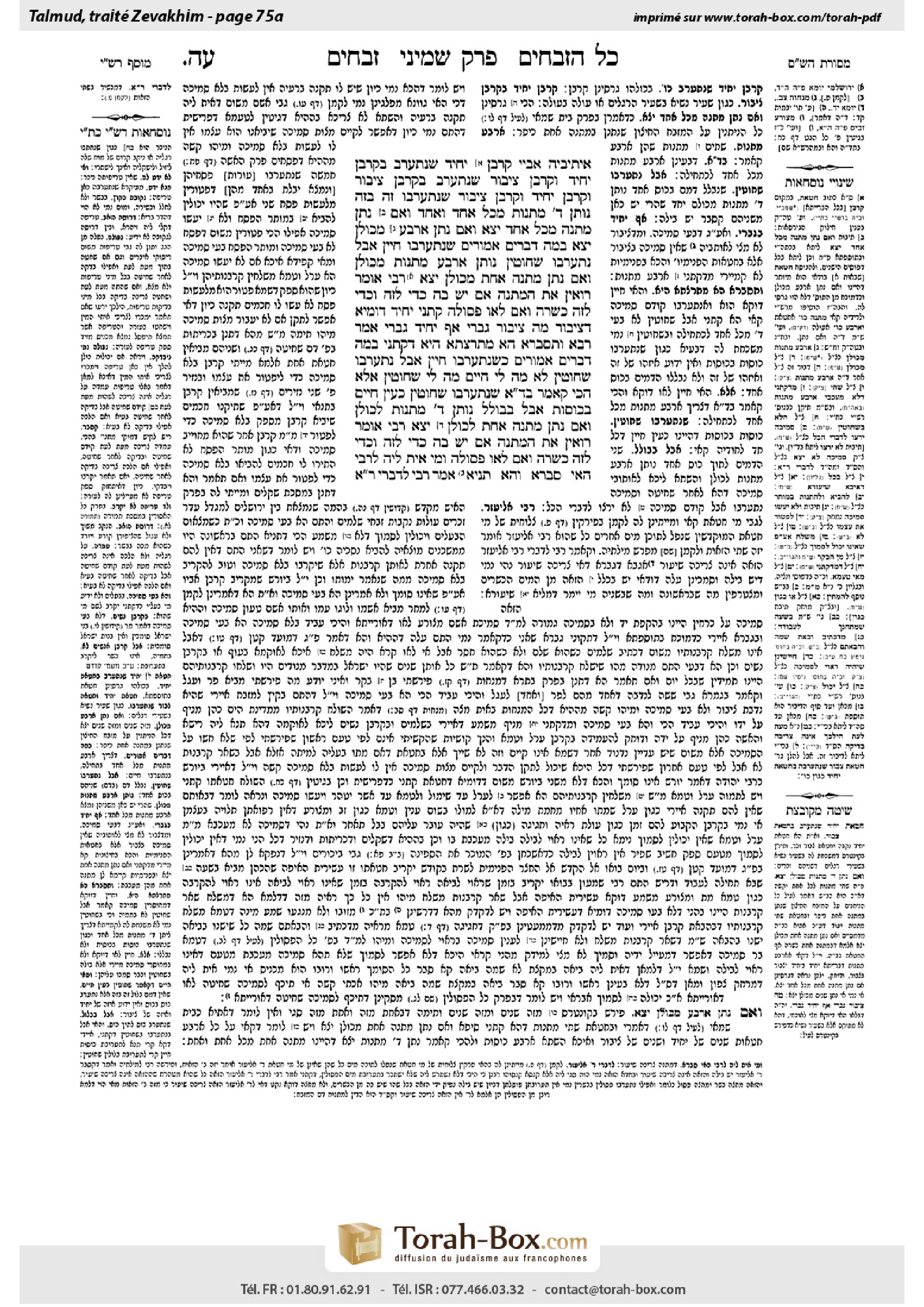
Zevachim 75a: Talmud study for Daf Yomi
Daf Yomi is the daily study of one Talmud folio. Explore 37 tractates with scans, Hebrew text, Sefaria English and AI-generated French translations where annotated.
Passage selection and English or AI-generated French translation are available where the scan has annotations. Daf Study is independent of Torah-Box and Sefaria.
Browse Zevachim · זבחים · All tractatesZevachim 75a text and translations
This page of Zevachim includes the Aramaic text, an English translation and an AI-generated French translation, alongside the scan above.
זבחים ע״ה א · Aramaic and Hebrew text
אֵיתִיבֵיהּ אַבָּיֵי: קׇרְבַּן יָחִיד שֶׁנִּתְעָרֵב בְּקׇרְבַּן יָחִיד, וְקׇרְבַּן צִיבּוּר שֶׁנִּתְעָרֵב בְּקׇרְבַּן צִיבּוּר, וְקׇרְבַּן יָחִיד וְקׇרְבַּן צִיבּוּר שֶׁנִּתְעָרְבוּ זֶה בָּזֶה – נוֹתֵן אַרְבַּע מַתָּנוֹת מִכׇּל אֶחָד וְאֶחָד. וְאִם נָתַן מַתָּנָה מִכׇּל אֶחָד – יָצָא, וְאִם נָתַן אַרְבַּע מִכּוּלָּן – יָצָא.
בַּמֶּה דְּבָרִים אֲמוּרִים – שֶׁנִּתְעָרְבוּ חַיִּין, אֲבָל נִתְעָרְבוּ שְׁחוּטִין – נוֹתֵן אַרְבַּע מַתָּנוֹת מִכּוּלָּן.
וְאִם נָתַן מַתָּנָה אַחַת מִכּוּלָּן – יָצָא. רַבִּי אוֹמֵר: רוֹאִין אֶת הַמַּתָּנָה; אִם יֵשׁ בָּהּ כְּדֵי לָזֶה וּכְדֵי לָזֶה – כְּשֵׁרָה, וְאִם לָאו – פְּסוּלָה.
קָתָנֵי יָחִיד דּוּמְיָא דְּצִיבּוּר – מָה צִיבּוּר גַּבְרֵי, אַף יָחִיד גַּבְרֵי.
אָמַר רָבָא: וְתִסְבְּרָא הָא מְתָרַצְתָּא הִיא?! דְּקָתָנֵי: בַּמֶּה דְּבָרִים אֲמוּרִים – כְּשֶׁנִּתְעָרְבוּ חַיִּין, אֲבָל נִתְעָרְבוּ שְׁחוּטִין – לָא. מָה לִי חַיִּים מָה לִי שְׁחוּטִין?
אֶלָּא הָכִי קָאָמַר: בַּמֶּה דְּבָרִים אֲמוּרִים – שֶׁנִּתְעָרְבוּ שְׁחוּטִין כְּעֵין חַיִּים, בְּכוֹסוֹת; אֲבָל בְּבוֹלֵל – נוֹתֵן אַרְבַּע מַתָּנוֹת לְכוּלָּן. וְאִם נָתַן מַתָּנָה אַחַת לְכוּלָּן – יָצָא.
רַבִּי אוֹמֵר: רוֹאִין אֶת הַמַּתָּנָה; אִם יֵשׁ בָּהּ כְּדֵי לָזֶה וּכְדֵי לָזֶה – כְּשֵׁרָה, וְאִם לָא – פְּסוּלָה. וּמִי אִית לֵיהּ לְרַבִּי הַאי סְבָרָא?! וְהָא תַּנְיָא, אָמַר רַבִּי: לְדִבְרֵי רַבִּי אֱלִיעֶזֶר,
Zevachim 75a · English translation
Abaye raised an objection to this from a baraita (Tosefta 8:22): With regard to the offering of an individual that was intermingled with another offering of an individual, and likewise a communal offering that was intermingled with another communal offering, or the offering of an individual and a communal offering that were intermingled with each other, the priest places four placements of blood from each and every one of them on the altar, and in this manner fulfills the obligation of the blood rites of all the offerings. But if he placed one placement from each one, he has fulfilled his obligation. And likewise, if he placed four placements from all of them together, he has fulfilled his obligation.
The baraita continues: In what case is this statement, that he places from the blood of each of the offerings ab initio, said? In a case where the offerings were intermingled when they were still alive, before they were sacrificed, and therefore the priest could perform four placements from the blood of each animal separately. But if slaughtered animals were then intermingled, i.e., their blood became mixed together in one container, the priest places four placements from all of them together, only one set of four.
And in any case, if he placed one placement from all of them, he has fulfilled his obligation, as the blood of all these offerings is placed on the outer altar, and with regard to all of them one fulfills the obligation after the fact with a single placement. Rabbi Yehuda HaNasi says: One assesses the blood of the placement given from each animal; if there is enough in that blood for a placement of blood for this offering and enough for that one, it is fit, but if not, the offering is disqualified.
The Gemara explains the difficulty: This baraita indicates that if live offerings became intermingled, each is sacrificed for its owner, despite the fact that these offerings are owned by men and therefore require placing of the hands. It is evident that the baraita is referring to offerings of men, as it teaches the case of the offering of an individual adjacent to, and therefore similar to, the case of a communal offering: Just as a communal offering is sacrificed by men, so too, the offering of an individual that is being discussed here also belongs to men. This presents a difficulty to the explanation of Rav Yosef.
Rava says: And can you understand the baraita in this manner? Is this baraita accurate as it stands? There is another difficulty with the baraita, as it teaches: In what case is this statement said? It is said in a case where these offerings were intermingled when they were still alive. But if slaughtered animals were intermingled it is not said. This is problematic, as what difference is it to me whether the animals are alive or whether they are slaughtered? This is not the decisive factor, as even if the animals were slaughtered, if the blood of each is in a separate vessel the priest should perform separate placements from the blood of each.
Rava continues: Rather, this is what the baraita is saying: In what case is this statement said? It is said in a case where these offerings were intermingled after they were slaughtered, but they were similar to living animals, i.e., the blood of each animal was in separate cups. But in a situation where the blood of these animals was mixed together in a single cup, the priest places four placements of blood from all of them. And if he placed one placement from all of them, he has fulfilled his obligation. If so, this baraita has no bearing on the issue of offerings that became intermingled while they were still alive, as it deals exclusively with the blood of animals that have been slaughtered.
§ The baraita cited teaches that Rabbi Yehuda HaNasi says: One assesses the blood of the placement given from each animal; if there is enough in that blood for a placement of blood for this offering and enough for that offering, it is fit, but if not, the offerings are disqualified. The Gemara asks: And does Rabbi Yehuda HaNasi hold in accordance with this line of reasoning, that there must be a minimum amount of blood placed from each offering? But isn’t it taught in a baraita (Tosefta, Para 9:5) with regard to the water of purification into which water that is invalid for sprinkling fell that Rabbi Yehuda HaNasi says: According to the statement of Rabbi Eliezer,
Zevachim 75a · Traduction française (IA)
Abaye objecta à cela à partir d’une baraïta (Tossefta 8:22) : Lorsqu’un sacrifice individuel s’est mélangé à un autre sacrifice individuel, de même lorsqu’un sacrifice communautaire s’est mélangé à un autre sacrifice communautaire, ou lorsqu’un sacrifice individuel et un sacrifice communautaire se sont mélangés, le prêtre fait quatre aspersions de sang sur l’autel pour chacun d’eux, et s’acquitte ainsi des rites du sang de tous les sacrifices. Mais s’il fait une seule aspersion pour chacun, il s’est acquitté de son obligation. De même, s’il fait quatre aspersions avec le sang de tous les sacrifices ensemble, il s’est acquitté de son obligation.
La baraïta poursuit : Dans quel cas cette règle, selon laquelle il fait d’emblée des aspersions avec le sang de chacun des sacrifices, a-t-elle été énoncée ? Dans le cas où les sacrifices se sont mélangés alors qu’ils étaient encore vivants, avant d’être sacrifiés ; le prêtre pouvait donc faire séparément quatre aspersions avec le sang de chaque animal. Mais si les animaux abattus se sont mélangés, c’est-à-dire si leur sang s’est mêlé dans un même récipient, le prêtre fait quatre aspersions avec le sang de tous les sacrifices ensemble, soit une seule série de quatre.
Dans tous les cas, s’il fait une seule aspersion avec le sang de tous les sacrifices ensemble, il s’est acquitté de son obligation, puisque le sang de tous ces sacrifices est appliqué sur l’autel extérieur et que, pour chacun d’eux, une seule aspersion suffit après coup. Rabbi Yehouda HaNassi dit : On évalue le sang utilisé pour l’aspersion provenant de chaque animal ; s’il y en a assez pour une aspersion de sang pour ce sacrifice et assez pour l’autre, il est valable, mais sinon, le sacrifice est disqualifié.
La Guemara explique la difficulté : Cette baraïta indique que, si des sacrifices encore vivants se sont mélangés, chacun est sacrifié pour son propriétaire, bien que ces sacrifices appartiennent à des hommes et requièrent donc l’imposition des mains. Il ressort clairement que la baraïta parle de sacrifices appartenant à des hommes, car elle enseigne le cas d’un sacrifice individuel à côté de celui d’un sacrifice communautaire, et donc un cas analogue : de même qu’un sacrifice communautaire est offert par des hommes, le sacrifice individuel dont il est question ici appartient lui aussi à des hommes. Cela pose une difficulté à l’explication de Rav Yossef.
Rava dit : Peut-on vraiment comprendre la baraïta de cette manière ? Est-elle cohérente telle qu’elle est formulée ? La baraïta présente une autre difficulté, puisqu’elle enseigne : « Dans quel cas cette règle a-t-elle été énoncée ? Dans le cas où ces sacrifices se sont mélangés alors qu’ils étaient encore vivants. Mais elle ne s’applique pas si les animaux abattus se sont mélangés. » Cela pose problème : quelle différence cela fait-il que les animaux soient vivants ou abattus ? Ce n’est pas là le facteur déterminant, car même si les animaux ont été abattus, si le sang de chacun se trouve dans un récipient distinct, le prêtre doit faire des aspersions séparées avec le sang de chacun.
Rava poursuit : Voici plutôt ce que dit la baraïta : Dans quel cas cette règle a-t-elle été énoncée ? Dans le cas où ces sacrifices se sont mélangés après leur abattage, mais où ils étaient semblables à des animaux encore vivants, c’est-à-dire que le sang de chaque animal se trouvait dans un récipient distinct. Mais si le sang de ces animaux s’est mélangé dans un seul récipient, le prêtre fait quatre aspersions avec le sang de tous les sacrifices ensemble. Et s’il fait une seule aspersion avec le sang de tous ensemble, il s’est acquitté de son obligation. Ainsi, cette baraïta n’a aucune incidence sur la question des sacrifices qui se sont mélangés alors qu’ils étaient encore vivants, car elle traite exclusivement du sang d’animaux qui ont été abattus.
§ La baraïta citée enseigne que Rabbi Yehouda HaNassi dit : On évalue le sang utilisé pour l’aspersion provenant de chaque animal ; s’il y en a assez pour une aspersion de sang pour ce sacrifice et assez pour l’autre, le sacrifice est valable, mais sinon, les sacrifices sont disqualifiés. La Guemara demande : Rabbi Yehouda HaNassi tient-il donc ce raisonnement, selon lequel une quantité minimale de sang doit être aspergée pour chaque sacrifice ? Pourtant, n’enseigne-t-on pas dans une baraïta (Tossefta, Para 9:5), au sujet de l’eau de purification dans laquelle est tombée de l’eau impropre à l’aspersion, que Rabbi Yehouda HaNassi dit : « Selon l’opinion de Rabbi Éliézer, »
Traduction française générée par IA à partir de l’édition anglaise de Sefaria. Vérifie toujours un passage avec le texte source.
Text from Sefaria: William Davidson Edition - Vocalized Aramaic (CC BY NC); William Davidson Edition - English (CC BY NC).