Zevachim 75b: Talmud study for Daf Yomi
Daf Yomi is the daily study of one Talmud folio. Explore 37 tractates with scans, Hebrew text, Sefaria English and AI-generated French translations where annotated.
Passage selection and English or AI-generated French translation are available where the scan has annotations. Daf Study is independent of Torah-Box and Sefaria.
Browse Zevachim · זבחים · All tractatesZevachim 75b text and translations
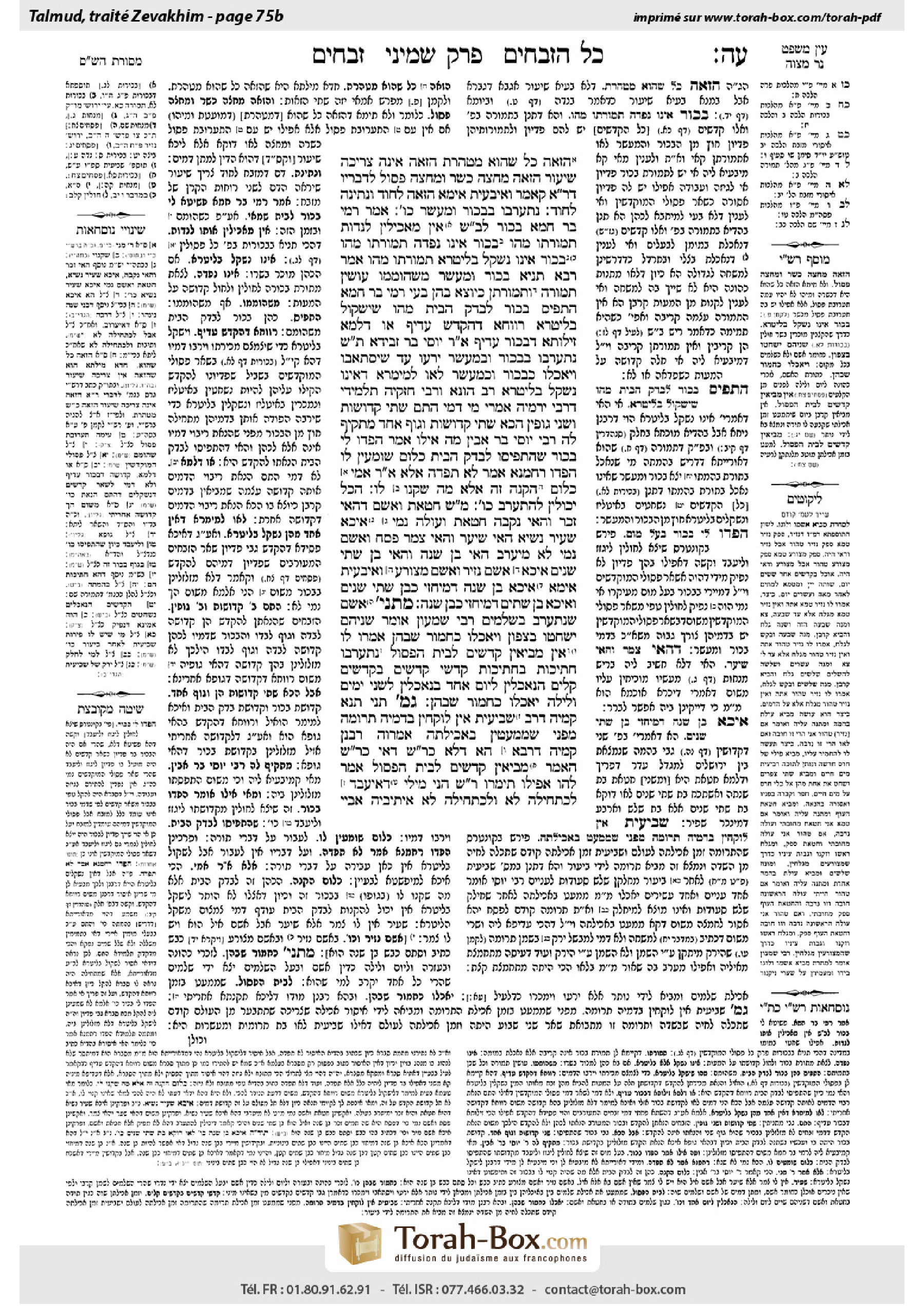
This page of Zevachim includes the Aramaic text, an English translation and an AI-generated French translation, alongside the scan above.
זבחים ע״ה ב · Aramaic and Hebrew text
הַזָּאָה כֹּל שֶׁהִיא – מְטַהֶרֶת; הַזָּאָה אֵינָהּ צְרִיכָה שִׁיעוּר; הַזָּאָה מֶחֱצָה כָּשֵׁר וּמֶחֱצָה פָּסוּל!
לִדְבָרָיו דְּרַבִּי אֱלִיעֶזֶר קָאָמַר. וְאִיבָּעֵית אֵימָא: הַזָּאָה לְחוּד וּנְתִינָה לְחוּד.
נִתְעָרְבוּ בִּבְכוֹר וּמַעֲשֵׂר כּוּ׳. אָמַר רָמֵי בַּר חָמָא: בְּכוֹר לְבֵית שַׁמַּאי – אֵין מַאֲכִילִין לְנִדּוֹת; תְּמוּרָתוֹ מַהוּ?
בְּכוֹר אֵינוֹ נִפְדֶּה; תְּמוּרָתוֹ מַהוּ? בְּכוֹר אֵינוֹ נִשְׁקָל בְּלִיטְרָא; תְּמוּרָתוֹ מַהוּ? אָמַר רָבָא, תַּנְיָא: בְּכוֹר וּמַעֲשֵׂר מִשֶּׁהוּמְמוּ – עוֹשִׂין תְּמוּרָה, וּתְמוּרָתָן כְּיוֹצֵא בָּהֶן.
בָּעֵי רָמֵי בַּר חָמָא: הִתְפִּיס בְּכוֹר לְבֶדֶק הַבַּיִת, מַהוּ שֶׁיִּשְׁקוֹל בְּלִיטְרָא? רַוְוחָא דְּהֶקְדֵּשׁ עֲדִיף, אוֹ דִלְמָא זִילוּתָא דִּבְכוֹר עָדִיף?
אָמַר רַבִּי יוֹסֵי בַּר זְבִידָא, תָּא שְׁמַע: נִתְעָרְבוּ בִּבְכוֹר וּבְמַעֲשֵׂר – יִרְעוּ עַד שֶׁיִּסְתָּאֲבוּ, וְיֵאָכְלוּ כִּבְכוֹר וּכְמַעֲשֵׂר. לָאו לְמֵימְרָא דְּאֵינוֹ נִשְׁקָל בְּלִיטְרָא?
רַב הוּנָא וְרַבִּי חִזְקִיָּה תַּלְמִידֵי רַבִּי יִרְמְיָה אָמְרִי: מִי דָּמֵי?! הָתָם שְׁתֵּי קְדוּשּׁוֹת וּשְׁנֵי גּוּפִין, הָכָא שְׁתֵּי קְדוּשּׁוֹת וְגוּף אֶחָד.
מַתְקֵיף לַהּ רַבִּי יוֹסֵי בַּר אָבִין, מָה אִילּוּ אָמַר: ״הַפְדּוּ לִי בְּכוֹר שֶׁהִתְפִּיסוֹ לְבֶדֶק הַבַּיִת״ – כְּלוּם שׁוֹמְעִין לוֹ?! ״הַפְדּוּ״?! רַחֲמָנָא אָמַר: ״לֹא תִפְדֶּה״!
אֶלָּא אָמַר רַבִּי אַמֵּי: כְּלוּם הִקְנָה זֶה – אֶלָּא מַה (שקנו) [שֶּׁקָּנוּי] לוֹ!
הַכֹּל יְכוֹלִין לְהִתְעָרֵב כּוּ׳. מַאי שְׁנָא חַטָּאת וְאָשָׁם – דְּהַאי זָכָר וְהַאי נְקֵבָה;
חַטָּאת וְעוֹלָה נָמֵי! אִיכָּא שְׂעִיר נָשִׂיא; הַאי שֵׂיעָר וְהַאי צֶמֶר.
פֶּסַח וְאָשָׁם נָמֵי לָא מִיעָרַב – הַאי בֶּן שָׁנָה וְהַאי בֶּן שְׁתֵּי שָׁנִים! אִיכָּא אֲשַׁם נָזִיר וַאֲשַׁם מְצוֹרָע. וְאִיבָּעֵית אֵימָא: אִיכָּא בֶּן שָׁנָה דְּמִיחֲזֵי כְּבֶן שְׁתֵּי שָׁנִים, וְאִיכָּא בֶּן שְׁתַּיִם דְּמִיחֲזֵי כְּבֶן שָׁנָה.
מַתְנִי׳ אָשָׁם שֶׁנִּתְעָרֵב בִּשְׁלָמִים – רַבִּי שִׁמְעוֹן אוֹמֵר: שְׁנֵיהֶם יִשָּׁחֲטוּ בַּצָּפוֹן, וְיֵאָכְלוּ כֶּחָמוּר שֶׁבָּהֶן.
אָמְרוּ לוֹ: אֵין מְבִיאִין קָדָשִׁים לְבֵית הַפְּסוּל.
נִתְעָרְבוּ חֲתִיכוֹת בַּחֲתִיכוֹת – קׇדְשֵׁי קָדָשִׁים בְּקָדָשִׁים קַלִּים, הַנֶּאֱכָלִין לְיוֹם אֶחָד בְּנֶאֱכָלִין לִשְׁנֵי יָמִים וְלַיְלָה – יֵאָכְלוּ כֶּחָמוּר שֶׁבָּהֶן.
גְּמָ׳ תָּנֵי תַּנָּא קַמֵּיהּ דְּרַב: שְׁבִיעִית אֵין לוֹקְחִין בְּדָמֶיהָ תְּרוּמָה, מִפְּנֵי שֶׁמְּמַעֲטִין בַּאֲכִילָתָהּ.
אַמְרוּהָ רַבָּנַן קַמֵּיהּ (דְּרָבָא) [דְּרַבָּה]: הָא דְּלָא כְּרַבִּי שִׁמְעוֹן; דְּאִי כְּרַבִּי שִׁמְעוֹן, הָאָמַר: מְבִיאִין קָדָשִׁים לְבֵית הַפְּסוּל!
אֲמַר לְהוּ: אֲפִילּוּ תֵּימְרוּ רַבִּי שִׁמְעוֹן – הָנֵי מִילֵּי דְּאִיעֲבַד, לְכִתְחִילָּה לָא. וּלְכִתְחִילָּה לָא?! אֵיתִיבֵיהּ אַבָּיֵי:
Zevachim 75b · English translation
a sprinkling of any amount of the water of purification on someone rendered impure by impurity imparted by a corpse purifies him from his ritual impurity, as sprinkling does not require a minimum measure to purify him. Likewise, a sprinkling of water that is half fit and half unfit for sprinkling serves to purify the individual. Evidently, Rabbi Yehuda HaNasi maintains that no minimum amount is required for the sprinkling of the water of purification, and the same should apply to the sprinkling of blood on the altar.
The Gemara answers that Rabbi Yehuda HaNasi stated his opinion in accordance with the statement of Rabbi Eliezer, but he himself does not agree with this opinion. And if you wish, say instead that sprinkling of water of purification is discrete and placement of blood on the altar is discrete, i.e., these are two separate halakhot that have no bearing on each other.
§ The mishna teaches: In a case where sacrificial animals were intermingled with a firstborn offering or with an animal tithe offering, they shall graze until they become unfit for sacrifice and they shall both be eaten as a firstborn offering or as an animal tithe offering. This means that one may not sell them in the marketplace nor sell their meat by weight, so as not to degrade consecrated animals. Rami bar Ḥama says: With regard to a firstborn offering, according to the opinion of Beit Shammai, who hold (Bekhorot 33a) that even after a firstborn offering develops a blemish the priest may not eat it in a state of ritual impurity, and therefore one may not feed it to menstruating women, what is the halakha with regard to its substitute? That is, if the owner of a firstborn animal stated with regard to a non-sacred animal in his possession: This animal is a substitute for the firstborn offering, is a menstruating woman permitted to eat that substitute after it develops a blemish?
Rami bar Ḥama further asks: A firstborn offering itself may not be redeemed, even after it develops a blemish, but what is the halakha with regard to redeeming its substitute? He likewise inquired: A firstborn offering itself, even after it develops a blemish, may not be weighed and sold by the litra, in the manner that non-sacred meat is sold. What is the halakha of its substitute in this regard? Rava says that an answer to these questions is taught in a baraita: With regard to a firstborn offering or an animal tithe offering, from when they develop a blemish they can be used to render another animal a substitute, and their substitute has the same status as them. Their substitutes have the same halakhot as they do.
Rami bar Ḥama raises a dilemma: If the priest who received a firstborn offering dedicated the firstborn offering to the Temple maintenance, i.e., he vowed to give the value of the firstborn offering to the Temple, what is the halakha with regard to the matter that he may weigh its meat by the litra? The Gemara explains the dilemma: In this case, is consideration of the profit of the Temple treasury preferable, or perhaps avoidance of the demeaning of the firstborn offering is preferable. If the profit of the Temple treasury is preferable, the firstborn offering should be weighed in the normal manner so as to increase its price; a buyer will pay more for meat he is able to resell afterward by exact weight. If avoidance of demeaning the firstborn offering is preferable, it should not be weighed by the litra, even though a loss to the Temple would result.
Rabbi Yosei bar Zevida says: Come and hear a proof from the ruling of the mishna: In a case where sacrificial animals were intermingled with a firstborn offering or with an animal tithe offering, they shall graze until they become unfit for sacrifice and they shall both be eaten as a firstborn offering or as an animal tithe offering. Is this not meaning to say that the sacrificial animal that became intermingled with a firstborn offering is also not weighed by the litra, despite the fact that this causes a slight loss to the Temple?
Rav Huna and Rabbi Ḥizkiyya, the students of Rabbi Yirmeya, say: Are these cases comparable? There, the mishna is referring to two separate sanctities, the sanctity of a firstborn offering and that of another offering, and two separate bodies, i.e., two different animals, and in such a case one may not degrade the sanctity of the firstborn due to the other animal with which it is intermingled. Conversely, here, with regard to one who vows to give the value of a firstborn to the Temple, there are two sanctities, a firstborn offering and the Temple maintenance, but they are both found in one body. In this case, as the sanctity of the Temple maintenance itself is in the firstborn offering, it may be weighed by the litra, because of the profit the Temple will gain.
Rav Yosei bar Avin objects to this: What would be the halakha if one says: Redeem for me, i.e., I wish to redeem, a firstborn offering that he had previously dedicated as the object of his vow to the Temple maintenance? Does the court listen to him? His request is certainly not granted, as by Torah law a firstborn offering may not be redeemed. Similarly, the fact that he dedicated the value of the firstborn offering to the Temple should not negate the prohibition of weighing it by the litra. The Gemara questions this comparison: One cannot raise a difficulty from a case where someone says: Redeem the firstborn offering for me, as the Merciful One states with regard to a firstborn offering: “But the firstborn of a bull, or the firstborn of a sheep, or the firstborn of a goat, you shall not redeem; they are sacred” (Numbers 18:17). But the weighing of the offering by the litra is not prohibited by Torah law.
Rather, the Gemara suggests a different resolution of Rami bar Ḥama’s dilemma: Rabbi Ami says: Can this priest transfer to the Temple maintenance anything other than that which was transferred to him? In other words, just as the priest who took the vow may not weigh the firstborn by the litra and gain a profit, the same applies to the Temple treasury, the recipient of his vow.
§ The mishna teaches: All offerings can become indistinguishably intermingled with each other, except for a sin offering and a guilt offering. The Gemara asks: What is different about a sin offering and a guilt offering, that they cannot become intermingled? Is the reason that this, a guilt offering, is always a male, and that, a sin offering, is always a female?
The Gemara questions this explanation: A sin offering and a burnt offering are also like this, as a sin offering is always female while a burnt offering is always male. The Gemara answers that although the standard sin offering is always female, there is the goat of the Nasi, which is a male sin offering, and therefore it can become intermingled with a male goat burnt offering. And as to the statement of the mishna that a sin offering cannot become intermingled with a guilt offering despite the male sin offering of the Nasi, that is because this goat has straight hair and that guilt offering comes only from sheep or rams, which have wool, and the wool is curly.
The Gemara raises a difficulty: A Paschal offering and a guilt offering also cannot become intermingled, as this Paschal offering is in its first year, and that guilt offering is in its second year. The Gemara answers that there is the guilt offering of a nazirite and the guilt offering of a leper, which must be in their first year. And if you wish, say instead that an animal in its first year can become intermingled with an animal in its second year, as there is an animal in its first year that looks like an animal in its second year, and likewise there is an animal in its second year that looks like an animal in its first year.
MISHNA: In the case of a guilt offering that was intermingled with a peace offering, Rabbi Shimon says: Both of them should be slaughtered in the north of the Temple courtyard, as a guilt offering must be slaughtered in the north while a peace offering may be slaughtered anywhere in the courtyard. And they both must be eaten in accordance with the halakha of the more stringent of them, i.e., the guilt offering, with the following halakhot: They may be eaten only in the courtyard rather than throughout Jerusalem; by male priests and not by any ritually pure Jew; and on the day they were sacrificed and the following night, and not on the day they were sacrificed, the following day, and the intervening night.
The Rabbis said to Rabbi Shimon: One may not limit the time of the consumption of an offering, as one may not bring sacrificial animals to the status of unfitness. According to Rabbi Shimon’s opinion, the peace offering becomes leftover, notar, the morning after it is sacrificed, and not at the end of that day, as is the halakha concerning peace offerings. Rather, the Rabbis hold, the owner shall wait until these animals become blemished, redeem them, and bring an offering of each type that is worth the monetary value of the higher-quality animal among them.
The mishna adds: Even according to the opinion of the Rabbis, if pieces of the meat of one offering were intermingled with pieces of the meat of another offering, e.g., meat from offerings of the most sacred order with meat from offerings of lesser sanctity; or if pieces of meat from offerings eaten for one day and the following night were intermingled with pieces of meat from offerings eaten for two days and one night, since in that case the remedy with regard to offerings that were intermingled cannot be implemented, they both must be eaten in accordance with the halakha of the more stringent of them.
GEMARA: In connection to the principle cited by the Rabbis in the mishna that one may not bring consecrated animals to the status of unfitness, a tanna taught a baraita (Tosefta, Shevi’it 6:29) before Rav: With regard to produce of the Sabbatical Year, one may not purchase produce of teruma from a previous year with its money, i.e., money received in its sale, because one thereby reduces the time of eating the teruma. The produce of the Sabbatical Year may be eaten only until the time of the removal of that type of produce from the field, whereas teruma may be consumed at any time.
The Sages said this baraita before Rabba, and they explained that this baraita is not in accordance with the opinion of Rabbi Shimon in the mishna. Their reasoning was that if you would say it is in accordance with the opinion of Rabbi Shimon, doesn’t he say, as can be inferred from the mishna, that one may bring sacrificial animals to the status of unfitness? Similarly, one can limit the time allowed for the consumption of the Sabbatical Year produce.
Rabba said to them: You may even say that the baraita is in accordance with the opinion of Rabbi Shimon. That statement, that one may bring sacrificial animals to the status of unfitness, applies only in a case that is after the fact, as in the mishna, where offerings became intermingled. Rabbi Shimon did not permit one to bring sacrificial animals to the status of unfitness ab initio. The Gemara asks: And does Rabbi Shimon not permit one to bring sacrificial animals to the status of unfitness ab initio? Abaye raised an objection to Rabba from a mishna that discusses the manner of eating the meat of offerings (Zevachim 90b):
Zevachim 75b · Traduction française (IA)
Une aspersion d’eau de purification, quelle qu’en soit la quantité, sur une personne rendue impure par l’impureté transmise par un cadavre la purifie de son impureté rituelle, car l’aspersion n’exige aucune quantité minimale pour produire cet effet. De même, une aspersion d’eau dont une moitié convient à l’aspersion et l’autre moitié n’y convient pas suffit à purifier la personne. Il apparaît donc que Rabbi Yehuda HaNassi estime qu’aucune quantité minimale n’est requise pour l’aspersion de l’eau de purification, et il devrait en aller de même pour l’aspersion du sang sur l’autel.
La Guemara répond que Rabbi Yehuda HaNassi a énoncé son opinion conformément à celle de Rabbi Eliezer, mais que lui-même ne partage pas cette opinion. Et si tu le souhaites, dis plutôt que l’aspersion de l’eau de purification relève d’une halakha distincte du placement du sang sur l’autel, c’est-à-dire que ces deux halakhot sont indépendantes l’une de l’autre.
§ La Michna enseigne : lorsque des animaux consacrés se sont mélangés à une offrande de premier-né ou à une offrande de dîme animale, ils doivent paître jusqu’à devenir impropres au sacrifice, puis les deux catégories d’animaux seront consommées selon les règles applicables à l’offrande de premier-né ou à celle de dîme animale. Cela signifie qu’on ne peut ni les vendre sur le marché ni vendre leur viande au poids, afin de ne pas avilir des animaux consacrés. Rami bar Ḥama dit : concernant une offrande de premier-né, selon l’avis de Beit Shammaï, qui soutiennent (Bekhorot 33a) que même après l’apparition d’un défaut, le prêtre ne peut pas consommer l’offrande de premier-né en état d’impureté rituelle et qu’on ne peut donc pas la donner à manger à des femmes menstruées, quelle est la halakha concernant son substitut ? Autrement dit, si le propriétaire d’un animal profane déclare au sujet de celui-ci : « Cet animal est le substitut de l’offrande de premier-né », une femme menstruée est-elle autorisée à manger ce substitut après l’apparition d’un défaut ?
Rami bar Ḥama demande en outre : une offrande de premier-né ne peut pas être rachetée, même après l’apparition d’un défaut ; quelle est toutefois la halakha concernant le rachat de son substitut ? Il demande également : une offrande de premier-né, même après l’apparition d’un défaut, ne peut pas être pesée et vendue à la litra, comme on vend la viande profane. Quelle est la halakha concernant son substitut à cet égard ? Rava dit que la réponse à ces questions est enseignée dans une baraïta : une offrande de premier-né ou de dîme animale peut, dès l’apparition d’un défaut, servir à rendre un autre animal substitut, et son substitut a le même statut qu’elle. Leurs substituts sont soumis aux mêmes halakhot que les animaux eux-mêmes.
Rami bar Ḥama soulève un dilemme : si le prêtre qui a reçu une offrande de premier-né l’a consacrée à l’entretien du Temple, c’est-à-dire s’il a fait vœu d’en donner la valeur à l’entretien du Temple, quelle est la halakha quant à la possibilité d’en peser la viande à la litra ? La Guemara explique le dilemme : faut-il privilégier le bénéfice du trésor du Temple, ou plutôt éviter d’avilir l’offrande de premier-né ? Si le bénéfice du trésor du Temple est prioritaire, il faut peser l’offrande de premier-né de la manière habituelle afin d’en augmenter le prix ; un acheteur paiera davantage pour une viande qu’il pourra ensuite revendre au poids exact. Si l’on privilégie le fait de ne pas avilir l’offrande de premier-né, il ne faut pas la peser à la litra, même si cela entraîne une perte pour le Temple.
Rabbi Yosei bar Zevida dit : viens et entends une preuve tirée de la décision de la Michna : lorsque des animaux consacrés se sont mélangés à une offrande de premier-né ou à une offrande de dîme animale, ils doivent paître jusqu’à devenir impropres au sacrifice, puis les deux catégories d’animaux seront consommées selon les règles applicables à l’offrande de premier-né ou à celle de dîme animale. Cela ne signifie-t-il pas que l’animal consacré qui s’est mélangé à une offrande de premier-né ne doit pas non plus être pesé à la litra, bien que cela entraîne une légère perte pour le Temple ?
Rav Houna et Rabbi Ḥizkiyya, les élèves de Rabbi Yirmeya, disent : ces cas sont-ils comparables ? Là-bas, la Michna parle de deux sanctités distinctes — celle d’une offrande de premier-né et celle d’une autre offrande — et de deux corps distincts, c’est-à-dire deux animaux différents ; dans un tel cas, on ne peut pas avilir la sainteté de l’offrande de premier-né à cause de l’autre animal avec lequel elle s’est mélangée. En revanche, ici, lorsqu’une personne fait vœu de donner au Temple la valeur d’une offrande de premier-né, il y a deux sanctités, celle de l’offrande de premier-né et celle de l’entretien du Temple, mais elles se trouvent toutes deux dans un seul corps. Dans ce cas, puisque la sainteté de l’entretien du Temple elle-même réside dans l’offrande de premier-né, on peut la peser à la litra, en raison du bénéfice qu’en tirera le Temple.
Rabbi Yosei bar Avin objecte : qu’en serait-il si quelqu’un disait : « Rachète pour moi », c’est-à-dire : « Je souhaite racheter », une offrande de premier-né qu’il avait auparavant consacrée à l’entretien du Temple dans le cadre de son vœu ? Le tribunal accède-t-il à sa demande ? Certainement pas, car selon la Torah, une offrande de premier-né ne peut pas être rachetée. De même, le fait qu’il ait consacré la valeur de l’offrande de premier-né au Temple ne devrait pas annuler l’interdiction de la peser à la litra. La Guemara met en question cette comparaison : on ne peut pas soulever une difficulté à partir du cas où quelqu’un dit : « Rachète pour moi l’offrande de premier-né », car le Miséricordieux dit à propos d’une offrande de premier-né : « Toutefois, le premier-né du taureau, le premier-né du mouton ou le premier-né de la chèvre, tu ne le rachèteras pas ; ils sont saints » (Nombres 18:17). En revanche, la Torah n’interdit pas de peser l’offrande à la litra.
La Guemara propose plutôt une autre résolution du dilemme de Rami bar Ḥama : Rabbi Ami dit : ce prêtre peut-il transférer à l’entretien du Temple davantage que ce qui lui a été transféré ? Autrement dit, de même que le prêtre qui a fait le vœu ne peut pas peser l’offrande de premier-né à la litra pour en tirer un bénéfice, il en va de même pour le trésor du Temple, bénéficiaire de son vœu.
§ La Michna enseigne : toutes les offrandes peuvent se mélanger indistinctement entre elles, à l’exception d’un sacrifice expiatoire et d’un sacrifice de culpabilité. La Guemara demande : qu’est-ce qui distingue un sacrifice expiatoire et un sacrifice de culpabilité, de sorte qu’ils ne peuvent pas se mélanger ? Est-ce parce que celui-ci, le sacrifice de culpabilité, est toujours un mâle, tandis que celui-là, le sacrifice expiatoire, est toujours une femelle ?
La Guemara met cette explication en question : un sacrifice expiatoire et un holocauste présentent aussi cette distinction, car le sacrifice expiatoire est toujours une femelle, tandis que l’holocauste est toujours un mâle. La Guemara répond que, bien que le sacrifice expiatoire ordinaire soit toujours une femelle, il existe le bouc du nassi, qui est un sacrifice expiatoire mâle ; il peut donc se mélanger à un bouc mâle destiné à l’holocauste. Quant à l’affirmation de la Michna selon laquelle un sacrifice expiatoire ne peut pas se mélanger à un sacrifice de culpabilité malgré l’existence du sacrifice expiatoire mâle du nassi, cela s’explique par le fait que ce bouc a le poil lisse, tandis que le sacrifice de culpabilité ne provient que de moutons ou de béliers, qui ont de la laine bouclée.
La Guemara soulève une difficulté : un sacrifice pascal et un sacrifice de culpabilité ne peuvent pas non plus se mélanger, car le sacrifice pascal est dans sa première année, tandis que le sacrifice de culpabilité est dans sa deuxième année. La Guemara répond qu’il existe le sacrifice de culpabilité d’un nazir et celui d’un lépreux, qui doivent être dans leur première année. Et si tu le souhaites, dis plutôt qu’un animal dans sa première année peut se mélanger à un animal dans sa deuxième année, car il existe un animal de première année qui ressemble à un animal de deuxième année, et, de même, un animal de deuxième année qui ressemble à un animal de première année.
MICHNA : Dans le cas d’un sacrifice de culpabilité qui s’est mélangé à une offrande de paix, Rabbi Shimon dit : on abattra les deux au nord de la cour du Temple, car un sacrifice de culpabilité doit être abattu au nord, tandis qu’une offrande de paix peut être abattue n’importe où dans la cour. Les deux doivent être consommés selon la halakha la plus stricte, celle du sacrifice de culpabilité, avec les règles suivantes : ils ne peuvent être consommés que dans la cour, et non dans toute la ville de Jérusalem ; ils ne peuvent être consommés que par des prêtres de sexe masculin, et non par n’importe quel Juif en état de pureté rituelle ; enfin, ils ne peuvent être consommés que le jour où ils ont été sacrifiés et la nuit suivante, et non le jour où ils ont été sacrifiés, le lendemain et la nuit intermédiaire.
Les Sages dirent à Rabbi Shimon : on ne peut pas limiter la durée de consommation d’une offrande, car on ne peut pas faire passer des animaux consacrés au statut d’invalidité. Selon l’avis de Rabbi Shimon, l’offrande de paix devient un reste, notar, le matin suivant son sacrifice, et non à la fin de cette journée, comme le prévoit la halakha concernant les offrandes de paix. Les Sages soutiennent plutôt que le propriétaire doit attendre que ces animaux présentent des défauts, les racheter, puis apporter une offrande de chaque type, d’une valeur égale à celle de l’animal de meilleure qualité parmi eux.
La Michna ajoute : même selon l’avis des Sages, si des morceaux de viande d’une offrande se sont mélangés à des morceaux de viande d’une autre offrande — par exemple, de la viande d’offrandes de sainteté supérieure avec de la viande d’offrandes de sainteté moindre — ou si des morceaux de viande d’offrandes consommées le jour même et la nuit suivante se sont mélangés à des morceaux de viande d’offrandes consommées pendant deux jours et une nuit, puisque, dans ce cas, on ne peut pas appliquer la solution prévue pour des offrandes mélangées, les deux doivent être consommées selon la halakha la plus stricte.
GUEMARA : À propos du principe cité par les Sages dans la Michna, selon lequel on ne peut pas faire passer des animaux consacrés au statut d’invalidité, un tanna enseigna devant Rav une baraïta (Tosefta, Shevi’it 6:29) : concernant les produits de l’année sabbatique, on ne peut pas acheter des produits de terouma d’une année antérieure avec l’argent obtenu de leur vente, car on réduit ainsi la période pendant laquelle la terouma peut être consommée. Les produits de l’année sabbatique ne peuvent être consommés que jusqu’au moment où ce type de produits doit être retiré du champ, tandis que la terouma peut être consommée à tout moment.
Les Sages présentèrent cette baraïta devant Rabba et expliquèrent qu’elle ne correspond pas à l’avis de Rabbi Shimon dans la Michna. Ils raisonnaient ainsi : si tu disais qu’elle correspond à l’avis de Rabbi Shimon, ne dit-il pas, comme on peut le déduire de la Michna, qu’on peut faire passer des animaux consacrés au statut d’invalidité ? De même, on pourrait limiter la période pendant laquelle les produits de l’année sabbatique peuvent être consommés.
Rabba leur dit : vous pouvez même dire que la baraïta correspond à l’avis de Rabbi Shimon. Cette affirmation, selon laquelle on peut faire passer des animaux consacrés au statut d’invalidité, ne s’applique qu’après coup, comme dans la Michna, où des offrandes se sont mélangées. Rabbi Shimon n’a pas autorisé à faire passer des animaux consacrés au statut d’invalidité a priori. La Guemara demande : Rabbi Shimon n’autorise-t-il donc pas à faire passer des animaux consacrés au statut d’invalidité a priori ? Abaye souleva une objection à Rabba à partir d’une Michna qui traite de la manière de consommer la viande des offrandes (Zevachim 90b) :
Traduction française générée par IA à partir de l’édition anglaise de Sefaria. Vérifie toujours un passage avec le texte source.
Text from Sefaria: William Davidson Edition - Vocalized Aramaic (CC BY NC); William Davidson Edition - English (CC BY NC).