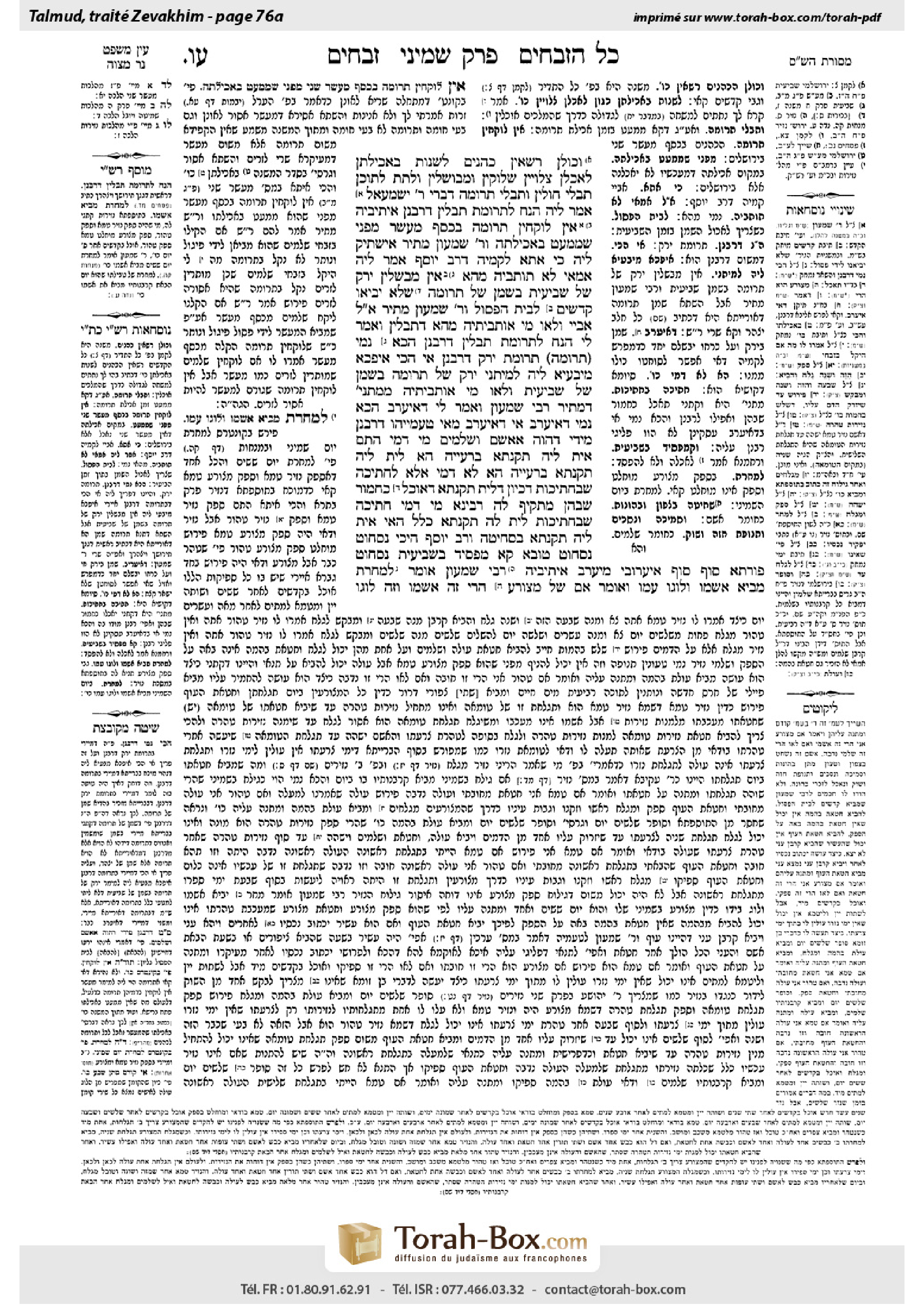
Zevachim 76a: Talmud study for Daf Yomi
Daf Yomi is the daily study of one Talmud folio. Explore 37 tractates with scans, Hebrew text, Sefaria English and AI-generated French translations where annotated.
Passage selection and English or AI-generated French translation are available where the scan has annotations. Daf Study is independent of Torah-Box and Sefaria.
Browse Zevachim · זבחים · All tractatesZevachim 76a text and translations
This page of Zevachim includes the Aramaic text, an English translation and an AI-generated French translation, alongside the scan above.
זבחים ע״ו א · Aramaic and Hebrew text
וְכוּלָּן רַשָּׁאִין כֹּהֲנִים לְשַׁנּוֹת בַּאֲכִילָתָן – לְאָכְלָן צְלוּיִין שְׁלוּקִין וּמְבוּשָּׁלִין, וְלָתֵת לְתוֹכָן תַּבְלֵי חוּלִּין וְתַבְלֵי תְרוּמָה. דִּבְרֵי רַבִּי יִשְׁמָעֵאל. אֲמַר לֵיהּ: הַנַּח לִתְרוּמַת תַּבְלִין – דְּרַבָּנַן.
אֵיתִיבֵיהּ: אֵין לוֹקְחִין תְּרוּמָה בְּכֶסֶף מַעֲשֵׂר, מִפְּנֵי שֶׁמְּמַעֵט בַּאֲכִילָתָהּ; וְרַבִּי שִׁמְעוֹן מַתִּיר! אִישְׁתִּיק לֵיהּ.
כִּי אֲתָא לְקַמֵּיהּ דְּרַב יוֹסֵף, אֲמַר לֵיהּ: אַמַּאי לָא תּוֹתְבֵיהּ מֵהָא – אֵין מְבַשְּׁלִין יָרָק שֶׁל שְׁבִיעִית בְּשֶׁמֶן שֶׁל תְּרוּמָה, שֶׁלֹּא יָבִיאוּ קָדָשִׁים לְבֵית הַפְּסוּל; וְרַבִּי שִׁמְעוֹן מַתִּיר!
אֲמַר לֵיהּ אַבָּיֵי: וְלָאו מִי אוֹתְבִיתֵיהּ מֵהָא דְּתַבְלִין, וְאָמַר לִי: הַנַּח לִתְרוּמַת תַּבְלִין דְּרַבָּנַן? הָכָא נָמֵי (תְּרוּמָה) תְּרוּמַת יָרָק דְּרַבָּנַן. אִי הָכִי, אִיפְּכָא מִיבַּעְיָא לֵיהּ לְמִיתְנֵי: יָרָק שֶׁל תְּרוּמָה בְּשֶׁמֶן שֶׁל שְׁבִיעִית!
וְלָאו מִי אוֹתְבִיתֵיהּ מִמַּתְנִיתִין דְּמַתִּיר רַבִּי שִׁמְעוֹן, וְאָמַר לִי דְּאִיעָרַב? הָכָא נָמֵי דְּאִיעָרַב.
אִי דְּאִיעָרַב, מַאי טַעְמַיְיהוּ דְּרַבָּנַן? מִידֵי דְּהָוֵה אַאָשָׁם וּשְׁלָמִים.
מִי דָּמֵי?! הָתָם אָשָׁם – אִית לֵיהּ תַּקַּנְתָּא בִּרְעִיָּיה; הָא – לֵית לֵיהּ תַּקַּנְתָּא בִּרְעִיָּיה!
הָא לָא דָּמֵי אֶלָּא לַחֲתִיכָה שֶׁבַּחֲתִיכוֹת – כֵּיוָן דְּלֵית תַּקַּנְתָּא, דְּאוֹכֵל כְּחָמוּר שֶׁבָּהֶן.
מַתְקֵיף לַהּ רָבִינָא: מִי דָּמֵי?! חֲתִיכָה שֶׁבַּחֲתִיכוֹת – לֵית לַהּ תַּקַּנְתָּא כְּלָל; הַאי – אִית לֵיהּ תַּקַּנְתָּא בִּסְחִיטָה!
וְרַב יוֹסֵף – הֵיכִי נִסְחוֹט? נִסְחוֹט טוּבָא – קָא מַפְסֵיד בִּשְׁבִיעִית; נִסְחוֹט פּוּרְתָּא – סוֹף סוֹף אִיעָרוֹבֵי מִיעָרַב.
אֵיתִיבֵיהּ רַבִּי שִׁמְעוֹן אוֹמֵר: לַמׇּחֳרָת מֵבִיא אֲשָׁמוֹ וְלוּגּוֹ עִמּוֹ, וְאוֹמֵר: אִם שֶׁל מְצוֹרָע – הֲרֵי זֶה אֲשָׁמוֹ וְזֶה לוּגּוֹ,
Zevachim 76a · English translation
And with regard to all of the offerings that are eaten, the priests are permitted to alter the manner of their consumption and eat them as they choose. Therefore, the priests are permitted to eat them roasted, boiled, or cooked, and they are likewise permitted to place non-sacred spices or teruma spices in the cooking pot. This is the statement of Rabbi Yishmael. This indicates that it is permitted to spice offerings with teruma spices ab initio, despite the fact that this reduces the time available to eat the teruma. Rabba said to Abaye: Set aside the halakha of teruma of spices, as this teruma applies by rabbinic law, not by Torah law.
Abaye raised an objection to Rabba from a mishna (Ma’aser Sheni 3:2): One may not purchase teruma with second tithe money, because he thereby limits the circumstances for the eating of the teruma. Teruma may be eaten in any place and even by an acute mourner, i.e., one whose relative died that same day and has not yet been buried, whereas second tithe and food purchased with second tithe money must be eaten in Jerusalem and is prohibited to an acute mourner. And Rabbi Shimon permits one to purchase teruma with second tithe money. This indicates that Rabbi Shimon allows one to bring teruma to the status of unfitness. Rabba was silent in response to his statement, and did not answer Abaye.
When Abaye came before Rav Yosef and told him of his discussion with Rabba, Rav Yosef said to him: Why didn’t you raise an objection to Rabba from this mishna (Shevi’it 8:7): One may not cook vegetables of the Sabbatical Year in teruma oil, so that one does not bring consecrated food, teruma, to the status of unfitness, as the teruma oil would have to be eaten before the time of the removal of the Sabbatical Year produce; and Rabbi Shimon permits one to cook in this manner. Evidently, Rabbi Shimon allows one to bring teruma to the status of unfitness ab initio.
Abaye said to Rav Yosef: And didn’t I raise an objection to Rabba from that mishna discussing the halakha of teruma spices, and he said to me: Disregard the halakha of teruma of spices, as this teruma applies by rabbinic law. Here too, with regard to vegetables of the Sabbatical Year, he could likewise say that this teruma oil is not olive oil, but oil that is teruma of vegetables, which applies by rabbinic law. Rav Yosef replied: If so, that this mishna is referring to vegetable oil of teruma, it should teach the opposite case, that one may not cook vegetables of teruma in oil of the Sabbatical Year. Since the tanna specifies teruma oil, he must certainly be speaking of teruma by Torah law, i.e., olive oil.
Abaye then said to Rav Yosef: And didn’t I raise an objection to Rabba from the mishna, in which Rabbi Shimon permits one to bring sacrificial animals to the status of unfitness, and Rabba said to me that Rabbi Shimon’s ruling applies only after the fact, when the guilt offering and peace offering have become intermingled? Here too, he would say that this ruling is after the fact, that when the teruma oil and the vegetables of the Sabbatical Year have become intermingled one may then cook them together, but he does not permit one to cook them together ab initio.
The Gemara asks: If this halakha is referring to a case where the foods have already become intermingled, what is the reason of the Rabbis for prohibiting one to cook them together? The Gemara answers: This is just as it is in the case of the mishna with regard to a guilt offering and a peace offering that became intermingled, that even after the offerings are intermingled, one may not bring the flesh of the peace offering to the status of unfitness.
The Gemara raises a difficulty: Are these two cases comparable? There, with regard to the offerings, the situation has a remedy by having the offerings graze until they develop a blemish, at which point the owner brings each offering of each type with the monetary value of the higher-quality animal. By contrast, in this case of teruma oil mixed with vegetables of the Sabbatical Year, the situation has no remedy similar to that of having the offerings graze, and therefore if the Rabbis prohibited the mixture the teruma would go to waste.
If one wishes to compare this case of oil and vegetables to an intermingling of sacrificial animals, this is comparable only to the other halakha of the mishna, which addresses a piece of the flesh of an offering of the most sacred order that was intermingled with pieces of the flesh of offerings of lesser sanctity. Here the Rabbis concede that since there is no remedy for the intermingled pieces, the halakha is that they both must be eaten in accordance with the halakha of the more stringent among them, but they are not prohibited.
Ravina objects to this comparison: Are these cases comparable? In the case of the piece of sacrificial flesh that is intermingled with the other pieces, it has no remedy at all, whereas this case of teruma oil has a remedy through squeezing the oil from the vegetables. If so, this case of vegetables is in fact comparable to that of an intermingling of a guilt offering and peace offering, which also have a means of remedy, and for this reason the Rabbis prohibited the mixture.
The Gemara asks: And how would Rav Yosef respond to the claim that the Rabbis prohibit this mixture after the fact because there is a remedy available through squeezing it? The Gemara explains that Rav Yosef would respond that squeezing is not in fact a remedy, as how can one squeeze it? If one squeezes the vegetables a lot, he thereby causes a loss of Sabbatical Year produce; if one squeezes the vegetables a little, ultimately the teruma oil and vegetables of the Sabbatical Year will still be intermingled, as this squeezing will be ineffective. If so, Rav Yosef’s contention that in this case the Rabbis would not have prohibited cooking vegetables of the Sabbatical Year in teruma oil remains valid. Consequently, this must be referring to a case where the vegetables and oil have not yet become mixed, which means that this case does prove that Rabbi Shimon permits one to bring sacrificial animals to the status of unfitness ab initio, not only after the fact, as claimed by Rabba.
Rav Yosef raised an objection to the opinion of Rabba from a baraita (Tosefta, Nazir 6:1): How should one whose status as a confirmed leper has not been determined bring his guilt offering and log of oil on the eighth day of his purification? Rabbi Shimon says: On the following day, after his seven days of purification, he brings his guilt offering and his log of oil with it, and says the following stipulation: If this offering is one of a leper, i.e., if I am a confirmed leper, this is his, i.e., my, guilt offering and that is his log of oil.
Zevachim 76a · Traduction française (IA)
Et, concernant toutes les offrandes qui sont consommées, les prêtres sont autorisés à en modifier le mode de consommation et à les manger comme ils le souhaitent. Ils peuvent donc les manger rôties, bouillies ou cuites, et ils peuvent également mettre dans la marmite des épices profanes ou des épices de terouma. Telle est la déclaration de Rabbi Yishmael. Il en ressort qu’il est permis, a priori, d’assaisonner des offrandes avec des épices de terouma, bien que cela réduise le temps disponible pour consommer la terouma. Rabba dit à Abaye : Fais abstraction de la halakha relative à la terouma des épices, car cette terouma relève de la loi rabbinique et non de la Torah.
Abaye objecta à Rabba à partir d’une Michna (Ma’aser Sheni 3:2) : On ne peut pas acheter de la terouma avec l’argent de la seconde dîme, car on limite ainsi les conditions dans lesquelles la terouma peut être consommée. La terouma peut être consommée en tout lieu et même par un endeuillé avant l’inhumation, c’est-à-dire une personne dont un proche est mort le jour même et qui n’a pas encore été enterré, tandis que la seconde dîme et les aliments achetés avec l’argent de la seconde dîme doivent être consommés à Jérusalem et sont interdits à un endeuillé avant l’inhumation. Rabbi Shimon permet, lui, d’acheter de la terouma avec l’argent de la seconde dîme. Cela indique que Rabbi Shimon permet de rendre la terouma impropre à la consommation. Rabba garda le silence en réponse et ne répondit pas à Abaye.
Quand Abaye se présenta devant Rav Yosef et lui raconta sa discussion avec Rabba, Rav Yosef lui dit : Pourquoi n’as-tu pas objecté à Rabba à partir de cette Michna (Shevi’it 8:7) : On ne peut pas cuire des légumes de l’année sabbatique dans de l’huile de terouma, afin de ne pas rendre impropre à la consommation une denrée consacrée, la terouma, puisque l’huile de terouma devrait être consommée avant le moment où les produits de l’année sabbatique doivent être retirés ; Rabbi Shimon permet, lui, de cuire de cette manière. Il ressort manifestement que Rabbi Shimon permet, a priori, de rendre la terouma impropre à la consommation.
Abaye dit à Rav Yosef : Mais n’ai-je pas objecté à Rabba à partir de cette Michna, qui traite de la halakha relative aux épices de terouma, et ne m’a-t-il pas répondu : Fais abstraction de la halakha relative à la terouma des épices, car cette terouma relève de la loi rabbinique ? Ici aussi, concernant les légumes de l’année sabbatique, il pourrait de même dire que cette huile de terouma n’est pas de l’huile d’olive, mais une huile de légumes relevant de la terouma, laquelle relève de la loi rabbinique. Rav Yosef répondit : Si tel était le cas, si cette Michna parlait d’huile végétale de terouma, elle devrait enseigner le cas inverse : on ne peut pas cuire des légumes de terouma dans de l’huile de l’année sabbatique. Puisque le tanna précise qu’il s’agit d’huile de terouma, il parle nécessairement de terouma relevant de la Torah, c’est-à-dire d’huile d’olive.
Abaye dit ensuite à Rav Yosef : Mais n’ai-je pas objecté à Rabba à partir de la Michna, dans laquelle Rabbi Shimon permet de rendre des animaux destinés à des sacrifices impropres à leur usage, et Rabba m’a répondu que la décision de Rabbi Shimon ne s’applique qu’a posteriori, lorsque le sacrifice de culpabilité et le sacrifice de paix sont devenus mélangés ? Ici aussi, il dirait que la décision ne vaut qu’a posteriori : lorsque l’huile de terouma et les légumes de l’année sabbatique se sont mélangés, on peut alors les cuire ensemble, mais il ne permet pas de les cuire ensemble a priori.
La Guemara demande : Si cette halakha concerne un cas où les aliments se sont déjà mélangés, pourquoi les Sages interdisent-ils de les cuire ensemble ? La Guemara répond : C’est comme dans le cas de la Michna concernant un sacrifice de culpabilité et un sacrifice de paix qui se sont mélangés : même après le mélange des offrandes, on ne peut pas rendre impropre à la consommation la viande du sacrifice de paix.
La Guemara soulève une difficulté : ces deux cas sont-ils comparables ? Dans le cas des offrandes, il existe une solution : laisser les offrandes paître jusqu’à ce qu’elles présentent un défaut, puis le propriétaire apporte, pour chaque type d’offrande, une offrande dont la valeur monétaire correspond à celle de l’animal de meilleure qualité. En revanche, dans le cas de l’huile de terouma mélangée aux légumes de l’année sabbatique, il n’existe pas de solution semblable consistant à laisser les offrandes paître ; si les Sages interdisaient le mélange, la terouma serait donc perdue.
Si l’on veut comparer ce cas de l’huile et des légumes à un mélange d’animaux destinés à des sacrifices, il est comparable uniquement à l’autre halakha de la Michna, qui traite d’un morceau de viande d’une offrande du plus haut degré de sainteté mélangé à des morceaux de viande d’offrandes de moindre sainteté. Dans ce cas, les Sages reconnaissent que, puisqu’il n’existe aucune solution pour les morceaux mélangés, la halakha est que les deux doivent être consommés conformément à la halakha la plus stricte qui leur soit applicable, mais ils ne sont pas interdits.
Ravina objecte à cette comparaison : ces cas sont-ils comparables ? Le morceau de viande de sacrifice mélangé aux autres morceaux n’a absolument aucune solution, tandis que, dans le cas de l’huile de terouma, il existe une solution : extraire l’huile des légumes en les pressant. Dans ce cas, la situation des légumes est effectivement comparable à celle du mélange d’un sacrifice de culpabilité et d’un sacrifice de paix, qui peuvent eux aussi faire l’objet d’une solution ; c’est pour cette raison que les Sages ont interdit le mélange.
La Guemara demande : Et que répondrait Rav Yosef à l’argument selon lequel les Sages interdisent ce mélange a posteriori parce qu’il existe une solution, en le pressant ? La Guemara explique que Rav Yosef répondrait que presser ne constitue pas réellement une solution. Comment pourrait-on les presser ? Si l’on presse beaucoup les légumes, on cause ainsi une perte des produits de l’année sabbatique ; si l’on presse peu les légumes, l’huile de terouma et les légumes de l’année sabbatique resteront finalement mélangés, puisque cette pression sera inefficace. L’argument de Rav Yosef, selon lequel les Sages n’auraient pas interdit dans ce cas de cuire les légumes de l’année sabbatique dans de l’huile de terouma, reste donc valable. Par conséquent, il doit s’agir d’un cas où les légumes et l’huile ne se sont pas encore mélangés, ce qui signifie que ce cas prouve bien que Rabbi Shimon permet, a priori, de rendre des animaux destinés à des sacrifices impropres à leur usage, et pas seulement a posteriori, comme Rabba le soutenait.
Rav Yosef objecta à l’opinion de Rabba à partir d’une baraïta (Tossefta, Nazir 6:1) : Comment celui dont le statut de lépreux avéré n’a pas encore été établi doit-il apporter son sacrifice de culpabilité et son log d’huile le huitième jour de sa purification ? Rabbi Shimon dit : Le lendemain, après ses sept jours de purification, il apporte son sacrifice de culpabilité avec son log d’huile, et formule la condition suivante : Si cette offrande est celle d’un lépreux, c’est-à-dire si je suis un lépreux avéré, ceci est son sacrifice de culpabilité, c’est-à-dire le mien, et cela est son log d’huile.
Traduction française générée par IA à partir de l’édition anglaise de Sefaria. Vérifie toujours un passage avec le texte source.
Text from Sefaria: William Davidson Edition - Vocalized Aramaic (CC BY NC); William Davidson Edition - English (CC BY NC).