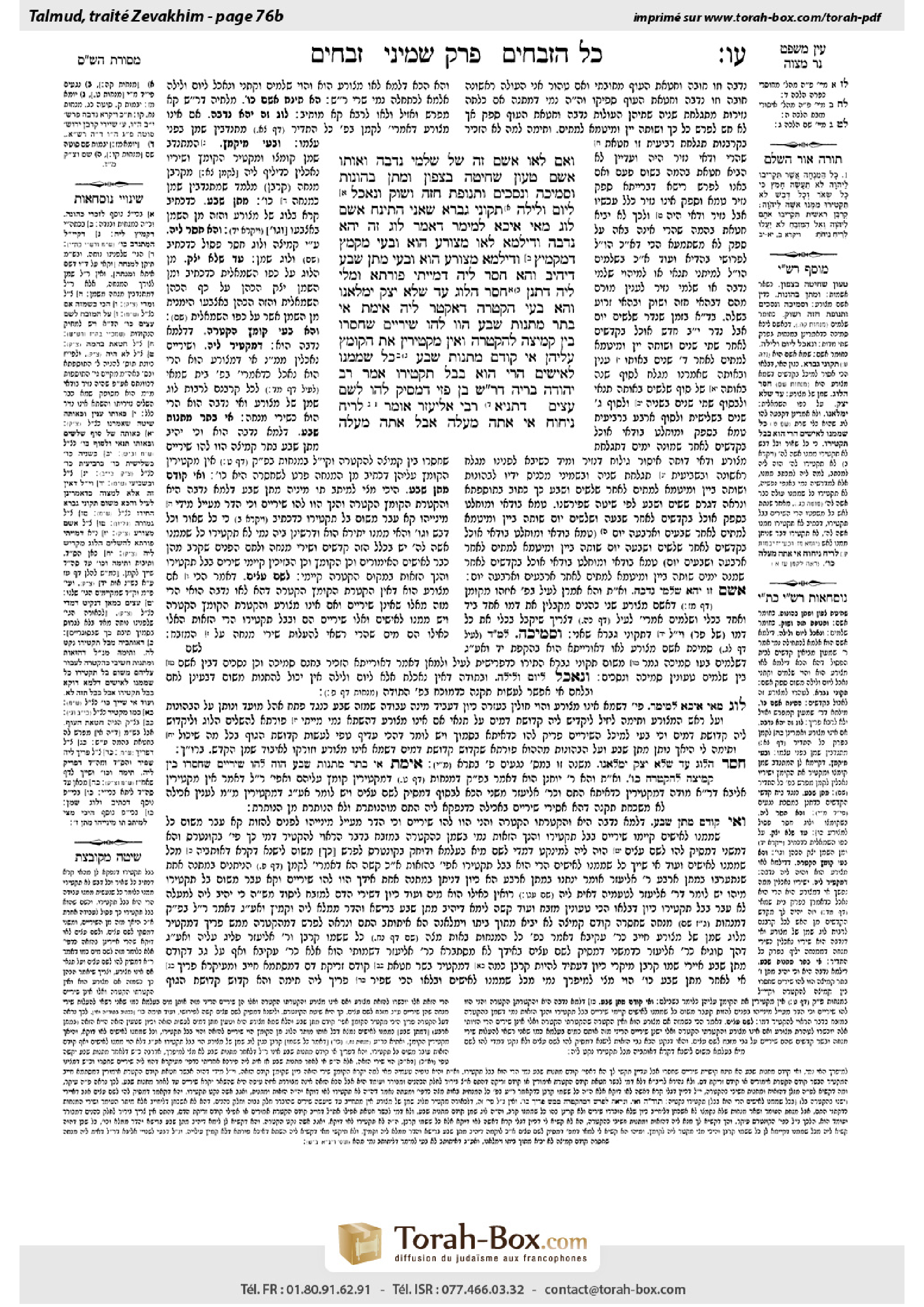
Zevachim 76b: Talmud study for Daf Yomi
Daf Yomi is the daily study of one Talmud folio. Explore 37 tractates with scans, Hebrew text, Sefaria English and AI-generated French translations where annotated.
Passage selection and English or AI-generated French translation are available where the scan has annotations. Daf Study is independent of Torah-Box and Sefaria.
Browse Zevachim · זבחים · All tractatesZevachim 76b text and translations
This page of Zevachim includes the Aramaic text, an English translation and an AI-generated French translation, alongside the scan above.
זבחים ע״ו ב · Aramaic and Hebrew text
וְאִם לָאו – אָשָׁם זֶה שֶׁל שַׁלְמֵי נְדָבָה. וְאוֹתוֹ אָשָׁם טָעוּן שְׁחִיטָה בַּצָּפוֹן, וּמַתַּן בְּהוֹנוֹת, וּסְמִיכָה, וּנְסָכִים, וּתְנוּפַת חָזֶה וָשׁוֹק,
וְנֶאֱכָל לְיוֹם וְלַיְלָה! תַּקּוֹנֵי גַּבְרָא שָׁאנֵי.
הָתִינַח אָשָׁם, לוֹג מַאי אִיכָּא לְמֵימַר? דְּאָמַר: לוֹג זֶה יְהֵא נְדָבָה. וְדִילְמָא לָאו מְצוֹרָע הוּא, וּבָעֵי מִקְמָץ? דְּמִקְּמִיץ.
וְדִילְמָא מְצוֹרָע הוּא, וּבָעֵי מַתַּן שֶׁבַע? דְּיָהֵיב.
וְהָא חָסַר לֵיהּ! דְּמַיְיתֵי פּוּרְתָּא וּמְמַלֵּי לֵיהּ; דִּתְנַן: חָסַר הַלּוֹג עַד שֶׁלֹּא יָצַק – יְמַלְּאֶנּוּ.
וְהָא בָּעֵי הַקְטָרָה! (דְּאַקְטַר) [דְּמַקְטַר] לֵיהּ.
אֵימַת? אִי בָּתַר מַתְּנוֹת שֶׁבַע – הָווּ לְהוּ שִׁירַיִים שֶׁחָסְרוּ בֵּין קְמִיצָה לְהַקְטָרָה, וְאֵין מַקְטִירִין אֶת הַקּוֹמֶץ עֲלֵיהֶן!
אִי קוֹדֶם מַתְּנוֹת שֶׁבַע – כֹּל שֶׁמִּמֶּנּוּ לָאִישִּׁים, הֲרֵי הוּא בְּבַל תַּקְטִירוּ!
אָמַר רַב יְהוּדָה בְּרֵיהּ דְּרַבִּי שִׁמְעוֹן בֶּן פַּזִּי: דְּמַסֵּיק לְהוּ לְשֵׁם עֵצִים. דְּתַנְיָא, רַבִּי אֱלִיעֶזֶר אוֹמֵר: ״לְרֵיחַ נִיחוֹחַ״ אִי אַתָּה מַעֲלֶה, אֲבָל אַתָּה מַעֲלֶה
Zevachim 76b · English translation
And if he is not a leper, this animal that is brought for a guilt offering shall be a voluntary peace offering, because their sacrificial rites are equivalent. And that uncertain guilt offering requires slaughter in the north of the Temple courtyard as a guilt offering, and placement of the blood on the right thumb and big toe and right ear of the leper, as described in Leviticus 14:14, and it requires placing hands on the head of the animal, and the accompanying wine libations and waving of the breast and thigh like a peace offering.
And lastly, it is eaten by males of the priesthood on the day it is sacrificed and the following night, in the Temple courtyard, like a guilt offering, not for two days and one night in the manner of a peace offering. This indicates that Rabbi Shimon permits one to bring sacrificial animals to the status of unfitness even ab initio, not only when the animals became intermingled. The Gemara answers that the remedy of a man is different from the case discussed by Rabba. Since this person has no way of purifying himself from his leprosy other than by bringing the offering, the concern of reducing the time available for its consumption is disregarded.
The Gemara asks a question with regard to the resolution suggested by Rabbi Shimon of bringing the offerings and stating a stipulation. This works out well with regard to the guilt offering, but with regard to the log of oil what can be said? A log of oil does not accompany a peace offering. The Gemara explains that the individual bringing the offering says: If I am not a leper, then this log shall be a gift to the Temple, as one can dedicate oil to the Temple. The Gemara questions this resolution: But perhaps he is not in fact a leper, and if so, it is required that a priest remove a handful of the donated oil and sacrifice a handful of it on the altar before the rest of the oil may be consumed by the priests, as is the halakha with regard to oil brought as an offering. The Gemara explains that this is referring to a case where the priest already removed a handful.
The Gemara further questions: But perhaps he is in fact a leper, and he requires the placement of seven sprinklings of oil before the Lord (see Leviticus 14:15–16). The Gemara answers that the priest does place these sprinklings.
The Gemara raises a difficulty: How can the priest sprinkle the oil? But it is lacking, as a handful has been removed from the oil, and one sprinkles only from a whole log. The Gemara explains that after the handful is removed the priest brings a little more oil to the container and fills it up to a log. This is as we learned in a mishna (Nega’im 14:10): In a case where the log lacked a full measure, then if it became lacking before the priest poured from it into his palm in order to place it on the right thumb and big toe of the leper, he shall fill it.
The Gemara poses yet another question: But if he is not a leper, and that log of oil is a gift, that handful removed from the oil requires burning on the altar for the remainder of the oil to be permitted to the priests. The Gemara explains that the priest does in fact burn the handful.
The Gemara asks: When does the priest burn the handful? If he does so after the placement of seven sprinklings for the leper’s purification, in such a case the log will be lacking due to the sprinklings. That which remains is akin to the remainder of a meal offering that was lacking between the removal of the handful and the burning, and one may not burn the handful for that remainder. Similar to a gift of oil, in a meal offering a handful is removed from the offering and then sacrificed on the altar. If after the handful is removed but before it is sacrificed some of the remainder of the meal offering is separated, the handful may not be sacrificed. The same should apply if some of the oil was sprinkled after the handful was removed.
If, alternatively, the priest burns the handful before the placement of seven sprinklings, once he has burned the handful he may no longer perform the sprinklings, in accordance with the principle: Whatever is partly burned in the fire on the altar is subject to the prohibition of: You may not make as an offering (see Leviticus 2:11). This principle states that if part of an item, such as the blood of an animal offering or the handful of a meal offering, has been sacrificed, one who sacrifices any other part of it that is not designated for sacrifice has violated a prohibition. The sprinkling of the oil is equivalent to sacrifice in this regard.
Rav Yehuda, son of Rabbi Shimon ben Pazi, says that the priest does not sprinkle the oil as a definite rite but stipulates that if the man is not a leper he is sprinkling it in a manner analogous to other items that one burns for the sake of wood, i.e., as fuel for the altar and not as a sacrificial rite. As it is taught in a baraita that Rabbi Eliezer says: The verse states: “No meal offering that you shall bring to the Lord shall be made with leaven; for you shall make no leaven, nor any honey, smoke from it as an offering made by fire to the Lord. As an offering of first fruits you may bring them to the Lord; but they shall not come up for a pleasing aroma on the altar” (Leviticus 2:11–12). This verse indicates that you may not offer up leaven and honey as a pleasing aroma, an offering. But you may offer up leaven and honey and other substances
Zevachim 76b · Traduction française (IA)
Et s’il n’est pas lépreux, cet animal apporté comme sacrifice de culpabilité sera un sacrifice volontaire de paix, car les rites sacrificiels de ces deux sacrifices sont équivalents. Ce sacrifice de culpabilité douteux doit être égorgé au nord de la cour du Temple, comme un sacrifice de culpabilité ; son sang doit être appliqué sur le pouce droit, le gros orteil droit et l’oreille droite du lépreux, comme le décrit Lévitique 14:14. Il faut aussi poser les mains sur la tête de l’animal, apporter les libations de vin qui l’accompagnent et balancer la poitrine et la cuisse, comme pour un sacrifice de paix.
Enfin, il est consommé par les hommes de la prêtrise, dans la cour du Temple, le jour où il est offert et la nuit suivante, comme un sacrifice de culpabilité, et non pendant deux jours et une nuit, comme un sacrifice de paix. Cela indique que Rabbi Shimon permet de rendre des animaux sacrificiels impropres même a priori, et pas seulement lorsque les animaux se sont retrouvés mêlés. La Guemara répond que le remède applicable à un homme est différent du cas évoqué par Rabba. Puisque cet homme ne peut se purifier de sa lèpre qu’en apportant le sacrifice, on ne tient pas compte du risque de réduire le temps disponible pour sa consommation.
La Guemara soulève une question au sujet de la solution proposée par Rabbi Shimon, qui consiste à apporter les sacrifices en formulant une condition. Cela convient pour le sacrifice de culpabilité, mais que peut-on dire du log d’huile ? Un log d’huile n’accompagne pas un sacrifice de paix. La Guemara explique que celui qui apporte le sacrifice dit : « Si je ne suis pas lépreux, ce log sera un don au Temple », car il est possible de consacrer de l’huile au Temple. La Guemara met en doute cette solution : Mais peut-être n’est-il effectivement pas lépreux ; dans ce cas, un prêtre doit prélever une poignée de l’huile donnée et la brûler sur l’autel avant que le reste de l’huile puisse être consommé par les prêtres, conformément à la halakha concernant l’huile apportée comme offrande. La Guemara explique qu’il s’agit d’un cas où le prêtre a déjà prélevé une poignée.
La Guemara pose une autre question : Mais peut-être est-il effectivement lépreux et doit-il recevoir sept aspersions d’huile devant l’Éternel (voir Lévitique 14:15–16). La Guemara répond que le prêtre procède bien à ces aspersions.
La Guemara soulève une difficulté : Comment le prêtre peut-il asperger l’huile ? Il en manque, puisqu’une poignée a été prélevée, et on n’asperge qu’à partir d’un log entier. La Guemara explique qu’après avoir prélevé la poignée, le prêtre ajoute un peu d’huile dans le récipient afin de le remplir jusqu’à un log. C’est ce que nous avons appris dans une Michna (Nega’im 14:10) : Si le log ne contenait pas la mesure complète et qu’il en est venu à manquer avant que le prêtre n’en verse dans sa paume pour appliquer l’huile sur le pouce droit et le gros orteil droit du lépreux, il le complétera.
La Guemara pose encore une question : Mais s’il n’est pas lépreux et que ce log d’huile est un don, la poignée prélevée sur l’huile doit être brûlée sur l’autel pour que le reste de l’huile soit permis aux prêtres. La Guemara explique que le prêtre brûle effectivement la poignée.
La Guemara demande : Quand le prêtre brûle-t-il la poignée ? S’il le fait après les sept aspersions destinées à purifier le lépreux, le log aura diminué à cause des aspersions. Le reste équivaut alors au reste d’une offrande végétale qui a diminué entre le prélèvement de la poignée et sa combustion ; on ne peut pas brûler la poignée pour ce reste. Comme dans le cas d’un don d’huile, une poignée est prélevée de l’offrande végétale, puis sacrifiée sur l’autel. Si, après le prélèvement de la poignée mais avant son sacrifice, une partie du reste de l’offrande végétale est séparée, la poignée ne peut pas être sacrifiée. Il devrait en être de même si une partie de l’huile est aspergée après le prélèvement de la poignée.
Si, en revanche, le prêtre brûle la poignée avant les sept aspersions, il ne peut plus procéder aux aspersions une fois la poignée brûlée, conformément au principe suivant : Tout ce qui est partiellement consumé par le feu sur l’autel est soumis à l’interdiction : « Tu ne présenteras pas comme offrande » (voir Lévitique 2:11). Ce principe signifie que si une partie d’un élément, comme le sang d’un sacrifice animal ou la poignée d’une offrande végétale, a été sacrifiée, celui qui en sacrifie une autre partie qui n’est pas destinée à l’être transgresse une interdiction. À cet égard, l’aspersion de l’huile équivaut à un sacrifice.
Rav Yehouda, fils de Rabbi Shimon ben Pazi, dit que le prêtre n’asperge pas l’huile à titre de rite définitif ; il pose plutôt la condition suivante : si l’homme n’est pas lépreux, l’huile est aspergée à la manière d’autres substances que l’on brûle comme du bois, c’est-à-dire comme combustible pour l’autel et non dans le cadre d’un rite sacrificiel. En effet, une baraïta enseigne que Rabbi Eliezer dit : Le verset déclare : « Aucune offrande végétale que vous présenterez à l’Éternel ne sera faite avec du levain ; car vous ne ferez brûler ni levain ni miel comme offrande consumée par le feu pour l’Éternel. Vous pourrez les présenter à l’Éternel comme offrande de prémices ; mais ils ne monteront pas sur l’autel comme odeur agréable » (Lévitique 2:11–12). Ce verset indique qu’on ne peut pas offrir le levain et le miel comme offrande destinée à produire une odeur agréable. Mais on peut présenter du levain, du miel et d’autres substances
Traduction française générée par IA à partir de l’édition anglaise de Sefaria. Vérifie toujours un passage avec le texte source.
Text from Sefaria: William Davidson Edition - Vocalized Aramaic (CC BY NC); William Davidson Edition - English (CC BY NC).