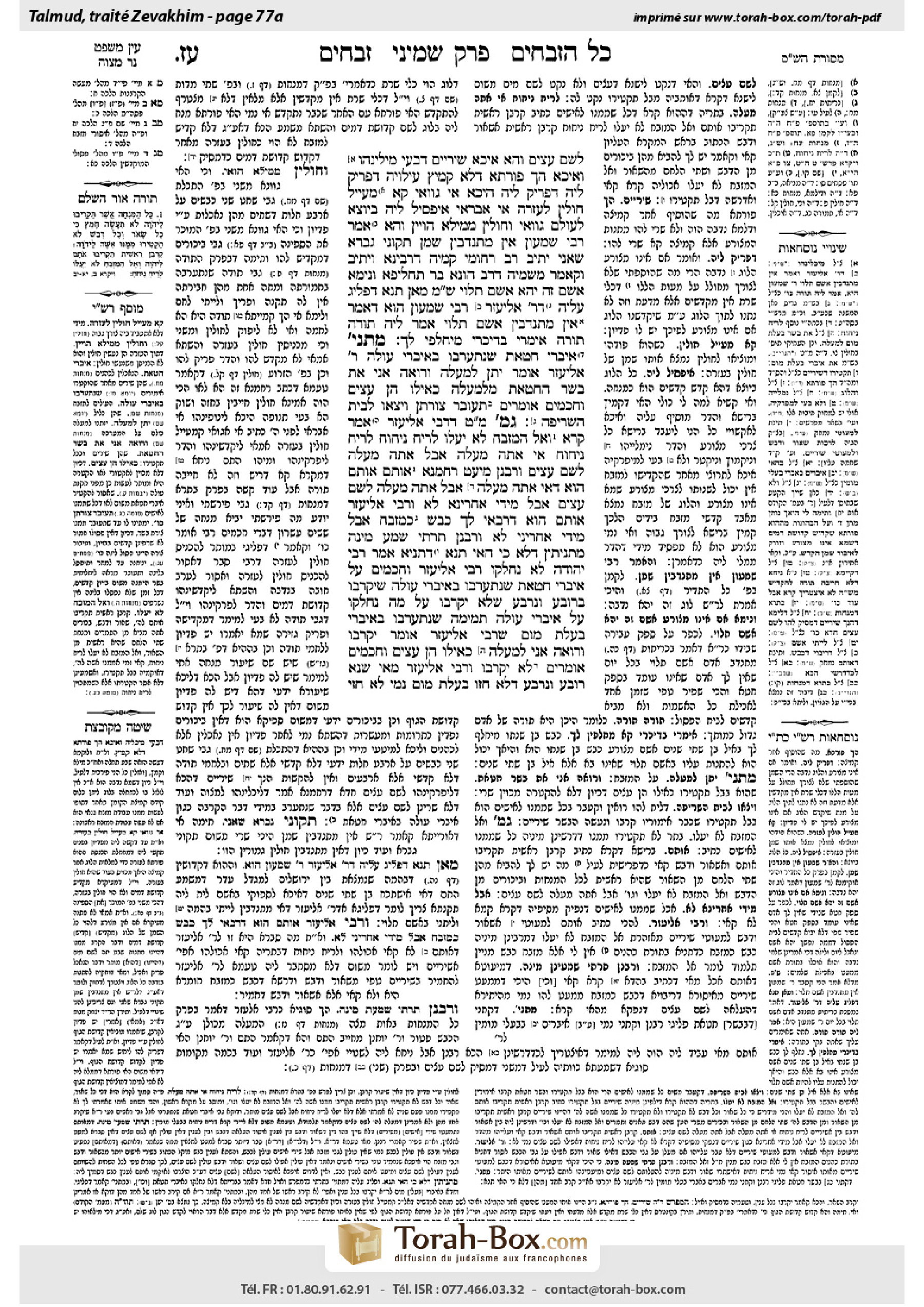
Zevachim 77a: Talmud study for Daf Yomi
Daf Yomi is the daily study of one Talmud folio. Explore 37 tractates with scans, Hebrew text, Sefaria English and AI-generated French translations where annotated.
Passage selection and English or AI-generated French translation are available where the scan has annotations. Daf Study is independent of Torah-Box and Sefaria.
Browse Zevachim · זבחים · All tractatesZevachim 77a text and translations
This page of Zevachim includes the Aramaic text, an English translation and an AI-generated French translation, alongside the scan above.
זבחים ע״ז א · Aramaic and Hebrew text
לְשֵׁם עֵצִים.
וְהָא אִיכָּא שִׁירַיִים דְּבָעֵי (מילינהו) [מֵיכְלִינְהוּ], וְאִיכָּא הָךְ פּוּרְתָּא דְּלָא קָמֵיץ עִילָּוֵיהּ! דְּפָרֵיק לֵיהּ.
דְּפָרֵיק לֵיהּ הֵיכָא? אִי גַּוַּואי – קָא מְעַיֵּיל חוּלִּין לָעֲזָרָה, אִי אַבָּרַאי – אִיפְּסִיל לֵיהּ בְּיוֹצֵא! לְעוֹלָם גַּוַּואי; חוּלִּין מִמֵּילָא הָוְיָין.
וְהָא אָמַר רַבִּי שִׁמְעוֹן: אֵין מִתְנַדְּבִין שֶׁמֶן! תַּקּוֹנֵי גַּבְרָא שָׁאנֵי.
יָתֵיב רַב רְחוּמִי קַמֵּיהּ רָבִינָא, וְיָתֵיב וְקָאָמַר מִשְּׁמֵיהּ דְּרַב הוּנָא בַּר תַּחְלִיפָא: וְנֵימָא, אָשָׁם זֶה יְהֵא אָשָׁם תָּלוּי!
שְׁמַע מִינַּהּ: מַאן תַּנָּא דִּפְלִיג עֲלֵיהּ דְּרַבִּי אֱלִיעֶזֶר – רַבִּי שִׁמְעוֹן הוּא, דְּאָמַר: אֵין מִתְנַדְּבִין אָשָׁם תָּלוּי? אֲמַר לֵיהּ: תּוֹרָה תּוֹרָה! אִימְּרֵי בְּדִיכְרֵי מִיחַלְּפִי לָךְ!
מַתְנִי׳ אֵיבְרֵי חַטָּאת שֶׁנִּתְעָרְבוּ בְּאֵיבְרֵי עוֹלָה – רַבִּי אֱלִיעֶזֶר אוֹמֵר: יִתֵּן לְמַעְלָה, וְרוֹאֶה אֲנִי אֶת בְּשַׂר הַחַטָּאת מִלְּמַעְלָה כְּאִילּוּ הֵן עֵצִים. וַחֲכָמִים אוֹמְרִים: תְּעוּבַּר צוּרָתָן וְיֵצְאוּ לְבֵית הַשְּׂרֵיפָה.
גְּמָ׳ מַאי טַעְמָא דְּרַבִּי אֱלִיעֶזֶר? אָמַר קְרָא: ״וְאֶל הַמִּזְבֵּחַ לֹא יַעֲלוּ לְרֵיחַ נִיחֹחַ״ – לְרֵיחַ נִיחוֹחַ אִי אַתָּה מַעֲלֶה, אֲבָל אַתָּה מַעֲלֶה לְשֵׁם עֵצִים.
וְרַבָּנַן – מִיעֵט רַחֲמָנָא ״אֹתָם״; אוֹתָם הוּא דְּאִי אַתָּה מַעֲלֶה, אֲבָל אַתָּה מַעֲלֶה לְשֵׁם עֵצִים. אֲבָל מִידֵּי אַחֲרִינָא – לָא.
וְרַבִּי אֱלִיעֶזֶר – אוֹתָם הוּא דְּרַבַּאי לָךְ כֶּבֶשׁ כְּמִזְבֵּחַ, אֲבָל מִידֵּי אַחֲרִינֵי – לָא.
וְרַבָּנַן – תַּרְתֵּי שְׁמַע מִינַּהּ.
מַתְנִיתִין דְּלָא כִּי הַאי תַּנָּא – דְּתַנְיָא, אָמַר רַבִּי יְהוּדָה: לֹא נֶחְלְקוּ רַבִּי אֱלִיעֶזֶר וַחֲכָמִים עַל אֵיבְרֵי חַטָּאת שֶׁנִּתְעָרְבוּ בְּאֵיבְרֵי עוֹלָה – שֶׁיִּקְרְבוּ; בְּרוֹבֵעַ וְנִרְבָּע – שֶׁלֹּא יִקְרְבוּ.
עַל מָה נֶחְלְקוּ? עַל אֵיבְרֵי עוֹלָה תְּמִימָה שֶׁנִּתְעָרְבוּ בְּאֵיבְרֵי בַּעֲלַת מוּם, שֶׁרַבִּי אֱלִיעֶזֶר אוֹמֵר: יִקְרְבוּ, וְרוֹאֶה אֲנִי לְמַעְלָה כְּאִילּוּ הֵן עֵצִים; וַחֲכָמִים אוֹמְרִים: לֹא יִקְרְבוּ.
וְרַבִּי אֱלִיעֶזֶר, מַאי שְׁנָא רוֹבֵעַ וְנִרְבָּע – דְּלָא חֲזוּ? בַּעֲלַת מוּם נָמֵי לָא חֲזֵי!
Zevachim 77a · English translation
for the sake of wood, not as an offering. Here as well, the priest stipulates that if the man is not a confirmed leper, the sprinkling of the oil should not be viewed as a rite.
The Gemara questions further: But even if the priest removes a handful from the oil and burns it, and also sprinkles from the oil, there is the matter of the remainder of the oil, which must be filled after the removal of the handful so that the priest can perform the sprinkling with a full log, and there is therefore that bit of oil that was added from which the priest did not remove the handful initially. If the one bringing the offering is not a leper, and the log of oil is a gift, it will turn out that there is a small portion of the oil that was not permitted by the removal of the handful. The Gemara explains that the priest redeems it, i.e., after the sprinklings of the oil have been performed, he stipulates that if the person who brought the offering is not a leper then the oil should be desacralized by his giving its value to the Temple treasury.
The Gemara asks: If you say that he redeems it, where does he redeem it? If he redeems it when the oil is within the walls of the Temple, he would thereby be bringing non-sacred oil into the courtyard. If he redeems the oil outside the courtyard, before he can redeem the oil it would become disqualified due to the prohibition of a consecrated item leaving the courtyard. The Gemara answers: Actually, he redeems the oil when it is within the walls of the Temple. This is permitted because the non-sacred oil is then found in the Temple courtyard by itself, i.e., he did not bring a non-sacred item into the Temple courtyard.
The Gemara asks a question with regard to the suggested resolution, according to the opinion of Rabbi Shimon, that one whose status as a leper is uncertain should bring a log of oil as a gift offering and state a stipulation. But doesn’t Rabbi Shimon say that one may not donate oil as a gift? The Gemara answers, as on 76b: The remedy of a person is different, i.e., Rabbi Shimon concedes that one may donate oil in this instance, as this is the only manner by which this person can undergo ritual purification.
The Gemara continues to discuss the opinion of Rabbi Shimon. It was stated above that according to Rabbi Shimon, one whose status as a leper is uncertain may bring a lamb as a gift for a peace offering and state a stipulation with regard to it. The Gemara relates that Rav Reḥumi was sitting before Ravina, and he was sitting and saying the following in the name of Rav Huna bar Taḥlifa: But why can’t he bring a lamb for a guilt offering and say that if he is not a leper then this guilt offering shall be a provisional guilt offering, brought by one who is uncertain whether he committed a sin that requires a sin offering? This guilt offering is eaten for one day and night, like the guilt offering of a leper, and therefore he would not be reducing the time for its consumption, unlike when he stipulates that it should be a peace offering.
Rav Reḥumi continued: Since this option was not suggested, one can learn from here that who is the tanna who disagrees with the opinion of Rabbi Eliezer, who holds that one may donate a provisional guilt offering (Keritut 25a)? It is Rabbi Shimon, who says, by inference from his suggestion here, that one may not donate a provisional guilt offering. Ravina said to Rav Reḥumi: Torah, Torah! That is, where is the Torah of such a great man as yourself? You are confusing lambs with rams. The guilt offering of a leper is a lamb in its first year (see Leviticus 14:10), which cannot be brought as a provisional guilt offering because these must be rams (see Leviticus 5:15), i.e., they must be in their second year.
MISHNA: In the case of the limbs of a sin offering, which are eaten by priests and may not be burned on the altar, that were intermingled with the limbs of a burnt offering, which are burned on the altar, Rabbi Eliezer says: The priest shall place all the limbs above, on the altar, and I view the flesh of the limbs of the sin offering above on the altar as though they are pieces of wood burned on the altar, and not as though they are an offering. And the Rabbis say: One should wait until the form of all the intermingled limbs decays and they will all go out to the place of burning in the Temple courtyard, where all disqualified offerings of the most sacred order are burned.
GEMARA: What is the reason of Rabbi Eliezer for deeming it permitted to burn the limbs of the sin offering on the altar as wood? The Gemara explains: The verse states: “No meal offering that you shall bring to the Lord shall be made with leaven; for you shall make no leaven, nor any honey, smoke as an offering made by fire to the Lord. As an offering of first fruits you may bring them to the Lord; but they shall not come up for a pleasing aroma on the altar” (Leviticus 2:11–12). This indicates that you may not offer up leaven and honey as a pleasing aroma, i.e., as an offering. But you may offer up leaven and honey and other substances that are prohibited to be sacrificed upon the altar, such as the limbs of a sin offering, for the sake of wood.
The Gemara asks: And the Rabbis, who disagree with Rabbi Eliezer, how do they respond to this reasoning? They claim that the Merciful One excludes other cases at the beginning of the verse: “As an offering of first fruits you may bring them.” This indicates that it is with regard to them, i.e., leaven and honey alone, that it is stated: You may not offer up as an offering, but you may offer up leaven and honey for the sake of wood. But with regard to any other substances that are prohibited to be brought on the altar, one may not offer them up to the altar at all.
The Gemara asks: And Rabbi Eliezer, what does he derive from this term of exclusion “them”? The Gemara explains: Rabbi Eliezer expounds this word as follows: It is only with regard to them, leaven and honey, that the verse includes a prohibition against bringing them up to the ramp of the altar like offering them up on the altar itself. But with regard to any other substances that are prohibited to be sacrificed upon the altar, bringing them up to the ramp is not considered like offering them up on the altar itself.
The Gemara further asks: And the Rabbis, from where do they derive this halakha? The Gemara answers that the Rabbis learn two halakhot from the word “them.” This term of emphasis teaches that all that is stated in this verse is referring only to leaven and honey, both the halakha that it is permitted to offer them up on the altar as wood, and the ruling that the ramp is considered like the altar with regard to this halakha.
§ The Gemara comments: The mishna is not in accordance with the opinion of this following tanna, as it is taught in a baraita (Tosefta 8:15) that Rabbi Yehuda said: Rabbi Eliezer and the Rabbis did not disagree with regard to the limbs of a sin offering that were intermingled with the limbs of a burnt offering, as all agree that they shall be sacrificed. Likewise, they agree that if limbs that are fit to be burned on the altar became intermingled with the limbs of an animal that actively copulated with a person, or with the limbs of an animal that was the object of bestiality, which are prohibited to be sacrificed upon the altar, that they shall not be sacrificed, even according to the opinion of Rabbi Eliezer.
Rabbi Yehuda continues: With regard to which case did Rabbi Eliezer and the Rabbis disagree? They disagreed with regard to the limbs of an unblemished burnt offering that were intermingled with the limbs of a blemished animal, which is disqualified from the altar. As in this case Rabbi Eliezer says: All the limbs shall be sacrificed, and I consider the flesh of the limbs of the sin offering above, on the altar, as though they are pieces of wood burned on the altar. And the Rabbis say: They shall not be sacrificed.
The Gemara asks: And concerning the opinion of Rabbi Eliezer, what is different about the limbs of an animal that actively copulated with a person, or the limbs of an animal that was the object of bestiality, that they may not be sacrificed? If one says that the reason is that they are not fit for the altar, that cannot be the reason, as a blemished animal is not fit for the altar as well, and there he holds that the limbs are burned.
Zevachim 77a · Traduction française (IA)
à titre de bois, et non comme offrande. Ici aussi, le prêtre pose comme condition que, si l’homme n’est pas un lépreux confirmé, l’aspersion de l’huile ne soit pas considérée comme un rite.
La Guemara objecte encore : même si le prêtre prélève une poignée d’huile et la brûle, puis en fait aussi l’aspersion, il reste à régler la question du complément d’huile, qu’il faut ajouter après le prélèvement de la poignée afin que le prêtre puisse procéder à l’aspersion avec un log entier. Il y a donc cette petite quantité d’huile ajoutée dont le prêtre n’avait pas prélevé de poignée au départ. Si celui qui apporte l’offrande n’est pas lépreux et que le log d’huile est un don, il s’avère qu’une petite quantité d’huile n’a pas été autorisée par le prélèvement de la poignée. La Guemara explique que le prêtre la rachète : c’est-à-dire qu’après avoir effectué les aspersions d’huile, il pose comme condition que, si celui qui a apporté l’offrande n’est pas lépreux, l’huile soit désacralisée en versant sa valeur au trésor du Temple.
La Guemara demande : si tu dis qu’il la rachète, où le fait-il ? S’il la rachète alors que l’huile se trouve dans l’enceinte du Temple, il ferait ainsi entrer de l’huile profane dans le parvis. S’il rachète l’huile à l’extérieur du parvis, avant qu’il puisse la racheter, elle serait disqualifiée en raison de l’interdiction de faire sortir un objet consacré du parvis. La Guemara répond : en réalité, il rachète l’huile alors qu’elle se trouve dans l’enceinte du Temple. Cela est permis, car l’huile profane se trouve alors d’elle-même dans le parvis du Temple, c’est-à-dire qu’il n’a pas fait entrer d’objet profane dans le parvis du Temple.
La Guemara pose une question au sujet de la solution proposée selon l’opinion de Rabbi Shimon, selon laquelle celui dont le statut de lépreux est incertain doit apporter un log d’huile comme offrande volontaire et énoncer une condition. Mais Rabbi Shimon ne dit-il pas qu’on ne peut pas offrir de l’huile en don volontaire ? La Guemara répond, comme en 76b : le remède d’une personne constitue un cas particulier ; Rabbi Shimon admet qu’on peut offrir de l’huile en don volontaire dans ce cas, car c’est le seul moyen pour cette personne d’accomplir la purification rituelle.
La Guemara poursuit l’examen de l’opinion de Rabbi Shimon. Il a été dit précédemment que, selon Rabbi Shimon, celui dont le statut de lépreux est incertain peut apporter un agneau comme offrande volontaire de paix et énoncer une condition à son sujet. La Guemara rapporte que Rav Reḥumi était assis devant Ravina et disait au nom de Rav Huna bar Taḥlifa : Mais pourquoi ne peut-il pas apporter un agneau comme sacrifice de culpabilité et déclarer que, s’il n’est pas lépreux, ce sacrifice de culpabilité sera un sacrifice de culpabilité provisoire, apporté par quelqu’un qui ne sait pas avec certitude s’il a commis une faute exigeant un sacrifice expiatoire ? Ce sacrifice de culpabilité est consommé pendant un jour et une nuit, comme le sacrifice de culpabilité d’un lépreux ; ainsi, la durée de consommation ne serait pas réduite, contrairement au cas où il pose comme condition qu’il s’agisse d’une offrande de paix.
Rav Reḥumi poursuivit : Puisque cette possibilité n’a pas été proposée, on peut en déduire qui est le tanna en désaccord avec l’opinion de Rabbi Eliezer, qui soutient qu’on peut apporter un sacrifice de culpabilité provisoire en don volontaire (Keritot 25a) : c’est Rabbi Shimon, qui affirme, par déduction de sa proposition ici, qu’on ne peut pas apporter un sacrifice de culpabilité provisoire en don volontaire. Ravina dit à Rav Reḥumi : « Torah, Torah ! » Autrement dit : où est passée la Torah d’un grand homme comme toi ? Tu confonds les agneaux et les béliers. Le sacrifice de culpabilité d’un lépreux est un agneau dans sa première année (voir Lévitique 14:10), qui ne peut pas être apporté comme sacrifice de culpabilité provisoire, car ceux-ci doivent être des béliers (voir Lévitique 5:15), c’est-à-dire des animaux dans leur deuxième année.
MICHNA : Dans le cas où les membres d’un sacrifice expiatoire, qui sont mangés par les prêtres et ne peuvent pas être brûlés sur l’autel, ont été mêlés aux membres d’un holocauste, qui sont brûlés sur l’autel, Rabbi Eliezer dit : « Le prêtre placera tous les membres sur l’autel. Je considère la chair des membres du sacrifice expiatoire placés sur l’autel comme des morceaux de bois brûlés sur l’autel, et non comme une offrande. » Les Sages disent : « On attendra que l’aspect de tous les membres mêlés se décompose ; ils seront alors tous conduits au lieu de combustion, dans le parvis du Temple, où sont brûlées toutes les offrandes de sainteté suprême disqualifiées. »
GUEMARA : Pourquoi Rabbi Eliezer estime-t-il permis de brûler les membres du sacrifice expiatoire sur l’autel à titre de bois ? La Guemara explique : le verset dit : « Aucune offrande de céréales que vous apporterez à l’Éternel ne sera faite avec du levain ; car vous ne ferez fumer ni levain ni miel comme offrande consumée par le feu pour l’Éternel. Vous pourrez les apporter à l’Éternel comme offrande de prémices, mais ils ne monteront pas sur l’autel pour une odeur agréable » (Lévitique 2:11–12). Cela indique qu’on ne peut pas offrir le levain et le miel pour en faire une odeur agréable, c’est-à-dire comme offrande. Mais on peut faire monter le levain, le miel et d’autres substances dont le sacrifice sur l’autel est interdit, telles que les membres d’un sacrifice expiatoire, à titre de bois.
La Guemara demande : et les Sages, qui sont en désaccord avec Rabbi Eliezer, comment répondent-ils à ce raisonnement ? Ils soutiennent que le Miséricordieux exclut les autres cas au début du verset : « Vous pourrez les apporter comme offrande de prémices. » Cela indique que c’est à leur sujet, c’est-à-dire au sujet du levain et du miel seulement, qu’il est dit : on ne peut pas les offrir comme offrande, mais on peut les faire monter à titre de bois. En revanche, aucune autre substance dont l’apport sur l’autel est interdit ne peut être offerte sur l’autel, sous quelque forme que ce soit.
La Guemara demande : et que déduit Rabbi Eliezer du terme d’exclusion « eux » ? La Guemara explique que Rabbi Eliezer interprète ce mot ainsi : c’est seulement au sujet du levain et du miel que le verset inclut une interdiction de les faire monter jusqu’à la rampe de l’autel, comme si on les offrait sur l’autel lui-même. En revanche, pour toute autre substance dont le sacrifice sur l’autel est interdit, la faire monter jusqu’à la rampe n’est pas considéré comme le fait de l’offrir sur l’autel lui-même.
La Guemara demande encore : et d’où les Sages déduisent-ils cette halakha ? La Guemara répond que les Sages tirent deux halakhot du mot « eux ». Ce terme de mise en relief enseigne que tout ce qui est énoncé dans ce verset ne concerne que le levain et le miel : aussi bien la halakha selon laquelle il est permis de les faire monter sur l’autel à titre de bois que la règle selon laquelle, pour cette halakha, la rampe est considérée comme l’autel.
§ La Guemara fait remarquer : la Michna n’est pas conforme à l’opinion du tanna suivant, car il est enseigné dans une baraïta (Tosefta 8:15) que Rabbi Yehuda a dit : « Rabbi Eliezer et les Sages n’étaient pas en désaccord au sujet des membres d’un sacrifice expiatoire mêlés aux membres d’un holocauste, car tous conviennent qu’ils doivent être sacrifiés. De même, ils conviennent que si des membres pouvant être brûlés sur l’autel ont été mêlés aux membres d’un animal qui s’est accouplé avec un être humain, ou aux membres d’un animal ayant fait l’objet d’un acte de bestialité, ils ne doivent pas être sacrifiés, même selon l’opinion de Rabbi Eliezer. »
Rabbi Yehuda poursuit : « Sur quel cas Rabbi Eliezer et les Sages étaient-ils en désaccord ? Ils étaient en désaccord au sujet des membres d’un holocauste sans défaut mêlés aux membres d’un animal porteur d’un défaut, qui est disqualifié pour l’autel. Dans ce cas, Rabbi Eliezer dit : “Tous les membres doivent être sacrifiés ; je considère la chair des membres placés sur l’autel comme des morceaux de bois brûlés sur l’autel.” Les Sages disent : “Ils ne doivent pas être sacrifiés.” »
La Guemara demande : et selon l’opinion de Rabbi Eliezer, qu’est-ce qui distingue les membres d’un animal qui s’est accouplé avec un être humain, ou ceux d’un animal ayant fait l’objet d’un acte de bestialité, de sorte qu’ils ne peuvent pas être sacrifiés ? Si l’on dit que c’est parce qu’ils ne conviennent pas à l’autel, cela ne peut pas en être la raison, car un animal porteur d’un défaut ne convient pas non plus à l’autel ; pourtant, dans ce cas, il soutient que les membres sont brûlés.
Traduction française générée par IA à partir de l’édition anglaise de Sefaria. Vérifie toujours un passage avec le texte source.
Text from Sefaria: William Davidson Edition - Vocalized Aramaic (CC BY NC); William Davidson Edition - English (CC BY NC).