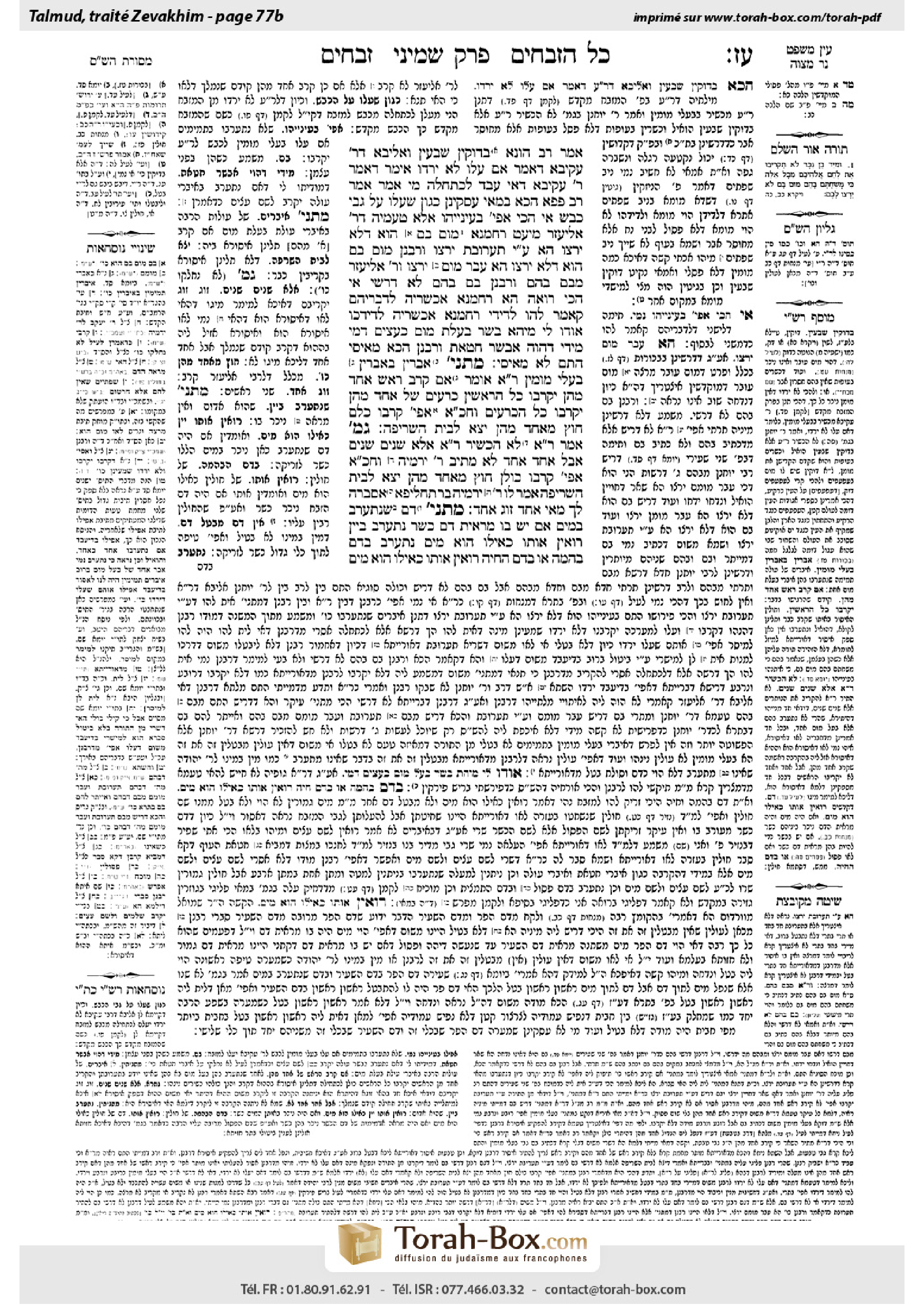
Zevachim 77b: Talmud study for Daf Yomi
Daf Yomi is the daily study of one Talmud folio. Explore 37 tractates with scans, Hebrew text, Sefaria English and AI-generated French translations where annotated.
Passage selection and English or AI-generated French translation are available where the scan has annotations. Daf Study is independent of Torah-Box and Sefaria.
Browse Zevachim · זבחים · All tractatesZevachim 77b text and translations
This page of Zevachim includes the Aramaic text, an English translation and an AI-generated French translation, alongside the scan above.
זבחים ע״ז ב · Aramaic and Hebrew text
אָמַר רַב הוּנָא: בְּדוּקִּין שֶׁבָּעַיִן, וְאַלִּיבָּא דְּרַבִּי עֲקִיבָא – דְּאָמַר: אִם עָלוּ לֹא יֵרְדוּ. אֵימַר דְּאָמַר רַבִּי עֲקִיבָא – דְּאִי עֲבַד; לְכַתְּחִלָּה מִי אָמַר?!
אָמַר רַב פָּפָּא: הָכָא בְּמַאי עָסְקִינַן – כְּגוֹן שֶׁעָלוּ עַל גַּבֵּי כֶּבֶשׁ. אִי הָכִי, אֲפִילּוּ בְּעֵינַיְיהוּ!
אֶלָּא טַעְמֵיהּ דְּרַבִּי אֱלִיעֶזֶר: מִיעֵט רַחֲמָנָא ״מוּם בָּם״ – הוּא דְּלֹא יֵרָצוּ, הָא עַל יְדֵי תַּעֲרוֹבֶת – יֵרָצוּ.
וְרַבָּנַן – ״מוּם בָּם״ הוּא דְּלֹא יֵרָצוּ, הָא עָבַר מוּם – יֵרָצוּ. וְרַבִּי אֱלִיעֶזֶר – מִ״בָּם״–״בָּהֶם״, וְרַבָּנַן – ״בָּם״–״בָּהֶם״ לָא דָּרְשִׁי.
אִי הָכִי, ״רוֹאֶה״?! הָא רַחֲמָנָא אַכְשְׁרֵיהּ! לְדִבְרֵיהֶם קָאָמַר לְהוּ: לְדִידִי – רַחֲמָנָא אַכְשְׁרֵיהּ; לְדִידְכוּ – אוֹדוֹ לִי מִיהָא, בְּשַׂר בַּעֲלַת מוּם – כְּעֵצִים דָּמֵי, מִידֵּי דְּהָוֵה אַבְּשַׂר חַטָּאת!
וְרַבָּנַן – הָכָא מְאִיסִי, הָתָם לָא מְאִיסִי.
מַתְנִי׳ אֵבָרִין בְּאֵבָרִין בַּעֲלֵי מוּמִין – רַבִּי אֱלִיעֶזֶר אוֹמֵר: אִם קָרַב רֹאשׁ אֶחָד מֵהֶן – יִקְרְבוּ כׇּל הָרָאשִׁין. כְּרָעַיִם שֶׁל אֶחָד מֵהֶן – יִקְרְבוּ כָּל הַכְּרָעַיִם, וַחֲכָמִים אוֹמְרִים: אֲפִילּוּ קָרְבוּ כֻּלָּם חוּץ מֵאֶחָד מֵהֶן – יֵצֵא לְבֵית הַשְּׂרֵיפָה.
גְּמָ׳ אָמַר רַבִּי אֶלְעָזָר: לֹא הִכְשִׁיר רַבִּי אֱלִיעֶזֶר אֶלָּא שְׁנַיִם שְׁנַיִם, אֲבָל אֶחָד אֶחָד – לֹא. מֵתִיב רַבִּי יִרְמְיָה, וַחֲכָמִים אוֹמְרִים: אֲפִילּוּ קָרְבוּ כּוּלָּן חוּץ מֵאֶחָד מֵהֶן – יֵצֵא לְבֵית הַשְּׂרֵיפָה!
אָמַר לוֹ רַבִּי יִרְמְיָה בַּר תַּחְלִיפָא, אַסְבְּרַהּ לָךְ: מַאי אֶחָד – זוּג אֶחָד.
מַתְנִי׳ דָּם שֶׁנִּתְעָרֵב בְּמַיִם, אִם יֵשׁ בּוֹ מַרְאִית דָּם – כָּשֵׁר. נִתְעָרֵב בְּיַיִן – רוֹאִין אוֹתוֹ כְּאִילּוּ הוּא מַיִם. נִתְעָרֵב בְּדַם בְּהֵמָה אוֹ בְּדַם הַחַיָּה – רוֹאִין אוֹתוֹ כְּאִילּוּ הוּא מַיִם.
Zevachim 77b · English translation
Rav Huna says: When Rabbi Eliezer makes reference to a blemished animal, he is speaking of an unobtrusive blemish, e.g., one that is on the cornea of the eye. And his ruling is in accordance with the opinion of Rabbi Akiva, who says that in the case of an offering with such a blemish, if its sacrificial parts ascended the altar, they shall not descend from it, because it is not a disgrace to the altar for the sacrificial parts of such an offering to be burned on it. The Gemara raises a difficulty: Say that Rabbi Akiva says this is the halakha after the fact, meaning that if the priest already brought up the limbs of these blemished animals, they do not descend from the altar. Does Rabbi Akiva say that one may burn a mixture of these limbs ab initio?
Rav Pappa says: What are we dealing with here? We are dealing with a case where all the limbs in the mixture were brought up upon the ramp. Since they have been brought on the ramp and sanctified as offerings, it is considered after the fact. The Gemara raises a difficulty: If so, i.e., if we are dealing with a case in which the limbs were already carried to the ramp, then even if they were as is, and not intermingled, the limbs of the blemished animal should be burned, as claimed by Rabbi Akiva.
Rather, the reason of Rabbi Eliezer is that with regard to the prohibition against sacrificing a blemished animal upon the altar, the Merciful One excludes certain cases. After listing the various disqualifying blemishes, the verse states: “Neither from the hand of a foreigner shall you offer the bread of your God of any of these, because their corruption is in them, there is a blemish in them; they shall not be accepted for you” (Leviticus 22:25). This teaches that it is only if there is a blemish clearly in them that they shall not be accepted; but if they were sacrificed by means of a mixture they shall be accepted. This exclusion is stated only with regard to blemished animals, not with regard to animals that copulated with people, and consequently the limbs of these animals are not brought up to the altar even if they became intermingled with the limbs of fit offerings.
The Gemara asks: And the Rabbis, how do they expound this verse? The Gemara explains that they expound it as follows: It is only if the blemish is still in them that they shall not be accepted; but if their blemish has passed, they shall be accepted. And Rabbi Eliezer derives this halakha from the previous clause in that same verse: “Because their corruption is in them [bahem].” Since the verse could have stated the shorter form of bam, and instead stated “bahem,” one derives from here that if the animal no longer is blemished it is accepted as an offering. And as for the Rabbis, they do not interpret anything from the variation between bam and “bahem”; they do not see this as a significant deviation from the standard language of the verse.
The Gemara asks: If that is so, and Rabbi Eliezer permits the limbs of blemished animals to be sacrificed if they are in a mixture, why is it necessary for him to say: I view the flesh of the limbs of the blemished animals as though they are pieces of wood? After all, the Merciful One permits them as an offering. The Gemara explains that Rabbi Eliezer is speaking to the Rabbis in accordance with their statement, as follows: According to my opinion, the Merciful One permits these limbs to be sacrificed upon the altar. But even according to your opinion, at least agree with me that the flesh of a blemished animal that was intermingled with the flesh of a qualified offering is considered like wood, just as is the halakha of the flesh of a sin offering that became intermingled with the flesh of a burnt offering, as according to this baraita the Rabbis concede that the flesh of these two offerings should be sacrificed together.
The Gemara asks: And the Rabbis, how do they respond to this claim of Rabbi Eliezer? The Gemara explains: According to the Rabbis there is a difference between the cases: Here, with regard to a mixture that includes limbs of blemished animals, these limbs are repulsive, and therefore they may not be brought upon the altar, even as wood. Conversely, there, in the case of a mixture of limbs of a sin offering and limbs of a burnt offering, the limbs of the sin offering are not repulsive in and of themselves, and consequently they may be sacrificed upon the altar as wood.
MISHNA: In a case where limbs of burnt offerings fit for sacrifice were intermingled with limbs of blemished burnt offerings, Rabbi Eliezer says: Although all the limbs are unfit for sacrifice, if the head of one of them was sacrificed all the heads shall be sacrificed, as the head that was sacrificed is assumed to have been that of the unfit animal in the mixture. Likewise, if one sacrificed the legs of one of them all the legs shall be sacrificed. And the Rabbis say: Even if all the limbs were sacrificed except for one of them, there is a concern that the remaining limb is the unfit limb, which may not be sacrificed. Rather, all of the limbs must go out to the place of burning in the Temple courtyard.
GEMARA: Rabbi Elazar says: Rabbi Eliezer permitted the sacrificing of all the heads only if they were sacrificed two by two, as at least one of each pair is certainly permitted; but he did not permit them to be sacrificed one by one, in case the priest may be sacrificing the prohibited head by itself. Rabbi Yirmeya raises an objection from the mishna, which states: And the Rabbis say: Even if all the limbs were sacrificed except for one of them, all the limbs must go out to the place of burning in the Temple courtyard. This indicates that even in this situation, where only one of the limbs remains, the dispute between Rabbi Eliezer and the Rabbis still applies, which means that Rabbi Eliezer permits it to be sacrificed despite the fact that it is only one limb.
Rabbi Yirmeya bar Taḥlifa said to Rabbi Yirmeya in response: I will explain the meaning of this statement to you: What does the mishna mean when it states: Except for one of them? It means except for one pair, i.e., two limbs, as even Rabbi Eliezer did not permit one to sacrifice the limbs individually.
MISHNA: In the case of blood of an offering fit for sacrifice that was mixed with water, if the mixture has the appearance of blood it is fit for sprinkling on the altar, even though the majority of the mixture is water. If the blood was mixed with red wine, one views the wine as though it is water. If that amount of water would leave the mixture with the appearance of blood it is fit for presentation. And likewise if the blood was mixed with the blood of a non-sacred domesticated animal or the blood of a non-sacred undomesticated animal, one considers the non-sacred blood as though it is water.
Zevachim 77b · Traduction française (IA)
Rav Houna dit : Lorsque Rabbi Eliezer fait référence à un animal présentant un défaut, il parle d’un défaut discret, par exemple situé sur la cornée de l’œil. Son avis suit celui de Rabbi Akiva, qui dit que, dans le cas d’une offrande présentant un tel défaut, si ses parties destinées à l’autel y sont montées, elles n’en redescendent pas, car il n’est pas déshonorant pour l’autel que les parties sacrificielles d’une telle offrande y soient brûlées. La Guemara soulève une difficulté : Peut-être Rabbi Akiva dit-il que telle est la halakha après coup, c’est-à-dire que si le prêtre a déjà fait monter les membres de ces animaux atteints d’un défaut, ils ne redescendent pas de l’autel. Mais Rabbi Akiva dit-il qu’on peut brûler d’emblée un mélange de ces membres ?
Rav Pappa dit : De quoi s’agit-il ici ? D’un cas où tous les membres du mélange ont été portés sur la rampe. Puisqu’ils y ont été amenés et sanctifiés comme offrandes, on considère qu’il s’agit d’un cas après coup. La Guemara soulève une difficulté : Si tel est le cas, c’est-à-dire si les membres ont déjà été portés jusqu’à la rampe, alors, même s’ils étaient seuls et non mélangés, les membres de l’animal atteint d’un défaut devraient être brûlés, comme l’affirme Rabbi Akiva.
Mais la raison de Rabbi Eliezer est plutôt la suivante : concernant l’interdiction de sacrifier sur l’autel un animal atteint d’un défaut, le Miséricordieux exclut certains cas. Après avoir énuméré les différents défauts qui invalident l’animal, le verset dit : « Tu ne présenteras pas non plus, de la main d’un étranger, le pain de ton Dieu, quel qu’il soit, car leur corruption est en eux, il y a un défaut en eux ; ils ne seront pas acceptés pour vous » (Lévitique 22, 25). Cela enseigne qu’ils ne seront pas acceptés uniquement si un défaut est clairement présent en eux ; mais s’ils ont été sacrifiés par le biais d’un mélange, ils seront acceptés. Cette exclusion ne concerne que les animaux atteints d’un défaut, et non ceux qui se sont accouplés avec des personnes ; par conséquent, les membres de ces animaux ne sont pas portés sur l’autel, même s’ils se sont mélangés aux membres d’offrandes aptes.
La Guemara demande : Et comment les Sages interprètent-ils ce verset ? La Guemara explique qu’ils l’interprètent ainsi : Ils ne seront pas acceptés uniquement si le défaut est encore en eux ; mais si le défaut a disparu, ils seront acceptés. Rabbi Eliezer déduit cette halakha de la proposition précédente de ce même verset : « Car leur corruption est en eux [bahem]. » Le verset aurait pu employer la forme plus courte bam, mais il a plutôt dit « bahem » ; on en déduit donc que si l’animal n’est plus atteint d’un défaut, il est accepté comme offrande. Quant aux Sages, ils ne tirent aucun enseignement de la différence entre bam et « bahem » ; à leurs yeux, il ne s’agit pas d’un écart significatif par rapport à la formulation habituelle du verset.
La Guemara demande : Si c’est ainsi, et que Rabbi Eliezer permet que les membres d’animaux atteints d’un défaut soient sacrifiés lorsqu’ils se trouvent dans un mélange, pourquoi doit-il dire : « Je considère la chair des membres des animaux atteints d’un défaut comme des morceaux de bois » ? Après tout, le Miséricordieux permet qu’ils soient offerts. La Guemara explique que Rabbi Eliezer s’adresse aux Sages en reprenant leur position, comme suit : Selon mon opinion, le Miséricordieux permet que ces membres soient sacrifiés sur l’autel. Mais, même selon votre opinion, reconnaissez au moins avec moi que la chair d’un animal atteint d’un défaut, mélangée à la chair d’une offrande apte, est considérée comme du bois, tout comme la halakha concernant la chair d’un sacrifice expiatoire mélangée à celle d’un holocauste ; car, selon cette baraïta, les Sages admettent que la chair de ces deux offrandes doit être sacrifiée ensemble.
La Guemara demande : Et comment les Sages répondent-ils à cette affirmation de Rabbi Eliezer ? La Guemara explique : Selon les Sages, les cas sont différents. Ici, dans le cas d’un mélange qui contient des membres d’animaux atteints d’un défaut, ces membres sont répugnants ; ils ne peuvent donc pas être portés sur l’autel, même comme du bois. En revanche, là, dans le cas d’un mélange de membres d’un sacrifice expiatoire et de membres d’un holocauste, les membres du sacrifice expiatoire ne sont pas répugnants en eux-mêmes ; ils peuvent donc être sacrifiés sur l’autel comme du bois.
Michna : Dans le cas où des membres d’holocaustes aptes au sacrifice se sont mélangés à des membres d’holocaustes atteints d’un défaut, Rabbi Eliezer dit : Bien que tous les membres soient inaptes au sacrifice, si la tête de l’un d’eux a été sacrifiée, toutes les têtes seront sacrifiées, car on suppose que la tête sacrifiée était celle de l’animal inapte du mélange. De même, si l’on a sacrifié les pattes de l’un d’eux, toutes les pattes seront sacrifiées. Mais les Sages disent : Même si tous les membres ont été sacrifiés à l’exception d’un seul, on peut craindre que le membre restant soit celui qui est inapte et ne peut être sacrifié. Tous les membres doivent plutôt être emportés vers le lieu de combustion dans la cour du Temple.
Guemara : Rabbi Elazar dit : Rabbi Eliezer n’a autorisé le sacrifice de toutes les têtes que si elles étaient sacrifiées deux par deux, car au moins une tête de chaque paire est nécessairement permise ; mais il n’a pas autorisé leur sacrifice une par une, de peur que le prêtre ne sacrifie la tête interdite à elle seule. Rabbi Yirmeya soulève une objection tirée de la Michna, qui dit : « Et les Sages disent : Même si tous les membres ont été sacrifiés à l’exception d’un seul, tous les membres doivent être emportés vers le lieu de combustion dans la cour du Temple. » Cela indique que, même dans cette situation où il ne reste qu’un seul membre, le désaccord entre Rabbi Eliezer et les Sages s’applique toujours, ce qui signifie que Rabbi Eliezer permet de le sacrifier, bien qu’il ne s’agisse que d’un seul membre.
Rabbi Yirmeya bar Taḥlifa dit à Rabbi Yirmeya en réponse : Je vais t’expliquer le sens de cette déclaration. Que signifie la formule de la Michna : « À l’exception d’un seul » ? Elle signifie : à l’exception d’une seule paire, c’est-à-dire de deux membres ; car même Rabbi Eliezer n’a pas autorisé à sacrifier les membres un par un.
Michna : Dans le cas où le sang d’une offrande apte au sacrifice s’est mélangé à de l’eau, si le mélange a l’apparence du sang, il convient à l’aspersion sur l’autel, même si la majorité du mélange est constituée d’eau. Si le sang s’est mélangé à du vin rouge, on considère le vin comme de l’eau. Si cette quantité d’eau donnait au mélange l’apparence du sang, le mélange convient à la présentation sur l’autel. De même, si le sang s’est mélangé au sang d’un animal domestique non consacré ou au sang d’un animal sauvage non consacré, on considère le sang non consacré comme de l’eau.
Traduction française générée par IA à partir de l’édition anglaise de Sefaria. Vérifie toujours un passage avec le texte source.
Text from Sefaria: William Davidson Edition - Vocalized Aramaic (CC BY NC); William Davidson Edition - English (CC BY NC).