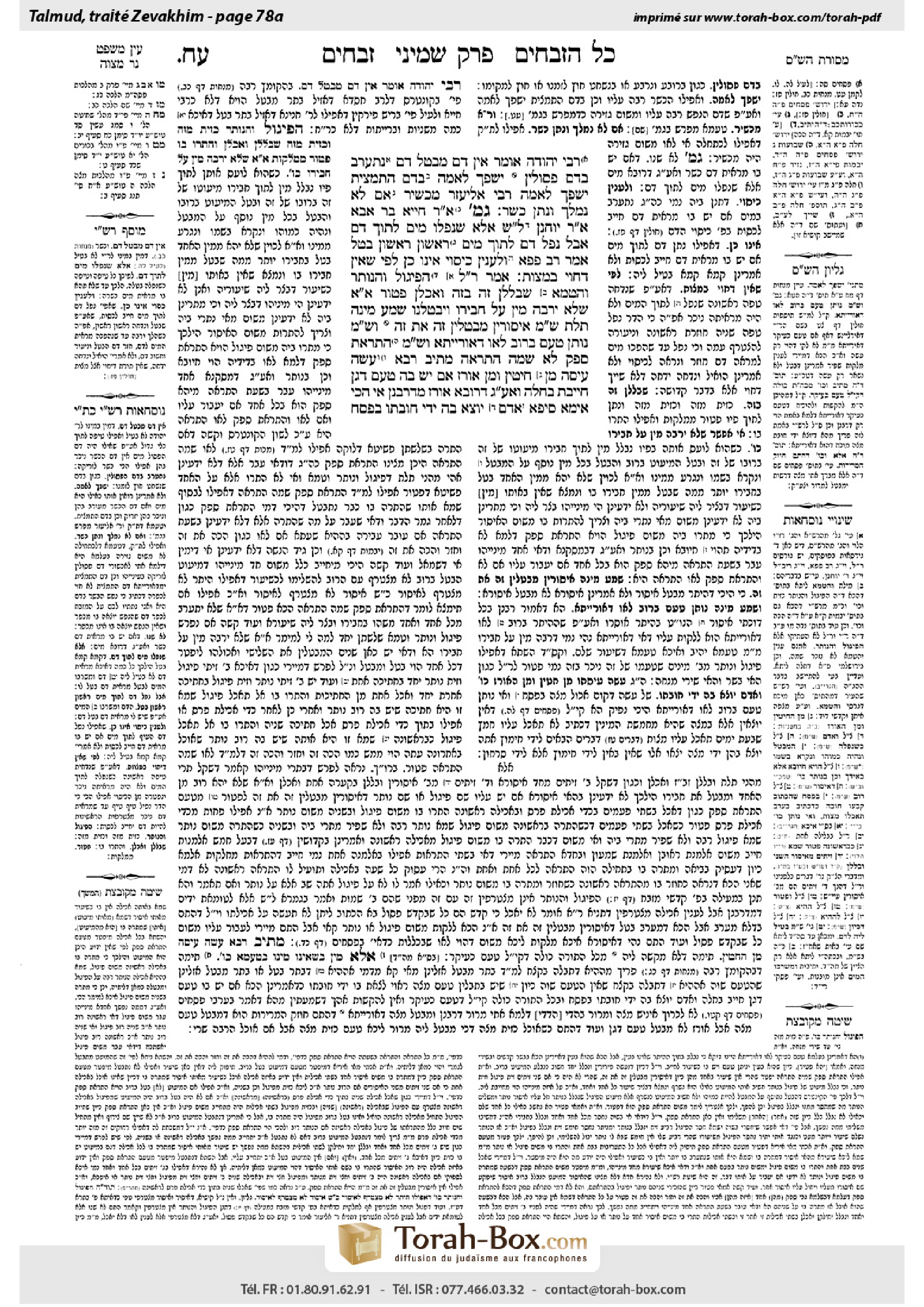
Zevachim 78a: Talmud study for Daf Yomi
Daf Yomi is the daily study of one Talmud folio. Explore 37 tractates with scans, Hebrew text, Sefaria English and AI-generated French translations where annotated.
Passage selection and English or AI-generated French translation are available where the scan has annotations. Daf Study is independent of Torah-Box and Sefaria.
Browse Zevachim · זבחים · All tractatesZevachim 78a text and translations
This page of Zevachim includes the Aramaic text, an English translation and an AI-generated French translation, alongside the scan above.
זבחים ע״ח א · Aramaic and Hebrew text
רַבִּי יְהוּדָה אוֹמֵר: אֵין דָּם מְבַטֵּל דָּם.
נִתְעָרֵב בְּדַם פְּסוּלִין – יִשָּׁפֵךְ לָאַמָּה. בְּדַם הַתַּמְצִית – יִשָּׁפֵךְ לָאַמָּה; רַבִּי אֱלִיעֶזֶר מַכְשִׁיר. אִם לֹא נִמְלַךְ וְנָתַן – כָּשֵׁר.
גְּמָ׳ אָמַר רַבִּי חִיָּיא בַּר אַבָּא אָמַר רַבִּי יוֹחָנָן: לֹא שָׁנוּ אֶלָּא שֶׁנָּפְלוּ מַיִם לְתוֹךְ דָּם, אֲבָל נָפַל דָּם לְתוֹךְ מַיִם – רִאשׁוֹן רִאשׁוֹן בָּטֵל.
אָמַר רַב פָּפָּא: וּלְעִנְיַן כִּיסּוּי אֵינוֹ כֵּן, לְפִי שֶׁאֵין דִּחוּי בְּמִצְוֹת.
אָמַר רֵישׁ לָקִישׁ: הַפִּיגּוּל וְהַנּוֹתָר וְהַטָּמֵא שֶׁבְּלָלָן זֶה בָּזֶה וַאֲכָלָן – פָּטוּר; אִי אֶפְשָׁר שֶׁלֹּא יַרְבֶּה מִין עַל חֲבֵירוֹ וִיבַטְּלֶנּוּ.
שְׁמַע מִינַּהּ תְּלָת: שְׁמַע מִינַּהּ אִיסּוּרִין מְבַטְּלִין זֶה אֶת זֶה, וּשְׁמַע מִינַּהּ נוֹתֵן טַעַם בְּרוֹב לָאו דְּאוֹרָיְיתָא, וּשְׁמַע מִינַּהּ הַתְרָאַת סָפֵק לֹא שְׁמָהּ הַתְרָאָה.
מֵתִיב רָבָא: עָשָׂה עִיסָּה מִן חִיטִּין וּמִן אוֹרֶז – אִם יֵשׁ בָּהּ טַעַם דָּגָן, חַיֶּיבֶת בְּחַלָּה. וְאַף עַל גַּב דְּרוּבָּא אוֹרֶז!
מִדְּרַבָּנַן. אִי הָכִי, אֵימָא סֵיפָא: אָדָם יוֹצֵא בָּהּ יְדֵי חוֹבָתוֹ בַּפֶּסַח!
Zevachim 78a · English translation
Rabbi Yehuda says: Blood does not nullify blood. Therefore, the priest presents the blood of the mixture on the altar.
If blood fit for presentation was mixed with the blood of unfit offerings, there is no remedy. Therefore, the entire mixture shall be poured into the drain running through the Temple courtyard. Likewise, if blood fit for presentation was mixed with blood of exudate, i.e., that exudes from the neck after the initial spurt following its slaughter concludes, which is unfit for presentation, the entire mixture shall be poured into the Temple courtyard drain. Rabbi Eliezer deems this mixture fit for presentation. Even according to the first tanna, if the priest did not consult the authorities and placed the blood on the altar, the offering is fit.
GEMARA: The mishna teaches that in a case where water became mixed with the blood of an offering, if the mixture has the appearance of blood it is fit, despite the fact that there is more water than blood. Concerning this Rabbi Ḥiyya bar Abba says that Rabbi Yoḥanan says: They taught this halakha only in a case where the water fell into the blood. But in a case where the blood fell into the water, the first drop of blood, and then the next first drop of blood, is nullified in the water, i.e., each drop is nullified in turn. Consequently, the mixture is unfit for presentation, regardless of whether it has the appearance of blood.
Rav Pappa says: But with regard to the mitzva of covering the blood of birds or undomesticated animals that are slaughtered, it is not so. In this case, even if the blood fell into water, the mitzva of covering applies to it, provided that the mixture has the appearance of blood. The blood is not nullified by the water because there is no permanent rejection with regard to mitzvot, i.e., its nullification was merely temporary, but once there is enough blood in the water, it reassumes its status of blood.
§ The Gemara continues to discuss various mixtures. Reish Lakish says: With regard to meat of piggul, i.e., an offering that was sacrificed with the intent to consume it beyond its designated time, and meat of notar, an offering whose designated time for consumption has passed, and ritually impure sacrificial meat, each of which was an olive-bulk, the minimum size for which one is liable to be flogged for its consumption, that one mixed together and ate them as a mixture, he is exempt from being flogged. The reason is that it is impossible that while eating them one type would not be greater than another type and nullify it. Since it is unknown which prohibition will nullify the other, one cannot forewarn the offender as to which prohibition he is about to transgress, and in order to be liable to be flogged one must receive a forewarning concerning a specific prohibition.
The Gemara comments: Conclude three halakhot from this statement of Reish Lakish. Conclude from it that prohibitions nullify one another in a majority, just as permitted items nullify a prohibited item. And conclude from it that the halakha that when a prohibited food imparts flavor to a permitted substance it prohibits it even when the permitted substance is the majority does not apply by Torah law, but by rabbinic law. The proof is that if this principle were applied by Torah law, then one should be flogged for this consumption, as the meats are of different types and therefore one of them must have imparted flavor to the other. And finally, conclude from it that an uncertain forewarning, e.g., one in which the witnesses cannot be sure which prohibition the transgressor is about to violate, is not considered a forewarning.
Concerning the inference that the halakha that when a prohibited food imparts flavor to a permitted substance it prohibits it even when the permitted substance is the majority does not apply by Torah law, Rava raises an objection from a mishna (Ḥalla 3:7): In a case where one prepared a dough from wheat and from rice, if this mixture has the taste of wheat, it is obligated in the separation of ḥalla, a portion of dough that must be given to a priest (see Numbers 15:17–21). Ḥalla is separated only from one of the five species of grain, not rice. Rava explains his objection: And this halakha applies even though the majority of the mixture is flour from rice. Apparently, the fact that the wheat imparts flavor to the dough renders it obligated in ḥalla even if the wheat is the minority.
The Gemara answers: The obligation to set aside ḥalla in this case applies by rabbinic law, not by Torah law. Rava raises a difficulty: If so, say the latter clause of that same mishna: A person can fulfill his obligation with matza from this type of dough on the first night of Passover. Since by Torah law this mitzva must be fulfilled with matza made from a grain, evidently the principle that one substance that imparts flavor to a greater amount of a different substance affects its status applies by Torah law.
Zevachim 78a · Traduction française (IA)
Rabbi Yehouda dit : Le sang n’annule pas le sang. Le prêtre présente donc sur l’autel le sang du mélange.
Si du sang apte à être présenté sur l’autel est mélangé au sang d’offrandes inaptes, il n’y a pas de solution : tout le mélange doit donc être versé dans le conduit d’évacuation qui traverse la cour du Temple. De même, si du sang apte à être présenté sur l’autel est mélangé à du sang d’exsudation, c’est-à-dire au sang qui s’écoule du cou après la fin du premier jet consécutif à l’égorgement, et qui est inapte à être présenté, tout le mélange doit être versé dans le conduit d’évacuation de la cour du Temple. Rabbi Eliezer considère ce mélange apte à être présenté. Même selon le premier tanna, si le prêtre n’a pas consulté les autorités et a placé le sang sur l’autel, l’offrande est valide.
GUEMARA : La Michna enseigne que, lorsque de l’eau s’est mélangée au sang d’une offrande, le mélange est apte si son apparence est celle du sang, même s’il contient plus d’eau que de sang. À ce sujet, Rabbi Ḥiyya bar Abba rapporte au nom de Rabbi Yoḥanan : Cette halakha a été enseignée uniquement dans le cas où l’eau est tombée dans le sang. Mais si le sang est tombé dans l’eau, la première goutte de sang, puis la goutte suivante, est annulée dans l’eau, c’est-à-dire que chaque goutte est annulée à son tour. Par conséquent, le mélange est inapte à être présenté, qu’il ait ou non l’apparence du sang.
Rav Pappa dit : Mais pour la mitsva de couvrir le sang des oiseaux ou des animaux sauvages égorgés, il n’en va pas ainsi. Dans ce cas, même si le sang est tombé dans l’eau, la mitsva de le couvrir s’applique, à condition que le mélange ait l’apparence du sang. Le sang n’est pas annulé par l’eau, car il n’y a pas de rejet définitif en ce qui concerne les mitsvot ; autrement dit, son annulation n’était que temporaire, mais dès qu’il y a suffisamment de sang dans l’eau, il retrouve son statut de sang.
§ La Guemara poursuit l’examen de différents mélanges. Reish Lakish dit : Celui qui mélange un kezayit de viande de piggoul — c’est-à-dire d’une offrande sacrifiée avec l’intention de la consommer après le délai prescrit —, un kezayit de viande de notar — c’est-à-dire d’une offrande dont le délai prescrit de consommation est écoulé — et un kezayit de viande sacrée rituellement impure, chacun de ces morceaux ayant la taille minimale dont la consommation rend passible de flagellation, puis mange le mélange, n’est pas passible de flagellation. En effet, il est impossible qu’en le mangeant, l’une des catégories ne soit pas en quantité supérieure à une autre et ne l’annule. Puisqu’on ignore quelle interdiction en annule une autre, on ne peut pas avertir le transgresseur de l’interdiction précise qu’il est sur le point de transgresser ; or, pour être passible de flagellation, il faut recevoir un avertissement concernant une interdiction déterminée.
La Guemara commente : On peut déduire trois halakhot de cette déclaration de Reish Lakish. Premièrement, les interdictions s’annulent mutuellement lorsqu’elles sont en quantité majoritaire, tout comme des éléments permis annulent un élément interdit. Deuxièmement, la halakha selon laquelle un aliment interdit qui donne son goût à une substance permise la rend interdite, même lorsque la substance permise est majoritaire, ne s’applique pas selon la Torah, mais selon la loi rabbinique. La preuve est que, si ce principe s’appliquait selon la Torah, celui qui consomme ce mélange devrait être passible de flagellation, car les viandes sont de catégories différentes et l’une d’elles a donc nécessairement donné son goût à l’autre. Enfin, on peut en déduire qu’un avertissement incertain, par exemple lorsque les témoins ne peuvent pas savoir avec certitude quelle interdiction le transgresseur est sur le point de violer, n’est pas considéré comme un avertissement.
Au sujet de la déduction selon laquelle la halakha qui interdit une substance permise lorsqu’un aliment interdit lui donne son goût, même si la substance permise est majoritaire, ne s’applique pas selon la Torah, Rava soulève une objection à partir d’une Michna (Ḥalla 3:7) : Si quelqu’un prépare une pâte avec du blé et du riz, elle est soumise à l’obligation de prélever la ḥalla, une portion de pâte qui doit être donnée à un prêtre (voir Nombres 15:17–21), si le mélange a le goût du blé. On ne prélève la ḥalla que sur l’une des cinq espèces de céréales, et non sur le riz. Rava précise son objection : cette halakha s’applique même si la majorité du mélange est de la farine de riz. Il semble donc que le fait que le blé donne son goût à la pâte la soumet à l’obligation de prélever la ḥalla, même si le blé est en minorité.
La Guemara répond : Dans ce cas, l’obligation de prélever la ḥalla relève de la loi rabbinique et non de la Torah. Rava soulève une difficulté : Dans ce cas, considère la dernière partie de cette même Michna : Une personne peut s’acquitter de son obligation avec de la matsa faite à partir de ce type de pâte, la première nuit de Pessaḥ. Puisque, selon la Torah, cette mitsva doit être accomplie avec de la matsa faite à partir d’une céréale, il semble que le principe selon lequel une substance qui donne son goût à une quantité supérieure d’une autre substance en modifie le statut s’applique selon la Torah.
Traduction française générée par IA à partir de l’édition anglaise de Sefaria. Vérifie toujours un passage avec le texte source.
Text from Sefaria: William Davidson Edition - Vocalized Aramaic (CC BY NC); William Davidson Edition - English (CC BY NC).