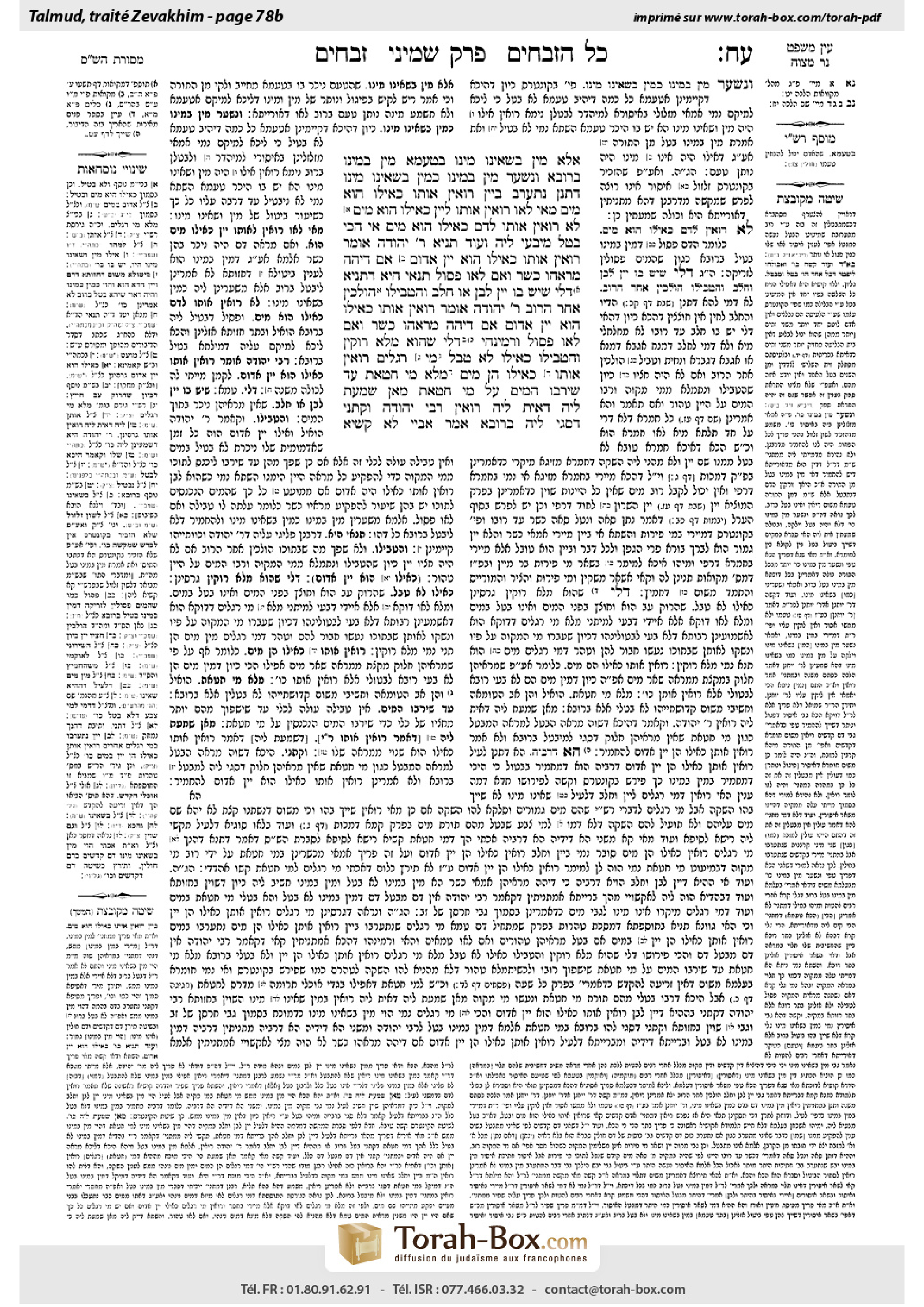
Zevachim 78b: Talmud study for Daf Yomi
Daf Yomi is the daily study of one Talmud folio. Explore 37 tractates with scans, Hebrew text, Sefaria English and AI-generated French translations where annotated.
Passage selection and English or AI-generated French translation are available where the scan has annotations. Daf Study is independent of Torah-Box and Sefaria.
Browse Zevachim · זבחים · All tractatesZevachim 78b text and translations
This page of Zevachim includes the Aramaic text, an English translation and an AI-generated French translation, alongside the scan above.
זבחים ע״ח ב · Aramaic and Hebrew text
אֶלָּא מִין בְּשֶׁאֵינוֹ מִינוֹ – בְּטַעְמָא, מִין בְּמִינוֹ – בְּרוּבָּא.
וּנְשַׁעֵר מִין בְּמִינוֹ כְּמִין בְּשֶׁאֵינוֹ מִינוֹ! דִּתְנַן: נִתְעָרֵב בְּיַיִן – רוֹאִין אוֹתוֹ כְּאִילּוּ הוּא מַיִם. מַאי, לָאו רוֹאִין אוֹתוֹ לַיַּיִן כְּאִילּוּ הוּא מַיִם?
לֹא; רוֹאִין אוֹתוֹ לַדָּם כְּאִילּוּ הוּא מַיִם. אִי הָכִי, ״בָּטֵל״ מִיבְּעֵי לֵיהּ!
וְעוֹד, תַּנְיָא רַבִּי יְהוּדָה אוֹמֵר: רוֹאִין אוֹתוֹ כְּאִילּוּ הוּא יַיִן אָדוֹם; אִם דֵּיהָה מַרְאֵהוּ – כָּשֵׁר,
וְאִם לָאו – פָּסוּל!
תַּנָּאֵי הִיא; דְּתַנְיָא: דְּלִי שֶׁיֵּשׁ בּוֹ יַיִן לָבָן אוֹ חָלָב וְהִטְבִּילוֹ – הוֹלְכִין אַחַר הָרוֹב. רַבִּי יְהוּדָה אוֹמֵר: רוֹאִין אוֹתוֹ כְּאִילּוּ הוּא יַיִן אָדוֹם; אִם דֵּיהָה מַרְאֵהוּ – כָּשֵׁר, וְאִם לָאו – פָּסוּל.
וּרְמִינְהִי: דְּלִי שֶׁהוּא מָלֵא רוּקִּין, וְהִטְבִּילוֹ – כְּאִילּוּ לֹא טָבַל.
מֵי רַגְלַיִם, רוֹאִין אוֹתוֹ כְּאִילּוּ הֵן מַיִם.
מָלֵא מֵי חַטָּאת – עַד שֶׁיִּרְבּוּ הַמַּיִם עַל מֵי חַטָּאת.
מַאן שָׁמְעַתְּ לֵיהּ דְּאִית לֵיהּ ״רוֹאִין״ – רַבִּי יְהוּדָה; וְקָתָנֵי דְּסַגִּי לֵיהּ בְּרוּבָּא!
אָמַר אַבָּיֵי: לָא קַשְׁיָא;
Zevachim 78b · English translation
Rather, one must say that according to Reish Lakish, in a case of a type of food mixed with food not of its own type, such as wheat flour and rice flour, whose tastes are different, the status is determined by the flavor. Therefore, if the dough tastes like wheat, it has the halakha of a dough made from wheat. But if it is a type of food mixed with food of its own type, e.g., a mixture of piggul and notar meat, which is the case addressed by Reish Lakish, the status of the mixture is determined by the majority.
The Gemara suggests: But let us estimate in a case of a type of food mixed with food of its own type as though it were a mixture of a type of food mixed with food not of its own type, and if so, the minority is not nullified if it is substantial enough to impart flavor to the majority. As we learned in the mishna: If the blood of an offering was mixed with wine, one considers it as though it is water. Although blood and wine certainly have different flavors, in the case of the mishna the determinative factor is not the taste of the mixture, but the appearance. Since they share the same appearance, they are considered a case of a substance in contact with the same type of substance. What, is it not correct to explain the mishna as stating that one views the wine as though it is water, i.e., a substance of a different type, and if the mixture would have the appearance of blood if the wine were water it is fit for presentation, despite the fact that the blood is not the majority?
The Gemara answers: No, this is not the explanation of the mishna. Rather, it means that one views the blood as though it is water, i.e., it is unfit for presentation, since it is as though one presented water on the altar. The Gemara questions this explanation: If so, the tanna of the mishna should have said: The blood is nullified.
And furthermore, it is taught in a baraita (Tosefta, Mikvaot 7:4): With regard to a ritually impure bucket containing a certain amount of white wine or milk that one immersed in a ritual bath, Rabbi Yehuda says: Although the appearance of the white wine or milk is not discernible in the water of the ritual bath that enters the bucket, one views the white wine or milk as though it is red wine, and makes the following determination: If its conjectured red appearance would pale due to the water that enters the bucket, the wine or milk is nullified by the water. Therefore, the act of purification is fit, and the bucket is ritually pure.
Rabbi Yehuda continues: But if its conjectured red appearance would not pale, the act of purification is unfit, and the bucket remains ritually impure. This is a case in which a substance was mixed with another substance of similar appearance, as white wine and milk have a similar appearance to the water, and yet it is treated as a mixture of a substance with a different type of substance, and it is not nullified in a majority.
The Gemara explains: One cannot cite a proof from the opinion of Rabbi Yehuda, as this is a dispute between tanna’im, and the ruling follows the opinion of the Rabbis, who disagree with the opinion of Rabbi Yehuda. As it is taught in that baraita: With regard to a ritually impure bucket in which there is white wine or milk, and one immersed it in a ritual bath, one follows the majority, i.e., if the majority of the contents of the bucket is now water from the ritual bath, it is pure. Rabbi Yehuda says: One views the white wine or milk as though it is red wine and makes the following determination: If its conjectured red appearance would pale due to the water that enters the bucket, the act of purification is fit, and the bucket is ritually pure. But if its conjectured red appearance would not pale, the act of purification is unfit, and the bucket remains ritually impure.
And the Gemara raises a contradiction to the opinion of Rabbi Yehuda from a mishna (see Mikvaot 10:6): If one had an impure bucket that is filled with spittle and one immersed it in a ritual bath, the spittle is considered an interposition between the water of the ritual bath and that of the bucket, and therefore it is as though he did not immerse it.
If the impure bucket was full of urine and he immersed it, although urine is slightly different in appearance than water, one views the urine as though it is water, and therefore once the urine is in contact with the ritual bath it is considered connected to the water, and it is not an interposition preventing the bucket from becoming ritually pure.
The mishna continues: If the impure bucket was filled with water of purification, the bucket is not purified until the water of the ritual bath that enters the bucket becomes greater in quantity than the water of purification it contains, thereby nullifying it in a majority.
The Gemara explains the contradiction: Whom have you heard who accepts this reasoning of: One views, which appears in this mishna with regard to urine? It is Rabbi Yehuda, as stated in the baraita cited above. And yet the mishna teaches that a majority suffices to nullify the water of purification that became mixed with water, and it is not considered as though it is red wine. This conflicts with the ruling of Rabbi Yehuda with regard to white wine and milk.
Abaye says: This is not difficult;
Zevachim 78b · Traduction française (IA)
Il faut plutôt dire que, selon Reish Lakish, lorsqu’un aliment est mélangé à un aliment d’une autre espèce, comme de la farine de blé et de la farine de riz, dont les goûts diffèrent, le statut est déterminé par le goût. Ainsi, si la pâte a le goût du blé, elle a le statut d’une pâte faite de blé. En revanche, lorsqu’un aliment est mélangé à un aliment de la même espèce, par exemple dans un mélange de viande de piggul et de notar, cas dont parle Reish Lakish, le statut du mélange est déterminé par la majorité.
La Guemara suggère : Mais ne pourrait-on pas évaluer un mélange d’aliments de la même espèce comme s’il s’agissait d’un mélange d’aliments d’espèces différentes ? Dans ce cas, l’élément minoritaire ne serait pas annulé s’il est en quantité suffisante pour donner son goût à la majorité. En effet, nous avons appris dans la Michna : si le sang d’une offrande a été mélangé à du vin, on le considère comme de l’eau. Bien que le sang et le vin aient certainement des goûts différents, dans le cas de la Michna, le facteur déterminant n’est pas le goût du mélange, mais son apparence. Puisqu’ils ont la même apparence, on considère qu’il s’agit d’une substance mêlée à une substance de même espèce. N’est-il pas juste d’expliquer que la Michna dit qu’on considère le vin comme de l’eau, c’est-à-dire comme une substance d’une autre espèce, et que, si le mélange avait l’apparence du sang lorsque le vin est considéré comme de l’eau, il serait apte à être présenté, bien que le sang ne soit pas majoritaire ?
La Guemara répond : Non, telle n’est pas l’explication de la Michna. Elle signifie plutôt qu’on considère le sang comme de l’eau, c’est-à-dire qu’il est impropre à être présenté, car ce serait comme si l’on présentait de l’eau sur l’autel. La Guemara objecte à cette explication : Dans ce cas, le tanna de la Michna aurait dû dire : « Le sang est annulé. »
De plus, une baraïta enseigne (Tossefta, Mikvaot 7:4) : Au sujet d’un seau rituellement impur contenant une certaine quantité de vin blanc ou de lait, que l’on a immergé dans un bain rituel, Rabbi Yehouda dit : Bien que l’apparence du vin blanc ou du lait ne soit pas discernable dans l’eau du bain rituel qui pénètre dans le seau, on considère le vin blanc ou le lait comme s’il s’agissait de vin rouge et on procède à l’évaluation suivante : si sa couleur rouge hypothétique s’éclaircirait sous l’effet de l’eau qui pénètre dans le seau, le vin ou le lait est annulé par l’eau. Par conséquent, l’immersion est valide et le seau est rituellement pur.
Rabbi Yehouda poursuit : Mais si sa couleur rouge hypothétique ne s’éclaircirait pas, l’immersion est invalide et le seau reste rituellement impur. Il s’agit d’une substance mélangée à une autre substance d’apparence semblable, puisque le vin blanc et le lait ont une apparence semblable à celle de l’eau ; pourtant, le mélange est traité comme celui d’une substance avec une substance d’une autre espèce, et l’élément minoritaire n’est pas annulé par la majorité.
La Guemara explique : On ne peut pas apporter de preuve à partir de l’opinion de Rabbi Yehouda, car il s’agit d’une controverse entre tannaïm, et la décision suit l’opinion des Sages, qui sont en désaccord avec Rabbi Yehouda. En effet, cette baraïta enseigne : Au sujet d’un seau rituellement impur contenant du vin blanc ou du lait, que l’on a immergé dans un bain rituel, on suit la majorité : si la majorité du contenu du seau est désormais constituée d’eau du bain rituel, le seau est pur. Rabbi Yehouda dit : On considère le vin blanc ou le lait comme s’il s’agissait de vin rouge et on procède à l’évaluation suivante : si sa couleur rouge hypothétique s’éclaircirait sous l’effet de l’eau qui pénètre dans le seau, l’immersion est valide et le seau est rituellement pur. Mais si sa couleur rouge hypothétique ne s’éclaircirait pas, l’immersion est invalide et le seau reste rituellement impur.
La Guemara soulève également une contradiction avec l’opinion de Rabbi Yehouda à partir d’une Michna (voir Mikvaot 10:6) : si quelqu’un a un seau impur rempli de salive et qu’il l’immerge dans un bain rituel, la salive est considérée comme une séparation entre l’eau du bain rituel et celle du seau ; c’est donc comme s’il ne l’avait pas immergé.
Si le seau impur était rempli d’urine et qu’on l’immergeait, bien que l’urine diffère légèrement de l’eau par son apparence, on considère l’urine comme de l’eau. Par conséquent, dès que l’urine est en contact avec l’eau du bain rituel, elle est considérée comme reliée à celle-ci et ne constitue pas une séparation empêchant le seau de devenir rituellement pur.
La Michna poursuit : Si le seau impur était rempli d’eau de purification, il n’est purifié que lorsque l’eau du bain rituel qui pénètre dans le seau devient plus abondante que l’eau de purification qu’il contient, annulant ainsi cette dernière par la majorité.
La Guemara explique la contradiction : Qui avons-nous entendu soutenir ce raisonnement de « on considère », qui apparaît dans cette Michna au sujet de l’urine ? Rabbi Yehouda, comme l’indique la baraïta citée plus haut. Pourtant, la Michna enseigne que la majorité suffit à annuler l’eau de purification mélangée à de l’eau, et qu’on ne la considère pas comme du vin rouge. Cela contredit la décision de Rabbi Yehouda au sujet du vin blanc et du lait.
Abayé dit : Il n’y a pas de difficulté.
Traduction française générée par IA à partir de l’édition anglaise de Sefaria. Vérifie toujours un passage avec le texte source.
Text from Sefaria: William Davidson Edition - Vocalized Aramaic (CC BY NC); William Davidson Edition - English (CC BY NC).