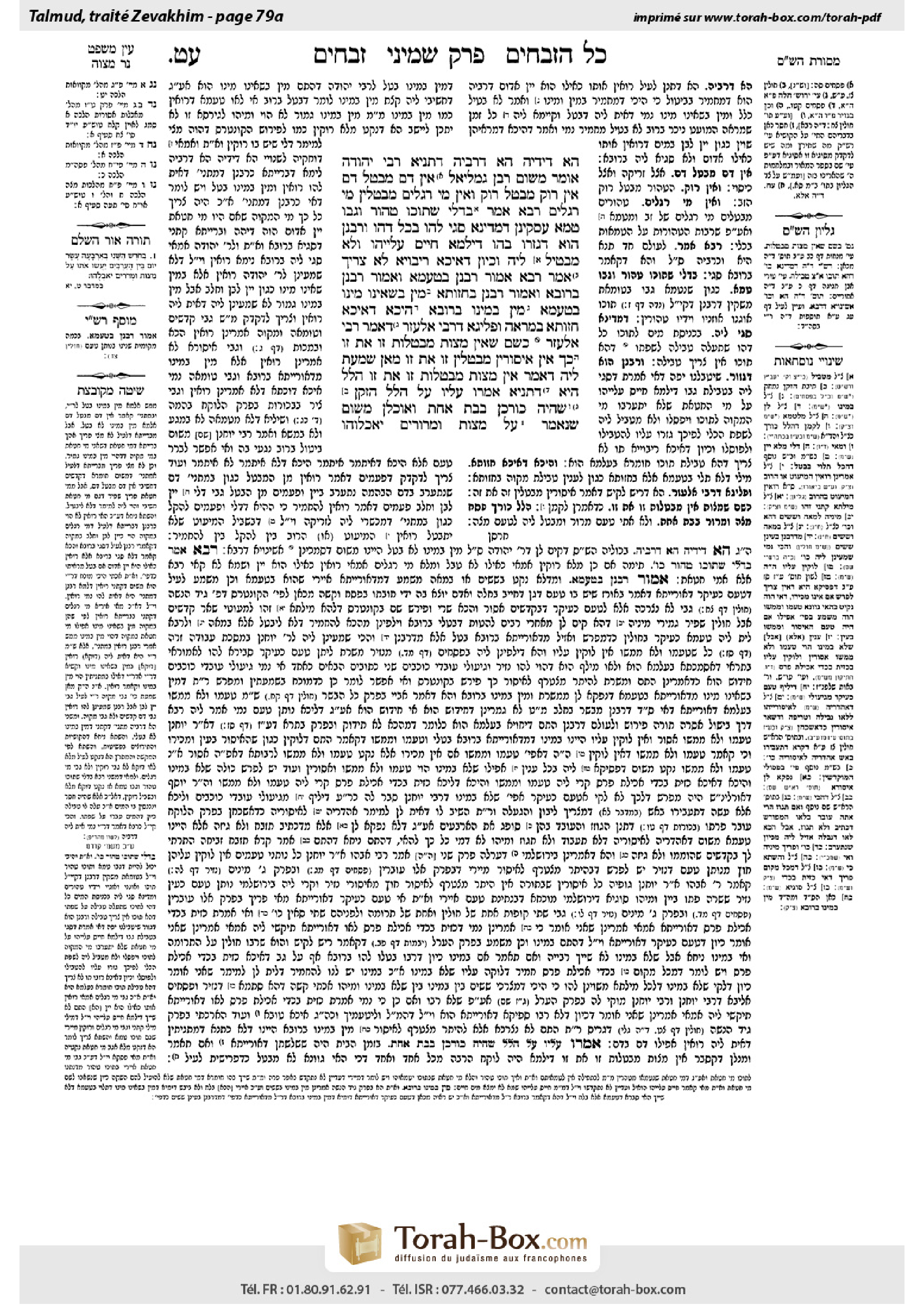
Zevachim 79a: Talmud study for Daf Yomi
Daf Yomi is the daily study of one Talmud folio. Explore 37 tractates with scans, Hebrew text, Sefaria English and AI-generated French translations where annotated.
Passage selection and English or AI-generated French translation are available where the scan has annotations. Daf Study is independent of Torah-Box and Sefaria.
Browse Zevachim · זבחים · All tractatesZevachim 79a text and translations
This page of Zevachim includes the Aramaic text, an English translation and an AI-generated French translation, alongside the scan above.
זבחים ע״ט א · Aramaic and Hebrew text
הָא דִּידֵיהּ הָא דְּרַבֵּיהּ. דְּתַנְיָא, רַבִּי יְהוּדָה אוֹמֵר מִשּׁוּם רַבָּן גַּמְלִיאֵל: אֵין דָּם מְבַטֵּל דָּם, אֵין רוֹק מְבַטֵּל רוֹק, וְאֵין מֵי רַגְלַיִם מְבַטְּלִין מֵי רַגְלַיִם.
רָבָא אָמַר: בִּדְלִי שֶׁתּוֹכוֹ טָהוֹר וְגַבּוֹ טָמֵא עָסְקִינַן; דְּמִדִּינָא – סַגִּי לְהוּ בְּכֹל דְּהוּ,
וְרַבָּנַן הוּא דִּגְזַרוּ בְּהוּ דִּילְמָא חָיֵיס עֲלַיְיהוּ וְלָא מְבַטֵּיל לֵיהּ; וְכֵיוָן דְּאִיכָּא רִיבּוּיָא – לָא צְרִיךְ.
אָמַר רָבָא: אֲמוּר רַבָּנַן בְּטַעְמָא, וַאֲמוּר רַבָּנַן בְּרוּבָּא, וַאֲמוּר רַבָּנַן בַּחֲזוּתָא. מִין בְּשֶׁאֵינוֹ מִינוֹ – בְּטַעְמָא, מִין בְּמִינוֹ – בְּרוּבָּא, הֵיכָא דְּאִיכָּא חֲזוּתָא – בְּמַרְאֶה.
וּפְלִיגָא דְּרַבִּי אֶלְעָזָר, דְּאָמַר רַבִּי אֶלְעָזָר: כְּשֵׁם שֶׁאֵין מִצְוֹת מְבַטְּלוֹת זוֹ אֶת זוֹ, כָּךְ אֵין אִיסּוּרִין מְבַטְּלִין זֶה אֶת זֶה.
מַאן שָׁמְעַתְּ לֵיהּ דְּאָמַר: אֵין מִצְוֹת מְבַטְּלוֹת זוֹ אֶת זוֹ? הִלֵּל הִיא, דְּתַנְיָא: אָמְרוּ עָלָיו עַל הִלֵּל הַזָּקֵן שֶׁהָיָה כּוֹרְכָן בְּבַת אַחַת וְאוֹכְלָן, מִשּׁוּם שֶׁנֶּאֱמַר: ״עַל מַצּוֹת וּמְרוֹרִים יֹאכְלוּהוּ״.
Zevachim 79a · English translation
this statement, that the water of purification is nullified in a majority of water, is his, i.e., Rabbi Yehuda’s, own opinion, whereas that statement, in the baraita, that white wine is not nullified in a majority of water, is his teacher’s ruling, i.e., that of Rabban Gamliel, who is stringent with regard to a mixture of a substance in contact with the same type of substance. As it is taught in a baraita that Rabbi Yehuda says in the name of Rabban Gamliel: Blood does not nullify blood, spittle does not nullify spittle, and urine does not nullify urine.
Rava says there is a different resolution of the apparent contradiction between the mishna that states that water of purification is nullified in a majority of water of a ritual bath and Rabbi Yehuda’s opinion in the baraita with regard to white wine mixed with water: In the mishna, we are dealing with a bucket whose internal surface is ritually pure, and only its external surface is impure. The significance of this is that by Torah law it suffices for the water of the ritual bath to enter the bucket in any amount to purify its external surface, and therefore the water of purification in the bucket does not prevent the purification of the bucket at all.
Rava continues: And it is the Sages who decreed with regard to this case that the internal surface must be purified as well, lest the owner wish to spare the water of purification and not to nullify it from its sanctity. In that case he would wish to avoid allowing water from the ritual bath to enter the vessel, and might immerse it in a manner which would not allow even the full external surface to come in contact with the water. Therefore, the Sages required that one immerse the entire vessel. But once there is a majority of water in the bucket from the ritual bath, he does not need to enable any more water to enter the vessel, as by Torah law it is already pure.
§ Rava says, in summary of these halakhot: The Sages said that the status of an item in a mixture is determined by the taste, i.e., if the taste of one substance is noticeable in a mixture with another substance it is not nullified, and the Sages said that a prohibited item is nullified by the majority, and the Sages also said that the status of an item in a mixture is determined by the appearance, i.e., if the appearance of a substance is recognizable in a mixture it is not nullified. Rava elaborates: With regard to a type of food mixed with food not of its own type, the nullification is determined by the taste. In the case of a type of food mixed with food of its own type, the nullification is determined by the majority. In a case where there is a possibility to determine the status of an item based on appearance, the nullification is by appearance.
§ The Gemara returns to its discussion of the opinion of Reish Lakish that prohibited items, such as piggul, notar, and ritually impure meat, nullify one another. The Gemara notes: And Reish Lakish disagrees with the statement of Rabbi Elazar, as Rabbi Elazar says: Just as items used in the performance of mitzvot do not nullify one another, despite the fact that one is of greater volume than the other or imparts flavor to it, so too, items to which prohibitions apply do not nullify one another.
The Gemara adds: Whom did you hear who says that items used in the performance of mitzvot do not nullify one another? It is Hillel, as it is taught in a baraita: They said about Hillel the Elder that when eating the Paschal offering, matza, and bitter herbs on the first night of Passover, he would wrap them all at once and eat them together, because it is stated with regard to the Paschal offering: “They shall eat it with matzot and bitter herbs” (Numbers 9:11), which indicates that these three foods should be eaten together. Hillel was not concerned that the taste of the bitter herbs would nullify the taste of the matza.
Zevachim 79a · Traduction française (IA)
Cette déclaration, selon laquelle l’eau de purification est annulée dans une majorité d’eau, exprime sa propre opinion, c’est-à-dire celle de Rabbi Yehuda, tandis que l’autre déclaration, dans la baraïta, selon laquelle le vin blanc n’est pas annulé dans une majorité d’eau, exprime l’avis de son maître, c’est-à-dire celui de Rabban Gamliel, qui se montre strict à l’égard d’un mélange d’une substance avec une substance de même espèce. En effet, il est enseigné dans une baraïta que Rabbi Yehuda dit au nom de Rabban Gamliel : « Le sang n’annule pas le sang, la salive n’annule pas la salive et l’urine n’annule pas l’urine. »
Rava propose une autre résolution de la contradiction apparente entre la Michna, selon laquelle l’eau de purification est annulée dans une majorité d’eau du bain rituel, et l’opinion de Rabbi Yehuda dans la baraïta au sujet du vin blanc mélangé à de l’eau : dans la Michna, il s’agit d’un seau dont la surface intérieure est rituellement pure et dont seule la surface extérieure est impure. Cela signifie que, selon la Torah, il suffit qu’une quantité quelconque d’eau du bain rituel pénètre dans le seau pour purifier sa surface extérieure ; l’eau de purification contenue dans le seau n’empêche donc nullement sa purification.
Rava poursuit : ce sont les Sages qui ont décrété, dans ce cas, que la surface intérieure devait également être purifiée, de peur que le propriétaire ne veuille préserver l’eau de purification et éviter de l’annuler en la dépossédant de sa sainteté. Dans ce cas, il voudrait empêcher l’eau du bain rituel de pénétrer dans le récipient et pourrait l’immerger de manière à ce que même la totalité de sa surface extérieure ne soit pas en contact avec l’eau. C’est pourquoi les Sages ont exigé que l’on immerge le récipient entier. Mais dès qu’une majorité d’eau du bain rituel se trouve dans le seau, il n’est pas nécessaire d’y faire entrer davantage d’eau, puisque, selon la Torah, il est déjà pur.
§ Rava résume ces halakhot : les Sages ont dit que le statut d’un élément dans un mélange est déterminé par le goût, c’est-à-dire que si le goût d’une substance reste perceptible dans un mélange avec une autre substance, elle n’est pas annulée ; les Sages ont dit qu’un élément interdit est annulé par la majorité ; et les Sages ont également dit que le statut d’un élément dans un mélange est déterminé par l’apparence, c’est-à-dire que si l’apparence d’une substance reste reconnaissable dans un mélange, elle n’est pas annulée. Rava précise : lorsqu’une sorte d’aliment est mélangée à un aliment d’une autre sorte, l’annulation dépend du goût. Lorsqu’une sorte d’aliment est mélangée à un aliment de même espèce, l’annulation dépend de la majorité. Lorsqu’il est possible de déterminer le statut d’un élément d’après son apparence, l’annulation dépend de l’apparence.
§ La Guemara revient à son examen de l’opinion de Reish Lakish, selon laquelle des éléments interdits, tels que le piggul, le notar et la viande rituellement impure, s’annulent mutuellement. La Guemara relève que Reish Lakish est en désaccord avec l’enseignement de Rabbi Elazar, car Rabbi Elazar dit : « De même que les éléments utilisés dans l’accomplissement des mitsvot ne s’annulent pas mutuellement, même si l’un a un volume supérieur à l’autre ou lui transmet son goût, de même, les éléments auxquels s’appliquent des interdictions ne s’annulent pas mutuellement. »
La Guemara ajoute : Qui avez-vous entendu dire que les éléments utilisés dans l’accomplissement des mitsvot ne s’annulent pas mutuellement ? Hillel. En effet, il est enseigné dans une baraïta : on disait de Hillel l’Ancien que, lorsqu’il mangeait le sacrifice pascal, la matsa et les herbes amères, le premier soir de Pessa’h, il les enveloppait tous ensemble et les mangeait ensemble, car il est dit au sujet du sacrifice pascal : « On le mangera avec des matsot et des herbes amères » (Nombres 9:11), ce qui indique que ces trois aliments doivent être mangés ensemble. Hillel ne craignait pas que le goût des herbes amères n’annule celui de la matsa.
Traduction française générée par IA à partir de l’édition anglaise de Sefaria. Vérifie toujours un passage avec le texte source.
Text from Sefaria: William Davidson Edition - Vocalized Aramaic (CC BY NC); William Davidson Edition - English (CC BY NC).