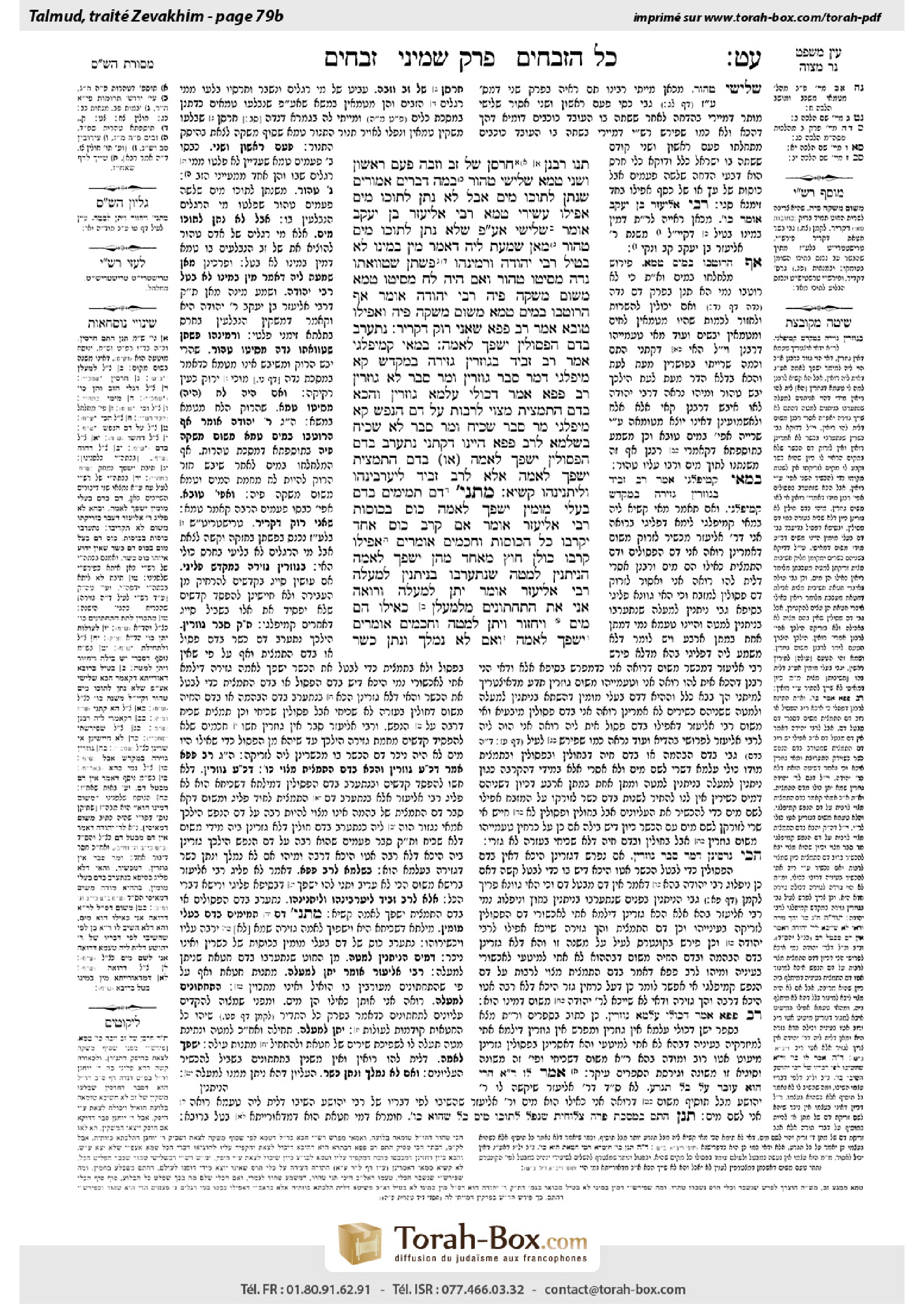
Zevachim 79b: Talmud study for Daf Yomi
Daf Yomi is the daily study of one Talmud folio. Explore 37 tractates with scans, Hebrew text, Sefaria English and AI-generated French translations where annotated.
Passage selection and English or AI-generated French translation are available where the scan has annotations. Daf Study is independent of Torah-Box and Sefaria.
Browse Zevachim · זבחים · All tractatesZevachim 79b text and translations
This page of Zevachim includes the Aramaic text, an English translation and an AI-generated French translation, alongside the scan above.
זבחים ע״ט ב · Aramaic and Hebrew text
תָּנוּ רַבָּנַן: חַרְסָן שֶׁל זָב וְזָבָה – פַּעַם רִאשׁוֹן וְשֵׁנִי טָמֵא, שְׁלִישִׁי טָהוֹר.
בַּמֶּה דְּבָרִים אֲמוּרִים – שֶׁנָּתַן לְתוֹכוֹ מַיִם; אֲבָל לֹא נָתַן לְתוֹכוֹ מַיִם – אֲפִילּוּ עֲשִׂירִי טָמֵא. רַבִּי אֱלִיעֶזֶר בֶּן יַעֲקֹב אוֹמֵר: שְׁלִישִׁי, אַף עַל פִּי שֶׁלֹּא נָתַן לְתוֹכוֹ מַיִם – טָהוֹר. מַאן דְּשָׁמְעַתְּ לֵיהּ דְּאָמַר: מִין בְּמִינוֹ לֹא בָּטֵיל? רַבִּי יְהוּדָה.
וּרְמִינְהוּ: פִּשְׁתָּן שֶׁטְּוָואָתוֹ נִדָּה – מְסִיטוֹ טָהוֹר. וְאִם הָיָה לַח – מְסִיטוֹ טָמֵא מִשּׁוּם מַשְׁקֵה פִּיהָ. רַבִּי יְהוּדָה אוֹמֵר: אַף הָרוֹטְבוֹ בְּמַיִם – טָמֵא מִשּׁוּם מַשְׁקֶה פִּיהָ, וַאֲפִילּוּ טוּבָא!
אָמַר רַב פָּפָּא: שָׁאנֵי רוֹק, דְּקָרִיר.
נִתְעָרֵב בְּדַם הַפְּסוּלִין, יִשָּׁפֵךְ לָאַמָּה. בְּמַאי קָמִיפַּלְגִי?
אָמַר רַב זְבִיד: בְּגוֹזְרִין גְּזֵירָה בַּמִּקְדָּשׁ קָא מִיפַּלְגִי – דְּמָר סָבַר: גּוֹזְרִין, וּמָר סָבַר: (לָא) [אֵין] גּוֹזְרִין.
רַב פָּפָּא אָמַר: דְּכוּלֵּי עָלְמָא גּוֹזְרִין;
וְהָכָא, בְּדַם הַתַּמְצִית מָצוּי לִרְבּוֹת עַל דַּם הַנֶּפֶשׁ קָא מִיפַּלְגִי – מָר סָבַר: שְׁכִיחַ, וּמָר סָבַר: לָא שְׁכִיחַ.
בִּשְׁלָמָא לְרַב פָּפָּא, הַיְינוּ דְּקָתָנֵי: נִתְעָרֵב בְּדַם הַפְּסוּלִין – יִשָּׁפֵךְ לָאַמָּה, (אוֹ) בְּדַם הַתַּמְצִית – יִשָּׁפֵךְ לָאַמָּה.
אֶלָּא לְרַב זְבִיד, לִיעָרְבִינְהוּ וְלִיתְנִינְהוּ! קַשְׁיָא.
מַתְנִי׳ דַּם תְּמִימִים בְּדַם בַּעֲלֵי מוּמִין – יִשָּׁפֵךְ לָאַמָּה. כּוֹס בְּכוֹסוֹת – רַבִּי אֱלִיעֶזֶר אוֹמֵר: אִם קָרַב כּוֹס אֶחָד, יִקְרְבוּ כָּל הַכּוֹסוֹת. וַחֲכָמִים אוֹמְרִים: אֲפִילּוּ קָרְבוּ כּוּלָּן חוּץ מֵאֶחָד מֵהֶן, יִשָּׁפֵךְ לָאַמָּה.
הַנִּיתָּנִין לְמַטָּה שֶׁנִּתְעָרְבוּ בַּנִּיתָּנִין לְמַעְלָה – רַבִּי אֱלִיעֶזֶר אוֹמֵר: יִתֵּן לְמַעְלָה, וְרוֹאֶה אֲנִי אֶת הַתַּחְתּוֹנִים מִלְּמַעְלָן כְּאִילּוּ הֵם מַיִם, וְיַחֲזוֹר וְיִתֵּן לְמַטָּה. וַחֲכָמִים אוֹמְרִים: יִשָּׁפֵךְ לָאַמָּה. וְאִם לֹא נִמְלַךְ וְנָתַן – כָּשֵׁר.
Zevachim 79b · English translation
§ The Gemara continues its discussion of cases involving a mixture of one substance in contact with the same type of substance, in which according to the opinion of Rabbi Yehuda in the mishna the prohibited substance is not nullified. The Sages taught a baraita (Tosefta, Teharot 5:3): In a case where a broken earthenware flask had absorbed the urine of a zav or a zava, whose urine is a primary source of ritual impurity, which imparts impurity to one who carries it, in such a case, if one poured water into this flask to clean it, after the first time and the second time one washed it, it remains ritually impure, but after the third time it is ritually pure, as the impure urine has been expelled from the flask.
The baraita continues: In what case is this statement said? It is said when one placed water into the flask. But if he did not place water into it, but instead placed the urine of a ritually pure person into it, even after the tenth time he places this urine into the flask it remains ritually impure, as one substance in contact with the same type of substance is not nullified. Rabbi Eliezer ben Ya’akov says: After the third time, even though he did not place water into it, but rather urine, it is ritually pure. The Gemara comments: Whom did you hear who says that a substance in contact with the same type of substance is not nullified? Rabbi Yehuda, and therefore he is the first tanna of this baraita.
And the Gemara raises a contradiction from another baraita (Tosefta, Teharot 4:11): With regard to flax that was woven by a menstruating woman, although it has absorbed the spittle of a menstruating woman, which imparts impurity by being carried, one who moves it remains ritually pure, as the spittle has dried. But if the flax was still moist, one who moves it is rendered impure due to the liquid of her mouth, i.e., the spittle of the menstruating woman. Rabbi Yehuda says: Even one who wets the flax with water is rendered impure due to the liquid of her mouth, and this halakha applies even if he wet the flax a great deal, several times, as the water does not nullify and expel the spittle. This apparently contradicts Rabbi Yehuda’s claim with regard to the broken flask that was washed with water three times.
Rav Pappa says: Spittle is different, as it is thoroughly absorbed and adheres to the flax, and therefore washing the flax with water does not nullify the spittle.
§ The mishna teaches: If blood fit for presentation was mixed with the blood of unfit offerings, the entire mixture shall be poured into the Temple courtyard drain, and similarly, if blood fit for presentation became mixed with blood of exudate, it shall be poured into the drain, whereas Rabbi Eliezer deems the mixture fit for presentation. The Gemara asks: With regard to what principle do the first tanna and Rabbi Eliezer disagree?
Rav Zevid says: They disagree with regard to the question of whether the Sages issue a rabbinic decree of this kind with regard to the Temple. As one Sage, the first tanna, holds that the Sages issue a rabbinic decree with regard to the Temple, and therefore one may not present this mixture of blood, lest one present a mixture that contains a majority of blood of unfit offerings or blood of exudate. And one Sage, Rabbi Eliezer, holds that the Sages do not issue a rabbinic decree with regard to the Temple, and consequently this mixture of blood is fit for presentation.
Rav Pappa says that there is a different explanation of the dispute: Everyone agrees that the Sages issue a rabbinic decree with regard to the Temple, and therefore in a case where blood fit for presentation was mixed with the blood of unfit offerings Rabbi Eliezer agrees that it should be poured into the Temple courtyard drain, and he deems the blood permitted only if it was mixed with blood of exudate.
Rav Pappa continues: And here they disagree with regard to the question of whether it is common for blood of exudate to be greater in quantity than blood of the soul, i.e., the blood that emerges immediately following the slaughter of the animal. One Sage, the first tanna, holds that this is a common occurrence, and therefore the Sages issued a decree concerning all mixtures of blood of exudate and blood of the soul. And one Sage, Rabbi Eliezer, holds that this is not a common occurrence, and therefore the Sages did not issue a decree concerning a mixture of this kind.
The Gemara comments: Granted, according to the opinion of Rav Pappa that Rabbi Eliezer’s lenient ruling applies only to a mixture with blood of exudate, but that he concedes to the first tanna that if blood fit for presentation was mixed with the blood of unfit offerings it is poured down the Temple courtyard drain, this explanation is consistent with that which the mishna teaches: If blood fit for presentation was mixed with the blood of unfit offerings, it shall be poured into the Temple courtyard drain; if blood fit for presentation was mixed with blood of exudate, it shall be poured into the drain. In other words, the fact that the mishna separates these two cases into different clauses makes sense, as Rabbi Eliezer’s ruling applies only to one case.
But according to the interpretation of Rav Zevid that Rabbi Eliezer disagrees with regard to both cases, let the mishna combine them and teach them together, as follows: If blood fit for presentation was mixed with the blood of unfit offerings or with blood of exudate, the entire mixture shall be poured into the drain running through the Temple courtyard, and Rabbi Eliezer deems the mixtures fit for presentation. The Gemara concludes: Indeed, the wording of the mishna poses a difficulty to the explanation of Rav Zevid.
MISHNA: If the blood of unblemished offerings was mixed with the blood of blemished animals unfit for sacrifice, the entire mixture shall be poured into the Temple courtyard drain. This is the halakha when the fit and unfit blood were mixed in one vessel. By contrast, if a cup of the blood of a blemished offering was intermingled with cups of blood fit for offering and it is unclear which blood is in the cup, Rabbi Eliezer says: Although it is prohibited to present all the blood due to the uncertainty, if it happened that a priest already sacrificed, i.e., presented, one cup, the blood in all the other cups shall be sacrificed, as the blood that was presented is assumed to have come from the unfit cup in the mixture. And the Rabbis say: Even if the blood in all the cups was sacrificed except for one of them, the remaining blood shall be poured into the Temple courtyard drain.
With regard to blood that is to be placed below the red line circumscribing the altar, e.g., blood of a burnt offering, a guilt offering, or a peace offering, that was mixed with blood that is to be placed above the red line, e.g., blood of a sin offering, Rabbi Eliezer says: The priest shall initially place the blood of the mixture above the red line for the sake of the sin offering, and I view the blood that was to be placed below that was in fact placed above as though it is water, and the priest shall again place blood from the mixture below. And the Rabbis say: It shall all be poured into the Temple courtyard drain. Even according to the Rabbis, if the priest did not consult the authorities and placed the blood above the red line, the offering is fit, and he should then place the remaining blood below the red line.
Zevachim 79b · Traduction française (IA)
§ La Guemara poursuit son examen des cas où une substance est mêlée à une substance du même type, cas dans lesquels, selon l’opinion de Rabbi Yehouda dans la Michna, la substance interdite n’est pas annulée. Les Sages ont enseigné dans une baraïta (Tosefta, Teharot 5:3) : Si une cruche en terre cuite brisée avait absorbé l’urine d’un zav ou d’une zava, dont l’urine est une source primaire d’impureté rituelle qui transmet l’impureté à celui qui la porte, et que l’on versait de l’eau dans cette cruche pour la nettoyer, elle demeurait rituellement impure après le premier lavage et après le deuxième, mais devenait rituellement pure après le troisième, car l’urine impure avait été expulsée de la cruche.
La baraïta poursuit : Dans quel cas cette règle a-t-elle été énoncée ? Lorsque l’on a mis de l’eau dans la cruche. Mais si l’on n’y a pas mis d’eau et qu’on y a mis à la place l’urine d’une personne rituellement pure, même après avoir versé cette urine dans la cruche une dixième fois, celle-ci reste rituellement impure, car une substance mêlée à une substance du même type n’est pas annulée. Rabbi Eliezer ben Yaakov dit : Après la troisième fois, même si l’on n’y a pas mis d’eau mais de l’urine, elle est rituellement pure. La Guemara fait remarquer : Qui as-tu entendu affirmer qu’une substance mêlée à une substance du même type n’est pas annulée ? Rabbi Yehouda ; il est donc le premier tanna de cette baraïta.
La Guemara soulève une contradiction à partir d’une autre baraïta (Tosefta, Teharot 4:11) : À propos du lin tissé par une femme menstruée, bien qu’il ait absorbé la salive d’une femme menstruée, qui transmet l’impureté par portage, celui qui le déplace reste rituellement pur, car la salive a séché. Mais si le lin était encore humide, celui qui le déplace devient impur à cause du liquide de sa bouche, c’est-à-dire de la salive de la femme menstruée. Rabbi Yehouda dit : Même celui qui mouille le lin avec de l’eau devient impur à cause du liquide de sa bouche. Cette halakha s’applique même s’il mouille abondamment le lin, à plusieurs reprises, car l’eau n’annule pas la salive et ne l’expulse pas. Cela semble contredire l’affirmation de Rabbi Yehouda au sujet de la cruche brisée lavée trois fois à l’eau.
Rav Pappa dit : La salive est différente, car elle est profondément absorbée et adhère au lin ; c’est pourquoi le lavage à l’eau n’annule pas la salive.
§ La Michna enseigne : Si du sang apte à être présenté sur l’autel a été mêlé au sang d’offrandes impropres, tout le mélange doit être versé dans le conduit d’évacuation de la cour du Temple. De même, si du sang apte à être présenté sur l’autel a été mêlé à du sang d’exsudat, il doit être versé dans le conduit d’évacuation, tandis que Rabbi Eliezer juge le mélange apte à être présenté. La Guemara demande : Sur quel principe le premier tanna et Rabbi Eliezer sont-ils en désaccord ?
Rav Zevid dit : Ils sont en désaccord sur la question de savoir si les Sages édictent une mesure rabbinique de ce genre concernant le Temple. Le premier Sage, le premier tanna, estime que les Sages édictent une mesure rabbinique concernant le Temple ; on ne peut donc pas présenter ce mélange de sang, de crainte de présenter un mélange contenant une majorité de sang d’offrandes impropres ou de sang d’exsudat. L’autre Sage, Rabbi Eliezer, estime que les Sages n’édictent pas de mesure rabbinique concernant le Temple ; par conséquent, ce mélange de sang peut être présenté.
Rav Pappa donne une autre explication du désaccord : tous s’accordent à dire que les Sages édictent une mesure rabbinique concernant le Temple. Par conséquent, dans le cas où du sang apte à être présenté a été mêlé au sang d’offrandes impropres, Rabbi Eliezer convient qu’il faut verser le mélange dans le conduit d’évacuation de la cour du Temple ; il ne juge le sang permis à la présentation que s’il a été mêlé à du sang d’exsudat.
Rav Pappa poursuit : Ici, ils sont en désaccord sur la question de savoir s’il est fréquent que la quantité de sang d’exsudat soit supérieure à celle du sang de l’âme, c’est-à-dire du sang qui s’écoule immédiatement après l’abattage de l’animal. Le premier Sage, le premier tanna, estime que cela arrive fréquemment ; les Sages ont donc édicté une mesure concernant tous les mélanges de sang d’exsudat et de sang de l’âme. L’autre Sage, Rabbi Eliezer, estime que cela n’arrive pas fréquemment ; les Sages n’ont donc pas édicté de mesure concernant un tel mélange.
La Guemara fait remarquer : Certes, selon l’opinion de Rav Pappa, la décision indulgente de Rabbi Eliezer ne s’applique qu’à un mélange avec du sang d’exsudat, tandis qu’il concède au premier tanna que, si du sang apte à être présenté a été mêlé au sang d’offrandes impropres, il faut le verser dans le conduit d’évacuation de la cour du Temple. Cette explication concorde avec l’enseignement de la Michna : Si du sang apte à être présenté a été mêlé au sang d’offrandes impropres, il doit être versé dans le conduit d’évacuation de la cour du Temple ; si du sang apte à être présenté a été mêlé à du sang d’exsudat, il doit être versé dans le conduit d’évacuation. Autrement dit, il est logique que la Michna expose ces deux cas dans des clauses distinctes, puisque la décision de Rabbi Eliezer ne s’applique qu’à l’un d’eux.
Mais selon l’interprétation de Rav Zevid, d’après laquelle Rabbi Eliezer est en désaccord dans les deux cas, que la Michna les réunisse et les enseigne ensemble, comme suit : Si du sang apte à être présenté a été mêlé au sang d’offrandes impropres ou à du sang d’exsudat, tout le mélange doit être versé dans le conduit d’évacuation de la cour du Temple, tandis que Rabbi Eliezer juge ces mélanges aptes à être présentés. La Guemara conclut : En effet, la formulation de la Michna pose une difficulté à l’explication de Rav Zevid.
MICHNA : Si le sang d’offrandes sans défaut a été mêlé au sang d’animaux atteints d’un défaut et impropres au sacrifice, tout le mélange doit être versé dans le conduit d’évacuation de la cour du Temple. Cette halakha s’applique lorsque le sang apte et le sang impropre ont été mêlés dans un même récipient. En revanche, si une coupe contenant le sang d’une offrande provenant d’un animal atteint d’un défaut a été mêlée à des coupes contenant du sang apte à être offert, et qu’on ne sait pas quel sang se trouve dans la coupe, Rabbi Eliezer dit : Bien qu’il soit interdit de présenter tout le sang en raison de l’incertitude, si un prêtre a déjà offert le contenu d’une coupe, c’est-à-dire en a présenté le sang, le sang de toutes les autres coupes doit être présenté, car on présume que le sang présenté provenait de la coupe contenant le sang impropre dans le mélange. Et les Sages disent : Même si le sang de toutes les coupes sauf une a été présenté, le sang restant doit être versé dans le conduit d’évacuation de la cour du Temple.
À propos du sang qui doit être placé sous la ligne rouge qui entoure l’autel, par exemple le sang d’un holocauste, d’un sacrifice de culpabilité ou d’une offrande de paix, mêlé au sang qui doit être placé au-dessus de la ligne rouge, par exemple le sang d’un sacrifice expiatoire, Rabbi Eliezer dit : Le prêtre doit d’abord placer le sang du mélange au-dessus de la ligne rouge, pour le sacrifice expiatoire. Je considère alors comme de l’eau le sang qui devait être placé en dessous mais qui a été placé au-dessus, et le prêtre placera ensuite du sang du mélange en dessous. Et les Sages disent : Tout doit être versé dans le conduit d’évacuation de la cour du Temple. Même selon les Sages, si le prêtre n’a pas consulté les autorités et a placé le sang au-dessus de la ligne rouge, l’offrande est valide ; il doit ensuite placer le sang restant en dessous de la ligne rouge.
Traduction française générée par IA à partir de l’édition anglaise de Sefaria. Vérifie toujours un passage avec le texte source.
Text from Sefaria: William Davidson Edition - Vocalized Aramaic (CC BY NC); William Davidson Edition - English (CC BY NC).