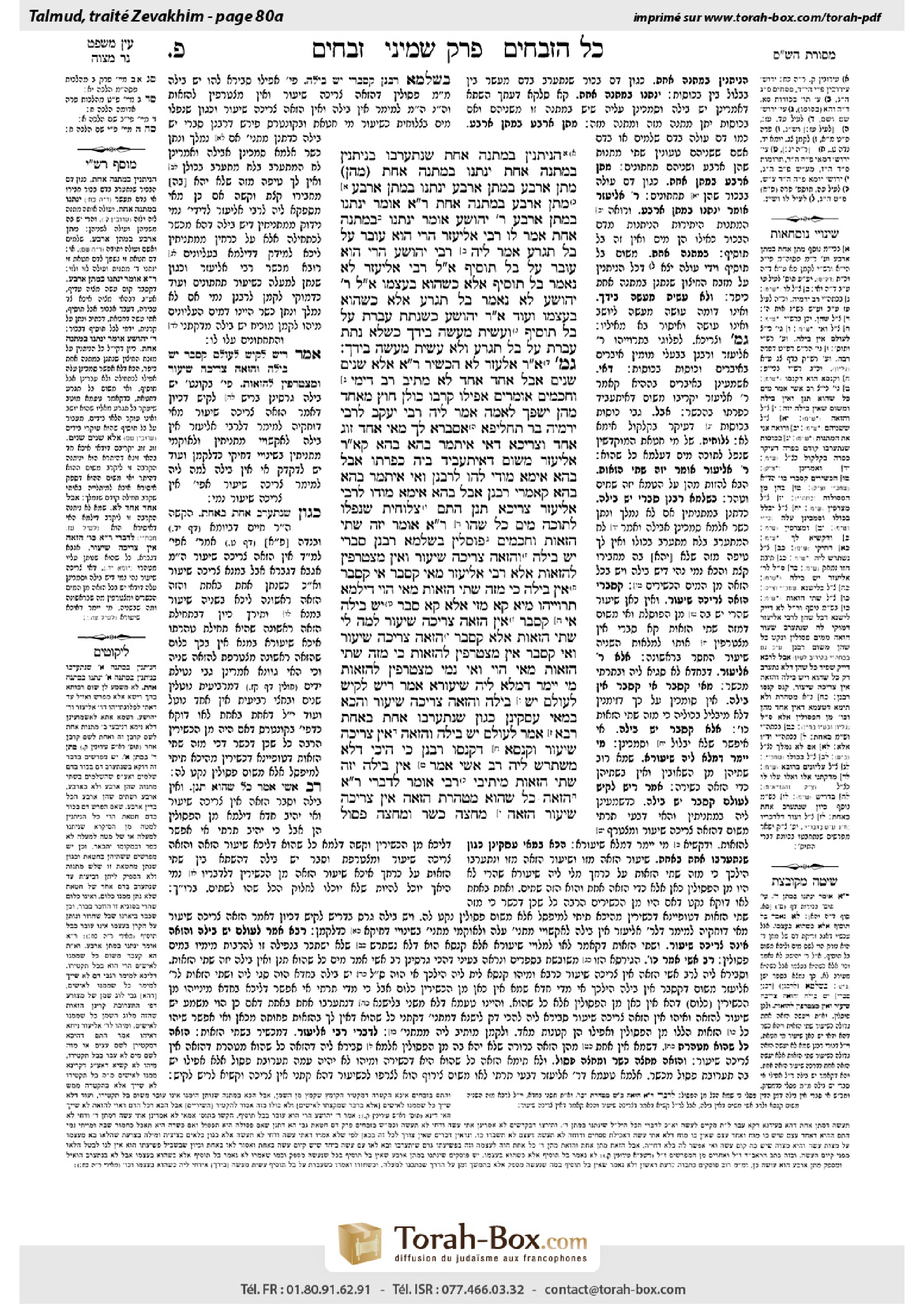
Zevachim 80a: Talmud study for Daf Yomi
Daf Yomi is the daily study of one Talmud folio. Explore 37 tractates with scans, Hebrew text, Sefaria English and AI-generated French translations where annotated.
Passage selection and English or AI-generated French translation are available where the scan has annotations. Daf Study is independent of Torah-Box and Sefaria.
Browse Zevachim · זבחים · All tractatesZevachim 80a text and translations
This page of Zevachim includes the Aramaic text, an English translation and an AI-generated French translation, alongside the scan above.
זבחים פ׳ א · Aramaic and Hebrew text
הַנִּיתָּנִין בְּמַתָּנָה אַחַת שֶׁנִּתְעָרְבוּ בַּנִּיתָּנִין בְּמַתָּנָה אַחַת – יִנָּתְנוּ בְּמַתָּנָה אֶחָת. (מֵהֶן) מַתַּן אַרְבַּע בְּמַתַּן אַרְבַּע – יִנָּתְנוּ בְּמַתַּן אַרְבַּע.
מַתַּן אַרְבַּע בְּמַתָּנָה אַחַת – רַבִּי אֱלִיעֶזֶר אוֹמֵר: יִנָּתְנוּ בְּמַתַּן אַרְבַּע, רַבִּי יְהוֹשֻׁעַ אוֹמֵר: יִנָּתְנוּ בְּמַתָּנָה אֶחָת.
אָמַר לוֹ רַבִּי אֱלִיעֶזֶר: הֲרֵי הוּא עוֹבֵר עַל בַּל תִּגְרַע! אֲמַר לֵיהּ רַבִּי יְהוֹשֻׁעַ: הֲרֵי הוּא עוֹבֵר עַל בַּל תּוֹסִיף!
אָמַר לוֹ רַבִּי אֱלִיעֶזֶר: לֹא נֶאֱמַר בַּל תּוֹסִיף אֶלָּא כְּשֶׁהוּא בְּעַצְמוֹ. אָמַר לוֹ רַבִּי יְהוֹשֻׁעַ: לֹא נֶאֱמַר בַּל תִּגְרַע אֶלָּא כְּשֶׁהוּא בְּעַצְמוֹ! וְעוֹד אָמַר רַבִּי יְהוֹשֻׁעַ: כְּשֶׁנָּתַתָּ – עָבַרְתָּ עַל בַּל תּוֹסִיף, וְעָשִׂיתָ מַעֲשֶׂה בְּיָדֶךָ. כְּשֶׁלֹּא נָתַתָּ – עָבַרְתָּ עַל בַּל תִּגְרַע, לֹא עָשִׂיתָ מַעֲשֶׂה בְּיָדֶךָ.
גְּמָ׳ אָמַר רַבִּי אֶלְעָזָר: לֹא הִכְשִׁיר רַבִּי אֱלִיעֶזֶר אֶלָּא שְׁנַיִם שְׁנַיִם, אֲבָל אֶחָד אֶחָד – לָא.
מֵתִיב רַב דִּימִי, וַחֲכָמִים אוֹמְרִים: אֲפִילּוּ קָרְבוּ כּוּלָּן חוּץ מֵאֶחָד מֵהֶן – יִשָּׁפֵךְ לְאַמָּה. אֲמַר לֵיהּ רַבִּי יַעֲקֹב לְרַבִּי יִרְמְיָה בַּר תַּחְלִיפָא, אַסְבְּרַהּ לָךְ: מַאי אֶחָד – זוּג אֶחָד.
וּצְרִיכָא; דְּאִי אִיתְּמַר בְּהָא – בְּהָא קָאָמַר רַבִּי אֱלִיעֶזֶר, מִשּׁוּם דְּאִיתְעֲבִיד בֵּיהּ כַּפָּרָתוֹ; אֲבָל בְּהָא – אֵימָא מוֹדֵי לְהוּ לְרַבָּנַן.
וְאִי אִיתְּמַר בְּהָא – בְּהָא קָאָמְרִי רַבָּנַן, אֲבָל בְּהָא אֵימָא מוֹדוּ לְרַבִּי אֱלִיעֶזֶר; צְרִיכָא.
תְּנַן הָתָם: צְלוֹחִית שֶׁנָּפְלוּ לְתוֹכָהּ מַיִם כׇּל שֶׁהוּ – רַבִּי אֱלִיעֶזֶר אוֹמֵר: יַזֶּה שְׁתֵּי הַזָּאוֹת, וַחֲכָמִים פּוֹסְלִין.
בִּשְׁלָמָא רַבָּנַן – סָבְרִי יֵשׁ בִּילָּה, וְהַזָּאָה צְרִיכָה שִׁיעוּר, וְאֵין מִצְטָרְפִין לְהַזָּאוֹת.
אֶלָּא רַבִּי אֱלִיעֶזֶר – מַאי קָסָבַר? אִי קָסָבַר אֵין בִּילָּה, כִּי מַזֶּה שְׁתֵּי הַזָּאוֹת מַאי הָוֵי? דִּילְמָא תַּרְוַיְיהוּ מַיָּא קָא מַזֵּי! אֶלָּא קָא סָבַר יֵשׁ בִּילָּה. אִי קָסָבַר אֵין הַזָּאָה צְרִיכָה שִׁיעוּר, לְמָה לִי שְׁתֵּי הַזָּאוֹת? אֶלָּא קָסָבַר הַזָּאָה צְרִיכָה שִׁיעוּר. וְאִי קָסָבַר אֵין מִצְטָרְפִין לְהַזָּאוֹת, כִּי מַזֶּה שְׁתֵּי הַזָּאוֹת מַאי הָוֵי? וְאִי נָמֵי מִצְטָרְפִין לְהַזָּאוֹת, מִי יֵימַר דִּמְלֵא לֵיהּ שִׁיעוּרָא?
אָמַר רֵישׁ לָקִישׁ: לְעוֹלָם יֵשׁ בִּילָּה, וְהַזָּאָה צְרִיכָה שִׁיעוּר; וְהָכָא בְּמַאי עָסְקִינַן – כְּגוֹן שֶׁנִּתְעָרְבוּ אַחַת בְּאַחַת.
רָבָא אָמַר: לְעוֹלָם יֵשׁ בִּילָּה, וְהַזָּאָה אֵין צְרִיכָה שִׁיעוּר; וּקְנָסָא קְנַסוּ רַבָּנַן, כִּי הֵיכִי דְּלָא (מִשְׁתָּרֵשׁ) [נִשְׁתָּרֵשׁ] לֵיהּ.
רַב אָשֵׁי אָמַר: אֵין בִּילָּה; יַזֶּה שְׁתֵּי הַזָּאוֹת.
מֵיתִיבִי, רַבִּי אוֹמֵר: לְדִבְרֵי רַבִּי אֱלִיעֶזֶר – הַזָּאָה כׇּל שֶׁהוּא מְטַהֶרֶת; הַזָּאָה אֵין צְרִיכָה שִׁיעוּר; הַזָּאָה מֶחֱצָה כָּשֵׁר וּמֶחֱצָה פָּסוּל.
Zevachim 80a · English translation
In a case of the blood of an offering that is to be placed on the altar with one placement that was mixed with the blood of another offering that is to be placed on the altar with one placement, e.g., the blood of a firstborn offering with the blood of another firstborn offering or the blood of an animal tithe offering, the blood shall be placed with one placement. In a case of the blood of an offering that is to be placed on the altar with four placements that was mixed with the blood of another offering that is to be placed on the altar with four placements, e.g., the blood of a sin offering with that of another sin offering, or the blood of a burnt offering with that of a peace offering, the blood shall be placed with four placements.
If the blood of an offering that is to be placed on the altar with four placements was mixed with the blood of an offering that is to be placed on the altar with one placement, Rabbi Eliezer says: The blood shall be placed with four placements. Rabbi Yehoshua says: The blood shall be placed with one placement, as the priest fulfills the requirement with one placement after the fact.
Rabbi Eliezer said to Rabbi Yehoshua: According to your opinion, the priest violates the prohibition of: Do not diminish, as it is written: “All these matters that I command you, that you shall observe to do; you shall not add thereto, nor diminish from it” (Deuteronomy 13:1). One may not diminish the number of required placements from four to one. Rabbi Yehoshua said to Rabbi Eliezer: According to your opinion, the priest violates the prohibition of: Do not add, derived from the same verse. One may not add to the one required placement and place four.
Rabbi Eliezer said to Rabbi Yehoshua: The prohibition of: Do not add, is stated only in a case where the blood is by itself, not when it is part of a mixture. Rabbi Yehoshua said to Rabbi Eliezer: Likewise, the prohibition of: Do not diminish, is stated only in a case where the blood is by itself. And Rabbi Yehoshua also said: When you placed four placements, you transgressed the prohibition of: Do not add, and you performed a direct action. When you did not place four placements but only one, although you transgressed the prohibition of: Do not diminish, you did not perform a direct action. An active transgression is more severe than a passive one.
GEMARA: The mishna teaches that according to the opinion of Rabbi Eliezer, if a cup containing the blood of blemished animals became intermingled with cups holding the blood of fit offerings, and the blood in one of the cups was sacrificed, all the remaining cups are fit. Rabbi Elazar says: Rabbi Eliezer permitted the rest of the cups only if they were sacrificed two by two, as at least one of them is certainly permitted; but he did not permit them to be sacrificed one by one, as he may be found to have presented the blood of the prohibited cup by itself.
Rav Dimi raises an objection from the mishna: And the Rabbis say that even if the blood in all the cups was sacrificed except for the blood in one of them, the blood shall be poured into the Temple courtyard drain. This indicates that even in this case, where only one cup remains, Rabbi Eliezer disagrees with the Rabbis and permits the blood in the cup to be presented. Rabbi Ya’akov said to Rabbi Yirmeya bar Taḥlifa: I will explain it to you: What does the mishna mean when it states: Except for the blood in one of them? It means except for one pair, i.e., two cups, as even Rabbi Eliezer did not permit the presentation of the cups one by one.
§ The dispute between Rabbi Eliezer and the Rabbis was also stated above with regard to a mixture of limbs from fit and unfit offerings. The Gemara notes: And it is necessary for the mishna to teach this dispute with regard to both cases, as, if it were stated only with regard to that case of the limbs, one would have said that it is in that case alone that Rabbi Eliezer says that the rest of the limbs are sacrificed, because the offering’s atonement, i.e., the presenting of the blood, has already been performed, as the limbs are sacrificed after the blood has been presented. But in this case of the blood in the cups, say that Rabbi Eliezer concedes to the Rabbis that the rest of the blood is unfit to be presented.
And conversely, if the dispute were stated only with regard to this case of the cups, one would have said that it is in this case alone that the Rabbis say that the blood in the rest of the cups is unfit, but in that case of the limbs, say that the Rabbis concede to Rabbi Eliezer that the rest of the limbs are fit to be sacrificed, as the blood has already been presented. Therefore, it is necessary for the mishna to state that the dispute applies in both cases.
§ The Gemara continues its discussion of the dispute between Rabbi Eliezer and the Rabbis. We learned in a mishna there (Para 9:1): With regard to a flask containing water of purification into which any amount of regular water fell, Rabbi Eliezer says: The priest should sprinkle two sprinklings on the ritually impure person, as in this manner he ensures that he will be sprinkled with some of the water of purification; but the Rabbis disqualify the mixture for purification.
The Gemara clarifies: Granted, one can understand why the Rabbis disqualify the mixture, as they hold three opinions: They hold that there is mixing, i.e., when two substances are mixed together each drop is assumed to contain a bit of each of them. And they hold that an act of sprinkling of the water of purification requires a minimum measure of water of purification, and in this case each sprinkling contained some of the regular water. And they hold that it is of no help to sprinkle the water twice, as one cannot combine sprinklings, i.e., two acts of sprinkling the water of purification do not combine to render one pure. Therefore, the person is not purified.
But what does Rabbi Eliezer hold? If he holds that there is no mixing, i.e., when two substances are mixed together each drop is not assumed to contain a bit of each of them, then even if one sprinkles two sprinklings, what of it? Perhaps on both occasions he sprinkles regular water. Rather, one must say that Rabbi Eliezer holds that there is mixing. If he holds that the act of sprinkling does not require a minimum measure, why do I need two sprinklings? One act of sprinkling would be enough. Rather, you must say that Rabbi Eliezer holds that the act of sprinkling requires a minimum measure. And if Rabbi Eliezer holds that one cannot combine sprinklings, then even if one sprinkles two sprinklings, what of it? And alternatively, if he holds that one combines sprinklings, who says that the two sprinklings will amount to the minimum measure? Perhaps most of the water he sprinkled was regular water.
Reish Lakish says: Actually, Rabbi Eliezer holds that there is mixing, and sprinkling requires a minimum measure. And here we are dealing with a case where the two types of water were mixed together in a ratio of one to one, and therefore by performing two sprinklings the priest ensures that he has sprinkled the minimum measure of one sprinkling of water of purification.
Rava says: Actually, Rabbi Eliezer maintains that there is mixing, and sprinkling does not require a minimum measure. Consequently, it should suffice for the priest to perform one sprinkling. And the requirement to sprinkle twice is a penalty that the Sages imposed, so that one who mixes regular water with the water of purification would not benefit from this act by diluting the valuable water of purification.
Rav Ashi states a different explanation: Rabbi Eliezer holds that there is no mixing, and therefore if the priest sprinkles only once there is a concern that he might not have sprinkled any water of purification at all, and therefore he sprinkles two sprinklings.
The Gemara raises an objection from a baraita against Reish Lakish’s opinion that Rabbi Eliezer holds that sprinkling requires a minimum measure. Rabbi Yehuda HaNasi says: According to the statement of Rabbi Eliezer that if the priest performs two sprinklings the purification ritual is valid, a sprinkling of any amount renders the impure person ritually pure, as sprinkling does not require a minimum measure, and even a sprinkling that contains half fit water and half unfit water renders the individual ritually pure.
Zevachim 80a · Traduction française (IA)
Dans le cas où le sang d’une offrande qui doit être appliqué sur l’autel en une seule aspersion est mélangé au sang d’une autre offrande qui doit être appliqué sur l’autel en une seule aspersion, par exemple le sang d’un sacrifice de premier-né mélangé à celui d’un autre sacrifice de premier-né, ou au sang d’un sacrifice de dîme animale, le sang est appliqué en une seule aspersion. Dans le cas où le sang d’une offrande qui doit être appliqué sur l’autel en quatre aspersions est mélangé au sang d’une autre offrande qui doit être appliqué sur l’autel en quatre aspersions, par exemple le sang d’un sacrifice expiatoire mélangé à celui d’un autre sacrifice expiatoire, ou le sang d’un holocauste mélangé à celui d’un sacrifice de paix, le sang est appliqué en quatre aspersions.
Si le sang d’une offrande qui doit être appliqué sur l’autel en quatre aspersions est mélangé au sang d’une offrande qui doit y être appliqué en une seule aspersion, Rabbi Eliezer dit : « Le sang est appliqué en quatre aspersions. » Rabbi Yehoshua dit : « Le sang est appliqué en une seule aspersion, car, même après coup, le prêtre s’acquitte de son obligation avec une seule aspersion. »
Rabbi Eliezer dit à Rabbi Yehoshua : « Selon ton opinion, le prêtre transgresse l’interdiction de ne pas diminuer, comme il est écrit : “Toutes ces paroles que je vous ordonne, vous veillerez à les accomplir ; vous n’y ajouterez rien et vous n’en retrancherez rien” (Deutéronome 13:1). On ne peut pas réduire de quatre à une le nombre d’aspersions requises. » Rabbi Yehoshua dit à Rabbi Eliezer : « Selon ton opinion, le prêtre transgresse l’interdiction de ne pas ajouter, qui se déduit du même verset. On ne peut pas ajouter aux aspersions requises, qui sont au nombre d’une, pour en faire quatre. »
Rabbi Eliezer dit à Rabbi Yehoshua : « L’interdiction de ne pas ajouter ne s’applique que lorsque le sang est seul, et non lorsqu’il fait partie d’un mélange. » Rabbi Yehoshua dit à Rabbi Eliezer : « De même, l’interdiction de ne pas diminuer ne s’applique que lorsque le sang est seul. » Rabbi Yehoshua dit également : « En faisant quatre aspersions, tu as transgressé l’interdiction de ne pas ajouter et tu as accompli un acte. En ne faisant pas quatre aspersions, mais seulement une, bien que tu aies transgressé l’interdiction de ne pas diminuer, tu n’as pas accompli d’acte. Une transgression active est plus grave qu’une transgression passive. »
GUEMARA : La Michna enseigne que, selon Rabbi Eliezer, si une coupe contenant le sang d’animaux présentant un défaut est mélangée à des coupes contenant le sang d’offrandes aptes, et que le sang de l’une des coupes est sacrifié, toutes les coupes restantes sont aptes. Rabbi Elazar dit : Rabbi Eliezer n’a autorisé le sacrifice du sang des autres coupes que deux par deux, car au moins l’une des deux est certainement permise ; mais il n’a pas autorisé à les sacrifier une par une, car on risquerait alors de présenter seul le sang de la coupe interdite.
Rav Dimi soulève une objection à partir de la Michna : « Et les Sages disent que, même si le sang de toutes les coupes a été sacrifié à l’exception du sang de l’une d’elles, le sang doit être versé dans le conduit d’évacuation de la cour du Temple. » Cela indique que, même dans ce cas où il ne reste qu’une seule coupe, Rabbi Eliezer est en désaccord avec les Sages et autorise la présentation du sang de cette coupe. Rabbi Ya’akov dit à Rabbi Yirmeya bar Taḥlifa : « Je vais te l’expliquer. » Que signifie la formule de la Michna « à l’exception du sang de l’une d’elles » ? Elle signifie : à l’exception d’une paire, c’est-à-dire de deux coupes, car même Rabbi Eliezer n’a pas autorisé à présenter les coupes une par une.
§ Le désaccord entre Rabbi Eliezer et les Sages a également été mentionné plus haut à propos d’un mélange de membres provenant d’offrandes aptes et inaptes. La Guemara fait remarquer qu’il est nécessaire que la Michna expose ce désaccord dans les deux cas. En effet, si elle ne le mentionnait qu’à propos du cas des membres, on aurait pu croire que Rabbi Eliezer dit que le reste des membres est sacrifié uniquement dans ce cas, puisque l’expiation de l’offrande, c’est-à-dire la présentation du sang, a déjà eu lieu, les membres étant sacrifiés après la présentation du sang. Mais, dans le cas du sang des coupes, on aurait pu croire que Rabbi Eliezer reconnaît aux Sages que le reste du sang ne peut pas être présenté.
Inversement, si le désaccord n’était mentionné qu’à propos du cas des coupes, on aurait pu croire que les Sages disent que le sang des coupes restantes ne peut être présenté uniquement dans ce cas ; mais, dans le cas des membres, on aurait pu croire que les Sages reconnaissent à Rabbi Eliezer que le reste des membres peut être sacrifié, puisque le sang a déjà été présenté. Il est donc nécessaire que la Michna indique que le désaccord porte sur les deux cas.
§ La Guemara poursuit son examen du désaccord entre Rabbi Eliezer et les Sages. Nous avons appris dans une Michna, là-bas (Para 9:1) : « À propos d’une fiole contenant de l’eau de purification dans laquelle est tombée une quantité, quelle qu’elle soit, d’eau ordinaire, Rabbi Eliezer dit : “Le prêtre doit faire deux aspersions sur la personne rituellement impure, car ainsi il s’assure que celle-ci recevra une aspersion avec de l’eau de purification.” Mais les Sages déclarent le mélange impropre à la purification. »
On comprend pourquoi les Sages déclarent le mélange impropre : ils soutiennent trois thèses. Premièrement, il y a mélange, c’est-à-dire que lorsque deux substances sont mélangées, on présume que chaque goutte contient un peu de chacune. Deuxièmement, une aspersion d’eau de purification requiert une quantité minimale d’eau de purification ; or, dans ce cas, chaque aspersion contenait un peu d’eau ordinaire. Troisièmement, deux aspersions ne sont d’aucun secours, car elles ne peuvent pas être combinées : deux aspersions d’eau de purification ne s’additionnent pas pour rendre une personne pure. La personne n’est donc pas purifiée.
Mais quelle est l’opinion de Rabbi Eliezer ? S’il considère qu’il n’y a pas mélange, c’est-à-dire que lorsque deux substances sont mélangées, on ne présume pas que chaque goutte contienne un peu de chacune, alors, même si l’on fait deux aspersions, qu’est-ce que cela change ? Il se peut que, les deux fois, on asperge de l’eau ordinaire. Il faut donc plutôt dire que Rabbi Eliezer considère qu’il y a mélange. S’il considère qu’une aspersion ne requiert pas de quantité minimale, pourquoi faut-il en faire deux ? Une seule suffirait. Il faut donc dire que Rabbi Eliezer considère qu’une aspersion requiert une quantité minimale. Et si Rabbi Eliezer considère que les aspersions ne peuvent pas être combinées, alors, même si l’on en fait deux, qu’est-ce que cela change ? À l’inverse, s’il considère qu’elles peuvent être combinées, qui dit que les deux aspersions atteindront la quantité minimale ? Il se peut que la majeure partie de l’eau aspergée ait été de l’eau ordinaire.
Reish Lakish dit : En réalité, Rabbi Eliezer considère qu’il y a mélange et qu’une aspersion requiert une quantité minimale. Le cas concerne ici deux types d’eau mélangés dans une proportion de un pour un ; en faisant deux aspersions, le prêtre s’assure donc d’avoir aspergé la quantité minimale requise pour une aspersion d’eau de purification.
Rava dit : En réalité, Rabbi Eliezer considère qu’il y a mélange, mais qu’une aspersion ne requiert pas de quantité minimale. Par conséquent, une seule aspersion devrait suffire au prêtre. L’obligation d’en faire deux est une pénalité imposée par les Sages, afin que celui qui mélange de l’eau ordinaire à l’eau de purification ne tire pas avantage de son acte en diluant cette précieuse eau de purification.
Rav Ashi donne une autre explication : Rabbi Eliezer considère qu’il n’y a pas mélange. Par conséquent, si le prêtre ne fait qu’une seule aspersion, on peut craindre qu’il n’ait aspergé aucune eau de purification ; il en fait donc deux.
La Guemara soulève, à partir d’une baraïta, une objection à l’opinion de Reish Lakish selon laquelle Rabbi Eliezer considère qu’une aspersion requiert une quantité minimale. Rabbi Yehuda HaNasi dit : « Selon Rabbi Eliezer, si le prêtre fait deux aspersions, le rite de purification est valide ; une aspersion, quelle qu’en soit la quantité, rend la personne rituellement impure pure, car une aspersion ne requiert pas de quantité minimale. Même une aspersion contenant pour moitié de l’eau apte et pour moitié de l’eau inapte rend la personne rituellement pure. »
Traduction française générée par IA à partir de l’édition anglaise de Sefaria. Vérifie toujours un passage avec le texte source.
Text from Sefaria: William Davidson Edition - Vocalized Aramaic (CC BY NC); William Davidson Edition - English (CC BY NC).