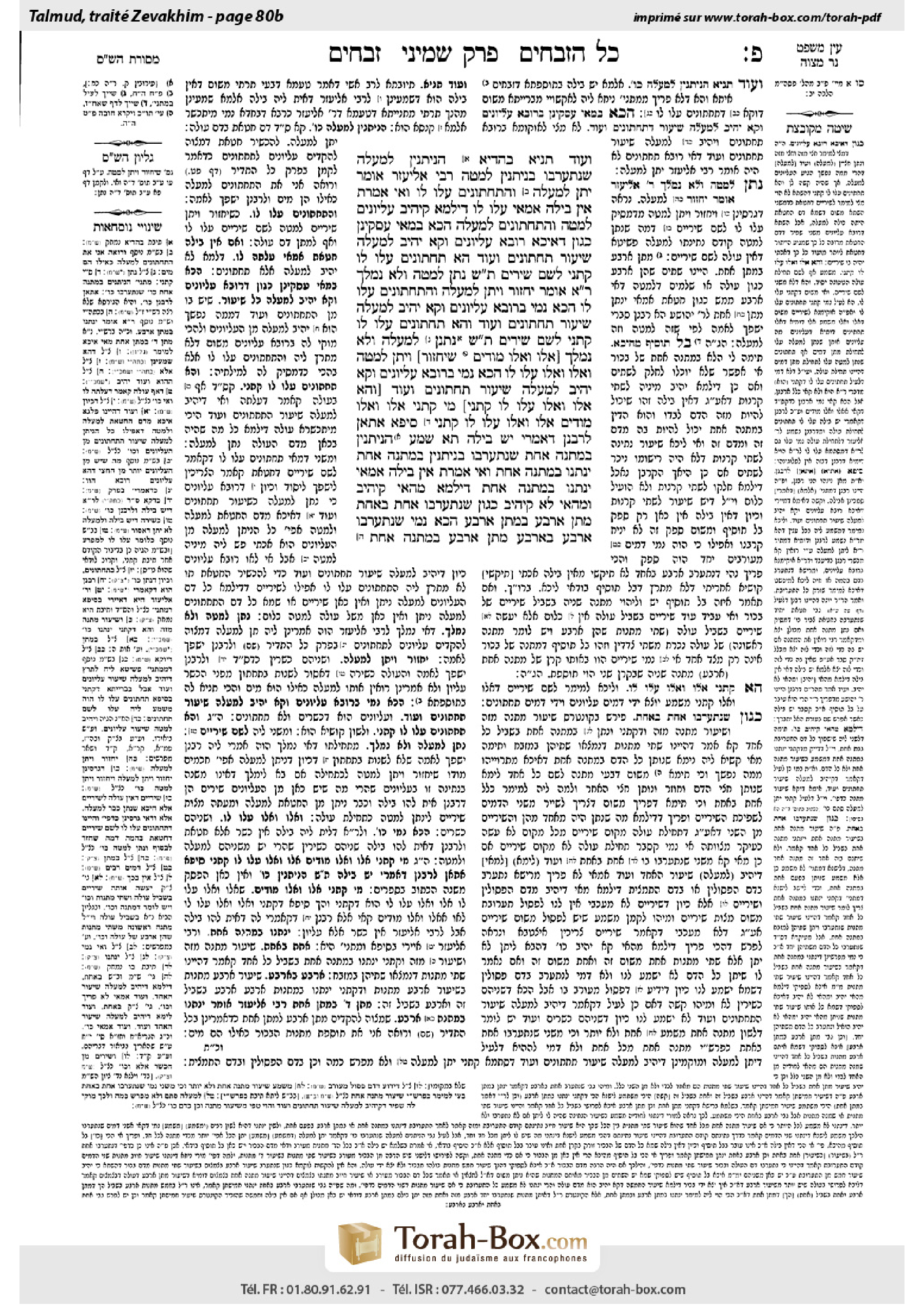
Zevachim 80b: Talmud study for Daf Yomi
Daf Yomi is the daily study of one Talmud folio. Explore 37 tractates with scans, Hebrew text, Sefaria English and AI-generated French translations where annotated.
Passage selection and English or AI-generated French translation are available where the scan has annotations. Daf Study is independent of Torah-Box and Sefaria.
Browse Zevachim · זבחים · All tractatesZevachim 80b text and translations
This page of Zevachim includes the Aramaic text, an English translation and an AI-generated French translation, alongside the scan above.
זבחים פ׳ ב · Aramaic and Hebrew text
וְעוֹד תַּנְיָא בְּהֶדְיָא: הַנִּיתָּנִין לְמַעְלָה שֶׁנִּתְעָרְבוּ בַּנִּיתָּנִין לְמַטָּה – רַבִּי אֱלִיעֶזֶר אוֹמֵר: יִתֵּן לְמַעְלָה וְהַתַּחְתּוֹנִים עָלוּ לוֹ.
וְאִי אָמְרַתְּ אֵין בִּילָּה, אַמַּאי עָלוּ לוֹ? דִּילְמָא קָיָהֵיב עֶלְיוֹנִים לְמַטָּה וְהַתַּחְתּוֹנִים לְמַעְלָה!
הָכָא בְּמַאי עָסְקִינַן – כְּגוֹן דְּאִיכָּא רוּבָּא עֶלְיוֹנִים, וְקָא יָהֵיב לְמַעְלָה שִׁיעוּר תַּחְתּוֹנִים וְעוֹד.
הָא ״תַּחְתּוֹנִים עָלוּ לוֹ״ קָתָנֵי! לְשֵׁם שִׁירַיִם.
תָּא שְׁמַע: נָתַן לְמַטָּה וְלֹא נִמְלַךְ – רַבִּי אֱלִיעֶזֶר אוֹמֵר: יַחֲזוֹר וְיִתֵּן לְמַעְלָה, וְהַתַּחְתּוֹנִים עָלוּ לוֹ!
הָכָא נָמֵי בְּרוּבָּא עֶלְיוֹנִים, וְקָא יָהֵיב לְמַעְלָה שִׁיעוּר תַּחְתּוֹנִים וְעוֹד. וְהָא ״תַּחְתּוֹנִים עָלוּ לוֹ״ קָתָנֵי! לְשֵׁם שִׁירַיִם.
תָּא שְׁמַע: נְתָנָן לְמַעְלָה וְלֹא נִמְלַךְ – אֵלּוּ וְאֵלּוּ מוֹדִים שֶׁיַּחֲזוֹר וְיִתֵּן לְמַטָּה, וְאֵלּוּ וָאֵלּוּ עָלוּ לוֹ!
הָכָא נָמֵי, בְּרוּבָּא עֶלְיוֹנִים, וְקָא יָהֵיב לְמַעְלָה שִׁיעוּר תַּחְתּוֹנִים וְעוֹד.
[וְהָא ״אֵלּוּ וָאֵלּוּ עָלוּ לוֹ״ קָתָנֵי!] מִי קָתָנֵי ״אֵלּוּ וְאֵלּוּ מוֹדִים״?! ״אֵלּוּ וָאֵלּוּ עָלוּ לוֹ״ קָתָנֵי – סֵיפָא אֲתָאן לְרַבָּנַן, דְאָמְרִי יֵשׁ בִּילָּה.
תָּא שְׁמַע: הַנִּיתָּנִין בְּמַתָּנָה אַחַת שֶׁנִּתְעָרְבוּ בַּנִּיתָּנִין בְּמַתָּנָה אַחַת – יִנָּתְנוּ בְּמַתָּנָה אֶחָת. וְאִי אָמְרַתְּ אֵין בִּילָּה, אַמַּאי יִנָּתְנוּ בְּמַתָּנָה אַחַת? דִּילְמָא מֵהַאי קָיָהֵיב וּמֵהַאי לָא קָיָהֵיב! כְּגוֹן שֶׁנִּתְעָרְבוּ אַחַת בְּאַחַת.
מַתַּן אַרְבַּע בְּמַתַּן אַרְבַּע! הָכָא נָמֵי, שֶׁנִּתְעָרְבוּ אַרְבַּע בְּאַרְבַּע.
מַתַּן אַרְבַּע בְּמַתָּנָה אַחַת!
Zevachim 80b · English translation
The Gemara adds: And furthermore, one can raise another difficulty against the opinion of Rav Ashi, who maintains that according to Rabbi Eliezer there is no mixing, as it is taught explicitly in a baraita: With regard to blood of an offering, e.g., a sin offering, which is to be placed above the red line that was mixed with blood of an offering, e.g., a burnt offering, which is to be placed below the red line, Rabbi Eliezer says: The priest shall initially place the blood of the mixture above the red line for the sake of the sin offering, and the priest should then place blood from the mixture below the red line for the sake of the burnt offering, and both the blood placed above and the blood placed below count for him toward the fulfillment of the mitzva.
The Gemara explains the difficulty from this baraita: And if you say that there is no mixing, why do both of the placements count for him? Perhaps he placed the blood of the mixture that belongs above the red line below it, and the blood that belongs below the red line above it.
The Gemara answers: Here we are dealing with a case where there is a majority of blood that is to be placed above the line, and the priest placed blood above by the measure of the blood in the mixture that is to be placed below the line, and slightly more blood. In this manner he ensures that he must have placed above the red line some of the blood that belongs there.
The Gemara raises a difficulty: But the baraita teaches: The blood placed below counts for him toward the fulfillment of the mitzva. According to this explanation, it is possible that all the blood of the burnt offering was placed above the red line. Why, then, has he fulfilled the mitzva by placing blood below the red line? The Gemara explains: The baraita does not mean that it counts for the mitzva of the placing of the blood of a burnt offering below the red line; rather, it means that it counts for him for the sake of the remainder of the blood of the sin offering, which must be poured onto the base of the altar.
The Gemara suggests: Come and hear a proof from a baraita: If the priest placed the mixed blood below the red line and did not consult the authorities, what should he do now? Rabbi Eliezer says: He shall again place the blood above the red line, and the blood placed below counts for him. Once again, the difficulty is that if Rabbi Eliezer maintains that there is no mixing, why does the placement count for him? Perhaps he placed the blood of the mixture that belongs above the red line below it, and the blood that belongs below the red line above it.
The Gemara answers: Here too, we are dealing with a case where the majority of blood belongs above the line, and the priest placed blood above from the measure of the blood in the mixture that belongs below the line, and slightly more blood. Again the Gemara asks: But the baraita teaches: The blood placed below counts for him. Since it is possible that all of the blood of the burnt offering was placed above the red line, why does the blood placed below count for him? The Gemara answers that the baraita means it counts for him for the sake of the remainder of the sin offering.
The Gemara further suggests: Come and hear another proof from a baraita: If the priest placed the mixed blood above and did not consult the authorities, both these Sages and those Sages, i.e., the Rabbis and Rabbi Eliezer, concede that he shall again place the blood below the red line, and these placements and those placements count for him. If Rabbi Eliezer maintains that there is no mixing, he would not concede this point, as perhaps he placed the blood that belongs below the red line above it, and the blood that belongs above, below.
The Gemara answers: Here too, this is referring to a case where the majority of blood belongs above the line, and the priest placed blood above in the measure of the blood in the mixture that belongs below the line, and slightly more blood. In this manner he fulfills the mitzva of the blood that is to be placed above the red line alone.
The Gemara raises a difficulty: But the baraita teaches: These and those count for him, not only the blood that is to be placed above. The Gemara explains: Does the baraita teach: These Sages and those Sages concede that these placements and those placements count for him? It teaches only: These and those count for him. In other words, although the baraita states in the first clause that both the Rabbis and Rabbi Eliezer concede that the priest returns and places the blood below the red line, this agreement does not apply to the next clause of the baraita, as in the latter clause we come to the opinion of the Rabbis alone, who say that there is mixing, which is why both placements count.
The Gemara suggests: Come and hear a proof from the mishna: In a case of the blood of an offering that is to be placed on the altar with one placement that was mixed with the blood of another offering that is to be placed on the altar with one placement, the blood shall be placed with one placement. And if you say that according to Rabbi Eliezer there is no mixing, why shall they be placed with one placement? Perhaps he places from this blood and does not place from that blood. The Gemara answers: This is referring to a case where the measure of one placement of this blood was mixed with the measure of one placement of that blood, and no more. Consequently, he certainly placed both types of blood.
The Gemara raises another difficulty: The mishna teaches that in a case of the blood of an offering that is to be placed on the altar with four placements that was mixed with the blood of another offering that is to be placed on the altar with four placements, the blood shall be placed with four placements. But if there is no mixing, perhaps he placed only the blood of one offering. The Gemara explains: Here too, it is referring to a case where the measure of four placements of this blood was mixed with the measure of four placements of that blood, and therefore he certainly placed blood from both offerings.
The Gemara raises another difficulty: The mishna teaches that if the blood of an offering that is to be placed on the altar with four placements was mixed with the blood of another offering that is to be placed on the altar with one placement, Rabbi Eliezer says: The blood shall be placed with four placements. Here too, if there is no mixing according to Rabbi Eliezer, perhaps he placed the blood of only one of the offerings.
Zevachim 80b · Traduction française (IA)
La Guemara ajoute : De plus, on peut soulever une autre difficulté contre l’opinion de Rav Ashi, qui soutient que, selon Rabbi Eliezer, il n’y a pas de mélange, car une baraïta l’enseigne explicitement : concernant le sang d’un sacrifice, par exemple un sacrifice expiatoire, qui doit être appliqué au-dessus de la ligne rouge et qui a été mélangé au sang d’un autre sacrifice, par exemple un holocauste, qui doit être appliqué au-dessous de la ligne rouge, Rabbi Eliezer dit : Le prêtre appliquera d’abord le sang du mélange au-dessus de la ligne rouge, pour le sacrifice expiatoire, puis il en appliquera au-dessous de la ligne rouge, pour l’holocauste ; les deux applications, celle du haut et celle du bas, comptent pour lui dans l’accomplissement de la mitsva.
La Guemara explique la difficulté tirée de cette baraïta : si tu dis qu’il n’y a pas de mélange, pourquoi les deux applications comptent-elles pour lui ? Il se peut qu’il ait appliqué au-dessous de la ligne rouge le sang du mélange qui doit être appliqué au-dessus, et au-dessus celui qui doit être appliqué au-dessous.
La Guemara répond : Il s’agit ici d’un cas où la majeure partie du sang doit être appliquée au-dessus de la ligne, et où le prêtre a appliqué au-dessus une quantité égale à celle du sang du mélange qui doit être appliqué au-dessous de la ligne, plus un peu. Ainsi, il est certain qu’il a appliqué au-dessus de la ligne rouge une partie du sang qui doit l’être.
La Guemara soulève une difficulté : Mais la baraïta enseigne que le sang appliqué au-dessous compte pour lui dans l’accomplissement de la mitsva. Selon cette explication, il est possible que tout le sang de l’holocauste ait été appliqué au-dessus de la ligne rouge. Pourquoi a-t-il donc accompli la mitsva en appliquant du sang au-dessous de la ligne rouge ? La Guemara explique : La baraïta ne veut pas dire que cela compte pour la mitsva consistant à appliquer au-dessous de la ligne rouge le sang de l’holocauste ; elle veut dire que cela compte pour lui au titre du reste du sang du sacrifice expiatoire, qui doit être versé au pied de l’autel.
La Guemara propose : Viens et entends une preuve tirée d’une baraïta : si le prêtre a appliqué le sang mélangé au-dessous de la ligne rouge sans consulter les autorités, que doit-il faire à présent ? Rabbi Eliezer dit : Il appliquera de nouveau du sang au-dessus de la ligne rouge, et le sang appliqué au-dessous compte pour lui. Là encore, la difficulté est que, si Rabbi Eliezer soutient qu’il n’y a pas de mélange, pourquoi cette application compte-t-elle pour lui ? Il se peut qu’il ait appliqué au-dessous de la ligne rouge le sang du mélange qui doit être appliqué au-dessus, et au-dessus celui qui doit être appliqué au-dessous.
La Guemara répond : Ici aussi, il s’agit d’un cas où la majeure partie du sang doit être appliquée au-dessus de la ligne, et où le prêtre a appliqué au-dessus une quantité égale à celle du sang du mélange qui doit être appliqué au-dessous de la ligne, plus un peu. La Guemara demande à nouveau : Mais la baraïta enseigne que le sang appliqué au-dessous compte pour lui. Puisqu’il est possible que tout le sang de l’holocauste ait été appliqué au-dessus de la ligne rouge, pourquoi le sang appliqué au-dessous compte-t-il pour lui ? La Guemara répond que la baraïta veut dire qu’il compte pour lui au titre du reste du sacrifice expiatoire.
La Guemara propose encore : Viens et entends une autre preuve tirée d’une baraïta : si le prêtre a appliqué le sang mélangé au-dessus de la ligne rouge sans consulter les autorités, ces Sages et ces Sages, c’est-à-dire les rabbins et Rabbi Eliezer, conviennent tous qu’il doit appliquer de nouveau du sang au-dessous de la ligne rouge, et que les deux séries d’applications comptent pour lui. Si Rabbi Eliezer soutient qu’il n’y a pas de mélange, il ne conviendrait pas de cela, car il se peut qu’il ait appliqué au-dessus de la ligne rouge le sang qui doit être appliqué au-dessous, et au-dessous celui qui doit être appliqué au-dessus.
La Guemara répond : Ici aussi, il s’agit d’un cas où la majeure partie du sang doit être appliquée au-dessus de la ligne, et où le prêtre a appliqué au-dessus une quantité égale à celle du sang du mélange qui doit être appliqué au-dessous de la ligne, plus un peu. De cette manière, il accomplit uniquement la mitsva relative au sang qui doit être appliqué au-dessus de la ligne rouge.
La Guemara soulève une difficulté : Mais la baraïta enseigne que les uns et les autres comptent pour lui, et pas seulement le sang qui doit être appliqué au-dessus. La Guemara explique : La baraïta enseigne-t-elle que ces Sages et ces Sages conviennent que ces applications et ces applications comptent pour lui ? Elle enseigne seulement : « Les uns et les autres comptent pour lui. » Autrement dit, bien que la première partie de la baraïta indique que les rabbins et Rabbi Eliezer conviennent tous que le prêtre revient appliquer le sang au-dessous de la ligne rouge, cet accord ne s’étend pas à la partie suivante de la baraïta. Dans cette dernière partie, il s’agit de la seule opinion des rabbins, qui disent qu’il y a mélange, raison pour laquelle les deux applications comptent.
La Guemara propose : Viens et entends une preuve tirée de la Michna : si le sang d’un sacrifice qui doit être appliqué sur l’autel en une seule application a été mélangé au sang d’un autre sacrifice qui doit également être appliqué sur l’autel en une seule application, le sang sera appliqué en une seule fois. Et si tu dis que, selon Rabbi Eliezer, il n’y a pas de mélange, pourquoi l’appliquera-t-on en une seule fois ? Il se peut qu’il applique du sang de celui-ci et pas de celui-là. La Guemara répond : Il s’agit d’un cas où la quantité de sang nécessaire à une application de ce sacrifice a été mélangée à la quantité nécessaire à une application de l’autre sacrifice, et rien de plus. Par conséquent, il a nécessairement appliqué les deux types de sang.
La Guemara soulève une autre difficulté : La Michna enseigne que si le sang d’un sacrifice qui doit être appliqué sur l’autel en quatre applications a été mélangé au sang d’un autre sacrifice qui doit lui aussi être appliqué sur l’autel en quatre applications, le sang sera appliqué en quatre fois. Mais s’il n’y a pas de mélange, il se peut qu’il n’ait appliqué que le sang d’un seul sacrifice. La Guemara explique : Ici aussi, il s’agit d’un cas où la quantité de sang nécessaire à quatre applications de ce sacrifice a été mélangée à la quantité nécessaire à quatre applications de l’autre sacrifice ; il a donc nécessairement appliqué du sang des deux sacrifices.
La Guemara soulève une autre difficulté : La Michna enseigne que si le sang d’un sacrifice qui doit être appliqué sur l’autel en quatre applications a été mélangé au sang d’un autre sacrifice qui doit être appliqué sur l’autel en une seule application, Rabbi Eliezer dit : Le sang sera appliqué en quatre fois. Ici aussi, si, selon Rabbi Eliezer, il n’y a pas de mélange, il se peut qu’il n’ait appliqué le sang que d’un seul des sacrifices.
Traduction française générée par IA à partir de l’édition anglaise de Sefaria. Vérifie toujours un passage avec le texte source.
Text from Sefaria: William Davidson Edition - Vocalized Aramaic (CC BY NC); William Davidson Edition - English (CC BY NC).